Specs are compiled from manufacturer listings and verified buyer reviews and can change over time — please confirm the key details on the product page before buying.
If you sand, saw, or turn wood in a closed shop, the fine dust hanging in the air is the real problem — not the chips you sweep up. A hanging shop air filtration unit grabs that floating dust at ceiling height, recirculates it through a filter, and drops cleaner air back into the room. The tricky bit is that CFM, filter ratings, and noise numbers all trade against each other, so the right unit depends on your square footage and how much you hate loud machines. This guide walks you through what actually matters and which units are built to do the job.
This guide is built by comparing the manufacturers’ published specifications and the patterns across verified customer reviews, so you get each pick’s real strengths and trade-offs instead of marketing spin.
You will learn how airflow, filter stages, and mounting decide whether a unit cleans a two-car garage or struggles in a small corner. Every pick is a hanging ceiling dust collector, not a small room purifier, so the facts below line up with real workshop duty. Read the buyer-first breakdown of the best workshop air filtration system before you spend a dime on a machine that will hang over your bench.
Top Picks


How to Choose the Best Workshop Air Filtration System
The headline numbers you see on the box — CFM, MERV, decibels — all describe a different job. Get them in the right order and you pick a machine that cleans your shop without making you want to leave it.
Match CFM to your shop size first
CFM (cubic feet per minute) is how many cubic feet of air the unit pushes every minute. More airflow moves more airborne sawdust through the filter per pass. A 300–400 CFM unit suits a smaller single-bay shop, while a 1000-plus CFM machine like the larger picks here is built for a full garage or a two-bay woodshop. Bigger room means you want the higher number.
Look at filter stages, not just micron size
Most units run two filters: an outer pre-filter that grabs the bigger chips and a finer inner filter that catches the small stuff. A 5-micron outer filter takes out larger dust particles, while a 1-micron inner filter catches the rest. Two stages keep the fine inner filter from clogging fast, which is why you see pairs like a 5-micron outer and 1-micron inner on the higher-end units.
Decide how loud you can tolerate
Noise is the number that decides whether you actually leave the unit running while you cut. Lower decibels mean you can hold a conversation and keep it on for hours. Higher airflow units run louder, so if your shop is close to living space, weight the quieter picks higher.
Plan your mounting before you buy
All of these units hang from the ceiling with hooks and chains, which frees up floor space for benches and tools. Check the dimensions against your ceiling height and joist layout. A flat, wide footprint works where headroom is tight; a taller unit eats more vertical space.
Side-by-Side Comparison
| Model | Best For | Airflow (CFM) | Filtration | Noise Level | Amazon |
|---|---|---|---|---|---|
| DEWALT DWXAF101★ Best Overall | Small shop, quiet auto mode | 3-speed | 2-stage, H11 HEPA | — | Amazon |
| ALORAIR Purecare 780Quietest Big Airflow | Big rooms, low noise | 580/780 CFM | 2-stage, MERV-11 | Below 50 dBA | Amazon |
| PURISYSTEMS PuriCare 500Compact Bench Pick | Compact shop, bench-friendly | 350/450/500 CFM | 2-stage, MERV-10/12 | 61 dB | Amazon |
| POWERTEC AF4001C | Extra filter kit included | 300/350/400 CFM | 5-micron outer, 1-micron inner | — | Amazon |
| ECOMAX MCF03 | Quiet mid-size ceiling unit | 300/350/400 CFM | 2-stage, washable | 58–62 dB | Amazon |
| ALORAIR Purecare 1350IG | Huge shop, built-in ionizer | 1050/1350 CFM | MERV-11, ionizer | 60–69 dB | Amazon |
| ABESTORM 1350 CFM | Large shop, 360° intake | 1350 CFM | MERV-11 | 60–69 dB | Amazon |
| WEN 3417 | Industrial-size shop, high CFM | 556/702/1044 CFM | 1-micron inner, 5-micron pre | 63–68 dB | Amazon |
| JET AFS-1000C | Dust-sensing auto control | 1000 CFM | 5-micron outer, 1-micron inner | 67 dB | Amazon |
| Powermatic PM1200 | Big shop, long timer runs | 547/706/1196 CFM | 5-micron outer, 1-micron inner | — | Amazon |
Detailed Reviews
1. DEWALT Air Filtration System DWXAF101
Our pick — 4.5+★ from 150+ verified ratings; the strongest balance of quality and price.
The one that watches the dust for you and ramps up without a hand on the dial.
The DWXAF101 hangs from your ceiling and runs a two-stage filtration setup: a static cotton pre-filter catches the heavy dust first, and an H11 HEPA filter traps the fine stuff. DEWALT rates it at capturing over 95% of 0.3 μm (micrometer) particles — the sub-micron sanding dust that stays airborne longest. In daily shop terms, that is the layer you see drifting in the sunbeam after you shut the saw off. It clears that haze rather than just settling the big chips.
Airflow is what wins people over. Filtration is the most-praised trait, and it goes hand in hand with dust removal: the machine keeps a shop space visibly cleaner while it runs. It offers four working modes — HI, MID, LO, and an AUTO setting that reads air quality and shifts gears on its own. The AUTO mode is the headline: sand a board and the fan spins up, then settles back down when the air clears. Owners describe it cycling speed as needed, which means you set it and keep working instead of reaching for a switch every few minutes.
Where it flexes is size and mounting. At 10.2″D x 15.9″W x 20″H it sits noticeably more compact than the bigger ALORAIR Purecare 1350IG at 20.5″D x 20.5″W x 9.8″H, so it fits tighter ceiling corners over a small bench. The trade-off most worth knowing is the remote — the control side is the grippiest part of the feedback, so plan to lean on the timer and the wall buttons if the handheld unit acts up. Timer options run 1H, 2H, 4H, and 8H, and the washable pre-filter plus a filter-replacement indicator keep upkeep simple. DEWALT backs it with a 3-year warranty.
What earns its place up top
- H11 HEPA two-stage filtration rates over 95% capture of 0.3 μm particles
- AUTO mode senses air quality and adjusts fan speed hands-free
- Four timer presets (1H, 2H, 4H, 8H) plus washable pre-filter and 3-year warranty
Where it asks for patience
- The remote is the weak link in owner feedback — the timer and panel do the reliable work
- Smaller airflow footprint than the big-CFM units, so it suits a compact shop, not a two-bay garage
Land this one: a small-to-mid shop where you want the machine to think for itself and HEPA-grade filtration is the priority.
Size check: if your shop runs more than a two-car footprint, the higher-CFM picks lower down this list will clear the room faster.
2. ALORAIR Purecare 780 Hanging Air Filtration System
Big-room airflow that stays under 50 dBA — you get to keep your hearing while it works.
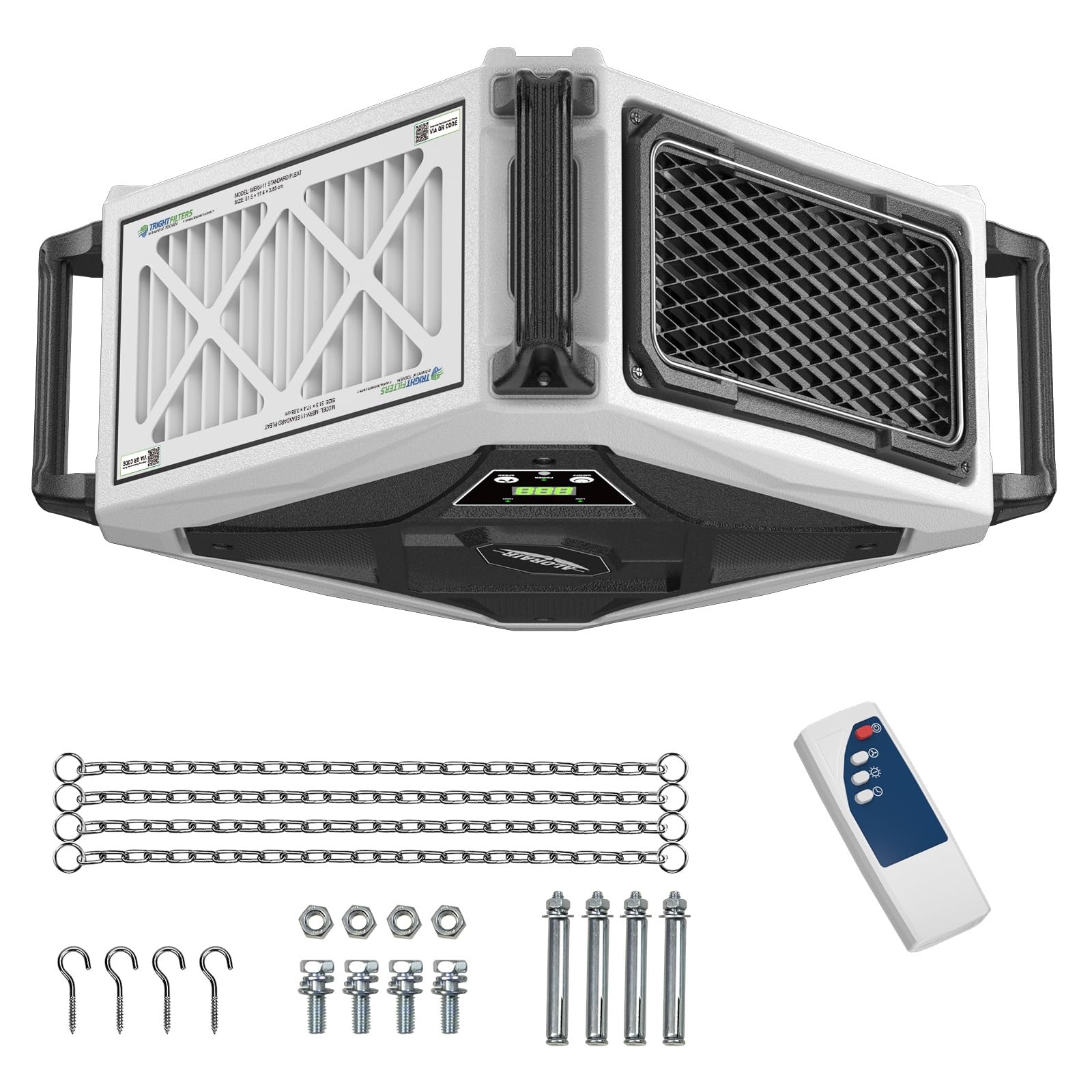
You can keep this unit running through a cut and still hear the blade or take a phone call. It moves up to 780 CFM (cubic feet per minute — how much air it pushes) yet stays below 50 dBA (decibels, the loudness scale), about the level of a quiet conversation. That is quieter than the PURISYSTEMS PuriCare 500 at 61 db, and far better than the DEWALT’s roar. It also covers up to 800 square feet, a step above the PURISYSTEMS unit’s 500 square feet. If loud machines are why you stopped running air filtration all day, this pick is the fix.
The 270° intake wraps the air in from three sides and pushes it through a two-stage MERV-11 filter. That filter class is designed to stop 90% of 3–10 μm particles and 85% of 1 μm particles — the fine wood flour that settles on shelves and reaches deepest into your lungs. The strong vortex fan keeps high static pressure even when the filter has loaded up with chips, so airflow does not collapse the way a weak fan does. Filter changes are a straightforward swap.
A timer cycle controller lets you shut the fan off automatically in 1–9 hours, and the IR remote works from a distance with no wireless interference. It hangs from the ceiling or drops on a workbench for flexible placement. One thing to know before you order: ALORAIR notes it does not meet California’s regular requirements and cannot be shipped there, so Golden State buyers need to look at a different unit on this list.
Why it stands tall: the combination of 780 CFM and sub-50 dBA is rare — you rarely get this much air movement without paying for it in noise. Coverage up to 800 sq. ft. keeps a full garage or small two-bay shop ahead of the dust.
The fine print: it is not shippable to California, so that is a hard stop for CA buyers no matter how good the numbers look.
Reach for this if: you want maximum airflow with minimum racket in an 800 sq. ft. shop or garage.
Look elsewhere if: you live in California, since this unit cannot ship there.
3. PURISYSTEMS PuriCare 500 Hanging Air Filter
A compact ceiling filter that pulls triple duty — hang it, bench it, or carry it to the dust.
The PuriCare 500 swaps between 350, 450, and 500 CFM across three speeds, and it covers up to 500 square feet. It runs two filters, both easily replaced and reusable with no tools needed — the outer filter grabs the larger particles, the inner filter traps the smaller ones. That two-stage approach keeps the fine filter from getting smothered by the big chips. For woodturning, sanding, or scroll-saw work in one bay, the 500 CFM ceiling mode creates circular airflow and keeps the fine dust film off your workbench.
Because it has a flat 20.1″D x 17″W x 11″H footprint, it drops onto a benchtop or other work surface where dust is actually being born — no need to only ceiling-mount it. Built-in RF remote (radio frequency, which works even when something blocks your line of sight) runs from any angle up to 26 feet away. That is handy when the unit hangs behind a saw or under a shelf and an IR remote would lose the signal. The handles and rubber feet make it easy to shift around without scratching your bench.
It earned praise for strong performance and build quality, which lines up with what real shops report — dust and dander both clear. The timer runs 1H to 6H, so you can leave the shop and the machine keeps cleaning while you are gone. One limit to plan around: it is louder than the sub-50 dBA ALORAIR Purecare 780 — at 61 dB it is a working-machine hum, not a whisper. And like that unit, it does not meet California’s air cleaner rules and cannot ship to California.
Best fit: a compact or single-bay shop where floor space is precious and you want a unit that doubles as a bench-top filter.
Worth knowing: it is a mid-CFM machine — great for one bay, not a replacement for a high-CFM unit in a full two-bay shop, and it cannot ship to California.
Solid choice for: bench-side dust control in a garage or single-bay workshop with flexible placement.
Skip the hassle if: you have a big shop needing 1000-plus CFM, or you are ordering to California.
4. POWERTEC AF4001C 3-Speed Air Filtration System
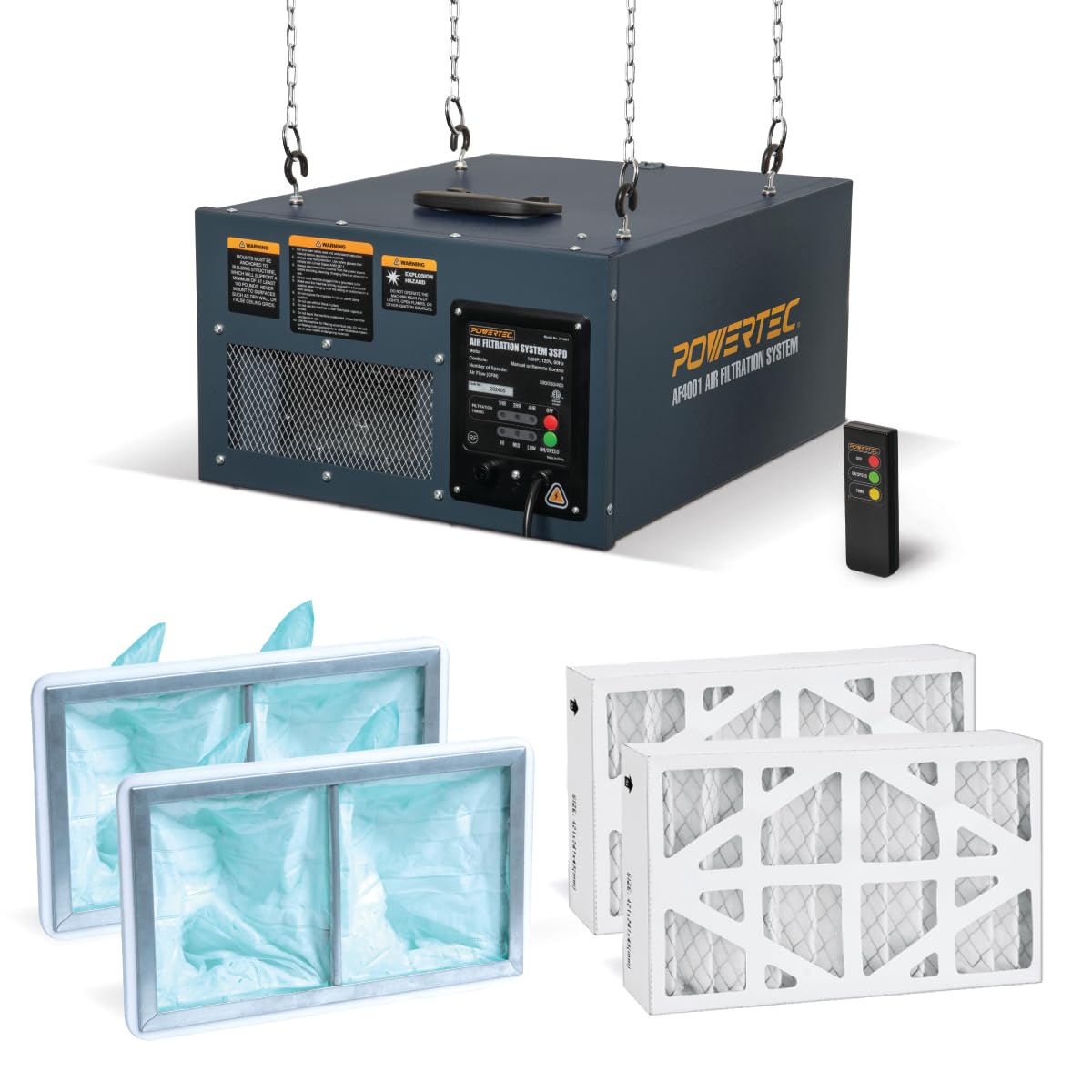
Two full sets of filters in the box — that is a year of cleaning before you buy a replacement.
The AF4001C’s clever move is what comes in the carton: the system plus a spare outer filter (MERV 10, 5-micron) and a spare inner filter (MERV 11, 1-micron). The 5-micron outer filter removes larger dust particles while the 1-micron inner filter catches the rest, and POWERTEC says the pairing eliminates 99% of airborne particulates, so the fine dust a single filter would pass gets caught. In practice, a spare set means you pop in fresh filters the day the originals load up instead of stalled mid-project waiting on a delivery.
Airflow runs in three steps — 300, 350, and 400 CFM. That puts it at the compact end of the range, closer to the POWERTEC’s own class than the 1000-plus CFM giants above, so it suits a small shop with modest square footage. The RF remote controls power and speed over long range and carries a timer with 1hr, 2hr, and 4hr options. It hangs from the ceiling with included hooks and a lightweight build keeps install simple. Air quality is the trait people notice first: it pulls particulate matter down to levels you stop seeing drifting in the light.
The honest catch sits in the remote and the long-haul build. Remote function divides opinion — plenty find it fine, but the control side is where the mixed word of mouth lives, so keep the panel as your fallback. Durability also draws more grumbles than the rest of the unit’s record, which tips toward careful handling over rough use. What holds the overall picture together is the noise — reviewers consistently call it quiet, and quiet means you will actually leave it running.
Why the value lands
- Ships with a spare inner and outer filter — a full spare set already in the box
- 5-micron outer plus 1-micron inner rated to eliminate 99% of airborne particulates
- Quiet operation and removable filters make routine cleaning easy
What to keep an eye on
- The remote control is the shakiest part of the feedback — the panel and timer are the steady route
- 400 CFM tops out lower than the big-CFM units, so measure your square footage before committing
Given to: a small shop owner who wants spare filters included and quiet running over raw airflow.
Only caveat: if you need to clear a full garage fast, a 1000-plus CFM pick lower down will beat its 400 CFM ceiling.
5. ECOMAX MCF03 Ceiling Mount Air Filtration System

Hangs quiet at 58 to 62 dB and runs filters you rinse instead of reorder.
The MCF03 keeps the noise down in a way your ears will notice: 58 to 62 dB depending on speed, which is quieter than the ABESTORM’s 60 to 69 dB band. It pushes 300, 350, or 400 CFM across three speeds and caps covers at a mid-size shop. The two-stage design splits the load — an outer filter for larger particles and an inner filter for smaller dust — and both filters are washable and reusable, so you are not buying replacements every few months. You rinse them and drop them back in.
Speed and timer are both controllable from the remote or the unit itself, and the timer offers 1, 2, or 4 hours of automatic shutdown. A hook and chain kit lets you hang it from the ceiling, or you can set it on a table in the workshop if headroom is tight. At 17.9 pounds it is lighter to hoist than the 27-pound ALORAIR and ABESTORM units, which matters when you are up a ladder threading chains. The 110–120V, 60Hz power spec matches a standard shop outlet.
The performance is there — it clears dust fast and noticeably cuts the fine haze after sanding or grinding. The remote is where opinions split, with some reports of flakiness; the panel buttons are the reliable fallback. Building in metal and backed by a 2-year service guarantee, this is a sensible mid-size ceiling unit, not a high-CFM monster for a two-bay garage.
What clicks: washable filters kill the replacement cost, and the 58–62 dB band keeps it liveable during cuts — a light 17.9 pounds makes ceiling install easier than the heavier aluminum-and-plastic rivals.
Where it bites: the remote control is the recurring shaky bit, and 400 CFM is compact-shop territory rather than whole-garage duty.
Pick it for: a mid-size shop where you want washable filters and a quieter ceiling unit.
Hold off if: your shop is a full two-bay setup needing 1000-plus CFM, or you want a rock-solid remote.
6. ALORAIR Purecare 1350IG Air Filtration System

A 1350 CFM shop cleaner that also attacks odor, not just sawdust.
When a shop gets big, the air problem stops being only dust. This unit moves up to 1350 CFM and covers up to 1700 square feet, so it can actually turn over the volume of a large garage or commercial woodshop. The 360° intake pulls air from every side, and the strong vortex fan holds high static pressure even when the MERV-11 filter is loaded with wood chips. That MERV-11 filter is rated to stop 90% of 3–10 μm particles and 85% of 1 μm particles, so it holds the fine sanding dust a coarse pre-filter passes through.
What makes the 1350IG different from every other pick here is the built-in ionizer. Air passing through gets an electric discharge that breaks down odor particles along with dust, so finishes, solvents, and general shop smells get knocked back too. That extra is a real reason to choose it over the ABESTORM 1350, which matches the airflow and coverage but stops at filtering. A timer runs 1–9 hours, the IR remote works from across the room, and hooks and a chain let you hang it or drop it on a bench.
You run this unit and then walk away, because at the top of its 60–69 dB range it is a loud machine — louder than the sub-50 dBA Purecare 780. Mounting hardware is the other spot that draws mixed feedback from buyers, so use the included chain kit carefully and check the rings before you hoist it overhead. Air quality and build quality are the traits that carry its reputation, and at 27 pounds it is a manageable solo install.
Standout extra: the ionizer tackles odor, not just dust — trimming fumes and shop smells that plain filters leave behind, backed by up to 1700 sq. ft. of coverage.
Real trade: it runs loud at 60–69 dB, and the mounting hardware is the softest part of the package, so inspect before you hang it.
Worth grabbing for: a large shop or garage that needs high airflow and help with odor as well as dust.
Think twice if: quiet running is your top concern — the sub-50 dBA at pick two fits that job far better.
7. ABESTORM 1350 CFM 360° Air Filtration System
The airflow monster that keeps pulling dust when a lesser fan would choke.
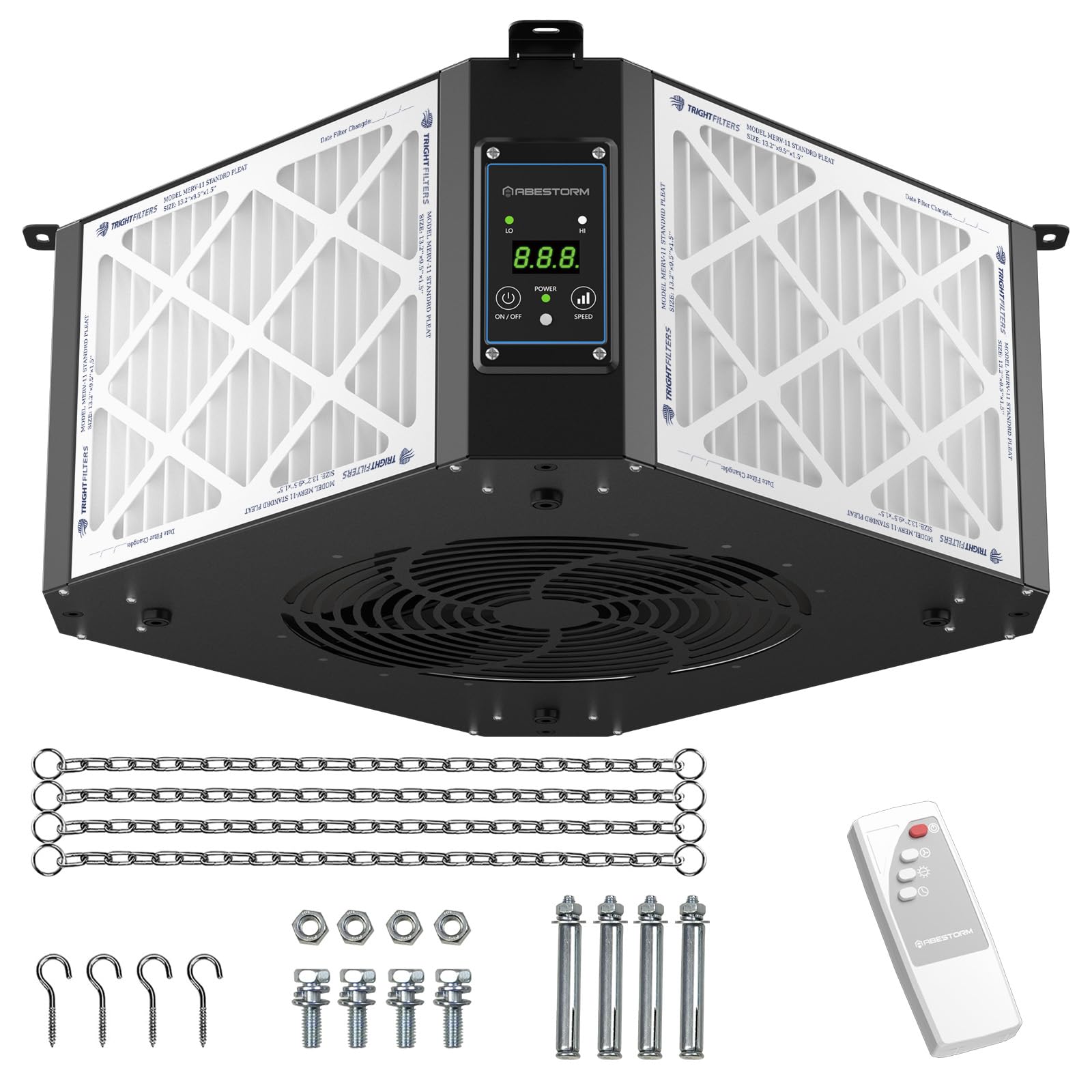
One number tells the story: 1350 CFM through a 360° intake, enough to circulate the air in a workshop up to 1700 square feet. That 360-degree ring pulls sawdust in from every direction instead of just the front, and the vortex fan holds high static pressure even when the MERV-11 filter has collected a heavy load of chips. That filter is rated to capture up to 90% of 3–10 micron particles and 85% of 1-micron particles, so the fine sanding flour gets trapped instead of inhaled.
Two speeds let you dial back for light work and open up for a sanding session. A 1–9 hour timer shuts the unit down automatically while you are away, and an IR remote lets you change settings without walking over. Hooks and chains handle ceiling mounting to save floor space, or you can set it on a workbench. The 115V/60Hz, 1.5A electrical spec matches a standard outlet, and the footprint mirrors the ALORAIR 1350IG at 20.5″L x 20.5″W x 9.8″H.
Effectiveness is the trait that carries it — the sawdust clears and the workspace stays visibly cleaner, with the airflow doing double duty by moving air around a warm shop. The catch comes up when the volume goes up. The 60–69 dB band is loud, so expect to run it and step away rather than linger beside it, and the remote draws split reports, with some finding it unresponsive — the touch panel is your backup.
The reason it pulls big rooms
- 1350 CFM and 360° intake cover workshops up to 1700 sq. ft.
- Vortex fan keeps high static pressure even with a loaded MERV-11 filter
- Ceiling or workbench mounting with hooks and chains
What to weigh first
- Runs loud at 60–69 dB on the higher speed — a run-and-leave machine
- The remote is the shaky piece; trust the touch panel as the reliable control
Go here for: a large workshop or garage where raw airflow is the whole point.
Give it a pass if: your shop is small or noise-sensitive — a lower-CFM, quieter unit suits those rooms better.
8. WEN 3417 3-Speed Industrial Air Filtration System

A 1044 CFM ceiling unit built for shops that throw a serious amount of dust.
Three speeds at 556, 702, and 1044 CFM put the WEN 3417 in the big-air class — ahead of the POWERTEC’s 400 CFM ceiling and the PURISYSTEMS 500 CFM top end. It covers rooms up to 1000 square feet and runs a 1-micron inner filter plus a 5-micron pre-filter, both easily replaceable. That split means the pre-filter catches the visible chips while the 1-micron layer handles the tiny sawdust that billows off a sander. The RF remote controls timer, speed, and power from up to 26 feet away, and works from any angle even when the unit is out of sight.
A programmable timer shuts the unit off after a set number of minutes, so you can clear the shop after the last cut without babysitting it. Electrical specs run 110–120V, 60Hz, 3A, and it measures 30.3″ L x 24″ W x 12.2″ H — a wide footprint, so check your joist layout. At 55 pounds it is heavier than the compact DEWALT, which is worth knowing if you are lifting it solo onto a high ceiling.
It moves a substantial amount of air and is effective at cutting dust and lingering smoke, which is why it stands out for shops with real output. Noise runs 63 to 68 dB, and the volume of air is the real reason to pick it: nothing else in its class tops 1000 CFM for a full industrial-size shop.
The headline spec: 1044 CFM on the top speed clears a 1000 sq. ft. shop — the most air of any mid-tier pick here, backed by a 1-micron inner filter that goes finer than a 5-micron pre-filter alone.
Do a lap before you buy: at 55 pounds and a wide 30.3″ footprint it is a beefy ceiling install, and the build quality varies unit to unit.
Made for: a serious workshop that generates a heavy dust load and has room for a wide overhead unit.
Not for: a small or low-ceiling shop, and not a pick for anyone worried about a 55-pound ceiling lift.
9. JET AFS-1000C Air Filtration System

The control panel tells you when the filter is spent — no guesswork.
The AFS-1000C runs 1000 CFM and puts the thinking on the front panel. A filter status indicator lights up when the filter needs replacing, so you stop trying to remember the last change date. The auto filter mode powers the fan up when dust levels rise and backs off when the air clears — same hands-free idea as the DEWALT’s AUTO mode, but in a 1000 CFM package. The outer filter captures 99% of 5-micron particles and the inner filter captures 85% of 1-micron particles.
Two design details matter during real use. A bright LED display is angled so you can read it while the unit hangs above your head on the ceiling — a small thing that saves squinting. And the injection-molded plastic housing is there to dampen vibration and noise, with a quiet BLDC motor (brushless, which runs cooler and lasts longer than a brushed motor) pushing the airflow. A CR2032 battery and four eye bolts come in the box for the remote and the ceiling mount.
Quality and solid function are what carry its record: it works, it clears dust, and you can lean on the auto mode. The one rough edge is value — the asking price draws a share of pushback, so this is a pick to justify by its control features and dust-sensing, not by bargain appeal. At 67 dB on the highest speed and 33 pounds, budget a two-person lift for the ceiling install.
Turns heads because: the auto filter reacts to rising dust and ramps the fan, the angled LED display stays readable overhead, and the filter status light removes the guesswork on replacement.
Watch this bit: value draws mixed feedback at this price point, so buy it for the automated control, not the savings.
Right for: a shop owner who wants the machine to react to dust automatically and never guess at filter changes.
Wrong for: a buyer shopping purely on value — the control smarts are the reason to pay up here.
10. Powermatic PM1200 Air Filtration System

Nine timer settings and 1196 CFM — built for a working shop that runs all day.
The PM1200 pushes three blower speeds — 547, 706, and 1196 CFM — to move air through a full shop, and a two-filter system traps 99% of 5-micron particles and 85% of 1-micron particles, so the fine dust a single filter would pass gets caught. The inner filter has fine mesh pockets for high efficiency and can be blown clean, and the filter guards pop off without tools so swapping filters is a one-minute job. An indicator lights after 200 hours to remind you to replace the filters, so maintenance is on a schedule rather than a memory test.
You can close up and walk away while it keeps clearing the air, thanks to a timer with nine settings for up to nine hours of continuous operation — the feature that separates it from the other high-CFM picks. The remote runs on radio frequency (RF, which reaches farther than an infrared line-of-sight remote), so it works through the room regardless of obstacles. At 33″D x 25″W x 13″H and 67 pounds, this is the biggest and heaviest unit here — plan a ceiling structure that can take the weight and a spot with vertical clearance.
The strength is build and airflow. It is a high-quality unit that lifts air quality in garage shops and basements, and owners find it quiet enough to run during work, with the remote making speed and time changes easy. The mounting is where the friction lives — the hardware side draws complaints, so prep your joists and use the supplied hardware with care. At 200-hour filter reminders and nine timer steps, this is the pick for a shop that gets real hours, not a hobby corner that sees an occasional project.
The draw: 1196 CFM, a nine-hour timer, and a radio-frequency remote that reaches across a big shop — plus a 200-hour filter reminder so maintenance stays on track.
The honest cost: it is the heaviest unit here at 67 pounds and 33″ deep, and mounting is the recurring weak spot in the feedback.
Best for: a high-hour shop or basement where you want long unattended filter runs and maximum air movement.
Second thoughts if: your ceiling cannot handle 67 pounds or you want an easy one-person hang — the compact picks here win that job.
Know the Specs
CFM (Cubic Feet Per Minute)
CFM is how much air the unit moves each minute — the single most important number for clearing a shop. Higher CFM means more airborne dust gets pulled through the filter per pass. A 400 CFM unit suits a small single-bay shop, while a 1000-plus CFM machine is built for a full garage or two-bay woodshop. Match CFM to your shop’s square footage and the unit clears the air faster.
Micron Ratings & MERV
A micron is one-millionth of a meter, so the smaller the micron number, the finer the dust the filter catches. A 5-micron outer filter grabs the bigger particles; a 1-micron inner filter catches the tiny sawdust that stays airborne longest. MERV is a filter rating scale — a higher MERV traps more particles. Many shop units run a MERV 10 or MERV 11 outer and a finer inner filter, splitting the work so the fine filter does not clog fast.
Noise in Decibels (dB)
Decibels measure loudness. A sub-50 dBA unit is roughly a quiet conversation, while 60–69 dB is a working-machine hum. Lower decibels mean you can run the unit during cuts and hold a conversation; higher airflow units tend to run louder. If your shop is near living space, weight the quieter picks higher so you actually leave it running.
Filter Stages & Washability
Two-stage filtration pairs a coarse outer filter with a fine inner one, so the bigger chips do not smother the fine filter. Washable and reusable filters cut your replacement cost — you rinse and reuse. Replaceable filters drop in with no tools on the better units. A spare set in the box or a washable pair means less downtime waiting on replacements.
Common Questions
How many CFM do I need for my shop size?
Is a hanging ceiling filter better than a floor air purifier?
What is the difference between MERV 10 and MERV 11 filters?
Can I wash the filters instead of buying new ones?
Why can’t some of these units ship to California?
How loud are these workshop air filtration systems?
Do I need a remote control, or can I use the panel?
How often do I need to replace the filters?
Can these units also remove odors, or only dust?
What weight and ceiling space do I need to plan for?
The Bottom Line
For most shop owners, the workshop air filtration system that earns the top spot is the DEWALT DWXAF101. Its two-stage H11 HEPA setup (a high-efficiency filter rated to trap fine dust) captures over 95% of 0.3 μm particles (micrometres — tiny airborne specks), and AUTO mode adjusts fan speed to the dust in the air without you touching a dial. If you want the quietest big-airflow machine on the list, reach for the ALORAIR Purecare 780 — 780 CFM at below 50 dBA covers up to 800 square feet without drowning out your saw. And if your shop is a full two-bay garage that needs odor handling too, the ALORAIR Purecare 1350IG delivers 1350 CFM with a built-in ionizer across up to 1700 square feet.
One last thing worth knowing before you buy: the DEWALT holds the top place on its control smarts and HEPA filtration, not on raw airflow — the higher-CFM picks deeper in the list move considerably more air. Pick by your square footage first, then by how much noise your ears will tolerate, and the machine will earn its spot on the ceiling.
How we choose
We do not accept paid placement. Every pick is matched to a real buyer and a real use-case; we do not hands-on test units.
Sources
Specifications: manufacturer listings and product documentation. Review insights: verified customer reviews, as of November 2026. Pricing: not shown on this page (it changes often); check the current price via the retailer link.
As an Amazon Associate, Tactical Gear Guy earns from qualifying purchases. This does not affect which products we feature.