Specs are compiled from manufacturer listings and verified buyer reviews and can change over time — please confirm the key details on the product page before buying.
Most people buying a home workout station get the wrong one because they shop the machine instead of their room. The station you will actually use is the one whose footprint fits your floor, whose resistance changes fast enough to keep your session moving, and whose frame does not wobble when you push a heavy set. This guide sorts the real contenders by those three things, so you can tell the keepers from the machines that end up as a very expensive clothes rack.
This guide is built by comparing the manufacturers’ published specifications and the patterns across verified customer reviews, so you get each pick’s real strengths and trade-offs instead of marketing spin.
Start with the two numbers almost nobody checks before checkout: floor space and weight stack. Get those wrong and nothing else matters. Here is how each station holds up as a workout station for home.
Top Picks

How To Choose The Best Workout Station for Home
A home station is a permanent piece of furniture that happens to hold weight. Measure your room and your ceiling before you measure your ambition. Then read the numbers below in the order they actually hurt you.
Read the weight stack and the frame rating as two separate things
The weight stack is the resistance you feel — the selectorized stack of plates that slides up and down on guide rods. It is what your muscles work against on cable, chest-press, and lat movements. The frame rating is how much total load the steel is built to hold, often quoted in the thousands of pounds.
A station with a 138-pound stack and a 2000-pound capacity is telling you two different stories. The 2000 pounds is about the cage surviving safeties and dropped bars, not about how much resistance the cable gives you. If you pull heavy cable work, look at the stack number first.
Measure the footprint before anything else
These machines are deep. A Smith machine body can run close to eight feet front to back, and a power cage sits around five to six feet deep with a similar width. Add clearance for a bench sliding in and out, plus room to load plates, and a spare bedroom can get tight fast.
Ceiling height matters just as much. Most of these units top out near 86 inches, so a low basement ceiling is a genuine blocker. Check the height figure on the spec sheet, then subtract a couple of inches for the pull-up bar.
Match the resistance type to how you train
A selectorized stack changes weight with a pin, so you move between sets in seconds. A plate-loaded trolley — like a Smith bar — needs you to slide plates on and off. A digital motor system sets resistance on a screen and changes it for you.
Cable ratio also shapes the feel. A 1:1 pulley ratio delivers roughly the full stack weight to your hands with more resistance, while a 2:1 setup moves the cable twice as far for half the felt load. Slow, heavy lifts favor the 1:1 feel; fast, full-range cable work suits the 2:1.
Assembly is part of the price you pay
Every one of these ships in heavy boxes and takes real hours to build. Numbered hardware and a step-by-step video make the difference between a weekend job and a two-weekend job. If you are not handy, price in a friend or a pro.
Side-by-Side Comparison
| Model | Best For | Resistance | Footprint (D x W x H) | Frame / Load Rating | Amazon |
|---|---|---|---|---|---|
| SunHome Multifunction Workout Station★ Best Overall | Two people training at once | 138 lb stack | 96.85″D x 55.12″W x 86.61″H | 2000 lb capacity | Amazon |
| Marcy Pro Deluxe Cage System PM-5108Best For Barbell Lifters | Barbell lifters wanting a squat cage | Plate-loaded trolley | 68.25″D x 44.33″W x 83.75″H | 300 lb max weight | Amazon |
| Marcy Home Gym Station MWM-989Best Compact Stack | Compact selectorized stack training | 150 lb stack | 68″D x 42″W x 78″H | 300 lb max weight | Amazon |
| SincMill Full Body Workout Equipment | Heaviest stack in a slim frame | 160 lb stack | 74.6″D x 34″W x 79.6″H | 160 lb max weight | Amazon |
| ULTRA FUEGO Multifunctional Station | Family use with a stepper built in | 118 lb stack | 63.8″D x 52.4″W x 85.8″H | 118 lb tension | Amazon |
| Mikolo K6 Power Cage | In-cage squat and bench safety | 230 lb tension | 67.5″D x 56.5″W x 86.4″H | 1500 lb squat rack | Amazon |
| SunHome S4 Pro Smith Machine | Plate-loaded Smith plus cable crossover | 120 lb stack | 72.5″D x 80″W x 86.8″H | 2000 lb max weight | Amazon |
| Body-Solid Powerline Adjustable Power Rack | Lifetime-warranty long-term build | 165 lb stack | 55″D x 47″W x 83″H | 12-gauge steel frame | Amazon |
| Major Fitness Drone2 | Smooth 1:1 cable resistance | 1:1 pulley ratio | 62.5″D x 85.2″W x 84.4″H | 2000 lb capacity | Amazon |
| Speediance Gym Monster 2 | Apartment-friendly digital resistance | 220 lb digital | 27.16″D x 48.03″W x 72.83″H | 300 kg max weight | Amazon |
Detailed Reviews
1. SunHome Multifunction Home Gym Equipment Workout Station
Our pick — 4.5+★ from 250+ verified ratings; the strongest balance of quality and price.
Two people, one machine, zero waiting for the cable stack to free up.
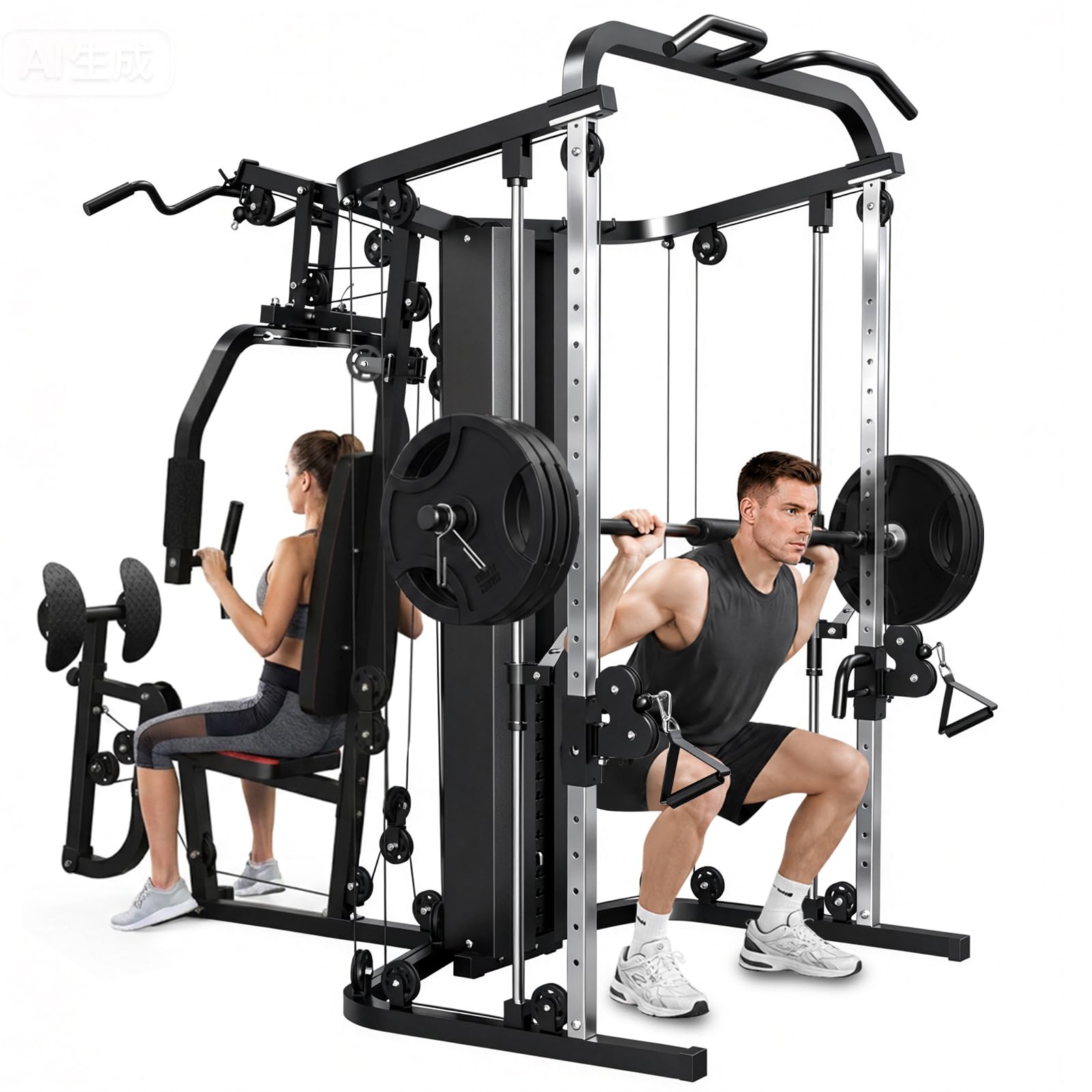
If you train with a partner, this is the station that solves the actual problem. SunHome built two independent 138-pound weight stacks — one per side — so a couple can run Smith squats on one end and cable crossovers on the other at the same moment. No trading sets, no watching the clock. That dual-stack layout is the single most useful thing in this entire list for a two-person household.
The frame is 2″x2″ commercial-grade steel rated to hold up to 2000 pounds, which is frame capacity, not cable resistance — keep those separate in your head. The cable pull you feel is the 138-pound stack. The 2000-pound figure is about the cage standing up to loaded barbells and safeties. It measures 96.85″D x 55.12″W x 86.61″H, so plan a deep footprint — roughly eight feet front to back — and a ceiling that clears 86 inches.
The build has earned a devoted following: quality and value both land as the top themes in the review pages, and the machine is a fixture in paired home setups where space is shared. The recurring friction is assembly and the odd fit-and-finish detail, so budget a full day with the step-by-step guide and have a second set of hands ready. What wins people over is how much of a commercial gym feeling fits in one frame.
What earns the top spot
- Two separate 138 lb stacks let partners train at different strength levels on the same machine
- 100+ exercise combinations across a Smith station, cable crossover, leg press, and lat tower
- 2″x2″ commercial-grade steel frame rated to 2000 lb capacity
- Folds a whole commercial floor into one machine’s footprint for couples short on space
What to weigh before you buy
- The 96.85″ depth is the longest here — measure your floor twice
- Assembly is a real project, not an afternoon
- Cable resistance tops out at the 138 lb stack, not the frame’s 2000 lb rating
- 1-year warranty is shorter than some premium rivals offer
The short answer: If two of you train together, the dual 138 lb stacks pay for themselves in saved waiting time.
Think twice if: you train solo and your floor is short on depth — the near-eight-foot footprint is a lot of room for one person.
2. Marcy Pro PM-5108 Cage System
A squat cage and a bench press station sharing one steel frame.
The Marcy Pro PM-5108 is for the lifter who wants a barbell rack first and a pulley station second. It is built from oversized 14-gauge square tubing with a powder coat, and it lines up as a cage that doubles as a squat rack, with a high pulley lat tower and a low pulley station on the same frame. If your program is built around squats and bench presses, this is the shape you want.
The numbers set the ceiling clearly. Max user weight is 300 pounds, the bar catch holds 300 pounds, the leg developer takes 100 pounds, and the sliding weight post takes 100 pounds. The weight trolley is plate-loaded, so you slide plates on and pull the pin — no selectorized stack here. It weighs 148.7 pounds, which matters when you are wresting the boxes into the room. The adjustable bar and safety catches suit 6- and 7-foot Olympic barbells.
Quality is what buyers talk about most with this cage, and it shows in how the frame feels under a loaded bar. Assembly gets mixed reports — some find it manageable, some find it a slog — and the cage earns a note about being too narrow for some lifters, so check the 44.33-inch width against your bar and stance. The removable bench adjusts to incline, flat, and decline, which is the kind of flexibility that keeps a single station useful for years.
Where it holds up: A 300 lb bar-catch rating and a true squat-cage layout make this the right pick for barbell-first training, and the removable bench frees the cage for standing work.
The honest caveat: The cable side is limited to a 100 lb sliding post, so heavy cable rows and pulldowns run out of room — the cage is the star, not the pulley.
Reach for this if: your lifting revolves around barbell squats and bench presses and you want a cage that can grow with a plate collection.
Look elsewhere if: cable resistance is your main lift — the 100 lb post will cap you early.
3. Marcy Home Gym Station with 150 lb Weight Stack MWM-989
A pin-select stack that changes weight in a second flat.
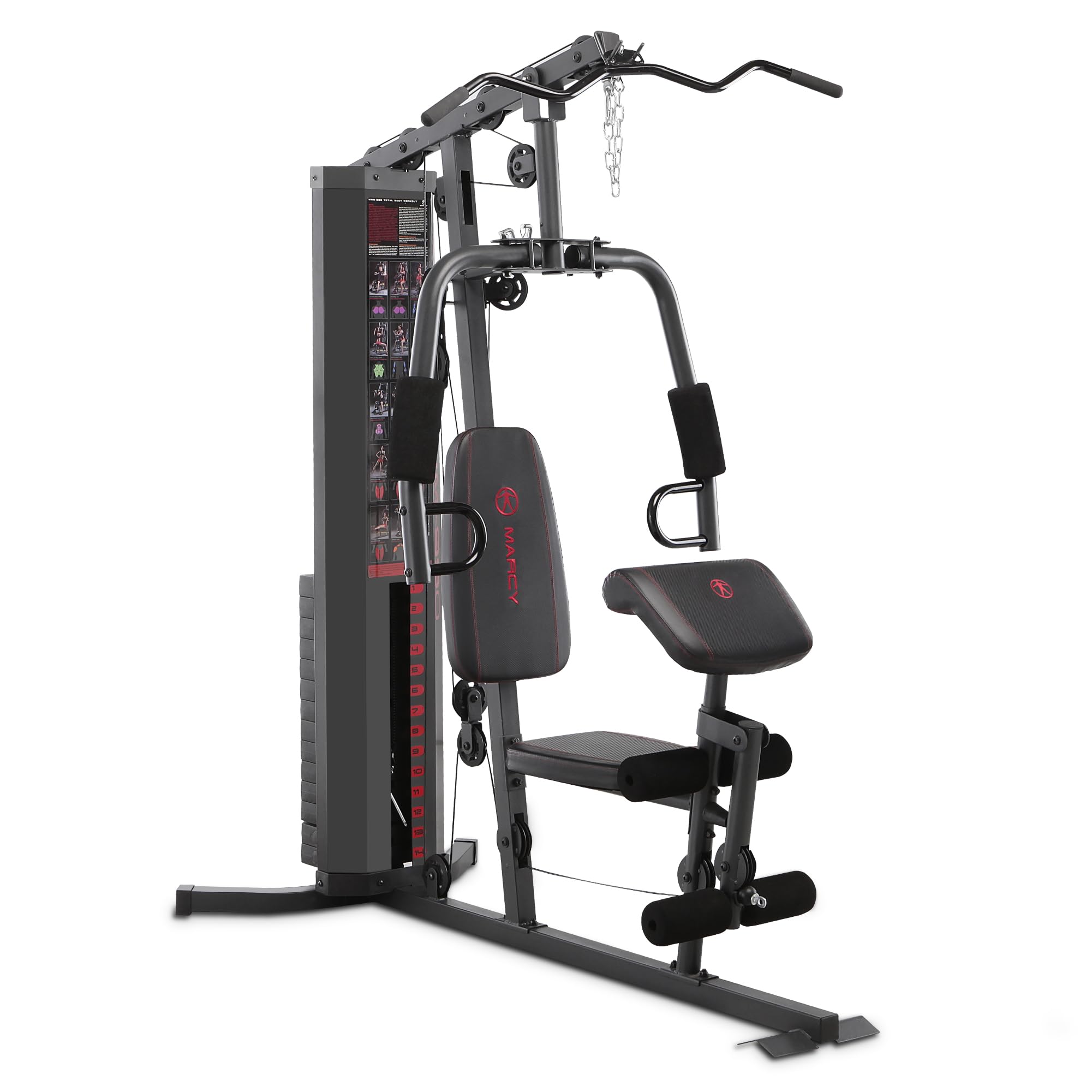
Here is the machine for someone who hates loading plates. The MWM-989 carries a 150-pound selectorized weight stack — a stack of plates with a pin you pull and reinsert — so you move from set to set without breaking rhythm. There is even a weight stack lock that keeps unauthorized hands off it, a small thing that matters in a house with kids.
Dual action press arms let you switch between chest press and vertical butterfly by removing and reinserting one pin. The preacher curl pad is removable and adjustable for isolated bicep work, and the seats use high-density boxed upholstery. It comes in at 68″D x 42″W x 78″H and 300 pounds max weight, which is one of the tighter footprints on this list and the reason it earns a compact label.
The steel frame and the 150-pound stack draw steady praise — build quality reads as a top theme, and owners find it does a wide variety of movements well. What is worth knowing is durability over the long haul; frame steel is solid, but a handful of long-term owners see wear. The 42-inch width is compact, so check your shoulder room against the press arms before you commit.
The value read: You get a pin-select stack, dual press arms, a removable curl pad, and a compact footprint from a name with a long line of home gyms behind it.
One fit note: The durability story over many years is the thing to weigh — this is a durable home machine, but not a lifetime commercial build.
The right buyer: Someone who wants fast weight changes and a smaller footprint, without a plate-loaded trolley.
Not for you if: your training needs a true squat cage with safety catches — this is a stack machine, not a power rack.
4. SincMill Home Gym
The heaviest cable stack on this list, squeezed into the narrowest frame.
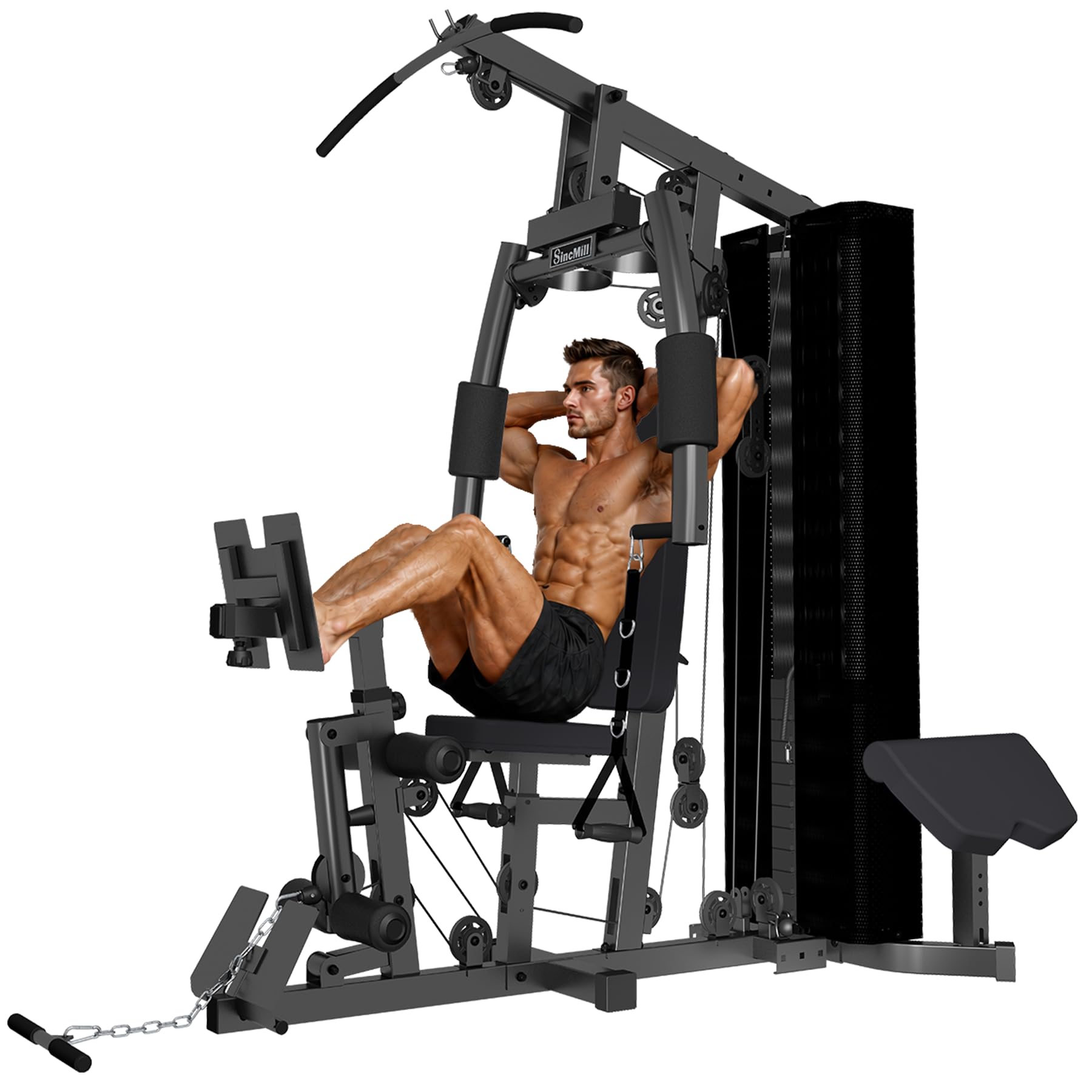
Two numbers define the SincMill. First, the 160-pound weight stack — the biggest pin-select load here, comfortably ahead of the SunHome’s 138 pounds of cable resistance. Second, the 34-inch width, the slimmest on this page. That pair makes it the pick for someone pulling heavy cable work in a hallway or corner where width is precious.
On the frame side: thick alloy steel, a 160-pound recommended maximum weight, and a stated half-hour assembly target with numbered screws and a step-by-step video. The machine weighs 287 pounds, so it is the heavier build than the Marcy Pro’s 148.7 pounds and it sits planted once you have it in place. Dimensions run 74.6″D x 34″W x 79.6″H.
Quality is the dominant theme in the review pages — owners consistently find it a full gym in one frame. Build stability and the install experience get mixed marks, so treat the half-hour target as best case and have a helper for the frame lift. Ease of use also comes up from some owners who found parts fiddly to dial in. The big win is the exercise range: one machine covers arms, chest, back, and legs without a second purchase.
The spec that sells it: A 160 lb stack in a 34″-wide footprint is a rare pairing — the SincMill tops the SunHome on cable resistance (160 vs 138) while being noticeably slimmer side to side.
The honest catch: Frame stability earns mixed marks, so recheck every bolt after the first week and expect the build to need a careful eye.
Pick this if: heavy pin-select resistance matters more to you than a wide, roomy frame.
Pass if: your room is generous and you would rather have a wider, more spread-out station than a tall narrow one.
5. ULTRA FUEGO Multifunctional Home Gym Station with Stepper

A cable station, power tower, and foldable stepper sharing one frame.
The ULTRA FUEGO is built for the household where more than one person wants a turn. It packs a double pulley system, an arm press frame, a leg developer, a power tower, and a foldable stepper onto a single frame, so cardio and strength can run side by side. The 118-pound stack handles lat pulldowns, bicep curls, seated rows, and leg extensions, and a dual-workout setup means family members can train together.
The steel tube is 50×50 mm commercial-grade, the pads are high-density foam with an EVA cover, and the metal is electrostatic powder-coated to resist rust. The frame stands 63.8″D x 52.4″W x 85.8″H — that 85.8-inch height means a low basement ceiling is a genuine issue. It is backed by a 2-year warranty, longer than several rivals here.
What buyers respond to is the versatility — you can hit arms, chest, abs, hips, and legs without a second machine, and the price-to-feature ratio reads strong. Assembly is the polarizing part: some find it very easy, others say it eats a weekend. Durability also gets mixed feedback, with a handful of owners seeing parts wear. The 118-pound stack is the real limiter for strong lifters.
Why families like it
- Foldable stepper plus power tower lets cardio and strength run together
- Dual-workout design supports two people at once
- 2-year warranty outlasts several rivals here
- Covers arms, chest, abs, hips, and legs in one frame
Where it asks patience
- The 118 lb stack is the lightest resistance here
- Assembly is a mixed bag — some weekend, some afternoon
- 85.8″ height rules out low ceilings
- Long-term durability draws a few concerns
The household pick: Great for a family that wants cardio and cable work in one corner without a commercial stack.
The trade-off: If you pull heavy, the 118 lb stack will run out before your strength does.
6. Mikolo K6 Power Cage with Cable Crossover
A true power cage you can step inside, with eight stations bolted to it.
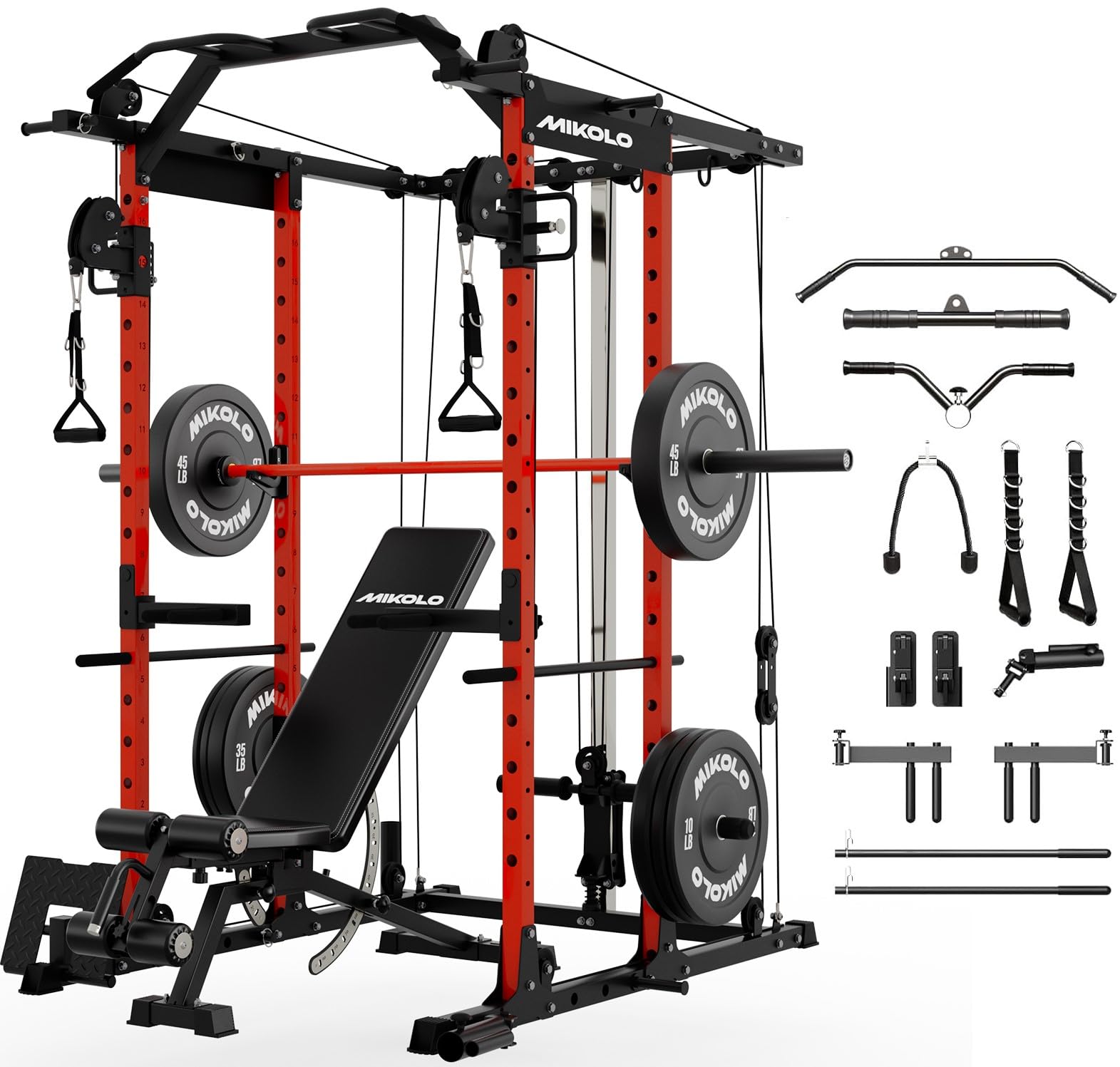
The K6 makes its case on in-cage training. A true power cage lets you squat and bench inside the frame with the safety bars set at your depth — worth more to a beginner than any single cable attachment. The cage is rated to 1500 pounds for squat work and weighs 230 pounds, with eight reinforcing tabs to keep it steady. Internal dimensions of 41″ x 60″ are deep enough to fit almost any weight bench.
The 8-in-1 list is long: power rack, cable crossover, lat pulldown, a 2:1 ratio low row station with a footplate, chin-up, dip, core trainer, and resistance station. Four white rollers glide along the riser to protect it from wear. The dimensions are 67.5″D x 56.5″W x 86.4″H, so again, check that 86.4-inch ceiling before you order. A pedal flips flat so you can stand right up to the cable system.
The review pages are short but warm — it is the kind of machine people recommend after living with it, and assembly tends to be described as straightforward. Accessories ship in the box: a lat pulldown bar, tricep rope, cable bar, two handles, two J-hooks, two dip bars, a landmine, a footboard, and clamps. That accessory bundle is a real cost saver, since buying those pieces separately adds up fast.
Why it ranks high: In-cage squats with a 1500 lb squat-rack rating give beginners a safe place to fail a rep — the thing a simple power rack cannot offer.
One reality check: The 230 lb tension figure refers to the equipment’s rated capacity, not a selectorized stack — there is no pin-select weight stack here, so plan to load plates or bands.
Buy this if: you want to squat and bench inside a real cage and enjoy the flexibility of a cable crossover on the same frame.
Keep looking if: you need a pin-select weight stack for quick weight changes — this is a plate-and-band setup.
7. SunHome S4 Pro Smith Machine with Weight Plates

The kit that arrives with plates, a bench, and a Smith bar already in the box.
Buying a home gym piecemeal is where the cost creeps up. The S4 Pro ships as a package: the Smith machine, an adjustable weight bench, a 230-pound Olympic plate set (two 10s, two 25s, two 35s, two 45s), four collars, and a built-in 120-pound adjustable weight stack. That is a starter gym in one delivery, and the reason value is the loudest theme in its reviews.
The frame is commercial steel square tube at 2 mm thickness, and the unit weighs 410 pounds — heavy enough that it stays planted under a loaded Smith bar. The footprint is 87″H x 65.7″L x 60.3″W. The 120-pound stack covers cable work, and a pair of plate holders lets you hang extra plates when the stack is not enough. The pulley system uses a rolling-bearing design that runs smoother and quieter than a sliding setup.
The Smith bar, cable crossover, lat pulldown, and a butterfly chest station share the frame, so chest day and squat day both have a home. Two things to know: reracking the Smith bar is the most-discussed sticking point, with some owners finding it takes practice to land the hooks. And the footprint spreads 80 inches wide once you count the bar and plates, so give it real room.
The package math: Plates, bench, bar, and a 120 lb stack in one order saves the separate shopping trip that usually adds up.
The honest limit: Reracking a Smith bar is a skill — give yourself a week to learn the hook placement before you judge the machine.
Made for: the buyer who wants a complete barbell-and-cable setup delivered in one go.
Skip if: you already own Olympic plates and a bench — you would be paying for gear you have.
8. Body-Solid Powerline Adjustable Power Rack

A 12-gauge steel frame backed by a lifetime warranty on frame, welds, cables, and pulleys.
Body-Solid has been at this for 30+ years, and the Powerline reads like a machine designed to stay. The frame is 12-gauge steel — a heavier gauge than the 14-gauge tubing on the Marcy Pro — and the care shows in the small parts: nylon bushings along the 165-pound stack keep the cable glide smooth and quiet. There are five stations: multi-press, lat pulldown, ab crunch, leg extension/curl, and seated row with a low pulley.
The dimensions are the friendliest space-wise on this list at 55″D x 47″W x 83″H, and it weighs 315 pounds — planted, not portable. It lists up to 40 unique exercises, from pec fly and incline press through glute kick and upright rows. The warranty is the headline: lifetime coverage on pulleys, bushings, bearings, hardware, plates, guide rods, cables, upholstery, grips, frame, and welds.
What earns the most praise is the build quality and stability — it does not budge mid-set, which is the thing you notice on a heavy press. Setup tends to go smoothly, and the weight capacity is rated to handle plenty up to 300 pounds. Durability draws mixed notes, with a few owners seeing paint chip where plates contact the frame — cosmetic, but worth knowing if finish matters to you.
The long-game case
- Lifetime warranty on frame, welds, cables, and pulleys
- 12-gauge steel and 165 lb nylon-bushed stack run smooth
- Compact 55″ x 47″ footprint for a full five-station machine
- Up to 40 exercises, from pec fly to glute kick
Fine print to expect
- Paint can chip where plates contact the frame
- No Smith bar or cable crossover — it is a stack station first
- The 165 lb stack caps heavy cable pulls
- Assembly still takes real time despite solid instructions
The keeper: For a buyer who wants a machine to last a decade or more, the lifetime warranty on frame, welds, cables, and pulleys is the reason to choose it.
Not the one if: you want a Smith bar or true cable crossover — this is a five-station stack machine.
9. Major Fitness Drone2 Advanced Training Smith Machine
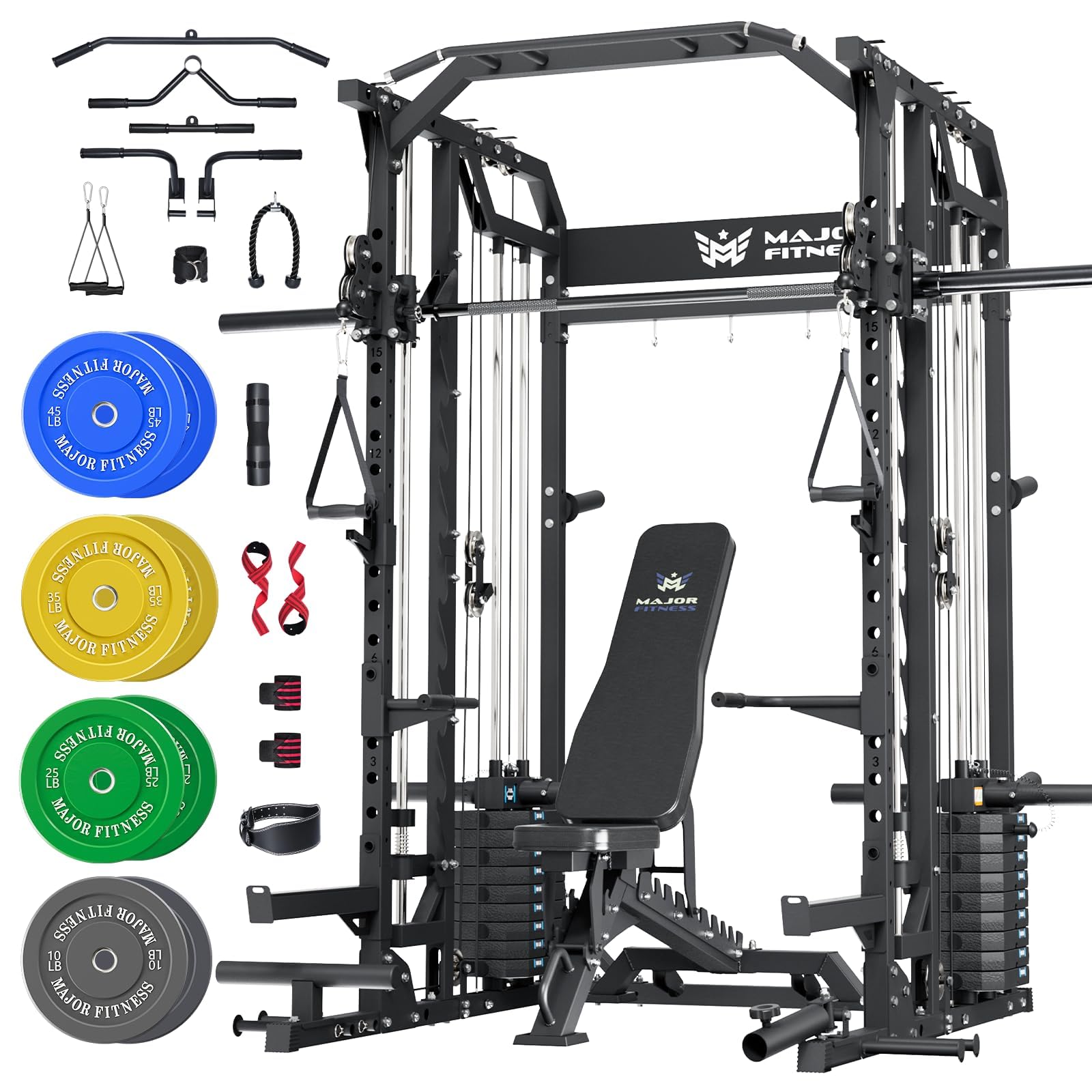
A 1:1 cable pull that feels heavier in your hands than a double-ratio setup.
Most cable machines use a 2:1 ratio, which halves the felt load for a longer pull. The Drone2 runs a 1:1 pulley ratio with an aluminum pulley set, so the resistance you feel is closer to the weight you load. For slow, heavy lat pulldowns, seated rows, and leg presses, that heavier feel is the point — and it is why this machine’s cable work reads as more serious than the Mikolo’s band-and-plate approach.
The frame is 2″x2″ commercial-grade steel uprights rated to 2000 pounds of capacity. It weighs 341.8 pounds and spans 62.5″D x 85.2″W x 84.4″H. The package pulls in a long accessory list: dip handles, a T-bar, barbell pad, tricep rope, ankle straps, wrist wraps, a weightlifting belt, and a lat pulldown bar. That is a stack of add-ons most buyers would otherwise pay for separately.
Quality is the dominant note in its reviews, and buyers find the build solid with assembly that goes smoother than expected and instructions that hit the right level of detail. The 85.2-inch width is the widest here, so double-check your wall clearance before committing. Lifetime after-sales support backs it up.
The cable advantage: A 1:1 ratio and aluminum pulleys give the Drone2 a heavier, more direct feel than the 2:1 low row on the Mikolo.
Plan for the footprint: At 85.2 inches wide this is the broadest machine on the list, so it needs a wall it can own.
Choose it if: heavy, slow cable resistance and a big accessory bundle matter more to you than a compact footprint.
Reconsider if: your room is narrow — the 85.2″ width needs clearance on both sides.
10. Speediance Gym Monster 2 Smart Home Gym
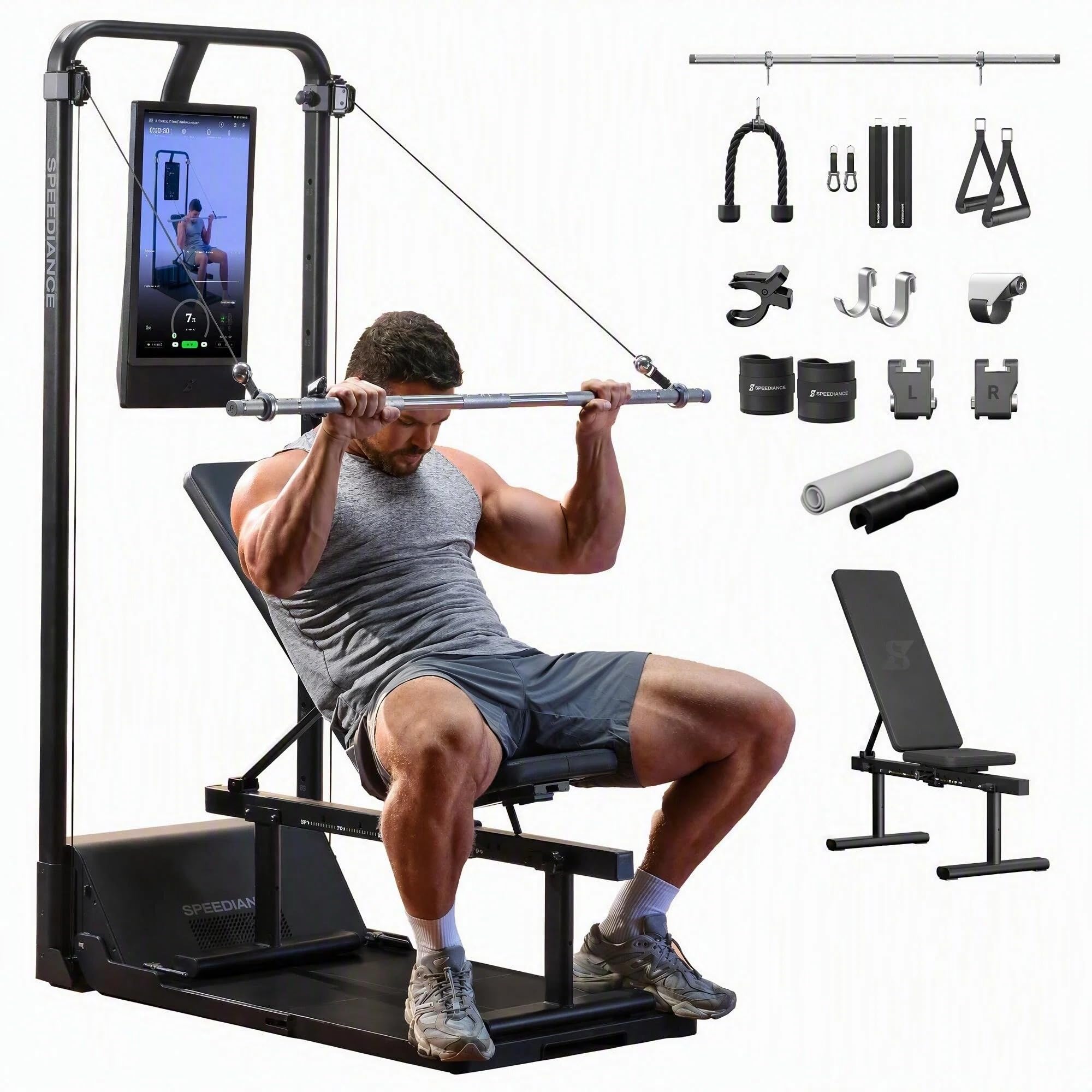
No plates, no plates to load — just a screen that sets the resistance.
The Gym Monster 2 removes the weight stack entirely. Dual 800W PMSM motors (permanent-magnet synchronous motors that spin to generate resistance) create up to 220 pounds of digital resistance you dial on a screen. There is no pin to pull and no plate to rack. That makes it the fastest machine here to change weight between sets, and the one that fits the smallest room.
The folded footprint is 0.25 m² / 2.69 ft², and the full unit measures 27.16″D x 48.03″W x 72.83″H — dramatically smaller than any cage on this page. A built-in AI coaching system tracks your performance and suggests weight changes after each set. The 220-pound digital resistance is a fair ceiling for most home lifters, and the 2.69 ft² fold makes it the only one that tucks away in an apartment.
Owners respond to the versatility and the ease of use — the preloaded workouts and the quick adjustment mechanism come up as favorites, and the compact size lets people train where a cage would never fit. The caveat is the ceiling: 220 pounds of digital resistance is real, but heavy barbell squatters will hit it. A two-year main-unit protection and one-year accessory coverage back it up.
The trade it makes: You give up the feel of a physical stack and the squat cage, and you get 220 lb of digital resistance that changes at a tap and folds to 0.25 m².
Who will feel the cap: A strong squatter or deadlifter will run past 220 lb fast — this is a versatile cable machine, not a barbell cage.
Best fit for: Apartment dwellers and small-space trainers who want a full cable workout that disappears into a corner.
Not the one if: you lift heavy with a barbell — the 220 lb digital ceiling will stop you.
Know the Specs
Weight stack versus frame capacity
The weight stack is the resistance you feel on the cable — the plates a pin selects. Frame capacity is how much load the steel cage is built to hold. A station can hold 2000 pounds of barbell on the frame while its cable stack tops out at 138 pounds. Read the stack figure when you want heavy cable work, and the frame figure when you want to drop a loaded bar safely. These two numbers are not interchangeable.
Footprint and ceiling height
These machines are deep and tall. Depth runs from just over two feet on a folding smart unit to nearly eight feet on a Smith machine. Height often lands near 86 inches, so check your ceiling before anything else. Add clearance for a bench to slide in and out, and room to load plates on both sides. A machine that fits your room gets used; one that crowds it becomes a clothes rack.
Pulley ratio, 1:1 versus 2:1
Pulley ratio changes how the resistance feels. A 1:1 ratio delivers roughly the full load to your hands with a heavier, more direct feel, which suits slow heavy lifts. A 2:1 ratio moves the cable twice as far for about half the felt load, which suits fast, full-range cable work. Neither is better — the right one depends on whether you train heavy or train fast.
Steel gauge and build
Steel gauge is a measure of tubing thickness, and a lower number means thicker, heavier steel. A 12-gauge frame is sturdier than a 14-gauge one, done at the cost of weight and cost. Commercial-grade square tube in the 2″x2″ range is the common standard for serious home stations. Thicker steel plus reinforcing tabs is what keeps a cage from shaking on a heavy rep.
Common Questions
How much floor space does a home workout station really need?
Is a 138 lb weight stack enough for building strength?
Do I need a power cage or a Smith machine?
How long does assembly take on these machines?
What does 1:1 versus 2:1 pulley ratio change for me?
Can I use a home station on a second-floor room?
Does the digital resistance on the Speediance feel like real plates?
How much weight can these framessafely hold?
How often should I check the bolts on a home workout station?
What ceiling height do I need for a lat pulldown and pull-up station?
Which station is easiest for one person to move once assembled?
The Bottom Line
The best pick for most homes is the SunHome Multifunction Workout Station — two independent 138-pound stacks, a Smith bar, cable crossover, leg press, and lat tower in one footprint, built for two people training together. Its 4.5+ star rating across 250+ owners backs that up, and no other station here solves the waiting-for-the-cable problem as well.
If you are a barbell lifter who wants a true squat cage, grab the Mikolo K6 — its 1500-pound squat rack rating and 41″ x 60″ interior give you a safe place to squat and bench. And for an apartment or small room where a cage simply will not fit, the Speediance Gym Monster 2 delivers 220 pounds of digital resistance that folds to 0.25 m².
One nudge before you commit: choose the machine whose footprint and weight stack match your room and your training, not the one with the biggest number on the box. The highest-rated pick here earns its place because its dual stacks, Smith bar, and cable crossover all work as one system.
How we choose
We do not accept paid placement. Every pick is matched to a real buyer and a real use-case; we do not hands-on test units.
Sources
Specifications: manufacturer listings and product documentation. Review insights: verified customer reviews, as of November 2026. Pricing: not shown on this page (it changes often); check the current price via the retailer link.
As an Amazon Associate, Tactical Gear Guy earns from qualifying purchases. This does not affect which products we feature.