Specs are compiled from manufacturer listings and verified buyer reviews and can change over time — please confirm the key details on the product page before buying.
You plug a headset into your Xbox One controller, and the first thing you need is for your squad to actually hear you. The second is that enemy footsteps land in the right ear. Everything else — mute buttons, cushioned pads, clamping force — comes after those two. This guide covers what matters for the Xbox One Headsets category: which models plug straight into the controller jack, which mic will not leave your teammates guessing, and which picks are worth owning long term.
This guide is built by comparing the manufacturers’ published specifications and the patterns across verified customer reviews, so you get each pick’s real strengths and trade-offs instead of marketing spin.
The Xbox controller jack is the great equalizer: any wired set with a 3.5 mm plug works without a dongle or pairing step. Our roundup of the Xbox One Headsets covers what actually holds up over long sessions instead of just launch-day promise. Every pick below plugs into the controller jack or pairs without a dongle hunt.
Top Picks

How To Choose The Best Xbox One Headsets
Most people buy a headset for the wrong reason: they chase the biggest driver number on the box. For an Xbox One setup, the buying decision is much narrower. You need a connection that works with your controller, a microphone your team can understand, and a headband that does not turn into a clamp after an hour.
Start with the jack, not the driver
Most Xbox One controllers have a 3.5 mm headset port — older controller revisions sometimes lack the jack. Any wired headset with that plug works the moment you push it in — no pairing, no dongle, no battery to charge. Most wireless sets need a dongle or a pairing handshake, and they all need power. If your main worry is “will this just work when I sit down,” a 3.5 mm wired set is the fastest answer.
Driver size and what it does for footsteps
Drivers are the speakers inside each earcup, and their diameter is measured in millimeters. Bigger does not automatically mean better, but a 50 mm driver moves more air than a 40 mm one, and that usually translates to more low-end punch. In a shooter, that bass is what sells an explosion — but clarity of mid-range detail is what sells a footstep. Treat driver size as one clue to the sound, not the verdict on it.
Microphone style affects how you mute
You can silence your mic by physically lifting the boom away from your mouth — that is what a flip-to-mute or swivel-to-mute boom does. It is faster than hunting for a mute switch mid-match. A detachable mic lets you pull the boom entirely when you are listening to music instead of talking. Both mute styles work; pick the gesture you will actually use mid-match.
Comfort is the spec you cannot see
You feel comfort through three things: cushion material, ear-cup depth, and clamp force (how tightly the headband squeezes your head). A deep, soft cushion lets you wear the headset for a full evening without pressure on your ears. A metal or aluminum frame tends to survive more drops than a plastic one, but it can also feel heavier. Weigh frame durability against weight based on how long you sit per session.
Side-by-Side Comparison
| Model | Best For | Driver Size | Connectivity | Mic Style | Amazon |
|---|---|---|---|---|---|
| Razer Kraken★ Best Overall | Wired all-rounder | 50 mm | Wired 3.5 mm | Retractable noise-isolating | Amazon |
| Razer BlackShark V3Premium Pick | Wireless competitive play | 50 mm | Wireless 2.4 GHz / Bluetooth 5.3 / USB-C | Detachable wideband 9.9 mm | Amazon |
| Logitech G Astro A20 XMulti-System Pick | Multi-system households | — | Wireless | 48 kHz mic with Blue VO!CE | Amazon |
| Xbox Wireless Headset Starfield | Collectors and Xbox loyalists | — | Wireless | Built-in with integrated EQ | Amazon |
| HyperX CloudX | Long-session comfort | 5.3 cm | Wired 3.5 mm | Detachable noise-cancelling | Amazon |
| SteelSeries Arctis Nova 1X | Slender setups | — | Wired | Built-in | Amazon |
| HyperX CloudX Stinger 2 Core | Official Xbox licensing | 40 mm | Wired 3.5 mm | Swivel-to-mute noise-cancelling | Amazon |
| EKSA Fenrir S | Big-driver budget pick | 50 mm | Wired | 120-degree rotatable | Amazon |
| Turtle Beach Recon 70 | Entry-level wired | 40 mm | Wired 3.5 mm | Flip-to-mute | Amazon |
Detailed Reviews
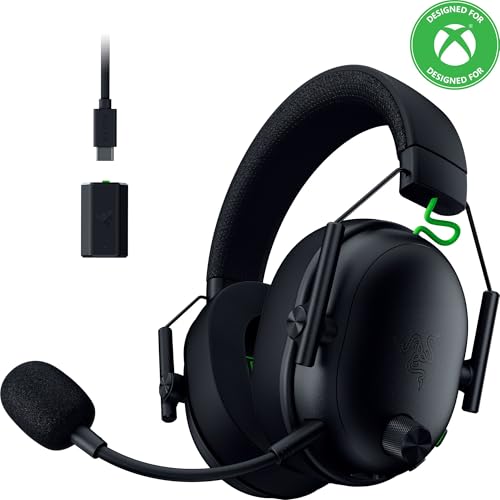
1. Razer Kraken Gaming Headset
Our pick — 4.5+★ from 48,500+ verified ratings; the strongest balance of quality and price.
Big drivers, cooling ear pads, and a mic you can pull back in one motion.
The number that earns this headset the top slot is the 50 mm driver in each ear cup. That is a larger speaker than the 40 mm unit inside the Turtle Beach Recon 70 below, and the extra diameter gives the Kraken a fuller, more physical low end. In a shooter, that means explosions feel weighted and vehicle rumble carries through. The same driver powers software-enabled 7.1 surround sound, which Razer notes is only available on Windows 10 64-bit — so save that trick for your PC, not the console.
Razer fits the Kraken with oval ear cushions filled with a cooling gel. That gel is the reason this headset stands out during long sessions — earcups made of plain foam heat up after the first hour, while the gel is designed to hold off that pressure build-up. The frame is bauxite aluminum, which Razer says is flexible and built to last. Both facts matter because the Kraken is a wired 3.5 mm headset, so it sees daily plugging and unplugging at the controller jack.
The microphone is the practical finisher. It is a retractable cardioid mic that tucks away into the earcup when you are not talking, and it is tuned to push your voice forward while cutting room noise. In-line analog controls handle two jobs — a volume wheel and a mic mute switch — so you are not diving into the console menu mid-match. The honest caveat is sound: some players hear the tuning as muffled rather than crisp, which matters if you want bright treble over a warm bass presentation. If you want a clean, forward mid-range above all else, checkout the HyperX CloudX later in this list. For everyone else, this is the strongest all-around wired pick.
What seals the top spot
- 50 mm driver throws a fuller low end than the 40 mm Recon 70
- Cooling gel cushions are designed to fight heat build-up over long sessions
- Bauxite aluminum frame holds up to daily plug-and-play
- Retractable cardioid mic cuts room noise and tucks away cleanly
The trade you accept
- Software 7.1 surround only works on Windows 10 64-bit, not on the console
- Warm tuning can read as muffled to listeners who want bright highs
Made for: the player who wants one wired headset that handles chat, bass, and marathon sessions without fiddling.
Two things to know: the surround trick is PC-only, and the sound signature leans warm rather than bright.
2. Razer BlackShark V3 Wireless Xbox Gaming Headset
The cordless one that treats latency like an enemy to be beaten.
Razer built the BlackShark V3 around a single promise: audio that arrives when the picture does. The HyperSpeed Wireless Gen-2 connection is rated at latency as low as 10 ms (a millisecond is one thousandth of a second), so the gap between an on-screen event and the sound in your ear shrinks to almost nothing. In a clutch firefight, that is the difference between hearing a reload behind you and being caught flat. This is the wireless pick that behaves like a wired one.
The drivers inside are Razer’s Triforce Titanium 50 mm Gen-2 units, tuned to sharpen positional cues. The diaphragm is titanium-coated, which Razer says reproduces footsteps and audio cues with detail. That is a real advantage in a tactical shooter where a soft footstep tells you which hallway to watch. On the microphone side, the detachable HyperClear Super Wideband mic measures 9.9 mm — the width of the capsule itself — and Razer says it covers a wider frequency range to capture more voice detail. Your squad gets richer, more natural callouts rather than thin, compressed audio.
Connectivity is where this headset flexes. It offers 2.4 GHz wireless, Bluetooth 5.3, and USB-C wired in one unit, and it can mix 2.4 GHz and Bluetooth audio across two devices at once. So you could hear game audio over the dongle while taking a phone call in the other ear. On Xbox One and Xbox Series X|S the set delivers next-gen surround sound for a wider soundstage, while the PC side open up 7.1.4 surround. Handling that much connectivity makes the premium placement obvious — the honest trade-off is that this set asks you to manage batteries and modes rather than just plugging in.
What earns the premium slot: low-latency 2.4 GHz wireless, three separate connection modes, and a detachable wideband mic — a genuine step up from any purely wired set here.
The honest friction: three modes mean more to learn, and a wireless headset always needs power. If you want zero charging in your life, a wired pick like the CloudX serves you better.
Pick it when: you want console audio without a cord draping across your lap, and you value split-second reactivity over plug-and-forget simplicity.
Pick wired instead when: the idea of charging a headset between sessions wears on you.
3. Logitech G Astro A20 X
Built for the player whose console shelf holds more than one machine.
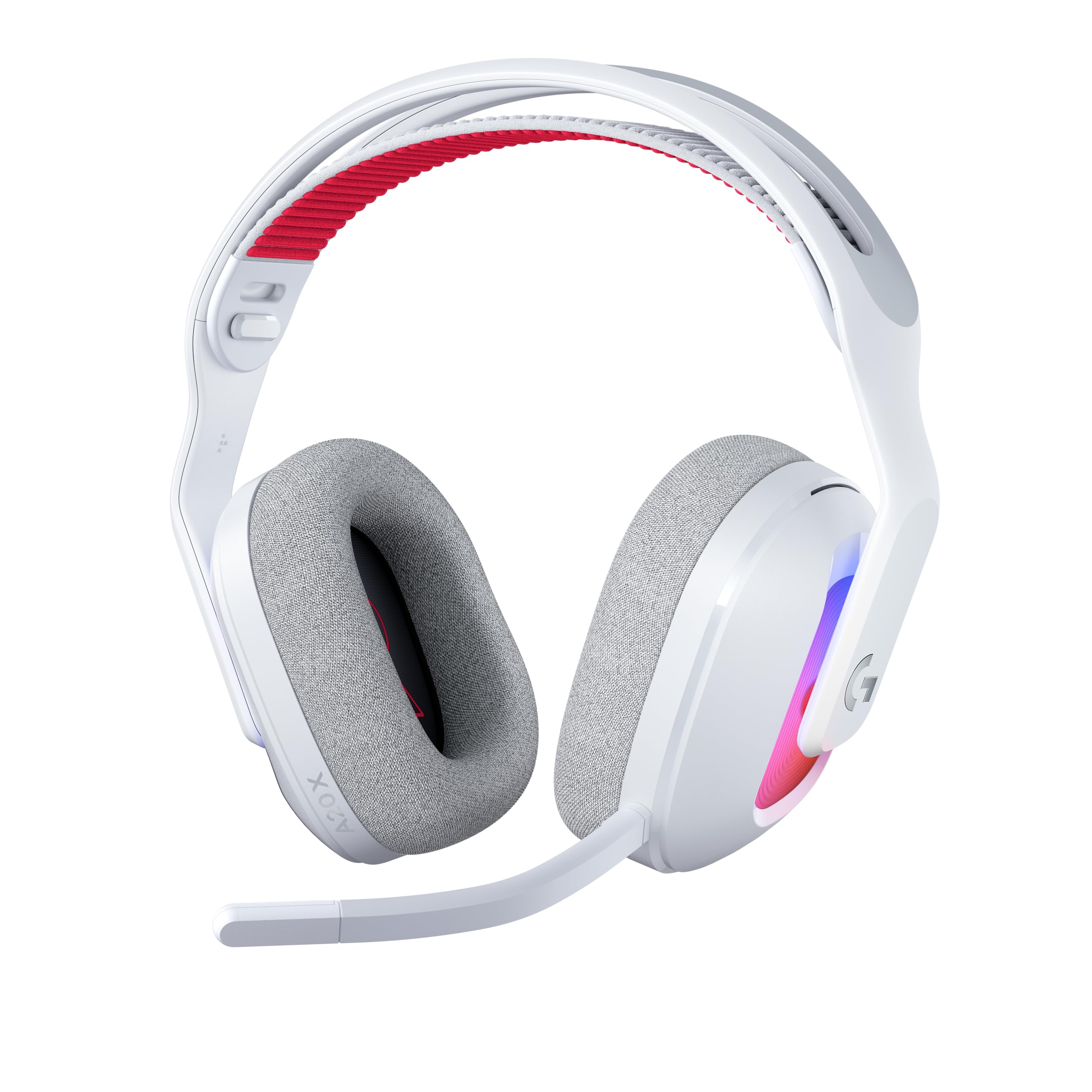
If you own an Xbox and a Switch, or a PS5, the A20 X is aimed squarely at you. The PLAYSYNC AUDIO system switches audio between Xbox and Switch on one side and PS5 and PC on the other, so one headset serves both setups without cable swaps. Better still, built-in MixAmp technology lets you balance game and chat audio independently on PC and Xbox, right from the headset, without visiting the console menu.
The weight figure is the other number worth knowing. Logitech lists this headset as weighing under 300 g, and calls it an ultra-light build. Anyone who has worn a dense gaming headset for three hours knows how much a heavier set pulls on the top of the head. The A20 X is designed to take that pressure away. The microphone is a 48 kHz high-resolution unit — the sample rate, which tells you how much of the voice signal is captured — paired with Blue VO!CE customization for tweaking your own audio settings.
The honest trade-off is not a flaw in the sound; it is the setup. This is a wireless, dongle-driven headset that expects you to manage a pairing routine and a charge, and it offers less choice in the way of connection types than the Razer BlackShark V3 above. If you only play on an Xbox One and you want the smallest possible moving parts, this is more headset than you need. If you are running two systems, nothing else here makes that hop as smooth.
Why it earns the multi-system label
- PLAYSYNC AUDIO hops between Xbox/Switch and PS5/PC
- Built-in MixAmp balances game and chat audio without menu diving
- Under 300 g keeps the top of your head free of pressure
- 48 kHz mic with Blue VO!CE customization
Where another set serves you better
- Dongle pairing and charging add routine that wired headsets skip
- Fewer connection types than the Razer BlackShark V3 offers
Best fit: households juggling two consoles and a PC — one device that keeps up with all of them.
Skip if: the setup ceremony of wireless charging and pairing is what pushed you to wire in the first place.
4. Microsoft Xbox Wireless Headset – Starfield Limited Edition

First-party Xbox hardware with a Starfield skin and a built-in EQ.
This one is a shelf piece as much as a gaming tool. It is a genuine Microsoft accessory, built as the Starfield Limited Edition, and it carries the Xbox brand directly — the same badge that sits on the console under your TV. That means it is designed specifically for Xbox hardware rather than adapted from a PC-first design. If you like the idea of a single brand running from console to headset, this is the cleanest expression of that.
Inside, you get an integrated equalizer for shaping your own sound profile across the bands. The set is wireless, pairs for use with consoles as well as a laptop or desktop, and ships with an adapter in the box so you are not chasing a separate dongle purchase. The carrying case is leather and alloy — noticeably a step above the soft pouches most gaming sets ship with — so the headset stays protected between sessions. The limited-edition styling is the differentiator: no other pick in this roundup was made as a themed collector’s set.
Where this pick asks for patience is documentation. Microsoft’s listing gives you design and identity rather than a deep spec sheet, so you will not find driver size printed the way you will on the EKSA Fenrir S or the Razer Kraken. If you are a spec-first buyer who wants to compare millimeter by millimeter, that is a frustration. If you want first-party Xbox design with a themed finish and a leather-and-alloy case, this is the pick that fits.
The reason to choose it: a genuine Microsoft accessory in a Starfield Limited Edition finish, with an integrated equalizer and a leather-and-alloy case that outclasses the soft bags on other sets.
The catch: the spec sheet stays quiet on driver size, so you cannot compare the sound internals head-to-head with the rest of the list.
Choose it for: the themed collector who wants an Xbox-branded headset with a proper carrying case.
Consider elsewhere: you are a numbers-driven buyer who needs the driver spec printed before you commit.
5. HyperX CloudX Official Xbox Licensed Gaming Headset

The one you forget you are wearing somewhere around hour three.
HyperX earned its reputation on comfort, and the CloudX leans all the way into it. The set is fitted with memory foam ear cushions that shape themselves to your head, and it wears over the ear rather than pressing on it. Marathon sessions are where that pays off — the foam takes the pressure instead of your skull. The frame is durable aluminum, which HyperX says provides reliable durability and stability, so the headset stays put without a crushing clamp.
This is also one of the few headsets here tested and approved by Microsoft for Xbox, and HyperX states it works with Xbox controllers that have a 3.5 mm headset jack. You plug it in and go. The cable is a braided type measuring 3 feet, flexible enough to let you shift on the couch without tugging against the controller. In-line audio controls cover volume and mic mute, so you never have to leave the game screen to fix chat.
The microphone is detachable and noise-cancelling, and it bends to sit where you need it. Pull it off entirely when you are listening to music and do not want a boom in your face. Audio runs on enhanced bass with clear lows, mids, and highs, which keeps the mix balanced rather than thumping. The recurring gripe across owner reviews is echo on your own voice in the channel — teammates hearing themselves come back. That tends to be a setup problem as often as a hardware one, but it is worth knowing before you buy. What wins people over is the comfort, which is not something the spec sheet can measure.
Where it wins your hours
- Memory foam over-ear cushions carry you through long sessions
- Tested and approved by Microsoft for Xbox controllers with a 3.5 mm jack
- Detachable noise-cancelling mic bends and removes cleanly
- Aluminum frame adds stability without a heavy clamp
Worth going in knowing
- Echo on your own voice shows up in enough reviews to be a real risk
- Enhanced bass tuning leans warm rather than analytical
This is your set if: you play long sessions and comfort outranks every other spec on your list.
Go in watching for: mic echo — test your chat channel on day one so a return period is still open.
6. SteelSeries Arctis Nova 1X Gaming Headset
Small footprint, wide reach across consoles, and a voice mic that carries.
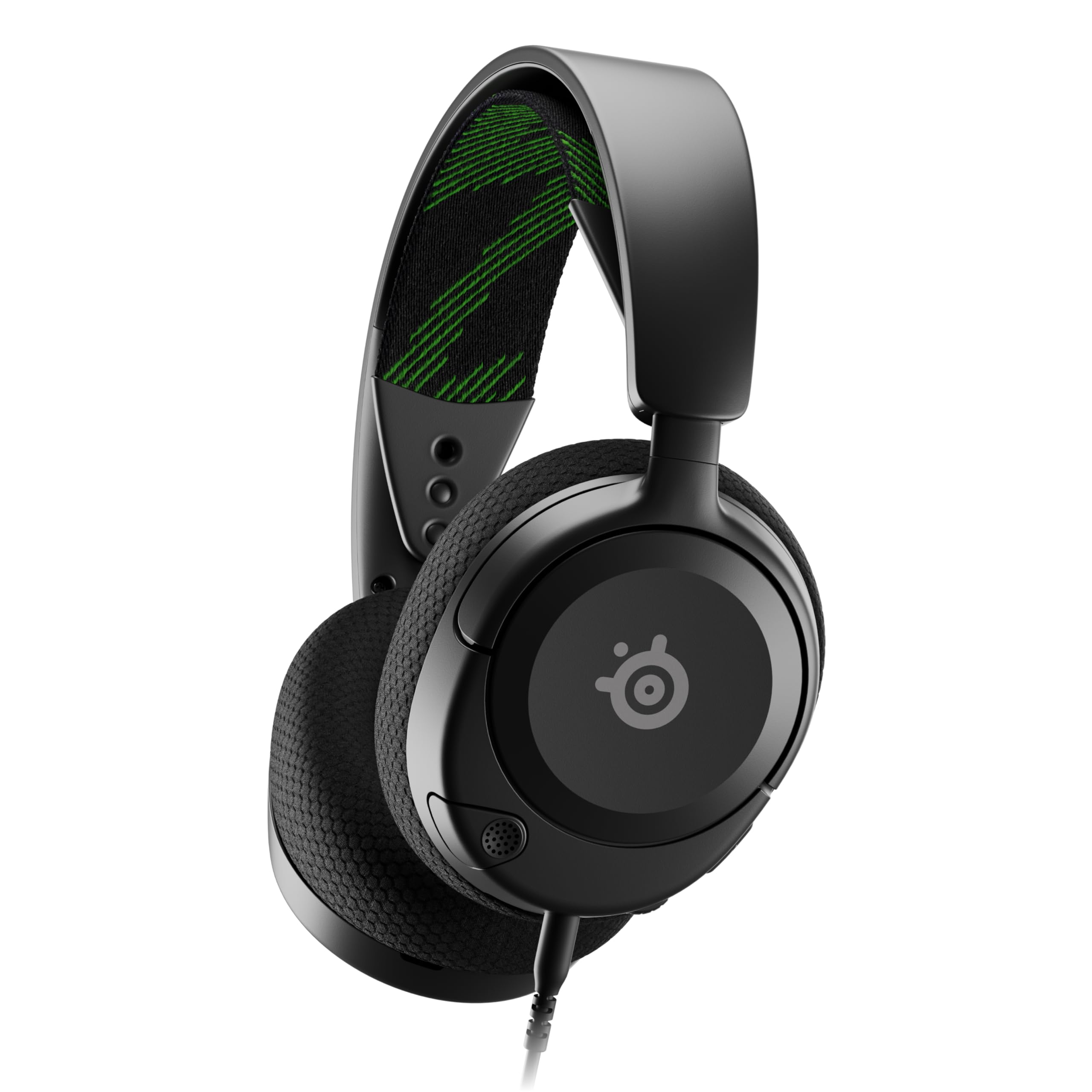
The Arctis Nova 1X is the pick for the player who moves between machines. SteelSeries lists support for Xbox Series X|S, PC, PlayStation, Switch, and mobile — one wired headset that covers a whole room of hardware. There is no dongle and no pairing step; you plug it in and your console recognizes it. Volume control sits on the headset body so you can adjust without leaving the match.
The audio side is where this headset earns quiet respect. What stands out most in owner feedback is voice capture — the mic picks up speech with enough clarity that teammates come through cleanly rather than muffled. Paired with a dynamic driver, that combination is what most gamers actually need from a headset: clear communication first, music and cinema second. The fit is where opinion divides. Some players describe it as snug and locked-in; others find the headband too small, especially on a larger head.
That fit note is the one thing to weigh honestly before buying. A snug headset is a comfort upgrade for a player who hates a loose cup sliding around; a too-small headset is a daily annoyance for anyone with a broader head. SteelSeries does not publish a driver size for this model, so you are buying on feel and reputation rather than a millimeter figure. The reward for that leap is a compact, wired headset that works across every console you own.
What it gets right: wired support across Xbox Series X|S, PC, PlayStation, Switch, and mobile, with a mic that keeps your voice clear in chat.
Read this before you order: the fit runs snug, and some players find the headband too small — worth measuring against a headset you already own.
Your match if: you want one wired headset that hops between consoles and keeps your mic clean.
Look for a looser fit if: you have a larger head and know snug headbands bother you.
7. HyperX CloudX Stinger 2 Core Wired Gaming Headset

The simplest path to a console: Microsoft approved it, and it just plugs in.
The pitch here is trust. HyperX says the CloudX Stinger 2 Core was tested and approved by Microsoft, and it connects directly to the 3.5 mm port on an Xbox One or Xbox Series X|S controller. That is the shortest possible distance between the box and your ears — no dongle, no pairing, no app. If you have ever set up a wireless headset only to find the console did not recognize it, that simplicity has real weight.
Explosions and engine noise get a bit of punch from the 40 mm directional drivers, which are tuned to emphasize bass and tune for console gaming. That is the same driver size as the Turtle Beach Recon 70, so the two are playing a close game on paper; the Recon 70 wins on pure volume of owner feedback, but both set out to be easy, affordable dongle-free headsets. The Stinger 2 Core adds something the Recon 70 does not: a swivel-to-mute microphone. Flip the boom up and outward and the mic is definitively off, which is the fastest mute in this roundup.
Soft ear cushions and a flexible mic that positions where you want it round this out. Onboard audio controls sit on the headset itself, so volume adjustments never require a system menu. Two things to weigh: the noise-cancelling mic and the bass-forward tuning earn a mixed read across owner reviews — some find the sound great, others describe the low end as too heavy. The set also has a slimmer footprint in the feedback pool than the big-name wired sets above.
The case for the Core
- Tested and approved by Microsoft for Xbox controllers
- Swivel-to-mute mic gives you the fastest mute here
- 40 mm directional drivers tuned for console bass
- Onboard audio controls keep you out of system menus
What to expect on the low end
- Bass-forward tuning divides listeners — some find it heavy
- Smallest voice in the feedback pool among the wired picks here
Buy it when: you want an officially Xbox-approved wired set with a physical mute you can trust at a glance.
Not your set if: you want a flat, analytical sound signature over a punchy one.
8. EKSA Fenrir S Gaming Headset

Werewolf styling outside, big 50 mm drivers inside.
The EKSA Fenrir S is the budget pick that punches at a higher weight on paper. Its 50 mm drivers are the same diameter as the Razer Kraken’s and the Razer BlackShark V3’s — and a full step above the 40 mm units in the CloudX Stinger 2 Core and the Recon 70. Those larger drivers are what EKSA tuned for sound clarity and deep, punchy bass, so footsteps creeping behind you and the roar of a win both come through with weight. For a set in the entry tier, that is a real spec advantage.
The build is where this headset goes its own way. EKSA describes an exclusive IP design with a werewolf image and monochrome lighting, which no other pick here offers. The over-ear cushions are engineered to be extra large, deeper, and softer, and EKSA says they are glasses-friendly — a meaningful detail for a player who wears frames and hates the earcup pressing them into the side of the head. The mic is a 120-degree rotatable unidirectional boom (it picks up sound from one direction) designed to cut environmental noise so teammates do not hear background static.
The honest trade-off is the sound’s consistency. Some players praise the audio and the bass punch; others describe actual echo in their own channel. EKSA backs the headset with a 24-month warranty and 24/7 customer service, which is a longer stated coverage than you usually see at this tier, and worth factoring into the decision. Weigh the warranty against the echo risk before you commit.
What makes it interesting: 50 mm drivers and eyeglasses-friendly deep cushions — a combination that is rare at the entry tier and easy to appreciate if you wear specs.
Weigh this risk: mic echo comes up in feedback, so test your chat shortly after unboxing while returns are still easy.
Reach for this if: you want maximum driver size and soft, deep cushions on a tighter budget.
Consider an upgrade if: clean, quiet voice capture on the first try is a dealbreaker for you.
9. Turtle Beach Recon 70 Wired Multiplatform Gaming Headset

The no-frills wired start for a first Xbox headset.
Turtle Beach keeps this headset simple on purpose. The 40 mm speakers are paired with a flip-to-mute mic — a boom you swing up and out of the way to silence — and on-ear volume control sits right on the headset. The noise-isolating ear cushions are designed to seal out room noise, and the build is listed as a lightweight design. Multiplatform compatibility means it works across consoles, PC, and mobile, and it is compatible with spatial audio technologies for virtual surround.
The mic design is the standout detail at this tier. Flipping the boom up is a binary mute — no hunting for a switch, no guessing whether the mic is live. That is the kind of feature that lives on your muscle memory after a week. The 40 mm driver is the same size as the CloudX Stinger 2 Core’s, so the two budget sets are close on paper.
What owners actually report is a split. Many describe the sound as very clear; others are less impressed, calling the headset terrible and not worth buying. The middle ground is the honest read — this is an affordable first headset rather than a long-term keeper, and the build quality is the point of disagreement. If you want a cheap spare set for a second player on the couch, the light build and multiplatform support are a sensible fit. If you want a headset that will still be on your head in two years, one of the wired sets further up the list is the better buy.
Why it makes sense as a starter
- Flip-to-mute mic gives you a binary, no-look mute
- Lightweight design and multiplatform compatibility across consoles and PC
- Compatible with spatial audio technologies
- On-ear volume control keeps adjustments simple
The straight talk on this tier
- Build quality divides listeners — long-term durability is the question mark
- Sound is clear to some, underwhelming to others
Great starter for: a first headset, a couch spare, or a player who wants a physical mic mute on a light headset.
Better served elsewhere if: you want one headset that outlasts a couple of console generations.
Know the Specs
Audio driver size in millimeters
The driver is the speaker inside each earcup, and its diameter is listed in millimeters. A larger driver moves more air, which usually shows up as stronger bass and fuller explosions. A smaller driver can still be very clear, and it often weighs less. On this list, the 50 mm drivers in the Razer Kraken, the Razer BlackShark V3 Gen-2, and the EKSA Fenrir S sit above the 40 mm units in the Recon 70 and the CloudX Stinger 2 Core. In a shooter, the smaller driver’s mid-range detail is what lets you hear a footstep at range; the larger driver’s bass is what makes a grenade feel like a grenade. Neither size is universally better — match the size to the game and the sound you prefer.
Wired connection vs wireless latency
A wired headset plugs straight into the 3.5 mm port on your Xbox One controller — no dongle, no battery, no pairing. A wireless headset sends audio over a radio signal instead, and that signal introduces a delay measured in milliseconds. The Razer BlackShark V3 quotes latency as low as 10 ms over its Gen-2 wireless link, which is nearly instant to human ears. Wireless buys you freedom to move; wired buys you zero charging and zero pairing. Buy wired if you want a headset that always works when you pick it up; buy wireless if the cord across your lap is the thing that bothers you.
Microphone type and how you mute
The microphone is what your squad actually hears, so its design matters more than most spec sheets admit. Retractable mics tuck into the earcup — the Razer Kraken uses one. Swivel-to-mute and flip-to-mute mics give you a physical gesture to silence the mic — the CloudX Stinger 2 Core swivels, the Recon 70 flips. Detachable mics — the HyperX CloudX and the Razer BlackShark V3 — let you pull the boom off entirely when you are not talking. Cardioid and noise-cancelling pickup patterns are designed to favor the voice directly in front of the mic while cutting room noise behind it.
Comfort: cushions, weight, and fit
A headset you wear for four hours is a comfort product as much as an audio one. Cushion material determines heat — cooling gel in the Razer Kraken is designed to fight pressure build-up, memory foam in the HyperX CloudX shapes to your head. Weight decides how much pull you feel on top of the head, and the Logitech G Astro A20 X is listed as under 300 g. Fit is the wildcard: the SteelSeries Arctis Nova 1X is described as snug by some players and too small by others, which is a fit decision rather than a defect. A deeper cushion also helps if you wear glasses and hate the earcup pressing on the arms of your frames.
Common Questions
Will any wired headset with a 3.5 mm plug work with my Xbox One controller?
Is a 50 mm driver actually better than a 40 mm one for hearing footsteps?
Do wireless Xbox headsets have noticeable audio delay?
What does flip-to-mute or swivel-to-mute actually mean?
Can I use a gaming headset with glasses without pain?
Should I buy the wireless Xbox set or a wired one for long sessions?
Do I need a detachable mic on an Xbox headset?
How do I balance game and chat audio on an Xbox headset?
Will the Razer BlackShark V3 work on my Xbox One and my PC equally well?
Can I mix Bluetooth audio from my phone with game audio at the same time?
The Bottom Line
For most Xbox One players, the xbox one headsets winner is the Razer Kraken — 50 mm drivers in each ear cup, cooling gel cushions designed for long sessions, and a retractable cardioid mic (it picks up your voice from the front and rejects the sides) that mutes with a flick. It is the safest all-round bet for a wired setup.
If cordless is non-negotiable, the Razer BlackShark V3 gives you 2.4 GHz wireless (a radio band that carries the audio) at latency as low as 10 ms, three connection modes, and a detachable 9.9 mm wideband mic (it captures a wider range of voice frequencies) — the pick for the player who wants console and PC audio from one headset. And if you run more than one console, the Logitech G Astro A20 X hops between Xbox, Switch, PS5, and PC without a cable swap.
One quiet nudge: every headset here is a wired-or-wireless trade rather than a quality gamble. Pick the connection you will live with, then judge the cushions, the mic, and the driver on that set.
How we choose
We do not accept paid placement. Every pick is matched to a real buyer and a real use-case; we do not hands-on test units.
Sources
Specifications: manufacturer listings and product documentation. Review insights: verified customer reviews, as of November 2026. Pricing: not shown on this page (it changes often); check the current price via the retailer link.
As an Amazon Associate, Tactical Gear Guy earns from qualifying purchases. This does not affect which products we feature.