Specs are compiled from manufacturer listings and verified buyer reviews and can change over time — please confirm the key details on the product page before buying.
Your weighted vest only works if the load stays where you put it. A vest that bounces during a jog or shifts during a burpee turns a 20-minute session into a wrestling match with your own gear. The picks below hold the load in different ways. Some lock it with buckles, some press iron plates against your back, and some use stretch lacing that hugs your ribs. You’ll see which style fits how you actually train — neighborhood walks, rucking (walking with a loaded pack or vest), CrossFit, or calisthenics (bodyweight exercises like push-ups and pull-ups).
This guide is built by comparing the manufacturers’ published specifications and the patterns across verified customer reviews, so you get each pick’s real strengths and trade-offs instead of marketing spin.
Weight distribution matters more than total load for most people, because a heavy vest that rides on your neck ruins the workout. Below you’ll find load ranges, closure types, and fit notes laid out side by side. Reading through the best Workout Weighted Vest options here means you can match a load and a closure to your own training instead of guessing.
Top Picks


How To Choose The Best Workout Weighted Vest
Start with your load, not the features list. Beginners typically want a vest they can start light in and grow into, while ruckers and CrossFit regulars often want a vest that hits a fixed heavy number and stays there. That single decision cuts the field to fixed-weight or adjustable vests.
Fixed weight versus adjustable load
A fixed-weight vest carries the same load every session — no pockets to fumble with, and no chance of a bag sliding loose mid-set. An adjustable vest uses removable iron sandbags, plates, or steel shot so you can scale the load as your capacity grows. Adjustable costs you a little setup time; fixed costs you the ability to progress without buying again.
Why the closure type decides your comfort
A buckle closure clicks and locks, which is why heavy rucking vests lean on it. Hook-and-loop (the Velcro-style strap) is faster on and off but can loosen as you sweat. Lace-up sides cinch the vest to your ribs for a close, slim carry. Whichever you pick, the strap has to sit snug at the start — a loose vest will bounce no matter how good the closure is.
Load placement: chest, shoulders, or back
Where the weight sits changes how the vest feels after 30 minutes. Vests that carry nothing over the chest keep the load low on your torso and off your neck, which many women prefer. Plate-loaded vests split the weight front and back for balance. A vest that hangs heavily on your shoulders will tire you out before your legs do.
Safety details worth checking
Reflective strips matter if you walk or run near traffic in low light — several picks here include them on the front, shoulders, and back. Breathable mesh and padded straps reduce heat and rubbing on longer sessions. And check the maker’s own guidance on starting load; many suggest staying under a modest percentage of your bodyweight at first.
Side-by-Side Comparison
| Model | Best For | Load Range | Closure Type | Load Style | Amazon |
|---|---|---|---|---|---|
| CROSS101 Adjustable Weighted Vest★ Best Overall | All-round training | 20–140 lbs (option dependent) | Hook | Removable weights | Amazon |
| WANOON Fixed Weight Fitness VestBest for Beginners | Beginners and walkers | 8 / 12 / 16 / 20 / 30 / 40 lbs | Buckle, Hook & Eye | Fixed iron sand | Amazon |
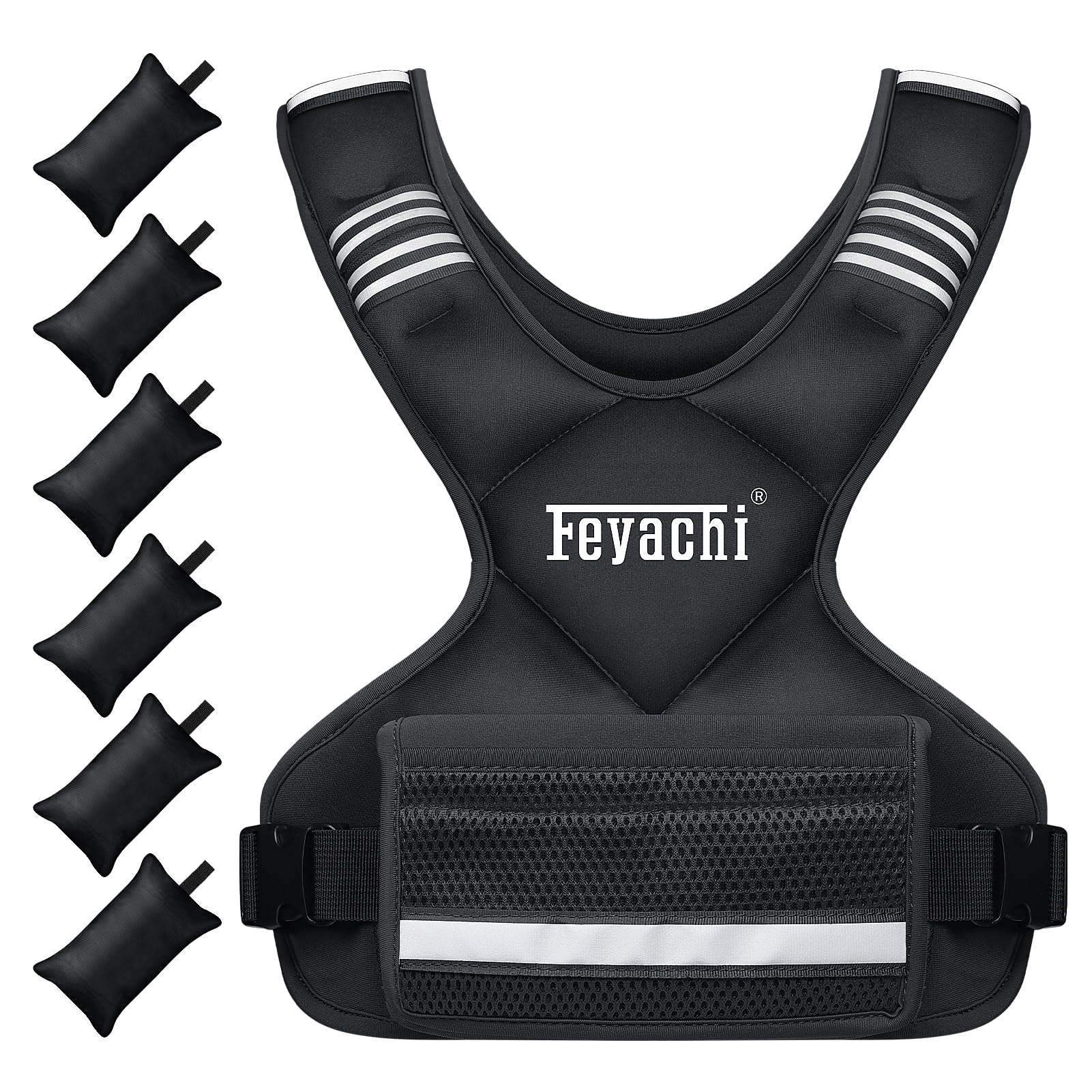
| Feyachi Adjustable Weighted VestBest for Low-Impact | Low-impact cardio | 3–12 lbs (up to 32 lbs by option) | Buckle | 6 removable iron sandbags | Amazon |
| Yes4All Adjustable Weighted Vest | Strength and walking | 11–20 lbs | Buckle | 6 iron sand packs | Amazon |
| Polyfit Fortify Weighted Vest | Rucking and runs | 40 lbs capacity (plates sold separately) | Hook and Loop | Plate-loaded, front and back | Amazon |
| BAGAIL Adjustable Weight Vest | Progressive strength | 2–20 / 2–30 / 2–40 lbs | Buckle | 2.5 lb iron blocks | Amazon |
| Hyperwear Hyper Vest FIT | Women’s walking | 1–10 lbs | Lace-Up, Zipper | 0.5 lb steel shot | Amazon |
| EVERLIT Adjustable Weighted Vest | Tactical training | 14 lbs / 20 lbs (option dependent) | Hook | Accepts multiple plate sizes | Amazon |
| MVRK Weighted Vest | Heavy rucking | 15 / 25 / 35 / 45 / 65 / 100 lbs (option dependent) | Buckle | 35 lb with removable weights | Amazon |
Detailed Reviews
1. CROSS101 20LBS – 140LBS Adjustable Weighted Vest
Our pick — 4.5+★ from 750+ verified ratings; the strongest balance of quality and price.
The 21-pound camo workhorse that scales from a light warm-up to a serious loaded carry
The number that defines this vest is its range: the CROSS101 line runs from 20 LBS up to 140 LBS depending on the option you choose, and every item ships with its weights included. Most vests cap out well below 140 lbs, so you can keep adding load as your training grows instead of buying a second vest. The nylon shell and hook closure keep the whole thing simple to strap on.
Build quality is what wins people over here — reviewers single it out more than any other trait. You feel it in the reinforced shoulder pads, which spread the load across your upper back instead of digging into your collarbones. Every model lets you remove the weights, so you can strip a heavy vest back to a lighter session. The vest is built for cross-training and CrossFit-style circuits, and its secure weight retention (the load stays put) suits that fast, varied movement.
The honest trade-off is seam durability. Plenty of training sessions go by without issue, but some long-term buyers report the fabric gave way within the first handful of uses. Compare its 21-pound starting weight to the Yes4All’s 11 pounds and you can see why — this is a heavier build carrying more load. Treat the stitching as the wear point and inspect it as you go. That extra heft buys the 140-pound load ceiling. With 750+ ratings and a 4.5+ star score, it’s also the crowd favorite of this group.
Where it wins you over
- Load ceiling of 20–140 LBS across the range means years of headroom
- Weights arrive included and are removable on every model
- Shoulder pads spread pressure so heavy sessions stay bearable
- Hook closure keeps the load locked through cross-training moves
Where to tread carefully
- Seam durability is the recurring wear point under heavy load
- At 21 pounds it opens heavier than most starter vests
- Camouflage finish won’t suit everyone’s taste
Reach for this if: you want one vest that can grow with you from moderate circuits to genuinely loaded training.
Inspect before you load it: check the stitching around the shoulder seams after heavy sessions, since that’s the part that wears.
2. WANOON Weighted Vest
No bags to fuss with — just strap it on and walk out the door
This is the pick for someone who wants zero setup. It’s a fixed-weight vest — you choose your load when you buy, from 8lb up to 40lb, and that’s the load you wear. No sandbags to insert, no plates to seat, nothing to re-tighten mid-walk. The heavy iron sand filling is odorless and the loom blend nylon shell wipes down easily.
Comfort is the thing buyers talk about most, and the anti-slip shoulder pads are a big part of why — they stop the straps from creeping and rubbing on longer sessions. The breathable mesh back helps airflow during HIIT, and the 360° reflective strips make it a sensible choice for early-morning or evening walks near traffic. There’s a secure phone pocket for your keys and cards too.
Stability is the split verdict: some wearers report it holds steady, others find it drifts back during certain movements. Note the maker’s own starting guidance — keep added weight under 10% of bodyweight as a beginner, which means a 150 lb wearer should stay at 15 lb or less. It’s a sensible rule to follow rather than load up too fast.
Why walkers like it: the fixed weight kills the faff — one strap-in and you’re out the door, with reflective strips covering the low-light safety angle.
The fit note to know: if you’re between sizes, size down — the adjustable buckle straps need a snug starting point to hold the load back where it belongs.
Good match for: newer walkers, joggers, and ruckers who want a set load and a simple buckle-up routine.
Look elsewhere if: you plan to progress your load over time — a fixed vest means buying a heavier one later.
3. Feyachi Adjustable Weighted Vest
Starts at 3 pounds and climbs in 1.5-pound steps — the gentlest ramp into loaded training
Feyachi’s X-type design starts at 3 pounds and climbs to 12 pounds with six 1.5-pound removable iron sandbags, with 12–20 and 20–32 lb options in the wider range. For comparison’s sake, the Yes4All tops out at 20 lbs while this one reaches 32 — a genuinely larger ceiling for anyone thinking long-term. That 3-pound floor is the real hook: it lets a total beginner start almost demand-free and add resistance in small, safe increments.
Adjustability is the most-praised aspect here, and the adjustable side straps are the reason — they let you cinch the vest down to your torso so it stays snug instead of hanging. The soft neoprene shell and iron sand fill are built to handle running, cycling, yoga, and strength work alike. Reflective strips sit on the front, shoulders, and back, and a roomy front pocket takes your keys and phone. Feyachi also markets it for posture and back support during training.
One quirk to know: because the sandbags are handcrafted, the actual weight can vary by up to 0.5 lbs from the stated figure. That’s not a dealbreaker unless you’re logging exact loads. Ease of use draws mixed feelings — some find it quick to suit up, others want a simpler strap system.
The load story
- Starts at 3 lbs — one of the few truly beginner-friendly floors
- Six 1.5 lb sandbags let you fine-tune resistance precisely
- Adjustable side straps keep it snug without bouncing
The catches to weigh
- Handcrafted sandbag weights can drift by up to 0.5 lbs
- Ease-of-use feedback is mixed on the strap setup
Worth picking up if: you’re easing into loaded training and want small, precise weight steps from a near-zero start.
Skip the assumptions: current models and what you actually get are the moving parts here — check which weight option you’re ordering, because the range spans 3–12 up to 20–32 lbs.
4. Yes4All Adjustable Weighted Vest with Reflective Strip

Six weight packs and two big pockets turn a strength vest into a proper session bag
Fit is what sells the Yes4All — it’s the trait reviewers bring up most, and it comes from the adjustable webbing and buckled straps that let you snug it down to your torso. The 11–20 LBS range covers strength training, walking, hiking, and cardio without you swapping vests. Iron sand weights sit in six packs that stay put during movement, so you’re not chasing the load every couple of minutes.
Storage is where it punches above most of the field: six weight packs plus two large net pockets give you real room to carry essentials mid-workout. Breathable fabric keeps it sweat-absorbent, and reflective strips run across the front, shoulders, and back for low-light visibility. Add or remove weights as your session demands and you’ve got a pretty flexible training tool for both men and women.
There are two honest fit notes. Seams have been known to give on some units after a few uses, so inspect them on arrival. And several buyers find it’s not the pick for small frames — the size feedback leans toward the roomier end, so if you’re on the smaller side, brace for a looser fit until you cinch it down hard. As a comparison point, its 11-pound starting weight against the CROSS101’s 21 pounds makes it the friendlier of the two to swing at first.
Storage win: the six weight packs plus two large net pockets beat most rivals on carrying room without adding bulk.
Frame check: the size feedback says it runs roomy — for smaller wearers, plan on tightening the webbing straps all the way down.
Choose it when: you want a genuinely adjustable vest with pockets big enough to actually use during a session.
Think twice if: you’re petite — the roomy cut is the recurring fit complaint, so measure up before committing.
5. Polyfit Fortify Weighted Vest

A plate-loaded shell that all but disappears during runs and bodyweight work
The Fortify is built around plates rather than sandbags — one pocket in front, one in back, each holding up to 20 lbs for 40 lbs total capacity. It fits Polyfit plates and most standard vest plates up to 13″ x 11″, so you’ve got options if you already own a set. Load splits front-to-back, which is the balanced approach most ruckers want.
Stability is the standout here — what wins people over is how the interior straps lock plates tight, so the vest doesn’t bounce during runs, rucks, or workouts. The build quality draws praise too, from the hook-and-loop closure to the 600D nylon shell (a heavy-duty woven fabric) and reinforced stitching. It’s also genuinely light and mobile, giving you full range of motion for calisthenics and strength work.
One important caveat: weight plates are sold separately. You’re buying the vest, so the load is on you. That said, the adjustable shoulder straps and stretch waist belt make it quick to put on and take off. Padded straps and breathable mesh keep pressure and heat down on longer sessions. Waistband and chest pockets hold small essentials. If you already own plates, this is among the most flexible platforms in the group.
What stands out
- 40 lb capacity split front and back for balanced carry
- Interior straps lock plates tight — bounce-free through runs
- 600D nylon shell with reinforced stitching holds up
- Fits most standard plates up to 13″ x 11″
What to plan around
- Plates are sold separately — budget for those too
- Lightweight design means the load is entirely plate-dependent
Pick the Fortify if: you already own plates or don’t mind sourcing them, and you want a mobile vest for runs and bodyweight circuits.
Hold off if: you want everything in the box — plates in a front-and-back split add real cost on top of the vest.
6. BAGAIL Weighted Vest
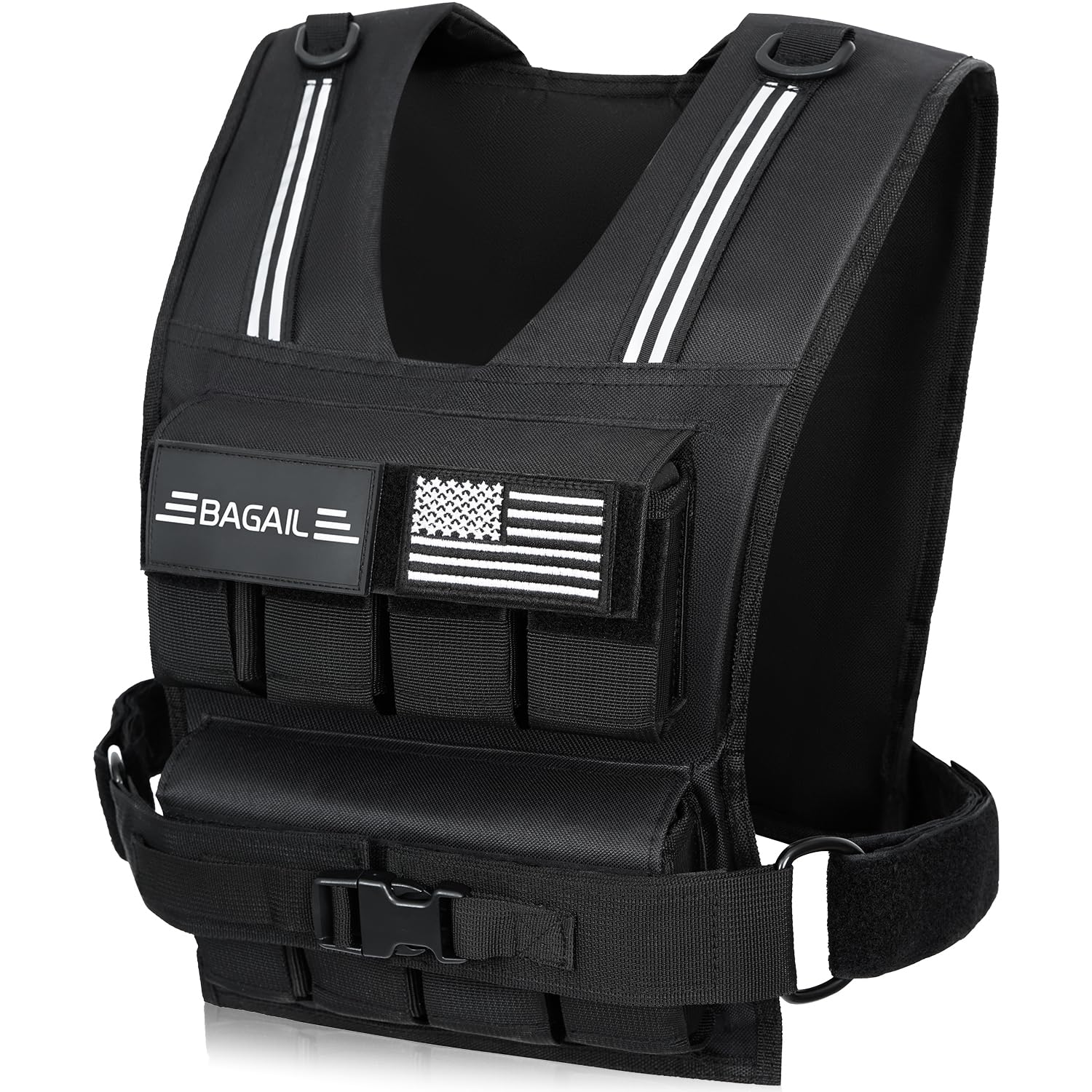
1200D Oxford nylon and 2.5-pound iron blocks make this the load-it-and-forget-it option
The BAGAIL’s shell is the headline: 1200D Oxford nylon (a tightly woven, abrasion-resistant fabric) with reinforced stitching, designed to shrug off sweat and wear. That 1200D Oxford nylon is the toughest fabric in this group. The 2.5-pound iron blocks are rust-resistant and let you scale in precise steps — 2–20 lbs with 8 blocks, 2–30 lbs with 12, and 2–40 lbs with 16. That’s a wide spread of options, each with a clean progression.
Versatility is what the vest is known for most — it’ll handle walking, running, rucking, HIIT, gym work, yoga, and functional training without complaint. The fit is built for comfort over the long haul: extra-thick shoulder pads, an adjustable waist belt, wide hook-and-loop straps, and safety buckles all work together to keep the load firm but flexible. Reflective strips on the front and back keep you visible in low light.
The follow-up question most buyers have is cleaning, and the answer is a plus — it’s washable, so you can keep it fresh instead of watching odor build up. Detachable logo and adjustable chest sizing mean it suits both men and women. The catch isn’t really the vest; it’s the price tier — this sits in the premium bracket, so you’re paying for the heavier-duty material and the block system rather than a bargain.
Material edge: the 1200D Oxford nylon shell is a step above the softer fabrics in this group, aimed squarely at longterm daily use.
Upkeep advantage: it’s washable, which most iron-sand vests are not — a real difference if you train hard and often.
Best suited to: high-frequency trainers who want a durable, washable vest and a fine-grained progression up to 40 lbs.
Consider the budget tier if: the premium fabric and block system aren’t must-haves for you — several cheaper picks cover basic walking and strength work.
7. Hyperwear Hyper Vest FIT Weighted Vest for Women

No weights over the chest, 0.5-pound steps, and it goes in the washing machine
The FIT is shaped specifically for women, and the design choice that matters most is what it leaves out: no weights over the chest, for comfort at any bust size. The load sits low on your torso instead of on your neck and shoulders, which is where men’s-style vests tend to press. USA steel shot fills 0.5-pound removable containers, so you can start at 1–2 lbs as a beginner and climb to 10 lbs without buying a new vest.
Three sizes cover petite through plus, and the performance stretch fabric plus elastic side lacing keeps it snug through running, jogging, rucking, HIIT, or jumping. The front zipper makes it quick on and off, and it’s thin enough to wear under a jacket or hoodie on cold walks. Reflective details cover early-morning or evening visibility. It’s machine-washable — pull the weights and toss it in — which beats the odor problem that plagues sand-filled neoprene vests.
The obvious limit is the ceiling: 10 lbs is the most this vest carries, so it’s a walking and light-training tool, not a heavy rucking platform. If you want to load up toward 30 or 40 lbs, look at the BAGAIL or MVRK instead. For neighborhood walks, stairs, and low-impact routines, though, the gentle 0.5-pound progression and the women-specific cut are a combination nothing else here matches.
Built around the fit
- No weights over the chest — comfortable for every bust size
- 0.5 lb steel-shot increments from 1–2 lbs up to 10 lbs
- Machine washable, so odor doesn’t build up
- Three sizes, petite to plus, with a slim zip-up profile
Where the ceiling sits
- 10 lb maximum — not a heavy-load vest
- Built for walking and low-impact work, not maximal lifting
Made for: women who want a low, comfortable carry for walking, hiking, and stairs with a slow, safe weight progression.
Not the one for: heavy rucking or maxed-out strength work — those need a vest with a higher load ceiling.
8. EVERLIT Adjustable Weighted Vest 14 Lbs / 20 Lbs
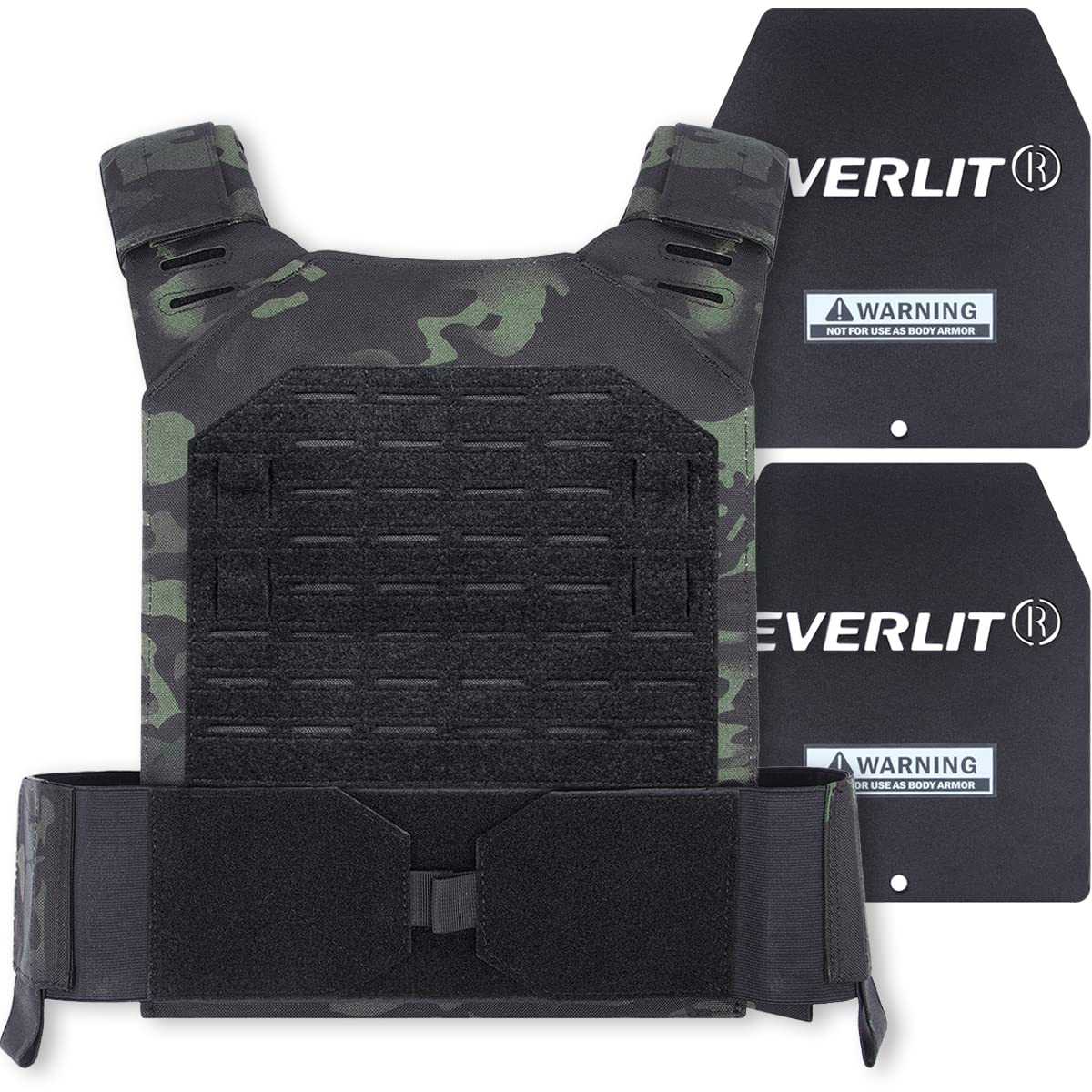
MOLLE panels on both sides let you build this vest out like a plate carrier
If you like your training gear tactical, the EVERLIT is the obvious pick. It’s built from 1000D nylon (a dense, heavy-duty fabric used in load-bearing military gear) and comes with laser-cut MOLLE panels front and back — the grid webbing system for clipping on pouches, patches, and lights. Those MOLLE panels let you clip on pouches, patches, and lights that most weight vests can’t carry. It’s available in 14 lb or 20 lb options, with weights included.
Quality is the strongest theme — reviewers consistently rate the build as solid, and the fully adjustable padded shoulder straps plus cummerbund let you dial in a contoured fit that stays tight during movement. The mesh padding works to even out weight distribution across your body while you train, and the cummerbund style wraps your waist for stability. Elastic side pockets hold a phone or personal items.
Two honest snags to weigh. Some users have had the weight plates work loose and drop out, so check that plates are properly seated before you start moving. A few also note the vest can bounce during certain activities. Both are the kind of thing a proper plate fit and a snug strap-down solve — just don’t skip that step.
Carry flexibility: the laser-cut MOLLE panels front and back let you attach pouches, patches, and lights wherever you want them.
Setup note: plate retention has been an issue on some units — make sure your plates are fully seated and strapped before training hard.
Ideal for: tactical and cross-training setups where you want to add pouches and gear to a weighted vest.
Worth knowing: with weights included and a cummerbund fit, it’s a solid value in the premium bracket if the MOLLE layout suits your training.
9. MVRK Weighted Vest

A 35-pound rucker with a load ceiling that climbs all the way to 100 pounds
MVRK goes where most vests in this article won’t: the range runs from 15 lbs up to 100 lbs depending on the option. The 35-pound model ships loaded, with removable weights so you can scale down to match your training level and goals. The compact design is the clever part — it packs a lot of weight into less bulk, so you keep your range of motion instead of waddling around like a weighted bear.
The construction leans into the heavy-load job: reinforced stitching at every stress point, heavy-duty buckles rated for the load, and sweat-resistant materials meant to hold up through long rucks. Nylon shell, buckle closure, and an evenly distributed weight layout for a secure fit. It’s the pick for calisthenics, HIIT, and serious rucking where a light vest just won’t cut it.
The catch is upkeep and comfort at the top end. Hand-wash only — remove the weights, wash with soap, hang to dry — so it’s not a machine-clean vest like the BAGAIL or Hyperwear. And a 35-pound-plus carry is a serious load that’ll take some building up to, so it’s not a beginner’s first vest. If you’re already rucking and want to load heavy, this is the tool.
Load ceiling: up to 100 lbs in the range, with the 35 lb model shipping loaded and restorable via removable weights.
The trade-offs: hand-wash care is a step more involved than machine-washable options, and the heavy carry demands you season into it.
Strap it on if: you’re rucking, doing calisthenics, or running HIIT and want a vest that carries serious weight without the bulk.
Look at a lighter tier first if: you’re brand new — building up to a 35-pound carry safely takes time and a lighter starting point.
Know the Specs
Load capacity and progression
Load capacity is simply how much weight the vest can carry, and it comes in two styles: fixed (one set load) or adjustable (removable bags, plates, or shot). Adjustable lets you progress gradually — the Hyperwear’s 0.5 lb steel-shot steps are easy on a beginner, while the MVRK’s 100 lb range suits someone already rucking heavy. Pick a ceiling with room to grow, or you’ll be re-buying sooner than you’d like.
Closure type and bounce
The closure is the mechanism that holds the vest to your body — buckle, hook-and-loop, or lace. Buckles lock solid and suit heavy loads; hook-and-loop is fast on and off but needs re-tightening as it warms; lace-up sides cinch close to the ribs. A snug closure is what stops the pull and bounce that ruins a session, so size your vest to allow a tight starting fit.
Weight placement
Where the load sits decides how your body feels an hour in. Front-and-back plate layouts (like the Polyfit) balance the carry; women’s-specific cuts (like the Hyperwear) keep weights off the chest and low on the torso. A vest that hangs on your shoulders will tire your upper body before your legs. Look at the pocket layout before you buy.
Fabric and care
Shell material affects both durability and how easy the vest is to clean. Heavy nylon grades like 1200D Oxford (BAGAIL) and 1000D nylon (EVERLIT) resist abrasion; iron-sand neoprene picks are often wash-limit. Machine-washable vests stay fresher with sweat, whereas hand-wash models demand a routine. Match care needs to how often you’ll train.
Common Questions
What weight weighted vest should I start with?
Is a fixed or adjustable weighted vest better?
Will a weighted vest fit a plus-size body?
How do I stop my weighted vest from bouncing?
Can I wash a weighted vest?
Are weighted vest weights interchangeable between brands?
Is a weighted vest good for rucking?
What is the maximum weight a weighted vest can carry?
Do weighted vests come with the weights included?
Can I wear a weighted vest for walking and jogging only?
The Bottom Line
For most people, the best workout weighted vest in this line-up is the CROSS101 Adjustable Weighted Vest. Its 20–140 LBS range and included removable weights give you real room to grow, and the shoulder pads keep heavy sessions bearable. Want a set-and-go vest with reflective safety for walking? Grab the WANOON Fixed Weight Fitness Vest. Kitting out for tactical training with a vest that takes pouches and plates? Reach for the EVERLIT Adjustable Weighted Vest. Whatever you choose, match the load to your training and cinch the straps down snug before your first set.
How we choose
We do not accept paid placement. Every pick is matched to a real buyer and a real use-case; we do not hands-on test units.
Sources
Specifications: manufacturer listings and product documentation. Review insights: verified customer reviews, as of November 2026. Pricing: not shown on this page (it changes often); check the current price via the retailer link.
As an Amazon Associate, Tactical Gear Guy earns from qualifying purchases. This does not affect which products we feature.