Specs are compiled from manufacturer listings and verified buyer reviews and can change over time — please confirm the key details on the product page before buying.
You want flat, even boards and you do not want to sand for a week to get them. The planer that does this cleanest for most home shops is the DEWALT DW735X. It pairs a 15 amp motor with a three-knife cutter head and two feed speeds, so you can trade surface finish for speed depending on the wood in front of you. Everything below is ranked on real specs and real owner experience, so you can pick the machine that fits your bench, your budget, and your board widths.
This guide is built by comparing the manufacturers’ published specifications and the patterns across verified customer reviews, so you get each pick’s real strengths and trade-offs instead of marketing spin.
Some planers fight you with snipe at the ends of every board, and some quietly eat a quarter inch per pass without complaint. The trick is matching cutter head type and feed speed to your wood, and this guide covers how to pick the right wood planer machine for the boards you actually run.
Top Picks


How To Choose The Best Wood Planer Machine
A planer does one job: it makes a board an even thickness from end to end. The machine you pick decides how much sanding comes after, how loud your shop gets, and how often you stop to rotate inserts or change blades. Three specs shape almost every decision — the cutter head, the feed speed settings, and the cutting width.
Cutter head type: straight knives versus spiral inserts
A straight-knife head uses two or three long blades that spin and slice the wood. A spiral head uses rows of small square inserts set at an angle, so each one takes a small shearing cut instead of one long slice. Spiral heads tend to run quieter and leave fewer tear-out marks on tricky grain, and you rotate a dull insert instead of replacing a whole blade. The trade-off is a higher upfront cost and more inserts to keep track of.
Feed speed and cuts per inch
Cuts per inch (CPI) tells you how many times the knives strike the wood as it passes through. A higher CPI means more, shallower cuts, which usually means a smoother board straight off the bed. Two-speed gearboxes let you drop to a slower feed for a finer finish on figured wood, or speed up for rough stock. If you plane a lot of hardwood with wild grain, the slow gear’s finer finish cuts your sanding time.
Width, depth of cut, and snipe control
Cutting width decides what boards fit. A 13-inch machine takes a standard board straight from the rack; a 12.5-inch machine leaves you trimming first. Depth of cut per pass sets how hard you can push — most benchtop planers list around an eighth of an inch. Snipe is the dip at the ends of a board where the cutter head lifts as the stock loses support. Carriage locks, long infeed and outfeed tables, and four-post heads all fight it.
Side-by-Side Comparison
| Model | Best For | Cutter Head | Cutting Width | Motor | Amazon |
|---|---|---|---|---|---|
| DEWALT DW735X★ Best Overall | Best overall for serious home shops | Three knife, two speed | 13 inches | 15 amp, 20,000 rpm | Amazon |
| WEN PL1326Best Value | Spiral finish on a mid-range budget | Spiral, 26 HSS blades | 13 inches | 15 amp, 10,000 rpm | Amazon |
| CRAFTSMAN CMEW320Compact Pick | Small projects and quick trim work | Two knife, solid steel | 12.25 inches | 15 amp | Amazon |
| DEWALT DW734 | Fine 96-CPI finish with long tables | Three knife | 12.5 inches | 15 amp, 20,000 rpm | Amazon |
| Cutech 40800H | Batch work with an 8-position depth stop | Spiral, 26 carbide inserts | 13 inches | Corded electric | Amazon |
| RIKON 25-135H | Repeatable thicknessing with two feed speeds | Helical, 26 HSS inserts | 13 inches | 15 amp | Amazon |
| Wahuda 60200PC-WHD | Long stock support with 45-inch extensions | Spiral, 4-sided carbide tips | 13 inches | 15 amp, 120VAC | Amazon |
| Cutech 40700H | Quiet spiral cutting for a small shop | Spiral, 6 rows of inserts | 12.5 inches | Corded electric | Amazon |
| WEN PL1252 | Entry-level planing with reversible blades | Two knife, SK5 blades | 12.5 inches | 15 amp, 20,000 cuts/min | Amazon |
| VEVOR Two-Blade 13″ | Wide boards on a tight budget | Two knife, solid steel | 13 inches | 15 amp, 2000W | Amazon |
| Makita 2012NB | Quiet jobsite planing at 83 dB | Disposable double edge | 11.86 inches | 15 amp-class portable | Amazon |
Detailed Reviews
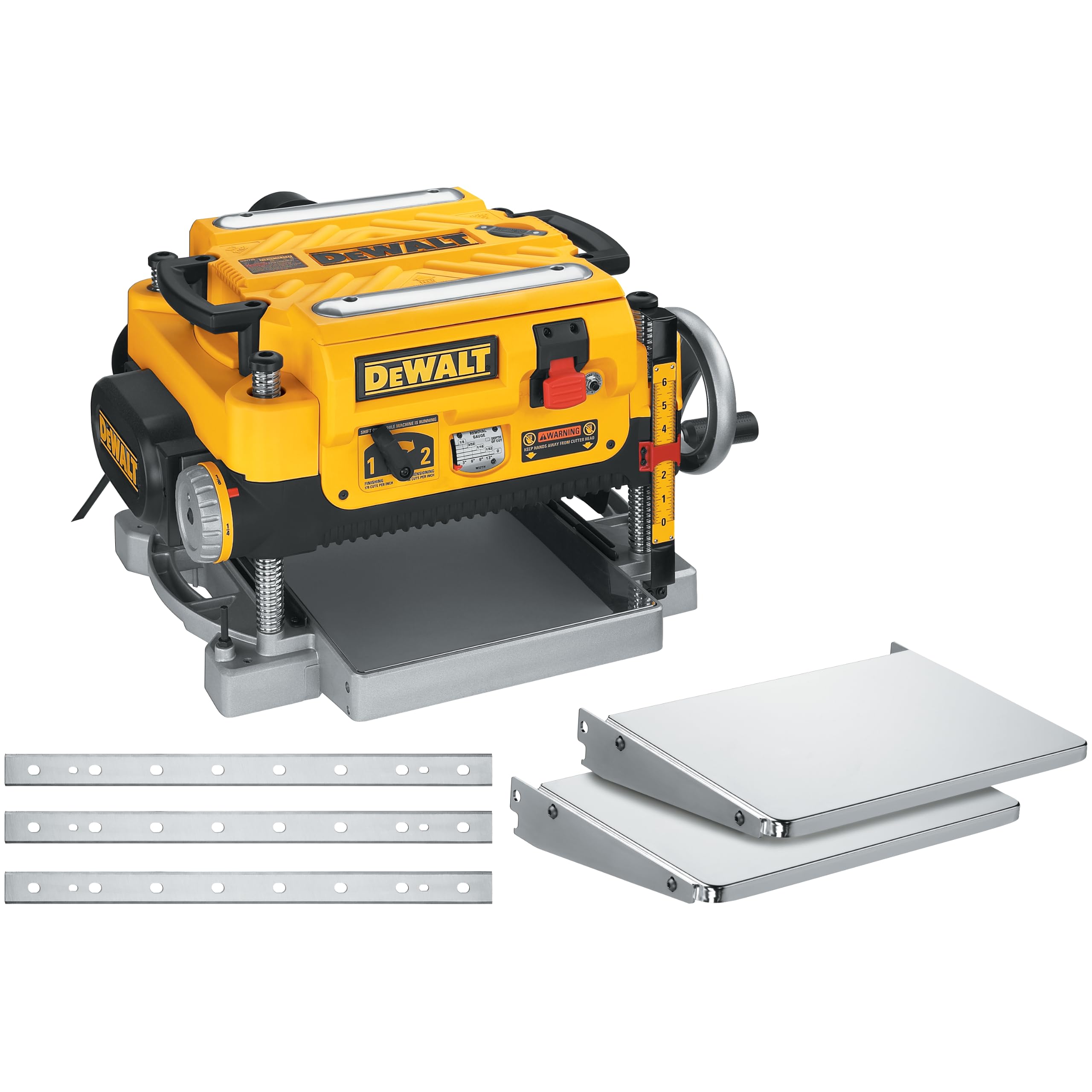
1. DEWALT Thickness Planer (DW735X)
Our pick — 4.5+★ from 7,500+ verified ratings; the strongest balance of quality and price.
The two-speed shop workhorse that turns rough stock into a sand-ready board.
What you get for a 102-pound machine is a 15 amp motor turning at 20,000 rpm with a cutter head speed of 10,000 rpm. That head holds three knives, and DEWALT rates the setup for 30% longer knife life than its single-life heads. The two-speed gearbox is the part that matters most day to day: you can run 96 or 179 cuts per inch, so a figured walnut board gets a fine, slow pass and a rough pine shelf gets a fast one.
The 19-3/4 in. cast aluminum base is built to be twice as rigid as a standard 10 in. base, and that stiffness is why boards come off flat instead of wandering. A fan-assisted chip ejection system blows chips off the cutter head and out of the machine, so you spend less time clearing the bed. An automatic carriage lock reduces the movement that causes snipe without you reaching for a lever, and the material removal gauge plus the extra-large thickness scale keep each pass honest.
The catch is weight and noise. At 102 pounds it is close to twice the 54 pounds of the VEVOR below, so this is a machine you build a permanent bench spot for rather than carry to a job. Owners describe the motor as loud enough to want hearing protection, and durability feedback runs mixed. None of that stops it being the planer most people should buy first.
What earns its place on the bench
- Two feed speeds give you 96 or 179 cuts per inch, so one machine covers rough and finish passes
- Three-knife cutter head rates for 30% longer knife life than a single-life head
- Automatic carriage lock cuts snipe without a manual lever
- Folding infeed and outfeed tables and an extra knife set come in the box
What you should know before it lands
- 102 pounds — plan a fixed home for it
- The motor runs loud enough that ear protection makes sense
- Durability feedback is mixed, so treat the knife changes as routine maintenance
Built for the busy home shop: anyone running board after board through a planer and wanting one machine that handles rough and finish passes.
The honest weight: if you need to carry your planer to a jobsite, the 54-pound VEVOR below saves your back.
2. WEN PL1326 15-Amp 13-Inch Spiral Benchtop Thickness Planer
Spiral-head smoothness without paying premium money for it.
The number worth starting with is 26 — that is how many staggered, rotatable HSS blades sit in the spiral cutter head. High-speed steel inserts shear the wood at an angle instead of slicing it in one long pass, so you get fewer torn fibers on the surface. A 15 amp motor turns 10,000 rpm at a 26 feet per minute feed rate, and the machine takes boards up to 6 inches thick and 13 inches wide.
An onboard material removal gauge shows the cut depth for each pass without guessing, which saves you wrecking a board by a sixteenth. The cast iron base gives it a planted feel, and at 36.74 kg it is substantially heavier than the CRAFTSMAN CMEW320 below at 27.71 kg — the kind of weight that keeps the machine from hopping on a heavy cut. Owners praise the build quality first, the functionality second, and several note the spiral head runs quieter than a straight-knife machine.
The spiral head is the reason this sits at the top of the mid-range. If you plane figured wood and hate tear-out, the insert layout is doing real work. It is not the lightest machine in this group, so give it a permanent spot rather than carrying it.
Where it shines: 26 rotatable HSS blades in a spiral head mean you rotate inserts instead of replacing a whole knife, and the 13-inch width takes a full standard board.
Reach for this if: you want spiral-head surface quality and 13-inch capacity without moving into the premium tier.
Look elsewhere if: your bench is cramped and you need a machine you can lift off a shelf between projects.
3. CRAFTSMAN 12.25 In. Benchtop Thickness Planer (CMEW320)
A smaller footprint that punches through trim and small stock without drama.
This one is built around a 12.25-inch cutting width — narrower than the 13-inch VEVOR, though its 27.71 kg body and 23.5″L x 17.5″W x 15.4″H frame make it the easier machine to slot onto a crowded bench. A 15 amp motor drives a solid steel two-knife cutter head mounted on ball bearings. The 8,000 RPM head delivers 16,000 cuts per minute, and the Poly-V cutterhead drive is set up for maximum stock removal per pass.
Knives are high carbon steel, double edged and reversible, so a nick on one edge just means flipping it over. A vacuum port takes a shop vac or dust collector, which keeps chips off the floor. Buyers praise the build quality first, then how well it handles trim and small stock — it is the planer people reach for on trim boards and quick jobs rather than full furniture runs.
The limitation is the width. At 12.25 inches it will not take a full 13-inch board without ripping it first, and snipe and adjustability feedback both run mixed. Both are manageable with a support stand and careful setup, but plan for them. Setup time is short and the machine is ready to plane soon after unboxing.
Small-shop reality: 16,000 cuts per minute out of a 8,000 RPM solid steel head, and reversible double-edged knives you can flip when they nick.
What to weigh: 12.25-inch width means trimming wide boards first, and snipe needs a support stand to tame.
Made for trim and small stock: anyone planing baseboards, cutting boards, and small project parts on a bench that has limited room.
Think twice if: you routinely feed full-width 13-inch stock and want zero trimming before the pass.
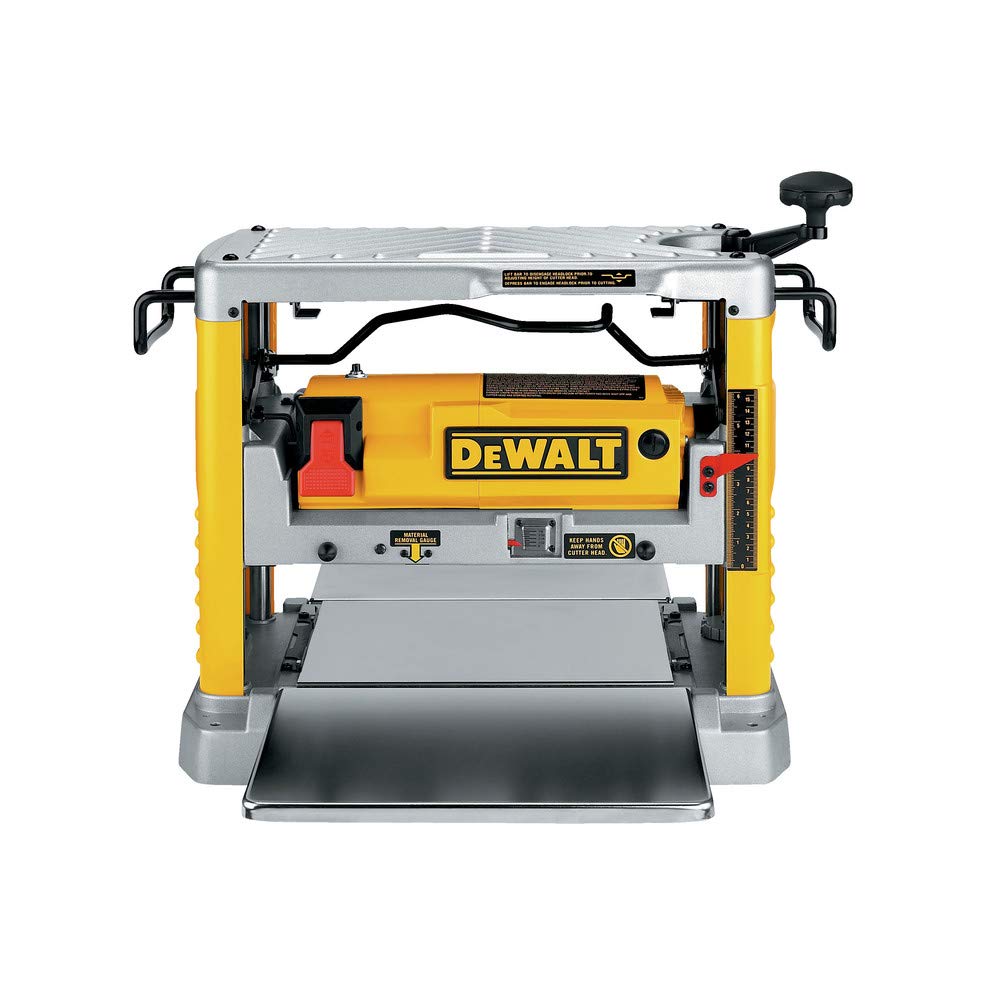
4. DEWALT Benchtop Planer (DW734)
The finish-pass specialist that leaves boards closer to final than anything at its size.
Here is the number that matters: 96 cuts per inch. A three-knife cutter head spinning at 10,000 rpm strikes the wood that often per pass, which DEWALT calls one of the finest finishes available on a portable planer. The 15 amp, 20,000 rpm motor has the torque to hold that finish through hard maple and oak. Four columns lock the carriage and cut the movement that causes snipe, and the extra-long infeed and outfeed tables give 33-1/2″ of material support.
Disposable, reversible knives give 30% more knife life than a single-life set, and swapping them is a quick job. The material removal gauge and extra-large thickness scale keep each pass accurate, and a turret depth stop lets you return to your most-used thicknesses without remeasuring. Owners reach for this on everything from soft pine to rosewood and ebony, and the surface quality is why so many shops keep it.
Unlike the 13-inch DW735X above, this one stops at a 12.5-inch cutting width, so a true 13-inch board needs a trim first. At 23.38″L x 16.52″W x 20.48″H it fits a bench without eating the whole thing, and the 12.5-inch width plus the 96-CPI finish still make it the easier grab for furniture-grade stock.
Worth the bench space
- 96 cuts per inch from a three-knife, 10,000 rpm head
- Four-column carriage lock fights snipe hard
- 33-1/2″ of infeed and outfeed support for long stock
- Reversible knives rated for 30% more life
The trade-offs to accept
- 12.5-inch cutting width, so wide stock needs trimming
- Snipe and dust collection feedback both run mixed, so add a support stand and a decent vac
Pick it for the finish: furniture makers who care more about a board coming off the bed close to sand-ready than about maximum width.
Consider the alternative if: you plane full 13-inch stock and would rather not rip it down first.
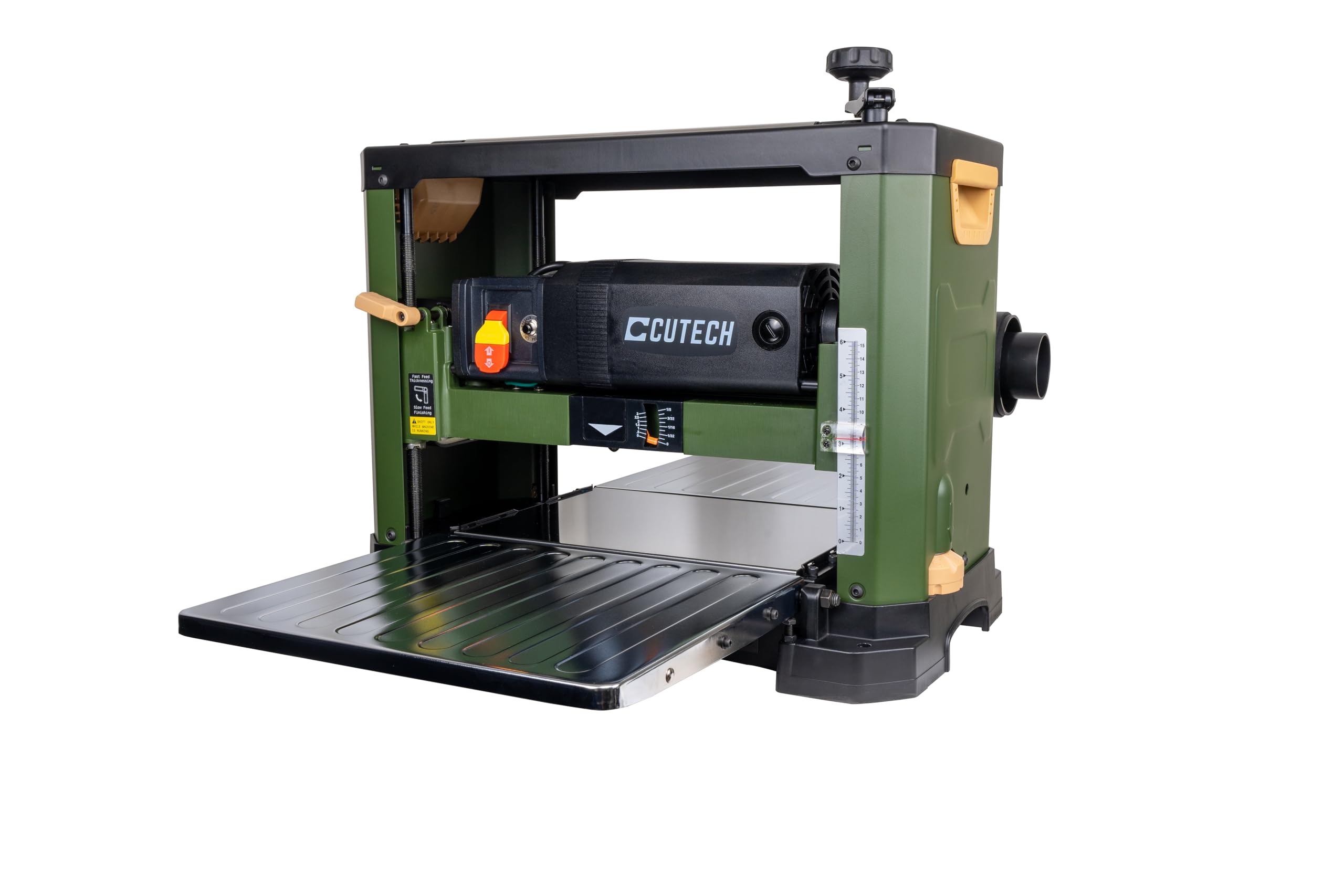
5. Cutech 40800H 13-Inch Spiral Cutterhead Planer (2-Speed)
A 13-inch spiral head built for batches of boards that all come out the same thickness.
The repeat cut depth stop is the star here. With eight positions you set a thickness once and feed board after board to the same dimension without measuring each one. A 13-inch cutting width takes a full board, and the spiral cutter head carries 26 tungsten carbide inserts across 6 rows. Max rotational speed is 10,000 rpm, and depth of cut goes to 0.25 inches.
The 2-speed feed rate matters for figured wood. Drop to 16 fpm and the slower pass reduces tear-out on boards that would otherwise chip out. Inserts are two-sided and sit in perfect alignment with the head, with a non-cutting edge designed to stop them skewing while planing — Cutech rates that precision above four-sided inserts. The patented 4-lead-screw coupling design tackles snipe automatically, and board return rollers on top send stock back for the next pass without walking around the machine.
Where it earns its keep is batch work and harder species, where the repeat stop and carbide inserts pay off. Where it asks patience is price tier — this sits in the premium range, and the value only shows once you are running enough boards to use that repeat stop. If your output is two boards a weekend, the WEN PL1326 keeps more money in your pocket.
The batch-work advantage: an 8-position repeat cut depth stop plus a two-sided insert head means consistent thickness across a whole run.
Best for repeat runs: a woodworker planing batches of parts to identical thickness on hardwood or figured stock.
Harder to justify if: your projects are one-off boards where an 8-position stop never earns its keep.
6. RIKON 25-135H 13-Inch Planer

Six rows of rotatable inserts tuned for repeatable thickness, board after board.
Start with capacity, because this one is generous: 13-inch width, stock up to 6 inches thick, and up to 1/8 inch of depth of cut on boards 6 inches wide or less. The six-row helical-style head carries 26 two-edge HSS inserts, and when an edge dulls you rotate it — no full blade change, no fiddly re-alignment. Two feed speeds at 16 or 26 SFPM let you trade material removal speed for surface finish on different jobs.
Setup stability is where the design shows. A threaded 4-post head support, depth gauge, thickness scale, and repeat-cut control all work together so stock comes out at the same thickness run after run. Setup itself is quick from the start, and the finish off the bed draws comparisons to a 150 grit sanded surface. Dust collection hardware is included: a dust hood plus a 4 in. to 2-1/2 in. adapter that fits common collectors and shop vacs.
The honest snag is table adjustability. The infeed and outfeed tables cannot be adjusted, which a few owners find frustrating when tuning for snipe. It buys you a rigid, fixed setup in exchange. At 67.9 pounds it is a two-person lift onto the bench, but once it is settled it stays put.
Why it holds thickness: 26 two-edge HSS inserts across six rows plus a repeat-cut control mean each board after the first comes out matching.
The fixed-table trade-off: tables do not adjust, so snipe tuning lives in your support setup rather than the machine.
Built for consistency: shops that need board after board at the same thickness and want rotatable inserts instead of throwaway blades.
Only a fit issue: if you like to micro-adjust tables for snipe, the fixed design will not let you.
7. Wahuda Tools 13″ Planer

The long-table machine that keeps a full-length board level from end to end.
Table length is the reason to look at this one. Pull-out extensions carry the table to 45 inches of total length, which is the most support here — well beyond the RIKON’s fixed tables — and that length directly reduces the dip at the ends of a long board. It takes 13-inch width and 6-inch thickness with a 1/8-inch maximum depth of cut, and an 8-position preset depth stop locks in your common settings.
The cutter head uses 4-sided carbide inserts, which are cost-effective and easy to maintain: rotate or swap an insert when it dulls rather than replacing a blade. A 15 amp, 120VAC motor drives the pass, and two speeds — 26 fpm for fast thicknessing, 18 fpm for a slower, smoother cut on figured stock — let you choose the finish you want. A 4″ to 2-1/2″ dust port adapter comes in the box, and at 77 lbs it is movable around a shop without a hoist.
The catch is the base material rather than the engine. Cast iron gives the machine planted weight, but moving it around regularly takes more effort than a lighter bench machine. It is a premium-tier machine built for long stock, and that is the honest reason to choose it over the simpler picks.
Where the 45 inches pay off
- 45 inches of total table length for long-stock support
- Two speeds at 18 or 26 fpm for finish vs. throughput
- 4-sided carbide inserts you rotate instead of replacing
- 8-position preset depth stop for repeat thicknesses
The cost of the extra length
- 77 lbs and cast iron means it is built to stay put rather than move around
- Premium-tier spend that only makes sense if long boards are routine
For long stock: anyone feeding boards longer than a bench machine comfortably supports and wanting the bed to hold them flat.
Only if length matters: short-stock planing never uses the 45-inch table, and a compact pick gets the same result for less.
8. Cutech 40700H 12½-Inch Spiral Cutterhead Benchtop Planer

Six staggered insert rows that cut quietly and leave a beginner-friendly surface.
A spiral head with 6 rows of staggered inserts is the whole story here. Staggered inserts shear the wood rather than slice it in one long pass, so the machine runs quieter and leaves a smoother finish — an advantage for a shop where noise carries. The two-sided inserts sit in perfect alignment with the head, with a non-cutting edge that stops them skewing, and the design uses in-house made inserts for the lowest amp draw compared to alternatives.
Snipe control comes through four lead screws and a patented coupling design that minimizes the dip at board ends automatically — you do not add a separate snipe lock to get the same result. Board return rollers on top send stock back to the front for the next pass, and a depth of cut indicator on the front shows what the next pass will take off. The head spins up to a maximum of 10,000 rpm.
The one spec to weigh is width: 12.5 inches, narrower than the 13-inch Cutech 40800H above, so a full-width board needs trimming first. At this rating and build it is a strong bench machine for the money, and the spiral head is why the surface comes off clean.
The quiet-cutting angle: 6 rows of staggered two-sided inserts reduce noise and smooth the cut without an extra snipe lock.
Best for a quiet bench: a home woodworker who wants spiral-head finish and less noise and has not committed to full 13-inch capacity.
The width limit: 12.5-inch cutting width means trimming a full-width board before it fits.
9. WEN PL1252 12.5-Inch Planer

The entry ticket to planing, with reversible blades and a fast 20,000-cut motor.
Two reversible 12.5-inch SK5 blades keep the blade cost down and let you flip an edge when it dulls. A 15 amp motor generates 20,000 cuts per minute at a 26 feet per minute feed rate, and the machine takes boards up to 6 inches thick and 12.5 inches wide. Depth of cut adjusts anywhere from 0 to 1/8 inch per pass, which is the standard pass for a benchtop machine and easy to control.
The 29.03 kg cast iron base gives it enough planted weight to stay steady on the bench. Buyers complete six cutting boards in under an hour with it, which tells you the workflow is fast enough for real output. Value for the cost is one of the strongest things about this machine, and softer woods like cedar come off with a smooth finish.
Two things to know before you commit: a straight two-knife head is noisier than a spiral and leaves more tear-out on wild grain, and the durability feedback runs negative on one point — the blades can chip. Treat blades as a consumable and buy a spare set, and this machine will do honest work for the money.
Entry-level done right: two reversible SK5 blades and a 15 amp motor at 20,000 cuts per minute keep this a low-cost way to get into thicknessing.
Plan for blades: a two-knife head means blade chips are the recurring cost, so buy a spare set early.
Best entry point: a first planer for cutting boards and stock that fits a 12.5-inch width, priced to start without a big commitment.
For gentler grain: if you plane figured wood, a spiral head like the WEN PL1326 beats a two-knife machine.
10. VEVOR Thickness Planer, Two-Blade, 13″ Width Benchtop Planer

Thirteen inches of width and a long feed table at a budget-aware tier.
The 13-inch widened worktable is the headline: it takes boards up to 6 inches thick and 13 inches wide, and the adjustable pull-out extensions bring total table length to 35 inches for better support on long stock. A precision machined cast iron bed keeps boards flat as they pass. At 54 pounds it is 48 pounds lighter than the DW735X above, which makes it the machine you can actually carry to a project.
The solid steel two-knife cutter head is quick-change, and after quenching and hardening it reaches a hardness of HRC55-60 — hard enough that it should hold an edge through steady use. A built-in 20A over-current protector cuts power automatically if total current exceeds 20A, which is a safety net for a machine fed by a shop circuit that also runs a vac. A vacuum port takes a shop vac or collector to pull chips off the cutter head.
Material removal feedback runs mixed, so keep passes conservative rather than hogging off the maximum. Buyers report it handles trim, baseboards, and charcuterie boards well, which is exactly the shape of work it was built for. It is not a furniture-run machine, and the two-knife head will leave more surface work than a spiral.
What the money buys: a 13-inch cast iron bed, 35 inches of total table support, and a 20A overload cutout that turns off the machine if current exceeds 20A.
The value call: a first planer or a jobsite machine for trim and baseboards where 13-inch width matters more than premium trim.
Skip it for: fine furniture runs that need spiral-head surface quality, since the two-blade head leaves more sanding.
11. Makita 2012NB 12″ Portable Planer

The jobsite planer that keeps the noise down and the blade swaps quick.
A noise rating of 83 dB is the standout spec. Most benchtop planers are loud enough that you want ear protection, and this one is built to be the quietest in its class. A 4-post design with diagonal cross supports gives the machine stability, and large table extensions support the workpiece on either side. The cutting width is 11.86 inches, the narrowest on this list, so it takes standard stock rather than full-width boards.
Blade changes are engineered for speed — disposable double-edge blades drop into a system designed for quick swaps, which matters on a jobsite where downtime is money. The machine is compact and lightweight for carrying between jobs, and the base is aluminum rather than cast iron to keep it that way. At 28.07 kg it is a real carry but far easier to move than a 67.9-pound bench machine.
The trade-off is capacity and durability. 11.86 inches will not take a full 13-inch board, and while build quality holds up, some owners mention tear-out on highly figured wood — the usual result of a straight-blade head on tricky grain. For dimensional lumber and trim on the go, the noise and portability are the whole reason to buy it.
Where it leads: 83 dB is the lowest noise rating here, making this the planer for a job where the machine runs near living space or in a garage with the door open.
For the jobsite: anyone moving between jobs who needs quick blade changes, low noise, and easy transport more than full 13-inch capacity.
Know the limits: 11.86-inch width and tear-out on highly figured wood mean it is not a furniture-shop finisher.
Know the Specs
Cutter head: straight knives vs. spiral inserts
A straight-knife head uses two or three long blades to slice the wood in one pass. A spiral head uses rows of small inserts set at an angle, so each takes a small shearing cut. Spiral heads tend to run quieter and leave fewer tear-out marks on figured grain, and a dull insert rotates instead of a whole blade being replaced. The trade-off is upfront cost and more inserts to track.
Cuts per inch and feed speed
Cuts per inch (CPI) counts how many times the knives strike the wood as it passes. More cuts at a shallower depth usually means a smoother surface straight off the bed. A two-speed gearbox lets you slow the feed for a finer finish on figured stock or speed up to remove material faster. Machines like the DW735X list 96 or 179 CPI to cover both jobs.
Snipe and how to cut it down
Snipe is the dip at the ends of a board where the cutter head loses support as the stock enters or leaves. Carriage locks, long infeed and outfeed tables, and four-post head designs all fight it. The DEWALT DW735X uses an automatic carriage lock, the Cutech 40700H and 40800H use a patented coupling design, and table length on the Wahuda extends to 45 inches for long-stock support.
Cutting width and depth of cut
Width decides what fits. A 13-inch machine takes a standard board straight off the rack; a 12.5-inch or 11.86-inch machine means trimming first. Depth of cut per pass sets how hard the machine works — most benchtop planers list around 1/8 inch, while the Cutech 40800H lists 0.25 inches. Pushing a lighter machine beyond its listed pass depth causes strain and rough surfaces.
Common Questions
What is the difference between a straight-knife planer and a spiral cutterhead planer?
Will a 13-inch planer take a full-width board without trimming?
What causes snipe on a benchtop planer and how do I reduce it?
How many cuts per inch do I need for a smooth finish?
Can I hook a shop vacuum up to these planers for dust collection?
How much does a benchtop planer weigh and can one person move it?
Is a spiral cutterhead worth the extra cost over a two-knife head?
How deep a cut can a benchtop planer take in one pass?
Why is my planer loud and is there a quieter option?
Can I planer a board wider than the cutting width by flipping it?
What warranty do these benchtop planers come with?
The Bottom Line
For most home shops, the best wood planer machine here is the DEWALT DW735X — 15 amps, three knives, and a two-speed gearbox that gives you 96 or 179 cuts per inch in the same machine, backed by a strong owner reputation. If you want spiral-head smoothness without the premium tier, the WEN PL1326 puts 26 rotatable HSS blades in a 13-inch head and keeps the money in your pocket. And if your boards routinely run long, the Wahuda with 45 inches of table support is the machine built to keep them flat.
My one honest nudge: if you plane figured wood, do not write off the spiral-head machines to save a little — the surface coming off the bed is where the money goes. The Cutech 40800H and RIKON 25-135H both give you rotatable inserts and a slower finish speed, and that slower finish pass is what turns sanding time into project time.
How we choose
We do not accept paid placement. Every pick is matched to a real buyer and a real use-case; we do not hands-on test units.
Sources
Specifications: manufacturer listings and product documentation. Review insights: verified customer reviews, as of November 2026. Pricing: not shown on this page (it changes often); check the current price via the retailer link.
As an Amazon Associate, Tactical Gear Guy earns from qualifying purchases. This does not affect which products we feature.