Specs are compiled from manufacturer listings and verified buyer reviews and can change over time — please confirm the key details on the product page before buying.
If you are tired of nicking your forearms on the sharp tail of a cut zip tie, the fix is a tool that cuts the tail dead flat against the tie head. A proper zip tie cutter does two jobs at once: it squeezes the tie to the tension you want, then trims the tail flush with no jagged stub left standing. That flat cut is what separates a clean bundle from one that scratches your forearm every time you reach into the panel.
This guide is built by comparing the manufacturers’ published specifications and the patterns across verified customer reviews, so you get each pick’s real strengths and trade-offs instead of marketing spin.
Below you will find cutters and tensioning guns split into two clearly different jobs, because the best pick for a harness bundle is not the same tool that trims a circuit board. Every pick here is judged on cutting capacity, flush quality, and how it feels during repeated cuts. A good zip tie cutter trims the tail flush with the tie head, so you can run a bare hand along the bundle without catching a stub.
Top Picks


How To Choose The Best Zip Tie Cutter
Your first decision is not brand or blade steel. It is if you need a tool that pulls the tie to tension and trims it in one squeeze, or a plain flush cutter that only snips off the tail after you have seated the tie by hand. Get that wrong and you will buy a gun for electronics work that needs a delicate nipper, or a nipper for a job that runs hundreds of ties a day.
Tensioning gun or plain flush cutter
A cable tie gun feeds the tie through a nose, pulls it to a set tension, and cuts the tail flush in one action. That is the tool for harness work, panel wiring, and any bundle where you need consistent tightness across dozens of ties. A plain flush cutter has no tensioning mechanism at all, so you seat the tie by hand and then trim. That suits small work, hobby builds, and repair jobs where a gun’s nose will not reach.
Cutting capacity and tie width
Capacity is the number that stops you buying the wrong tool. Guns in this list are rated for plastic ties up to 1/4 inch wide, while the hand cutters are rated in tie width and soft wire gauge. Match the rating to your widest tie, and give yourself a little headroom — a cutter working right at its limit dulls faster and cuts less flat.
Why flush beats sharp
A sharp blade is not the same as a flush blade. Flush means the cutting edge sits flat against the tie head so the trimmed end has nothing standing proud of it. A standard diagonal cutter shears the tail at an angle and leaves a spike. On a bundle you handle daily, that spike is the thing that catches skin and snags wire insulation.
Side-by-Side Comparison
| Model | Best For | Type | Cutting Capacity | Weight | Amazon |
|---|---|---|---|---|---|
| Tsunoda KBN-150★ Best Overall | Overall flush cut plus tightening | Pull & flush cut gun | Ties up to 0.31 in | 135 g | Amazon |
| DURATECH 8-Inch Zip Tie ToolBudget Gun | Budget tensioning gun | Tensioning gun | Ties 0.1 to 0.4 in | — | Amazon |
| HAUTMEC HT0317-PLTwo Jobs | Prying clips then trimming | Panel clip pliers | 7 in overall pliers | 0.15 kg | Amazon |
| Tsunoda TH-150NC | Clean trimming with lead catcher | Flush nipper | 0.16 in cutting width | 160 g | Amazon |
| Cable Tie Cutters (TR Industrial) | Pocket-size tail trimmer | Hand cutter | Nylon cable ties | 5.9 oz | Amazon |
| Smithology Micro Flush Cutters 3-Pack | Hobby bench and electronics | Micro flush cutter | Up to 20 AWG (0.8 mm) | 3.8 oz | Amazon |
| VAMPLIERS 4.75″ Precision Flush Cutters | Precision electronics work | Micro nipper | 14 mm cutting width | 71 g | Amazon |
| DataShark PA70076 | Delicate bundles and tubing | Tensioning gun | Ties up to 1/4 in | — | Amazon |
| Eastwood Professional Cable Tie Gun | Heavy daily gun work | Tensioning gun | Ties up to 1/4 in | 11.5 oz | Amazon |
Detailed Reviews
1. Tsunoda KBN-150 Zip Tie Cutter
Our pick — 4.5+★ from 850+ verified ratings; the strongest balance of quality and price.
The one-squeeze cutter that pulls a tie tight and trims the tail dead flat.
What makes the KBN-150 the pick here is that it does both halves of the job in a single tool. You feed the tie into the nose, squeeze, and the built-in grip section pulls it to tension before the blade trims the excess flush. That means no second tool, no hand-seating each tie, and no sharp stub left standing on the bundle. For anyone running harnesses or panel wiring, that one-motion action is the difference between a tidy loom and a row of ragged spikes.
The capacity is generous for a tool this compact. It handles cable ties up to 0.31 inch wide, and it also cuts soft iron 14 AWG, copper 10 AWG, stranded copper 10 AWG, brass 12 AWG, and plastic up to 4 mm. So this is not a zip-tie-only gadget — it can trim soft wire ends during the same wiring job. The body is iron with polyvinyl chloride handles, and the whole tool runs just 6 inches long and 135 g, which keeps it in a pouch rather than a toolbox.
What wins people over here is build quality — it is the most-praised thing about the tool by a wide margin, followed closely by how sharp it stays. The flush cut itself leaves nothing to catch on. It caps out at 0.31 inch, so it is not built for the widest heavy-duty ties. The crowd consensus is strong — 4.5+ stars across 800+ ratings — and it earns that score on the cut, not the marketing.
Where it pulls ahead
- Pulls to tension and flush-cuts in one squeeze, so no second tool is needed
- Handles ties up to 0.31 inch wide plus soft iron 14 AWG, copper 10 AWG, brass 12 AWG, and 4 mm plastic
- Just 6 inches long and 135 g, so it lives in a pouch
- Made in Japan, iron body, and the flush edge leaves no jagged tail
What to weigh first
- Hard grip type means heavy repetitive squeezing tires the hand
- Caps out at 0.31 inch tie width, so it is not for the fattest heavy-duty ties
- No adjustable tension dial — the pull is set by the mechanism
Reach for this if: you run cable harnesses or panel wiring and want tension and a flat trim from one hand tool.
Look elsewhere if: you regularly use ties wider than 0.31 inch or need a soft grip for all-day repetitive work.
2. DURATECH 8-Inch Zip Tie Tool, Cable Tie Gun
The full-size gun that covers the widest tie range here without stretching to a premium price.
If you want a tensioning gun but do not want to step up to the top of the market, the DURATECH is the value play. It swallows nylon ties from 0.1 to 0.4 inch wide, which is a wider range than the Tsunoda KBN-150’s 0.31 inch ceiling. And at 8 inches long versus the KBN-150’s 6 inches, the extra reach comes from a longer handle and nose that give you more leverage per squeeze. The work flow is simple: feed the tie in, press the handle to tighten to your chosen tension, then push the cutoff lever to shear the tail clean.
It is built for a working life, not a drawer. The body is alloy steel with a black powder-coated finish for rust resistance, and it is aimed at electrical work, industrial assembly, construction, and home cable management alike. Quality is the aspect buyers praise most, with value close behind, and a fair share of the discussion centers on how well it slices through thick tie material.
The honest caveat sits in the tightening mechanism. That part draws mixed feedback — some owners find it works smoothly while others hit a gripping plate that fails to grab the tie and let it slip back. Treat the tension setting as the fiddly part, not the cut. The cutting side is the strong half of the tool, and for the occasional bundle or home project it does the job without costing much.
Straight read: a wide 0.1 to 0.4 inch tie range in an 8-inch alloy steel body makes this the most flexible budget gun on the list, and the powder-coated finish stands up to garage and site use.
The honest trade-off: the gripping plate is the weak link — test your first few ties on scrap before you commit to a bundle.
Best for: home cable management, light site work, and anyone who wants tensioning power without a premium outlay.
Think twice if: you need guaranteed repeatable tension on a production line — the gripping plate is the least consistent part.
3. HAUTMEC 7 inch Panel Clip Removal Pliers
Pry the trim clip, then trim the zip tie, all from one pair of pliers.
This is the odd one on the list, and that is exactly why it belongs. It is a panel clip removal plier first — tapered nose, opening spring, high leverage — built to pry plastic rivets and fasteners out of car trim. But the same forged head carries heat-treated flush cutting blades that reach right to the tip, so it can also cut zip ties, cable ties, hose ties, soft metal wire, and plastic. For a mechanic or body-shop hand who already has one in the tray, that means one fewer tool to reach for.
The build is the draw. The head is forged from high carbon steel with a machine-polished surface and a rust-prevention coating, and the cutting edges are heat-treated and hardened, which the maker claims delivers up to twice the number of cuts. Over-molded ergonomic grips are shaped to stop your hand slipping and are made not to peel under heavy jobsite use. Speaking of size, the 7-inch figure in this plier’s spec is overall tool length, not a tie-width rating — quite different from the KBN-150’s 0.31 inch tie capacity. Read it as a full-size jobsite plier, not a delicate nipper.
Build quality is the thing that stands out to buyers, with value right behind it, and the general verdict is that it outperforms ordinary panel pry tools. The trade-off to plan around: a 0.15 kg plier with a tapered nose is made for trimming and prying, not for pulling ties to a set tension. You still seat the tie by hand. That makes it a bodywork companion rather than a dedicated harness gun.
Pick this one if: you do car trim and bodywork and want clip prying plus flush tie trimming from a single forged plier.
Skip it for: repeatable tension on hundreds of ties — this tool trims and pries, it does not tension.
4. Tsunoda TH-150NC Flush Cutters
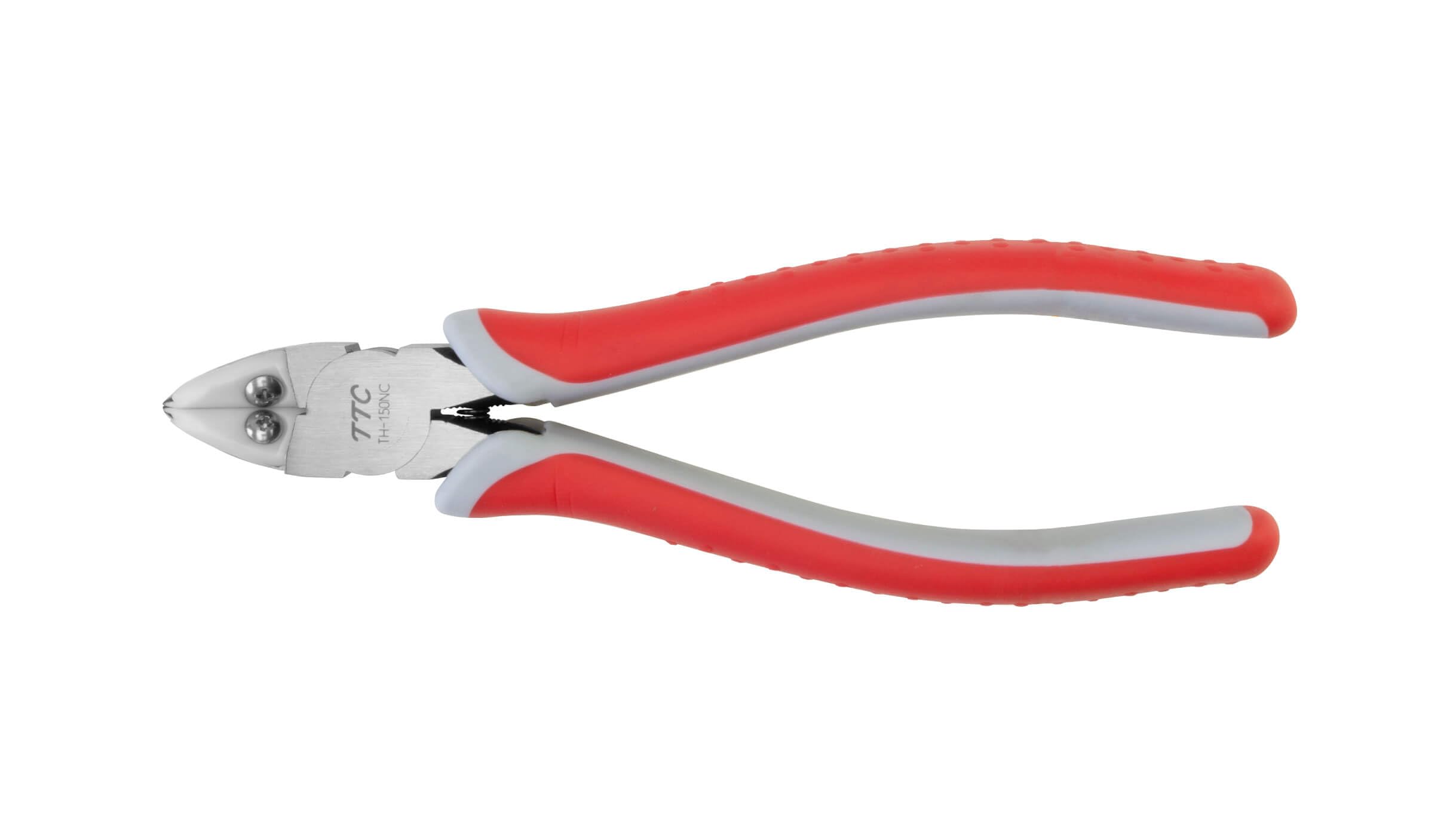
The nipper with a built-in catcher, so trimmed tie ends never drop into live gear.
Anyone who has fished a snipped wire end out of a rack cabinet will understand this tool in a second. The TH-150NC’s flush-cutting edges trap the trimmed tail between shatterproof pads instead of flicking it across the room. That keeps your bench clean and stops tiny pieces of tie and soft wire from falling into equipment you were only supposed to be tidying. It ships with a spare set of those pads, so the holding action stays consistent as they wear.
You get a compact precision nipper, not a jobsite prying tool: the cutting width is 0.16 inch, which is a real contrast with the HAUTMEC’s 7-inch overall plier length — these are two different measurements. The body is fully heat-treated iron with induction-hardened cutting edges (edges hardened by electrical induction for extra wear resistance), so it holds a sharp edge through repeated trimming. The whole tool is 6 inches long and 160 g, with resin handles and an ergonomic grip shape.
Quality is the clear strength, and owners also rate how well it simply works — plus how tidy it leaves the work area. The one thing to check is the handle grip itself, which draws mixed feedback. If you have large hands or grip hard, test the feel before you commit to a long trimming session. For bench work where snipped tie ends fly across the desk, the catcher pads are the fix.
Why it earns the spot: the shatterproof catcher pads catch trimmed tie and wire ends instead of launching them, and a spare set is in the box to keep that grip working.
Worth knowing: the handle grip is the least-loved part — the ergonomic shape, not the blade, is where opinions split.
Suits you when: you trim ties and soft wire near racks, boards, or anything that hates a stray offcut.
Not your tool if: you want a tensioning gun — this trims only, and its handle shape is the one thing to try first.
5. Cable Tie Cutters (TR Industrial TR89150)

A purpose-built tail slicer that never grabs the bundle underneath.
Some cutters are general-purpose nippers that happen to trim ties. This one is built the other way around — the blade design is shaped specifically to slice through nylon cable ties on a bundle without catching the wires or items the tie is holding. That matters when you cut ties off a live harness or a cable you cannot afford to nick. The manufacturer says flat out that the smart blade is meant to stop slipping and stop damage to the bundled goods.
It leaves a clean cut with no jagged edges or frayed ends, which is the whole point of flush cutting. The handles are ergonomic with an auto-return spring that reopens the jaws after each squeeze, and a safety-lock latch closes the tool up for storage. At 5.9 ounces it carries noticeably more in the pocket than the Smithology’s 3.8 ounces, but that weight reads as a solid feel in hand rather than a burden.
The verdict from buyers lands on good quality and strong cutting performance, with the sharpness and overall function getting consistent praise. The one thing a buyer should know is that this is a cutter, not a tensioning gun. You seat the tie by hand, then trim with this. If your job is pulling ties to a consistent tension across a loom, buy a gun instead.
Why it makes the cut
- Blade designed to cut nylon ties off a bundle without damaging the wires beneath
- Flush finish with no jagged edges or frayed ends
- Auto-return spring and safety-lock latch make it quick and safe to pocket
- 5.9 oz body feels solid rather than flimsy
Keep in mind
- No tensioning mechanism — you seat each tie by hand first
- At 5.9 oz it is heavier in the pocket than a micro cutter
Good match for: anyone who cuts ties off finished bundles and wants the bundle to survive the cut.
Wrong job for: production harness work that needs a set tension — this one trims, it does not pull.
6. Smithology Micro Flush Cutters 3-Pack

Three tiny cutters that each need a home on your bench, hobby kit, and toolbox.
The strength of this set is that you stop hunting for a cutter. Three identical 4.8-inch micro flush cutters means one at the workbench, one in the hobby kit, one in the toolbox, always ready. Each one weighs just 3.8 ounces, so a cutter rides in a pocket without you noticing it. The angled blade slices through copper wire, component leads, and PCB pins up to 20 AWG (0.8 mm), and it handles zip ties, 3D print supports, model sprues, beading wire, and small components in the same pass.
The details are aimed at people doing long, repetitive cuts. A side-mounted spring keeps wire from snagging in tight spaces and auto-reopens the jaws to cut down on hand fatigue. The ribbed rubber handles keep the tool steady when a precise line matters, which is the kind of thing jewelry makers and electronics tinkerers notice on the tenth cut, not the first. High carbon steel blades are heat-treated to resist wear and corrosion on soft wire, sprue, and plastic.
Cutting performance and general quality are what buyers talk about most, and value gets plenty of attention too — three tools for the price of one is a real draw. The thing to watch is the handles. Durability draws mixed feedback, with the handles coming loose being the recurring issue on harder use. For light hobby and craft cutting they hold up fine; if you plan to lean on them daily, expect to re-seat a handle now and then.
What you get: an angled flush blade rated to 20 AWG (0.8 mm) in a 3.8 oz body, repeated across three cutters so one is always within reach.
The caveat: handle durability is the weak point — fine for craft work, worth watching under daily pressure.
Reach for this set when: you cut zip ties, sprues, and thin wire across a workbench, hobby table, and toolbox.
Look past it if: you need one heavy-duty cutter for daily professional wire work — the handles are the soft spot.
7. VAMPLIERS 4.75″ Precision Flush Cutters

A 2.5-ounce precision nipper built for boards, not bundles.
The VAMPLIERS is the tool you buy when the cut has to be perfect on something tiny. It is 4.75 inches long and 2.5 oz (71 g), and it cuts copper solid wire at Ø2.6 mm, stranded copper at Ø3.5 mm², and brass wire at Ø2 mm. It also handles wire ties, zip ties, UTP ethernet cables, soft IC lead wires, and copper wire with a flat, clean finish. That is electronics-grade work, and the tight blade alignment is the reason it cuts clean rather than crushing.
Two features set it apart for board work. An angle opening adjuster lets you set how narrow or wide the jaws open, which helps when components are packed tight and you cannot open a full-width cutter between them. The ESD-safe thermoplastic elastomer handles are made for static-sensitive environments, with a cushioned grip and oil resistance. The body is Japanese S58C heat-treated carbon steel at HRC58±4 and meets RoHS compliance. It is also spring-loaded for gentle movement, with a strap hole at the base for a lanyard.
The build is the thing buyers rave about, with cutting performance close behind, and it slices even the finest wire cleanly. Value and durability are the split opinions — the price is higher than a bench nipper, and there is a report of jaws rusting over time, so keep it dry. The upside of the higher price is backing: an automatic 4-year warranty, extended to 5 years with product registration.
Choose it if: you do board-level repairs, ESD-sensitive work, and need an adjustable jaw opening for tight layouts.
Weigh the cost: premium outlay for a 4.75-inch nipper, so it only pays off on precision work — and keep it dry to protect the jaws.
8. DataShark PA70076 Cable Tie Gun

The gun that bundles delicate wires and pneumatic tubing without crushing them.
Most tensioning guns pull hard by default, which is exactly the wrong thing when you are bundling soft wire or flexible tubing. The DataShark is built around adjustable tension, so you can dial down the pull to match a fragile bundle and stop before the tie crimps the material. It feeds a tie up to 1/4 inch wide, tightens it, and cuts off the excess in one action — neatly fastening and trimming in a single motion.
Functionality is what buyers praise most here, and it is specifically valued on delicate work like pneumatic tubing and fine wire bundling, where a firmer gun would do damage. Sturdiness and how tightly it holds a zip tie both get consistently good marks, and the clean cut doesn’t leave a sharp edge to catch on. Adjustability is the talking point on the controls, and it is worth knowing that the tension comes out lower than some owners expect. The unit has also moved from metal to plastic in its construction over the years.
So this is the pick for precision on soft material, not maximum pulling force. If you need to cinch a hard bundle rock-solid, a firmer gun suits better. If you need to bundle something that dents or crushes easily and still get a clean flush trim, this is the tool shaped for that job.
Where it lands: adjustable tension plus one-action fasten-and-cut makes delicate wire and pneumatic tubing bundling the core use, and the tight hold keeps ties seated.
Read before buying: the tension tops out lower than expected and the build now uses plastic parts — set expectations to match gentle work.
Made for you if: you bundle delicate wire or pneumatic tubing and want to control the pull.
Not ideal when: you need to crank a hard bundle to maximum tightness — the tension and plastic build suit lighter work.
9. Eastwood Professional Cable Tie Gun
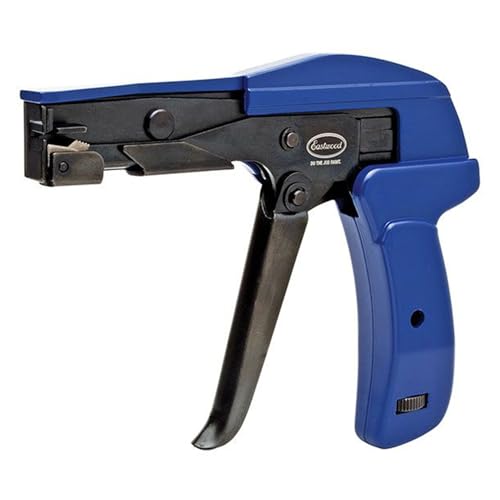
An all-metal gun that fastens and trims a tie in one pro squeeze.
This is the gun for someone who runs ties all day and wants the tool to feel like it will last. It has all-metal construction with a lightweight aluminum alloy cover, so the body feels substantial without being a brick — 11.5 ounces in hand. It works on cables up to 1/4 inch wide, and one quick squeeze fastens the tie and cuts the excess flush. No sharp edges left behind, even on a full loom.
Adjustable tension is the control that matters most here. You set it so the ties are not crimped too tightly into the wires, which protects insulation on a tight bundle. Quality is the leading thing buyers point to, with functionality right behind it, and the tie tightening itself gets steady praise. The general read is that this is a pro-quality tool that pulls ties tight and cuts clean, and it is considered good value for the build.
Where it differs from the DataShark is intent. The DataShark tunes down for fragile tubing; this one is built for solid, repeatable daily work on standard cable bundles. The all-metal body is what you pay for: plastic-bodied guns wear out and get replaced, and this one is built to avoid that. On a busy install or panel job, that durability is what keeps the gun in service instead of in the returns bin.
Why it holds up
- All-metal construction with an aluminum alloy cover for a long working life
- One-squeeze fasten and flush cut with no sharp edges left on the bundle
- Adjustable tension so ties do not crimp into the wires
- Handles cable ties up to 1/4 inch wide at 11.5 oz in hand
Where it asks more
- Built for standard bundles, not the ultra-gentle pull the DataShark offers for fragile tubing
- The all-metal build adds weight compared with a compact hand cutter
Best fit for: installers and panel builders running standard bundles daily who want an all-metal gun built to last.
Think twice if: you mostly bundle fragile tubing — the DataShark’s softer pull suits that better.
Know the Specs
Cutting capacity
Cutting capacity tells you the biggest tie or wire the tool will handle, and it is usually given as a tie width in inches or a wire gauge in AWG. A gun rated for ties up to 1/4 inch or 0.31 inch will not like a wider heavy-duty tie, and a nipper rated to 20 AWG is for fine wire, not battery cable. Match the rating to your widest tie and you avoid a cutter that strains and dulls early.
Flush cut versus standard cut
A flush cut trims the tail flat against the tie head so nothing stands proud. A standard diagonal cut shears at an angle and leaves a spike that catches skin and snags insulation. Flush cutters align the blade edge to the tie surface so the trimmed end sits flat, which is what makes a bundle safe to handle with bare hands.
Tensioning gun versus nipper
A tensioning gun pulls the tie to a set tension and cuts in one action, which is what you want for consistent bundles across a panel. A flush nipper has no pulling mechanism, so you seat each tie by hand and then trim. Guns are for volume and repeatability; nippers are for precision and reaching tight spots a gun nose cannot get into.
Lead catcher and safety features
Some nippers hold the trimmed wire or tie end between pads instead of flicking it away, which keeps small offcuts out of equipment and off the floor. Others add an auto-return spring and a safety-lock latch for quick, safe storage. If you work near open electronics, a catcher pad is worth having: it traps the offcut so you cut one-handed instead of chasing snipped ends out of the chassis.
Common Questions
Will a cable tie gun work on heavy-duty ties wider than a quarter inch?
What is the difference between a flush cutter and a regular diagonal cutter?
Can I use a zip tie cutter on soft electrical wire too?
Do I need a tensioning gun or just a hand cutter for zip ties?
How long does a flush cut blade stay sharp on a cable tie cutter?
Will these cutters damage the wire inside a bundle when removing ties?
What does a lead catcher do on a pair of flush nippers?
Are the micro flush cutters strong enough for zip ties?
Is a made-in-Japan cutter worth it over a cheaper option?
Can a cable tie gun be set so it does not over-tighten a bundle?
The Bottom Line
For most buyers, the zip tie cutter winner is the Tsunoda KBN-150 because it pulls a tie to tension and flush-cuts in a single squeeze with a 0.31 inch tie capacity. If you need repeatable tension on standard cable bundles and want an all-metal body built to last, grab the Eastwood Professional Cable Tie Gun. And for bundling delicate wire or pneumatic tubing without crushing it, the adjustable DataShark PA70076 is the one to reach for.
How we choose
We do not accept paid placement. Every pick is matched to a real buyer and a real use-case; we do not hands-on test units.
Sources
Specifications: manufacturer listings and product documentation. Review insights: verified customer reviews, as of November 2026. Pricing: not shown on this page (it changes often); check the current price via the retailer link.
As an Amazon Associate, Tactical Gear Guy earns from qualifying purchases. This does not affect which products we feature.