Specs are compiled from manufacturer listings and verified buyer reviews and can change over time — please confirm the key details on the product page before buying.
Here is the short answer: buy the Winnerwell Nomad Medium if you heat a canvas tent and want a stove that will still be solid after several winters. Buy the VEVOR if you are starting out and want the most stove for the least money. Everything else on this list is a specialised tool for a narrower job — titanium for the backpacker, big fireboxes for the wall-tent camper, glass doors for the person who wants the fire visible from the sleeping bag. This page sorts all eight by the job they do best, so you can stop comparing and start loading the truck.
This guide is built by comparing the manufacturers’ published specifications and the patterns across verified customer reviews, so you get each pick’s real strengths and trade-offs instead of marketing spin.
A wood stove tent is a portable wood-burning heater built to vent through a stove jack, and the wrong one will smoke you out or leave you cold by 2 a.m. This breakdown of the wood stove tent category covers heat output, chimney fit, and packed weight so you pick the right one.
Top Picks


How To Choose The Best Wood Stove Tent
The stove will only work if the chimney can leave the tent. That single point ruins more first-time hot tent setups than any other, so settle it before you look at firebox size or weight.
Match the chimney diameter to your stove jack first
Your tent has a hole cut for the pipe, called a stove jack, and it is sized to a diameter. A stove with a 2.24-inch chimney and a jack cut for 2.5 inches will leave a gap that lets cold air and smoke back into the tent. Check the pipe diameter in the specs and measure the jack on your tent. The three common figures across this list are 2.24 inches, 2.36 inches and 2.5 inches — close enough to look similar and different enough to matter. If you are buying a tent to go with the stove, get the jack cut to match the stove you want.
Think about reload interval, not headline heat
A stove does not heat a tent on its own — it heats it between the times you get up to add wood. Firebox volume is the number that predicts how long you can stay in the sleeping bag. A stove with a small firebox on 2.5-inch firewood will need attention in the night. A larger firebox with a damper you can dial back will hold heat longer and let you stretch the gap. Wood species matters too; dense hardwood logs burn longer than softwood.
Weigh packed weight against how you travel
Stainless steel stoves that pack down to the size of a duffel are fine when the truck is parked beside the tent. They are miserable when the tent is a mile off the trailhead. Titanium changes the calculus by cutting metal mass, but it costs more. Be honest about the trip you actually take, not the one you plan to take someday.
Plan for smoke and carbon monoxide
Every wood stove produces carbon monoxide, so a hot tent needs ventilation regardless of the stove brand. The pipe has to seal at every joint and at the jack, and the damper has to be able to hold a burn without smouldering. Set a fireproof mat under the stove and leave a vent open. Curing smoke on the first burn is normal — burn the stove outdoors for at least an hour before the first trip so that coating burns off away from your sleeping area.
Side-by-Side Comparison
| Model | Best For | Firebox | Packed Weight | Chimney Diameter | Amazon |
|---|---|---|---|---|---|
| Winnerwell Nomad Medium★ Best Overall | Long-term canvas tent owners | 800 cubic inch | 19.4 lb | 2.5″ | Amazon |
| VEVOR Camping Wood StoveBudget Champion | First-timers on a tight budget | 640 cubic inch | 11.7 lb | — | Amazon |
| tounto Hot Tent Wood StoveFastest Setup | Fast setup and cooking | 15.2 x 7.7 x 8.5 in | 17.9 lb | — | Amazon |
| Ytaoeo Tent Stove | Versatile cooking and grilling | 14.96 x 7.68 x 8.66 in | 10 kg | 2.36″ | Amazon |
| KUNGKA Portable Hot Tent Stove | Big wall tents and deep cold | 200 sq ft coverage | 24 lb | 2.24″ | Amazon |
| AVOFOREST Wood Burning Stove | Quick heat for small tents | 17.8 x 11 x 9.73 in | 6.96 kg | — | Amazon |
| OneTigris Tiger Roar | Fire watching and even burns | 10.6 x 8.5 x 17.3 in | 10 kg | — | Amazon |
| TSG Portable TA1 Titanium | Backpack-in hot tenting | 16.5 L | 6.6 lb | 2.48″ | Amazon |
Detailed Reviews
1. Winnerwell Nomad Medium Tent Stove
Our pick — 4.5+★ from 350+ verified ratings; the strongest balance of quality and price.
A 304 stainless stove with an 800-cubic-inch firebox that warms a 16-foot canvas bell tent in about twenty minutes.
This is the one to buy if you camp in a canvas tent several times a winter and want to stop replacing stoves. The body is built from 304 stainless steel — a grade that resists rust and corrosion when it gets wet and left out — so a soggy pack-out does not shorten its life. The firebox holds 800 cubic inches, which is the largest on this page and the reason you are not feeding it every hour. It packs to 15 by 8 by 8 inches with the chimney sections stowed inside the body, and the side shelves fold up into a carry handle so you move it in one trip.
Buyers judge this stove on its build, and it holds up well. They report warming a 16-foot bell tent in roughly twenty minutes and say the four fanned legs keep it planted on uneven ground. The four legs nest flat under the stove when packed and fan out to give it a stable base on uneven ground. Compare the weight against the budget VEVOR and you see the trade: 19.4 pounds versus 11.7 pounds. That extra metal is where the stiffness comes from, and it is also why this is a truck-camp stove rather than a backpacking one.
The catch is cost, and buyers are split on it. Plenty call it fair value for a stove that should outlast several cheaper units; others feel it is steep next to the budget options. Both readings are fair. What you are paying for is the steel grade, the precision construction, and a 2.5-inch chimney that fits the common canvas tent jack directly. The 90-inch assembled height is the total of the stove plus the chimney, so measure your jack height against your tent before you commit — running short on pipe is the one setup problem this stove cannot solve for you.
Where it earns its keep
- 304 stainless steel resists rust and corrosion in wet, cold conditions
- 800 cubic inch firebox means fewer middle-of-the-night reloads
- Chimney sections and legs stow inside the body for one-piece carrying
- Side shelves double as a carry handle and a flat cooking surface
What to weigh before buying
- 19.4 pounds is heavy for anything further than a short walk from the truck
- Buyers are divided on whether the price matches the value
- You need a 2.5-inch stove jack and enough height for 90 inches of stove plus pipe
Buy this if: you heat a canvas bell tent, teepee or wall tent from a vehicle and want a stove you will not be replacing soon.
Think twice if: you carry your stove on your back — 19.4 pounds is a lot of steel to haul, and the titanium TSG below cuts that down sharply.
2. VEVOR Camping Wood Stove
A full stove kit with a 640-cubic-inch firebox that asks for very little money.
If this is your first wood stove tent, start here. The firebox holds 640 cubic inches, well short of the Winnerwell’s 800 but generous for a first stove, and it comes with a damper and ventilation holes so you can hold a fire low instead of letting it run. The 1 mm stainless panels are the part that matters for durability — thin enough to keep the weight at 11.7 pounds, thick enough that the panels do not warp when you load them up. That is the lightest full steel stove kit here apart from the titanium.
Size is what buyers bring up most, and in a good way: this stove is small enough to pack into a car boot with sleeping bags still in it. The 8 x 12 inch detachable shelves give you real cooking room, and the heat conduction plate under the cooktop moves heat into a pan fast. The kit is genuinely complete — rain hat, stove bag, protective gloves, eight smoke pipes and a BBQ conductive plate all included. Assembly is straightforward and most people are burning within a reasonable time of opening the box.
Keep your expectations calibrated on burn time and smoke. People are split on whether it throws enough heat for a big tent, and a few find smoke leaking at the seams when the wind turns. Heats up to 100 sq ft is the figure to work from — that is a small to mid-size tent, not a 16-foot canvas palace. The Kungka covers 200 sq ft versus this stove’s 100 sq ft, and that is the clearest reason to step up if your tent is large. If you are heating a compact tent on a budget, none of that will bother you.
The honest read: a complete kit at an entry-level price that will get you through a winter or two of weekend trips. It is not the stove you hand down to your kids.
The seam question: if you plan to camp in serious wind, budget for some high-temperature sealant and go over the pipe joints before your first trip.
Reach for this if: you want to try hot tenting without committing real money and your tent is on the smaller side.
Look elsewhere if: you heat a large canvas tent or camp in high wind and need sealed joints and more heat.
3. tounto Hot Tent Wood Stove
Four feet out, chimney in, fire lit — this one is running in about two minutes.
Dragging a stove out of a cold truck at dusk is the worst part of winter camping, and this one is built around that moment. Open the four supporting feet, slide in the chimney section, drop the ceramic glass door into place and you are loading firewood. The whole kit folds flat for storage in a gear bin, and at 17.9 pounds it is light enough to move from truck to tent without a second person. The firebox measures 15.2 by 7.7 by 8.5 inches and covers up to 150 sq ft — enough for a hot tent, an ice fishing shelter, a hunting blind or a truck camper.
Build quality and assembly carry this stove. It is a well-made little burner that goes together without a fight and throws good heat once it is going. The flat cooktop does double duty: boil water and brew coffee on top while the tent warms, and the adjustable sliding damper lets you choose between steady overnight warmth and a hot flame for cooking. One load of 2.5-inch firewood burns around 1.5 hours, which tells you what a night looks like — plan on reloading.
Two things to size properly. The firebox is small, and buyers report so plainly; it is a tent warmer, not a cabin heater, despite the description. Burn time is the other variable — how long it stays hot depends heavily on what wood you feed it and how far you close the damper. The crack-resistant ceramic glass door lets you watch the flame without opening the stove, which keeps the heat inside. Expect the stainless to take on a heat tint after the first burn; that is normal and not a defect.
Best at: getting hot fast when you are cold, tired and setting up in the dark.
The trade to know: small firebox plus 1.5-hour loads means you will feed it through the night on a cold trip.
Matches best with: the camper who values setup speed and wants to cook breakfast on the stove top.
Not the pick for: anyone heating a large wall tent or expecting to sleep through without reloading.
4. Ytaoeo Tent Stove, Wood Burning Stove for Camping Tent

Seven chimney sections, a 90-degree elbow and a lid that turns into a grill.
The chimney is the reason to look at this one. You get seven 2.36-inch diameter sections plus a 90-degree elbow and an anti-spark pipe, so the pipe run can bend around a tent pole or exit at an angle instead of going straight up. That extra flexibility solves the stove-jack alignment problem a lot of people run into. All seven pipes, the ash scraper and the fire grate stow inside the stove body, and the side shelves fold up as carry handles. Weighing in at 10 kg, it sits between the light kit stoves and the heavier steel builds.
Most people who buy it talk about heat and value. It puts out a lot of warmth, holds temperature well, and feels better made than the price suggests. The cooking side is where it separates from plain heaters: the stove cover doubles as a BBQ grill and the L-shaped handle flips into a grilling surface, so you can boil water, cook and grill over the same firebox. The large glass window lets you watch the fire and see when to add wood without lifting the lid.
Smoke is the honest weak point. A number of owners mention it smoking heavily and venting poorly, which in a tent is the difference between cozy and unbearable. Some of that depends on drawing properly — a chimney that is long enough, a damper set right and dry wood all help — and some to how well the section joints seat. Inspect the pipes on arrival and seal anything loose. If smoke control is your top priority, the Kungka below handles it better, though it costs more and weighs more.
Why it stands out: a full cooking and grilling setup with a chimney you can route around obstacles.
The catch: smoke behaviour is the recurring gripe, so budget time to seat the joints properly before your first trip.
Worth it for: campers who cook and grill as much as they heat, and tents where the pipe has to bend.
Pass on it if: you want a set-and-forget draw with no joint fussing.
5. KUNGKA Portable Hot Tent Stove

A 200-square-foot wall tent heater rated to -20°F, with 2 to 4 hours of burn per load on hardwood.
The number that decides this stove’s job is 200 sq ft. That is the largest rated coverage on this page, at 200 sq ft versus the VEVOR’s 100 sq ft. A canvas wall tent or big bell tent that leaves the small stoves struggling is exactly what this one is built for. The manufacturer rates it down to -20°F, and it burns 2 to 4 hours per load on hardwood logs. The chimney is 2.24 inches across and comes in seven sections reaching 6 feet, adjustable to match your stove jack height.
Setup and heat output are what people bring up. It goes together without drama and the flat top takes a cast iron pan, a kettle or a camp pot for cooking breakfast while the tent warms. The borosilicate glass door — a heat-resistant glass that tolerates big temperature swings — lets you watch the flame and see the wood level without opening the stove. All seven pipes, the fire poker and the accessories stow inside the stove body, the legs fold flat and the storage rack flips into a carry handle.
The variables are weight and smoke. At 24 pounds this is the heaviest stove here, which is the price of heating a big tent — it is a truck-camp tool, not a backpacking one. On smoke, the reports are mixed: some owners see little to none, others note a paint smell that needs burning off. The manufacturer recommends a 60-minute outdoor burn before the first trip to cure the coating and clear the brief curing smoke. Do that, and the smell should not follow you into the tent.
What it brings: the most rated coverage here plus a glass door that makes the stove a pleasure to sit beside.
What it costs you: 24 pounds to move and a 2.24-inch jack requirement that will not fit a 2.5-inch opening.
Built for: the big canvas wall tent and the deep-cold hunting or ice fishing trip.
Wrong tool for: the small tent and the trailhead that is a walk away — the weight and coverage are overkill.
6. AVOFOREST Wood Burning Stove
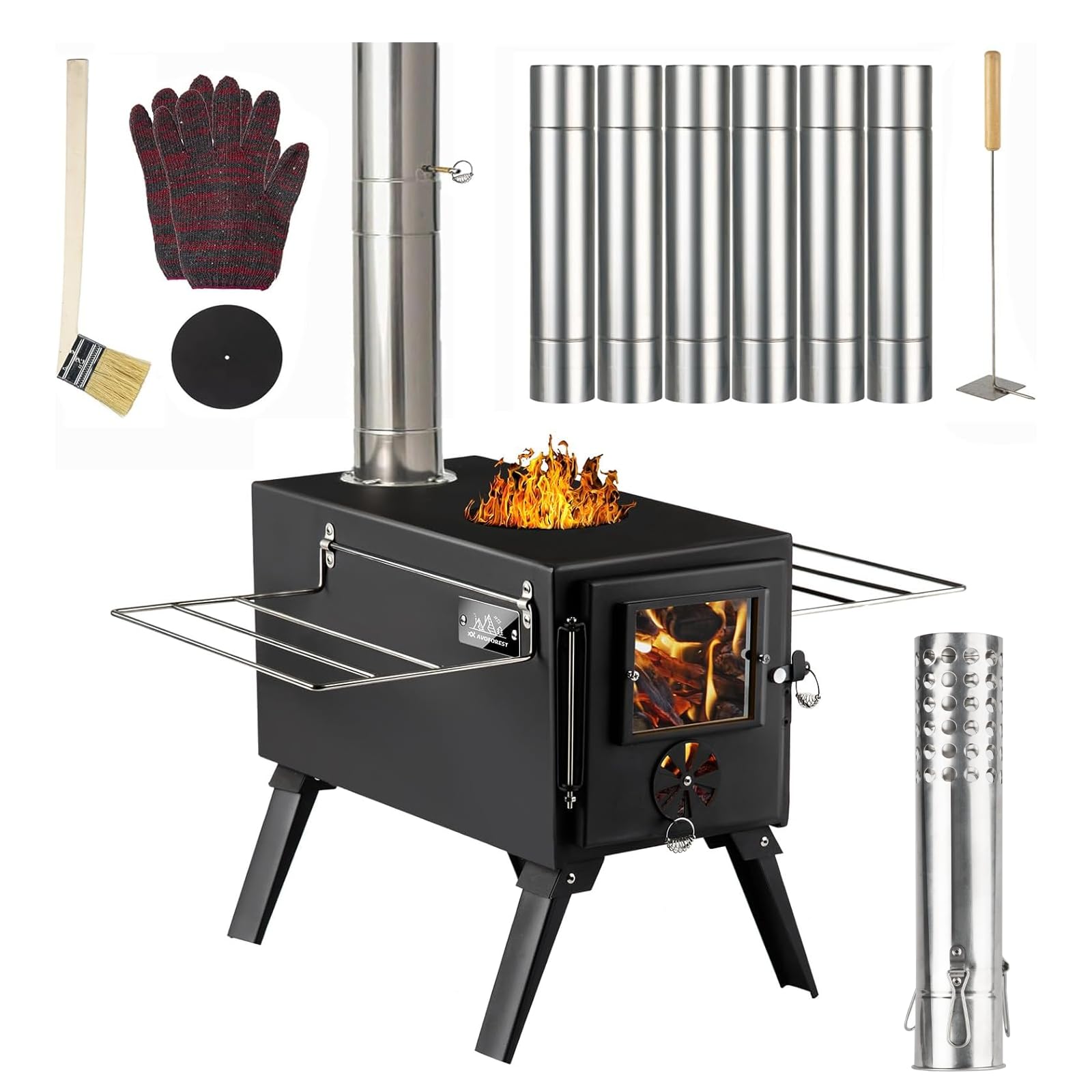
Iron body, stainless chimney, and a firebox that comes up to temperature fast.
Where this stove beats the cheaper steel kits is the material split. The body is cast iron — heavy, but it holds heat and does not distort — while the liftable chimney section is stainless steel so it stays clean and easy to handle. It comes with seven stainless chimney pipes, and the firebox measures 17.8 by 11 by 9.73 inches. That is a wider footprint than most here, which means you can lay longer logs across it and put more wood in per load. It packs into a single box that goes in the back of the car for a trip.
The accessories set it apart from a bare stove. Fire tongs and a brush handle the ash — use the brush only after the stove is cool — and woven gloves protect your hands from cuts. A drain screen filters the burned-out ash. Every piece of that kit stows inside the stove body, so nothing rattles around the truck bed. The heat comes up quickly, and for a small tent it is more than enough. Coffee or an easy meal on top is part of the routine.
Be clear about size. Buyers frequently describe this as extremely small, and that is the fair characterisation — it is a one- or two-person tent stove, not a wall-tent heater. Smoke escaping from the top and uneven burning are the other points that come up. A tight seal at the top joint and dry, well-split wood make a real difference here. Follow the maker’s advice and do a full outdoor burn before the first trip; this is the stove where skipping that step is most noticeable.
Why people like it
- Cast iron body holds heat and resists warping
- Wide firebox takes longer logs and more wood per load
- Full cleaning kit — tongs, brush, gloves and ash screen — stows inside
- Heats quickly with a stainless chimney that stays easy to handle
Where it falls short
- Genuinely compact — too small for a large canvas tent
- Smoke at the top joint needs attention and a good seal
- Cast iron adds weight compared to thin steel shells
The right call for: the solo or two-person hot tent where fast, steady heat on small wood matters.
Not the right call for: a group tent or a large canvas shelter, where the compact firebox runs out of capacity.
7. OneTigris Tiger Roar Tent Stove
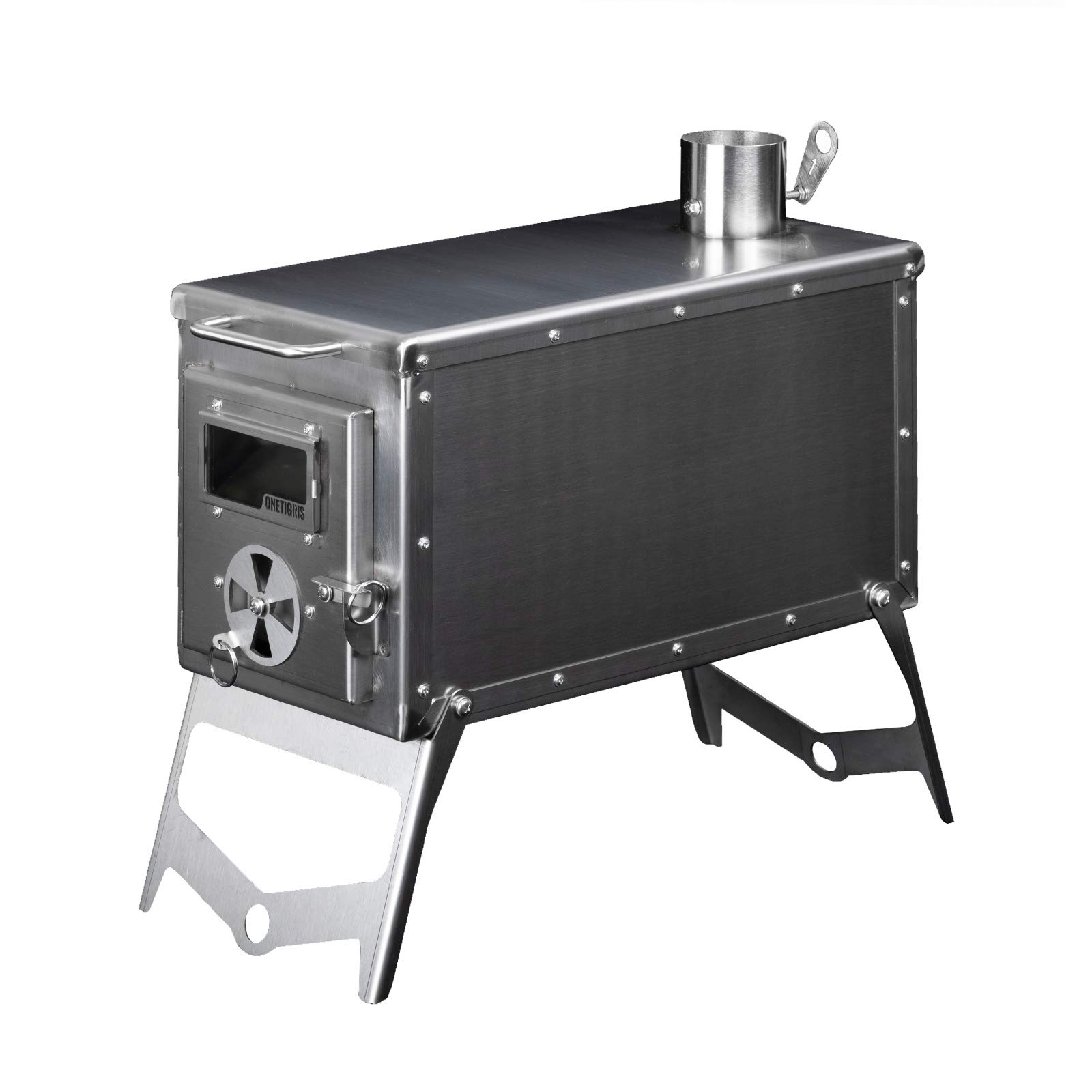
A stove built around the fire view, with glass rated to 760°C and an air valve that fights backdraft.
The glass is the headline here. It is Schott ROBAX glass-ceramic — a fire-viewing panel built for extreme heat — and it withstands short-term blazes up to 760°C as well as the sudden temperature swings that crack ordinary glass. That matters on a cold morning when you throw wood onto hot coals. The body is forged from 304 stainless steel with 3 mm thickness at the top to stop the plate blending after repeated burns, and the chimney and elbow pipes are 201 stainless. A spare glass panel comes in the box, which is a thoughtful touch for a stove this dependent on its window.
What the air valve does is the quieter reason to buy it. It splits incoming air so some flows upward and some goes down across the fire — that controls how fast the wood burns and keeps sparks and carbon from falling out of the inlet, and it helps stop smoke flowing back into the tent. A guide flake inside the fire chamber slows the gas flow and catches sparks, so you do not need a spark arrestor on top of the pipe. The exhaust valve gives you control, and you can rotate the elbow pipe to keep rain and snow out of the stove.
The kit is generous: 7 pipe sections, two 45-degree elbows and two 90-degree elbows so you can route the chimney however the tent requires, plus an ash scraper, a pair of leather gloves and the replacement glass. Set the sections with the small opening down and the big opening up so creosote and tree oil do not run down the outside of the pipe. The honest limits are heat output for large spaces and long-term durability — this is a car-camping stove that heats a small tent well, not a permanent structure heater.
The standout: a fire-view window you can rely on in the cold, backed by a spare panel in the box.
What to plan around: the pipe layout needs thought before the first setup, and it rewards small-tent use over big shelters.
Pick it for: the camp that wants the fire visible from the sleeping bag and a stove that does not spit sparks.
Think again if: you are heating a large tent or want the simplest possible pipe assembly.
8. TSG Portable TA1 Titanium Tent Wood Stove
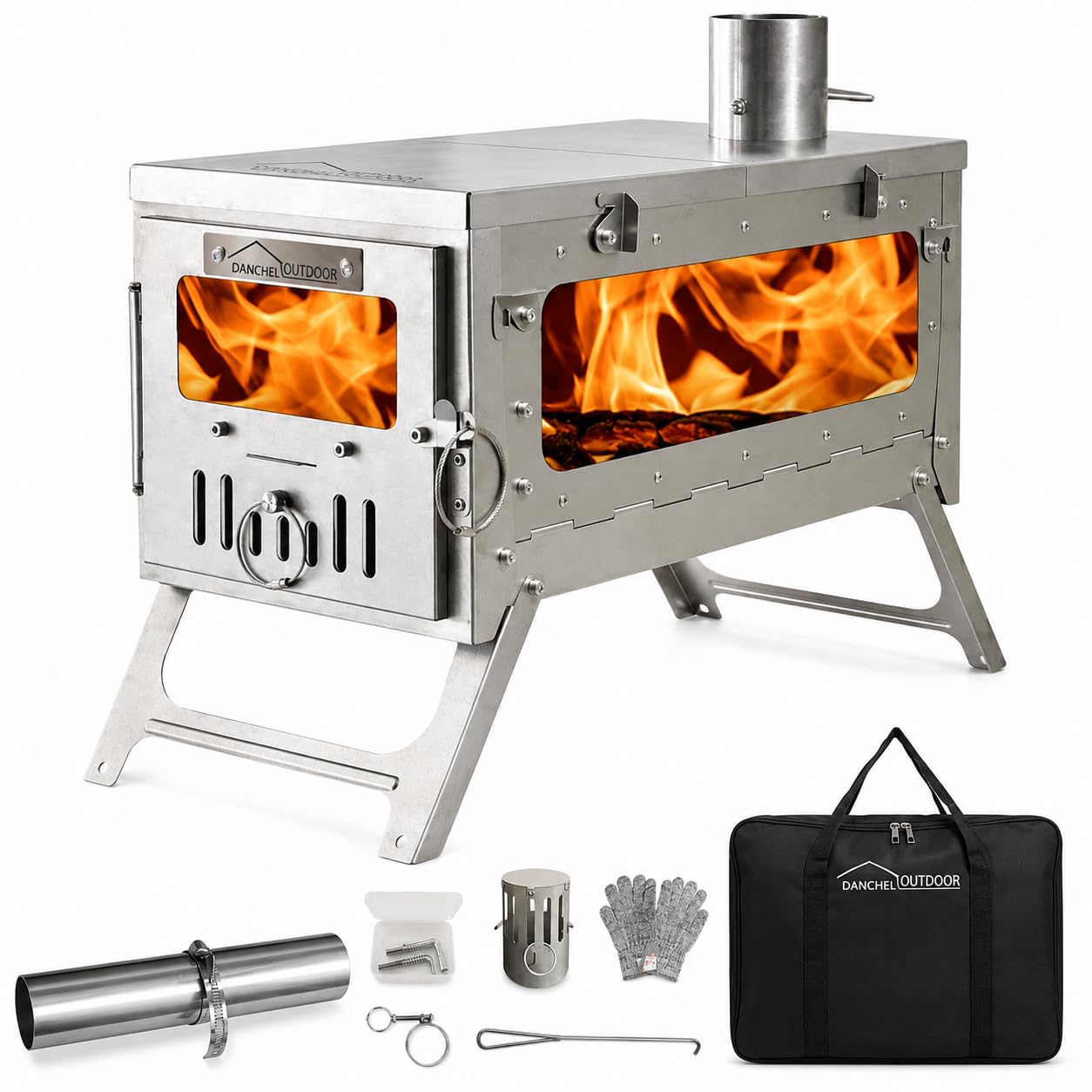
Titanium drops the stove to 6.6 pounds without shrinking the firebox.
If you carry your shelter in, the weight is the whole argument. This stove is 6.6 pounds including every part, made from rust-proof TA1 titanium — a metal with a high strength-to-weight ratio — with steel fasteners and hinge pins taking the stress points. The firebox holds 16.5 liters, which is big capacity for long combustion, not a token box. The roll-up titanium chimney pipe runs 7.2 feet at 2.48 inches diameter and installs quickly once you have done the initial burn-in. It packs into a carry bag that doubles as a laptop-style bag for the trail.
Titanium conducts heat fast, and the draft system leans into that. Seven slidable door intakes plus an adjustable damper let you dial the burn to the weather, and the wider door takes thicker firewood than most small stoves will swallow. The manufacturer rates it for extreme cold down to -30°C and sizes it for one to three people. A 11.6 by 3.2 inch high-temperature side window lets you see the burn without opening the door, and the top panel is split into two plates with a load-bearing bar rated to support up to 22 pounds — enough for a pot or a pan.
The folding design is where the practical thinking shows. The door frame sits flush with the bottom of the stove so ash sweeps out cleanly, and the H-shaped legs are built for uneven ground. A titanium spark arrestor catches sparks and three wind rope fixing rings are built in. Durability is the honest question mark with titanium this thin — it is strong for its weight, but it is still thin metal and it wants careful handling. Treat it as backcountry gear, not a truck-bed beater.
Who it suits: the backpacker or the bike-packer who counts ounces and still wants a real fire at night.
The honest limit: thin titanium rewards careful packing, and the 2.48-inch pipe needs a jack to match.
Go titanium if: your stove travels on your back and the weight of a steel kit would change your trip.
Stay steel if: your stove lives beside the truck and you would rather have thickness than lightness.
Know the Specs
Firebox volume in cubic inches and liters
This is how much wood the stove holds at once, and it is the number that decides how long you sleep. A bigger box means fewer trips out of the sleeping bag on a cold night. Firewood size matters too — a wide box takes longer, thicker logs, which burn slower. Our picks list this in cubic inches (800 on the Winnerwell, 640 on the VEVOR) or liters where the maker uses that unit (16.5 L on the titanium TSG). If you camp in deep cold, size this up, not down.
Chimney diameter and stove jack fit
The chimney is the pipe that carries smoke out through the tent roof. Its diameter has to match the opening in the tent — the stove jack — or you get a leak. On this list the diameters run 2.24 inches, 2.36 inches, 2.48 inches and 2.5 inches. They look close on paper and they are not interchangeable. Measure your jack before ordering. Length matters too: a taller pipe draws better, so plan for enough sections to clear the roof and get above the tent by a safe margin.
Packed weight versus how you travel
Weight decides whether the stove is a truck-camp tool or trail gear. On this page it ranges from 6.6 pounds for the titanium TSG up to 24 pounds for the Kungka. Anything past the mid-teens is a vehicle stove in practical terms. Lower weight also tends to mean thinner metal, so match the stove to your honest trip. A titanium stove in a truck bed is paying for lightness you never use. A 24-pound steel stove on a backpacking trip is misery.
Material — stainless, cast iron and titanium
Stainless steel resists rust and handles heat well, and 304 is the grade that appears on the Winnerwell and the OneTigris body. Cast iron, used on the AVOFOREST body, holds heat longer but adds weight. Titanium in TA1 grade on the TSG gives the best strength for the weight, at a higher cost. Each has a place. The material choice is really a weight-versus-robustness decision, and it should follow how far you carry the stove.
Common Questions
Will a 2.24-inch chimney fit a 2.5-inch stove jack?
How cold a night can a wood stove tent handle?
How long does one load of wood last in a small tent stove?
Do I need a fireproof mat under the stove?
Is the smoke on the first burn a problem?
Can I cook on a wood stove tent, or is it only for heat?
How much does a wood stove tent weigh, and does it matter?
Does a taller chimney make the stove draw better?
Can I use a wood stove tent as a permanent cabin heater?
Is titanium worth the extra cost over stainless steel?
The Bottom Line
For most campers, the winner is the Winnerwell Nomad Medium. Its 304 stainless body resists rust through wet pack-outs, and the 800 cubic inch firebox is the largest here, so you reload less overnight. If you want a complete kit without spending much, the VEVOR gives you an 11.7-pound stove with eight pipes and the accessories in one box. And for the camper who carries the shelter in, the TSG titanium stove at 6.6 pounds is the one to grab.
Before you order, measure your stove jack and match it to the chimney diameter. That single measurement decides whether the stove works in your tent at all, and it is worth more of your time than any spec on this page.
How we choose
We do not accept paid placement. Every pick is matched to a real buyer and a real use-case; we do not hands-on test units.
Sources
Specifications: manufacturer listings and product documentation. Review insights: verified customer reviews, as of November 2026. Pricing: not shown on this page (it changes often); check the current price via the retailer link.
As an Amazon Associate, Tactical Gear Guy earns from qualifying purchases. This does not affect which products we feature.