Specs are compiled from manufacturer listings and verified buyer reviews and can change over time — please confirm the key details on the product page before buying.
Most engine model kits look like engines. A set that moves its pistons and spins its crankshaft teaches you how a real motor works; a static pile of bricks just sits there. Every kit below drives its pistons and crankshaft, so you can skip the static shelf models entirely.
This guide is built by comparing the manufacturers’ published specifications and the patterns across verified customer reviews, so you get each pick’s real strengths and trade-offs instead of marketing spin.
Every pick here drives its pistons, so you can compare cylinder count, piece total and motor type instead of guessing whether it moves. Below you’ll find the full breakdown, from cylinder count and piece totals to whether the motor actually drives the pistons, so you can pick the right working model engine kits without wasting a weekend on a set that never moves.
Top Picks


How To Choose A Working Engine Kit
Decide up front how many hours you want to spend building and if you want a motor or a hand crank, because those two choices separate a 175-piece four-cylinder from a 3,472-piece V12. A 175-piece four-cylinder and a 3,472-piece V12 are both “working engines,” but they belong to completely different kinds of buyers.
Start with the cylinder layout, not the piece count
A four-cylinder inline engine is the simplest shape to build — the pistons sit in a straight row, so the crankshaft and valve motion are easy to follow. A V8 splits those cylinders into two angled banks, which means more gears and more places to get the timing wrong. A W16 or V12 multiplies that complexity again. If this is your first engine kit, start with an inline four and work up to a V8 or W16 once you’ve built one that runs.
Decide between a motor and a hand crank
Motorized kits run on their own once you install batteries or charge a built-in pack, so you can stand back and watch the pistons cycle. Manual kits ask you to turn a handle, which is fine for a quick demonstration but tiring for long viewing. Some kits give you both, letting you switch modes when the battery runs down.
Look at whether the cylinders are see-through
A transparent cylinder head or clear engine case is the whole point of a working display — it lets you watch pistons and valves move instead of hiding them under plastic. Check the listing for a clear cylinder head or transparent engine case before buying, because opaque plastic hides the pistons you paid for.
Match the age rating to the builder, honestly
Age ranges on these kits run from 8 and up to 16 and up. That spread reflects real differences in part size, instruction clarity and how much force a connector needs. A younger builder on a 3,472-piece set will need an adult beside them for most of the build.
Side-by-Side Comparison
| Model | Best For | Pieces | Engine Layout | Power Source | Amazon |
|---|---|---|---|---|---|
| Mould King 10131 W16★ Best Overall | Supercar fans wanting a running 16-cylinder showpiece | 952+ | W16 (twin V8) | Motor + battery box | Amazon |
| Sikewettx W16 Building KitBest for Younger Builders | Younger builders and gift buyers | 751 | W16 (twin V8) | USB motor, two speeds | Amazon |
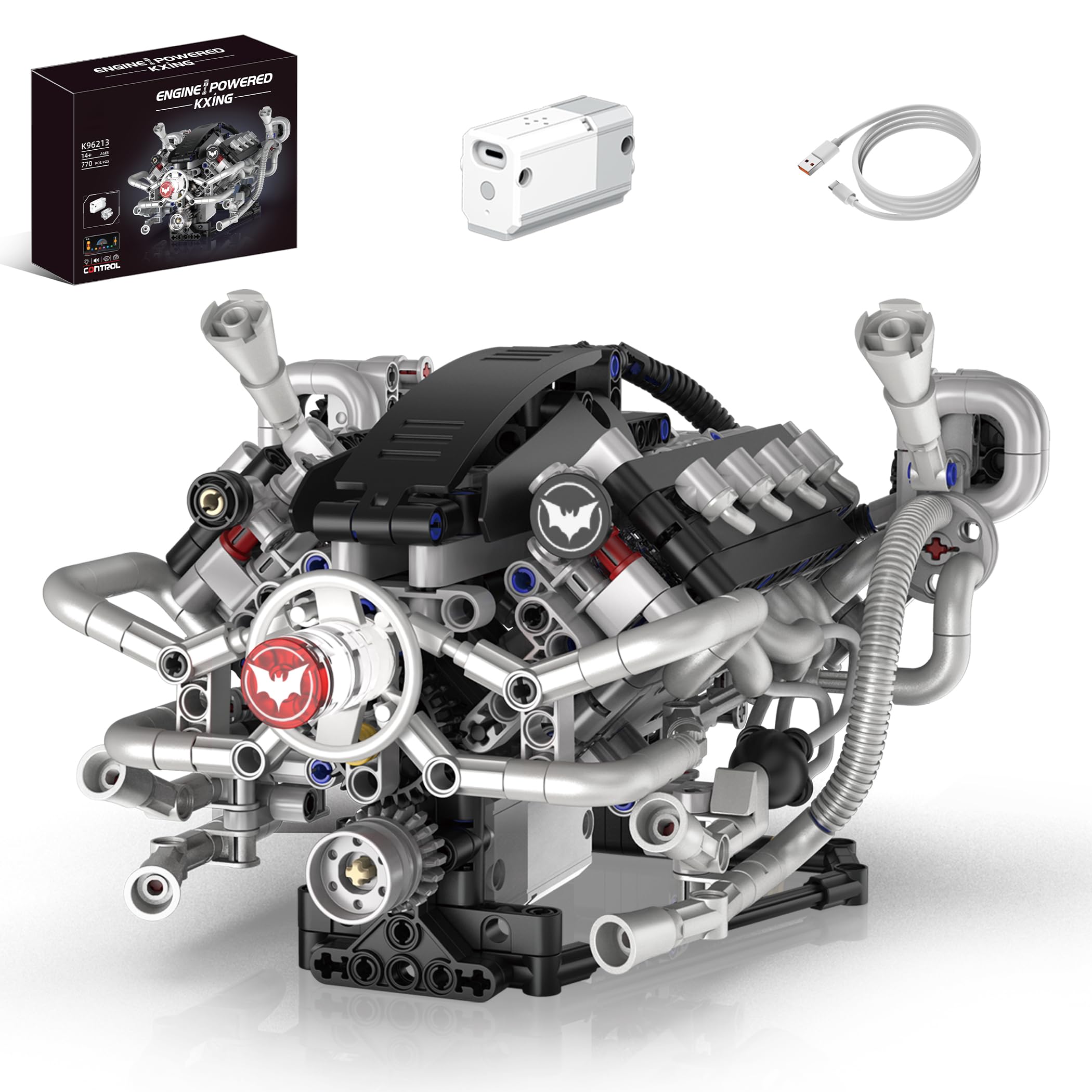
| BeepZipp Mini V8Best Light-Up Display | Desk display with light-up emblem | 770 | V8 | Motor + LED lights | Amazon |
| National Geographic 4-Cylinder | Kids and first-time builders | 175+ | Inline 4-cylinder | 3 AA batteries | Amazon |
| Machine Works 4-Cylinder | Learning projects with sound and light | 100+ | Inline 4-cylinder | 3 AA batteries | Amazon |
| Karei V8 1065 PCS | Dual-mode electric and manual display | 1065 | V8 | USB rechargeable motor + hand crank | Amazon |
| Mould King V12 | Serious builders wanting a huge challenge | 3472 | V12 (90-degree) | Included battery + motor | Amazon |
| TECHING Metal V8 | Collectors wanting machined metal construction | 500+ | V8 DOHC | Internal electric motor | Amazon |
Detailed Reviews
1. Mould King 10131 W16 Engine Building Blocks Set
Our pick — 4.5+★ from 350+ verified ratings; the strongest balance of quality and price.
Sixteen cylinders, a transparent head, and a motor that actually turns them.
This is the kit for the supercar obsessive who wants the rarest engine shape on the market. A W16 is two V8 blocks fused into a W arrangement, and Mould King builds it from 952+ pieces into a unit that measures 11.89 x 5.83 x 5.91 inches on the shelf. One motor and one battery box drive it once assembly is finished.
The detail work is where the money goes. A transparent cylinder head lets you look straight through and watch the valve train move as one unit. Four turbochargers and an exhaust system sit alongside precise piston travel. What wins people over most is the part quality itself — the pieces fit and hold, which is exactly what you want in a 16-cylinder mechanism where one loose gear kills the whole motion.
Two honest notes before you commit. Instructions are the divisive part — some builders sail through in a few hours, others find the steps hard to follow on the trickier sub-assemblies. And at 1 kg, this is a dense build that rewards a clean, well-lit table rather than a lap tray.
What earns it the top spot
- 952+ pieces produce a genuinely complex W16 with four turbochargers
- Clear cylinder head shows the valve train working in real time
- Motor and battery box included, so it runs straight after the build
- Part quality is the most-praised thing about this set
Where it asks more of you
- Instructions split opinion — the complex sections need patience
- 1 kg of assembled plastic wants a stable display surface
Worth the build time: anyone chasing a 16-cylinder supercar engine they can switch on and watch cycle.
Think first: first-time builders should expect the instruction manual to slow them down on the dense sections.
2. Sikewettx W16 Engine Building Kit
A 751-piece W16 that runs at two speeds.
Here’s the direct contest worth knowing: this kit weighs 0.78 kg against the Mould King W16’s 1 kg, so it’s the friendlier one to lift and reposition. It also comes in at 751 pieces versus the Mould King’s 952+, which means fewer steps between the box and a running engine.
The two-speed USB motor is the feature that sells it. Slow mode lets you follow each piston stroke; fast mode mimics a high-revving race engine. Lift the top cover and you find a turbocharger and exhaust assembly, and the engine covers come off so you can watch the pistons and cylinders work through the gears. It’s compatible with Lego, so spare pieces are easy to source later.
The trade-off is scale. At 10 x 2 x 2.7 inches assembled, this is a compact model, and the 0.78 kg build feels lighter in the hand than a 16-cylinder showpiece. That’s the point — it’s sized for a desk or a kid’s room shelf rather than a display cabinet centerpiece.
The two-speed payoff: being able to slow the pistons down to a crawl is what turns this from a toy into something you can actually explain engine timing with.
The build rating: the listing targets builders 8 and up, so it suits a family project where an adult handles the gear assemblies.
Reach for this if: you want a running W16 that a younger builder can help finish.
Look elsewhere if: you need a large-format display model that fills a shelf.
3. BeepZipp Mini V8 Engine Model Kit
The V8 that glows in the dark and lights its own emblem when it runs.
This one holds 770 pieces and finishes at 7.48 x 9.13 x 5.12 inches. For scale, the Mould King W16 spans 11.89 x 5.83 x 5.91 inches, so the BeepZipp runs wider but noticeably shorter front to back — it sits better on a desktop than a bookshelf’s top.
What makes it different is the light. An integrated LED illuminates a unique emblem once the build is complete, switched on by a button, and the model also glows in the dark. Add the motor and the gear-and-crankshaft system drives the pistons in a visible cycle. The result is a piece you switch on at night and actually look at.
Numbered bags and a detailed manual are meant to keep the 770-piece build manageable for beginners, and the age rating puts it at 15 and up — so treat this as a teen or adult project rather than a child’s toy. The lights and motor are cosmetic-plus-functional, not an engineering lesson; the motion is real but the kit is honest about being a display piece first.
Why it stands out: the lit emblem and glow-in-the-dark finish make this the one kit here designed to be shown off with the room lights down.
What it demands: 770 pieces at a 15-plus rating is not a quick evening job for an impatient builder.
Made for: someone who wants a conversation-piece V8 that looks alive on a desk after dark.
Not the pick if: you care more about mechanical depth than presentation — the moving parts are simplified next to a 1,065-piece build.
4. National Geographic 4-Cylinder Engine Building Kit

A 175-piece four-cylinder that a ten-year-old can finish and then start up.
This is the teaching kit of the group. A clear 4-cylinder body with 175+ durable pieces shows pistons, valves and gears all moving where you can see them. Three AA batteries (not included) bring it to life, and the whole thing measures 12.01 x 3.27 x 14.84 inches once built — tall and thin, which makes it easy to stand on a bedroom desk.
The build is the strongest part of the experience. Instructions are described as very clear, and the assembly is described as genuinely not difficult, which matters when the builder is 10 and up. A Learning Guide comes in the box alongside tools and illustrated steps. Quality is the thing that lands best overall, and this is a kit from Blue Marble, made exclusively for Amazon.
Set expectations on the motion: this is a simplified visible engine, not a high-revving replica, and there’s no turbo or exhaust detail to find. It’s a genuinely educational build rather than a collector’s display piece — and for a first engine, that’s the right trade.
Where this kit delivers
- 175+ pieces with a clear body so the piston and valve motion is visible
- Instructions described as very clear by the people building it
- Learning Guide and tools included for a self-contained project
- 10-and-up rating makes it a realistic first engine
The limits worth knowing
- Needs 3 AA batteries before it will start
- A four-cylinder scale, so no turbocharger or big-block detail
Right answer for: a curious kid’s first real engine build where the instructions have to make sense.
Wrong answer for: collectors wanting a large, intricate display model for a study shelf.
5. Machine Works Build Your Own Visible Engine Kit

A simplified inline-four with real engine sounds, glowing spark plugs and a transparent case.
This replica of an inline 4-cylinder internal combustion engine takes 100+ pieces and 3 AA batteries you supply. The transparent engine case is the design choice that makes it work: crankshaft, pistons and valves are all visible in motion, and the spark plugs illuminate as they fire. Front to back it measures 11 x 9 x 9 inches, so it takes up a real chunk of a desk.
What it does better than anything else here is teach. Owners describe it as a learning project for young gearheads, and the manual includes detailed descriptions of the engine’s key features rather than just assembly steps. Simulated sounds add the one thing no brick kit can pull off — you hear the engine as well as see it. Adults and children over 10 are expected to build it together.
The catch is the assembly, and you should take it seriously. The build and the running performance split opinion more than any other kit here — some go together easily and work well, others end with an engine that won’t fire. The components are metal-heavy, and at 2.3 pounds the finished model feels substantial. Go slowly and check each connection before moving on.
What it does better than anything else: sound plus light plus visible motion turns abstract combustion theory into something you can point at and hear.
The honest warning: this is a kit that rewards careful, patient assembly — rush the steps and you may end up with a model that never runs.
Buy it for: the young gearhead who learns by watching and hearing a mechanism work.
Hold off if: you want a fuss-free build where everything clicks first time — this one demands care.
6. Karei V8 Engine Building Set, 1065 PCS
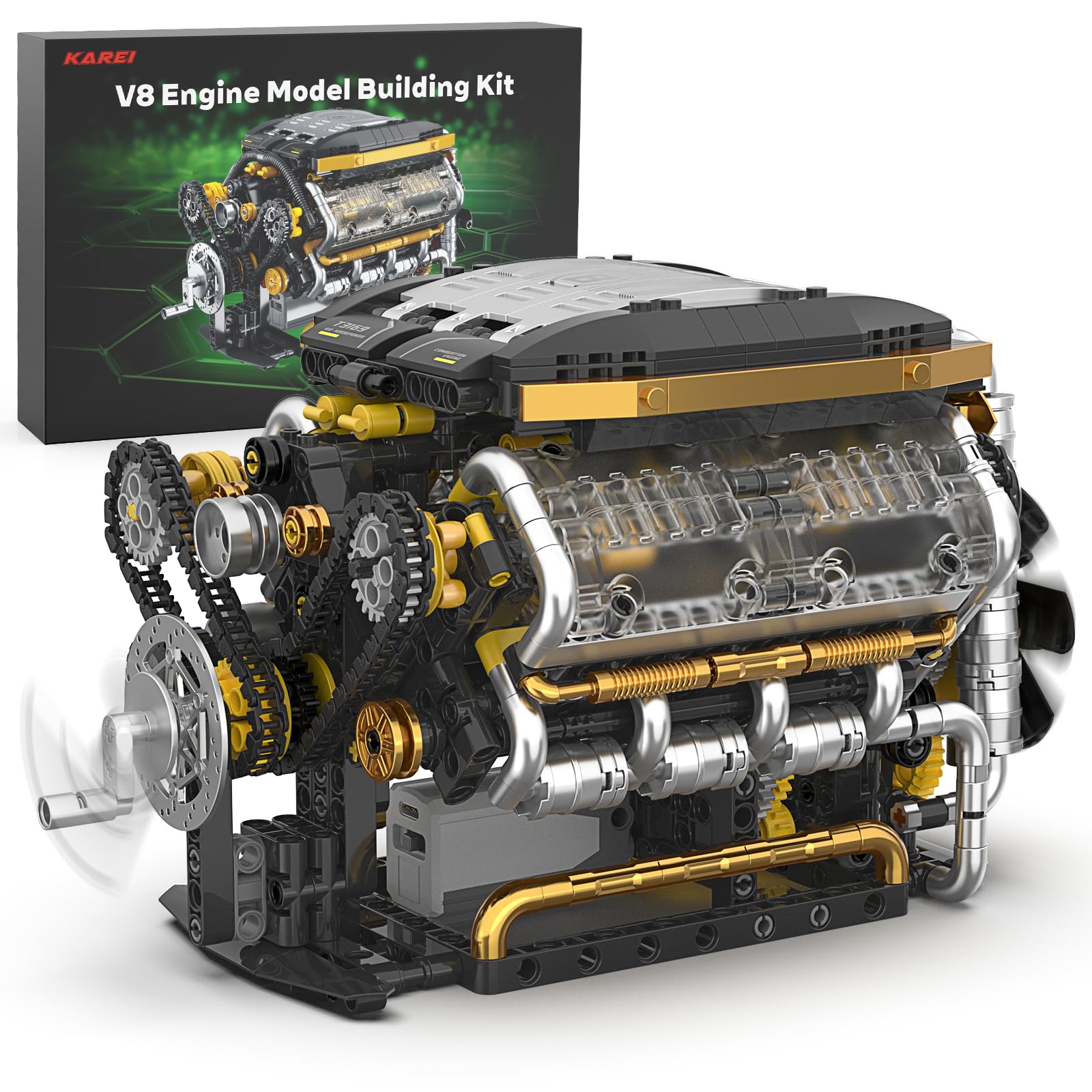
Rechargeable electric drive and a hand crank, in one 1,065-piece V8.
How does it compare on size against the other big builders? This V8 measures 10.39 x 5.75 x 5.98 inches and weighs 2.2 pounds — close in scale to the Mould King W16 but a slightly smaller footprint. what separates it is that the motor inside is USB rechargeable, so there’s no battery shopping list before you start.
The build itself is serious. You get moving pistons, valves, a turbocharger and an exhaust system, plus a crankshaft, fan and supercharger all driven by chain belts. Two modes let you run it electrically — the gear shifter and motor button combine for direction and speed, low or high in either clockwise or counterclockwise — or crank it manually with the handle. If you’re learning how a real motor cycles, seeing the chain-driven internals move is the payoff.
The complexity is the honest caveat. The 1,065-piece count and the 14-plus recommendation are there for a reason, and the manufacturer notes parts are made from non-toxic ABS with a firm finished structure. This is an adult or older-teen project, not a weekend quickie.
The rechargeable win: running the pistons off a USB-charged motor means the model is ready whenever you are, and the manual crank covers you if the pack is flat.
The fit note: 14+ and 1,065 pieces go together — plan on several sessions, not one.
Get this one if: you want the biggest V8 build here with two ways to run it.
Pass if: your builder is younger than the 14-plus rating suggests.
7. Mould King V12 Engine Model Kit

3,472 pieces, a 90-degree V12 and four speeds — this is the long haul.
No other kit on this list asks this much of your patience. The V12’s cylinders are arranged in a 90-degree V to counteract vibration as it runs, and the included battery and motor reproduce the dynamic principle 1:1. The drive train works through precise piston movements, and a gear lever lets you shift four different speeds.
Everything about the packaging says project. You get 3,472 parts with colorful paper instructions, and the set is compatible with mainstream building blocks so you can borrow spares. The ABS parts are described as easy to assemble and unlikely to fall apart once built — build quality is the thing this kit is best known for, and it’s rated for adults at 14 and up.
The one real friction point is the directions. Instructions split the room — some find them clear, others find the steps hard to follow on a set this large. Given the piece count, that’s a genuine time cost, and the assembly process is the aspect most likely to slow you down.
What the V12 brings
- 3,472 pieces and a 90-degree V12 layout for maximum build challenge
- Four speeds adjustable via a gear lever
- Battery and motor included so it runs after assembly
- Build quality is what this kit is best known for
Where it bites back
- Instructions divide opinion, and at this size that means real time lost
- Adult-level project — the size and part count demand a dedicated workspace
Built for: the experienced builder who wants a multi-week V12 project with shifting gears.
Second thoughts if: you only build in short evenings — 3,472 pieces will take a while.
8. TECHING Metal V8 Engine Model Kit
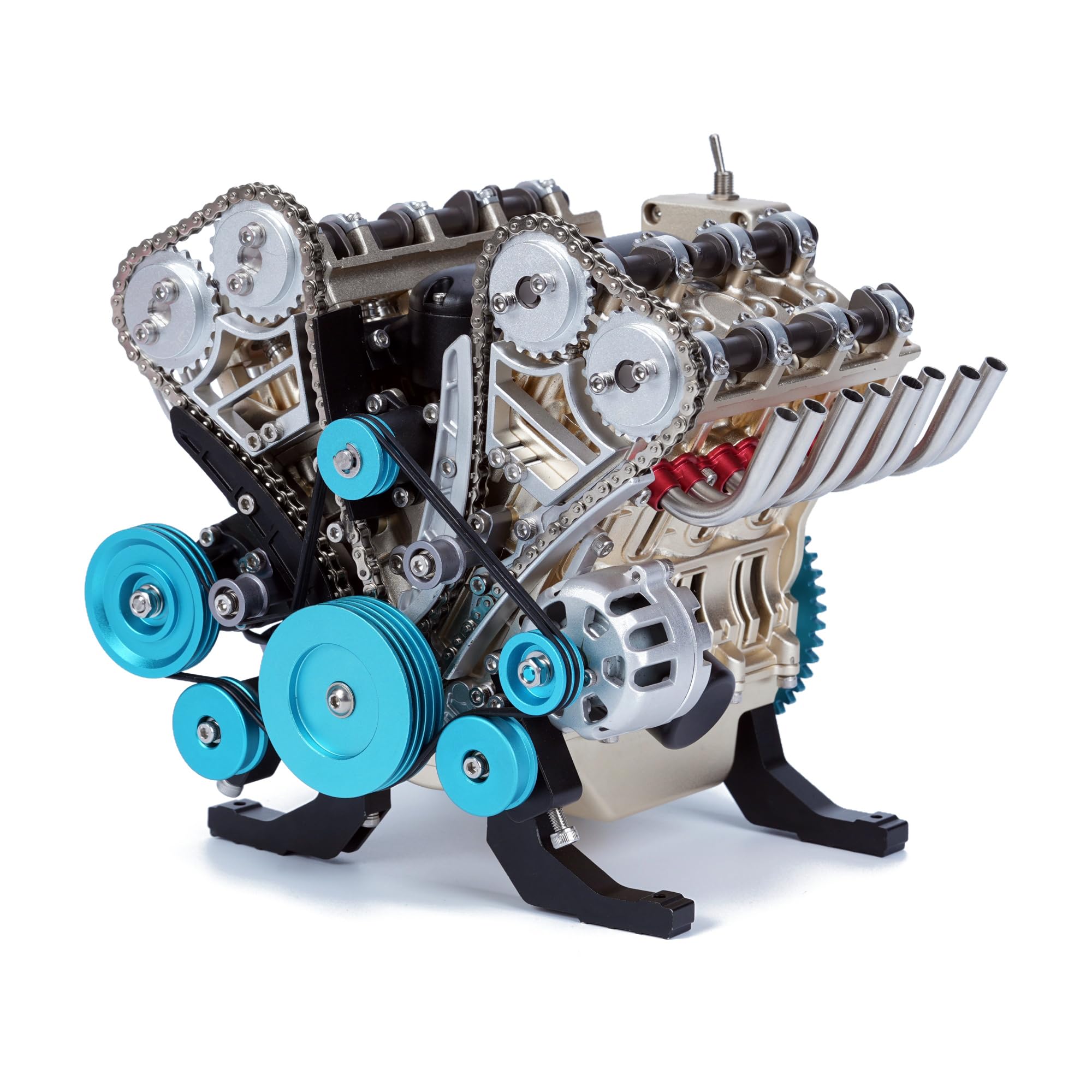
Machined aluminum instead of plastic, and a V8 that runs through a full four-stroke cycle.
This is the collector’s pick, and it feels different the moment you open the metal gift box. Precision-cast and machined parts in anodized aluminum and stainless steel replace the plastic bricks everywhere else on this list. More than 500 labeled components arrive in custom foam trays, with a full tool set and a color manual guiding roughly five hours of assembly. At 6.3 pounds and 7.80 x 6.69 x 7.09 inches, it is by far the heaviest finished model here.
The exposed DOHC layout is what you’re paying for. Two angled cylinder banks, four overhead camshafts, dual timing-chain drives, a central intake section and outward-facing exhaust headers are all visible before you switch it on. Once running, a motor hidden inside the starter housing drives the crankshaft, connecting rods, pistons and valvetrain through a four-stroke sequence — camshafts, timing chains and belt-driven pulleys all shifting motion across the block.
The caveat is fair and worth naming plainly: with a machined-metal kit, parts can fit too loosely or too tightly, and the instructions don’t always resolve the ambiguity. On a five-hour assembly, expect to spend some of it adjusting. But the model quality is what buyers value, and the educational payoff lands just as hard — this is an engine you leave on a study desk and people pick up.
The premium payoff: anodized aluminum and stainless steel, exposed camshafts and see-through viewing openings make this the only kit here that looks like a machined instrument.
Plan extra time: about five hours of assembly, and some of it goes to fitting adjustments.
For the collector: an engineering fan who wants a metal V8 to display in a study or workshop.
Not for the first-timer: five hours of assembly and tight metal tolerances reward someone who has built a model before.
Know the Specs
Piece count and what it really means
Piece count is the closest thing to a difficulty score on these kits. A 100-piece build finishes in an afternoon; a 3,472-piece V12 spans weeks. More importantly, more pieces usually means finer internals — a kit with 1,065 parts can carry chain-driven camshafts and a working gear lever where a 175-piece kit shows simple piston travel. A 175-piece kit finishes in an afternoon and a 3,472-piece V12 takes weeks, so pick the piece count that fits your evenings.
Motorized drive vs manual crank
A motorized drive turns the crankshaft for you, so you stand back and watch the pistons cycle — usually via a battery box or a built-in rechargeable pack. A manual crank asks you to turn a handle, which is fine for short demonstrations but tiring over time. Dual-mode kits like the Karei V8 let you crank the pistons by hand once the rechargeable pack runs flat.
Cylinder layout and build complexity
An inline four lines its pistons in a straight row, so the crank and valve motion is easy to follow. A V8 splits them into two angled banks; a W16 fuses two V8s into a W shape; a V12 sets cylinders at 90 degrees to counter vibration. Each step up adds gears and timing connections, so cylinder layout predicts build difficulty better than piece count alone.
Transparent internals and age ratings
A clear cylinder head or transparent engine case is why these kits exist — it turns hidden motion into something you can watch and explain. Check that the listing mentions clear or exposed internals if seeing the pistons is your goal. Age ratings from 8-and-up to 16-and-up reflect part size and instruction clarity as much as complexity, so treat them as a real guide when buying for someone younger.
Common Questions
Do working engine model kits need batteries to run?
What is the difference between a working engine kit and a display model?
Can you actually see the pistons move inside these engines?
How hard is a 3,472-piece V12 engine kit to build?
Are these engine kits compatible with standard building blocks?
What age are these working engine kits actually suitable for?
Do the metal engine kits run differently from the plastic brick ones?
What should I do if pieces are missing from the kit?
Is a V8 kit harder to build than a four-cylinder one?
Can these engine models be displayed long term after building?
The Bottom Line
The working model engine kits worth building are the ones you’ll actually switch on — and the Mould King 10131 W16 does that best, pairing 952+ pieces with a transparent cylinder head, four turbochargers and a running motor. If you want a compact builder the whole family can finish, the National Geographic 4-Cylinder is the honest first-engine pick. And if you’re chasing the most demanding build here, the Mould King V12 gives you 3,472 pieces, four speeds and weeks of evenings.
How we choose
We do not accept paid placement. Every pick is matched to a real buyer and a real use-case; we do not hands-on test units.
Sources
Specifications: manufacturer listings and product documentation. Review insights: verified customer reviews, as of November 2026. Pricing: not shown on this page (it changes often); check the current price via the retailer link.
As an Amazon Associate, Tactical Gear Guy earns from qualifying purchases. This does not affect which products we feature.