Specs are compiled from manufacturer listings and verified buyer reviews and can change over time — please confirm the key details on the product page before buying.
You want a lawn that comes in thick and even, not a patchwork of burned stripes and bare gaps. That is exactly what a spreader decides for you. The right one drops the same dose across the whole pass, rolls over uneven ground without tipping, and holds enough material to finish a zone on one fill. The wrong one dumps a fat stripe down the middle of your path and leaves the edges starving.
This guide is built by comparing the manufacturers’ published specifications and the patterns across verified customer reviews, so you get each pick’s real strengths and trade-offs instead of marketing spin.
Below you will see how hopper capacity, gate control, and tire size split these machines apart, plus the honest quirks that show up once the bag is empty and the season is real. Every pick here earns its place as a genuinely useful yard fertilizer spreader.
Top Picks

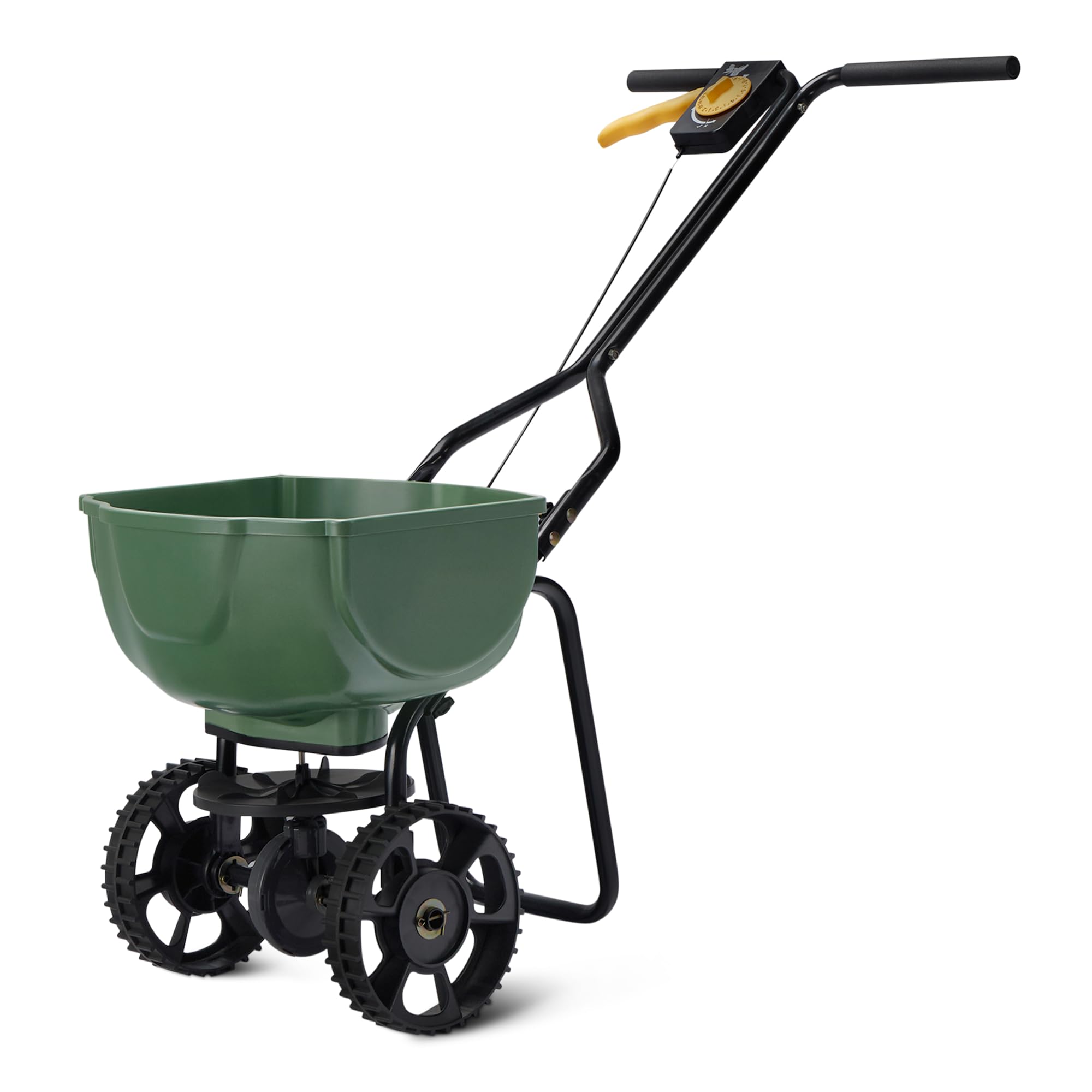

How To Choose The Best Yard Fertilizer Spreader
A fertilizer spreader is a simple machine — a hopper, a gate, and a spinning disc or drop slot — but the small differences decide whether your lawn greens up evenly or shows stripes. Start with how much ground you actually cover in one pass, then work backward to the hopper and the tires.
Match the hopper size to your lawn
Hopper capacity is measured in pounds of material, not square feet, because a bag of fertilizer, a bag of seed, and a bag of ice melt all weigh differently. A 40-lb hopper means fewer refills on a small-to-mid lawn. A 100-lb hopper means one fill can carry you across a large property. If your yard runs past a few thousand square feet, size up to a 50-lb or larger hopper.
Look hard at the gate and drop-rate control
The gate is the opening at the bottom of the hopper, and the drop-rate setting decides how wide that opening sits. A precise, easy-to-reach control lets you dial a light seeding pass or a heavier fertilizer dose without guessing. A shut-off gate that seals fully matters too — it stops material leaking onto your driveway while you turn around.
Pneumatic tires versus plastic wheels
Pneumatic tires are air-filled rubber tires, and they roll over roots, ruts, and soft ground without digging in or bouncing the hopper. Plastic wheels are lighter and cheaper but tend to skip and jolt on uneven turf, which throws off your spread pattern. If your lawn is lumpy or you cross gravel, air-filled tires are worth the extra weight.
Check the frame and hopper material
Fertilizer and ice melt are corrosive, so a rust-proof poly hopper or a stainless steel frame lasts longer than plain painted steel. An enclosed gearbox keeps grit and moisture out of the moving parts. Those are the details that decide whether the agitator still turns freely in year three.
Side-by-Side Comparison
| Model | Best For | Hopper Capacity | Spread Width | Weight | Amazon |
|---|---|---|---|---|---|
| Scotts Turf Builder EdgeGuard DLX★ Best Overall | No-fuss year-round spreading | Up to 15,000 sq. ft. of product | — | 10.9 pounds | Amazon |
| Amazon Basics Broadcast SpreaderBudget Champion | Budget-friendly small lawns | 33 pounds | — | 8.86 pounds | Amazon |
| Yard Commander Commercial 50 LBRough-Terrain Pick | Rough terrain and big coverage | 50 pounds | 10-12 feet | 26.4 pounds | Amazon |
| EarthWay 2600A-PLUS | Prosumer precision on a mid lawn | 40 pounds | — | 15 pounds | Amazon |
| Agri-Fab 45-0532 Pro Push | Large properties, fewer refills | 85 pounds | — | 22 pounds | Amazon |
| Brinly P20-500BHDF-A | Long-term durability and control | 50 pounds | — | 28.5 pounds | Amazon |
| Agri-Fab 45-0614 | Half-acre coverage in one fill | 130 pounds | 10-12 feet | 22 pounds | Amazon |
| EarthWay 2150 Commercial | Heavy commercial workloads | 50 pounds | — | 25 pounds | Amazon |
| Chapin 8400C SureSpread | Acreage and tough farmland | 100 pounds | — | 38 pounds | Amazon |
Detailed Reviews
1. Scotts Turf Builder EdgeGuard DLX Broadcast Spreader
Our pick — 4.0+★ from 6,500+ verified ratings; the strongest balance of quality and price.
The one that keeps fertilizer off your driveway so your lawn greens and your concrete stays clean.
For a homeowner who wants to open the box and get spreading the same afternoon, this is the easiest starting line in the group. It arrives pre-calibrated and ready to use, so there is no dial-and-guess session before your first pass. It holds up to 15,000 sq. ft. of Scotts lawn products per fill — a number that means one hopper carries you across a typical suburban front and back yard without a refill stop.
The feature that actually earns it the top spot is EdgeGuard, a shield on the side of the spread pattern that keeps product off landscaping, driveways, and sidewalks. If you have ever watched fertilizer pellets scatter across a walkway and stain it, you know why that matters. The hopper and agitator are built to funnel product down smoothly for consistent coverage, and the same machine handles lawn food, grass seed, salt, and ice melt across the year.
The catch is durability at the edge-guard assembly — some long-term users report that part giving out earlier than the rest of the spreader. It is light at 10.9 pounds, which makes it easy to push but also means it is a residential tool, not a farm-grade unit. Treat the shield gently and store it dry, and it holds up fine for normal seasonal use.
What it does well
- Ships pre-calibrated, so no setup dialing before first use
- EdgeGuard shield keeps product off drives and beds
- Handles fertilizer, seed, salt, and ice melt across all seasons
- Covers up to 15,000 sq. ft. per fill of Scotts product
Where it asks for care
- Edge-guard component is the part most likely to wear early
- At 10.9 pounds it is built for residential duty, not acreage
Reach for this if: you want a ready-to-go spreader that protects your hardscaping and pulls double duty as an ice melt spreader in winter.
Look elsewhere if: you are managing a large property and want a hopper that carries a full heavy bag without constant refills.
2. Amazon Basics Broadcast Fertilizer Spreader
Featherweight and honest-priced, this one is built for a small yard and a first-time spreader.
At just 8.86 pounds, this is the lightest machine in the group — the Brinly P20-500BHDF-A weighs 28.5 pounds — so if you have a small lot and no interest in wrestling a heavy hopper, that gap is the whole story. It carries 33 pounds of material and covers up to 5000 square feet per load. For a compact suburban lawn, that is one fill and done.
The steel frame and plastic bin stand up to all-season weather, and the release cable comes pre-installed so assembly is quick. Owners describe smooth operation and even spreading once it is set up, and the multi-gear control covers a reasonable range of drop rates. It handles seed, fertilizer, salt, and ice melt — same four jobs as the rest of the group.
What it does not do is precision. The 3.5+ rating and the mixed feedback tell you this is a basic tool that mostly works, with the occasional unit that leaves a buyer frustrated. If you want spreadsheet-level accuracy for a show lawn, this is not it. If you want a light, low-cost spreader to green up a modest yard a couple of times a year, it does the job.
Where it fits: a first spreader for a small lawn, a rental property, or a backup unit you keep for ice melt in winter.
The honest limit: it is the least precise pick here, so treat the gear settings as a starting point and walk your passes slowly for even coverage.
Worth it for: budget-minded buyers with under a quarter acre who want light handling over heavy capacity.
Step up if: you need repeatable, dialed-in accuracy or a hopper that carries a full heavy bag.
3. Commercial 50 LB Walk-Behind Push Broadcast Spreader
Big studded tires and a clog-free grate for the lawn that fights back.
This spreader is large at 40.9 x 21.3 x 36.4 inches — against the Scotts Turf Builder EdgeGuard DLX at 19 x 22 x 22 inches, so measure your storage shed before you commit. In exchange you get 12-inch pneumatic studded tires built for high flotation over tough ground, plus a 50-pound corrosion-resistant composite hopper that holds a full bag and still stores compactly.
The clog-free grate is the practical win — it keeps big chunks from jamming the hopper opening, and it lifts out when you do not need it. A fully enclosed gearbox shields the moving parts from weather, and the adjustable drop rate lets you set the spread radius from 10 to 12 feet.
Honest read on the scores here: assembly frustrates a fair number of buyers, and reliability is a split verdict — some units run great, others do not hold up. It also carries extra weight, which is the price of those tires. If you want the flotation tires and a full-bag hopper, plan for a fiddly build day and check the gearbox as soon as it arrives.
The tire advantage: 12-inch pneumatic tires roll over ruts and soft ground where small plastic wheels stall.
Set aside time: build quality on arrival is the variable to watch — assemble carefully and test the spread before the return window closes.
Pick this for: uneven ground and a hopper that swallows a full 50-pound bag.
Pass if: you dread assembly or need a machine that lives up to every spec right from the start.
4. EarthWay 2600A-PLUS Fertilizer Spreader

A 3-hole drop gate and solid linkage for people who actually read the fertilizer bag rates.
What sets this EarthWay apart is the 3-hole drop shut-off system with solid linkage — a gate design that gives you precise, repeatable distribution rather than an approximate guess. The hopper is rust-proof polypropylene and the frame is epoxy powder-coated steel, so the weather does not chew it up. It holds 40 pounds, a useful middle ground for a normal residential lawn.
Owners like the all-terrain pneumatic tires for moving over varied surfaces, and the prosumer framing fits — it is a step up from entry tools without going full commercial. What wins people over is ease of use once it is going, and the versatility of spreading both seed and fertilizer through the same machine. For tall fescue seed or a seasonal feed, the 40-pound hopper cuts down on refill stops.
Now the part you need to hear clearly: assembly gets a lot of mixed-to-negative talk, with dozens of buyers finding it incredibly difficult, and the printed instructions get the heaviest criticism of any part of this machine. The spreading itself also draws a split verdict. None of that means it is a poor spreader once built — it means you should budget an afternoon and pull up a video guide rather than trusting the paper sheet.
Reasons it earns the spot
- 3-hole drop gate with solid linkage for precise distribution
- Rust-proof polypropylene hopper with epoxy-coated steel frame
- All-terrain pneumatic tires handle varied ground
- Handles both seed and fertilizer through one 40-lb hopper
The honest friction points
- Assembly is genuinely difficult and the printed instructions draw the most criticism
- Spread consistency produces a split verdict among buyers
Built for: the buyer who wants drop-gate precision and does not mind a real assembly session.
Think twice if: you want to spread within an hour of opening the box.
5. Agri-Fab Inc 45-0532 Pro Push Spreader, 85-lb. Capacity

An 85-pound hopper against a 40-pound machine, so refills come far less often.
Capacity is the whole argument here. At 85 pounds versus the EarthWay 2600A-PLUS at 40 pounds, you cross a large lawn on one fill instead of several. The spacious polypropylene hopper is made for exactly that — covering wide ground with a push-behind spreader while refilling less often. It is built in the USA and weighs 22 pounds, so it stays pushable even loaded.
Adjustable spreading control lets you tune the flow for fertilizer or seed, and the pneumatic caster setup keeps it moving. Owners praise the 85-lb hopper and the pneumatic tires, and most say it spreads fertilizer well. For a large yard and a bag-heavy fertilizer plan, that capacity is real money saved on time.
The trade to know: assembly and performance land on both sides of the fence, with some units going together easily and running well while others fight the build or underperform. There is also no manufacturer warranty listed, which is worth factoring in for a machine this size. Build it carefully, test it early, and the capacity advantage shines.
Capacity that pays off: 85 pounds per fill versus 40 on the smaller units means dramatically fewer stops on acreage.
The fine print: no listed manufacturer warranty and a split record on assembly — do a careful first-season check.
Best matched to: large lots where refill time is the real cost and you want one fill per zone.
Not for: buyers who want factory-backed coverage or a guaranteed easy build.
6. Brinly P20-500BHDF-A Push Spreader with Side Deflector Kit

Stainless hardware and an enclosed gearbox — serious build for a spreader you keep for years.
The spec sheet here reads like a machine meant to outlast the lawn it feeds. You get a rust-resistant fully enclosed gearbox, and stainless steel hardware, shaft, and agitator that eliminate downtime and cut maintenance. The hopper is heavy-duty rust-proof and holds 50 pounds of fertilizer, seed, or snow and ice-melt. It is the heaviest unit in the mid-group at 28.5 pounds — heavier than the EarthWay 2600A-PLUS at 15 pounds — and that weight is the hardware doing its job.
The side deflector kit is the standout control feature: it holds material flow back from unwanted areas and flips up and out of the way when you do not need it. Big 12″ x 3″ pneumatic turf-tread tires push easily over the lawn, and easy-to-reach controls with simple calibration settings keep your rates accurate. What wins people over most is overall quality and functionality — it feels professional in the hands.
Where it wobbles is the lever mechanism and spread consistency, both of which split opinion. Some find setup and use simple, others fight the lever. It is a heavy machine to push with a full hopper on wet grass. If you want a long-haul tool and can handle the weight, this is a smart pick.
Why it stands out
- Stainless steel hardware, shaft, and agitator resist rust and reduce upkeep
- Side deflector flips up out of the way when you do not need it
- Fully enclosed gearbox shields moving parts
- Large 12″ x 3″ pneumatic turf-tread tires roll easy
What to weigh
- At 28.5 pounds it is heavy to push when loaded on soft ground
- Lever mechanism and spread consistency draw split feedback
Ideal for: someone who wants a spreader that feels professional and is willing to trade a little push weight for stainless durability.
Skip if: you need the lightest possible push over wet, mushy turf.
7. Agri-Fab 45-0614 130 lb. Push Broadcast Spreader

One hopper, half an acre — the biggest single-fill reach before you hit commercial pricing.
This is the capacity headline of the mid-tier: a 130-pound hopper that covers 1/2 acre, or 25,000 square feet, in one go. The 10-to-12-foot spread width rolls out fast across open ground, and 13″ x 4″ pneumatic tires handle the terrain. A direct rod control keeps the gate operation simple, and the whole thing is built in the USA. At 22 pounds it stays manageable despite the huge hopper.
Owners describe it as well-built with quality that reads professional-grade, and the large tires make it easy to operate across a wide lawn. For anyone feeding a big property, the fewer-refill math is the entire value proposition — fill once, walk your zones, done.
The honest caveat is that this is a big, wide machine, and the control is a direct rod rather than a fine-tuned dial, so precise low-rate seeding takes a steady hand. It is built for volume, not fussy fine application. If you need acres fed fast, the capacity wins.
The coverage math: 1/2 acre per fill at a 10-12 foot spread turns a full-day job into a couple of passes.
The trade: a simple direct-rod control favors volume over fine dialing — not the tool for hairline seeding rates.
Made for: half-acre yards and bigger where refills are the bottleneck.
Look past it if: you want a fine-tuned drop-rate dial for light overseeding.
8. EarthWay 2150 Commercial 50 LB Broadcast Fertilizer Spreader

A five-year warranty and stud tires — this is the one built to be used hard every season.
Where the 2600A-PLUS is prosumer, this EarthWay 2150 is aimed at real workload. It carries 50 pounds, weighs 25 pounds, and rides on 13-inch high-flotation pneumatic stud tires with rustproof poly rims that glide over rough, uneven lawn. The clog-free grate separates out big chunks before they jam the hopper, and it slides out when you do not need it. A fully enclosed gearbox is meant to give the same clog-free results even in moist, damp conditions.
The 3-hole-drop system with side-spread control is the precision story — it promotes an even spread pattern with feathered edging, and you adjust the drop rate right on the spreader. What wins people over here is quality: sturdy steel construction, accurate spreading, and it stays easy to push even fully loaded. The 5-year limited warranty backs it up in a way most of this group does not.
Two things to plan around. Assembly is the most-discussed part of this machine and it splits opinion, and the instructions draw heavy criticism — count on a video guide rather than the paper sheet. Once built, though, it is a serious spreading tool. For a large property or a small pro operation, the warranty and stud tires make it a confident pick.
Where it puts in work
- 5-year limited warranty gives real long-term backing
- 3-hole-drop system with feathered edging for even coverage
- 13-inch high-flotation stud tires glide over rough ground
- Sturdy steel construction stays pushable fully loaded
Plan around
- Assembly is the most-discussed pain point, with heavy criticism of the instructions
- 50-pound hopper means more fills than the 130-pound Agri-Fab on big acreage
The right call for: heavy seasonal use where a 5-year warranty and stud tires matter more than a quick build.
Give it a miss if: you want a spreader you can use the day it lands.
9. CHAPIN 8400C 100-Pound Professional SureSpread Turf Spreader

A 100-pound hopper on a stainless steel frame, built for acreage and tough farmland.
This is the most substantial machine in the group: a 100-pound capacity, weather- and rust-resistant one-piece poly hopper supported on a stainless steel frame, with an enclosed gearbox and a grease fitting to keep friction down. It weighs 38 pounds — the heaviest pick here — and rides on 14-inch pneumatic tires meant to handle uneven farmland and tougher terrain. A rain cover and hopper grate come included.
The spread control is a rotary gate with steel linkage, which lets you apply fertilizer, seed, weed control, and pest control particles across the seasons. The T-shaped handle with rubber grips lets you push it over rough ground with or without gloves. Owners call it a quality spreader with solid construction, and the 14-inch pneumatic tires are a noted advantage over smaller-wheeled machines. It is made in the USA and backed by a 5-year limited warranty.
The limits are firm and worth stating plainly: assembly is required, and this spreader is not recommended for salt products, sand or sand mixes, pelletized lime, lime, or lime powders. So if winter ice melt is part of your plan, this is the wrong tool. For acreage and serious turf feeding, though, the stainless frame and 100-pound hopper are a long-term buy.
What you are paying for: a stainless steel frame, an enclosed gearbox with a grease fitting, and a hopper that holds 100 pounds.
Know before you buy: salt, sand, and lime are off the menu, and you will assemble it yourself.
Right for: acreage owners feeding turf at volume who want stainless durability and a 5-year warranty.
Wrong for: winter ice-melt duty or anyone wanting a no-assembly spreader.
Know the Specs
Hopper capacity in pounds
This is how much material the bin holds, measured by weight. A 40-pound hopper suits a modest lawn with a few refills. An 85- or 100-pound hopper means one fill covers far more ground — but a heavier bag also means more weight to push. Buy capacity to match your property, not the biggest number.
Spread width and drop rate
Spread width is how wide a swath the machine throws, often 10 to 12 feet on broadcast models. The drop rate is how fast material falls through the gate. Together they set your coverage. A wide spread saves passes; a precise gate saves product and prevents burned stripes.
Pneumatic tires
These are air-filled rubber tires that cushion the ride over roots, ruts, and soft turf. They keep the hopper level and the spread even, where small hard wheels skip and jolt. On rough ground, bigger air-filled tires are the difference between a smooth pass and a fight.
Frame and hopper material
Fertilizer and ice melt corrode metal, so rust-proof poly hoppers and stainless frames last longer. An enclosed gearbox keeps grit and moisture out of the turning parts. Those are the details that decide whether the gearbox still spins freely next season.
Common Questions
How do I set the right drop rate for fertilizer?
Can a broadcast spreader also spread grass seed and ice melt?
What size hopper do I need for a half-acre lawn?
Do I need pneumatic tires or will plastic wheels work?
Why does my spreader leave stripes of fertilizer?
How long should a push spreader last?
Is a broadcast spreader better than a drop spreader?
Do I need to clean the spreader after using fertilizer?
Can I use one spreader for both fertilizer and weed control?
How much assembly is involved in a push spreader?
The Bottom Line
If you want the easiest win for a normal suburban lawn, the Scotts Turf Builder EdgeGuard DLX is the one to grab — it arrives ready to use and its EdgeGuard shield keeps fertilizer off your driveway, which is the payoff most homeowners feel on the first pass. For rough terrain and a full 50-pound bag, the EarthWay 2150 backs its build with a 5-year limited warranty. And if half an acre or more is on your schedule, the Agri-Fab 45-0614 carries 130 pounds per fill so you stop refilling and start covering ground.
How we choose
We do not accept paid placement. Every pick is matched to a real buyer and a real use-case; we do not hands-on test units.
Sources
Specifications: manufacturer listings and product documentation. Review insights: verified customer reviews, as of November 2026. Pricing: not shown on this page (it changes often); check the current price via the retailer link.
As an Amazon Associate, Tactical Gear Guy earns from qualifying purchases. This does not affect which products we feature.