Specs are compiled from manufacturer listings and verified buyer reviews and can change over time — please confirm the key details on the product page before buying.
If you lift, jump, or do HIIT on a hard floor, the right workout floor mat is the one that stays exactly where you put it and swallows the noise. Get that wrong and every squat turns into a slide, and every dropped dumbbell sends a thud through the whole floor. This guide covers nine mats that solve that in different ways — roll-up sheets for open floor space, interlocking tiles for big rooms, and thicker surfaces for knees and elbows on concrete.
This guide is built by comparing the manufacturers’ published specifications and the patterns across verified customer reviews, so you get each pick’s real strengths and trade-offs instead of marketing spin.
You can judge every workout floor mat below on three things: how thick it is, how well it grips, and how it holds up to a real home gym with shoes on and weights coming down. Your right pick depends on one question: do you need a mat you roll away, or a floor you lay down for good? Answer that and the nine picks below sort themselves in minutes.
Top Picks


How To Choose The Best Workout Floor Mats
Thickness is not the first question — roll-up sheet or interlocking tiles is. The first question is if you want a floor you build or a mat you roll. Roll-up or tiles rules out half of these nine picks before you read a single spec.
Roll-up sheet or interlocking tiles
A roll-up sheet — a single large mat you unroll for a session and roll away afterward — suits a living room or a garage bay you share with a car. It goes flat fast and stores in a bag. Interlocking tiles are individual squares that link like puzzle pieces to build a permanent floor. They cover a whole room, stay down, and you can pull one out if it gets damaged. The trade-off: tiles take longer to assemble the first time and they are not something you roll up and carry.
What thickness actually does
Thickness buys you cushioning for knees, wrists, and elbows, plus a little noise reduction underfoot. More thickness is not always better: a very thick soft pad can wobble under a heavy squat. A very thick soft pad can wobble under a heavy squat, and a thin pad lets your knuckles hit concrete. Roll-up fitness mats in this roundup run from 0.27 inch to 0.5 inch. Puzzle tiles run from 0.4 inch up to 0.79 inch. Match the number to what you do: a stability pad for standing lifts, a deeper pad for floor work and stretching.
Grip is the make-or-break spec for burpees and heavy sets
A mat that slides during a burpee is a hazard, so check the underside pattern before the thickness. Look for a textured top that grabs hands and feet, and a bottom that grips the floor underneath. Double-sided non-slip surfaces do both. On smooth hardwood, a suction-cup or dense circular underside pattern holds far better than a plain smooth back.
Side-by-Side Comparison
| Model | Best For | Thickness | Coverage | Style | Amazon |
|---|---|---|---|---|---|
| GymCope Large Exercise Mat★ Best Overall | All-round home gym | 0.27″ (7mm) | 6′ x 4′ | Roll-up sheet | Amazon |
| GXMMAT Large Exercise MatTop Performer | Garage floors & cardio | 0.28″ (7mm) | 6′ x 6′ | Roll-up sheet | Amazon |
| VEVOR Large Exercise MatWidest Coverage | Whole-room coverage | 0.28″ (7mm) | 12′ x 6′ | Roll-up sheet | Amazon |
| AIRHOP Dual-Layer Tiles | Heavy weights on hard floor | 0.79″ | 48 sq ft | Puzzle tiles | Amazon |
| MRO Extra Large Exercise Mat | HIIT and shoe workouts | 0.28″ (7mm) | 8′ x 4.5′ | Roll-up sheet | Amazon |
| HAPBEAR Large Exercise Mat | Joint cushioning | 0.32″ | 7′ x 5′ | Roll-up sheet | Amazon |
| Hatha Yoga Large TPE Mat | Yoga and floor work | 0.5″ | 6′ x 4′ | Roll-up sheet | Amazon |
| BalanceFrom Puzzle Mat | Big-room flooring value | 0.75″ | 96 sq ft | Puzzle tiles | Amazon |
| bemaxx Gym Mats Set | Custom floor coverage | 0.4″ | 96 sq ft | Puzzle tiles | Amazon |
Detailed Reviews
1. GymCope Large Exercise Mat
Our pick — 4.5+★ from 800+ verified ratings; the strongest balance of quality and price.
The 6′ x 4′ sheet that anchors a home gym you share with a car and a concrete floor.
The headline number is the size: a 6′ x 4′ sheet at 0.27 inch (7mm) thick. That is enough room to move through a full routine without stepping off. The 0.27-inch high-density PVC pad gives you cushioning without a spongy wobble underfoot, so squats and lift setups feel planted. It’s the most complete package here for one reason — every size in the lineup works as a roll-up mat you keep down, not a floor you build.
What wins people over is the density of the PVC. It’s tear-resistant and abrasion-resistant, which matters when you train in shoes. The double-sided anti-slip surface keeps a grip on tile, carpet, concrete, and hardwood — and once it’s down, it stays down. Owners running it in a garage over concrete report it doesn’t shift or slide mid-workout, and it’s firm enough underfoot for burpees and squats.
The catch is the thickness. That 0.27 inch is on the lean side compared to the deeper puzzle tiles, and the thickness feedback is the one mixed spot in the record. If you want a deep pad for long floor work on bare knees, look at the Hatha below. For everything else — cardio, weights, stretching — this is the sheet to beat. It’s the best overall because one 6′ x 4′ PVC sheet grips tile, carpet, concrete, and hardwood and rolls away with a bag.
What holds up under use
- High-density PVC resists tearing and scratching under shoes
- Double-sided grip stays put on tile, carpet, concrete, and hardwood
- 6′ x 4′ gives real room for full routines
- Rolls up with a bag and 3 straps for storage
Where it comes up short
- 0.27-inch thickness is lean for deep floor work
- Thickness feedback is the one mixed note
Go for it if: you need one mat for a shared garage or living-room setup that grips and rolls away.
Pause if: you want a deep pillow under bare knees for long stretching sessions.
2. GXMMAT Large Exercise Mat
The square 6′ x 6′ sheet built for garage cardio and jump-rope sessions.
Six feet by six feet is the shape that separates this from the rectangular sheets. That square footprint is wide enough for P90X and Insanity-style circuits, T25 and Zumba, and jump rope, and it works with or without shoes. The 7mm high-density memory foam hits a balance — stable enough to lift on, cushioned enough to protect knees and elbows during aerobics. It also cuts noise and vibration and keeps your floor free of scratches.
Grip is where it earns its keep. The double-sided non-slip surface grabs hands and feet, and the grooved matrix-circle underside stops the mat from sliding on the floor. Add the stability owners keep coming back to — it doesn’t creep or shift once it’s laid out — and it’s a very planted surface for garage training. It ships with a pair of gloves, 3 Velcro straps, and a carry bag, so rolling it up and stashing it is quick.
Here’s the honest limit: a 6′ x 6′ square is a big roll to store, and it’s heavier than the trimmer rectangles when you pack it away. It’s not the widest mat here either — the VEVOR spreads to 12′ x 6′ for the same kind of money. But for a single person who wants a stable square of floor for cardio and weights, this leads on grip and stability.
The stand-out: a grooved, matrix-circle underside that keeps the sheet from sliding is what most owners count on session after session.
The honest catch: the square footprint eats storage space, and it’s more awkward to carry than a slimmer roll.
Reach for this if: your sessions are cardio-heavy and you want a stable square that grips a concrete garage floor.
Look elsewhere if: you need the widest possible spread for multiple people at once.
3. VEVOR Large Exercise Mat
Turn a whole room into a gym with a 12′ x 6′ sheet made for three or four people.
This is the widest roll-up mat in the lineup by a wide margin. The 12′ x 6′ spread is sized for three or four people working out together, so a family session or a partner circuit never runs out of floor. Unroll it and a spare room becomes a training space. It handles yoga, HIIT, aerobics, dance, and jump rope, and it’s built from high-density PVC at 2800g/㎡ — a dense, wear-resistant surface that stays intact through long use.
The grip is a two-part job. The top is anti-slip and wear-resistant, and the dense circular texture underneath provides the traction that keeps the sheet from slipping or sliding out from under you. On floors — carpet, tile, hardwood, or a concrete garage — it protects the surface from scratches and gives you a 0.28-inch (7mm) pad that cushions joints while you move. It ships with a soft absorbent fiber towel, a storage bag, and 3 straps.
The catch is realistic: a 12′ x 6′ sheet is a serious roll to handle solo, and it’s not a mat you’ll want to unroll and pack up every single day. The thickness also draws mixed feedback — some find it plenty thick, others want more. If you have a dedicated space to leave it down, that extra width is the whole point. It’s the pick for groups and full-room conversions, not for a quick roll-out in a tight corner.
What it solves: a genuinely huge 12′ x 6′ surface that keeps a whole household training without stepping off the mat.
What to plan for: the size that makes it versatile also makes it awkward to store and carry, and thickness preferences vary.
Best for: a dedicated home-gym room where the mat stays down and several people train together.
Not ideal for: a small apartment where you pack the mat away after each session.
4. AIRHOP Dual-Layer Tiles
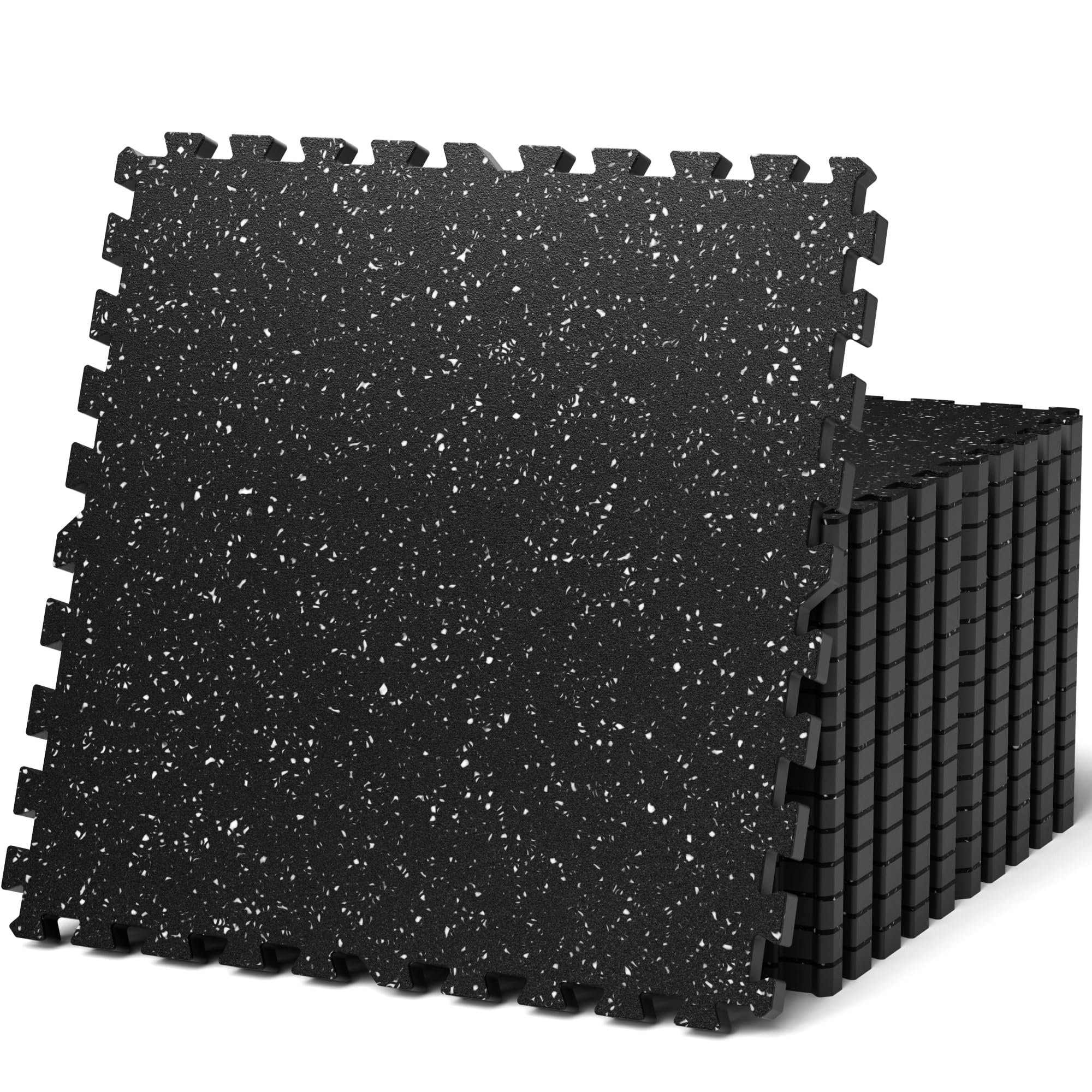
A rubber-topped, foam-backed tile floor that shrugs off dropped weights and dumbbells.
Where a bare foam tile can scuff under metal, this one puts a textured rubber top layer over a high-density EVA foam base. That two-layer build creates a non-slip, tough surface with strong shock absorption, so equipment doesn’t scratch through to the floor. Twelve tiles at 24″ x 24″ x 0.79″ each cover 48 sq ft — an 8 x 6 ft area. The upgraded interlocking locks hold a secure fit, so pieces don’t separate mid-session.
This is the deepest tile here at 0.79 inch, and it’s the pick for anyone placing heavy gear. The recycled rubber handles intense workouts and supports heavy machinery, protecting the floor from scratches, scuffs, and dents from weights, dumbbells, medicine balls, and jump ropes. Maintenance is simple — a damp cloth wipes it clean, and the EVA base dampens noise and vibration. Quality is what most owners point to, with durability close behind as tiles hold up to free weights being dropped on them.
The follow-up question is set-up time. Twelve interlocking tiles take longer to lay than a single roll-up sheet, and once they’re down they’re a permanent floor, not something you roll away. There’s also a mild odor note in the feedback as the tiles air out, which fades. If you want a protected basement or garage floor that stays put under real weight, this earns its place. For pure portability, a roll-up sheet wins.
Why it earns the heavy-duty slot
- Rubber top layer resists scratches, scuffs, and dents from weights
- 0.79-inch depth is the deepest tile here
- Larger interlocking locks hold pieces together during workouts
- Waterproof surface wipes clean with a damp cloth
The price of a permanent floor
- Twelve tiles take longer to assemble than one mat
- Permanent once laid — not a roll-away option
- Mild break-in odor as the tiles air out
Choose it for: a garage or basement floor that has to survive dropped weights and heavy gear.
Pass it by if: you need something you roll up and store between sessions.
5. MRO Extra Large Exercise Mat

An 8′ x 4.5′ shoe-friendly sheet that holds its grip through intense training.
The size sets the tone: 8′ x 4.5′ of surface at 0.28 inch (7mm), which is plenty of runway for HIIT, weightlifting, MMA, and Zumba. The double-sided non-slip design adds traction and grips the floor so it doesn’t slide out from under you, even in the toughest sessions. It’s built for shoes, and it doubles as an equipment mat, dance mat, jump rope mat, or kids’ play mat.
Underfoot it’s an upgraded high-density foam that cushions knees and elbows during aerobics while staying stable enough to lift on. It cuts noise and vibration and protects your floor from impact. The clean-up is quick, and it rolls up with 3 straps and a carry bag, so it stores without a fight. It also comes with a microfiber towel and a jump rope. Grip and quality are the two things owners lean on most here, and the sheet holds its place well during floor exercises and ab work.
The one thing to weigh: at 0.28 inch it’s a mid-depth pad, not a deep cushion, so heavy standing lifts feel firmer than long floor work. And the 8′ x 4.5′ spread is generous but not the widest here. If you train in shoes and want a big grip-first sheet that packs down, this is a smart buy. If you want a softer landing for knees, the thicker tiles come out ahead.
Where it shines: a shoe-friendly 8′ x 4.5′ sheet that stays gripped and stable through heavy, sweaty sessions.
Where it trades off: mid-depth cushioning means a firmer feel underfoot than the deepest puzzle tiles.
Worth it for: shoe-on training and floor work where you want grip and size without a deep, wobbling pad.
Think twice if: bare knees on long stretching sessions is your main use.
6. HAPBEAR Large Exercise Mat

The 8mm high-density pad that keeps your knees and wrists comfortable through intense cardio.
Here the number to notice is the depth. The pad runs up to 8mm (about 0.32 inch) of high-density foam, which is a step softer than the lean 0.27-inch sheets. That extra cushion goes to work on your knees, wrists, and elbows during intense aerobic exercise, absorbs shock, and cuts noise while protecting the floor. The 7′ x 5′ size in this build gives you room to move without stepping off.
The grip is a two-layer design: a corrugated top and a suction-cup bottom that combine for a strong hold and comfort. However strenuous the movement, it provides enough friction and stability to keep your ankles protected. Owners find it ideal for HIIT, yoga, and bodyweight training, with the non-slip surface keeping them steady. It rolls up easily, lies flat, and comes with HAPBEAR resistance bands and a storage bag. The high-density PVC resists curling and wipes clean.
The realistic caveat: at 8mm it’s softer, which some find perfect for floor work and a little less firm under heavy standing lifts. It’s also heavier to haul than a thinner pad. If cushioning for joints is your priority, this is the one to reach for. If you want maximum stability for loaded squats, the leaner sheets feel more planted.
The comfort angle
- 8mm high-density foam cushions knees, wrists, and elbows
- Corrugated top and suction-cup bottom for solid grip
- Resists curling, unlike ordinary yoga mats
- Includes resistance bands and a storage bag
What you give up
- Softer pad feels less firm under heavy standing lifts
- 15.6 pounds is on the heavier side to carry
The right call if: your joints need a softer landing through HIIT and bodyweight work.
Keep looking if: you want a stiff, dead-flat platform for heavy barbell work.
7. Hatha Yoga Large TPE Mat

A half-inch-thick TPE mat for tall bodies and floor work that needs a real cushion.
Half an inch of thickness is the defining figure, and it’s the deepest roll-up pad here. The 72″ x 48″ surface is genuinely large, wide enough that tall people with long arms and legs fit comfortably with room to spare. That 1/2-inch TPE (thermoplastic elastomers) pad cushions joints during floor work, so long sessions on your knees and hips feel kinder. At 8.8 pounds it’s lighter than the 13.2-pound GymCope, so carrying it to a class or another room is less of a chore.
Grip and durability come from a special non-slip texture on both sides and a high-density build. It holds traction through yoga, pilates, stretching, jump rope, and squats, and it doesn’t slip during use. The TPE material is phthalate-free and recyclable. Quality and size are what owners value most here, and the extra thickness is a common point of praise for being gentle on joints.
The honest trade-off: durability feedback is genuinely split — some owners find it tough, others report it tears with heavy use. TPE is a softer material than the PVC sheets, so it rewards careful handling and won’t love being dragged or dug into with shoes. There’s also an odor note as a new mat airs out. If you want a thick, body-sized cushion for yoga and floor work, this is the plush one. For a shoe-on, drop-proof floor, the tiles are the tougher bet.
What stands out: a full 1/2 inch of joint-friendly cushion across a 72″ x 48″ surface that fits long frames.
The fair caveat: TPE rewards gentle handling, and durability opinions are split between tough and tear-prone.
Pick it for: yoga, pilates, and floor work where you want a plush half-inch pad and a roomy surface.
Skip it for: shoe-on weight training, where the softer TPE won’t hold up like a PVC sheet.
8. BalanceFrom Puzzle Exercise Mat

A 96-square-foot EVA tile floor with the deepest tile cushion in the lineup.
The coverage is the headline: 24 foam tiles with 48 end borders giving 96 sq. ft. of cushioned flooring. The tiles are 24 x 24 x 0.75 inches, so you’re laying a genuinely deep 3/4-inch pad. Against the bemaxx set, which runs 0.4 inch thick, that’s a real depth difference. That high-density EVA foam (ethylene vinyl acetate) cushions your spine, hips, knees, and elbows on hard floors, so mat work on a concrete garage or basement stays comfortable.
Set-up is simple. The tiles interlock and the double-sided non-slip surfaces keep the floor securely in place through stretching, warm-ups, martial arts drills, or play. It resists moisture and wipes clean with soap and water, so sweat and spills are no problem. The whole floor is lightweight — 18 pounds total — so moving tiles and re-laying them is easy. Durability, easy assembly, and value are what buyers rely on most, and it works under a stationary bike as well as a mat area.
It’s also a build-it floor, not a roll-away mat. But for the coverage you get, it’s the value play — a big cushioned room for laying out a home gym or a kids’ activity floor. If you want rubber toughness under heavy weights, step up to the AIRHOP tiles. If you want a deep, roomy, budget-smart floor, this is it.
What it wins on: 96 sq. ft. of coverage at 3/4-inch depth — a lot of cushioned floor for the outlay.
What to know: foam compresses under very heavy loads, and it’s a permanent lay-down floor rather than a mat you roll up.
Ideal for: a big garage, basement, or kids’ play area that needs wide, deep, affordable coverage.
Reconsider if: you plan to drop heavy metal directly on it or want something portable.
9. bemaxx Gym Mats Set
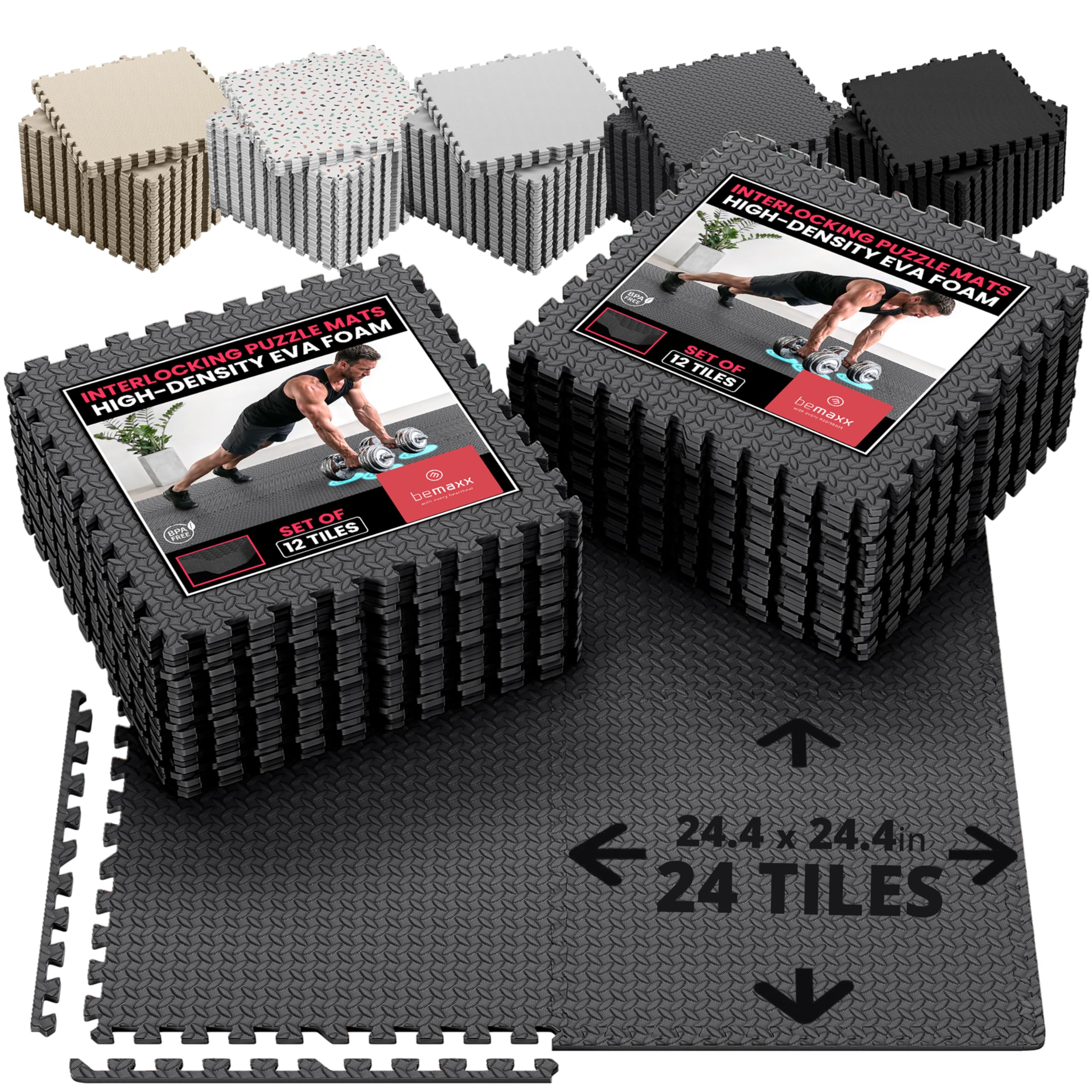
Twenty-four leaf-patterned tiles you can lay into roughly 16 by 12 feet of floor.
The coverage math leads here: 24 tiles at 24.4″ x 24.4″ x 0.40″ each, plus edge pieces, build out to roughly 16 ft x 12 ft — about 96 sq ft. The expandable puzzle design lets you shape the floor to your space instead of fitting your space to a fixed mat. The tiles are non-toxic, BPA-free, latex-free, and phthalate-free EVA foam, and they interlock easily. Coverage and easy assembly are what owners appreciate most.
This set is built for protecting a floor, not just training on it. The anti-slip surface and cushioned foam reduce pressure on knees and joints, dampen noise and impact, and insulate warmth. It shields concrete and hard floors from scratches, knocks, dents, cold, sweat, and other fluids — so it suits a home gym, a garage, a basement, or a playroom. It wipes clean with soap and water. The anthracite leaf pattern looks good enough to leave down, and the appearance is a genuine point of praise.
The honest limit is sturdiness, which is the one mixed note in the feedback — thin foam tile flexes and doesn’t shrug off heavy dropped loads the way a rubber-topped tile does. At 0.40 inch it’s also shallower than the 0.75-inch BalanceFrom and the 0.79-inch AIRHOP. So it’s the pick for a protected, good-looking, customizable floor under lighter gear and feet. For a floor that faces dropped dumbbells, move up to the AIRHOP.
The case for it
- 24 tiles plus edges cover roughly 96 sq ft
- Expandable puzzle design adapts to your room shape
- BPA-free, latex-free, phthalate-free EVA foam
- Leaf pattern that looks good left down
The trade-offs
- 0.40-inch depth is shallower than rival tiles
- Sturdiness is the one mixed note — thin foam flexes under heavy loads
A good fit for: a renter or home-gym builder who wants a flexible, good-looking floor under lighter gear.
Not the one if: you need rubber-level toughness for dropped iron.
Know the Specs
Thickness (mm and inches)
Thickness measures how deep the padding is under your body, and it’s what most people check first. A deeper pad cushions knees, wrists, and elbows and mutes noise, which helps on concrete. A thinner pad stays firmer and more stable under standing lifts. The roll-up sheets here run from 0.27 inch to 0.5 inch, and the puzzle tiles from 0.4 inch to 0.79 inch. Match depth to use: deeper for floor work, leaner for heavy standing lifts.
Coverage (square feet)
Coverage is the total floor area a mat or tile set fills. A single roll-up sheet covers one footprint — 6′ x 4′, or 12′ x 6′ on the widest option. Interlocking tiles multiply out: 24 tiles can reach around 96 sq ft. More coverage means more room to move without stepping off, but it also means a heavier, bulkier setup to store. Measure your space before you buy, and plan where it lives when it’s not in use.
Material: PVC vs EVA vs TPE
PVC is the dense, heavy-duty choice for roll-up sheets — tear-resistant and shoe-friendly. EVA foam is the lighter puzzle-tile material that interlocks and cushions while staying portable. TPE is a softer, recyclable material that feels plush under bare feet and suits yoga and floor work. Each has a place: PVC for grip and durability, EVA for coverage and assembly, TPE for cushioning and comfort.
Grip and non-slip surfaces
Grip is what keeps the mat from sliding during a burpee or a heavy set. Look for a textured or corrugated top that grabs hands and feet, and a bottom that holds the floor — a suction-cup pattern, dense circular texture, or grooved matrix underside. Double-sided surfaces do both jobs. On smooth hardwood, a patterned underside holds far better than a plain back, and that stability is the difference between training with confidence and chasing your mat.
Common Questions
How thick should a workout floor mat be for lifting weights?
Can I use a workout floor mat on carpet?
Are interlocking puzzle tiles better than a roll-up mat?
Will a workout mat protect my floor from dropped dumbbells?
Do workout mats smell when they’re new?
How do I clean a workout floor mat?
Is a 7mm mat thick enough for jump rope and HIIT?
Can I wear shoes on a workout floor mat?
How much floor space does a puzzle tile set cover?
The Bottom Line
For most home gyms, the workout floor mats winner is the GymCope Large Exercise Mat — a 6′ x 4′ PVC sheet that grips tile, carpet, concrete, and hardwood and rolls away with a bag when you’re done. If you train heavy and want a permanent floor that shrugs off dropped weights, reach for the AIRHOP Dual-Layer Tiles. And if you want a plush half-inch pad for yoga and floor work, the Hatha Yoga Large TPE Mat is the one to unroll. Choose roll-up for shared rooms, tiles for permanent floors, and the mat stops being a thing you think about.
How we choose
We do not accept paid placement. Every pick is matched to a real buyer and a real use-case; we do not hands-on test units.
Sources
Specifications: manufacturer listings and product documentation. Review insights: verified customer reviews, as of November 2026. Pricing: not shown on this page (it changes often); check the current price via the retailer link.
As an Amazon Associate, Tactical Gear Guy earns from qualifying purchases. This does not affect which products we feature.