Specs are compiled from manufacturer listings and verified buyer reviews and can change over time — please confirm the key details on the product page before buying.
You want a walker that stays under your baby instead of tipping over, rolls on your floor without scratching it, and still gives your toddler something to play with once walking is old news. That is the whole job. Everything else — the xylophone, the bead maze, the gear set — is bonus. Below are nine wooden walkers, sorted by what they are actually good at, so you can pick the one that matches your baby’s stage rather than the one with the most toys bolted to the front.
This guide is built by comparing the manufacturers’ published specifications and the patterns across verified customer reviews, so you get each pick’s real strengths and trade-offs instead of marketing spin.
The gap between a good and a bad wooden walker usually shows up in two places: wheel resistance and base width. A quick-scan comparison is the fastest way to spot which models let you dial that resistance down for a new walker. This survey of the wooden baby walker field focuses on exactly those two things first.
Top Picks


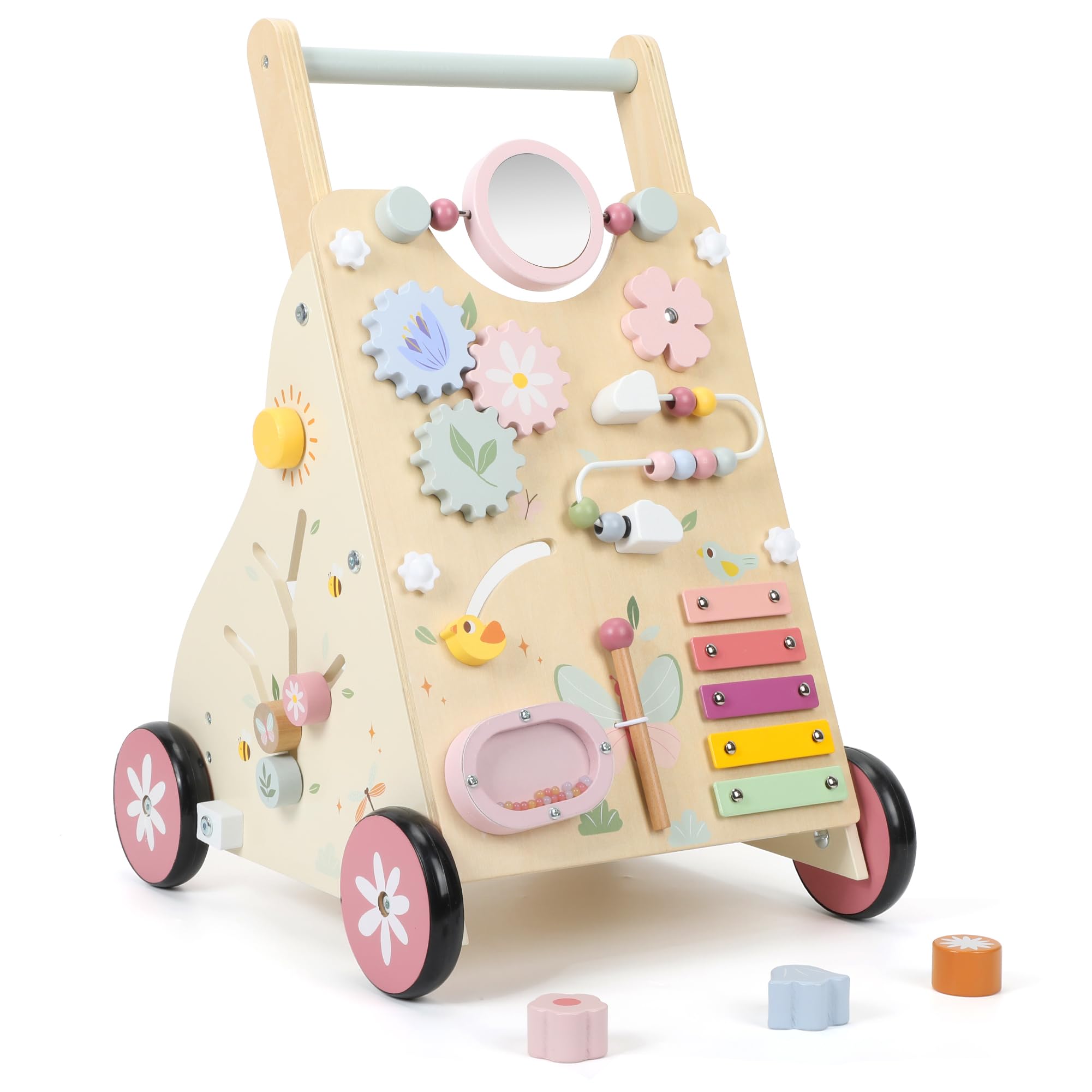
How To Choose The Best Wooden Baby Walker
A wooden walker is a stability tool first and a toy second. If it rolls too freely, a baby who is still finding their balance gets ahead of their own feet and goes down. If it rolls too stiffly, they push, nothing moves, and they lose interest. The best walkers let you dial in that middle ground with a knob or rear-axle screws, then loosen it as your toddler gains confidence.
Start with the speed control, not the toy count
The single most useful feature on a walker is a way to add friction to the rear wheels. Some models use a knob you turn; others use screws you tighten on the back axle. Either way, you want the walker to creep along for a baby who is just pulling up, then glide once they are cruising. A walker with no resistance control at all will outrun a beginner on a smooth floor.
Match the handle height to your child, not your nursery
Handle height decides whether your baby can push with flat feet or has to reach up on tiptoe. A two-stage adjustable handle lets the same walker serve a shorter baby and grow with them across a few months. Fixed-height walkers are fine, but check that the bar height suits a child standing upright rather than hunched forward — a hunched push is what causes the tipping you are trying to avoid.
Check how the wheels treat your floor
Bare wooden wheels on a hardwood floor is a scratch waiting to happen. Rubber-coated or silicone-treaded wheels roll quieter and protect the surface. This matters most in apartments, where a walker clattering across laminate at 6 a.m. is a fast way to meet your downstairs neighbor.
Decide whether the activity panel should come off
Once your toddler walks on their own, a walker with a fixed play panel becomes a piece of furniture. A detachable panel — or a walker that converts to a toy trailer — stays in use longer. If floor space is tight, that conversion matters more than the number of activities on the front.
Side-by-Side Comparison
| Model | Best For | Adjustable Speed | Weight | Footprint (L x W x H) | Amazon |
|---|---|---|---|---|---|
| Beright Wooden Baby Walker★ Best Overall | First-time walkers on hardwood | Yes — tightens at the wheels | 7.3 pounds | 15″L x 14″W x 18″H | Amazon |
| bpmfkid Adjustable Height WalkerBest Height Range | Growing toddlers who need a taller bar | Not stated | 3.19 kg | 14.5″L x 13″W x 23″H | Amazon |
| Pithfor Wooden Baby WalkerMost Color Choices | Sensory play and easy assembly | Not stated | 3.74 kg | 13.3″L x 15.3″W x 20.6″H | Amazon |
| Woodtoe Adjust Speed Walker | Two-stage height plus speed control | Yes — dedicated speed adjuster | 4.03 kg | 15.75″L x 12.2″W x 19.69″H | Amazon |
| WOODMAM Push Baby Walker | Busy-board play that travels | Yes — screw adjustment on rear wheels | — | — | Amazon |
| ROBOTIME Vacation Bus Walker | Toddlers who want a themed toy | Yes — adjustable speed | 4.51 kg | 12.6″L x 6.69″W x 16.93″H | Amazon |
| Tiny Land Activity Center Walker | One walker across every stage | Yes — built-in speed knob | 9.5 pounds | 13.78″L x 11.81″W x 21.26″H | Amazon |
| HABA Walker Wagon | Long-term use with seat and storage | Yes — adjustable wheel friction | 4.9 kg | 13″W x 19.5″H | Amazon |
Detailed Reviews
1. Beright Wooden Baby Walker
Our pick — 4.5+★ from 400+ verified ratings; the strongest balance of quality and price.
The one that stops where your baby stops, thanks to rubber-banded wheels.
Most walkers on this list give you a knob or a screw to slow the rear axle. The Beright takes a different route: the wheels themselves carry non-slip rubber bands, so the drag is baked into the wheel rather than added by you. For a baby who is still working out how much weight to lean into the handlebar, that built-in friction is the whole point. It creeps. It slows. It never gets away from them.
The front panel is packed — xylophone, mirror, shape puzzle, beads, gears — which the maker counts as eight play methods for motor-skill and physical development. It sits on a birch plywood frame measuring 15″L x 14″W x 18″H and weighs 7.3 pounds, so it has enough mass to feel planted without being a chore to shift between rooms. That 18-inch height is the number to check against your own child before you commit. A taller toddler will want a higher bar; the next pick on this list solves for exactly that.
Where it earns its top spot is the balance of steady wheels and enough play to keep a toddler at the handlebar after they have already learned to walk. The rear wheels can be tightened and loosened, though the adjustment takes more effort than a simple knob turn — worth knowing if you plan to change the resistance often. It is the pick for a household with hard floors, a baby somewhere between sitting and cruising, and no appetite for chasing a runaway walker down the hallway. Reviewers repeatedly report it still in rotation after two years of toddler play.
What earns it the top slot
- Non-slip rubber bands in the wheels build in braking from the first push.
- Eight activities — xylophone, mirror, shape puzzle, beads, gears — hold attention past the walking stage.
- 7.3 pounds of planted weight on a 15″L x 14″W footprint, so it does not skate.
- Birch plywood body with rubber-covered wheels that protect hardwood and tile.
The honest trade-offs
- Adjusting wheel tension means loosening or tightening the wheels themselves — slower than a knob.
- The 18-inch handle height suits a shorter toddler better than a tall one.
- Assembly needs a screwdriver; it is not a fold-out-of-the-box walker.
Go with this if: you have a hardwood or tile floor and a baby just starting to pull up — the rubber-banded wheels do the braking for you.
Look at the bpmfkid instead if: your toddler is on the tall side and needs a handlebar higher than 18 inches.
2. Wooden Baby Walker Push Toy
A handlebar that climbs to 23 inches so the walker grows with your child.
If your baby is already tall for their age, an 18-inch bar puts them on tiptoe. This one tops out at 23 inches total height, with a maximum handle height of 21.65 inches, so a toddler who shot up fast can still push with flat feet. At 3.19 kg it is one of the lighter walkers here — compare it to the Beright’s 7.3 pounds and you feel the difference when you lift it over a baby gate. The trade-off is that less mass can mean less planted push on a smooth floor, which is why the adjustable bar matters more here.
The rotating gears and educational games sit on a wooden frame in a brown finish, and the recommended weight ceiling is 25 pounds. It assembles without fuss and its compact footprint tucks into a corner when playtime ends. What wins people over across the reviews is the quality of the wood and the paint colors — the finish looks better in the nursery than the listing photos suggest. Playability is the second thing that keeps coming up, which for a walker is a quiet compliment: it means toddlers keep coming back to it.
The catch is in the assembly and the wheels. Some find the build straightforward and others hit a fight with it, and there are scattered reports of wheels working loose over time. Treat the wheel fixings as something to check and re-tighten every few weeks and the walker holds up. It is also not the pick if you are shopping for a baby who is not yet pulling up — the handle is designed around a standing child, so a sitter will mostly use the front panel.
Where it makes sense: a tall, fast-growing toddler whose first walker needs a bar above the usual 18-inch mark.
Know before you buy: wheel fixings benefit from a periodic re-tighten, and the assembly is not the smoothest on this list.
Right for: parents who want the handlebar to keep pace with a sprouting toddler.
Not the fit for: anyone who wants a walker they never have to look at a screwdriver about.
3. Pithfor Wooden Baby Walker
Seven sensory toys on one front panel, in a finish that looks handmade rather than mass-produced.
Count the front panel: mirror, bead maze, xylophone, spinning gears, shape sorter, sound button. That is a lot of activity packed onto a walker that measures 13.3″L x 15.3″W x 20.6″H and tips the scale at 3.74 kg. Compared with the Beright’s 15″L x 14″W x 18″H footprint, this one is a bit longer and a good deal taller, so the handle suits a child who is already standing comfortably. The anti-slip rubber wheels are the safety anchor, and the collapsible style name suggests it stores flat.
Appearance is what leads the conversation around this walker, and the colors hold up in person. Assembly is easy enough that most parents get it together without drama. Babies take to the sensory panel quickly, and the wooden construction feels sturdy in the hand — the kind of frame that does not flex when a toddler leans their whole weight on it.
Two things to plan for. The wheels do not always roll smoothly from the start, which is a common enough note that it is worth a test push before you hand it over. And it ships in pieces, so check the box against the parts list the day it arrives rather than the night before a birthday. Neither is a dealbreaker; both are the sort of thing you fix once and forget.
Why parents like it
- Mirror, bead maze, xylophone, gears, shape sorter and sound button on one panel.
- 20.6-inch total height fits a child who is already standing with confidence.
- Anti-slip rubber wheels protect hard floors.
- Assembly is quick and the finish matches the photos.
What to watch for
- Wheels may need a nudge to roll smoothly the first few pushes.
- Check the parts list on arrival — it ships flat-packed.
- The 3.74 kg weight is lighter than the Beright’s 7.3 pounds, so on a slick floor it moves more freely.
Best matched to: a toddler who is already upright and wants a busy panel, in a nursery where the color matters.
Worth knowing: do a test roll before handing it over, and stand the wheel fixings up on day one.
4. Woodtoe Wooden Baby Walker

A dedicated speed dial and a two-stage bar — the most tunable walker on the list.
Most walkers let you adjust one thing. This one lets you adjust two: the handle sits at either 45 cm or 50 cm depending on your child’s age, and a separate speed adjuster dials the roll up or down. For a baby just learning to place one foot in front of the other, you set it slow. For a toddler who has found their stride, you loosen it. A separate height stage plus a speed dial is rare at this price, and it is why this walker punches above its bracket.
The build backs it up. It is made from African sapele, European beech and American basswood, all FSC-certified, with no paint on the surface and a gap tolerance between 5mm and 12mm so small fingers will not get pinched. The frame measures 15.75″L x 12.2″W x 19.69″H and weighs 4.03 kg. Once your toddler walks unaided, it converts into a toy trailer that can hold dolls and other playthings — a second life most walkers do not get.
The honest caveat is in the wheels. Some owners find them unscrew in use, and the general functionality draws mixed notes. Regular checks on the wheel fixings solve this before it becomes a problem, but it does mean this is not a walker you set up and then ignore. It is the pick for a parent who likes a dial to turn and does not mind the odd maintenance check.
The decisive pair: 45 cm and 50 cm handle stages plus a dedicated speed adjuster — a genuine two-variable tune, which almost no other walker here offers.
The one thing to keep an eye on: wheel fixings want a periodic tighten; a few owners found them working loose.
Choose it for: a child who needs both a height step and a speed dial as they progress.
Think twice if: you want zero ongoing maintenance — the wheel fixings want checking.
5. WOODMAM Push Baby Walker

The front panel unhooks and travels — a walker and a tabletop toy in one.
Ten activities sit on the front of this walker: gears, a peek-a-boo window, counting beads, a pretend phone, a mirror, a xylophone, spinning blocks, a shape sorter, and a sliding puzzle. The part that matters is that the whole busy board detaches. Lift it off and you have a tabletop toy for a restaurant, a park, or a sibling — then click it back on for walking practice. That detachable panel makes it the most flexible walker here for a family with more than one child.
The height is set at 17 inches, designed for toddlers between 50 cm and 75 cm tall, with a wider anti-tip base and rubber wheels that roll quietly. The maker names composite wood — linden and beech — with a hand-polished finish and non-toxic water-based paint, plus stated compliance with ASTM F963 toy safety and ASTM F977 walker safety standards. Speed is adjustable via screws on the rear wheels. Assembly runs about ten minutes with the included tools.
The durability reports are mixed. Most describe a sturdy frame, but some note one wheel working loose. Treat the wheel fixings like a periodic check and the walker holds. It is engineered for a child at the sit-to-stand threshold rather than a toddler already charging around, and the 17-inch height is the number to match against your child before ordering.
What makes it different: a detachable busy board (a panel of activities) that turns the walker into a travel toy for tabletop play.
Set expectations: wheel fixings are worth monitoring, and the 17-inch bar suits early walkers more than tall toddlers.
Reach for this if: you want one buy that serves both walking practice and quiet play on the go.
Look elsewhere if: your toddler is already tall enough that a 17-inch handle means hunching.
6. ROBOTIME Wooden Baby Walker

A whale-and-lighthouse bus with a real gear lever and a rearview mirror — play first, push second.
Not every walker needs to look like a walker. This one is styled as a vacation bus, with whale and lighthouse blocks, a rearview mirror, and a gear lever that makes it feel like a toy car a toddler can steer. Flip blocks and a tracking maze sit on the body, and the car lights sound off when pressed. Measured at 12.6″L x 6.69″W x 16.93″H and weighing 4.51 kg, it is the most compact of the taller walkers here — useful if floor space is tight.
Playability is what wins people over, and cuteness is a close second. The speed is adjustable, which means it can be set to roll slower for a cautious walker and faster as confidence grows. Assembly is reportedly easy with clear instructions, and the build is finished in blue with a wooden frame.
The important caveats: durability and functionality land mixed, with some reporting frame issues and some reporting features that do not work as expected. It also ships with stickers to apply — a job best saved for a quiet afternoon, since aligning them is fiddly. If you want a walker that is more toy than tool, this is the pick. If you want maximum stability, the wider anti-tip base on the Tiny Land or the built-in braking on the Beright serves better.
What sells the theme
- Vacation Bus styling with whale and lighthouse blocks, gear lever, and rearview mirror.
- Adjustable speed lets you tune the roll as your child progresses.
- 12.6″L x 6.69″W footprint is the most compact here for tight rooms.
- Assembly is straightforward with the included tools.
The fine print
- Stickers need applying by hand, which is a fiddly job.
- Durability and functionality reports are mixed.
- 4.51 kg weight puts it on the heavier side for lifting over baby gates.
Fits best: a playroom where the theme is the point and a toddler likes steering.
Skip if: frame reliability is the top of your checklist — a wider anti-tip base is the safer call.
7. Tiny Land Wooden Baby Walker
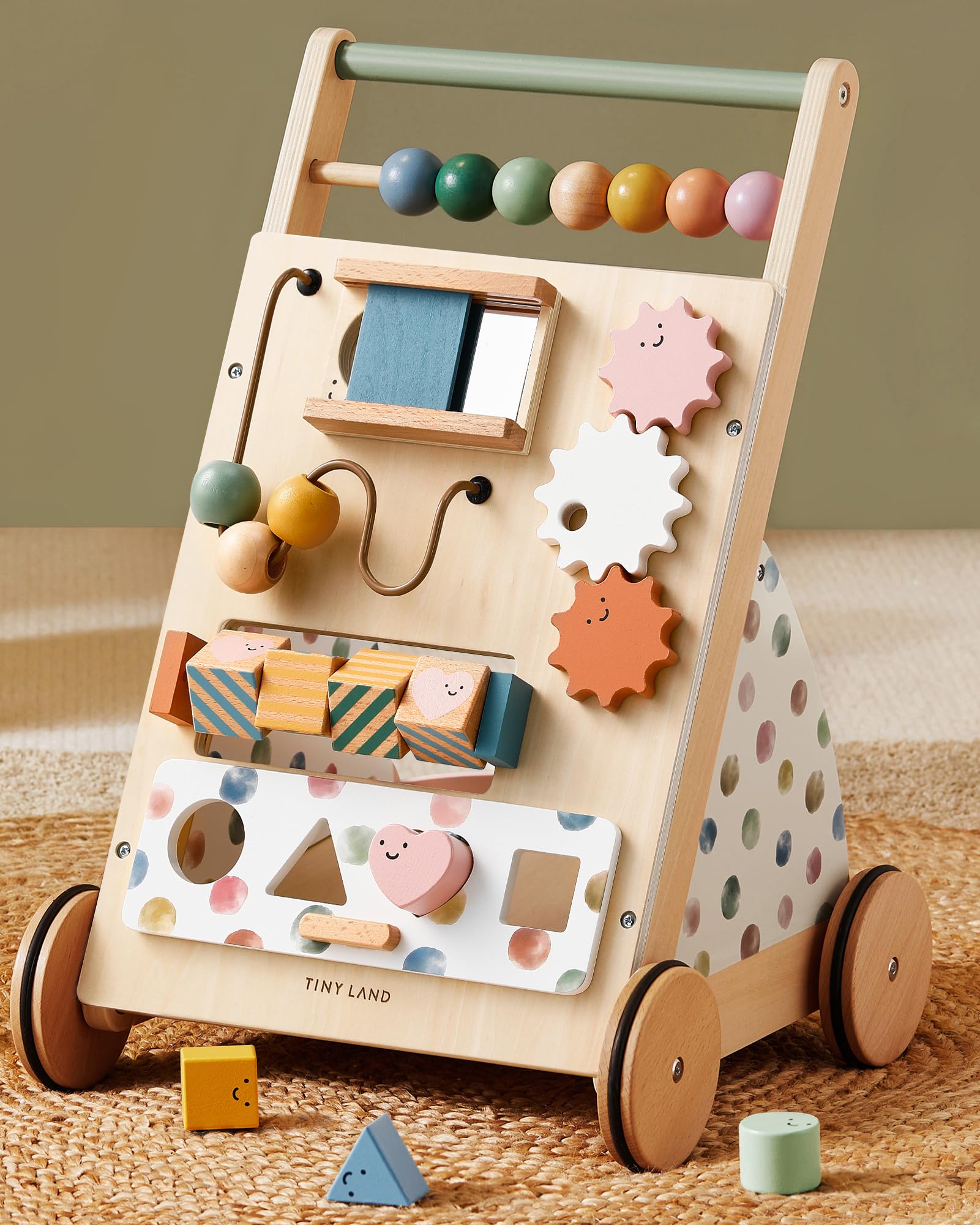
One walker across four stages — floor play, pull-to-stand, first steps, then busy toy.
This is the walking aid that thinks ahead. It starts as a floor-level activity center for a sitting baby, becomes a pull-to-stand support at the crawling stage, then a first push walker, and finally a busy toy for a confident toddler. The frame is 13.78″L x 11.81″W x 21.26″H and weighs 9.5 pounds — the heaviest here apart from the HABA — which is the mass that makes the anti-tip rods and wide base do their job. A speed knob controls wheel resistance so you can dial it slow for a beginner and loosen it as they gain confidence.
The activity set is Montessori-inspired: beads, gears and a shape sorter encourage coordination and fine-motor control, on solid wood with rounded corners and a water-based non-toxic finish. The rubber-coated wheels roll quietly and protect hardwood, laminate and tile — the reason this one keeps coming up in apartment households. The soft pastel finish fits modern living rooms and nurseries rather than screaming ‘baby gear’.
The recurring note is assembly. Most find it very easy, but some have hit components that do not fit as they should — worth a dry-fit before you commit, and worth keeping the packaging until the build is done. Its 21.26-inch maximum height is the tallest bar in the group, so a tall toddler benefits most. It is the pick if you want a single walker to carry your child from sitting to cruising without a second purchase.
The case for it
- Four stages from floor play to first steps to busy toy.
- Speed knob lets you tune wheel resistance as confidence grows.
- Anti-tip rods and a wide base add stability at the pull-to-stand stage.
- Rubber-coated wheels are quiet and floor-safe.
The one knock
- Some builds hit components that do not fit — dry-fit before the final tighten.
- 9.5 pounds is heavy for moving between rooms.
- The pastel finish will not suit every nursery color scheme.
The long-haul pick: a walker you buy once and still use when your child is three.
Fair warning: give yourself an unhurried session for assembly, and keep the box until the build checks out.
8. HABA Walker Wagon — Wooden Push Walker with Seat and Storage

A walker that becomes a doll stroller with a passenger seat and toy storage.
Most walkers are done the day your toddler walks unaided. This one is not. The HABA has a seat so a sibling can ride along, plus storage space for favorite toys underneath. That turns a walking aid into a doll stroller and a toy caddy, which is why it stays in the playroom for years instead of heading to a storage bin. Adjustable wheel friction lets you increase resistance for early walkers and decrease it as they gain confidence. The frame measures 13″W x 19.5″H and weighs 4.9 kg, made in Bulgaria from beechwood and plywood.
The silicone wheel treads (soft rubbery covers on the wheels) let you use it indoors and outdoors without scratching floors. So patio, sidewalk, and living room are all fair game — a rare quality here. The finish is a non-toxic water-based stain, and the walker carries a 2 year limited warranty. It is also the only pick here with a toy award to its name.
What owners keep coming back to is how it refuses to tip — the sheer weight of the thing keeps it planted when a toddler pulls up on it. The honest catch is the price: this is the most expensive walker here by a wide margin, and value-for-money reports are mixed as a result. Screw quality is another note, with some finding the included hardware softer than it should be for the price. It is the pick for a family that wants the walker to earn its place for years and will pay the premium for the seat and storage.
The defining bonus: a seat and storage that turn a first walker into a stroller and toy caddy for years after the first steps.
Where the money and maintenance go: puts it at the top of the price bracket, and the included screws are worth replacing with a harder set if you want to be thorough.
Buy it for: a walker that doubles as a doll stroller and storage, indoors and out, with the silicone treads to prove it.
Give it a pass if: you want the shortest possible list of purchases or you do not plan to use it outdoors.
Know the Specs
Adjustable Speed and Wheel Resistance
Look for a walker where you can dial up the friction on the wheels — either with a knob or with screws you tighten on the rear axle. A slow roll is what keeps a beginner from outrunning their own feet. The best walkers let you loosen the resistance as your toddler gains balance, so the same walker serves them across the whole learning curve.
Handlebar Height and Base Width
The bar height decides whether your child pushes with flat feet or on tiptoe. Most walkers land around the 18-inch mark; a few on this list go higher. Base width and anti-tip rods decide how stable the walker stays when a toddler leans full weight on the handle while pulling themselves up. A wider base is the single best defense against tipping.
Wheel Materials and Floor Protection
Bare wooden wheels will scratch hardwood. Look for rubber, rubber-banded, silicone-treaded, or rubber-coated wheels. These roll quieter, grip better on a slick floor, and protect laminate, tile and hardwood. Silicone treads also mean the walker can go outside without chewing up the wheels.
Play Value and Detachable Panels
A walker’s life outlasts the walking phase only if the front panel keeps a toddler entertained — beads, gears, a shape sorter, a xylophone, or a busy board that detaches for floor play. If you have limited space or a toddler who moves on to toys quickly, a removable panel or a walker that converts to a toy trailer is the deciding feature.
Common Questions
Will a wooden walker scratch my hardwood floors?
What age is a wooden push walker suitable for?
How do I stop the walker from rolling too fast for a beginner?
Is a wooden walker better than a plastic one?
Can my baby use a walker on carpet?
How long does assembly take?
Do the walkers convert into something else once my child walks?
What is the weight limit for these walkers?
Which walker is easiest to store if I have a small apartment?
Can an older toddler still use these walkers?
The Bottom Line
For most families, the wooden baby walker winner is the Beright Wooden Baby Walker — it pairs built-in rubber-band braking on the wheels with eight activities on the front, on a 15″L x 14″W x 18″H birch plywood frame that weighs 7.3 pounds and stays put on a hardwood floor. If growing height is the problem, grab the bpmfkid Adjustable Height Walker with its 21.65-inch maximum bar. And for a family that wants the walker to outlive the walking phase, the HABA Walker Wagon turns into a doll stroller with a seat and storage — the only pick here that goes outdoors with silicone wheel treads and stays in play for years.
How we choose
We do not accept paid placement. Every pick is matched to a real buyer and a real use-case; we do not hands-on test units.
Sources
Specifications: manufacturer listings and product documentation. Review insights: verified customer reviews, as of November 2026. Pricing: not shown on this page (it changes often); check the current price via the retailer link.
As an Amazon Associate, Tactical Gear Guy earns from qualifying purchases. This does not affect which products we feature.