Specs are compiled from manufacturer listings and verified buyer reviews and can change over time — please confirm the key details on the product page before buying.
If you have ever rounded a rusted bolt because your wrench was a hair too loose, you already know the real question here. Which metric wrench set actually grips the fastener, keeps every size you need, and survives years of garage abuse? The short answer: a ratcheting long-pattern set wins for tight, awkward spaces, and a no-skipped-size combination set wins for general household and auto work. Everything below explains which set fits your garage, not someone else’s.
This guide is built by comparing the manufacturers’ published specifications and the patterns across verified customer reviews, so you get each pick’s real strengths and trade-offs instead of marketing spin.
Wrench sets look nearly identical on a shelf, so the differences hide in tooth count, jaw capacity, and whether the size run skips a number. This breakdown of the best metric wrench set shows you exactly where each one earns its place.
Top Picks


How To Choose The Best Metric Wrench Set
The wrong set shows up as a wrench that slips, a size you do not own, or a handle too short to break a stubborn nut loose. The right one grips without slipping and stays comfortable through a long job. These four things decide which camp you land in.
Ratchet or plain combination
A ratcheting box end lets you work a fastener without lifting the wrench off — you swing, reset, and swing again. On a 72-tooth ratchet the swing arc shrinks to 5 degrees, which is the difference between getting a turn on a cramped serpentine belt tensioner and giving up. A plain combination wrench has no moving parts to wear, so it is the simpler tool for open, easy-to-reach bolts. If your work is automotive and tight, pay for the ratchet. If your work is furniture, plumbing unions, and lawn equipment, the plain set does everything you ask.
The size run and whether it skips
Metric fasteners cluster in common sizes like 10 mm, 13 mm, 15 mm, and 17 mm, but plenty of jobs run smaller or larger. A set that covers every number in its range from 6 mm to 24 mm means you never stall mid-repair. A set with gaps can leave you hunting for the one size you skipped. Check the printed range before you buy, especially if you work on older machines that mix unusual sizes.
Point count and bolt-head protection
Point count describes how many contact faces the box end has inside the ring. A 12-point end gives you more ways to drop the wrench onto a fastener in a cramped spot. A 6-point end puts more material against each flat and tends to hold a soft or slightly worn head with less risk of rounding it. Neither is universally better — the choice is access versus grip.
Steel, finish, and length
Chrome vanadium steel is the standard alloy for hand wrenches, and it holds up to repeated torque. The finish decides how long it keeps looking and working right in a damp garage. Longer handles give you more leverage on a rusted nut, but they also take up more room in a drawer or pouch. Weigh that trade-off against how you actually store your tools.
Side-by-Side Comparison
| Model | Best For | Pieces | Size Range | Style | Amazon |
|---|---|---|---|---|---|
| WORKPRO Extra Long Ratcheting Wrench Set★ Best Overall | Tight-spot auto work | 10 | 8–19 mm | Ratcheting double box | Amazon |
| SWANLAKE 15-Piece Metric Combination Wrench SetBest Value | All-round garage value | 15 | 8–22 mm | Combination, 12-point | Amazon |
| Qnkaa Ratchet Spanner SetCompact Pick | Compact ratcheting kit | 12 | 8–19 mm | Ratcheting combination | Amazon |
| EFFICERE 19-Piece Metric Wrench Set | No-skip full coverage | 19 | 6–24 mm | Combination, 12-point | Amazon |
| TEKTON Combination Wrench Set WCB91203 | Precision fit and finish | 14 | 6–19 mm | Combination, 12-point | Amazon |
| GEARWRENCH 14 Piece 6 Point Set 81925 | Stubborn bolt heads | 14 | 6–19 mm | Combination, 6-point | Amazon |
| Wera 6003 Joker 5 Set 1 | Collector-grade precision | 5 | 8–19 mm (5 sizes) | Joker combination | Amazon |
| GEARWRENCH 12 Piece 72T Ratcheting Set 9412 | Fast repeated turns | 12 | 8–19 mm | Ratcheting combination | Amazon |
Detailed Reviews
1. WORKPRO Extra Long Ratcheting Wrench Set, 10-Piece
Our pick — 4.5+★ from 850+ verified ratings; the strongest balance of quality and price.
The long-reach ratcheting set that works a bolt where your hand barely fits.
Nineteen and seven-tenths inches of handle is the headline here, and it is what sets this set apart from the shorter combination wrenches further down this list. That extra length gives you two things at once: more leverage on a rusted nut, and enough handle to reach deep past engine components. Owners regularly point to serpentine belt tensioners as the job where this set stopped the swearing.
The ratcheting box end carries 72 teeth, so it needs only a 5-degree swing to grab the next tooth. On a standard wrench you would need 30 degrees of room to make the same move, which on a cramped pulley is often simply not there. The box end on both ends keeps the force on the flats rather than the corners, so a bolt that has already been chewed up still has a chance.
Chrome vanadium steel with a black electrophoretic coating — a baked-on finish that resists corrosion — means this is a set you can leave in a damp shop without watching it bloom orange. The metrics run 8 mm through 19 mm in ten sizes, and the roll-up pouch has a hanging rope and a strong fastener to keep it cinched.
Where this set pulls ahead
- Extra-long handle delivers real leverage on stuck fasteners and reaches deep-set bolts
- 72-tooth ratchet needs a 5-degree swing arc, so confined spaces stop being a dead end
- Anti-slip tooth geometry holds worn or rounded heads that a plain wrench loses
What to weigh first
- The long handle is genuinely long — it will not tuck into a small drawer or a compact road bag
- Ten sizes stop at 19 mm, so larger metric fasteners live outside this set
Reach for this if: your work is automotive, the bolts sit behind belts, pulleys, and brackets, and you want the ratchet to do the resetting for you.
Think twice if: you need coverage past 19 mm or you keep your tools in a shallow drawer — this one wants a hook or a long pouch.
2. SWANLAKE 15-Piece Metric Combination Wrench Set
Fifteen sizes, a storage rack, and a mirror finish — the sensible first metric set.
Fifteen wrenches spanning 8 mm to 22 mm is a wider run than the ratcheting sets above offer, and it covers the 21 mm and 22 mm sizes that show up on suspension and plumbing work. The rack keeps all fifteen standing in order, so you can see a missing tool from across the garage instead of unrolling a pouch to check.
What buyers come back to is the sense that these feel like proper tools rather than filler. The forging quality shows in the mirror finish and the solid in-hand weight. The price is the other draw — 15 sizes plus a rack for less than most ratcheting sets.
The open end grips on four planes of the fastener head for stronger torque transfer and less angular wear on the bolt. The 12-point box ends sit at a 15-degree offset, which lets your fingers clear the surface and gets the ring onto a nut tucked behind a bracket. One honest note: the size run skips the long-pattern option, so if you specifically want extended-reach wrenches you are looking at a different style entirely.
How the rack changes things: A wall-mounted rack is underrated in a working garage — you spot a gap instantly, and you stop re-sorting a pile after every job. The trade-off is that a rack is a fixed home, not a portable one.
The part that separates it: 8 mm through 22 mm in a single continuous run gives you coverage most 19 mm-capped ratcheting sets cannot match.
Fits best: the home garage that wants one shelf of wrenches covering everything from lawn mower bolts to suspension nuts.
Wrong pick for: anyone who needs a long-pattern reach or a ratcheting head — this set is plain combination all the way.
3. Qnkaa Ratchet Spanner Set, 12 Piece Metric 8mm to 19mm
Twelve ratcheting sizes that roll into a bag and live in a bike or car kit.
At 1.8 kg this is the light end of the ratcheting crowd — noticeably easier to sling in a vehicle than the long WORKPRO set, which sits at 2.84 kg. If the wrench set lives in your trunk or your tank bag rather than a wall, that weight difference is what decides whether it comes along at all.
Twelve sizes cover 8 mm to 19 mm with a 19 mm jaw capacity, and the ratchet also runs 72 teeth on a 5-degree arc. The steel is drop-forged chrome vanadium heat-treated to HRC 48 — a hardness rating that speaks to how well it resists deforming under load — with a polished chrome finish on top. Open and bi-hexagonal box ends in one wrench means you get both styles without carrying two sets.
The 72-tooth ratchet is the reason to buy it, turning bolts a 5-degree arc at a time in tight spots. Durability is the place to slow down, though. A small number of reports describe a 16 mm wrench coming apart on its first serious use, so treat the smaller ratcheting heads as the light-duty end of the line and lean on the larger ones for the heavy breaking.
The travel argument: A pouch that closes around all twelve wrenches and drops into a side compartment solves the actual problem with a car kit — tools that rattle loose and go missing. This one stays together.
Where it stops short: It caps at 19 mm and the smaller ratcheting heads are not built for breaker-bar abuse.
Pick this for: bike repairs, car emergency kits, and small engine work where you want ratchet speed in a portable package.
Better elsewhere: if you plan to lean hard on a stubborn 10 mm bolt, a forged combination wrench will take that punishment more gracefully.
4. EFFICERE 19-Piece Metric Combination Wrench Set, 6mm–24mm

Nineteen wrenches with zero gaps, from 6 mm all the way to 24 mm.
Compare this to the Qnkaa set and the gap is immediate: 19 wrenches against 12, reaching 24 mm where the Qnkaa stops at 19 mm. That 24 mm jaw capacity matters on larger nuts — axle hardware, plumbing fittings, and hydraulic lines — and it means you are not reaching for a second tool to finish the job.
Every size between 6 mm and 24 mm is present, and the size stamps sit at both ends on both sides. In a dim engine bay that marking is the difference between grabbing the right wrench first and guessing. The 15-degree angled open end and the 15-degree offset 12-point box end both exist to buy you clearance where your hand will not comfortably go.
The build is industrial-grade chrome vanadium steel with a rust-preventative chrome finish, and it carries a lifetime warranty. One honest caveat shows up in the size feedback: some owners find these run about half a size smaller than marked. On a fastener with any tolerance to spare that rarely surfaces, but on a precise bolt you should test-fit rather than assume.
The case for owning this one: Full coverage without duplicates is what saves the second trip to the parts store. Nineteen sizes plus a stamped marking at each end make it the set you reach for when you do not yet know what size you need.
The catch: Sizing that reads slightly small means the wrench can feel sloppy on a tight-tolerance bolt.
Suits: the household and workshop kit that has to handle whatever walks in — garage, auto repairs, emergency jobs, general assembly.
Look past it if: you work on precision fasteners where an exact fit matters more than broad coverage.
5. TEKTON Combination Wrench Set, 14-Piece WCB91203
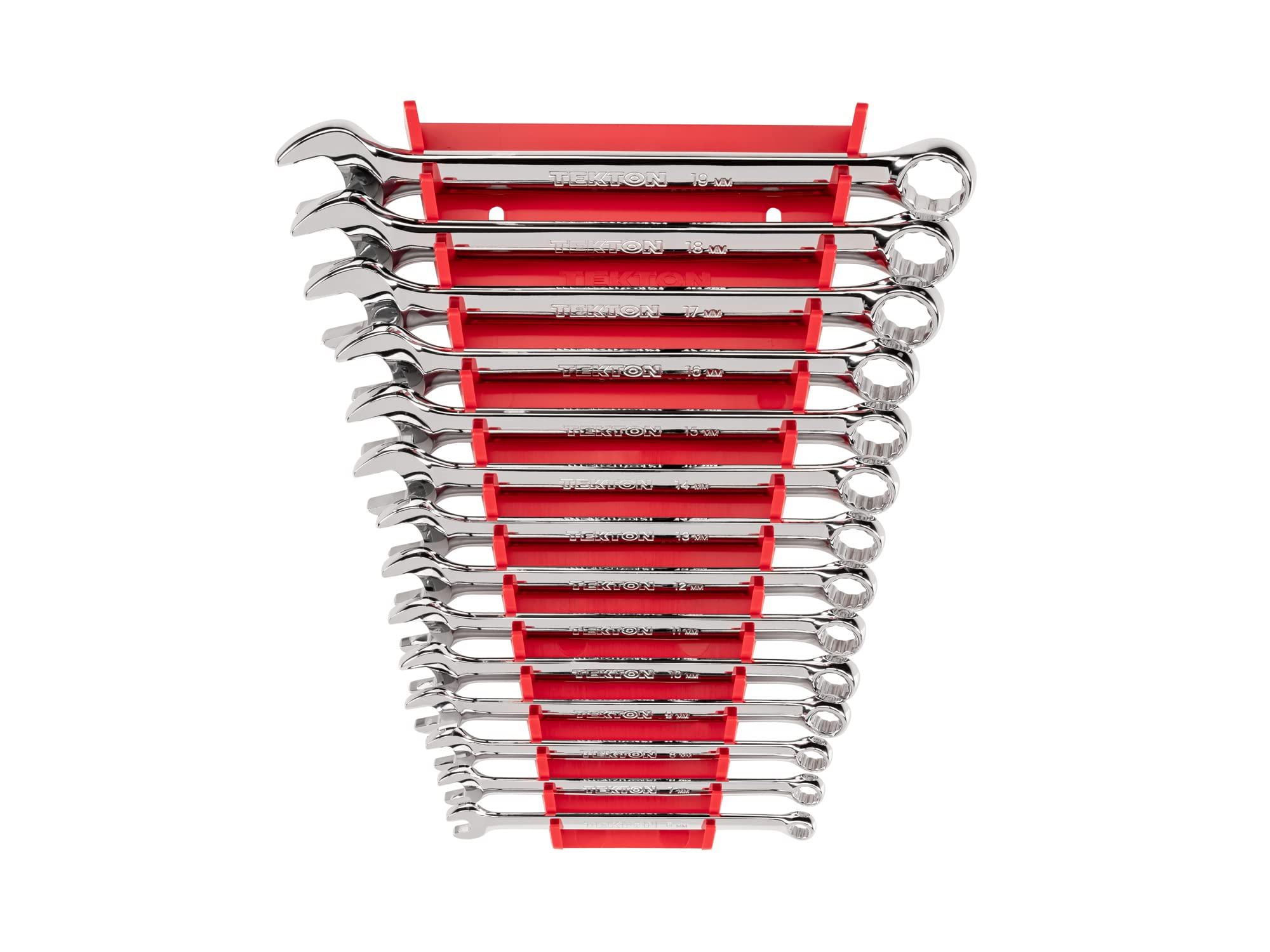
Fourteen wrenches finished to a standard that makes people double-check the label.
At 12 inches in length, this is a shorter, more traditional handle than the 19.69-inch WORKPRO — and for a plain combination set that is exactly what you want, because it fits a standard drawer and still gives you enough handle for normal leverage. Fourteen sizes run 6 mm to 19 mm with an organizer rack to keep the order.
The box end is the part worth explaining. It applies force to the sides of the fastener head rather than the corners, which is the specific design choice that keeps a worn bolt from rounding off completely. A 12-point ring doubles your available access angles over a 6-point, and the 15-degree offset lifts your knuckles clear of whatever surface the nut is sitting on.
Owners single out the machining and the polished chrome, which they compare to far more expensive professional brands. The price sits well below those same professional brands. The one thing to hold in mind is that this is a combination set, not a ratcheting one, so a fastener in a corner still needs room for the flip-and-turn.
What the money buys: A polished, well-machined wrench with corner-safe box ends — the kind of tool that stays in the family for a long time.
The honest limit: It stops at 19 mm, so the 21 mm and 22 mm fasteners are not covered here.
Great for: anyone who cares about how a tool feels in the hand and wants a combination set that will not embarrass itself next to the expensive brands.
Consider the EFFICERE instead: if you need coverage past 19 mm, since that set reaches 24 mm.
6. GEARWRENCH 14 Piece 6 Point Combination Metric Wrench Set 81925

The 6-point set you grab when a bolt head is already starting to round.
A 6-point box end puts more steel on each flat of the fastener than a 12-point does, and on a head that has already taken damage that is the difference between loosening it and making it worse. The Surface Drive Plus open end adds a grip design aimed at the same goal: hold the head, do not chew it. GEARWRENCH rates the Surface Drive Plus open end for up to 25% more torque than a standard open end.
Fourteen sizes cover 6 mm to 19 mm with an offset box end for clearance. Where this set really earns its place is on the fasteners nobody wants to touch — the ones on older equipment where the corners have already gone soft. Owners describe the 6-point box ends as solid, capable tools that outperform their price bracket.
Fit on the bolt head gets noticed, and the finish holds up to shop life. It is also easy to carry as a take-along kit rather than a permanent bench fixture. The trade-off is that a 6-point ring gives you fewer drop-on angles than a 12-point, so on a fastener you can only reach from one awkward direction, you may want the 12-point TEKTON above instead.
The engineering that matters: Off-corner loading plus a 6-point ring is a deliberate anti-rounding choice, and it shows up exactly where you would expect — salvage jobs.
Where it gives ground: Fewer access angles on the box end make contorted, blind-fastener work harder than a 12-point set.
Pulls its weight on: rust-belt repairs, older vehicles, and any fastener that is already showing wear on the corners.
Not the tool for: the tightest blind corners, where a 12-point ring or a ratcheting head gets you there faster.
7. Wera 05020230001 6003 JOKER 5 Set 1

Five wrenches with a mouth geometry built for positions other wrenches cannot reach.
Five pieces is a small set, and there is no pretending otherwise: 8mm, 10mm, 13mm, 17mm, and 19mm — the sizes that do the bulk of real-world work. If you wrench professionally you will notice the missing numbers long before you notice the clever geometry. If you carry a compact kit for the jobs that actually come up, five is often enough.
The clever part is the open end. Its low return angle takes the screw every 15 degrees, so the wrench can reposition in spaces where a standard open end cannot swing. The slim ring side angles at 15 degrees for the same reason — clearance. The mouth geometry expands where you can put the tool, and that is the whole pitch.
Total length runs 25 centimeters across the set, with individual wrenches at 115 mm, 125 mm, 160 mm, 190 mm, and 230 mm as sizes climb. The system also docks with the Wera 2go storage line, so it can live inside a larger modular kit rather than a loose pouch. This is a specialist’s set, priced accordingly by position rather than rank.
What makes it different: The 15-degree take-up angle on the open end is a real mechanical answer to confined fasteners, not a marketing angle.
The real cost: Only five sizes, and none smaller than 8 mm or larger than 19 mm — a lot of common work still needs another wrench.
Worth it for: the mechanic or tinkerer who already owns a full set and wants a precise, compact wrench for obstructions.
Not a first set: with five sizes it cannot be your only metric coverage, no matter how well each piece is made.
8. GEARWRENCH 12 Piece 72T Ratcheting Combination Metric Wrench Set 9412

The ratcheting set that turns a pile of bolts into a rhythm instead of a fight.
Where the WORKPRO above wins on handle length, this one wins on being a ratcheting wrench with a full combination profile in every size. Twelve wrenches cover 8 mm to 19 mm, and every one has a 72-tooth ratcheting box end at one end and a standard open end at the other. That combination is what lets you ratchet a bolt loose and then flip to the open end for the final break on a fitting.
The ratchet needs only 5 degrees of movement to catch the next tooth, where a standard wrench needs 30 degrees to make a turn. Off-corner loading on the box end goes after the same thing every good wrench does — a grip on the flats, not the corners. The thin head and beam are shaped to buy access in confined areas, and the size is stamped at both ends of the beam for quick reads.
Value is where this set does the most talking. Owners describe the feel and function as landing right alongside far costlier ratcheting sets, and the case keeps tools organized rather than scattered. One honest note: the ratchet mechanism is a mixed bag in the feedback, so leverage it for speed and repeated small turns rather than as a breaker on a seized bolt.
Why mechanics gravitate here: A ratcheting combination in every size from 8 to 19 mm removes the flip-and-reseat routine that eats time on a long job.
Where to be gentle: The ratchet mechanism is the point of vulnerability — use the open end for the hard break-loose turn.
The right buy for: anyone doing repetitive reassembly work — engine bays, bracket runs, jobs where the wrench never sets down.
Go with the WORKPRO for: pure reach and leverage on a stubborn bolt, since its long handle and 5-degree arc are built for that specific fight.
Know the Specs
Tooth Count and Swing Arc
Tooth count is how many notches the ratcheting mechanism has inside the ring, and swing arc is how far the handle must travel before it catches the next one. A 72-tooth ratchet needs 5 degrees of travel; a standard non-ratcheting wrench needs about 30 degrees to complete a turn. Smaller ratios matter where the handle hits something before it completes a sweep — that is the whole reason long-reach ratcheting wrenches exist. If a job has open space, this spec barely matters. If a job has a bolt bracketed by hoses and pulleys, it decides everything.
Point Count: 6 vs 12
The box end’s point count describes the contact faces inside the ring. Twelve points double the number of ways you can seat the wrench on a fastener, which helps in blind or awkward spots. Six points put more material on each flat instead, which helps on a head that has already been chewed. Neither wins outright; pick 6-point if you fight damaged fasteners and 12-point if access is your bottleneck. Some sets give you both styles in one wrench — open end on one side, box on the other.
Chrome Vanadium Steel and Finish
Chrome vanadium, usually written Cr-V, is the standard alloy for hand wrenches because it balances hardness with enough give to survive torque. The finish matters as much in a damp garage: a black electrophoretic coating is baked on for corrosion resistance, while polished chrome resists rust and cleans easily. Both are legitimate; a raw uncoated tool is the one to avoid in humid conditions. When a listing mentions HRC hardness, that is a steel rating — higher numbers generally mean a harder tool that resists deforming under load.
Size Range and Skipped Numbers
Metric fasteners cluster on common numbers — 10 mm, 13 mm, 15 mm, 17 mm, 19 mm — but larger hardware runs to 21 mm and 22 mm, and small assemblies use 6 mm and 7 mm. A set that skips a number means a repair stalls until you buy that one size. Sets that run continuously from 6 mm to 24 mm cover nearly every metric fastener in a typical garage. If you only need auto work, a 8 mm to 19 mm set often covers the whole job.
Common Questions
Will a metric wrench set fit American-made car bolts?
Is a 72-tooth ratcheting wrench stronger than a standard wrench?
What does 12-point versus 6-point mean on a wrench set?
Do these wrenches come with a case or a pouch?
How long should a chrome vanadium wrench set last?
Can I use a ratcheting wrench to break loose a stuck bolt?
Is a long-pattern wrench set worth it over a standard length?
What size metric wrench do I reach for most often?
Does the finish on a wrench set actually prevent rust?
The Bottom Line
Most garages should start with the WORKPRO Extra Long Ratcheting Set. The 72-tooth ratchet, the 5-degree swing arc, and the 19.69-inch handle solve the two problems that make wrench work miserable: no room to turn and no leverage to break a stubborn nut. If tight-spot access is less your world and full size coverage is more, the EFFICERE 19-Piece runs every size from 6 mm to 24 mm without a gap. And for a plain combination set that feels far costlier than its place on this list, the TEKTON WCB91203 is the one worth putting in the drawer.
How we choose
We do not accept paid placement. Every pick is matched to a real buyer and a real use-case; we do not hands-on test units.
Sources
Specifications: manufacturer listings and product documentation. Review insights: verified customer reviews, as of November 2026. Pricing: not shown on this page (it changes often); check the current price via the retailer link.
As an Amazon Associate, Tactical Gear Guy earns from qualifying purchases. This does not affect which products we feature.