Specs are compiled from manufacturer listings and verified buyer reviews and can change over time — please confirm the key details on the product page before buying.
If your apartment has no spare room for a running machine, you need a walking pad that slides under the sofa or stands against a wall when the day is done. The hard part is that “small” hides a trap: plenty of slim decks make the footprint tiny and then leave you with a short belt, a weak motor, or a speed range that never gets above a stroll. This list sorts them by what actually matters — deck length, top speed, incline, and real weight capacity — so you buy a pad you keep using, not one that ends up a drying rack.
This guide is built by comparing the manufacturers’ published specifications and the patterns across verified customer reviews, so you get each pick’s real strengths and trade-offs instead of marketing spin.
A compact deck only works if the belt is long enough for your stride and the motor can hold speed under load, so check both before you buy. The picks below cover every budget tier of small walking pad.
Top Picks
How To Choose The Best Small Walking Pad
A small walking pad is a slim, handrail-free treadmill deck that runs at walking speeds while you work at a desk or watch television. Because it has no railings and a low deck, it fits where a full treadmill cannot. The catch is that the same low deck that saves space also limits how fast and how long you can walk. Buy on deck length, top speed, and weight capacity, not on overall footprint.
Deck length decides whether your stride survives
Your stride decides whether a walking pad feels roomy or cramped, and the walking surface is measured as width by length in inches. A short belt forces you to shorten your step, which is what makes a pad feel tight and unsafe at faster speeds. Longer belts in this group run from 42.5 inches on the MERACH pads up to 47.6 inches on the WalkingPad Z1, so a tall walker gets room to land a full step. The T10 uses a 15″ x 36″ belt — the most compact stride here, and the one to think twice about if you are tall or like to pick up the pace.
Speed range and horsepower go together
Most pads here top out at 4 MPH, which is brisk walking pace. The FOUSAE stretches to 6.2 MPH for light jogging, and it backs that with a 2.75 hp motor. The connection matters: a motor with more horsepower holds its speed under a heavier walker without straining. If you plan to jog, pick 2.75 hp or more, like the FOUSAE. If you only walk at a desk, a 4 MPH ceiling and a 2.0 hp motor are enough.
Stored height is the number a small apartment cares about
Look at how low the pad sits when flat. The WalkingPad Z1 measures 4.1 inches high and folds to 5.4 inches, and the FOUSAE deck is 4.72 inches tall. Those figures decide whether the pad slides under a bed, a sofa, or a standing desk without you lifting anything heavy. A pad you have to lift into a closet each night is the one that ends up unused.
Side-by-Side Comparison
| Model | Best For | Max Speed | Weight Capacity | Incline | Amazon |
|---|---|---|---|---|---|
| FOUSAE 6.2MPH Under Desk Walking Pad★ Best Overall | Fast walkers who want to jog | 6.2 MPH | 350 lbs | 10% manual | Amazon |
| T10 Walking Pad Powered By BOSCH®Most Compact | Tight floor space | 4 MPH | 300 lbs | 7% fixed manual | Amazon |
| MERACH W50 Walking PadHeaviest Duty | Heavy users who want auto incline | 4 MPH | 400 lbs | 12% auto | Amazon |
| WalkingPad Z1 Foldable | Storing flat under a bed | 4 MPH | 242 lbs | — | Amazon |
| MERACH UltraWalk W60 | Tall walkers who want app extras | 3.5 HP motor | 400 lbs max / 330 lbs sustained | 12-level auto | Amazon |
| WalkingPad C2 Foldable | Desk workers who want colour choices | 4 MPH | 220 lbs | — | Amazon |
| Walker Pro Under Desk Folding Treadmill | Small-space apartments on a standing desk | — | 220 lbs | 5% | Amazon |
| Rockare Walking Pad with Incline 9% | Light bodies who want decline training | 4 MPH | 265 lbs | 9% to -4% | Amazon |
| Sunny Health & Fitness Treadpad | App-guided training with incline presets | 3.7 MPH | — | 7% auto, 6 presets | Amazon |
Detailed Reviews
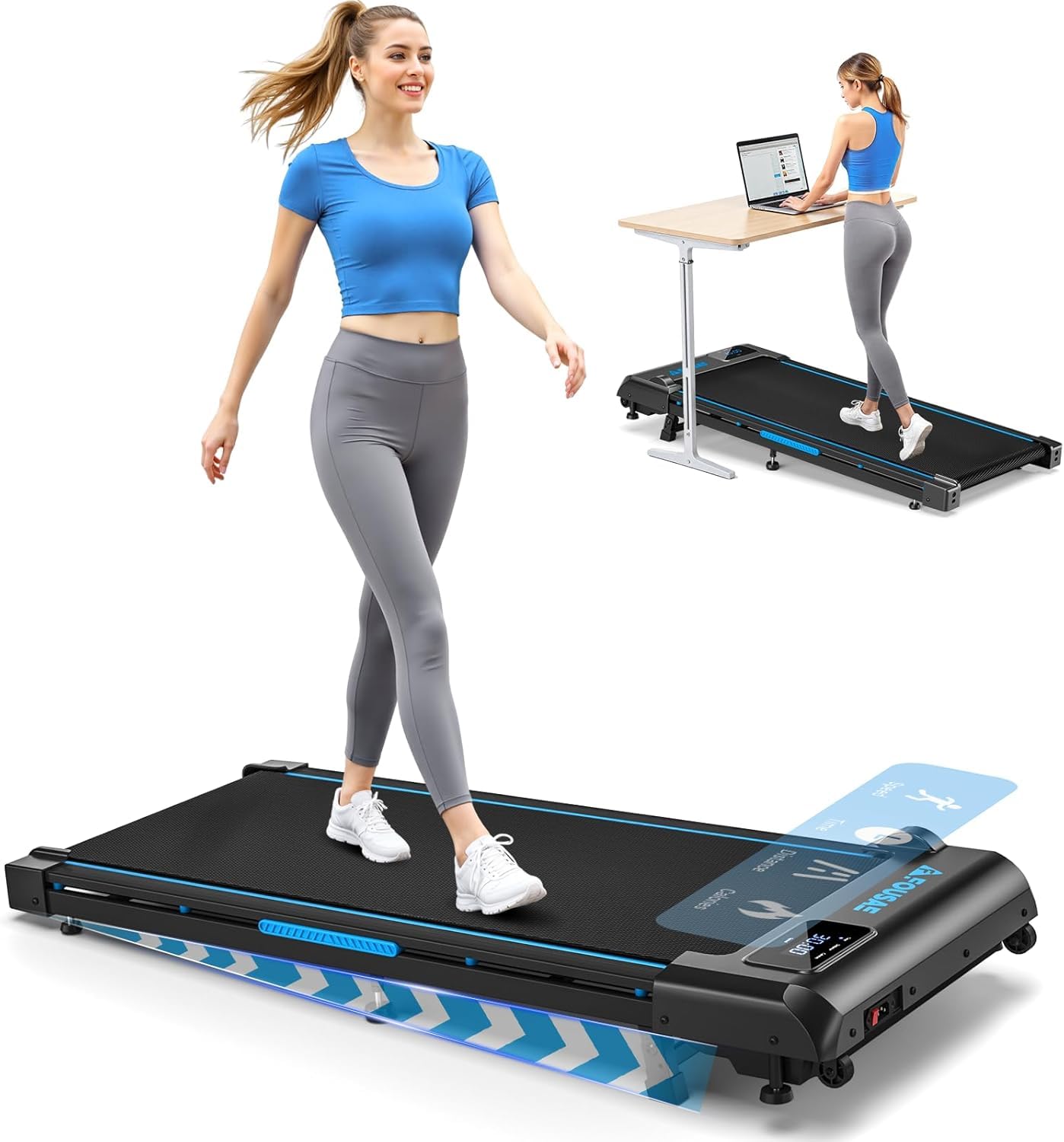
1. FOUSAE 6.2MPH Walking Pad
Our pick — 4.5+★ from 600+ verified ratings; the strongest balance of quality and price.
The slim deck that refuses to be a one-speed stroll machine
You can actually jog on this pad, not just shuffle: it tops out at 6.2 MPH. That is a genuine jogging pace on a deck only 4.72 inches tall, and it comes from a 2.75 hp brushless motor — a brushless design has no carbon brushes to wear down, so it runs cooler and needs less upkeep. The 350 lb weight capacity means a big-framed walker gets a stable deck rather than a flexing one. The motor is rated to run at under 40 dB, which is roughly library-level sound, so a call on your headset stays audible.
You get more room to land your foot without clipping the front, and that is what separates it from the T10. The FOUSAE belt is 40 x 16 inches against the T10’s 15″ x 36″ deck. It is also the only pad here with 12 HIIT programs baked in — HIIT meaning short bursts of hard effort followed by recovery, which the machine can pace for you without a trainer on screen. Add the three countdown modes (time, distance, calories) and the 10% manual incline, set before you start rather than by motor, and you have a pad that scales from a 0.6 MPH desk shuffle to a real sweat session.
The trade-off is speed accuracy. What wins people over is the build — the double frame and the general sense that the thing is put together properly — but the speed readout is the one area that divides opinion. Some find it spot on and some find it noticeably off, so trust your own legs over the display for the first week. The 10% incline is also manual, meaning you break position to change it. If you want button-press incline mid-walk, the MERACH W50 above handles that with its 12% auto incline instead.
What earns it first place
- 6.2 MPH top speed — the fastest here, so it doubles as a light jogging deck
- 2.75 hp brushless motor running at under 40 dB
- 350 lb capacity on a double frame
- 12 pre-set HIIT programs plus three countdown goals
- Pre-assembled, so it works straight from the box
Where it asks a little patience
- The incline is manual, not motorised — you set it before you walk
- Speed readout is the one thing owners split on
Go for it if: you want one slim pad that covers desk walking and a real jog, and you can live with setting the incline by hand.
Pass it over if: motorised mid-walk incline changes are non-negotiable for you.
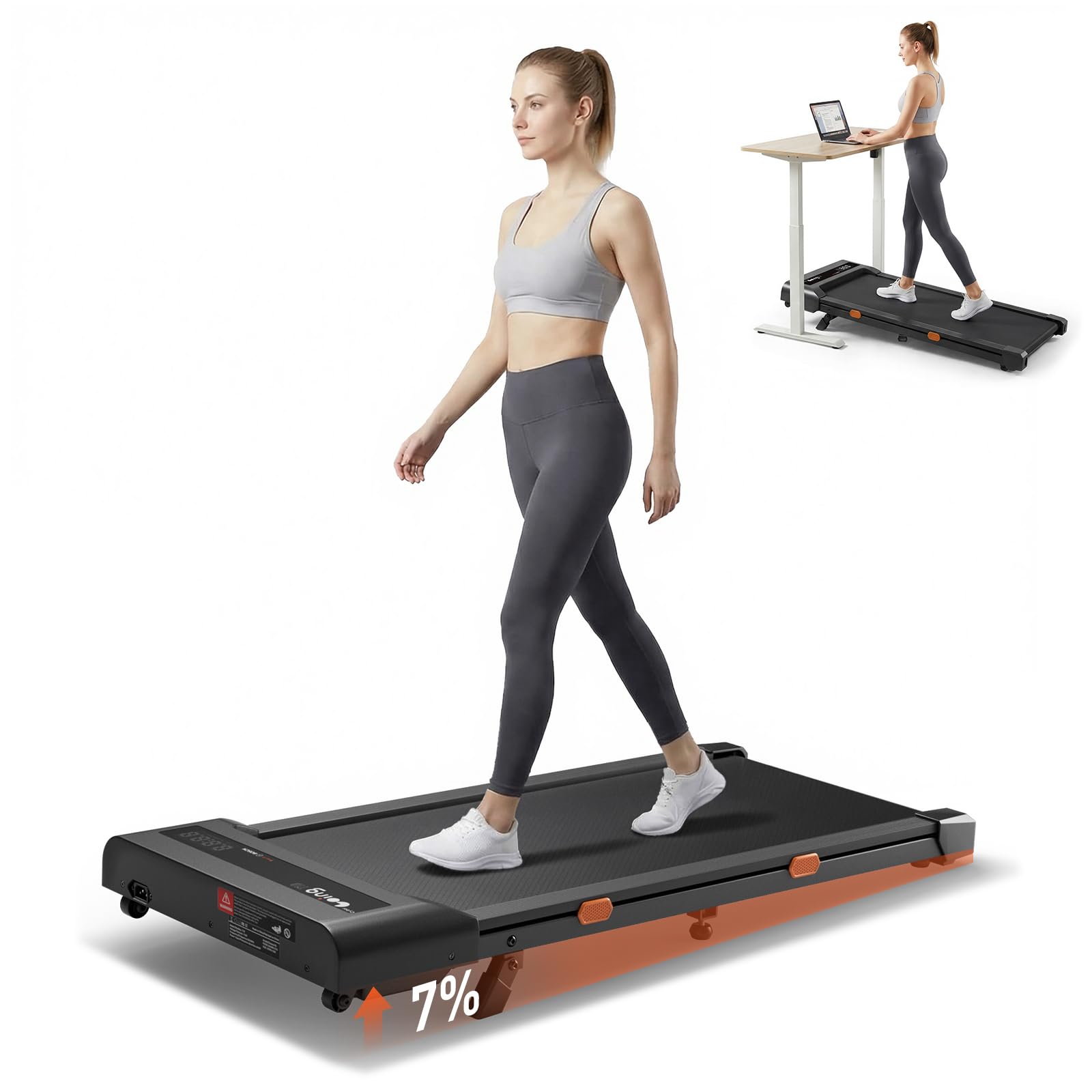
2. T10 Walking Pad Treadmill Powered By BOSCH®, Under Desk
The pad that disappears into a hallway corner between walks
For a genuinely tiny room, the T10 gives you the least floor-hungry package in this group — and the numbers say so plainly. Its footprint runs 5.7″D x 19.3″W x 42.3″H against the MERACH W50’s 50.2″D x 22.2″W x 6.1″H, which means the T10 stands tall and narrow where the MERACH spreads out flat. That upright shape is what lets it tuck beside a doorframe or into a closet corner without a dedicated floor zone.
The Bosch motor carries up to 300 lb, and 36.4 pounds of body weight means most adults can shift it without help. Speed runs 0.6 to 4 MPH, which is a proper walking band and no more. The fixed 7% manual incline is a set-it-before-you-start ramp — you tilt the deck, then walk the whole session at that grade. It compares to the FOUSAE’s 10% in that both make you break stride to change it, though the MERACH W50 goes further with 12% that adjusts automatically from the remote.
Now the honest part. That 15″ x 36″ belt is the shortest walking surface on the list, so a long stride will feel cramped and a tall walker should measure first. The app-and-remote pairing routine needs a tidy sequence — power on, then hold the remote button within a few seconds to catch the beep — and owners who rush it end up controlling speed by hand. Buy the T10 for its footprint, not for pace.
Best reason to pick it: the upright, narrow stance makes it the most forgiving pad to store in a cramped flat, and the Bosch motor plus a 12-month warranty covers the basics of daily walking.
Know before you buy: with a 36-inch deck and a 4 MPH ceiling, this is a walking-only machine for short-to-medium strides.
The right call for: renters and studio dwellers whose priority is floor space, not speed.
Measure first if: you are tall — that 36-inch belt will feel tight.
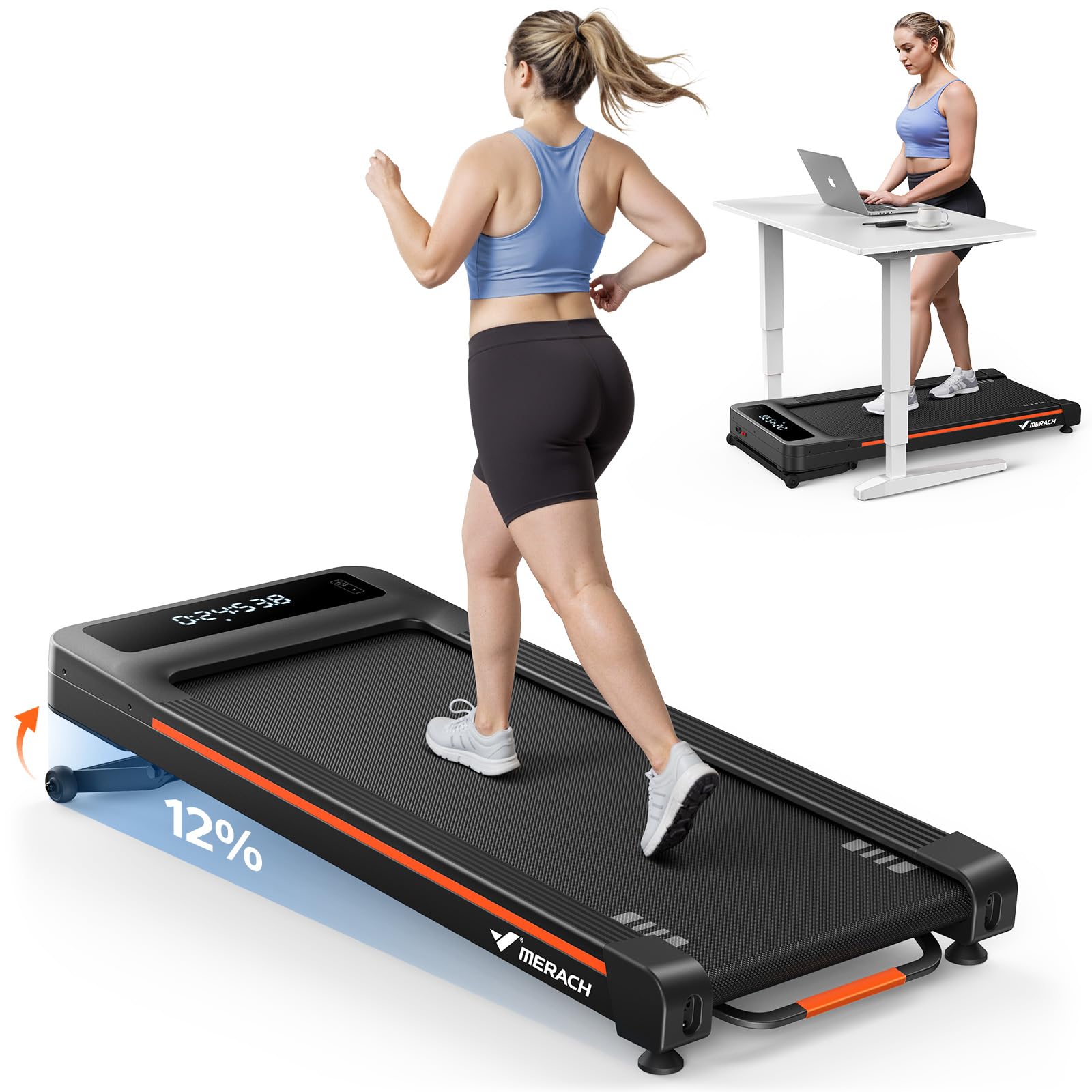
3. MERACH Walking Pad 400lbs
A 400-pound-rated deck that climbs hills without you touching it
Load rating is the reason to start here. The W50 holds 400 lbs on an alloy steel frame, and set against the WalkingPad Z1’s 242 lbs that is a deck built for heavier walkers rather than slim ones. It pairs that with a 3.5 hp brushless motor, which is a bigger motor than the FOUSAE’s 2.75 hp, so the belt holds pace even with a full-load walker on it. The 12% auto incline is motorised — press the button and the deck lifts while you keep walking, unlike the manual ramps on the FOUSAE and T10.
Sturdiness is what the crowd talks about most, and the wording leans the same way every time: solid, no shake, built like it means it. The 16.5″ x 42.5″ non-slip belt gives you a long landing zone, and the multi-layer shock system spreads the impact out rather than pushing it up into your knees. Weight comes in at 31 kg, so you will welcome the wheels on one end when it is time to roll it out of the way. The LED display tracks speed, time, distance and calories, and the remote or app lets you adjust without bending down mid-stride.
The honest hiccup is noise, which is the one area reviewers split on. Some find the W50 surprisingly hushed at its rated under 25 dB, others hear a rattle or a strange whine and want it quieter still. That is worth knowing if you plan to walk in a silent room during a call. A second thing to weigh is that this pad is 50.2 inches deep, so it is the largest footprint here and wants a bit more clearance than the T10 does.
Where the value shows: you get a 400 lb rating and 12% motorised incline on a mid-range pad, which is a lot of capability for the money. Buyers report the incline works exactly as promised, and the “would buy again” tone comes through in how owners describe it.
Fit note: if your room is truly tiny, the depth here may be more deck than you can spare.
Built for: heavier walkers who want a hill climb at the touch of a button.
Skip if: you need the pad to hide in a shoe-sized slot — this one wants a proper floor lane.
4. WalkingPad Z1 Foldable Walking Pad

It folds in half, and that single trick changes where it can live
The fold is the headline. This deck halves its footprint when stored, dropping to 31.8 x 22 x 5.4 inches and sitting only 4.1 inches high when flat. That means it slides under a bed or a sofa without being lifted by anyone who would rather not. At 50 lbs it is light enough to drag with one hand — a weight that is 14.6 pounds heavier than the T10’s 36.4 pounds, but far easier to stow flat thanks to the hinge.
Stride room is generous for a compact pad. The belt measures 47.6 inches long, which is longer than the 42.5-inch mats on the MERACH pads, so a taller walker does not feel pinched step to step. Speed runs 1 to 4 MPH with a smooth start and stop from the brushless motor, and the aluminium frame keeps the whole thing light without looking flimsy at rest. The low-profile deck also makes stepping on and off easier for anyone with balance concerns.
Set against the MERACH W50, this is the gentler package: a 2 hp motor and a 242 lb limit mean it is aimed at everyday walking, not jogging with a heavy pack. Foldability is what buyers keep praising, but the belt itself is the thing to watch. A number of the most critical reviews describe fraying or tearing within the first weeks of use. If you will walk long sessions every day, choose a beefier build like the W50. If you want something slim that vanishes under the bed, this is the one that does it best — and the fold system is built to take daily opening and closing without giving up.
The reason it tops the storage group: a 4.1-inch flat height and a true half-fold give it the smallest stowed footprint here, and the longer belt keeps the walk comfortable.
The watch point: the belt and its long-term wear are the recurring concern, so treat long daily sessions as a reason to spend more on a sturdier deck.
Lands well for: small flats that need a pad to disappear completely between walks.
Look elsewhere if: you walk daily for long stretches — the belt is the weak link at this weight class.
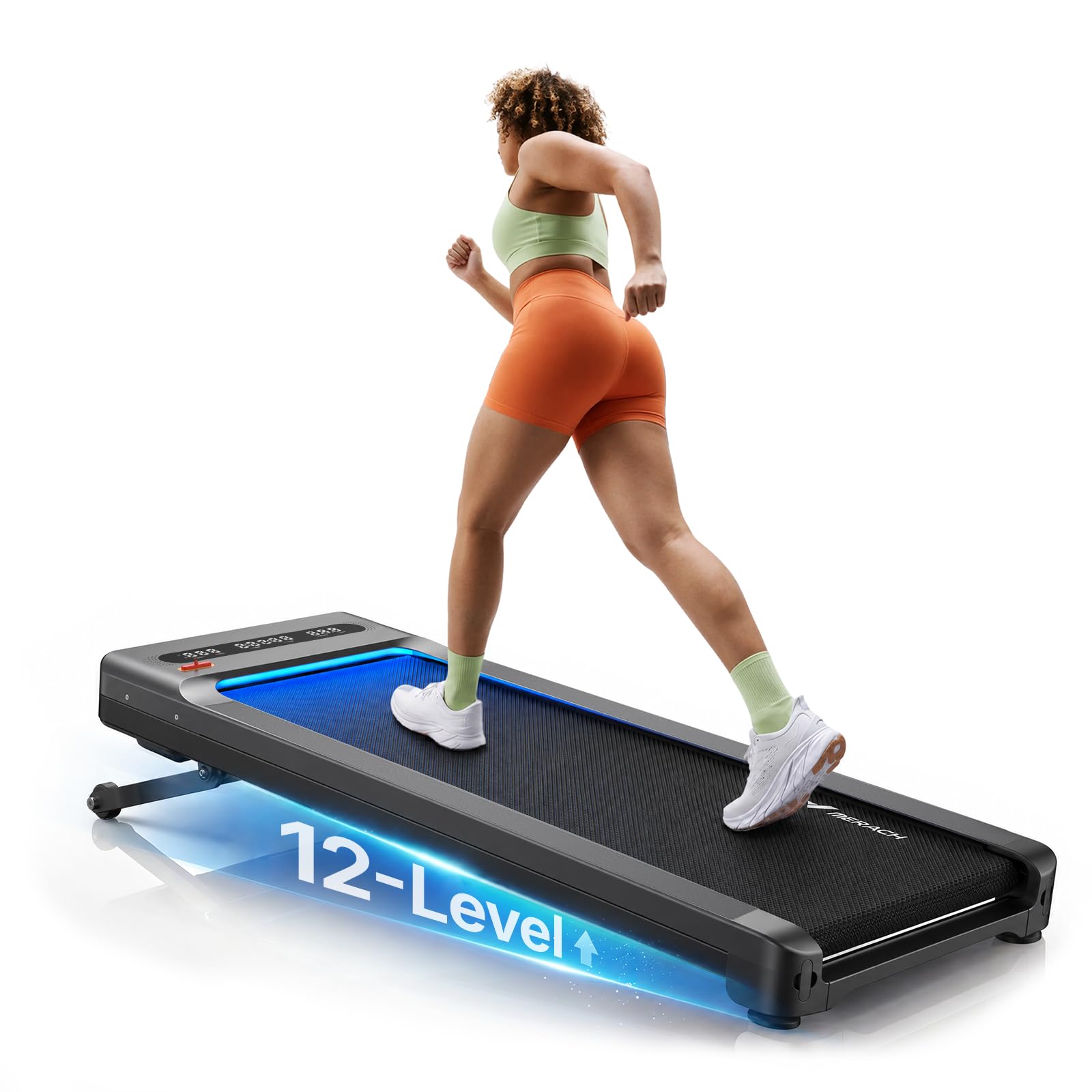
5. MERACH UltraWalk W60 Walking Pad
Wide-deck comfort for tall walkers, with a motor sized for long days
Tall walkers get the short end of the walking pad unless the deck is broad, and the W60 makes that its pitch. Its 16.5″ x 41.3″ walking deck is marketed as giving more stride space than standard pads, so a long-legged walker has room to move. The 3.5 hp peak brushless motor with Hall sensor control — a sensor that reads the belt’s rotation so speed stays precise — keeps acceleration smooth through a long session. MERACH rates the motor at up to 15,000 hours, a manufacturer figure with no independent verification.
Incline is the W60’s real trick. It offers 12 levels of auto incline at a button press, and it pairs that with a Bluetooth speaker, customizable RGB lighting, and pause memory so you pick up where you left off. The remote docks magnetically on the machine, and it syncs with Apple Health and Google Fit through the MERACH app. Dual safety comes standard: a safety key on a tether that pulls out and stops the belt if you stumble, plus a child lock for homes with little ones.
What weighs against it is size — literally. At 67.7 pounds, this is the heaviest pad here, and that is what splits buyer opinion: half love how planted it feels, half find it a chore to reposition. SGS independently rates it at 330 lb sustained (400 lb max), but the 51.4″D x 22″W x 6.5″H footprint needs a dedicated floor lane. If you plan to stash it under a low bed between sessions, the WalkingPad Z1 folds far more neatly.
What stands out on the spec sheet
- 12-level auto incline for hands-free hill workouts
- SGS-verified 330 lb sustained / 400 lb max capacity
- Built-in Bluetooth speaker, RGB light, app and health sync
- Safety key tether plus child lock
- Three-year warranty
What to weigh up
- 67.7 pounds makes it a two-hand move for most people
- The larger footprint wants real floor space, not a corner
Pick this if: you are tall, you want motorised incline, and the pad can claim a permanent spot in the room.
Think twice if: you need to lift or fold the machine daily — its weight is the price of that stability.
6. WalkingPad C2 Foldable Walking Pad
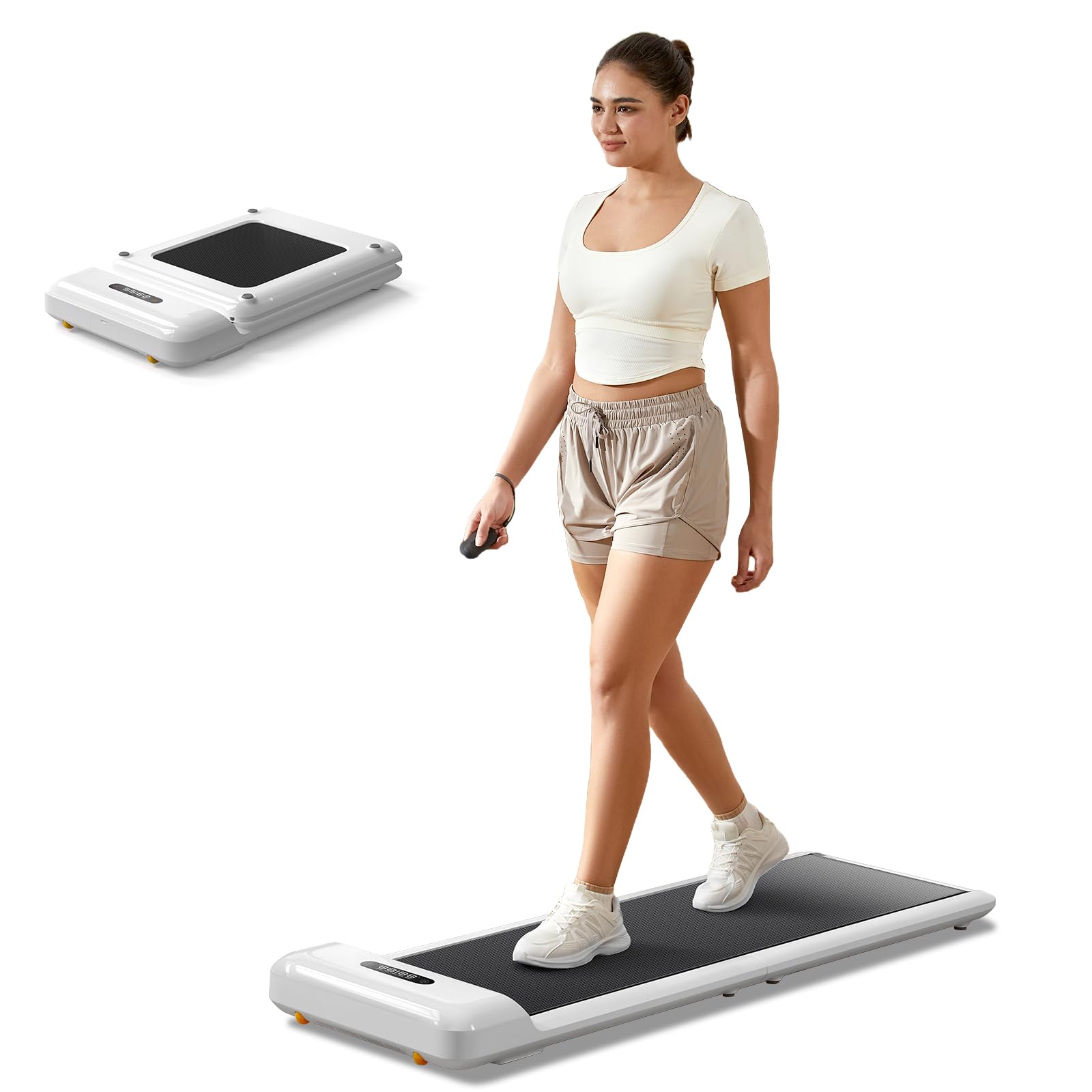
The pad that looks like it belongs in your living room, not a gym
Most compact pads are industrial grey boxes. The C2 is the one that comes in five soft, lasting shades, so it can sit out in a modern lounge or a cozy bedroom without looking like equipment. The fold does the heavy lifting for storage: the platform folds a full 180 degrees and drops to 5.4 inches tall, tucking under a bed or a sofa in a way a rigid deck cannot match.
The 2.0 hp motor supports up to 220 lb and stays quiet enough for the calls and video meetings that desk walking is built around. Speed runs 1 to 4 MPH, adjusted from the remote or the app, and the LED display keeps steps, time, speed, calories and distance visible mid-walk. No assembly at all: unfold, plug in, walk. At 55 lbs with two wheels, it rolls from office to living room without ceremony.
Where the C2 gives ground to the MERACH W50 is capacity and incline. At 220 lb and no incline listed, it is a straight flat-deck walker, not a hill climber. And noise is the thing buyers differ on — some call it very quiet by treadmill standards, some hear more than they expected. For a low-volume home office that matters; in a busy household it will not. What owners agree on is how painless it is to set up and start using, which is why it suits someone buying their first walking pad.
Why it earns a spot: the full 180-degree fold and the five colour choices make it the most furniture-friendly pad here.
The honest limit: no incline and a 220 lb ceiling mean it is built for flat walking, not training variety.
A good match for: a first pad that has to live visibly in a styled room and roll away easily.
Not for you if: incline work or a higher weight rating is on your wish list.
7. Walker Pro Walking Treadmill

The apartment-sized folding deck with its own automatic lubrication system
If your standing desk sits in a one-room flat, the Walker Pro folds down to 19.19 x 13.09 x 3.45 inches — small enough to push out of sight when guests arrive. Its walking surface is 16.5 inches wide and 51 inches long, so you still get a full stride. The 5% incline lets you add gentle grade without touching the speed or the clock. It comes with remote and app control, and the 6.89-inch LCD shows your session at a glance.
The feature that sets this apart in a category full of flexible belts and manual tensioning is auto lubrication. In plain terms, the machine oils its own belt on a schedule, so you are not crawling under the deck with a bottle. The alloy steel frame carries a 220 lb load rating, and the 550-watt input power keeps it running steadily through a long workday. The whole thing arrives ready to use — no assembly, just plug in and go.
The trade-off is that a 220 lb capacity and a compact design leave less margin than the 400 lb MERACH W50, so this is aimed at lighter, desk-bound walkers. And the remote has a troubled reputation — some units simply do not respond, and a few owners mention the belt belt noise or a stop in early use. If the remote is how you plan to control it, check the unit runs right when it arrives. The pad itself is a clever small-space solution; just factor in that the control gear is the weak spot.
Where it shines: that 3.45-inch fold and self-lubricating belt make it the most maintenance-free compact option here.
Room for doubt: the remote and belt adjustment are the two things reviewers flag most, so keep the packaging until you have walked a few sessions.
Worth choosing: if your flat is tiny, your desk is standing height, and you want a deck you rarely have to maintain.
Be cautious if: you are a heavier walker — 220 lbs is the ceiling here.
8. Rockare Walking Pad with Incline 9%, Under Desk Treadmill
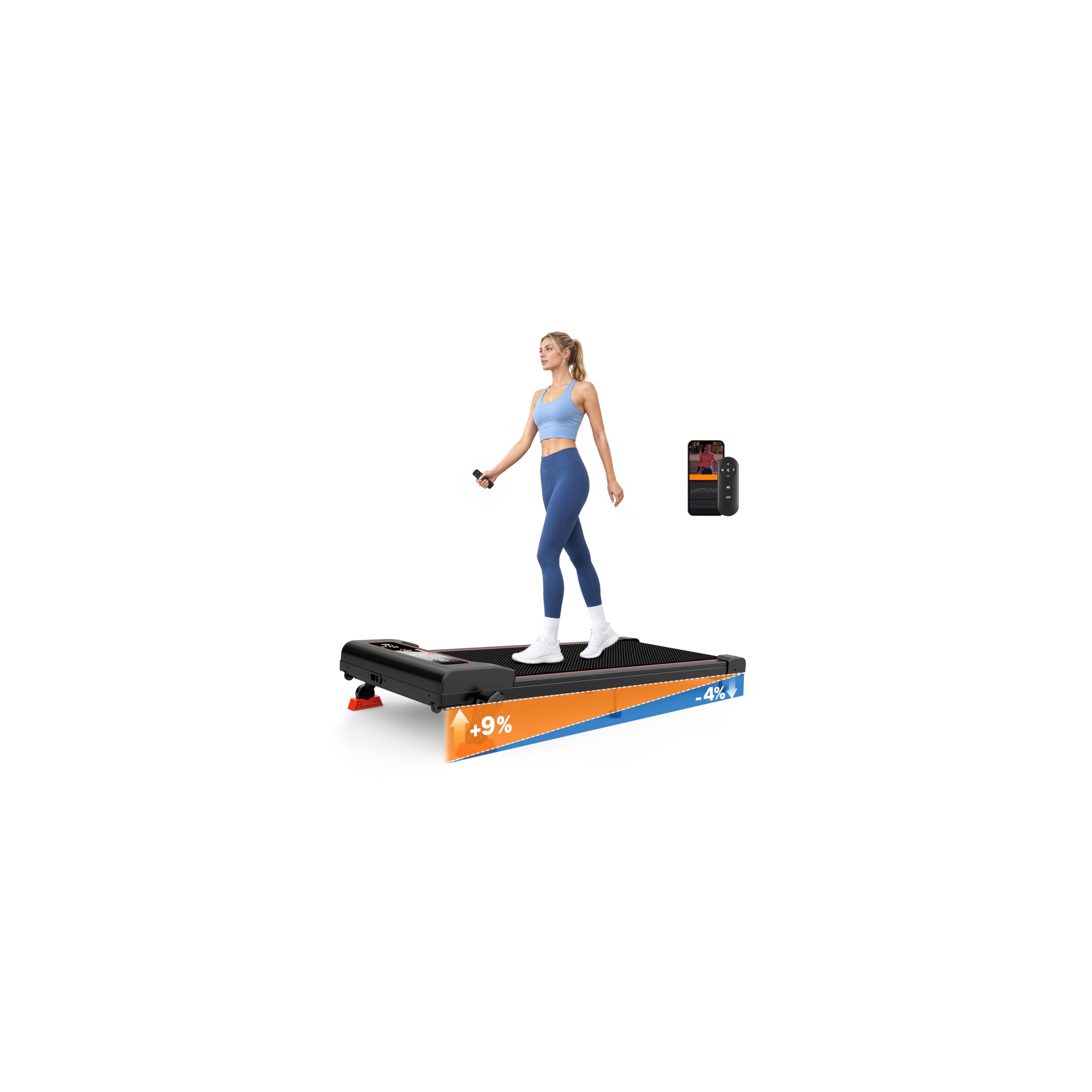
It walks downhill too, which almost no pad in this class can do
Downhill is the unusual part. The Rockare offers five adjustable levels stretching from a 9% climb to a -4% decline, so you can load the front of your stride on the way up and the back on the way down. That range is wider than the FOUSAE’s 10% up-only ramp or the MERACH W50’s 12% climb, because neither of those drops below flat. The EvoDrive 2.5 hp brushless motor runs at 0.6 to 4 MPH and is tuned for low noise, and the large full-metrics display shows the session without squinting.
Underfoot is a NeoFloat quad cushioning system — four soft zones under the deck that soak up the impact of each step — paired with an anti-slip belt for confident footing. At 34.2 pounds it is one of the lightest pads here, so rolling it into place is easy. The corded electric design means no charging ritual; plug in and walk. The tangerine colour also gives it a warmer look than the black and grey boxes that dominate the shelf.
The one number to be sure of is weight. This deck is rated to 265 lbs, so a heavy walker needs the MERACH W50’s 400 lb frame instead. It is also a relatively new listing with fewer owner notes than the others, so there is less long-term feedback to draw on. But if the decline feature is what you want — a genuine post-walk cooldown at a negative grade — nothing else here gives it to you.
Why the incline crowd likes it
- Five levels from 9% incline to -4% decline — the only true downhill pad here
- 2.5 hp EvoDrive brushless motor at 0.6 to 4 MPH
- NeoFloat quad cushioning underfoot
- 34.2 pounds, easy to move
What you give up
- 265 lb ceiling rules out heavier walkers
- Thinner review history than the long-running pads on this list
Grab it if: downhill walks and grade variety matter and you sit under the 265 lb limit.
Elsewhere for you if: you need a heavy-duty frame or a proven repair history.
9. Sunny Health & Fitness Treadpad

The one that comes pre-assembled and logs your walks in an app
If you want hills without touching a setting mid-walk, the Treadpad gives you six preset incline options reaching up to 7%, each one adjusting automatically at the touch of a button. That 7% matches the T10’s fixed grade in steepness but takes the manual tilt out of the equation. The 45.7L x 16W inch walking surface is a solid stride length, and the 6.3 x 2.4-inch display keeps time, speed, calories, steps and distance visible. Speed ranges from 0.5 to 3.7 MPH.
Bluetooth ties it to the SunnyFit app, which opens up a library of 2000+ workouts and 10,000+ workout routes from around the world. Think of it as a virtual walking tour with your pace feeding the screen. It ships fully assembled, and integrated shock absorbers under the deck soften each footfall. The remote makes speed changes simple, so you are not reaching down mid-stride.
That range of features comes with the most mixed track record in the group. Reliability is the most-discussed topic by a wide margin and the tone is genuinely split — plenty of machines run fine for a year or more, but a meaningful share stop working inside a few months, and customers note belt tracking that drifts left as a common issue. The beeping is the other love-it-or-hate-it, and for some owners it is incessant. None of this makes it a bad pad — the build itself holds up when the unit is good — but if you want the safest bet on long-term service, the MERACH W50’s sturdier record is the wiser spend. Buy the Treadpad for the app ecosystem and the price-tier value, not for confidence on repairs.
The strongest reason to choose it: six auto-incline presets plus the SunnyFit workout and route library turn a basic walk into guided training.
The recurring concern: durability and belt tracking are the pattern to keep an eye on, and a quiet room will notice the beeping.
Made for: app lovers who want guided workouts and preset hills without a manual incline lever.
Choose the W50 instead if: you want the longest odds on a durable deck.
Know the Specs
Deck length and width
The deck is the surface you walk on, written as width by length in inches. It decides how natural your step feels. A short belt teaches you to shorten your stride, which is tiring and risky at speed. On this list the belts run from 36 inches on the T10 to about 47 inches on the WalkingPad Z1 and Walker Pro. If you are tall or want to jog, a longer belt is the single most important number to buy.
Max speed and motor horsepower
Speed tells you how fast the belt can go; horsepower tells you how strongly it holds that speed. Walking pads here range from 0.5 MPH up to 6.2 MPH. A motor at or above 2.5 hp, like the FOUSAE’s 2.75 hp or the MERACH W50’s 3.5 hp, holds pace under a heavier walker. A 2.0 hp motor does the job for flat, slower walking.
Weight capacity
This is the heaviest walker the frame is rated to carry. It is not just about whether it collapses — a deck that is working near its limit flexes more and sounds louder. Here the range runs from 220 lbs on the Walker Pro and WalkingPad C2 up to 400 lbs on the MERACH W50. Weigh yourself and leave a little headroom.
Incline, manual versus auto
Incline tilts the deck so you walk uphill and work harder. A manual incline is set once before you start, like the FOUSAE’s 10% or the T10’s 7%. An auto incline lifts and lowers at a button press, like the MERACH W50’s 12%. The Rockare goes further with decline down to -4%. Manual is simpler and cheaper; auto is more convenient mid-walk.
Common Questions
Will a small walking pad fit under a standing desk?
How long should the walking belt be for a tall person?
Is a manual incline or an auto incline better on a walking pad?
What weight capacity do I need for a walking pad?
Can I jog on a small walking pad?
How much noise does a walking pad make?
Do I need to assemble a folding walking pad?
How do I store a walking pad in a small apartment?
Is an incline worth it on a walking pad?
What is the difference between a walking pad and a treadmill?
The Bottom Line
For most people, the most complete small walking pad is the FOUSAE 6.2MPH Walking Pad, because it is the only one here that walks at desk pace and jogs at 6.2 MPH, with a 2.75 hp motor and a 350 lb deck to back it up. If a motorised incline and the widest weight margin matter more than top speed, the MERACH W50 is the sturdier workhorse. And if the pad has to vanish under the bed between sessions, the WalkingPad Z1 folds flattest of the group. Whatever you pick, check the deck length first — that is the number that decides whether your stride fits. The FOUSAE earns its top spot with a 6.2 MPH top speed and a 2.75 hp brushless motor on a 350 lb double frame.
How we choose
We do not accept paid placement. Every pick is matched to a real buyer and a real use-case; we do not hands-on test units.
Sources
Specifications: manufacturer listings and product documentation. Review insights: verified customer reviews, as of November 2026. Pricing: not shown on this page (it changes often); check the current price via the retailer link.
As an Amazon Associate, Tactical Gear Guy earns from qualifying purchases. This does not affect which products we feature.