Specs are compiled from manufacturer listings and verified buyer reviews and can change over time — please confirm the key details on the product page before buying.
Most fridge regret starts with a tape measure, not a brand. A standard depth refrigerator pushes out 28 to 36 inches before you add the doors, and that extra reach is what decides whether your kitchen walkway still works. Get the depth, door swing, and capacity right and the fridge stops being a daily problem. This guide breaks down eight full-depth models by the numbers that actually change your day: cubic feet, door bins, ice output, and energy draw.
This guide is built by comparing the manufacturers’ published specifications and the patterns across verified customer reviews, so you get each pick’s real strengths and trade-offs instead of marketing spin.
You do not need the biggest box on the block — you need one that fits your opening, holds what your family eats, and runs quiet. Below you get the exact capacity figures, freezer splits, and door counts for all eight, so the choice goes from guesswork to arithmetic. Here is the honest breakdown of standard depth refrigerators.
Top Picks

How To Choose The Best Standard Depth Refrigerators
A standard depth refrigerator is the normal-depth model — roughly 28 to 36 inches of body before the doors — as opposed to a counter-depth unit that sits flush with your cabinets. That extra depth is where the storage lives. Decide three things before you compare anything else: the width of your opening, how the doors swing, and how the space splits between fridge and freezer.
Measure the opening, then measure the door swing
The body dimensions are only half the story. A French door model needs both doors to swing out and clear your countertops or a nearby wall, and that swing adds real inches to your walkway. One pick here lists a depth-with-door-open figure so you can plan the swing before delivery day. A top-freezer model swings one wide door instead, which can be easier in a narrow galley but harder next to a pantry return.
Read the fresh and frozen split, not just the total
Two fridges can both say 18 cubic feet and still behave completely differently. The numbers that matter are fresh food capacity and freezer capacity separately, because a big freezer drawer eats into the shelf space you use every day. Large families tend to favor the freezer side; couples and smaller households often want the fresh compartment to win.
Ice makers, water filters, and your countertop
An automatic ice maker needs a water line run to the refrigerator, and a filter needs replacing on a schedule. If the dispenser sits on the outside of the door, it also needs clear floor space in front. Think about who will fill the ice trays — nobody — and whether you would rather trade that convenience for more interior shelving.
Side-by-Side Comparison
| Model | Best For | Total Capacity | Freezer Capacity | Door Bins | Amazon |
|---|---|---|---|---|---|
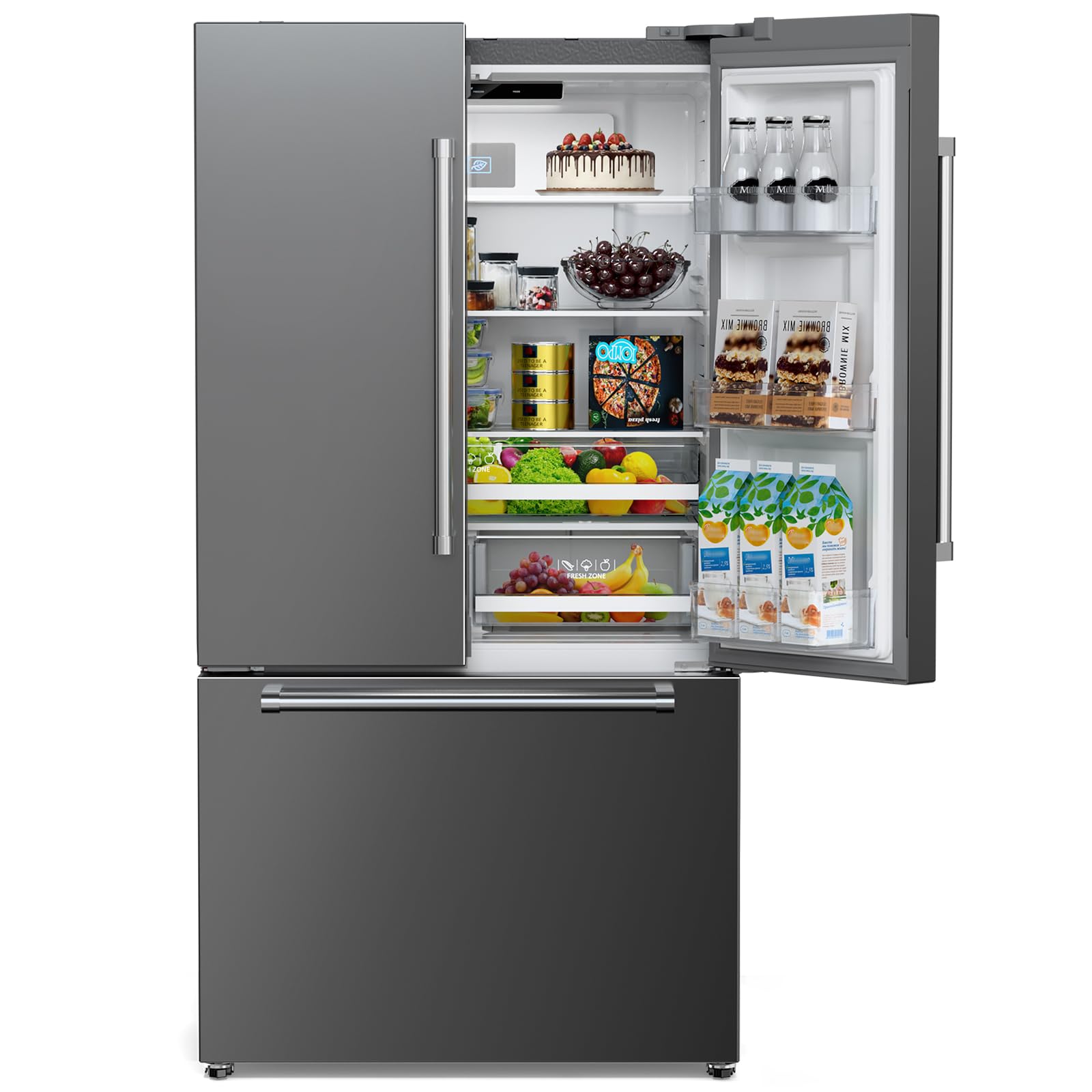
| Antarctic Star 2 French Door★ Best Overall | Big households that want ice on tap | 20.3 cubic feet | 6.13 cubic feet | — | Amazon |
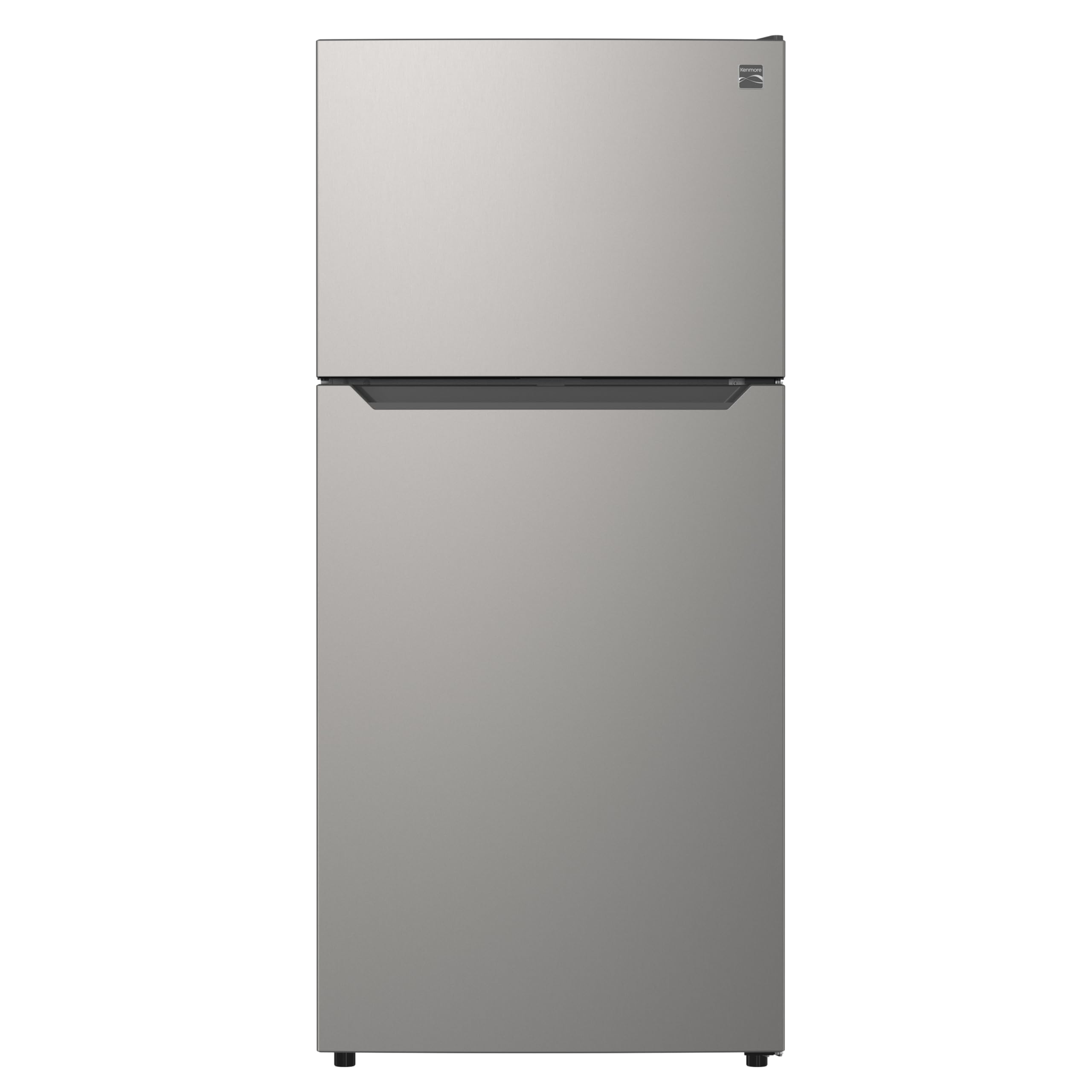
| Kenmore 20.2 cu. ft. Top MountGarage Ready | Garage or basement second fridge | 20.2 cubic feet | 5.09 cubic feet | 6 | Amazon |
| BLACK+DECKER BR1460HSSmall-Space Pick | Small kitchens and apartments | 14.6 cubic feet | 3.2 cubic feet | 2 | Amazon |
| ICEVIVAL 18 Cu.Ft. French Door | Narrow kitchens that still want French doors | 18 cubic feet | 5.4 cubic feet | 6 | Amazon |
| BLACK+DECKER BRF1600GIMW | White appliance setups with ice needs | 16 cubic feet | 5.06 cubic feet | — | Amazon |
| Commercial Cool CCRF1890KW | Two freezer drawers and Sabbath mode | 18.9 cubic feet | 6.5 cubic feet | 8 | Amazon |
| Midea MRF29D6AST | High-volume cooking and dual ice | 29.3 cubic feet | — | — | Amazon |
| GE Profile PVD28BYNFS | Four-door layouts with a middle drawer | 27.9 cubic feet | — | 6 | Amazon |
Detailed Reviews
1. Antarctic Star 2 French Door Refrigerator, 20.3 Cu Ft
Our pick — 4.0+★ from 50+ verified ratings; the strongest balance of quality and price.
A 20.3 cubic foot French door that hands you ice without you ever filling a tray.
If you buy meat in bulk, this fridge gives you somewhere to put it: 6.13 cubic feet of freezer space inside a 20.3 cubic foot body. That is 1.9 times the frozen room of the BLACK+DECKER BR1460HS further down this list. The fresh side gets only 14.21 cubic feet, so produce and dairy sit in a compact compartment while the freezer drawer carries the volume. That split suits households that cook from frozen more than from raw. A high-performance inverter compressor (a variable-speed motor that ramps up and down instead of kicking on and off) holds the temperature without the start-stop clatter.
Quality is the theme reviews return to most, with reliability right behind it. An automatic ice maker and a built-in water filter handle the drinks end without trays or pitchers. Multi-air flow pushes cold air to every corner so the top shelf and the crisper drawer sit at the same temperature, and an LED-lit interior means you can actually read a label at the back. The door-open alarm catches the freezer drawer left cracked open.
The catch is depth and plumbing, not performance. A standard depth body this size reaches well past your countertop, and the ice maker needs a water line run before delivery. The doors open to 90 degrees so a wall beside the fridge will not block the drawers, but you still want to measure that swing. Consider the interior list, too: there is no listed door-bin count here, so if you store a wall of condiments in the door, check your layout against a model that spells its bins out.
Where it earns its keep
- 6.13 cubic feet of freezer space handles bulk buying without a second unit
- Inverter compressor keeps temperature steady and the noise down
- Automatic ice maker plus water filter means no trays, no pitchers
- Door-open alarm and 90-degree hinge make daily use forgiving
What to plan around
- The 14.21 cubic foot fresh side is the smaller half of the split
- Needs a water line run for the ice maker and filter
- Full depth body projects past standard cabinetry
Buy this one if: you want ice and filtered water on tap and your freezer gets more traffic than your shelves.
Think twice if: your kitchen is tight on depth or you have no easy path to run a water line.
2. Kenmore 20.2 cu. ft. 30″ Wide Top Mount Refrigerator
A 30-inch-wide workhorse built to keep its cool in a garage that swings from 45°F to 110°F.
Most fridges give up when the room gets cold or boiling hot. This one carries a built-in temperature sensor rated for environments from 45°F to 110°F, which is the whole reason it belongs in a garage, a basement workshop, or a second kitchen. At 20.2 cubic feet with a 5.09 cubic foot top freezer, it swallows party trays and bulk drinks without crowding the main fridge. The inverter compressor — a motor that adjusts speed instead of switching fully on and off — keeps temperatures steady and runs quieter than a conventional compressor.
Performance draws more review feedback on this model than almost anything else in the category. Value comes up second, and the spacious interior earns its own praise, with a fresh side deep enough for a wall of drinks and drawers that hold vegetables and produce. Six clear door bins, including a gallon bin, keep the everyday grab items off the shelves. The tempered glass shelves are spill-proof and adjust for sheet cakes or tall pitchers.
Here is the honest part: reliability, cooling, and durability feedback are genuinely mixed. Some units run flawlessly for years and make ice without a fuss, while a smaller group reports trouble within the first six months or a unit that arrives dented. That mixed record is not unusual for a large appliance shipped on a pallet, but it argues for inspecting the delivery before you sign. An ENERGY STAR rating keeps the running cost in check, which matters for a fridge parked in an unconditioned space.
The garage logic: the 45°F to 110°F ambient range is a spec you rarely see, and it is why this one works where a normal fridge struggles.
The fair warning: inspect the crate and the cabinet on arrival, because durability is the one theme where the reviews genuinely split.
Reach for this if: you need a second fridge for the garage or basement and want a top-freezer layout with gallon storage in the door.
Look elsewhere if: you want a French door layout or you expect a flawless delivery record.
3. BLACK+DECKER 14.6 Cu. Ft. Top Mount Refrigerator, BR1460HS
The leanest footprint here — 14.6 cubic feet that slips into a small kitchen without a fight.
If your apartment kitchen is really a hallway, this is the shape you want. At 14.6 cubic feet with a 3.2 cubic foot top freezer, it gives you a full-size form factor without the bulk of a 20-plus unit. The 3.2 cubic feet of frozen space is less than half of what the Antarctic Star 2 offers, so a big freezer family will feel the squeeze. But for one or two people it is plenty, and it handles a sheet pan and a week of leftovers with room to spare. Frost-free auto-defrost means no scraping ice with a spatula, and the removable wire freezer shelf lets you clear space for a larger item when you need to.
Adjustable temperature control runs both compartments separately, so you can dial the fridge cooler than the freezer or the other way around. Sabbath mode pauses displays and sounds to comply with religious observation, and it is one of the few sub-15-cubic-foot models in this group with that feature. The reversible door lets you hang it left or right depending on your layout. At 333 kilowatt hours per year it is the lightest energy draw on this entire list, and one of the few picks here with a number that low — useful when the fridge runs all day every day.
The trade-off is the door. Two door bins is a thin count compared to the six bins on the Kenmore and the ICEVIVAL, so condiment hoarders will run out of door space fast. The stainless steel look is a finish rather than true stainless, which is fine until you expect it to match a paneled appliance wall.
Good match if: your kitchen opening or budget is small and you want a no-fuss top-freezer with low energy use.
Pass if: you need generous door storage or a freezer that swallows bulk purchases.
4. ICEVIVAL 18 Cu.Ft. French Door Refrigerator with Ice Maker
French doors and an ice maker in a body 29.8 inches wide — a narrow-kitchen answer.
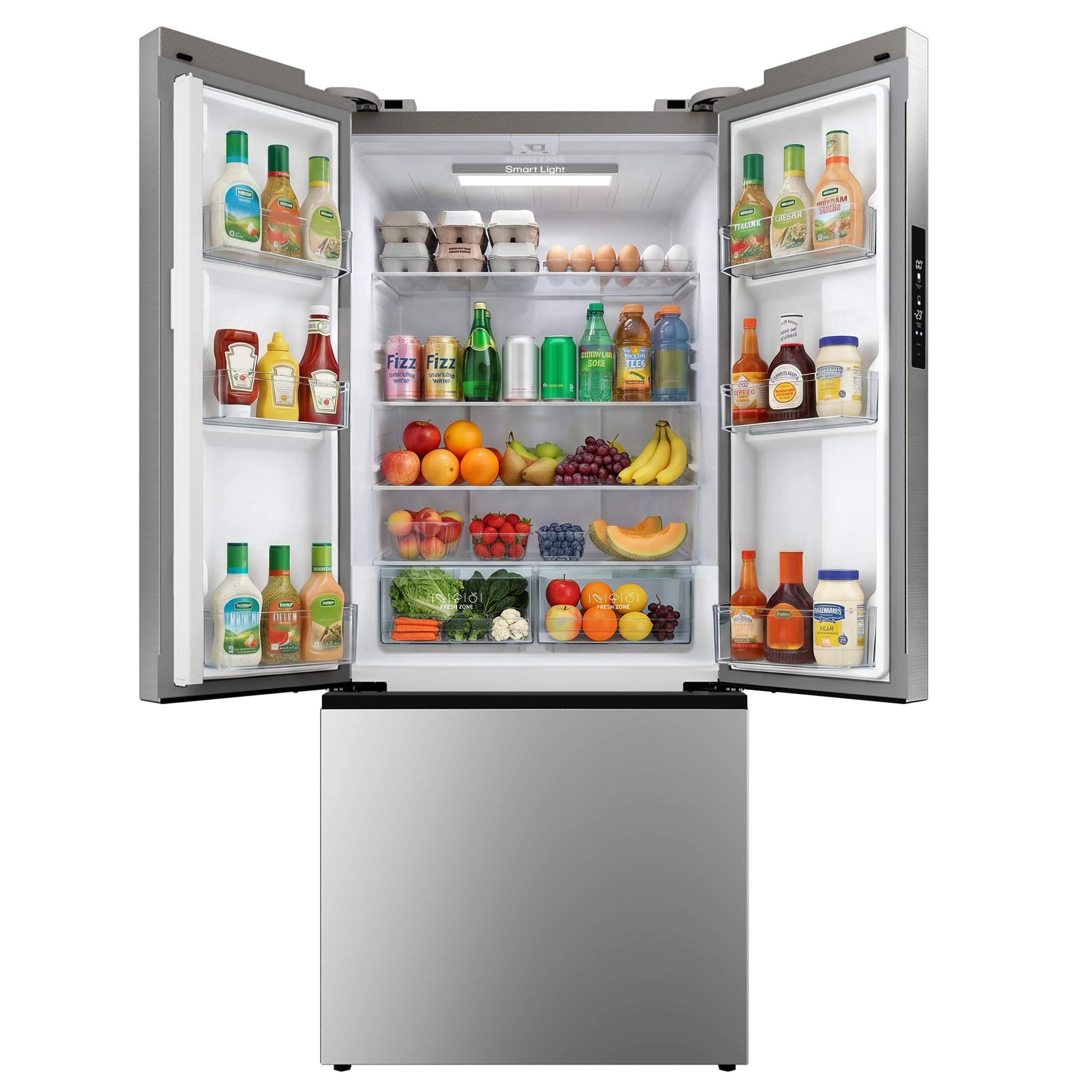
You get French door shelving in a footprint that fits a galley: the body measures 29.8 inches wide, 28.9 inches deep, and 68.9 inches tall. The 18 cubic feet splits into 12.6 cubic feet of fresh food and a 5.4 cubic foot bottom freezer. That is 13 percent less fresh space than the Antarctic Star 2 offers, so pick the Antarctic Star 2 if fresh room matters more than a narrow fit. The built-in ice maker makes up to 4 lbs of fresh ice per day, against the BLACK+DECKER BRF1600GIMW’s 3.5 lbs, so weigh those two numbers if ice volume is your thing.
Three smart modes handle the fridge’s moods: Fast Cool for a fresh grocery haul, Fast Freeze for a freezer restock, and Vacation mode to ease energy use while you are away. Six door bins and four adjustable glass shelves mean you can configure the inside around what you actually buy, and two crispers give produce its own space down low. The door-ajar alarm prevents a wasted day of cooling. UL certification is worth naming for a big appliance drawing power all day — it is a safety mark on the electrical build.
The honest limit is where the 18 cubic feet ends up. And a 28.9-inch depth still juts past a standard countertop, so the slim profile is about width, not flush depth.
Why it fits a narrow kitchen
- 29.8-inch width keeps French doors viable in a galley layout
- 6 door bins and 4 adjustable shelves give flexible interior storage
- Ice maker puts out up to 4 lbs a day
- Fast Cool, Fast Freeze, and Vacation modes cover the whole week
The measurements to accept
- 511 kWh a year is a heavier draw than the low-energy top-freezer picks
- 28.9-inch depth still projects past standard cabinetry
Ideal for: narrow kitchens that want French door access and an ice maker without going over 30 inches wide.
Skip if: energy draw is your priority or you need the maximum fresh food volume.
5. BLACK+DECKER BRF1600GIMW Refrigerator
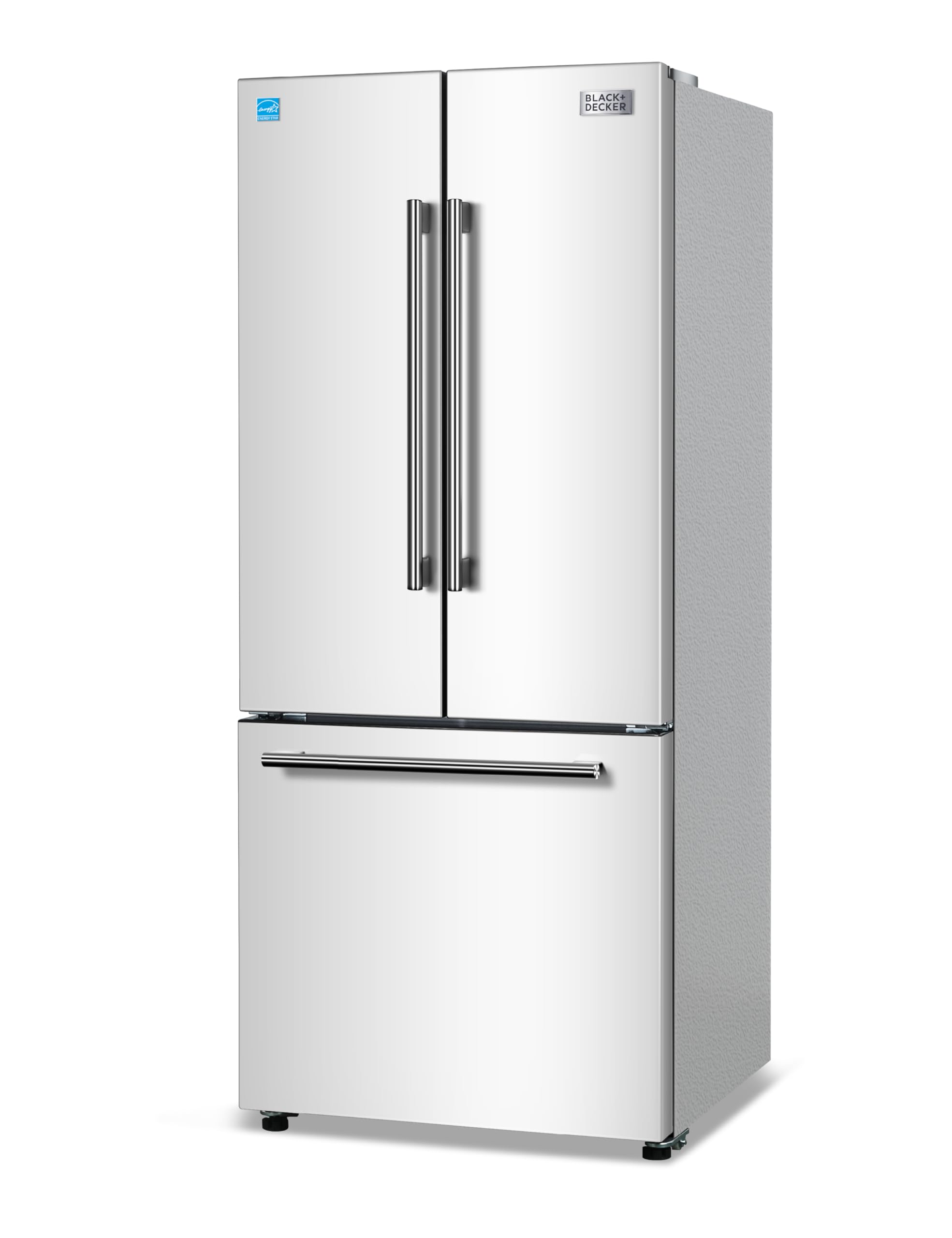
A French door in white with a bottom freezer drawer and a built-in ice maker that keeps up.
White is the finish that disappears into an older kitchen rather than fighting it, and this 16 cubic foot French door does that while adding a bottom freezer drawer with a built-in ice maker. The split is 11.15 cubic feet of fridge to 5.06 cubic feet total freezer, a frozen share that is generous for the total capacity. The ice maker uses a built-in sensor and produces as much as 3.5 lbs of ice a day depending on freezer temperature and operating conditions — a sensible figure if you have a household of ice-in-water drinkers.
Performance is what owners talk about most, and the freezer draws particular praise for exceeding expectations. Space earns the second-most praise: 16 cubic feet behind French doors feels bigger than a top-freezer of the same capacity. Digital temperature control runs each compartment separately, and ENERGY STAR certification means the compressor is not wasting money. Owners consistently call it quiet, which is the note you want in an open-plan kitchen where the fridge hums behind your dinner chair.
Predictably, reliability and temperature control are where feedback thins out and splits. Some units run well for years; a few report trouble within six months or temperatures that wander. Dented doors on delivery come up as well, so check the crate. Also note that the interior freezer is a single drawer, so a serious bulk-buyer may prefer the double-drawer Commercial Cool for organizing a bigger frozen haul.
What the layout delivers: 11.15 cubic feet of fresh space behind French doors, 5.06 cubic feet of freezer below, and an ice maker that runs on its own sensor.
The honest caveat: inspect the doors on arrival, since shipping dents are the recurring note and the finish is not a warranty for a rough delivery.
Choose it for: a white-appliance kitchen where a bottom freezer drawer and steady ice supply matter more than maximum capacity.
Consider a different pick if: you want a double-drawer freezer layout or a proven long-run reliability record.
6. Commercial Cool CCRF1890KW Refrigerator
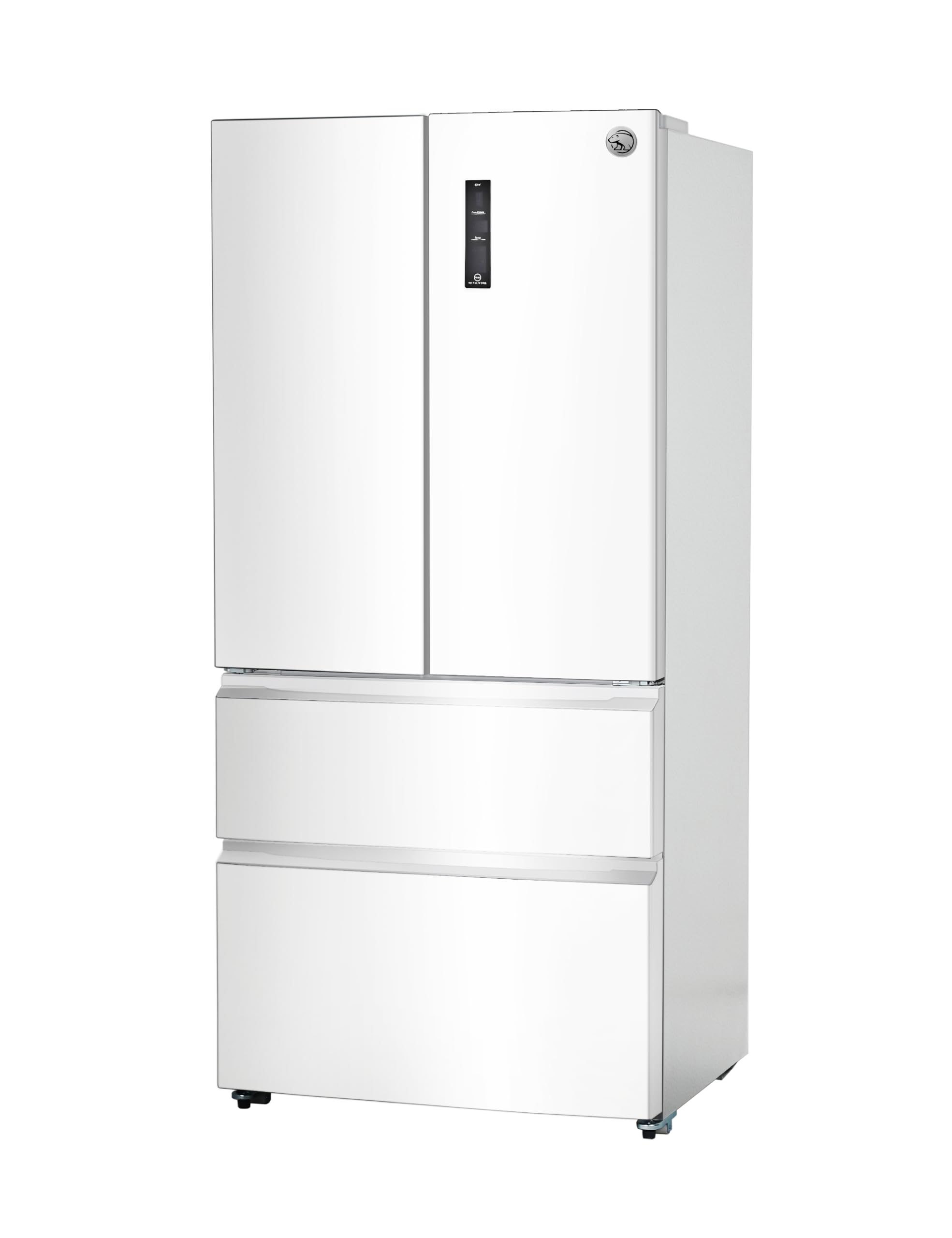
Two freezer drawers, eight door bins, and a fridge built to organize a busy household.
Two separate bottom freezer drawers end the argument over where the bag of peas goes: frozen meals, ice, and meat each get their own slot. This Commercial Cool splits 18.9 cubic feet into 12.35 cubic feet of fridge and 6.53 cubic feet of total freezer. That frozen share is roughly the same as the Antarctic Star 2’s 6.13 cubic feet, so you are not giving up volume to get the split. Eight door bins is the highest count on this list, which turns the door into real shelving rather than a condiment shelf.
The control panel runs each compartment on its own digital thermostat, with an AI mode that regulates temperature, a Vacation mode that trims energy consumption while you are away, and a door alarm when one is left ajar. Sabbath mode pauses displays and sounds for religious observance. A matte finish keeps fingerprints less visible than a bright stainless. Combined with the two-drawer freezer, that makes this a strong organizing pick for a family that keeps the freezer stocked.
Two numbers do not lie. First, this is not ENERGY STAR certified — the listing only meets the DOE standard — and it draws 528 kilowatt hours a year, the heaviest draw among the mid-size picks here. Budget for the utility cost. Second, the rating lands lower than the rest of this list, so go in with your eyes open and inspect the unit carefully on delivery. Neither is a reason to pass, but they are the facts you weigh against the two-drawer flexibility.
Where the storage shines
- Two separate freezer drawers help organize frozen food by type
- 8 door bins — more shelf-in-the-door storage than any other pick here
- AI, Vacation, and Sabbath modes cover most household routines
- 12.35 cubic feet of fridge space and 6.53 cubic feet of freezer
Trade-offs worth weighing
- Not ENERGY STAR certified — DOE standard only
- 528 kWh a year is the heaviest draw in this group of mid-size fridges
- Rating sits below the other picks, so inspect on arrival
Best for: a busy kitchen that needs two freezer drawers, eight door bins, and modes for vacation and observance.
Think twice if: low energy draw or a top rating is non-negotiable.
7. Midea MRF29D6AST 29.3 Cu. Ft. French Door Smart Refrigerator
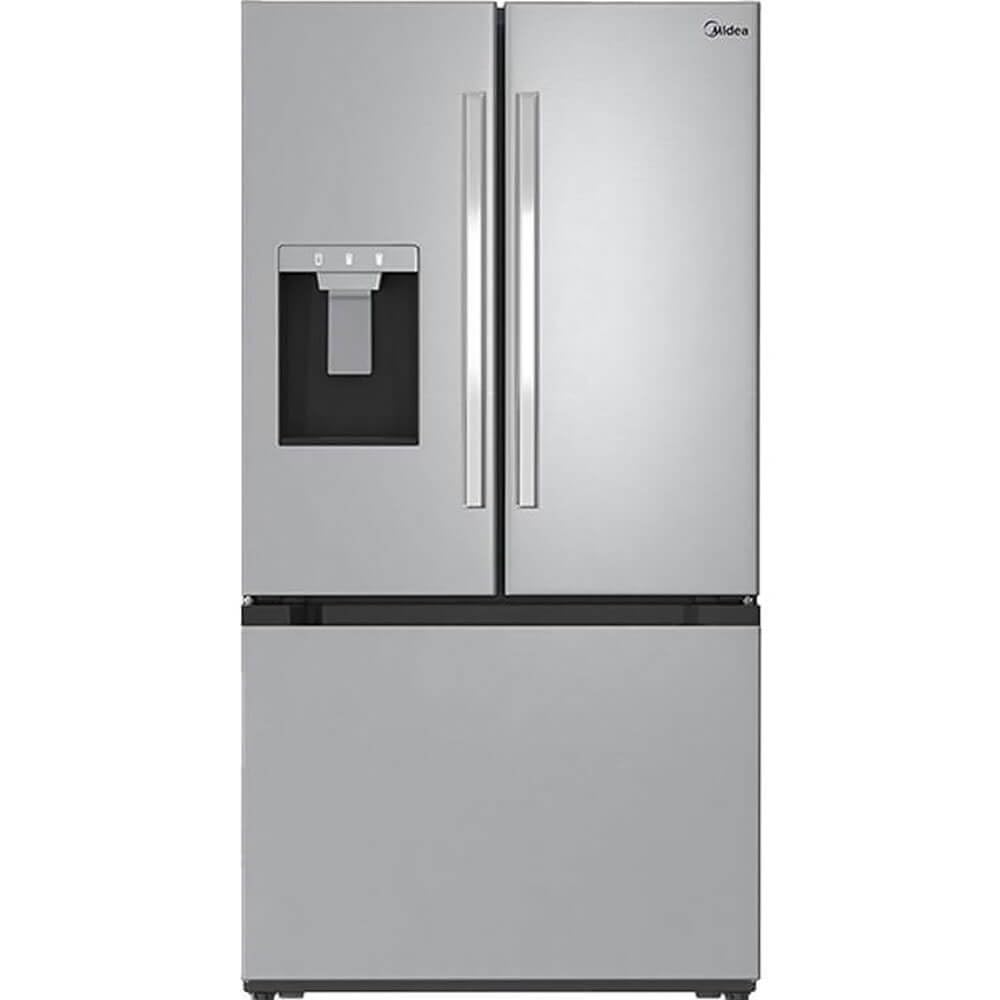
The biggest box on the list — 29.3 cubic feet for households that buy in bulk.
At 29.3 cubic feet, the Midea carries more than twice the volume of the BLACK+DECKER BR1460HS’s 14.6 cubic feet, and it beats the biggest pick below it in this guide. A family that does a huge weekly shop, entertains often, or keeps a chest-freezer-sized frozen inventory gets room to spread out. A dual ice maker means one bin in the fridge and a second in the freezer, so the door dispenser never runs dry mid-party. The front-door dispenser pours cold filtered water plus cubed and crushed ice.
Fingerprint-resistant stainless keeps the front panel clean through a week of kids and cooking, and LED interior lighting makes the shelves easy to scan. The French door side-by-side form factor gives full access to the fridge at counter height, so you are not bending for the milk. And the builder calls out standard depth specifically — this is a full-depth body, not a counter-depth unit, so it stores what it promises. The “smart” in the name means connected controls and status reporting, not a gimmick.
What you must accept is the footprint and the price. A body this deep projects well past your cabinetry, so the walkway needs to work with it. The water and ice dispenser also needs a supply line, and the dual ice maker draws on that line twice. If your kitchen is tight or your water hookup is awkward, this is the wrong shape no matter how much it holds.
Pick this if: raw capacity is the priority and you have the kitchen footprint and water line to feed a dual ice maker.
Keep looking if: your cabinet run is shallow or you cannot route a water supply to the door.
8. GE Profile PVD28BYNFS 36″ 4-Door French Door Refrigerator

Four doors, a middle drawer with its own thermostat, and a front dispenser for water and ice.
The GE Profile brings 27.9 cubic feet and a layout that puts a full-width middle drawer between the fridge and the freezer. That middle drawer gets its own adjustable temperature settings, so you can run it as a second fridge, a chilled drink drawer, or a soft-freeze zone depending on the week. The upper compartment gives French door access at eye level, and the lower freezer keeps the bulk down low. An external dispenser delivers cold filtered water plus cubed and crushed ice from the door, so nobody has to open the fridge for a glass of water.
Performance is what owners praise most, and LED interior lighting comes up again and again for making every shelf easy to find at night. Storage capacity and freezer space draw praise, and the multi-air flow system keeps temperatures consistent across the compartments. The stainless steel finish is fingerprint resistant, which matters on a four-door front where hands land on multiple panels. At 722 kilowatt hours a year the draw is on the higher end, but that is the cost of 27.9 cubic feet and four doors. The 36-inch width puts this squarely in a standard kitchen rather than a compact one.
The details to plan around are the swing and the depth. With the doors open this needs 48.38 inches of maximum clearance to let the hinges reach full swing, so check the run in front of the fridge before delivery. Depth is standard, not counter-depth, so the front will sit proud of your cabinets. Cooling performance is the one aspect where feedback splits rather than sings, so go in expecting to verify the temperature settings on delivery.
The step-up case: the adjustable middle drawer is a genuine fourth zone, and the front dispenser means no one opens a door for water.
The space math: 48.38 inches of door-open clearance is a real constraint, so measure your walkway before you commit.
Suits you if: you want a four-door layout with a temperature-flexible middle drawer and a front water-and-ice dispenser.
Look elsewhere if: your walkway cannot spare the door-open swing or you need counter-depth flush mounting.
Know the Specs
Total Capacity vs. Fresh and Frozen Split
The headline cubic feet is the total interior volume, but the number that shapes your day is how it splits between the fresh compartment and the freezer. A fridge with a big freezer number spends that space on frozen storage, which is great for bulk meat and ice cream but leaves less room for produce and dairy. Read both figures, then think about what your household actually fills. Two fridges can say the same total and still feel completely different to use.
Annual Energy Consumption
This is the total electricity the fridge is expected to draw across a year, measured in kilowatt hours (kWh — the unit your utility bill uses). A lower number means the compressor runs less and costs less to keep cold. The gap here is real: 333 kWh a year on a smaller top-freezer versus 722 kWh a year on a large four-door. That gap reflects size and features, so weigh it against what you actually need in the box.
Door Bins and Shelf Configuration
Door bins are the shelves built into the inside of the door, and they hold the small things you reach for constantly — condiments, drinks, butter. A higher bin count turns the door into real storage instead of a place where jars fall over. Adjustable glass shelves let you clear height for a sheet pan or tall pitcher, and crisper drawers keep produce at its own humidity. Count the bins and the shelves, because that is where the daily frustration or delight lives.
Ice Makers, Water Filters, and Dispensers
A built-in ice maker needs a water line, and a filter needs replacing on a schedule. An automatic maker produces a set amount of ice per day, so compare the daily output if ice volume matters in your household. An external dispenser adds cold filtered water at the push of a button, but it also needs room in front of the door and a clean supply line. Factor in the hookup before you fall for the layout.
Common Questions
What does standard depth mean on a refrigerator?
Will a standard depth refrigerator fit in my kitchen opening?
Do I need a water line for an ice maker?
Is a bigger cubic foot total always better?
How much energy does a standard depth refrigerator use?
French door vs top freezer — which layout should I choose?
What is Sabbath mode on a refrigerator?
Do these refrigerators need defrosting?
Can I use a standard depth refrigerator in a garage?
The Bottom Line
For most households, the winner among these standard depth refrigerators is the Antarctic Star 2 French Door. Its 20.3 cubic feet, automatic ice maker, and water filter cover a family’s daily demands without asking you to fill a tray. If you need a second unit for the garage or basement, reach for the Kenmore 20.2 cu. ft. Top Mount, rated for 45°F to 110°F ambient temperatures. And when capacity is king, the Midea MRF29D6AST at 29.3 cubic feet and a GE Profile four-door with its adjustable middle drawer give you a clear step up.
Before you hit checkout, measure the opening, the walkway, and the door swing — then pick the layout that matches how your household actually eats.
How we choose
We do not accept paid placement. Every pick is matched to a real buyer and a real use-case; we do not hands-on test units.
Sources
Specifications: manufacturer listings and product documentation. Review insights: verified customer reviews, as of November 2026. Pricing: not shown on this page (it changes often); check the current price via the retailer link.
As an Amazon Associate, Tactical Gear Guy earns from qualifying purchases. This does not affect which products we feature.