Specs are compiled from manufacturer listings and verified buyer reviews and can change over time — please confirm the key details on the product page before buying.
If your phone dies on the drive home while your passenger’s phone sits at 90%, you have a port problem, not a battery problem. The fix is a car charger with enough real output to run two or three devices at once — and enough honest labelling that you are not fooled by a big number on the box. Below are seven chargers worth plugging in, sorted by what each one actually does best: the two-device commuter, the laptop-capable road warrior, the three-port family hauler, and the multi-pack you can scatter across two cars.
This guide is built by comparing the manufacturers’ published specifications and the patterns across verified customer reviews, so you get each pick’s real strengths and trade-offs instead of marketing spin.
You will see per-port wattage, connector types, and the small fitting details that decide whether a charger sits flush or rattles loose, so you can match one to your socket and your devices. Here is the practical shortlist of the Best Phone in Car Charger options for your next drive.
Top Picks

How To Choose The Best Phone in Car Charger
The single mistake almost every buyer makes is reading the headline wattage and stopping there. A charger advertised as “136W” does not hand 136W to your phone. That number is the sum of every port running at once, and each port has its own ceiling.
Read the per-port number, not the total
A USB-C port rated for Power Delivery (PD — the standard that lets a charger and phone negotiate the right voltage) will list its own maximum, such as 100W on one port or 45W on another. That port number is what your phone actually receives. If you charge a laptop and a phone together, check whether the charger splits power or holds speed on both — several here promise dual-channel output without splitting.
Match the connector to your cable drawer
USB-C to USB-C is now the fast lane for iPhone and Android alike, and a USB-A port still handles older cables and dashcams. A charger with both a USB-C and a USB-A socket covers more of your existing cables without buying new ones. Some units include a cable in the box; check the length and connector type before you assume it fits your setup.
Check the fit before the specs
A charger that sits loose in the socket loses contact over bumps, and a flickering connection charges nothing. Look for a body sized to sit snugly in a standard 12V socket, and note whether the charger supports 24V systems if you drive a truck or RV. A wide, tall splitter body can also crowd the console, while a thumb-sized plug leaves your cup holder clear.
Decide if you need a display
Some chargers show your car battery’s live voltage on a small LED readout. That is a diagnostic convenience, not a charging feature — it tells you the state of the vehicle’s electrical system at a glance. If you already have a dash gauge or a healthy battery, it is a nice-to-have rather than a reason to buy.
Side-by-Side Comparison
| Model | Best For | Max Port Output | Ports | Rated Amperage | Amazon |
|---|---|---|---|---|---|
| Belkin 36-Watt Dual-USB Car Charger★ Best Overall | Two-device commuters | 18W per USB-C port (36W total) | 2x USB-C | 3.33 A | Amazon |
| LISEN PD3.2 136WTop Performer | Laptop plus phone on the road | 100W on USB-C1 (136W total) | 2x USB-C + 1x USB-A | 5 A | Amazon |
| 130W 3-Port USB C with Voltage Display | Voltage monitoring on the dash | 130W total across 3 ports | 2x USB-C + 1x USB-A | 6.5 A | Amazon |
| FLYLEAD 200W GaN Car Charger | Built-in cable, laptop charging | 100W per PD output (200W total) | Fixed USB-C cable + USB-C + USB-A | — | Amazon |
| AINOPE 67.5W Car Charger | Cable included, extreme cold | 45W PD + 22.5W QC | 1x USB-C + 1x USB-A | 3 A | Amazon |
| JOYROOM 225W 7-in-1 Splitter | Whole-car, whole-family power | 36W on PD1 (225W rated) | 5x USB + 2 cigarette sockets | 15 A | Amazon |
| Bangfun 5 Pack 36W Dual USB | Outfitting several cars | 20W PD + QC 3.0 | 1x USB-C + 1x USB-A | 2 A | Amazon |
Detailed Reviews
1. Belkin 36-Watt Dual-USB Car Charger
Our pick — 4.5+★ from 950+ verified ratings; the strongest balance of quality and price.
Two USB-C ports that both charge at full speed — the commuter’s quiet favourite.
This is the pick for the driver who wants one small plug that handles a phone and a second device without drama. Belkin splits its 36W total across two USB-C ports rated at 18W each, and both ports fast-charge at the same time rather than one throttling to feed the other. For a phone and a pair of earbuds, or a phone and a passenger’s phone, that is enough for a real top-up on a 20-minute commute.
What earns it the top spot is consistency. The maker’s PPS technology (a voltage-tuning mode that adjusts output to match the specific phone connected) fast-charges an iPhone or a Galaxy at their proper rate instead of falling back to a slow trickle. It is USB-C PD 3.0 certified, which means the power negotiation follows a known standard rather than a guess. A small LED on top confirms it is live, so you are not troubleshooting a dead port at a red light.
The comparison that matters: the LISEN below pushes 136W against this charger’s 36W, and the AINOPE runs 5A against Belkin’s 3.33A. If you need to fast-charge a laptop from the socket, this is not the one. Two phones at 18W each, though, is exactly what most cars actually need, and doing that reliably is a different skill from chasing the biggest number. Across review pages, the consensus is quality and no-fuss function — the kind of plug you forget is even there.
What holds up
- Both USB-C ports run 18W simultaneously, so two devices charge at full speed
- PPS voltage tuning matches iPhone and Galaxy charging rates properly
- USB-C PD 3.0 certified for standard-based negotiation
- LED indicator confirms live power instantly
Where it tops out
- 36W total is not enough for laptop charging
- Two USB-C ports only — no USB-A socket for older cables or a dashcam
- Value is the one point reviewers split on; this is a mid-range buy, not the cheapest
Reach for this if: you charge two phones or a phone plus earbuds and want both at full speed with a known standard behind it.
Look elsewhere if: a laptop, dashcam, or USB-A cable is part of your daily load.
2. LISEN PD3.2 136W Super Fast Car Charger
A laptop charger built into a plug the size of your thumb.
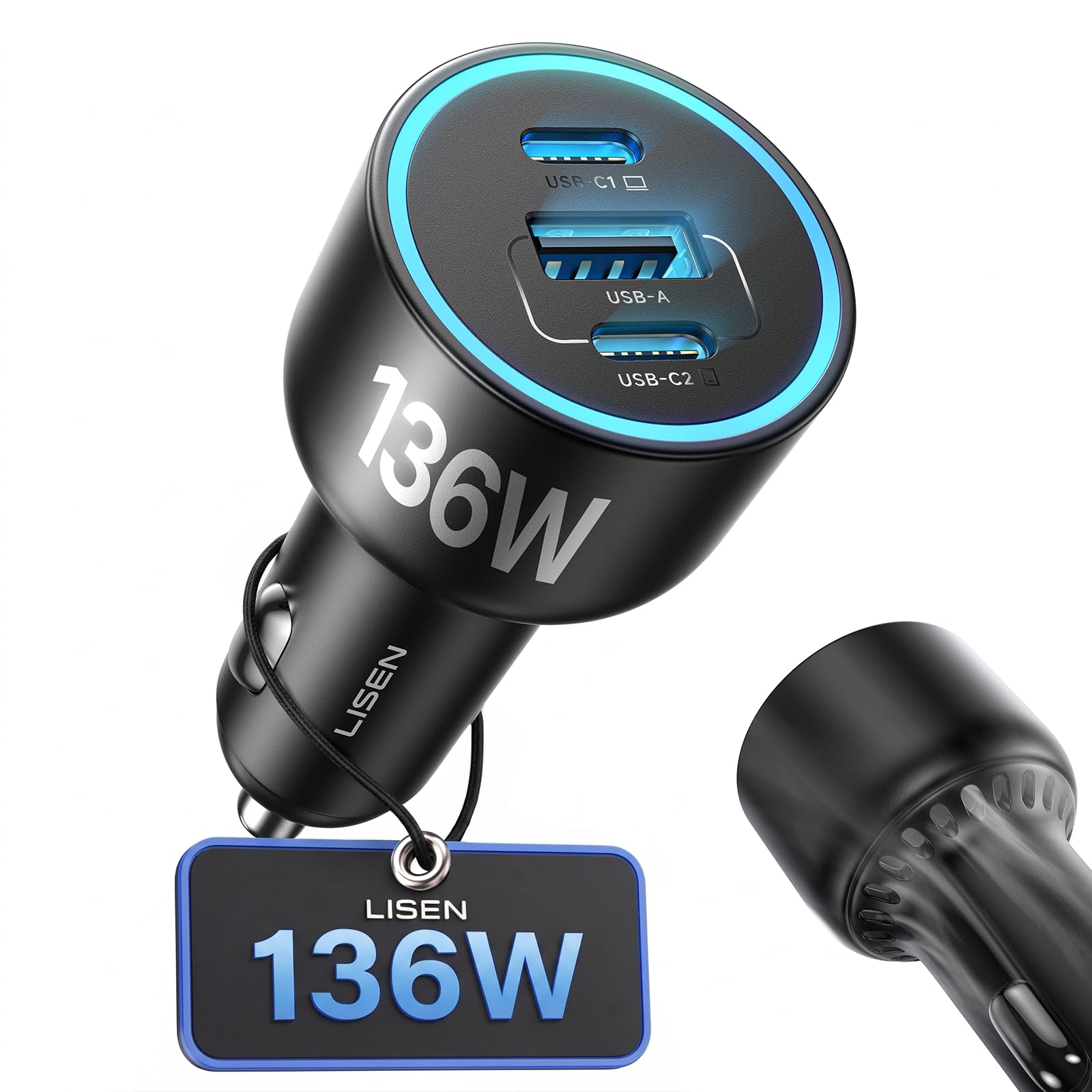
Here is the number that separates this from the rest of the list: one USB-C port delivers up to 100W on its own, enough to fast-charge a MacBook, Dell, or other USB-C laptop straight from the cigarette socket. A buck-boost circuit steps voltage up internally, so you get that same 100W whether your vehicle runs a 12V or 24V system. The LISEN outruns the Belkin on total wattage by a wide margin, and it does it without giving up an ounce of physical size — the whole unit weighs 42 g.
The three ports share 136W total: USB-C1 up to 100W, plus USB-C2 and a USB-A port at up to 36W each. That means a laptop, a phone, and a set of earbuds can all pull power together while the chip allocates by need. The maker is unusually upfront about measuring each port rather than summing the box, and the PD3.2 SPR AVS standard (an adjustable-voltage mode that fine-tunes in small steps to keep speed high while cutting heat) backs that claim with real engineering rather than marketing.
What makes it liveable day to day is the fit. The body seats firmly and the maker specifically addresses road vibration — no flicker, no dropouts on rough surfaces. A passive vent handles cooling without a fan, and protections cover over-current, over-voltage, over-temperature, and short circuit. For a road-tripping professional or a family where one seat has the work laptop, this is the pick that does something the others simply cannot.
Why it earns its spot: 100W on a single port from a 12V socket is rare at this size, and 136W across three ports lets the whole front row plug in at once. The heat-management story — adjustable voltage plus passive venting — is what keeps that speed from sagging after 20 minutes.
The honest limit: 136W is a shared pool, so with a laptop on USB-C1 the other two ports drop to a combined 36W. If everyone in the car is running a laptop, you will feel the split.
The one to buy: anyone who wants to work from a laptop in the passenger seat without hunting for an outlet.
Not necessary if: your devices are phones and earbuds only — the Belkin handles that with less to think about.
3. 130W 3-Port USB C Car Charger
Three ports plus a live readout of your car’s electrical health.
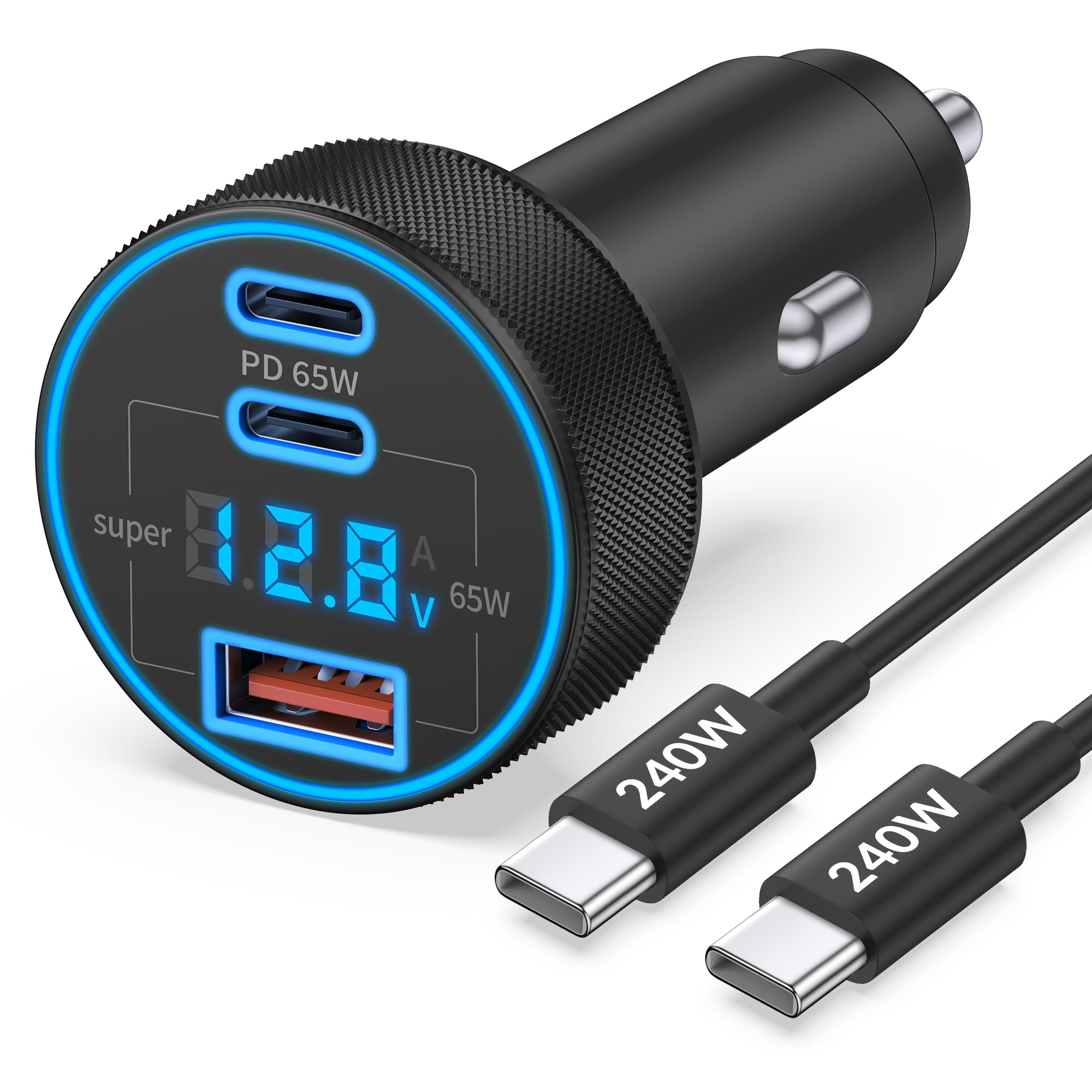
Most chargers are silent about what is happening under the hood. This one shows it. An LED digital display reports your car battery’s voltage in real time, so you can see the operating condition of the electrical system rather than discovering a weak battery on a cold morning. That is a convenience feature, not a charging spec — but for an older vehicle or a car that sits for weeks between drives, it is genuinely useful information sitting right where you already look.
On the charging side, 130W spreads across two USB-C ports and one USB-A, with PPS, PD, and QC protocols on board. The maker rates a Samsung Galaxy S26/S25/S24/S23 Ultra to 80% in 30 minutes and an iPhone 18 Pro/Pro Max or iPhone Duo to 70% in 30 minutes. Intelligent power distribution reallocates output as devices come and go, so adding a third device does not leave the first one stranded. A 240W USB-C to USB-C cable is in the box, with an E-Marker chip (a small chip that tells the charger what the cable can safely carry) protecting against overcharging and heat.
Compared with the LISEN above, this one spreads its power wider but caps lower on any single USB-C port, which is the right trade if you are running three phones rather than a laptop. The metal enclosure feels more substantial than the plastic shells on several rivals here, and it takes both 12V and 24V inputs. If you want to keep tabs on the car’s electrical system while your phone tops up, nothing else on this list does that.
What makes it different: the voltmeter is the whole reason to pick this over a cheaper three-port plug — it turns a charging accessory into a light diagnostic tool.
Worth knowing: the display and the power sharing are the story, not single-port speed, so a laptop owner should look at the LISEN or the FLYLEAD instead.
Best for: drivers of older or hard-working vehicles who want a health check on the battery every time they plug in.
Skip the voltmeter: if you drive something new and just want the fastest phone charge, you are paying for a feature you will not read.
4. FLYLEAD 200W GaN Car Charger
Two laptops at once, with one cable you never have to untangle.
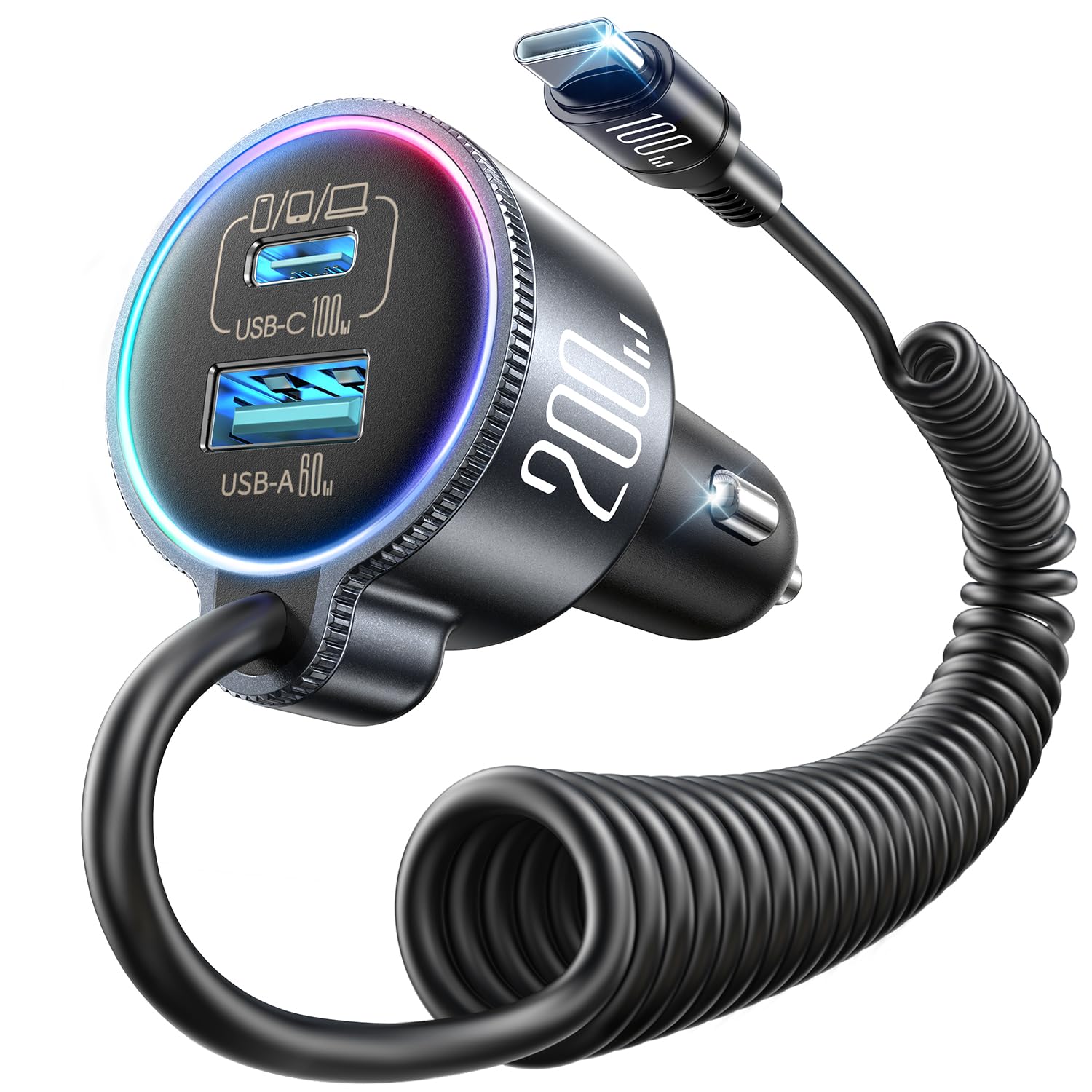
Two 100W outputs is the headline, and it is not a sum on a box — the fixed coiled USB-C cable and the separate USB-C port each deliver up to 100W simultaneously. Charge a MacBook Pro and an iPhone 18 Pro Max together at full speed and neither one concedes. That is the highest per-device ceiling on this list, and the GaN construction (gallium nitride, a semiconductor that runs cooler and smaller than older silicon designs) is the reason it can sit in a plug that size without cooking.
The integrated 5-foot coiled cable is the detail that quietly changes the experience. It reaches a dashboard-mounted phone or the back seat without a loose cable trailing through the console, then retracts out of sight. A smart chip reallocates power depending on load — 100W plus 100W for two devices, or 100W plus 24W when a third plugs into the QC60W USB-A port. Three widened metal contact points resist interruption from bumps, and the maker’s stated protections cover overcurrent, overvoltage, overload, overheating, and short circuits.
The catch to weigh: at 200W, this charger’s focus is laptop-class output, and if your car only ever carries two phones you are buying headroom you will not spend. Compare it to the LISEN’s three-port flexibility and you lose one port but gain that built-in cable.
The case for it
- Dual 100W PD outputs run two laptops at full speed at once
- 5-foot coiled cable built in, retracts cleanly, cannot be lost
- GaN construction keeps heat down and the body compact
- Three widened contact points resist bumps and vibration
The trade-offs
- Only three outputs total — one fewer than the LISEN’s three plus flexibility
- 200W is overkill if your car never carries a laptop
- The USB-A port drops to 24W when both PD outputs are loaded
Pick this one if: you want laptop-class charging and hate hunting for a cable in the footwell.
Think twice if: your passengers are all phones — the Belkin covers that with less complexity.
5. AINOPE 67.5W Car Charger USB C Fast Charge
The out-of-the-box kit that survives a blizzard and a thousand tugs.
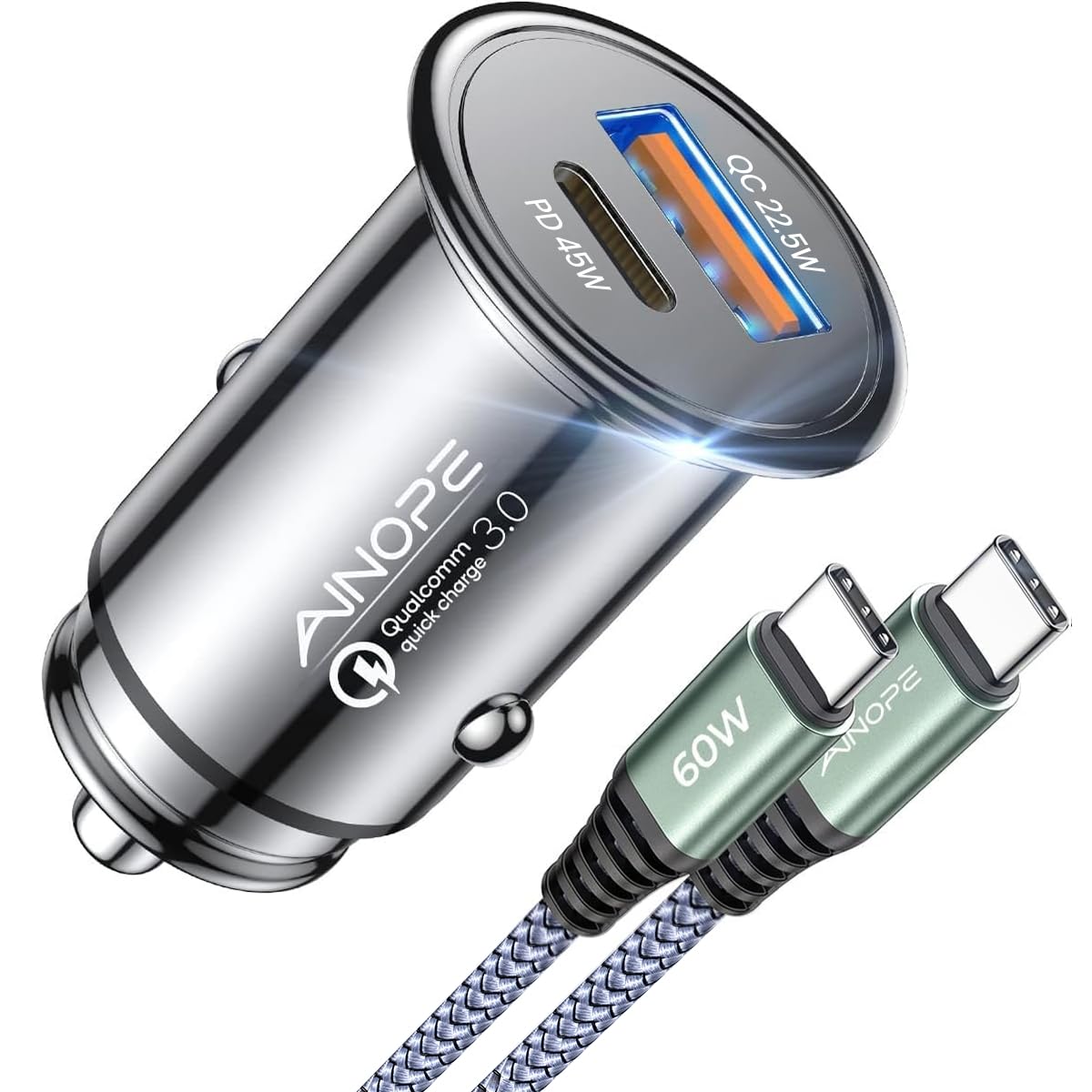
Two numbers define this one: a 45W USB-C PD port and a 22.5W USB-A QC port, with the maker rating a Samsung S25 Ultra or iPhone 18 Pro Max to a full-speed 45W charge and the QC port to 80% in 35 minutes. The 45W PD port is rated ten times faster than a 2.4A charger — the maker’s comparison, not measured here — and it also charges MacBooks, iPads, and Android devices. AINOPE holds 3A where the LISEN runs 5A, so on raw current this one gives ground.
What makes it stand out is what ships in the box. A 3.3-foot nylon 60W USB-C to USB-C cable is included, rated to survive 40,000+ bend tests, so the kit works on day one without digging through a drawer. The dual-channel design runs both ports at full speed without splitting power, and a superconductor chip keeps heat low. The maker also rates it safe for freezing weather, which matters if you park outside in a cold climate.
The body is thumb-sized and designed to sit snugly in most cigarette lighters without blocking the surrounding console. A note on compatibility: this kit is USB-C only, and the maker states plainly it does not work with a Lightning connector, so an older iPhone needs a different cable. There is also a real-life split — most drivers charge two devices simultaneously and love it, while a smaller share hit a mismatch with specific models. That is a fit question to check before you buy, not a reason to avoid the kit.
The review-page consensus: the base is quality and no-worry function, with the build and the bundled cable drawing the strongest praise. Reviewers repeatedly call it solid, heavy-duty, and worth a repeat buy.
What to check first: confirm your devices are USB-C, since the included cable will not serve a Lightning port, and verify the fitment in your specific socket.
Ideal for: the buyer who wants a complete, rugged kit without ordering a separate cable.
Not the fit if: you still charge an older Lightning iPhone or need laptop-class wattage.
6. JOYROOM 225W 7-in-1 Cigarette Lighter Splitter
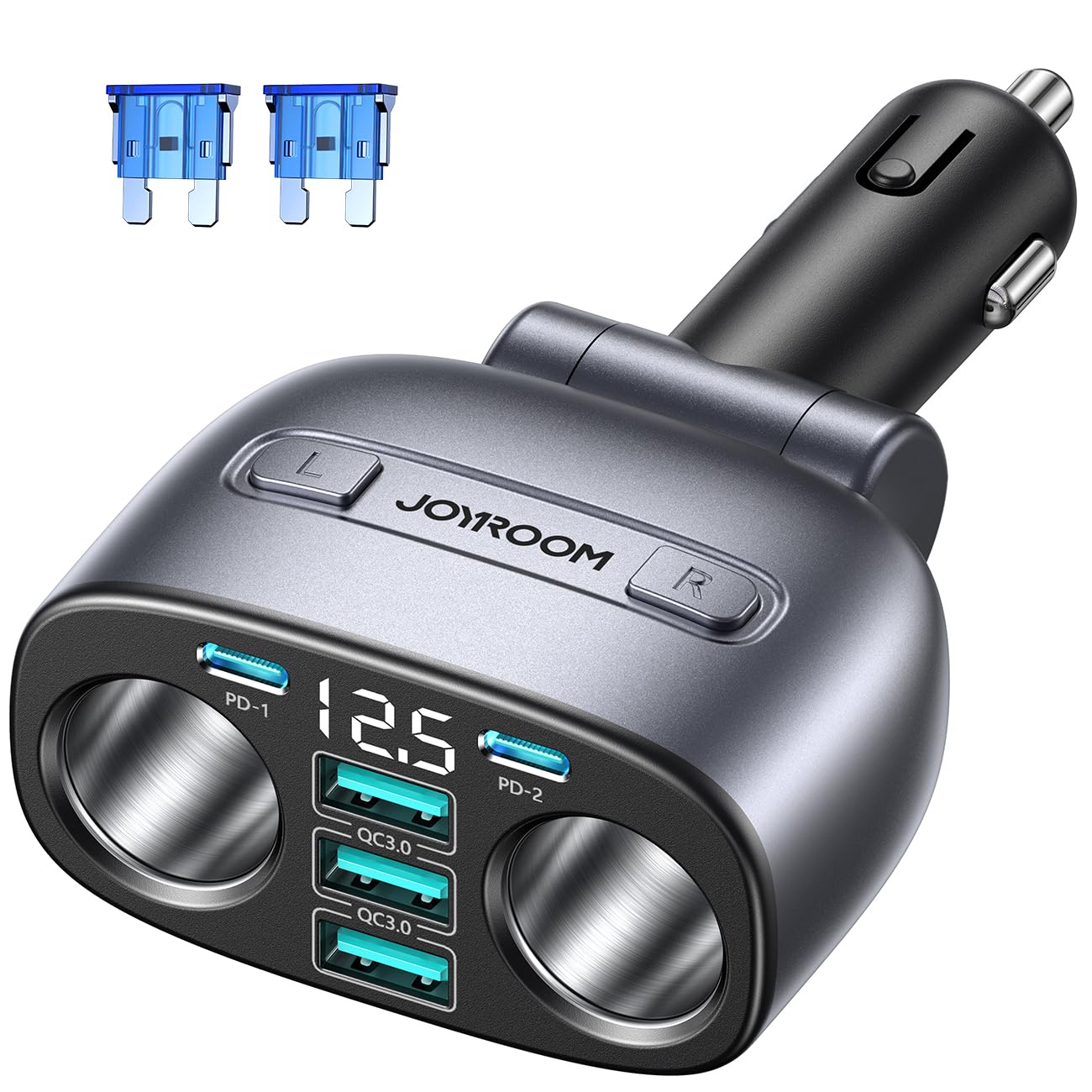
The family road-trip answer: seven outlets and nobody waiting for a socket.
This is not a tiny plug — it is a whole power strip for the car, and that is the point. Seven outlets total: five USB ports (PD1 36W, PD2 and QC1 at 30W, QC2 and QC3 at 30W) plus two cigarette-lighter sockets carrying up to 225W rated power. Three dedicated fast-charging schemes let you run up to three phones or tablets at 30W+ at the same time, so the back seat and the front seat all plug in together.
The cigarette sockets have been upgraded to 120W, which opens the door to dashcams, radar detectors, GPS units, car refrigerators, heated seat cushions, and even car kettles and food warmers — the sort of gear that would trip a cheap splitter. It works on 12V and 24V systems alike, and a replaceable 15A fuse plus protection circuits cover overcharging, over-temperature, and short circuit. A voltage indicator is built in, so you can see the car’s electrical reading while everything runs.
What wins people over here is simply how many things it means you stop arguing about. Every device in the car gets its own outlet, and the cord length gives you room to route it where you want. The recurring gripe is the adhesive mount — it does not hold as firmly as some would like, so plan to place it where its own weight or a firm mounting point keeps it steady rather than relying on the sticky pad alone. For a car carrying kids, tablets, and a dashcam, nothing else here comes close on outlet count.
Where it wins
- Seven outlets: five USB plus two cigarette sockets from one plug
- Three phones or tablets fast-charging at 30W+ simultaneously
- Cigarette sockets rated to 120W for dashcams, coolers, and seat heaters
- Replaceable 15A fuse and built-in voltage indicator
Real-world notes
- The bolt-on adhesive is the weak spot — plan a firmer mounting point
- A larger body that takes console space compared with a thumb-sized plug
- 225W is a shared ceiling, so heavy appliances and phones compete for current
Where it belongs: a family car or work vehicle with dashcams, tablets, and multiple passengers drawing power.
Where it does not: a single-driver commuter who wants something that disappears into the socket.
7. Bangfun 5 Pack 36W Dual USB Car Charger

Five chargers, so every vehicle in the household gets one.
Five plugs for roughly the cost of a single mid-range charger is the entire proposition here, and it solves a problem the others do not: the second car, the work truck, the spouse’s sedan, and the spare in the glovebox. Each unit is a 36W dual charger with a USB-C PD 3.0 port rated to 20W max and a USB-A Quick Charge 3.0 port that the maker rates to take a Samsung Galaxy from 0% to 80% in 35 minutes. An independent PD and QC chip runs both protocols at once without one throttling the other.
Each plug lights up with a soft blue ring, which makes finding the port in a dark car a one-second job instead of a fumble. The maker states it will not drain the car battery, because the 12V outlets shut off when you pull the keys. The metal enclosure feels sturdier than the plastic shells on some rivals, and the package covers iPhone 15/14/13 down through older models, iPads, Samsung Galaxy handsets, Pixels, and LG phones.
Set expectations honestly: 20W on the USB-C port is a phone charge, not a laptop charge, and the fastest competitors here put out more on a single port. Reliability is the one area where experiences divide — most units run fine, a smaller share report a dud on arrival, which is the classic multi-pack trade. The way to use this smartly is to test all five when they land and keep the spares bagged. For a two-car household or a small fleet that just needs everyone topped up, the value is difficult to match.
Why the math works: a five-pack turns a single-car upgrade into a fleet-wide one, and the dual protocol chip means both ports fast-charge at the same time rather than in turns.
The realistic caveat: 20W per port is a phone-only ceiling, and a multi-pack always carries some variation between units — check them on arrival.
Best value for: households with two or more vehicles, or anyone who keeps a charger in every bag and glovebox.
Budget pick, honest limit: for laptop charging or the fastest single-port speed, step up to the LISEN or FLYLEAD.
Know the Specs
Total Wattage vs. Per-Port Wattage
A “136W” or “200W” number on the box is the sum of every port running at full tilt, and you almost never draw that much at once. What actually matters is the ceiling on the port your phone is plugged into. A charger with 100W on one USB-C port can run a laptop; a charger with 18W per port tops up two phones comfortably. When you read a spec sheet, look for the single-port figure first, then the total.
Power Delivery, PPS, and Quick Charge
Power Delivery (PD) is the standard that lets a charger and a device agree on the right voltage and current instead of guessing. PPS is a PD extension that fine-tunes voltage in small steps, which is how phones keep charging fast without overheating. Quick Charge (QC) is a separate fast-charge protocol used mainly by older Samsung and Android gear over USB-A. A charger carrying both PD and QC covers more devices without a second plug.
12V vs. 24V Vehicle Systems
Cars run on a 12V socket, while many trucks, SUVs, and RVs run 24V. A charger rated for 12V–24V handles both, which matters if your household mixes a sedan and a work truck. Check the input voltage range on the spec sheet before buying for a heavy vehicle, since a 12V-only plug may not deliver its rated output in a 24V system.
Socket Fit and Retention
A charger only works while it stays in contact. Thumb-sized plugs sit snugly and keep the console clear; larger splitters offer more outlets but take more space and can lean on an adhesive mount to stay put. Widened or multiple contact points resist vibration better than a thin single spring. If your roads are rough, weigh the fit as heavily as the wattage.
Common Questions
Will a USB-C car charger fast-charge my iPhone or does it need a special cable?
Can a car charger really charge a laptop from the 12V socket?
What does the voltage display on a car charger actually show?
Will a car charger stay put over potholes and rough roads?
Do multi-port chargers split power, so my phone slows down when I add a second device?
Is a car charger safe to leave plugged in all the time?
How many devices can I charge at once on these chargers?
What is the difference between the USB-C and USB-A port on these chargers?
Should I buy a three-port charger or a seven-outlet splitter?
The Bottom Line
For most drivers, the phone in car charger worth reaching for first is the Belkin 36-Watt Dual-USB Car Charger, because two simultaneous 18W USB-C ports cover the everyday phone-and-second-device reality with a known PD 3.0 standard behind them. If you need laptop-class output from the socket, the LISEN PD3.2 136W is the one that can push 100W on a single port. And for the family vehicle hauling dashcams and tablets, the JOYROOM 225W 7-in-1 Splitter gives every passenger their own outlet. The Belkin’s build quality is the most-praised strength across its reviews, and that reliability is exactly what a charger needs to do its quiet job every morning.
How we choose
We do not accept paid placement. Every pick is matched to a real buyer and a real use-case; we do not hands-on test units.
Sources
Specifications: manufacturer listings and product documentation. Review insights: verified customer reviews, as of November 2026. Pricing: not shown on this page (it changes often); check the current price via the retailer link.
As an Amazon Associate, Tactical Gear Guy earns from qualifying purchases. This does not affect which products we feature.