Specs are compiled from manufacturer listings and verified buyer reviews and can change over time — please confirm the key details on the product page before buying.
You set 22 eggs, waited three weeks, and got four chicks. That gap between what the box promised and what the tray delivered almost always depends on two things: a temperature that drifts a degree or two, and humidity you can’t hold steady for 21 days. The incubators below earn their place by controlling those two numbers well — or by being honest about where they fall short. They also bring the small features that decide whether a hatch is a joy or a chore: automatic turning that stops on schedule, a candler (a built-in light that lets you see inside the egg) in the lid, and a water system you don’t have to fight.
This guide is built by comparing the manufacturers’ published specifications and the patterns across verified customer reviews, so you get each pick’s real strengths and trade-offs instead of marketing spin.
A chick that hatches needs one thing above all: an environment that does not change underneath it. That is the whole job, and it is what separates the incubators for hatching eggs on this list from the ones that quietly ruin a clutch.
Top Picks

How To Choose The Best Incubators for Hatching Eggs
Most first-time hatchers buy on egg count and regret it by day ten. The number on the box tells you how many shells fit. It tells you nothing about whether the heat stays put when you lift the lid to add water.
Start with your species, not the egg count
Chicken eggs need roughly 21 days. Quail and bantam eggs are smaller and often run shorter cycles. A unit rated for 18 standard eggs can hold far more quail eggs, because the trays are sized to the smaller shell. Match the tray to what you actually plan to hatch in the next year.
Auto-turning that knows when to stop
Turning keeps the embryo from sticking to the shell wall. It has to stop before hatch day so the chick can position itself. Some units let you set the interval — 60, 120, or 180 minutes — and count down the stop automatically. Others just run a fixed cycle. The programmable kind is worth having if you hatch more than one species.
Humidity: the setting that actually breaks hatches
Too little moisture and the chick dries out inside the shell. Too much and it drowns before it can pip. Small foam and plastic units are the most sensitive, because the air volume is tiny and one lid-opening swings it hard. Auto-replenishment systems and external reservoirs exist specifically to cut down how often you open the lid.
Where you put it matters as much as what you buy
An incubator in a drafty garage or a sun-hit windowsill is fighting a battle its thermostat can’t win. Steady room temperature, away from vents and direct sun, is the cheapest upgrade you can give any unit on this list.
Side-by-Side Comparison
| Model | Best For | Egg Capacity | Turning | Weight | Amazon |
|---|---|---|---|---|---|
| CluckRun 25 Egg (CK25)★ Best Overall | Best overall all-rounder | 25 eggs | Auto, stops 4 days before hatch | 5.7 lb | Amazon |
| TRIOCOTTAGE M12HSmallest Footprint | Small-space beginners | 12 eggs | Auto, fixed intervals | 3.65 lb | Amazon |
| Onsju 18H-OOBest for Classrooms | Classroom and mixed species | 18 standard / 40 small | Auto, 60/120/180 min, stops 96 hrs out | 5.48 lb | Amazon |
| Sailnovo SL-5390-G | Largest hobby batch | 56 eggs | Auto, every 2 hrs, stops 3 days out | — | Amazon |
| Little Giant 10300 | Foam-box traditionalists | 41 large / 120 bantam with turner | Requires add-on turner | 4 lb | Amazon |
| Chickcozy JY011 | Family watching the hatch | 25 eggs | Auto, rotates hourly | 4 kg | Amazon |
| Harris Farms Nurture Right | Mixed poultry and ducks | 22 chicken / 12–18 duck | Auto, stops 3 days out | 2.2 lb | Amazon |
| Farm Innovators 2450 | Larger eggs, deep tray | 41 eggs | Auto with hatch-day countdown | — | Amazon |
| Brinsea Ovation 56 EX | Serious breeders, hands-off humidity | 56 chicken eggs (carriers included) | Auto, programmable intervals | 11 lb | Amazon |
Detailed Reviews
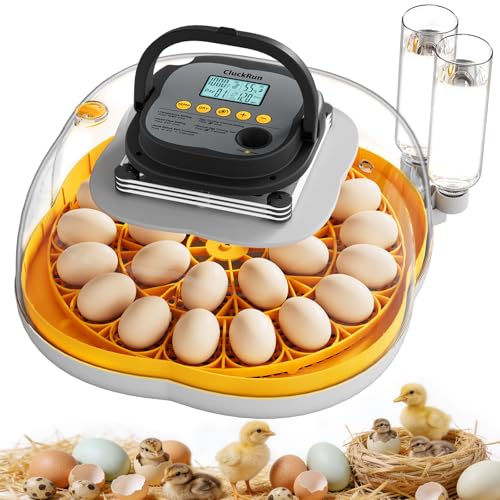
1. CluckRun 25 Egg Incubator
Our pick — 4.5+★ from 300+ verified ratings; the strongest balance of quality and price.
Twenty-five eggs, a turner that counts itself down, and a candler already in the box.
The CluckRun CK25 hits the balance most hobby hatchers are actually looking for. It takes 25 eggs, sits at 5.7 pounds on the shelf, and runs a stainless steel body in yellow, which makes it easy to wipe down between clutches. The turning interval is yours to set — 60, 120, or 180 minutes — and the unit counts down and stops turning four days before hatch on its own. That four-day window is the one that matters most for chickens, because the chick needs room to turn and pip without the tray nudging it.
What wins people over here is build quality — it is far and away the most-praised trait, with ease of use close behind. The display puts incubation day, turning countdown, temperature, and humidity on one screen, so you are not cycling through menus with a flashlight. The built-in candler means you can check embryo development without hunting for a separate light in a dark room. It also ships with two 10oz water bottles, a cleaning brush, and a written how-to booklet, and it carries a 3-year warranty — unusually long for the class, where most units stop at a year.
Buyers report a 100% hatch rate on quail eggs, which fits the automatic stop feature cutting turning four days out on the shorter quail cycle. The honest catch is the water system: it refills itself, but humidity is still the setting that draws the most complaints in this class, and this unit is no exception — expect to fine-tune the vents in your first week.
What earns the top spot
- Automatic turning stops four days before hatch, with a visible countdown on the display
- Three interval choices — 60, 120, or 180 minutes — so you can match species
- Built-in candler saves a separate purchase and lets you candle without disturbing the lid
- Stainless steel walls and a 5.7-pound footprint that sits steady on a workbench
- 3-year warranty plus a 10oz bottle pair and cleaning brush in the box
Where it makes you work
- Humidity still needs vent adjustment in the first week — it is not set-and-close
- 25 eggs is a modest batch if you plan to scale up past hobby volume
Grab this one if: you want a 25-egg unit with the turning schedule handled and a candler that needs no separate purchase.
Know before you buy: budget an evening in week one for dialing in the vents to your room’s humidity.
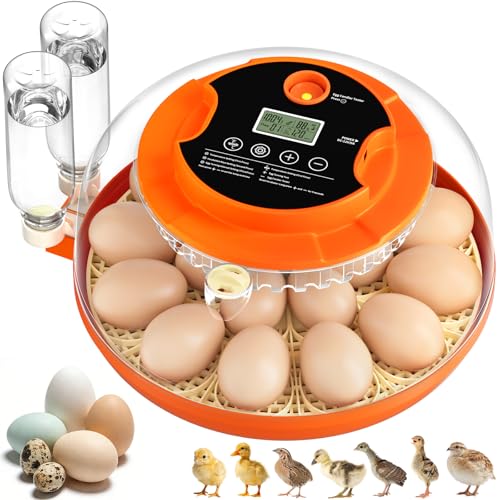
2. TRIOCOTTAGE M12H 12 Egg Incubator with Automatic Turning
A 3.65-pound dome that fits on a kitchen counter and turns twelve eggs by itself.
At 7.5 x 7.5 x 6.6 inches, the M12H takes up less bench space than a mixing bowl. That is the whole pitch for anyone hatching a small first clutch indoors. Compare it to the CluckRun’s 25-egg tray: this one holds 12 eggs, and it weighs 3.65 pounds versus 5.7 — 56% less on the scale. That is why it is the one you can move to a shelf and forget about without clearing space first.
Running it is straightforward. The eggs turn automatically at regular intervals, water tops itself up so you are not lifting the lid every day, and the LED display reads temperature for you. The curved 360° cover gives a clear view without opening anything, and the external insulation layer is meant to help hold heat in a cold room — a real consideration if you keep your hatching setup somewhere unheated.
The trade-off is honesty about the controls. Humidity and temperature each land in mixed territory here: many hatchers find it holds the perfect range, others find it hard to lock in, and the same split shows up on egg rotation. Owners mention hatching up to 70-80% of their eggs, so it works — it just asks you to watch the gauge rather than fully trusting it.
Room with a view: the 360° curved cover lets you watch a chirping chick without cracking the seal, and the compact dome makes it easy to find a spot in a small house.
The honest caveat: this is a unit to buy when you plan to check the readout daily — the mixed feedback on humidity and temperature means trust but verify.
Made for: a first clutch of a dozen eggs in a kitchen or small heated room, where bench space is tight.
Look elsewhere if: you want a unit that runs itself for three weeks without a daily glance at the gauge.
3. Onsju 18H-OO Egg Incubator, 18 Eggs or 40 Quail
One tray that takes 18 chicken eggs or 40 quail eggs, with a stop timer that thinks ahead.
The headline number here is the dual capacity: 18 standard eggs such as chicken or duck, or 40 smaller eggs like quail or parrot. That flexibility makes it a natural pick for a classroom or a breeder working more than one species. The 11.73 x 11.73 x 6.85 inch body is small enough to sit on a lab table without dominating it.
The turning schedule is the feature that separates it from the simpler 12-egg dome. You pick 60, 120, or 180 minute intervals, and the system pauses turning 96 hours before hatch day — then the STOP indicator lights on the display so you know it has stopped on purpose, not failed. Temperature is monitored in real time, with both a visual and an audible alert if something drifts. An airflow system with a silent fan pushes the heat around so you are not relying on one hotspot.
The humidity side runs on a sealed water system that tops itself up across the development stages, which cuts down how often anyone has to open the dome. The high-intensity LED candler under the clear top makes fertility checks a two-minute job. Two things to know: this is the lighter-weight sibling at 5.48 pounds, and the manufacturer is clear that setup should follow the manual to get full lifespan — so it rewards reading the instructions once properly.
Why it fits a shared space
- Dual capacity — 18 chicken or duck eggs, or 40 quail and parrot eggs
- Turning stops 96 hours before hatch with a display indicator confirming it
- Audible plus visual alerts when temperature drifts
- LED candler under a 360° clear dome for fast fertility checks
The honest limits
- Humidity is auto-regulated but hands-off hatchers will still want a backup gauge
- Setup needs a careful read-through to get the best lifespan
Reach for it if: you are hatching mixed species on a schedule and want a stop timer that tells you it stopped.
Think twice if: you want a larger single-species batch — the 56-egg units below cover that ground.
4. Sailnovo SL-5390-G 56 Egg Incubator with Auto Humidification
Fifty-six eggs in one cabinet — and a lid you almost never have to open.
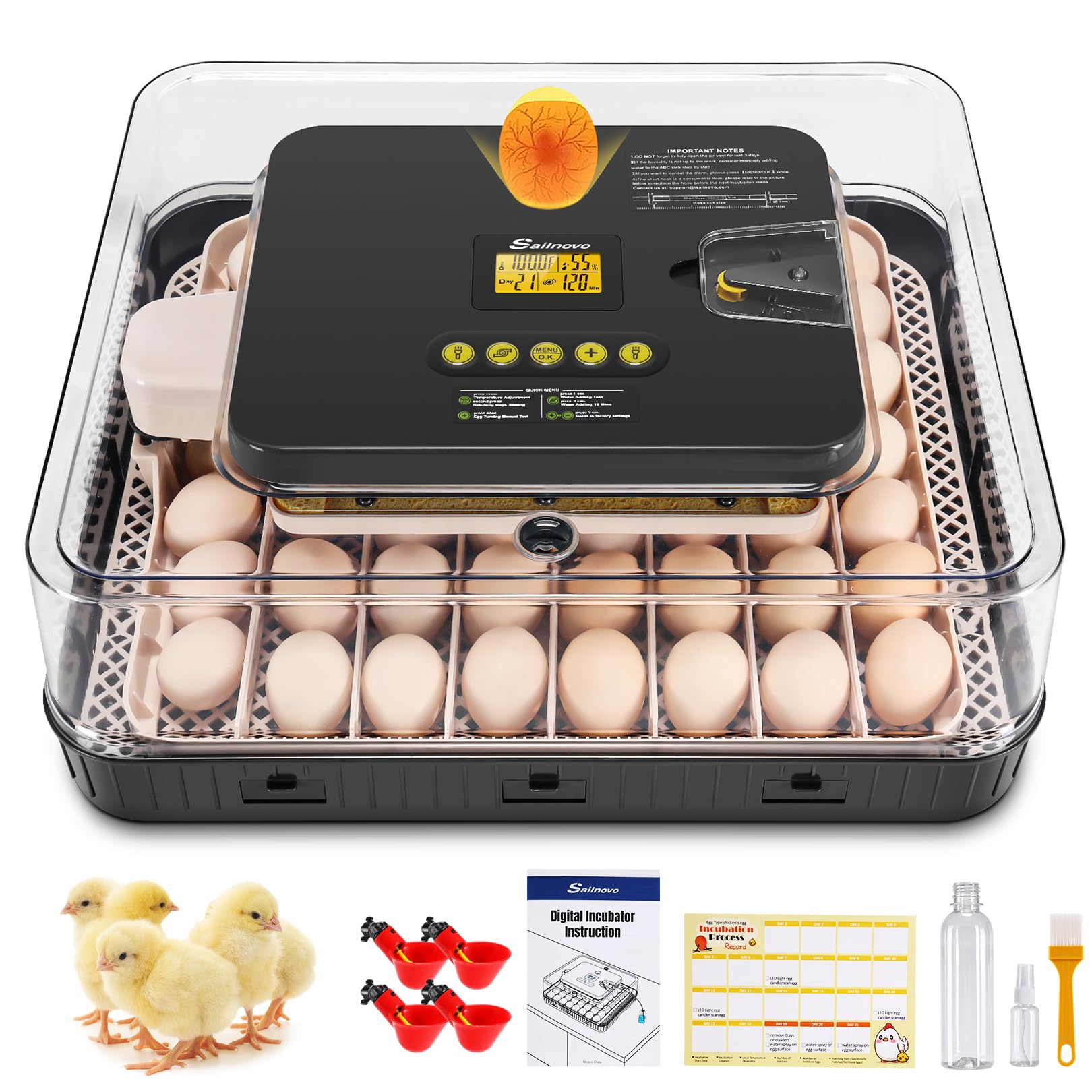
If you are hatching to sell rather than for the fun of a dozen chicks, capacity decides everything. The Sailnovo holds 56 eggs against the TRIOCOTTAGE dome’s 12 — a 4.7x difference in one load. It also measures 18.7 x 16.1 x 6.3 inches versus the M12H’s 7.5 x 7.5 x 6.6, so plan a dedicated surface for it rather than a shelf corner.
The design centers on not opening the lid. External water addition and automatic humidification keep conditions steady, minimizing the temperature drop you get every time warm air escapes. The turner rotates eggs every two hours and stops three days before hatch. An alarm system flags temperature or humidity problems, can be silenced for 30 minutes with a press of the Menu key, and can be switched off entirely for dry incubation. The LED display tracks incubation day, turning countdown, temperature, and humidity in one view, and the built-in candler handles fertility checks. After the hatch, the cabinet doubles as a warm room for chicks — a genuine second life for the unit.
The parts bundle is unusually complete: styrofoam, a watering bottle, a watering can, four poultry feeders, a tube assembly, a record-keeping calendar card, and a cleaning brush. Customers note a 100% hatch rate and steady temperature through the full cycle. The gripe that recurs is humidity — some find it stays on point, some find it fiddly, and the percentage is small enough that it reads as a fine-tuning task rather than a flaw. Noise gets the same split treatment.
What the batch size open up: hatching 56 eggs at once means a single clutch can supply a small farm stand, and the deep cabinet accommodates chicken, duck, goose, quail, pigeon, and turkey eggs in the same run.
What it asks in return: this is a piece of furniture, not a countertop gadget — and the alarm will demand your attention until you learn the humidity rhythm.
The right call for: anyone hatching at volume who wants one unit to do the work of several smaller ones.
Not the right call for: a first-time hatcher with a dozen eggs and no spare table.
5. Little Giant 10300 Digital Circulated Air Incubator

The styrofoam box your grandparent used, with a digital board bolted to it.
There is a reason this format has survived: warmth-retaining styrofoam is a genuinely good insulator, and this one holds 41 large chicken eggs or up to 120 bantam and quail eggs when you add the Little Giant Automatic Egg Turner. At 4 pounds it is light enough to shift around, and the 18 x 18 x 9 inch footprint is a known quantity on a shelf. Made in the USA matters to some buyers, and this is one of the few on the list that can say it.
The digital board lets you set temperature with one touch and self-regulates to hold it within one degree. A built-in fan circulates warm air so you are not relying on still air to spread heat. The hygrometer reads humidity and water channels are meant to reduce moisture loss. Safety details are thoughtful: the redesigned plastic heater runs cooler to the touch than old metal elements, and the mesh screen has no sharp edges for you or for the chicks.
The catch is the control story. Temperature is the single most-criticized thing about this unit — buyers describe swings and drift that call for calibration, and durability does not escape scrutiny either. Reliability lands in mixed territory overall. If you are a hands-on hatcher who likes to watch a gauge and adjust, that is a fair trade for the price and the styrofoam insulation. If you want a unit that manages itself, this is not the one.
The buyer this suits: a traditionalist who wants styrofoam insulation, an LCD readout, and a light 4-pound body — and does not mind calibrating.
The buyer this does not suit: anyone who needs temperature to hold steady without intervention.
6. Chickcozy JY011 25 Egg Incubator with Pull-Out Water Tray
A pull-out drawer for water and a clear dome that turns hatch day into a spectator sport.
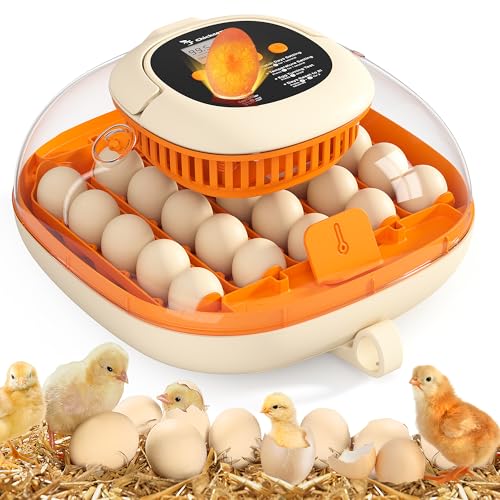
The Chickcozy’s best idea is the visual water tray. It slides out so you can fill it, wipe it, and top it up without ever lifting the lid — and it does not spill or overfill. That one detail solves the problem every hatch has: the moment you crack the seal to add water, the heat and moisture shift. With this unit you can add or remove water at will, which gives you a real lever on humidity in a dry room. Two watering zones, C and D, let you push moisture higher when the air is especially dry.
Turning runs once every hour on this unit — a fixed schedule, not a variable one — and the design mimics how a hen shifts her eggs. The 2-inch protective wall keeps newly hatched chicks from tumbling out, and an anti-slip mat gives them something to stand on. The top fan detaches and the base can be rinsed, so cleanup after a messy hatch is not a fight. A built-in candler rounds out the toolset, and there is a two-year warranty behind it all.
Where it lands: incubator quality is the most-praised aspect by a wide margin, and hatch rates follow close behind, with buyers reporting hatch rates of 80% and higher. The recurring theme is control — gauges can read significantly off from a separate thermometer, so the experienced move is to verify with your own instrument and adjust the fan and vents rather than trusting the display blind.
The one-handed lid: the handle makes it easy to open and re-seat with a single hand — a small thing that matters when you are holding a water bottle in the other.
The gauge caveat: treat the built-in readings as a starting point and cross-check with an external hygrometer before you commit a clutch.
Best for: families hatching a first clutch who want to watch the chicks arrive under a clear dome.
Skip if: you need a turner that lets you choose intervals — this one runs hourly, fixed.
7. Harris Farms Nurture Right Egg Incubator, Holds 22 Eggs

Twenty-two eggs, 2.2 pounds, and the biggest following of any unit on this list.
By sheer number of owners, the Nurture Right is the crowd favorite — 4.0+ stars across 5,000+ ratings, a figure no other incubator here comes close to. Part of that is the 2.2-pound weight, which makes it the lightest full-size option on this list and easy to tuck onto any counter. Part is the species flexibility: it holds up to 22 chicken eggs, 12-18 duck eggs, and 22-24 pheasant eggs, so a mixed flock is workable in one cabinet.
The operational story is clean. The automatic turner stops three days before hatch so chicks can settle. A 360° window gives you all-angle visibility without opening anything. A 360° induced-airflow fan circulates heat so you are not chasing cold spots. The humidity knob and display are simple to read, and the water is easy to add. Ease of use is the second-most praised trait here, and hatch rate is the first, with buyers reporting a 98% success rate, some hatching 18 of 22 eggs.
The nuance: reliability is the most-discussed topic, and it cuts both ways — many units run cycle after cycle while a portion stop working, and the auto turner can fail. Quality and humidity get the same mixed treatment. It is a unit to buy when you want a large, well-supported community and a light cabinet — and to watch carefully through your first hatch so you know how your specific unit behaves.
Why it has the biggest following
- Holds 22 chicken, 12–18 duck, or 22–24 pheasant eggs in one tray
- 2.2 pounds — the lightest full-size cabinet here
- Turner stops three days out, with 360° visibility throughout
- Easy water addition and a readable humidity knob
The honest mixed signals
- Reliability is the most-discussed topic and splits — some units run forever, some quit
- Humidity readings call for an external gauge to confirm
Right answer for: a mixed flock and a buyer who values a large owner community to learn from.
Wrong answer for: someone who wants a guarantee against a failed turner — calibrate early and check in.
8. Farm Innovators 2450 Pro Series Digital Air Incubator
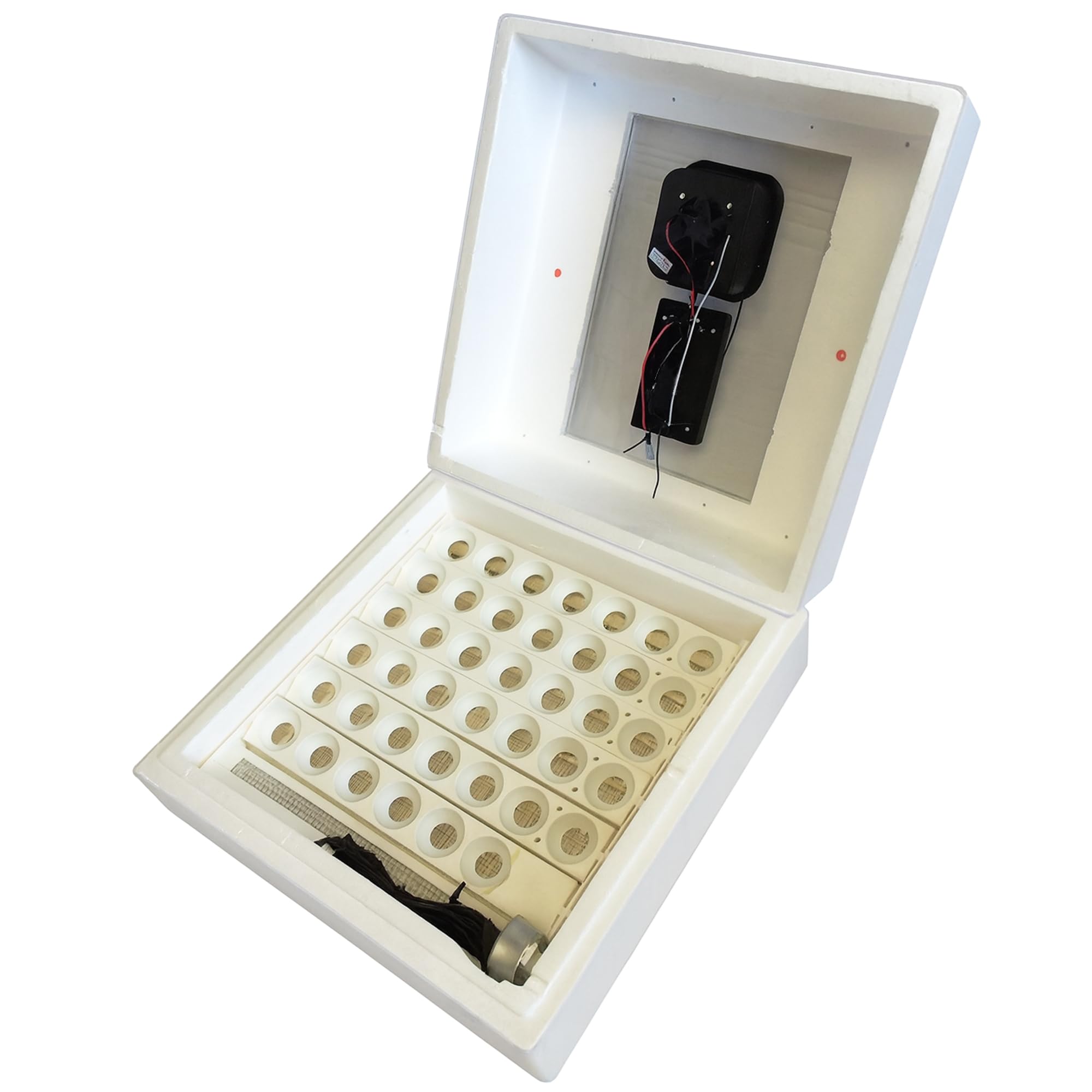
A deep foam tray built for goose and duck eggs, with water channels you can fill from outside.
Most hobby cabinets will not happily seat a goose egg. This one will — the deep bottom tray is sized for larger eggs, including ducks and geese. It holds 41 eggs in total, and the recycled polystyrene foam body is a strong insulator, keeping heat where it belongs even when the room around it cools overnight. For anyone hatching waterfowl, that combination is the reason to look here first.
The convenience features are well thought out. E-Z Fill water channels let you add water without pulling the lid, so humidity stays put between refills. The auto turner takes over the egg rotation and links to an adjustable days-to-hatch countdown for different species. A forced-air fan circulates fresh air to even out heat, and the large 360° viewing windows plus an LED light that shows when the heater is active make it easy to see what is happening inside.
The calibration story is the one to hear clearly. Temperature is the most-criticized topic, with buyers reporting units that run below the set point and thermostats off by as much as 10 degrees. That is why the smart play is a separate thermometer on the floor of the tray from day one, and why reliability — the most-praised trait — still arrives as mixed. This is a solid cabinet if you verify before you trust.
Waterfowl strength: the deep tray and foam insulation make it one of the few units here genuinely aimed at duck and goose eggs.
The calibration must-do: budget for a hygrometer and a second thermometer, and test the run empty for a day before any eggs go in.
Pick this when: your hatch includes ducks or geese and you want a deep, insulating tray.
Pass if: you want a single device that arrives calibrated and stays there without a second gauge.
9. Brinsea Ovation 56 EX Egg Incubator with Automatic Humidity
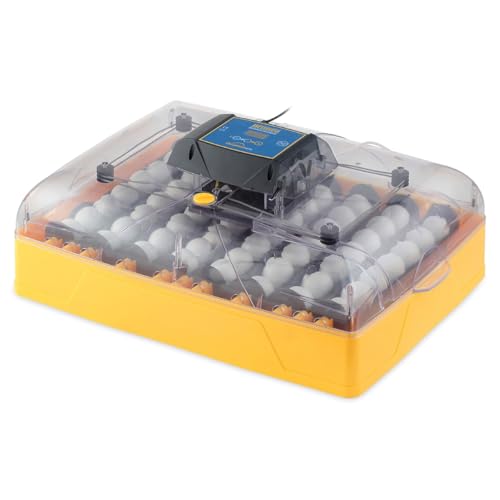
The one that adds its own water — a pump keeps humidity steady so the lid stays shut.
For a serious breeder, the failure mode that costs the most is a humidity crash on day eighteen when the lid comes off to top up. The Ovation 56 EX was engineered to remove that step: an integrated pump maintains moisture on its own, without opening the lid, and an external reservoir cuts how often you refill. That is the single defining feature, and it is why this unit is in a class by itself on this list. The Induced Dual Airflow system holds conditions across the cabinet, not just near the heater.
Capacity is 56 chicken eggs with carriers included, and optional larger carriers fit duck, goose, turkey, quail, and pheasant eggs. The digital screen shows temperature in °F and °C, humidity percentage, and turning status in real time; audible alarms fire on temperature deviations and power interruptions. Turning is programmable to your intervals, so you tailor it to each species. The clear top gives you visibility without breaking the seal.
Build and support back it up: ABS plastic with Biomaster protection for easy cleaning, whisper-quiet operation, UK manufacturing, a 3-year warranty, and US-based support out of Florida. At 11 pounds it is the heaviest in this round-up — the foam classics here run lighter, so plan a permanent spot rather than a portable one. Reviewers point out a 100% hatch rate and 85% success on day 21, and performance is the most-praised trait. The honest friction points are cleaning and value, both mixed, and this is a premium unit that will feel expensive next to foam boxes.
What the premium buys
- Integrated pump maintains humidity with the lid closed — no opening to top up
- 56-egg capacity with carriers included; optional carriers for duck, goose, turkey, quail, pheasant
- Real-time temperature (°F and °C), humidity, and turning status on one screen
- Audible alarms for temperature deviation and power interruption
- 3-year warranty and US-based support; ABS with Biomaster protection for cleaning
Where it costs you
- At 11 pounds it is the heaviest unit here — plan a dedicated counter
- Cleaning is a mixed experience; the ABS body wants a gentle hand
Reserved for: breeders and conservationists hatching 56 eggs at a time who cannot afford a humidity crash.
Not reserved for: a first clutch of a dozen eggs — the foam-and-plastic units above cover that without the pump premium.
Know the Specs
Egg capacity by species
The number on the box usually refers to standard chicken eggs. Smaller eggs like quail and bantam take less space, so the same tray can hold far more — the Little Giant lists up to 120 bantam or quail eggs when used with its turner, against 41 large chicken eggs. Size the tray to the species you hatch most, not the biggest number on the label.
Turning intervals and the auto-stop
Turning keeps the embryo free-floating in the shell. The interval — 60, 120, or 180 minutes on the programmable units — is how often the tray rocks. The stop matters more: it must halt before hatch day so the chick can position itself to pip. Some stop three days out, some four, some ninety-six hours; match the stop window to your species’ cycle.
Humidity control and auto-replenishment
Humidity is the setting hatches live or die on. Manual water channels work, but every time you lift the lid you trade moisture and heat for a refill. Auto-replenishment systems and external reservoirs exist to cut that trade. A pump-driven system (as on the Brinsea) goes further and maintains moisture without ever opening the lid.
Built-in candler vs. external light
A candler is a bright light you shine through the shell to see whether an embryo is developing. A built-in one sits under the dome or in the wall, so you can check without a separate flashlight. Useful for culling infertile eggs early, which matters because a dead egg in a warm cabinet can spoil the air around it.
Common Questions
How many quail eggs can fit in an incubator rated for chicken eggs?
When should the automatic egg turner stop before hatch day?
Do I need a separate thermometer if the incubator has a display?
What is the difference between manual water channels and auto-replenishment?
Can one incubator hatch chicken, duck, and quail eggs at the same time?
Is a styrofoam incubator or a plastic dome better for a beginner?
How often should I candle eggs during incubation?
Why does humidity cause more hatching problems than temperature?
Can I use an incubator as a brooder after the chicks hatch?
What does the alarm on these incubators actually alert me to?
The Bottom Line
The incubators for hatching eggs pick that covers the widest ground is the CluckRun 25 Egg, because it pairs programmable turning that stops on its own with a built-in candler and a 3-year warranty — a combination that lets a first-time hatcher focus on the eggs rather than the schedule. If you are hatching at volume, the Sailnovo 56 Egg gives you a real batch and a lid you rarely open. And for anyone who cannot afford a humidity crash, the Brinsea Ovation 56 EX is the one to reach for — a pump that adds its own water and a 3-year warranty behind it. Whichever you choose, verify the readings with your own gauge before the eggs go in, and the hatch will reward the care.
How we choose
We do not accept paid placement. Every pick is matched to a real buyer and a real use-case; we do not hands-on test units.
Sources
Specifications: manufacturer listings and product documentation. Review insights: verified customer reviews, as of November 2026. Pricing: not shown on this page (it changes often); check the current price via the retailer link.
As an Amazon Associate, Tactical Gear Guy earns from qualifying purchases. This does not affect which products we feature.