Specs are compiled from manufacturer listings and verified buyer reviews and can change over time — please confirm the key details on the product page before buying.
Most people buying a temperature sensor for Alexa end up with a gadget that talks to an app but not to their Echo. The fix is simple once you know it: check what Alexa actually reads from the sensor, not just whether the box says “works with Alexa.” Some sensors let you ask “Alexa, what’s the humidity of the wine cabinet?” and hear a real number back. Others only appear inside a third-party app, and a few need a separate hub before Alexa can see them at all. This guide sorts nine of them by that one question, then by accuracy, hub requirements, and how many rooms one kit covers.
This guide is built by comparing the manufacturers’ published specifications and the patterns across verified customer reviews, so you get each pick’s real strengths and trade-offs instead of marketing spin.
You’ll see which kits need a hub, which read straight into Alexa, and where the accuracy gaps actually sit. Here are the picks that make a voice-first setup genuinely worth wiring in with the temperature sensor for alexa.
Top Picks


How To Choose The Best Temperature Sensor for Alexa
Three things decide whether you’ll be happy with an Alexa temperature sensor: whether Alexa can actually read it, what it needs to get online, and how tight its accuracy is. Get those three right and the rest is placement detail.
Start with what Alexa can actually do with the reading
Some sensors let you ask your Echo a plain question and hear the current temperature or humidity spoken back. That works best when the sensor sits in a room you’re standing in, like a wine cabinet or a nursery. Others hand their numbers to the Alexa app for routines — a fan kicking on when the temperature climbs past your limit — but won’t read out loud. Decide between voice readout and app-only routines before you shop — it cuts the field fast.
Then check the hub, the Wi-Fi band, and the range
A Zigbee sensor is a small radio device that talks to a hub (a separate box that bridges it to your network) rather than straight to Wi-Fi. Zigbee kits save battery life, but you need the right hub in the house first. Wi-Fi sensors skip the hub but often insist on a 2.4 GHz network (the slower, longer-reaching band most smart devices use), so a 5 GHz-only router will leave you stuck. Longer open-air range matters in multi-level homes — the X-Sense kit claims 1,700 ft of open-air reach.
Weigh accuracy and battery life against the job
For a wine cellar or a reptile tank, a sensor accurate to ±0.2 °C keeps you inside a tight comfort band. For a rough “is the garage hot?” check, ±1 °C is plenty. Battery life splits along the same line: Zigbee sensors often stretch to about 2 years on standard batteries, while some Wi-Fi units are hungrier. For attic or ceiling installs, favor the Zigbee sensors rated for about 2 years per set of cells.
Side-by-Side Comparison
| Model | Best For | Connection | Temp Accuracy | Sensors Included | Amazon |
|---|---|---|---|---|---|
| X-Sense STH54 (3 Sensors + Base)★ Best Overall | Whole-home coverage with voice readout | Wi-Fi 2.4 GHz + base station | ±0.2 °C | 3 sensors + 1 base | Amazon |
| Shelly BLU H&T ZBOutdoor Ready | Outdoor and damp spots | Bluetooth + Zigbee (gateway needed) | ±0.5 °C | 1 | Amazon |
| Gaoducash TH01 2-PackTwo-Room Value | Cheap two-room spread | Wi-Fi 2.4 GHz | — | 2 | Amazon |
| Aqara T1 | Tight climate control via Aqara Hub | Zigbee (Aqara Hub required) | ±0.3 °C | 1 | Amazon |
| GE Cync Smart Sensor | Cync thermostat owners killing hot spots | Wi-Fi (Cync thermostat required) | — | 1 | Amazon |
| SwitchBot Meter + Hub Mini | Data hoarders and Home Assistant fans | Bluetooth + Wi-Fi via Hub | Not published | 1 meter + 1 hub | Amazon |
| SONOFF SNZB-02B 4-Pack | Zigbee households wanting bulk | Zigbee (hub required) | ±0.2 °C | 4 | Amazon |
| Zecamin TH02 Pro 4PCS | Spreading coverage on a budget | Wi-Fi | ±1 °C | 4 | Amazon |
| Comboss TH02 Pro 4-Pack | LCD screen plus voice checks | Wi-Fi (2.4 GHz) | — | 4 | Amazon |
Detailed Reviews
1. X-Sense Indoor Wi-Fi Thermometer Hygrometer
Our pick — 4.5+★ from 550+ verified ratings; the strongest balance of quality and price.
Three sensors, one base, and a spoken answer when you ask about the wine cabinet.
This kit is the best overall pick because it solves the Alexa question cleanly and covers the whole house. You ask your Echo “Alexa, what’s the humidity of the wine cabinet now?” and the answer comes back as a real number — the sensor feeds that reading straight into Alexa. Three sensors and a base station go in one box, and the base handles up to 10 sensors, so you can add rooms later instead of starting over.
The accuracy is the headline for anyone monitoring wine, cigars, or a greenhouse. The Swiss-made sensor reads temperature to ±0.2 °C (about a third of a degree Fahrenheit) and humidity to ±2% RH across a 0–100% RH span. That tightness matters in a humidor, where a couple of points of drift is the difference between a good stick and a dry one. The temperature window runs -4–140°F, so a cold basement and a sun-baked attic both stay in range. It does all this with no batteries required.
The catch is the radio. It needs a 2.4 GHz Wi-Fi network (the longer-reaching band, not the faster 5 GHz one), so a 5 GHz-only router will fight you. The wide 1,700 ft open-air transmission range is what makes multi-level homes work, but walls and floors cut into that in practice. Setup is the part owners like most — it’s the most-praised feature in the review data, and the app makes adding a sensor quick. What wins people over on the negative side is occasional connectivity grumbles, mostly around only one device staying paired at a time, so budget a little patience when you first link everything up.
What it gets right
- Alexa reads temperature and humidity out loud on request
- ±0.2 °C accuracy across a -4–140°F range
- Base station scales to 10 sensors
- No batteries to swap
- Free CSV export of a year’s data
Where it asks patience
- Locked out of 5 GHz Wi-Fi networks
- Some owners hit pairing trouble with multiple devices
Buy it if: you want wine cellar, greenhouse, and bedroom all monitored from one app and askable by voice.
Think twice if: your router is 5 GHz-only — you’d need to switch bands before this works.
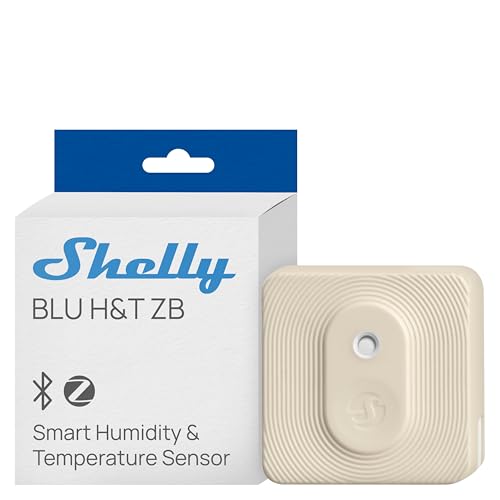
2. Shelly BLU H&T ZB Ivory Temperature & Humidity Levels Sensor
A featherweight sensor built to survive the patio, not just the living room.
Here’s the spec that matters for a back-garden setup: IP54 (a rating for dust and splashing water). That makes this the one of the group that can sit outdoors and trigger an early weather alert — telling Alexa to adjust heating or close blinds before the cold rolls in. The radio side is Bluetooth and Zigbee together, so it pairs through the Shelly BLU Gateway or any Shelly Plus, Pro, or Gen3 device. There’s a 3-year warranty behind it, longer than most in this lineup.
On accuracy it lands at ±0.5 °C, which is looser than the X-Sense’s ±0.2 °C — roughly a 2.5x gap. For a patio weather alert that’s fine; for a humidor you’d want tighter. It tops out at 140 °F and runs on a 3V DC cell. The whole unit weighs 13 g, making it vastly lighter than the 30 g Aqara T1 (about 2.3x). Lean and easy to tuck out of the weather, but know it needs the Shelly gateway before Alexa can read it — no gateway, no voice answer.
Ease of use is what owners talk about most here, and it’s the top positive in the data. Accuracy is the softer spot — a mixed read, so treat the ±0.5 °C figure as the honest ceiling rather than a promise of laboratory precision. If you’re building a Shelly or Home Assistant house, it slots in without drama. If you want a plug-and-play Echo sensor with no gateway, look elsewhere first.
The value read: you’re paying for outdoor survivability and Shelly ecosystem fit, not razor accuracy. The temperature sensor for alexa shopper who wants a set-and-runs-inside device should weigh the gateway requirement heavily.
Leans toward: damp garages, patios, server rooms, and anyone already running Shelly gear.
Holds back if: you expect Alexa to read it without first owning a Shelly gateway — this one can’t.
3. Gaoducash 2-Pack WiFi Temperature Humidity Sensor
Two Wi-Fi sensors, no hub, and a voice question you can actually ask.
What this pair offers is simplicity: two Wi-Fi sensors, no hub to buy, and a working voice question once you’re in the Tuya Smart or Smart Life app. Ask “Alexa, what’s the temperature in the living room?” and it answers. Set a scene and it’ll fire off an alert when the room leaves your preset range, or even switch on the AC when the temperature crosses your limit. You lay one on a shelf or stick it to a wall with the included sticker or screws.
Setup is the strongest part — it’s the top positive in the review data, and most owners have it running in minutes. The catch is the pattern owners keep hitting: reliability is the most-discussed topic overall and it’s mixed. Some units run for years. Others stop reporting entirely, and network connectivity is the roughest spot — a chunk of buyers report it dropping off Wi-Fi and refusing to reconnect. Battery life is the other watch point; alkaline cells burn out in about two months according to complaints.
Two AAAs come in the box and a low-battery alert hits your phone when they weaken, which helps. For a cheap two-room spread — a nursery and a garage — this does the job at a budget-friendly entry point. For a wine cellar where losing the signal matters, the reliability track record is a real risk. Weigh the price against that.
Earning its spot
- No hub needed
- Two sensors for a genuine spread
- Works with Alexa and Google voice questions
- Scene automation can trigger AC or dehumidifier
- Low-battery alert to the app
Reading the fine print
- Reliability is genuinely mixed across owners
- Connectivity drops are the recurring gripe
- Alkaline batteries don’t go the distance for everyone
Reach for it if: you want two rooms covered cheaply and can accept the reliability gamble.
Leave it if: the reading has to stay solid in a wine cellar or humidor with no drops.
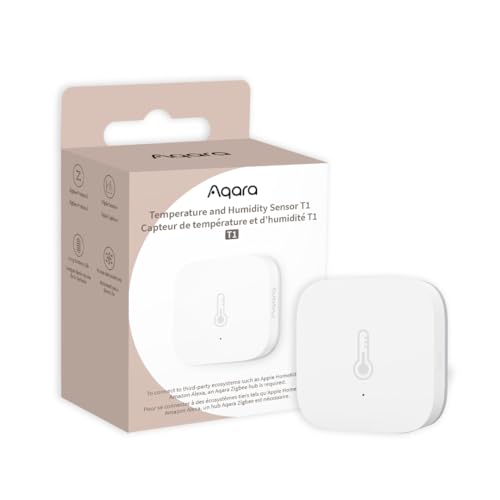
4. Aqara Zigbee Temperature and Humidity Sensor T1
Three readings in one device, accurate to a third of a degree.
This sensor monitors temperature, humidity, and air pressure in real time — a three-in-one that gives you the fuller picture a two-reading sensor skips. The accuracy figure is the reason to care: ±0.3 °C across -15 °C to 50 °C, paired with ±3% humidity accuracy across 0–100%. That’s tighter than the Shelly’s ±0.5 °C, and it’s why this one earns a precision label.
The hard limit comes up front: it needs an Aqara Hub, sold separately. Without the hub, there’s no HomeKit, no Alexa, nothing. Placement matters too — you need to stay within about 400 inches of the hub for a stable Zigbee link, so a basement sensor far from the hub may not hold. That 400-inch reach is a genuine constraint, not a generous one.
Set thresholds in the Aqara App and it’ll trigger alerts or automate a fan, humidifier, or smart plug. Battery life reaches up to 2 years on ultra-low power, and 3M adhesive on the back makes placement easy on a pet-house or greenhouse wall. The spec sheet confirms the trade-off: 30 g of device for a tight, accurate read — heavier than the 13 g Shelly, and tethered to a hub. It’s a precision instrument, not a roam-anywhere transmitter.
Why it wins: three readings, ±0.3 °C, ±3% humidity, and 2-year battery life within the Aqara ecosystem.
The honest constraint: no Aqara Hub means no Alexa — budget the hub and the 400-inch placement limit into your plan.
Suits: anyone already running Aqara, or willing to buy the hub for tight climate control.
Won’t suit: a mixed-brand house that wants Alexa to read it with no Aqara gear.
5. GE Cync Smart Temperature Sensor

Not a standalone sensor — a room-level fix for homes already running a Cync thermostat.
If you have a Cync smart thermostat, this small sensor earns its keep by giving the system a temperature reading from a second room instead of the hallway where the thermostat sits. Add one to a drafty bedroom and the heat stops blasting there while the rest of the house roasts. It reads temperature and humidity in real time through the Cync App, and it pairs with Alexa or Google for voice control once connected on 2.4 GHz internet.
The catch is context: this sensor requires the Cync Smart Thermostat, sold separately. Buy it expecting a general-purpose Alexa room thermometer and you’ll be disappointed — it isn’t that. Owners who pair it find the setup easy, and the app pairing is what works best. The functionality side is where opinions split; a portion of owners find it helps balance rooms, others see no difference and call it unhelpful. Compatibility is a smaller, similarly mixed list, mostly around app pairing.
Physically it’s a 1.6-inch disc that mounts with a screw or removable tape, weighing 1.12 ounces — so it disappears on a wall. No hub or bridge needed, which keeps the install clean. It is a companion device that fits neatly inside a Cync system and gets awkward on its own; the value hinges entirely on whether you already own that thermostat.
Where it fits: a Cync thermostat owner with one stubborn cold or hot room to balance.
The barrier: without that thermostat, this sensor has nothing to talk to — no stand-alone Alexa reads at all.
Grab it if: your Cync thermostat keeps getting fooled by one bad room, and you want that room fixed.
skip it if: you don’t own a Cync thermostat — this is pure companion gear.
6. SwitchBot WiFi Hygrometer Thermometer with Hub

The data hoarder of the bunch — 36 days onboard, unlimited in the cloud.
For anyone who wants the actual numbers logged and exported, this is the standout. It keeps 36 days of data on the meter, and with the included Hub Mini you get unlimited cloud storage plus a CSV export. It reports changes 10x per second and shows large digits on a high-resolution LED screen along with battery volume. It also reads dewpoint, VPD, and absolute humidity alongside standard temperature and humidity — three layer readings most competitors skip.
The hub is the make-or-break piece for Alexa. With it, you can trigger a Scene that turns the humidifier on when humidity drops below 45%RH, or the AC on when the temperature passes 25 °C. Without it, you’re limited to Bluetooth range (about 394 ft unobstructed). The compatibility data carries a warning that matters here: integration is mixed, and a chunk of owners specifically note Alexa not working as expected, even though Home Assistant and Google Home integrate fine. Read that carefully before buying for an Echo-only setup.
Where it scores is functionality — the most-praised topic overall — with owners using it to track temperature throughout a house. Setup is easy, and the app interface is simple. Value splits both ways, with some buyers calling it a bargain and others regretting the purchase. The Bluetooth connectivity data is similarly mixed, with some reporting a clean phone link and others finding it drops. It’s a rich data tool that needs the hub and a careful read on your Alexa setup.
What earns the fans
- 36 days onboard, unlimited in cloud with Hub Mini
- CSV export for logging and review
- Dewpoint, VPD, and absolute humidity readings
- LED screen with battery volume
- Home Assistant and Google Home integration
What trips people up
- Alexa compatibility is the weakest link in the data
- Full remote access needs the bundle hub
- App shows Celsius for some users
Choose it when: logging, exporting, and multi-sensor readings matter more than an Alexa readback.
Walk past if: “Alexa, what’s the temperature?” reliability is your only goal — the integration reports are mixed.
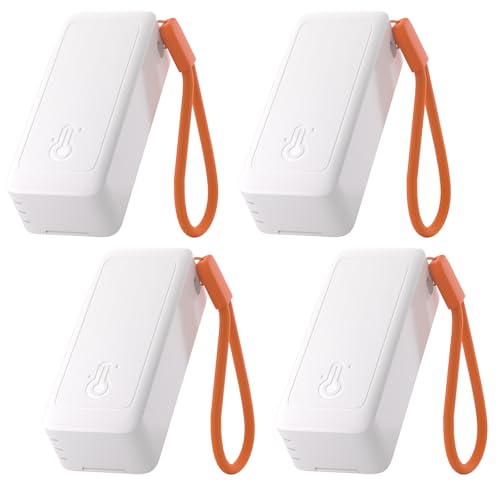
7. SONOFF SNZB-02B AirGuard TH Lite Zigbee Sensor
Four Swiss-sensor Zigbee pucks for a house that already speaks Zigbee.
The honest starting line: this pack only makes sense if you already run a Zigbee hub — SONOFF gateways, Echo (4th Gen), SmartThings, or Home Assistant via Zigbee2MQTT/ZHA. Four sensors go in the box, and each carries a Swiss professional-grade sensor accurate to ±0.4 °F with ±2% RH humidity accuracy. Updates every 5 seconds means you see temperature swings almost live, which suits greenhouse and wine cellar tracking.
Beyond temperature and humidity, it reads air pressure plus calculated dew point and VPD, and the ultra-slim body tucks into guitar cases and reptile terrariums. It runs up to 2 years on standard AAA batteries — handy for attic installs where changing cells is a chore. A firmware note comes with it: after pairing, update to V1.0.7 or later, which is worth doing first thing.
Here’s the real caution, and it’s the most-discussed topic for this pack: reliability is genuinely mixed. Some owners have all four working steadily; others report units stop reporting after a few days, and connectivity is the roughest spot — the sensor disconnecting or refusing to link. Accuracy is the strong side and the top positive in the data. If you’re comfortable updating firmware and troubleshooting a Zigbee mesh, the four-pack covers a lot of rooms for a mid-range outlay. If you want zero fiddling, this asks more of you than a Wi-Fi kit.
What’s under the hood: ±0.2 °C accuracy, ±2% humidity, 5-second refresh, 2-year AAA battery life, dew point and VPD.
The real trade-off: four sensors is great coverage, but the reliability record means you may be the one keeping the mesh healthy.
Right call for: a Zigbee household wanting four rooms monitored without four separate Wi-Fi gadgets.
Wrong call if: you can’t update firmware or prefer a plug-in Wi-Fi sensor with no hub.
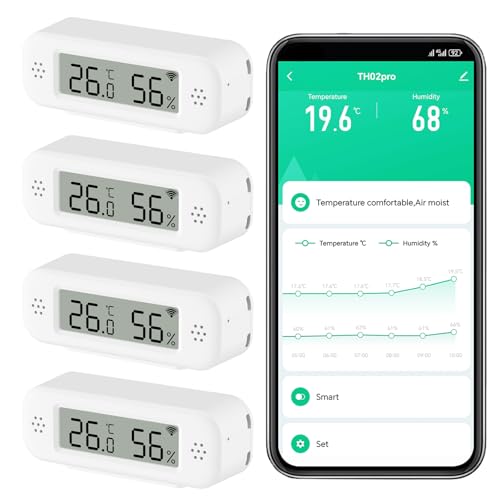
8. Zecamin Smart Digital Thermometer Hygrometer
Four Wi-Fi sensors with a screen on each, for staking out the whole house at once.
You get four Wi-Fi sensors in one box, each with an LCD screen showing temperature and humidity at a glance, so you’re not forced to your phone for every check. Accuracy lands at ±1 °C across -10 °C to 50 °C and ±5% humidity across 0–95% — the loosest on this list, which is fine for “is the baby’s room warm enough?” and not for a humidor. They run on 2 AAA batteries each, included.
The Alexa trick is the one to note: it can work with Alexa for voice temperature and humidity reads, but the data won’t display inside the Alexa app. It also supports smart scenes — a humidifier turning on when humidity drops below 50%, for example. One setup quirk: to switch the reading from Celsius to Fahrenheit, you press a pinhole twice with a needle. Tiny but worth knowing.
Functionality and quality are the strengths owners like, and it’s easy to set up. The soft side is accuracy and connectivity — both mixed — with some reporting readings several degrees off, Celsius-only displays, and Alexa connection trouble. At a tiny palm-sized footprint it fits in potted plants, humidors, and terrariums. For four rooms on a budget this covers a lot of ground, provided you don’t demand precision or a clean Alexa handshake every time.
Points in its favor
- Four sensors with LCD screens in the box
- No hub needed
- Batteries included
- Smart scenes for humidifier or AC control
Points to weigh
- ±1 °C accuracy is looser than the field
- Reading won’t show inside the Alexa app
- Celsius-only reports from some units
Made for: four rooms with a visible screen each, on a budget-friendly outlay.
Not made for: wine cellars or humidors where a degree of drift matters.
9. Comboss WiFi Thermometer Hygrometer Sensor, 4 Pack

Four sensors that read aloud and put the number on a screen you can see from across the room.
What separates this pack is the LCD on every unit — you glance at the screen for current temperature and humidity, or pull up history in the Tuya or Smart Life app. Each sensor talks to Alexa and Google Assistant for voice questions like “Alexa, how many degrees is it here?” and exports historical data as a CSV by email. Four sensors in one pack spreads coverage across a baby room, garage, and greenhouse in one go.
The Wi-Fi caveat lands the same way as others here: 2.4 GHz only, and 5 GHz is unsupported. Beyond that, the app handles push notifications when temperature or humidity leaves your set range, and a low-battery function flags cells before they die. Historical data download is quick on a phone. For anyone who likes both a screen to look at and a voice answer to ask, this combines the two.
The mid-range positioning comes from packing a screen and voice readback into every sensor without a hub. What you give up is tight calibration data — this listing doesn’t publish an accuracy figure, so you’re trusting the app readings rather than a spec. It suits the practical buyer who wants visible readings in several rooms and a working Alexa question, and who won’t be using the data to hold a cigar humidor at an exact point.
The draw: a screen on every sensor plus a live Alexa voice readback, no hub in the box to buy.
The gap: no published accuracy spec and a firm 2.4 GHz Wi-Fi requirement — plan for it.
Perfect for: a family that wants to glance at four screens and ask Alexa without opening an app.
Hold off if: you need documented precision figures before you buy.
Know the Specs
Temperature accuracy (±°C / ±°F)
This is how far off the true temperature the sensor might be. A ±0.2 °C figure (about one-third of a degree Fahrenheit) is tight enough for a humidor; ±0.5 °C is looser but fine for a patio alert; ±1 °C is the rough end, good for “is it cold?” checks. Tighter accuracy matters most for wine, cigars, and reptile habitats, and least for casual comfort checks.
Wi-Fi band and hub requirements
Wi-Fi sensors usually need a 2.4 GHz network (the longer-reaching band), and most refuse 5 GHz. A Zigbee sensor is a low-power radio that talks to a hub instead of your router — cheaper on battery, but you need the right hub before Alexa can see it. Check the band and the hub before you buy, or a working sensor can sit invisible to your Echo.
Battery type and lifespan
Standard AAA cells are the easiest to live with — swap them at any store, and some sensors stretch to about 2 years. Wi-Fi units often work harder and can drain faster, sometimes needing fresh alkaline cells every couple of months. For attic or ceiling placement, lean toward a Zigbee sensor with long battery life.
Transmission range and placement
Open-air range figures like 1,700 ft assume clear space — walls and floors cut them down. Zigbee sensors often need to sit close to their hub (the Aqara T1 asks for roughly 400 inches), while Wi-Fi units rely on your router’s reach. Place sensors where the signal is strong, not just where the shelf is convenient.
Common Questions
Will a Zigbee temperature sensor work with my Echo without a hub?
Can Alexa read the humidity out loud or only the temperature?
Do I need a 2.4 GHz router for a Wi-Fi temperature sensor?
How accurate does a sensor need to be for a wine cellar?
Can I connect the GE Cync sensor to Alexa without a Cync thermostat?
How long do the batteries last in these sensors?
Can one sensor monitor my greenhouse and another my basement at once?
What is VPD and do I need it in a temperature sensor?
Do these sensors store data I can export later?
The Bottom Line
For most homes, the temperature sensor for alexa winner is the X-Sense STH54 kit — three sensors and a base that scales to 10, ±0.2 °C accuracy, and a working voice readback on your Echo. If you already run Aqara and want three readings in one device, the Aqara T1 brings ±0.3 °C precision once the hub is in place. And for a Zigbee household covering four rooms, the SONOFF SNZB-02B 4-pack is the one to reach for. One nudge: the X-Sense kit carries the most owner backing of the group, so if a voice-readback sensor with real review history matters to you, that’s where to put your money.
How we choose
We do not accept paid placement. Every pick is matched to a real buyer and a real use-case; we do not hands-on test units.
Sources
Specifications: manufacturer listings and product documentation. Review insights: verified customer reviews, as of November 2026. Pricing: not shown on this page (it changes often); check the current price via the retailer link.
As an Amazon Associate, Tactical Gear Guy earns from qualifying purchases. This does not affect which products we feature.