Specs are compiled from manufacturer listings and verified buyer reviews and can change over time — please confirm the key details on the product page before buying.
If you have acreage and a tractor, the mulcher question is simple: which flail mower actually survives a season of saplings and brush without shedding bolts. The short answer is to match the working width to your horsepower first, then check hammer count and how the mower handles debris — everything else is secondary. Get that wrong and the deck sits in the yard instead of the field.
This guide is built by comparing the manufacturers’ published specifications and the patterns across verified customer reviews, so you get each pick’s real strengths and trade-offs instead of marketing spin.
These four tractor-mounted flail mowers cover light-duty paddock topping up to ditch-bank work, and each one asks something different of your machine before it earns its place. Below you get the fit numbers, the hammer counts, and the honest limits, so you can choose the right mulcher for tractor work that matches your land.
Top Picks
How To Choose The Best Mulcher For Tractor Use
The first thing that decides whether a flail mower works on your land is horsepower. A 68-inch cut on a 20HP tractor will bog down in tall grass and stall you in the field. A 48-inch cut on a 60HP machine leaves power on the table but never leaves you stranded. Read the tractor range on each spec sheet and respect it.
Match Working Width To Horsepower
Working width is the actual swath of cut, measured in inches across the mower deck. Wider means fewer passes across a paddock, but it also means more weight hanging behind your three-point hitch and more power pulled from the PTO (power take-off — the splined shaft at the back of your tractor that spins the implement). A 48-inch mower suits smaller, lighter tractors, while a 68-inch deck wants a bigger engine behind it. Pick the widest deck your tractor can pull at 540 RPM without labouring — 48 inches on 15-35HP, 60 or 68 inches on 30-60HP.
Hammer Count And What It Does To Your Cut
Flail mowers shred material with swinging hammers rather than a single spinning blade. More hammers mean more cuts per revolution and a finer finish; fewer hammers mean a coarser chop but less strain on the drive. If you are topping pasture grass, either count works. If you are chewing through saplings and dense debris, hammer count and the size of material the mower will mulch both matter more than the finish.
Hitch Type And Offset For Banks And Ditches
A category 1 three-point hitch is the standard mounting pattern most compact and mid-size tractors use, so confirm your tractor matches that category before ordering. A standard centered mower cuts directly behind you, which is fine for flat ground. An offset hitch shifts the deck sideways so you can reach the lip of a ditch or the slope of an embankment without driving onto it. If your land has banks, drains, or fence lines, the VAM48’s 69-inch offset and 60°/90° tilt reach the slope while the tractor stays on flat ground.
Side-by-Side Comparison
| Model | Best For | Working Width | Tractor Range | Hammer Count | Amazon |
|---|---|---|---|---|---|
| MechMaxx 48” PTO Powered 3 Point Light-Duty Flail Mower★ Best Overall | Small tractors and general paddock topping | 48 inches | 15-35HP | 20 | Amazon |
| MechMaxx 68″ Working Width PTO Flail Mower, Model NAM68 | Covering big acreage fast | 68 inches | 30-60HP | 28 | Amazon |
| MechMaxx 48″ PTO Drive Offset Flail Ditch Bank Mower, Model VAM48 | Ditches, banks and fence lines | 48 inches | 25-50HP | 20 | Amazon |
Detailed Reviews
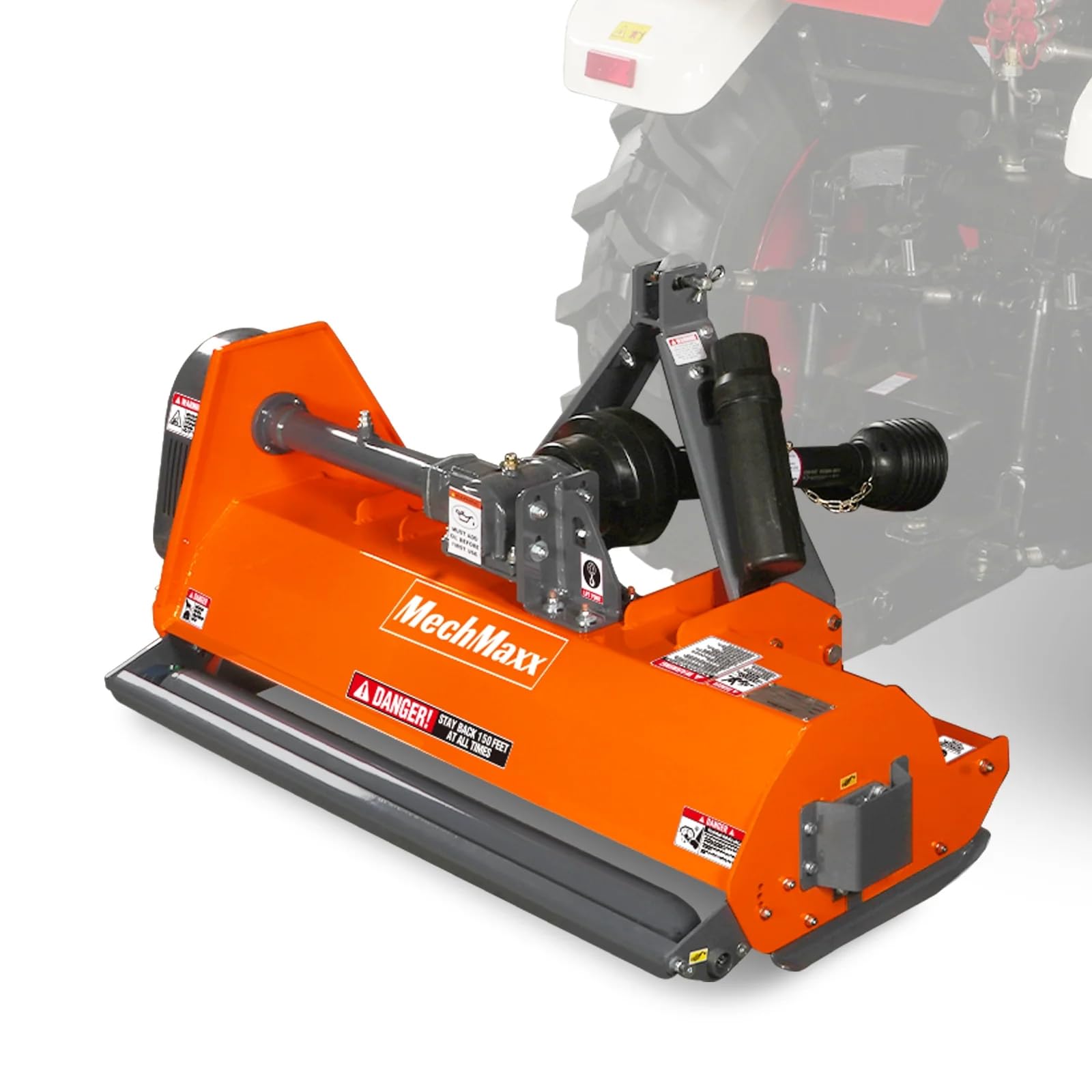
1. MechMaxx 48” PTO Flail Mower
Our pick — 4.0+★ from 40+ verified ratings; the strongest balance of quality and price.
The compact-tractor mulcher that shreds 0.75-inch saplings without asking for more engine than you own.
This is the pick for the owner of a smaller tractor who needs a real flail mower rather than a rough-cut deck. It bolts to a category 1 three-point hitch and is rated for 15-35HP tractors, which covers a lot of compact machines that bigger mowers would simply bog down. The PTO shaft turns at 540 RPM, the standard implement speed, so a healthy tractor hydraulics-and-gear setup has no trouble driving it. Belt transmission carries the power from the shaft to the rotor, and that belt drive is what smooths out the shock when you hit something hard in tall grass.
Where the design earns its keep is the chewing end. Twenty flail hammers are spread across the 48-inch working width, and those swinging blades let it mulch material up to 0.75 inches in diameter — thin saplings, blackberry canes, and woody regrowth all get shredded rather than left as windrows. Cutting height adjusts from 0.6 inches up to 1.8 inches above ground, so you can set it low for a pasture trim or lift it to clear uneven ground. Front safety chains block debris from flying forward, sealed tapered roller bearings keep the rotor spinning freely without constant greasing fuss, and a kickstand props the deck up for storage. This is also the mower the crowd rates highest here, holding 4.0+ stars across 40+ ratings — the strongest score on this list.
What wins people over most is plainly the cutting itself; the machine is judged effective above all else, and build quality and value come in strong behind it. The honest catch sits in durability. Shear bolts have snapped and hammer bolts have backed out on some units, and one machine reportedly let go after 12 hours of use. Treat bolt torque as a pre-season checklist item rather than a set-and-forget, and keep spare shear bolts in the toolbox. The other fit note: this mower does not work with quick-hitch units, so if your tractor runs a quick-hitch system you will be swapping it off first.
Where It Shines
- Mulches material up to 0.75 inches across — handles thin saplings and canes, not just grass
- 20 hammers on a 48-inch cut give a genuinely short finish in pasture grass
- Rated 15-35HP, so it suits compact tractors that cannot pull a wider deck
- 0.6 to 1.8 inches of cutting-height adjustment covers both a close trim and rough ground
What To Watch
- Shear bolts and hammer bolts need checking — some units have shed them in use
- Not compatible with quick-hitch units, so quick-hitch owners must remove it first
- The 673-pound deck is heavy to hang on a small tractor’s three-point hitch
Reach for this if: you run a compact tractor in the 15-35HP band and want one mower that tops pasture and chews light brush.
Look elsewhere if: your tractor carries a quick hitch, since this deck is not built for one.
2. MechMaxx 68″ Working Width PTO Flail Mower, Model NAM68
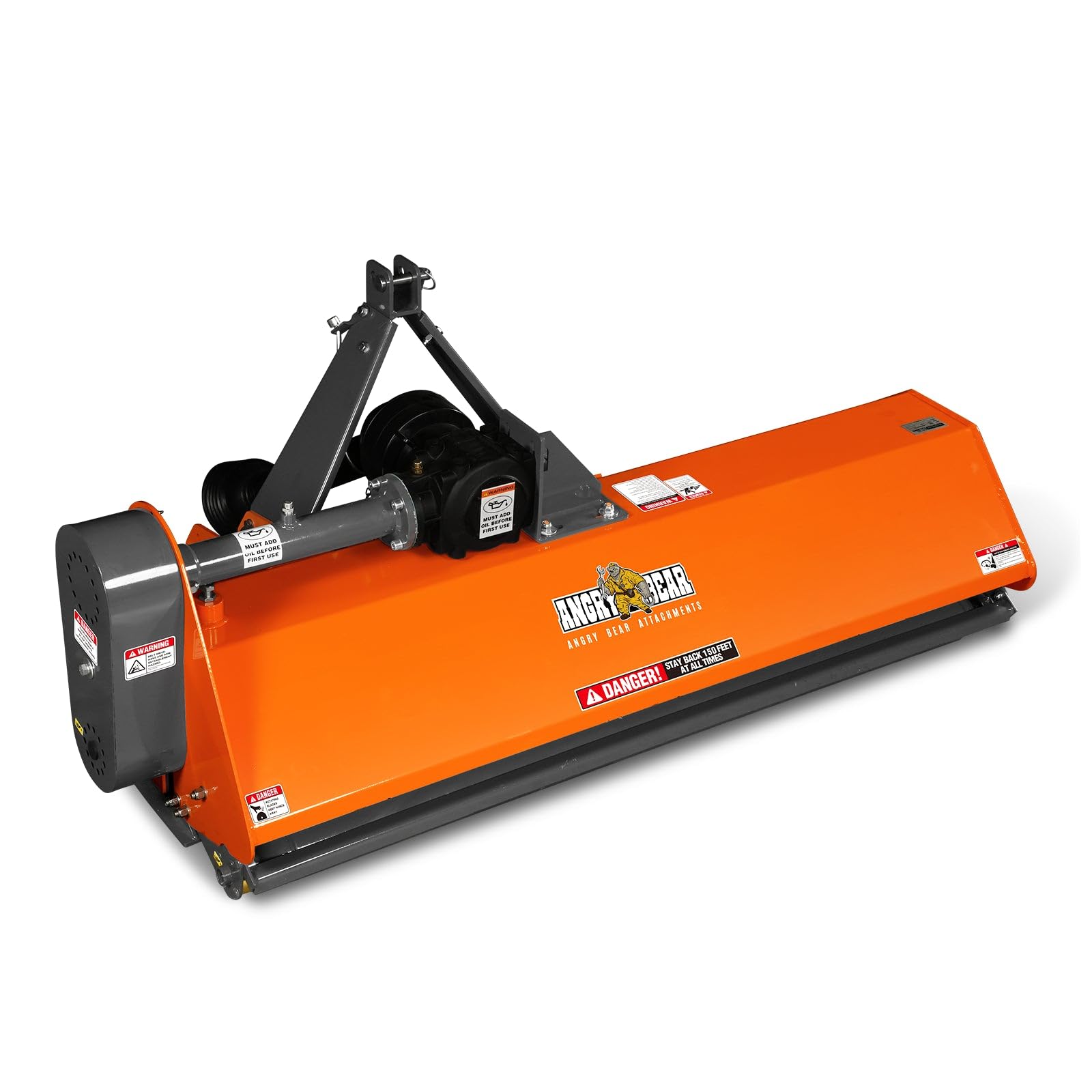
Twenty inches more cut per pass than the light-duty 48, built for tractors that can actually pull it.
Start with the number that changes your whole day: 68 inches of working width. Against the 48-inch light-duty mower above, that is 20 extra inches of ground cleared every single pass — the kind of gain you feel when a paddock that used to take four hours takes three. The hammer count climbs with it, to 28 forged flail hammers, so the deck keeps a fine chop even at the wider span. A forged hammer is a blade shaped and hardened as one piece rather than cast, which is the construction that survives regular contact with rocks and stumps.
This one asks more of your tractor. It is recommended for 30-60HP machines on a category 1 three-point hitch, and it is an offset 3-point design, so you can shift the deck sideways for edges rather than dead-centre cutting only. The PTO shaft comes in the box and the belt drive moves power from shaft to rotor. At 673 pounds it is the same weight as the 48-inch light-duty model, which is the quiet win here — you get a much wider deck without adding more mass to the hitch.
Buyers have not had long enough to build a deep track record on this model, and the honest read is that it is a big-deck tool for open ground and rough acreage rather than a delicate finish mower. Skid steer and highway-verge work is where a 68-inch swath pays off. If your tractor sits under 30HP, look down the list instead — this deck will drag the engine down in thick growth. It ships with a 1-year warranty, and the alloy steel build is the same family material as the rest of the range.
Best gain for the money: if you already own a 30-60HP tractor, 68 inches of width and 28 hammers is the fastest way to cover large acreage on this list, and it does not weigh more than the light-duty 48.
The honest limit: that same width is a liability on a smaller tractor — under 30HP, the deck wants more pull than the engine can give in tall growth.
The fast-acreage choice: a 30-60HP tractor owner with open fields and a lot of ground to cover.
Too much deck if: you are running a compact tractor under 30HP, where the 68-inch span outruns your engine.
3. MechMaxx 48″ Offset Flail Ditch Bank Mower VAM48
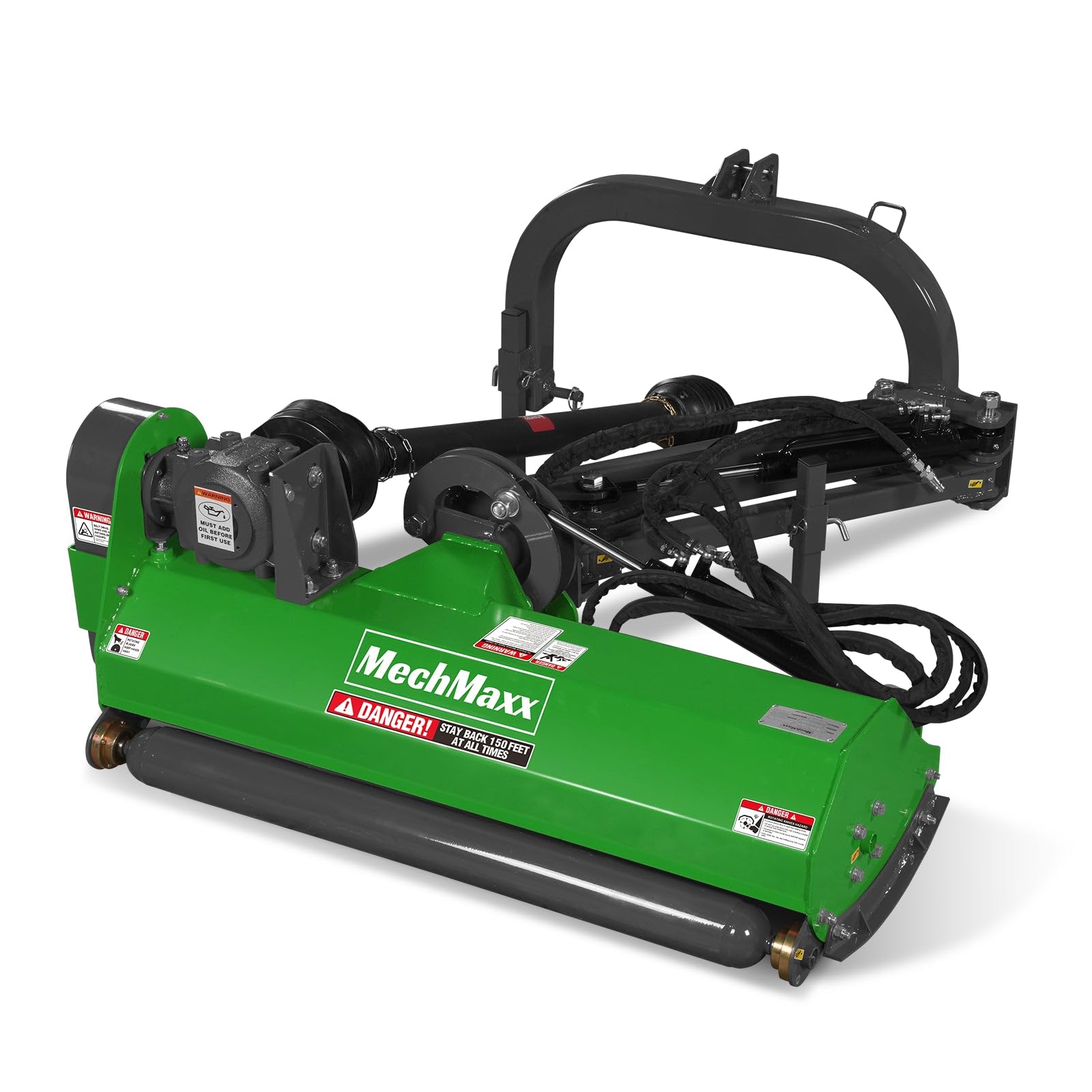
The only mower here that swings its deck out to reach the ditch instead of driving into it.
Ditches, embankments, and steep fence lines are the ground no centered mower can touch, and this one is built specifically for them. The offset hitch shifts the deck laterally up to 69 inches from centre, so the cutting head reaches out over a bank while the tractor stays on flat, safe ground. Hydraulic control tilts the deck 60° downward and 90° upward, letting you follow the fall of a slope or fold it back for transport and storage. Nothing else on this list does any of that.
The cutting hardware is also the most capable of the four for woody growth. It mulches material up to 1.5 inches in diameter — twice the 0.75-inch limit of the light-duty 48 — so thick shrubs and overgrown plants that would choke a lighter deck get shredded instead. Twenty flail hammers drive that cut, and the rotor spins from a PTO shaft at 540 RPM input against a rotor speed of 2356 RPM, which is where the fine chop comes from. A heavy rear roller smooths the pass and keys the cut height to the ground. Fitment is a category 1 three-point hitch on 25-50HP tractors and loaders, and a kickstand holds it upright for storage. Front safety chains keep debris out of the rotor path, and sealed tapered roller bearings keep it spinning without constant maintenance.
What impresses owners most here is the build itself — the quality is the thing people single out approvingly, and the fine cut draws praise too. Where it gets murkier is performance: it works beautifully for some and bogs down, scalps, or even stalls the tractor for others. The conditions you run it in seem to separate those experiences, with heavy grading and thick growth asking more than light topping. Durability reads the same mixed way, and a drum mount has split on one machine after three uses. Buyers rated it solidly overall, and it stands as the most capable tool here for rugged terrain — just respect the load you feed it.
The terrain specialist: with 69 inches of offset reach, a 60°/90° hydraulic tilt, and a 1.5-inch mulching limit, this reaches places a centered deck cannot and shreds woody growth the lighter mowers would struggle with.
Read the mixed feedback honestly: it shines on light-to-medium clearing but can bog down, scalp, or stall on heavy grading — match the job to the deck rather than leaning on it for everything.
Built for the hard land: anyone with ditches, embankments, and steep banks that a standard mower physically cannot reach, on a 25-50HP tractor.
Choose a centered deck instead if: your ground is flat field work, where the offset and tilt add capability you will never use.
Know the Specs
Working Width And What It Costs You
Working width is the swath of grass or brush the deck cuts in one pass, given in inches across the mower. A wider deck covers more ground per lap of the field, which is the whole reason to pay for one. That width is not free, though — every extra inch of cut pulls more power from the PTO and adds weight hanging off your three-point hitch. A 48-inch deck suits a lighter tractor, while a 68-inch deck needs a beefier engine behind it and more lift capacity on the hitch. Match the width to your horsepower before anything else: 48 inches for 15-35HP tractors, 60 or 68 inches for 30-60HP.
PTO Speed, Hammers And Offset Explained
PTO stands for power take-off — the splined shaft at the rear of your tractor that spins the implement — and 540 RPM is the standard input speed flail mowers are built around. The rotor turns faster than that once belt or gear drive steps it up, and the number of flail hammers on the rotor sets how fine the chop lands. Fewer hammers give a coarser cut with less strain; more hammers give a finer finish but ask more of the drive. An offset hitch moves the deck sideways so you can reach a ditch lip or bank without putting the tractor on the slope, while a centered deck cuts directly behind you on flat ground.
Common Questions
Will a 48-inch flail mower fit my 20HP compact tractor?
What does a flail mower do differently from a rotary cutter?
How big a sapling can these mowers mulch?
Why do shear bolts snap on a flail mower?
Do I need an offset hitch or is a centered mower enough?
What tractor horsepower do the 68-inch and 60-inch decks need?
Can I use these mowers on a quick hitch system?
How do I set the cutting height on a flail mower?
What maintenance does a flail mower need each season?
Which working width should I pick for my acreage?
The Bottom Line
For most tractor owners, the strongest all-round mulcher for tractor work here is the MechMaxx 48” Light-Duty Flail Mower — it fits a wide 15-35HP band, mulches 0.75-inch material with 20 hammers, and holds the best score on this list. If you own a 30-60HP machine and want to cover fields faster, the NAM68 gives you 68 inches of cut and 28 hammers, while the NAM60 splits the difference at 60 inches and 78 pounds lighter than the 68. And for ditches, banks and steep fence lines, the VAM48 is the one to reach for, with 69 inches of offset reach and a 1.5-inch mulching limit. Whichever you choose, match the working width to your horsepower first — a 48-inch deck on a 15-35HP tractor, a 60- or 68-inch deck on 30-60HP.
How we choose
We do not accept paid placement. Every pick is matched to a real buyer and a real use-case; we do not hands-on test units.
Sources
Specifications: manufacturer listings and product documentation. Review insights: verified customer reviews, as of November 2026. Pricing: not shown on this page (it changes often); check the current price via the retailer link.
As an Amazon Associate, Tactical Gear Guy earns from qualifying purchases. This does not affect which products we feature.