Specs are compiled from manufacturer listings and verified buyer reviews and can change over time — please confirm the key details on the product page before buying.
That sulfur smell in your water is hydrogen sulfide gas, and it tells you something specific: the odor is coming from the water supply itself, not the drain. A sulfur-specific whole-house filter removes it before the water reaches any faucet, shower, or washing machine. The picks below range from two-stage cartridge systems plumbed into the main line to air injection tanks that oxidize sulfide out without salt or chemicals. Match the system to your GPM draw and iron ppm, and the egg smell stops.
This guide is built by comparing the manufacturers’ published specifications and the patterns across verified customer reviews, so you get each pick’s real strengths and trade-offs instead of marketing spin.
The first thing to settle is whether your water needs sulfur-specific treatment or a full whole-house filter that handles iron, sediment, and odor at once. Every pick here works on sulfur, but they do it in different ways, and that difference decides which one belongs in your basement. Here is how to pick the best sulfur water filter system for your water.
Top Picks
How To Choose The Best Sulfur Water Filter System
Three numbers decide almost everything here: how many gallons per minute (GPM) your home draws, how much iron sits in the water, and how the system actually attacks the sulfur. Get those three right and a cartridge system runs a year or more between changes.
Match the flow rate to your household
Flow rate is how many gallons the system can push per minute without choking your pressure. A family of four running two showers and a washing machine at once may draw a lot of water at peak. A system rated up to 15 GPM handles that comfortably, while a 7 GPM unit is better suited to smaller homes or lighter simultaneous use. Size too small and shower pressure sags the moment the dishwasher kicks on.
Oxidation versus cartridge media
Sulfur removal happens two main ways. Cartridge systems pass water through compound or carbon media that traps hydrogen sulfide as it flows. Air injection tanks work differently — they build a pocket of air that oxidizes the sulfide first, then the media traps the oxidized material and a backwash cycle flushes it down the drain. Cartridge setups are simpler and cheaper to start; air injection tanks are built for heavier iron and sulfur loads and regenerate themselves automatically.
Iron and manganese change the pick
Hydrogen sulfide rarely travels alone. Well water with sulfur often carries iron that stains fixtures orange and manganese that leaves dark marks. A filter that only targets odor can clog fast when iron is high. Look for a system whose media is rated for the iron level you actually have, and check whether it names a ppm (parts per million) limit for iron before you buy.
What the micron rating means
Sediment filters are rated in microns — a micron is one millionth of a meter. A 5-micron rating captures particles far smaller than a grain of sand, which protects the specialty media behind it and keeps fine grit out of your appliances. The pleated pre-filter stages in some systems can be rinsed and reused, which stretches the life of the cartridge that does the odor work.
Side-by-Side Comparison
| Model | Best For | Max Flow Rate | Capacity | Filter Life | Amazon |
|---|---|---|---|---|---|
| iSpring WGB22B-KS★ Best Overall | Best overall two-stage | 15 gpm | 100000 gallons | 1 years | Amazon |
| iFilters MWH-D20-WELLBest Value | Budget well-water starter | 1 gpm | 1 gallons | 12 months | Amazon |
| H&G lifestyles Whole House Iron FilterMost Versatile | Iron plus sulfur in one tank | 7 gpm | 700000 gallons | 10 years | Amazon |
| iSpring WGB32B-KDS | Three-stage scale defense | 15 gpm | 250000 gallons | 1 years | Amazon |
| The Sulfur Eliminator Deluxe | No-tool hose spigot install | — | — | 1 years | Amazon |
| DuraWater Air Injection Iron Eater 1.0 | Air injection value | — | — | — | Amazon |
| Fleck 5600 SXT Iron Eater 1.5 cu ft | Catalytic carbon upgrade | — | — | — | Amazon |
| Oceanic Water Systems AIS10-25SXT | Large households | 7 gpm | 1 cubic feet | 5 years | Amazon |
| AFWFilters Air Injection AIK10-56SXT | Chemical-free heavy iron | — | — | — | Amazon |
Detailed Reviews
1. iSpring WGB22B-KS Whole House Water Filter System
Our pick — 4.5+★ from 800+ verified ratings; the strongest balance of quality and price.
Two cartridges that handle sulfur, chlorine, and heavy metals while the whole house keeps its pressure.
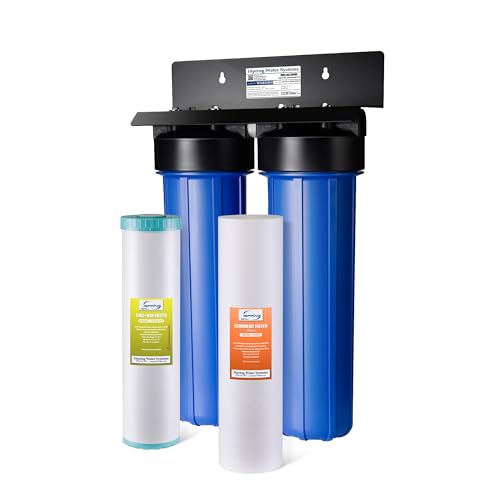
For most homes dealing with rotten-egg water, this is the one to buy. It runs a two-stage cartridge stack — a polypropylene sediment filter (model FP25B) that catches particles down to 5 microns, then a compound cartridge (model FG25B-KS) aimed at hydrogen sulfide, chlorine, chloramine, lead, mercury, and PFAS. The system pushes up to 15 gallons per minute through 1-inch NPT inlet and outlet connections, so showers and laundry keep full pressure even when several taps run at once. It holds 100,000 gallons before the cartridges need swapping, which the maker figures at about a year of clean water for a family of four.
The thing owners rave about is build quality, and the function reports back it up — the water simply tastes better and the chlorine smell disappears from showers. Installation is genuinely a weekend DIY job, with a printed manual and video walkthroughs, and the cartridges arrive individually wrapped so nothing sits open on a shelf. One honest note on the specification: this system does not reduce TDS (total dissolved solids, the mineral content in water). It keeps those minerals on purpose, so if a low TDS reading is your goal, look at a reverse osmosis unit instead.
Buyers report one recurring problem on the review pages: leaks at the fittings. The union between the two housings and the outlet header connection come up again and again, and a few units arrived with a cracked housing. Thread tape, careful tightening, and a slow first pressure test head off most of that. Sizing works out clean against the iFilters pick below: 100,000 gallons of capacity next to 1 gallon on paper, and 15 GPM (gallons per minute, the flow rate) against 1 GPM if you read the listing specs literally. That tells you the iSpring is built for a full household, while the other leans toward point-of-entry duty.
What buyers keep praising
- Two-stage removal that hits hydrogen sulfide alongside chlorine and heavy metals in one housing set
- 15 GPM flow with minimal pressure drop across a whole house
- Cartridges arrive pre-wrapped, so the media is fresh when you install it
- U.S. tech support out of Atlanta, GA, by phone or email
Where it can trip you up
- Fitting leaks come up often enough that thread tape and a careful pressure test are worth the extra ten minutes
- Does not lower TDS — that is by design, not a defect
Buy it if: your well water smells of sulfur and you want a full-house cartridge system that keeps pressure and installs with basic plumbing skills.
Look elsewhere if: you specifically need TDS reduction — that calls for a reverse osmosis stage.
2. iFilters 4.5 x 20 Sediment CTO
A budget entry into well water treatment with a reusable first stage you can rinse instead of replace.
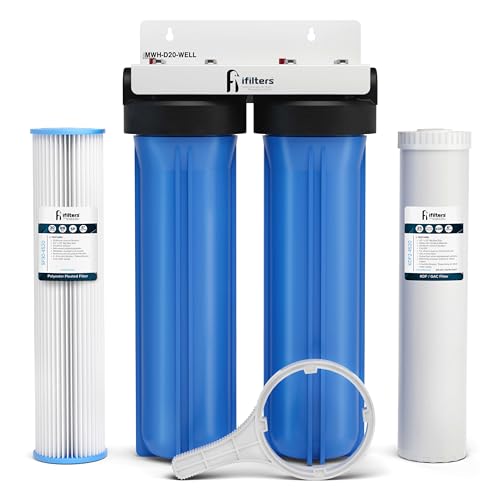
If your well water arrives cloudy, rusty, or smelling of sulfur, this system (model MWH-D20-WELL) is built for that job. It runs three stages inside two big housings. First, a washable pleated sediment pre-filter traps dirt, rust, sand, and silt, and you can rinse and reuse it. Then a cartridge combines GAC (granular activated carbon, which soaks up chlorine taste and organic compounds) with KDF media that helps reduce iron, sulfur odor, and heavy metals. The housing is a 4.5-inch by 20-inch Big Blue-style design with 1-inch ports, and the whole unit weighs 27.8 pounds — light enough for one person to mount.
This one makes sense if your sulfur problem is light and your priority is keeping spend down. It is simple and mechanical, and the replacement media is easy to source — the manufacturer names its SP30-KDF2-4520 cartridge for proper fit. The listing rates it up to 100,000 gallons or 6-12 months of service, with lifespan swayed by your pressure, sediment, iron, and sulfur levels. Compare the raw numbers and it is the smaller system by a wide margin: 1 GPM on the spec sheet next to the iSpring’s 15 GPM, and 4.5 by 4.5 by 20 inches of footprint next to the iSpring’s 16 by 8 by 28 inches. If your household draws a lot of water at once, that gap matters.
Owners mention the system as functional and easy to install, but experiences split on water quality — some see the orange iron stains disappear, others still find them. Leaks are a coin flip too, with some units sealing cleanly while others will not stop dripping at the fittings. Treat it as a good fit for a modest, single-bathroom well setup where you want to test the waters before committing to a tank system.
The reusable angle: the pleated pre-filter is designed to resist harboring bacterial growth and can be rinsed rather than tossed, which cuts long-term cartridge spend on a system already priced as the most affordable pick here.
Where it falls short: the 1 GPM maximum flow rate is the honest ceiling — a full household drawing water at once will likely notice it, so a smaller home or point-of-entry setup suits it better.
Reach for this if: you are on a tight budget and want a genuine three-stage well filter you can install yourself and maintain cheaply.
Think twice if: you run multiple bathrooms at peak — the 1 GPM ceiling is looking at you.
3. H&G lifestyles Iron and Manganese Filter
Seven hundred thousand gallons of capacity in a tank that also softens — the long-game pick.
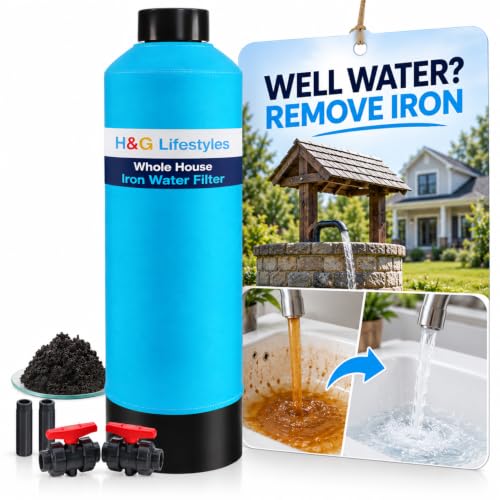
The headline here is the capacity: 700,000 gallons, with a filter life rated at 10 years. That dwarfs every cartridge pick in this article — compare it to the iSpring WGB22B-KS at 100,000 gallons and 1 year, and the H&G is built to be a set-and-check-annually piece of equipment. Its 5A food-grade resin media, per the maker, reduces up to 99.6% iron, 99.3% manganese, and 99.5% hydrogen sulfide. It also softens water as a second job, protecting appliances from scale.
Flow and pressure are specified clearly: up to 7 GPM, and it works across a pressure range of 20-100 PSI (pounds per square inch, the measure of how hard your water pushes). It installs on the main line with 1-inch PVC piping and two control valves. When the resin loads up, it regenerates rather than getting replaced, which is why the lifespan figure stretches out to a decade. For a well with both iron staining and sulfur smell, one tank handling both jobs saves space and a separate softener purchase.
The feedback split here is real and worth sizing honestly. The system works beyond what people expect when it is running well — installation runs on the main line, and the regenerable resin is a genuine advantage over throwaway cartridges. Quality opinions are more divided, with some owners delighted and a few saying they would not recommend it. If your iron and sulfur levels are known and moderate, the capacity and softening combo is the strongest long-term value in the mid-range group.
The long-run math: 700,000 gallons and a 10-year filter life mean far fewer media changes than a cartridge system, and the built-in softening is a second appliance you do not have to buy.
Know before you buy: 7 GPM is well below the 15 GPM cartridge systems here, so confirm your household peak draw fits before committing to the tank.
This is your pick if: you want iron, manganese, sulfur, and hardness handled in a single regenerable tank you set up once.
Not for you if: your home pulls high simultaneous flow — 7 GPM has a ceiling you should respect.
4. iSpring WGB32B-KDS
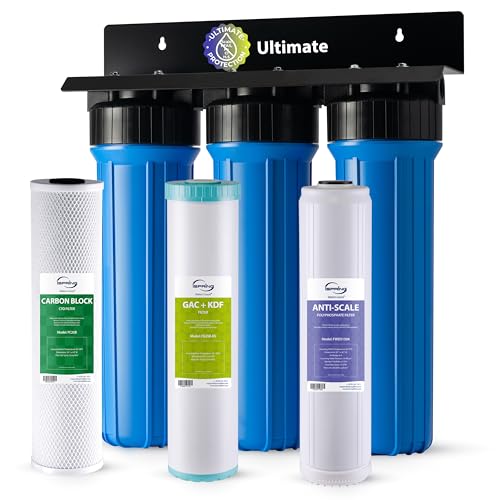
Three stages of protection that also fight scale and corrosion, not just sulfur and chlorine.
Where this steps past a standard cartridge filter is the first stage: an FWDS150K anti-scale cartridge that sequesters calcium and magnesium (the minerals that form scale) and lays down a protective layer inside pipes to slow corrosion. Behind it sits the FG25B-KS compound cartridge targeting chlorine, lead, mercury, hydrogen sulfide, and heavy metals, and an FC25B carbon block rated by the maker for up to 99% chlorine reduction. The whole stack is rated to filter up to 250,000 gallons — a year of clean water for a family of four — at up to 15 GPM through 1-inch NPT connections.
Owners recommend this one heavily — the effectiveness and taste scores are the story. The chlorine taste and smell are gone completely, sediment and impurities clear out, and glassware and showerheads stop spotting. Installation is described as a straightforward DIY process, and the system looks the part: alloy steel, copper, and metal construction, with a 55-pound shipping weight that tells you the housings are substantial. That weight and 24.5 by 8 by 28 inches of footprint mean you want a solid mounting spot. It meets NSF/ANSI standards, which is the industry body that sets filtration performance benchmarks.
Pressure is the one area that splits opinion — some customers note no change, others find their pressure still low afterward. That often depends on incoming pressure and pipe sizing rather than the filter itself, so check your baseline before installing.
What wins people over: the anti-scale stage. Sequestering calcium and magnesium before the water leaves the system protects water heaters and appliances in a way a sulfur-only cartridge cannot, and the 250,000-gallon capacity runs longer than the WGB22B-KS’s 100,000 gallons.
The honest caveat: pressure results vary, and heavy-duty metal construction means a 55-pound install you will want to mount securely.
Choose this one when: you want sulfur and chlorine handled and scale defense working alongside it for appliances and pipes.
Pick a simpler cartridge if: scale is not an issue and you want a lighter, cheaper two-stage install.
5. The Sulfur Eliminator Deluxe Well Water Filter System

If you can screw on a garden hose, you can install this aerating sulfur eliminator — no tools at all.
This one takes a completely different approach from every cartridge and tank here. It installs directly onto a well spigot or faucet with no tools — the maker’s rule of thumb is that if you can thread a garden hose, you can fit it. It works on any size well 4 inches and above, and it runs on water pressure alone, with no electricity needed. The Sulfur Eliminator aerates the water into a recycled air-and-water mist to strip out the rotten-egg odor, and it also addresses iron, rust, and sediment. It is rated for water up to 1000 PPM TDS (total dissolved solids) and comes with a lifetime warranty that holds as long as the companion Iron Buster Filter is replaced once a year.
Owners are clear on the strongest point: odor removal works. Reviewers also praise the install — it depends on a hose connection that takes minutes. For a camp, a cabin, or a well spigot where you do not want to cut into the main line or run a backwash drain, that combination is hard to match at this level of effort.
Set expectations honestly: it is a freestanding, spigot-mounted unit, not a whole-house inline system, and the odor win depends on the aerator running on your well’s own pressure. If your goal is whole-house sulfur control at every tap with automatic regeneration, the tank systems above are the better fit.
The standout spec: zero electricity and zero tools — the unit runs off your well’s own water pressure, so there is nothing to wire, no pump to install, and no drain line for a backwash.
Set your expectation: it installs on a spigot rather than the main line, which suits a camp or cabin better than a whole-house retrofit.
Grab it if: you want rotten-egg smell gone from a well spigot with a five-minute, tool-free install and no power run.
Pass if: you need whole-house sulfur treatment at every tap — this is spigot-mounted, not inline.
6. DuraWater Air Injection Iron Eater Filter 1.0
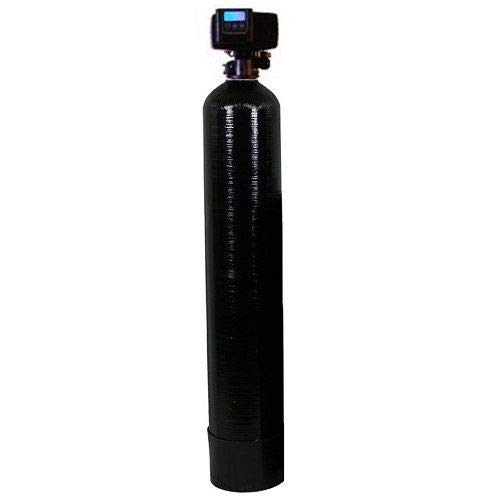
Air injection enters the picture with a complete tank package and a digital valve at the entry tier.
This is the first pick in the article that treats water with oxidation rather than cartridges. The DuraWater Black Series uses air injection — the system creates a pocket of air that oxidizes the iron and hydrogen sulfide in your water, then a bed of filter media traps the material. You get a full 1.0 cubic foot of media, a 10-inch by 54-inch mineral tank, a 1-inch plastic bypass, and a digital control valve. It handles iron, manganese, and H2S as its primary job.
The owner experience carries real weight. Shoppers say a dramatic difference in water quality — the rusty toilet rings and stains go away, the odor clears, and the water runs clear. The quality of the equipment draws repeated praise, installation is described as doable for a DIYer with basic plumbing skills, and the value is repeatedly called a good investment. For a chemical-free, salt-free system with automatic oxidation, this sits at the entry end of the tank category.
The catch is the install. Air injection tanks need some plumbing work to set up and a drain for the backwash to run to — no garden-hose simplicity here. Confirm your water flow and pressure before choosing the 1.0 cubic foot media size, because media capacity should match your iron load and household draw.
What you get: the complete air injection package — 10×54 inch mineral tank, 1.0 cubic foot of media, digital control valve, and 1-inch bypass — for salt-free oxidation of iron, manganese, and H2S.
The trade-off: it needs basic plumbing skills and a drain line for backwash, so budget the install realistically before choosing it.
This suits you if: you have basic plumbing skills and want salt-free air injection oxidation without going to the priciest tanks.
Skip a tank if: you would rather not add a drain line — a cartridge system installs without one.
7. Fleck 5600 SXT Air Injection Iron Eater Filter 1.5 cu ft
Same air injection approach as the DuraWater, but with a bigger tank and upgraded catalytic carbon.
The 1.5 cubic foot size here is the step up from the DuraWater’s 1.0 cubic foot — more media means more capacity for iron and sulfur between backwashes, which matters on wells with heavier loads. It also steps up the media itself: 1.5 cubic feet of Centaur catalytic carbon, which is designed to enhance contaminant removal beyond standard media. The Fleck 5600 SXT digital valve backwashes the tank daily to flush captured contaminants down the drain. You get the 10×54 inch mineral tank, the media, and a 1-inch plastic bypass, weighing 65 pounds.
What buyers describe most is how immediately the results show up — clear water, iron and manganese gone, and the rust stains and cloudy water a memory. Detailed instructions come in the box, and the automatic daily backwash takes maintenance off your plate. Value comes up often too, with buyers noting this runs a fraction of an installed system’s cost. The 65-pound weight and 12 by 12 by 48-inch footprint mean a secure mounting spot and possibly a second set of hands.
The carbon media needs the same drain line for backwash as any tank, plus basic plumbing to install. Size the tank against your iron load before ordering — 1.5 cubic feet is a real upgrade over the 1.0 cubic foot DuraWater, but a very heavy iron well may call for checking whether the media capacity matches your ppm reading.
Upgrades worth noting
- 1.5 cubic feet of Centaur catalytic carbon — more media capacity than the DuraWater’s 1.0 cubic foot
- Daily automatic backwash cleans the media and flushes contaminants for you
- Buyers report the odor and stains clear almost immediately
- Instructions are detailed, and the value is repeatedly called out against installed systems
Plan around these
- 65 pounds and 12x12x48 inches — a two-person install and a firm mounting spot
- Needs a backwash drain line and basic plumbing skills
The right call if: you want a bigger tank and upgraded carbon media than the entry air injection pick, without going to the top of the price range.
Go bigger only if: your water test shows heavy iron and manganese — 1.5 cubic feet is generous but check it against your load.
8. Oceanic Water Systems AIS10-25SXT Air Injection Filter

Built for households with four bathrooms and up, with media rated to last five years before a change.
Oceanic sizes this unit for homes with 4 or more people and a workload to match, filtering iron, sulfur, and manganese at a rated 7 GPM. The media inside the 10-inch by 54-inch tank traps oxidized iron and sulfur until the backwash cycle washes it down the drain. The maker rates the media for 5 years on average, which lines up with its 5-year filter life cycle — a longer window than the 1-year cartridge picks, and one worth weighing against the 1.0 and 1.5 cubic foot tanks above. It carries 1 cubic foot of media, weighs 50 pounds, and uses the same 5600SXT AIO (air-injection oxidation) valve with automatic backwashing as the other tanks.
The engineering angle worth knowing: the system holds a pocket of pressurized air at the top of a single tank, which eliminates the need for a separate air pump or second tank. The piston design keeps the oxidation process inside one tank, cutting downtime and upkeep. A single-tank design saves floor space in a utility room where you may not have a second footprint to spare.
The honest caveats: do not expect TDS reduction — the maker is explicit that this system is not built for it. And at 7 GPM you want a small-to-medium household with reasonable peak draw rather than a sprawling house where four showers run at once. The 50-pound tank needs a solid floor and a backwash drain.
Standout spec: 5 years of rated media life in a single-tank air injection design — no separate pump, no second tank, and 1 cubic foot of media doing the oxidation work automatically.
The trade-off: 7 GPM handles a medium household cleanly, but peak simultaneous use in a very large home could test it, and TDS stays where it is.
Built for you if: you have a busy household and want oxidation in one compact tank with media rated to last five years.
Consider a cartridge system if: you have limited floor space and would rather avoid a backwash drain.
9. AFWFilters Air Injection AIK10-56SXT

The most expensive tank here, and the one built for the heaviest iron loads — no salt, no chemicals.
This is the top-of-range air injection system in the list, and it targets the toughest water: the maker states it removes high levels of iron and sulfur from your water with no salt and no chemicals. It super-oxidizes the water before it ever reaches the filter media, and the K series media is designed to work with a fraction of the flow rate of normal systems. It uses a titanium iron filter build, includes the complete system, and ships with AFW’s instructions on a USB drive. It is the priciest pick here, aimed at wells where iron and sulfur are heavy enough that lesser systems struggle.
The owner feedback is encouraging on the fundamentals — the system works well for people who have installed it, quality is described as excellent, and the odor clears completely. Installation is called easy for a DIYer, though the 54-inch tank height and backwash drain requirement mean it is a real project, not a hose splice.
Two things to keep your eyes on. First, that K series media design works best when your flow rate is matched to it, so check your plumbing before you buy. Second, no chemical means no salt-based regeneration — instead you rely on the automatic backwash cycle. For a chemical-free, salt-free setup on a demanding well, this is the heavy-duty tank option.
The standout spec: a titanium iron filter with K series media that super-oxidizes water before it hits the media — designed to handle high iron and sulfur loads without salt or chemicals.
Plan for this: it is the priciest tank in the article, and the media needs a matched flow rate plus a drain line, so check your setup before committing.
Go with this when: your well carries heavy iron and sulfur and you want a chemical-free, salt-free treatment built for demanding loads.
Choose lighter media if: your iron and sulfur counts are moderate — the premium build is more than a mild well needs.
Know the Specs
Flow Rate (GPM)
Gallons per minute measures how much water the system can pass without a pressure drop. A 15 GPM rating supports several fixtures at once — showers, laundry, a dishwasher — while a 1 or 7 GPM rating suits a smaller household or a single-entry point. Look at how many taps run at the same time in your home and match upward.
Micron Rating
A micron is one millionth of a meter, and a 5-micron filter catches particles smaller than a grain of sand. The finer stages protect the specialty media behind them and keep grit out of your water heater and appliances. Coarse pre-filters clog slowly; fine ones need more frequent changes.
Air Injection
Air injection creates a pocket of oxygen-rich air inside a tank that oxidizes iron, manganese, and hydrogen sulfide so the filter media can trap them. The oxidized material gets flushed away in a backwash cycle. This is why air injection tanks handle heavier iron and sulfur loads than most cartridge systems.
Glycol/Anti-Scale Cartridges
Some systems add an anti-scale stage that sequesters calcium and magnesium so they cannot form crust in pipes and appliances. Paired with corrosion inhibitors, it stretches the life of your water heater and fixtures. These cartridges work alongside the sulfur stage rather than replacing it.
Common Questions
Will a cartridge filter remove sulfur smell from well water?
Do I need air injection or a cartridge system for my iron level?
Will a whole-house sulfur filter drop the water pressure in my showers?
How often do I replace the media or cartridges?
Will a sulfur filter lower my TDS reading?
Can I install a whole-house sulfur filter myself?
Does an air injection tank need electricity to run?
What is the difference between KDF media and activated carbon for sulfur?
Will a sulfur filter also handle iron stains on my fixtures?
How much space does a whole-house sulfur filter take up?
The Bottom Line
For most wells dealing with that rotten-egg smell, the sulfur water filter system winner is the iSpring WGB22B-KS — it targets hydrogen sulfide with a dedicated compound cartridge, moves up to 15 GPM so your showers keep pressure, and and it holds 4.5+ stars across 800+ owner reviews. If scale and appliance protection matter alongside the sulfur, the iSpring WGB32B-KDS adds an anti-scale stage and 250,000 gallons of capacity. And when the iron and sulfur are heavy enough that cartridges struggle, the Fleck 5600 SXT Iron Eater brings 1.5 cubic feet of catalytic carbon and a daily automatic backwash to the job.
How we choose
We do not accept paid placement. Every pick is matched to a real buyer and a real use-case; we do not hands-on test units.
Sources
Specifications: manufacturer listings and product documentation. Review insights: verified customer reviews, as of November 2026. Pricing: not shown on this page (it changes often); check the current price via the retailer link.
As an Amazon Associate, Tactical Gear Guy earns from qualifying purchases. This does not affect which products we feature.