Specs are compiled from manufacturer listings and verified buyer reviews and can change over time — please confirm the key details on the product page before buying.
If you have ever changed clothes lying on your back inside a tent, you already know why center height is the number that decides whether a tent works. Every pick below clears 72 inches at the center, so you can stand, walk, and pull on a jacket without folding in half — and the CORE Family Camping Straight Wall Cabin Tent wins with the tallest ceiling (86 inches) and largest floor (176 sq ft) here. One honest note before you read on: this list uses flexible, human-like matching for tall stand-up interior height (cabin-style, roughly 6 ft or higher center height), so not every pick is the exact number you searched. Where a pick lands near that mark rather than on it, I note the exact center height in inches.
This guide is built by comparing the manufacturers’ published specifications and the patterns across verified customer reviews, so you get each pick’s real strengths and trade-offs instead of marketing spin.
Some of these tents top out at 86 inches of center height while others sit at 72 inches, which changes how a full-grown adult moves inside. Below you’ll find ceiling heights, floor areas, and setup times laid out side by side across all of the tall camping tents.
Top Picks

How To Choose The Best Tall Camping Tents
Standing height is where most tent shopping goes wrong. A listing that says “8-person tent” tells you nothing about whether you can put your boots on upright. Start with the center height in inches, then check how that height holds up at the walls — a teepee and a straight-wall cabin treat a 6-foot camper very differently.
Center Height and What 72 Inches Actually Feels Like
Center height is the distance from floor to ceiling at the tent’s highest point, measured in inches. At 72 inches you clear six feet of headroom in the middle, so most adults stand without ducking, but you will stoop as you near the side walls. At 80 inches and up — like the PORTAL instant cabin at 80 inches or the CORE straight-wall cabin at 86 inches — you get real walking room and can stretch your arms overhead. If you are tall, prioritize center height over sleeping capacity — a 72-inch peak lets you stand only in the middle, while 80 inches and up gives walking room.
Straight Walls vs. Sloped Shapes
Straight-wall cabin tents keep the ceiling vertical for most of the footprint, so height carries out toward the edges where you actually dress and move. Tunnel and teepee tents taper inward, which means the advertised peak is only available dead center. The CORE straight-wall design is the clearest example of full-height walls, while the OneTigris teepee trades that edge-height for wind-shedding shape.
Floor Area, Capacity, and Gear
A tent marketed as 12-person rarely sleeps 12 people with luggage. The CORE straight-wall cabin is 16 by 11 feet with 176 square feet of floor, and even it is described by owners as comfortable for 6 people plus gear. Read the floor area in square feet, then subtract space for bags, cots, and a dog. Couples who want a table and chairs indoors should look at the 160 square foot tunnels, not the 87 square foot cabins.
Weather Protection That Matters
Look for a fully taped rainfly, sealed seams, and a millimetre-rated fabric coating. The CORE tents use H20 Block Technology with 1200mm fabric, the Naturehike uses a 2000mm+ waterproof rating, and both specs tell you how much water pressure the shell resists before it soaks through. A removable rainfly lets you stargaze through the mesh ceiling on clear nights and batten down when storms roll in.
Side-by-Side Comparison
| Model | Best For | Center Height | Floor Area | Stated Capacity | Amazon |
|---|---|---|---|---|---|
| CORE Family Camping Straight Wall Cabin Tent★ Best Overall | Standing room for a big family | 86 inches | 176 sq ft | 12 people | Amazon |
| PORTAL Instant Cabin Tent with RainflyTwo-Room Pick | Two-room privacy plus a porch | 80 inches | 112 sq ft | 6/8/10 people | Amazon |
| TIMBER RIDGE 8 Person with Screen PorchCar-Camping Favorite | Car camping with a screen room | 76 inches | 160 sq ft | 8 people | Amazon |
| PORTAL Family Tunnel Tent with Screen Porch | Long stays with a bug-screened porch | 80 inches | 160 sq ft | 8 people | Amazon |
| EVER ADVANCED Blackout 6 Person | Sleeping past sunrise | 77 inches | 87.75 sq ft | 6 people | Amazon |
| Coleman Instant Camping Tent | Fastest possible pitch | 6 ft | 90 sq ft | 4/6/8/10 people | Amazon |
| OneTigris Rock Fortress Hot Tent | Cold-weather stove camping | 7.8 ft | 60.84 sq ft | 4-6 people | Amazon |
| CORE Instant Lighted Cabin Tent | Built-in ceiling lights | 72 inches | 99 sq ft | 6 people | Amazon |
| Naturehike Village Instant Tent | Blackout plus stand-up cabin | 72 inches | 140 sq ft | 8 people | Amazon |
| Night Cat 8-Person Hot Tent | Stove-jack cabin with a vestibule | 80 inches | 112 sq ft | 8 people | Amazon |
| Kodiak Canvas Cabin Lodge | Four-season canvas basecamp | 7.5 ft | 192 sq ft | 10 people | Amazon |
Detailed Reviews
1. CORE Family Camping Cabin Tent
Our pick — 4.5+★ from 850+ verified ratings; the strongest balance of quality and price.
The 86-inch ceiling that turns a tent into a room you can walk through.
Of everything here, this is the tent that most nearly behaves like a cabin. The center height is 86 inches — over seven feet at the peak — and because the walls run nearly straight rather than tapering, that headroom carries out toward the sides where you actually dress. The footprint is 16 by 11 feet with 176 square feet of floor, and CORE says it fits four queen-size air beds, sleeps 6 people with gear, or up to 12 without gear.
What wins people over is the sense of space, with owners describing room enough for three people and a dog plus cots and gear, and setup that runs about five minutes. Water protection is the other headline: H20 Block Technology on 1200mm fabric with a fully taped rainfly, sealed seams, and fully zipped windows. Campers report staying dry through rainstorms, and the going comparison on the review pages is that it is the Taj Mahal of tents. Value, appearance, and water resistance all trend strongly positive across the feedback.
The honest catch sits in two places. The fabric poles earn mixed reports, with a share of owners seeing fiberglass rods break, and the front zipper can stick or fight you. Neither is universal, but on a tent this size those two parts take the most strain — so pitch it fully guyed out with the included steel stakes, and treat the zipper gently. It also holds 176 square feet, against the PORTAL instant cabin’s 112 square feet, a 57% larger floor that explains the extra bulk in the car.
Where it earns its keep
- 86-inch center height with near-straight walls for standing room that reaches toward the sides
- 176 square feet of floor and four queen air beds
- H20 Block 1200mm fabric, taped rainfly, and sealed seams for storms
- Room divider turns one big space into two private ones
- Storage pockets keep small gear off the floor
Where to slow down
- Fiberglass poles draw mixed durability reports
- Front zipper can snag and needs a light hand
- The sheer size makes it a two-person pitch and a trunk-filler
The stand-up winner: Built for families who want to walk upright and sleep 6 with gear in comfort.
Measure your trunk first: This is the largest floor on the list, so confirm the vehicle before committing.
2. PORTAL Instant Cabin Tent
Two private rooms and a screened porch, all under an 80-inch ceiling.
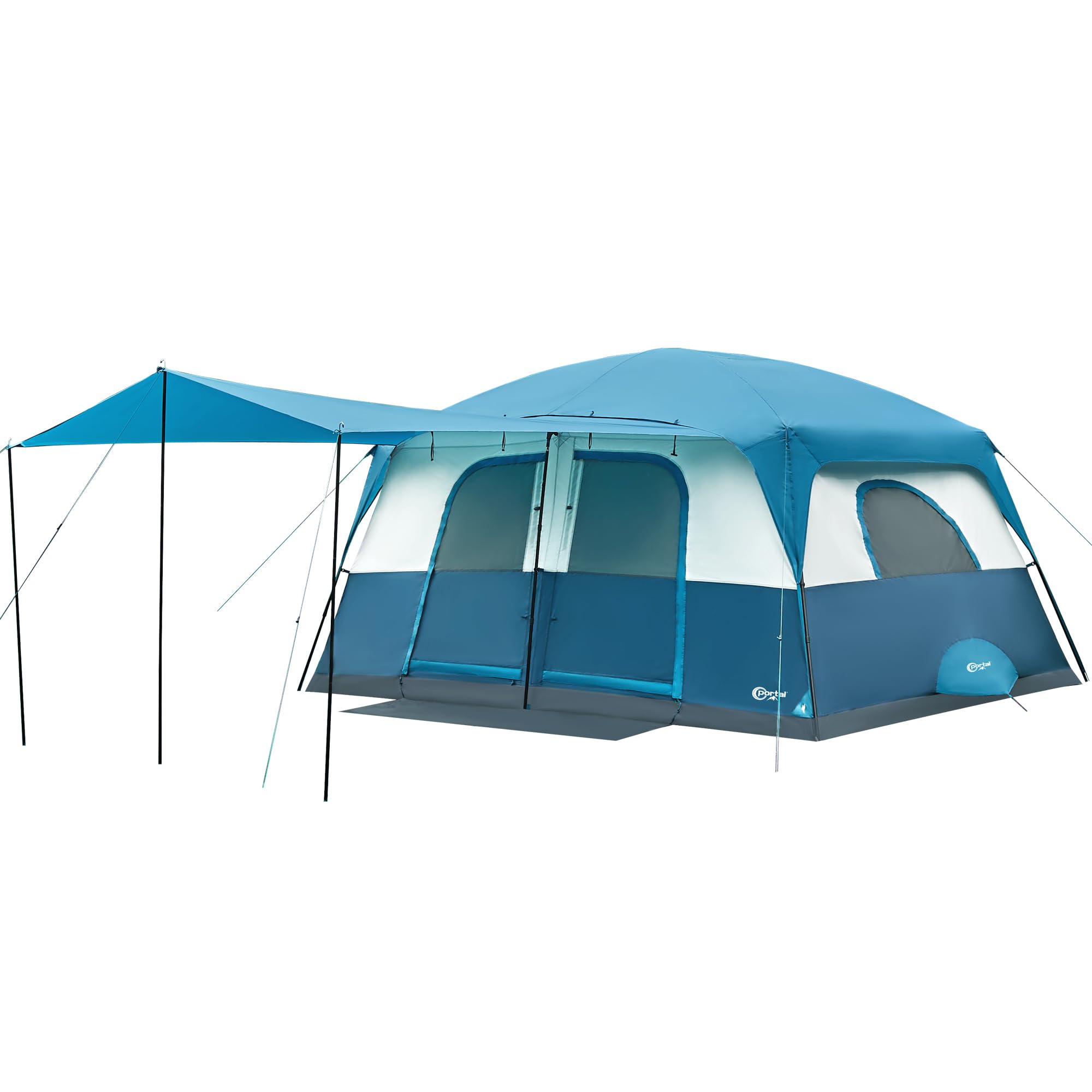
For the camper who wants a sleeping side and a living side, this PORTAL splits a 14 by 8 foot footprint into two rooms with separate doors. The 80-inch center height keeps you standing upright throughout, and the attached 14 foot by 7 foot 6 inch porch gives you a place for gear or a chair before you ever step inside. Floor area is 112 square feet, which owners say fits two queen air mattresses or one plus a table and chairs — the “mansion” description comes up a lot.
The setup story is stronger than you’d expect for a tent this shape, with the design pitched at about ten minutes for two people and several owners managing it alone. Weather-wise it carries a PU-coated waterproof shell, fiberglass and steel poles, fully taped seams, a rainfly, and fabric-covered zippers; reports describe it holding out hours of heavy thunderstorm rain. Two D-shaped doors, six mesh windows, two ground vents, and a mesh ceiling keep air moving and views open.
Where it gives ground to the winner above is pure floor space — 112 square feet against the CORE straight-wall’s 176. Durability feedback is the mixed part, with some owners questioning long-term wear, so budget for careful handling of the poles. The extras still add up: two E-ports for running power inside, a gear loft, wall pockets, carabiner clips, a mud mat, and a room divider.
Best for the divided life: Couples and small families who want separate sleeping and hanging-out zones without giving up standing height.
The trade-off: Smaller floor than the top pick, and the durability picture is steady rather than bulletproof.
Reach for this if: You want a porch and two doors for privacy more than maximum square footage.
Look elsewhere if: You need to sleep a true 8 with cots — go bigger on floor area.
3. TIMBER RIDGE 8 Person Family Camping Tent with Screen Porch
A 20-foot tunnel that gives you a wide front door and a porch to match.
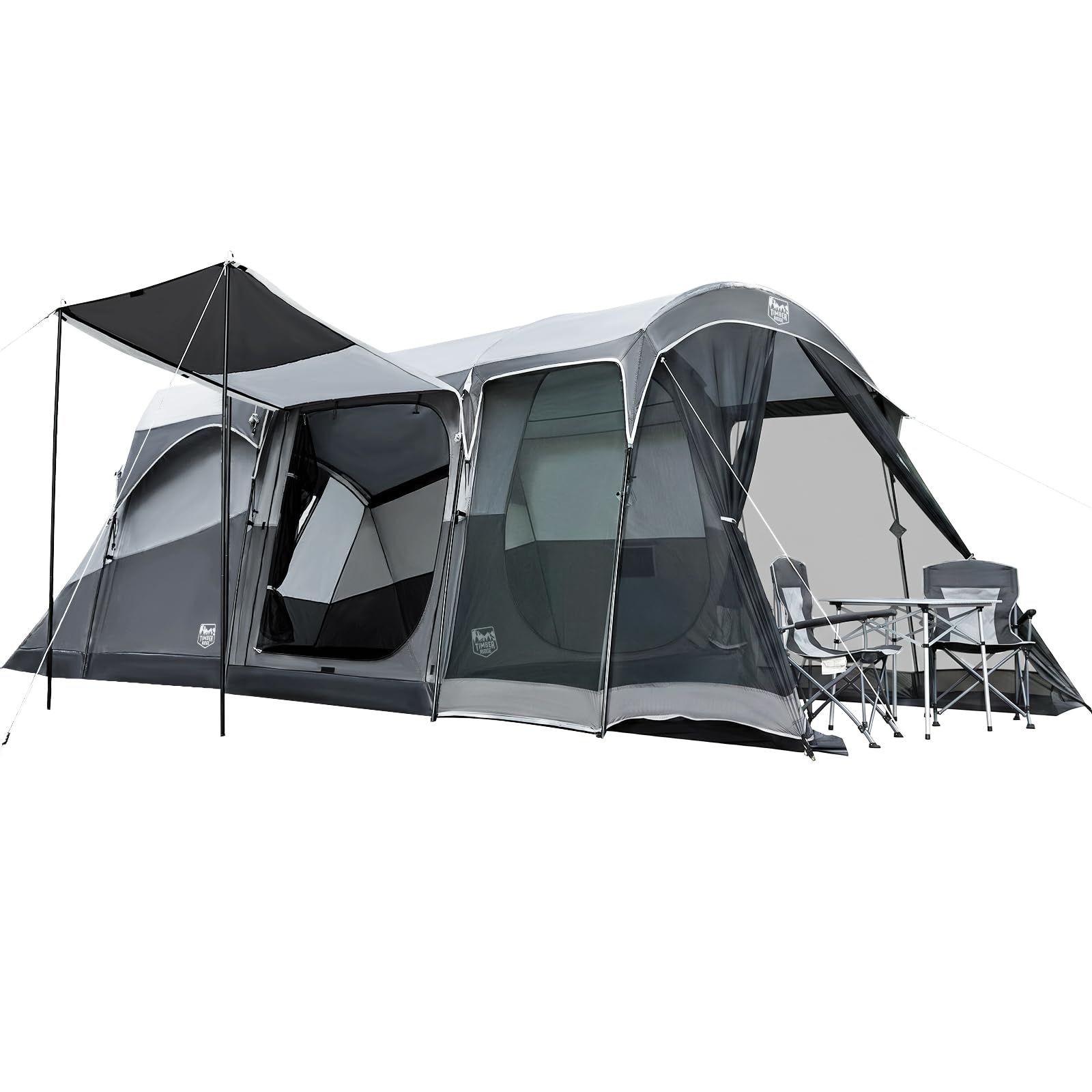
Length is this tent’s calling card. At 20 feet long and 8 feet wide, it stretches to 160 square feet of floor and a 76-inch center height — enough to walk in the middle, and long enough that the front door feels like a proper entryway. That 20-foot run beats the PORTAL instant cabin’s 14 feet, giving you more front-to-back room to arrange cots in a line.
Ease of pitching is what owners talk about most, and the numbers back it: color-coded poles and illustrated instructions get two people set up in about 15 minutes. A removable rainfly and a wind-resistant tunnel shape handle changing weather, while the full mesh ceiling, windows, and doors create cross-ventilation you can open up at night to stargaze. There is a built-in E-port for power and pockets for phones and lights, and the whole thing packs into a large carry bag at 32 pounds.
Two things come up honestly. The zippers draw real criticism — they can catch on the cover and get hard to operate — and durability feedback is mixed, with reports of rips at the bottom and holes near seams and folds. This is a favorite for car camping rather than a rough-terrain tent, so choose grassy and forested sites and add a groundsheet to protect the floor.
What sets it up fast: Color-coded poles and printed instructions mean a 15-minute, two-person pitch on a long 20-foot frame.
Handle with care: The zippers and the thin floor are the weak links, so site selection and a groundsheet go a long way.
Suits the road-tripper: Anyone who drives to a site, wants a huge front door, and values a quick pitch over backcountry toughness.
Think twice if: You expect years of hard use on rocky ground — the seams and zippers want gentler treatment.
4. PORTAL Family Tunnel Tent

A 20-foot tunnel with a 6 by 8 foot bug-screened room bolted to the front.
The layout is the whole pitch here: a 20 by 8 foot tunnel, an 80-inch center height so you stand and move without bending, and a 6 by 8 foot front screen room for shoes, chairs, pets, or a quiet sit-down away from the bugs. The screen room is open-floor, so it keeps the sleeping side organized instead of tracking grit inside. That 80-inch ceiling clears the TIMBER RIDGE tunnel’s 76 inches.
Quality and assembly are the two things that carry the most praise, and the numbers reflect a settled, well-liked tent. It is rated for up to 8 people, though the maker’s own guidance is 4–5 campers with gear or two queen air mattresses for a comfortable trip. Fabric is 66D with a removable rainfly, guy lines, and stake points for a three-season setup — not built for severe weather. The whole shell is PFAS-free polyester, for anyone trying to avoid those compounds.
The porch aside, durability is the mixed note: some buyers report poles breaking and tents that did not survive a first night, while others find it sturdy and steady. Water resistance splits the same way, with dry reports alongside accounts of seepage through the sides. Stake and guy it fully for stability, and this doubles nicely as a bug-free hangout spot on a mild night.
The case for this tunnel
- 6 by 8 foot screen room for gear, pets, or seating
- 80-inch center height and 20 by 8 foot floor
- PFAS-free 66D polyester shell
- Mesh ceiling and windows you can open for sky views
Where it asks for care
- Durability reports split between sturdy and short-lived
- Water resistance is mixed, so seal it and stake it well
- Three-season only — not for severe weather
For the porch lover: Pick this if a screened outdoor room is worth more to you than a second bedroom.
For mild-weather campers: skip it if you camp in harsh storms, where the mixed water reports matter most.
5. EVER ADVANCED Blackout 6 Person Tent

A tent that blocks 90% of the light so sunrise stops running your schedule.
If your tent mornings begin before you want them to, this is the answer. The outer shell carries a blackout coating that blocks 90% of light, so a bright summer dawn does not force you awake — as owners put it, you can sleep any time without harsh sunlight cutting in. It also keeps your space private from the outside. The 77-inch center height is a notch below the 80-inch cabins here, but it still lets you stand in the middle.
The cabin measures 9.75 by 9 feet for 87.75 square feet of floor and sleeps 6, which owners say comfortably takes two double cots. Setup is the other big draw: the instant frame goes up in about 60 seconds, and the feedback trend is that it disappears just as fast when you leave. A vestibule adds shaded space or a spot for luggage and a pet, and it folds to 8.7 by 8.7 by 48.8 inches for the car.
The blackout coating is double-edged. Durability feedback is mixed — some report the blackout layer cracking and the center of the floor ripping — and airflow is a split verdict, with some finding it stays cool and others noting it gets warm inside. A dark shell traps heat, so on hot trips plan to vent it hard and pitch in shade. It holds 87.75 square feet, against the CORE straight-wall’s 176, so it favors sleep quality over floor space.
The light trick: 90% light blocking plus a 60-second instant frame make this the tent for late nights and lazy mornings.
Mind the warmth: The dark coating can heat up, so ventilate on summer trips.
The right fit: Anyone who values uninterrupted sleep over elbow room — the blackout shell is the reason to buy.
The wrong fit: Big families needing more than 87.75 square feet should size up.
6. Coleman Instant Camping Tent
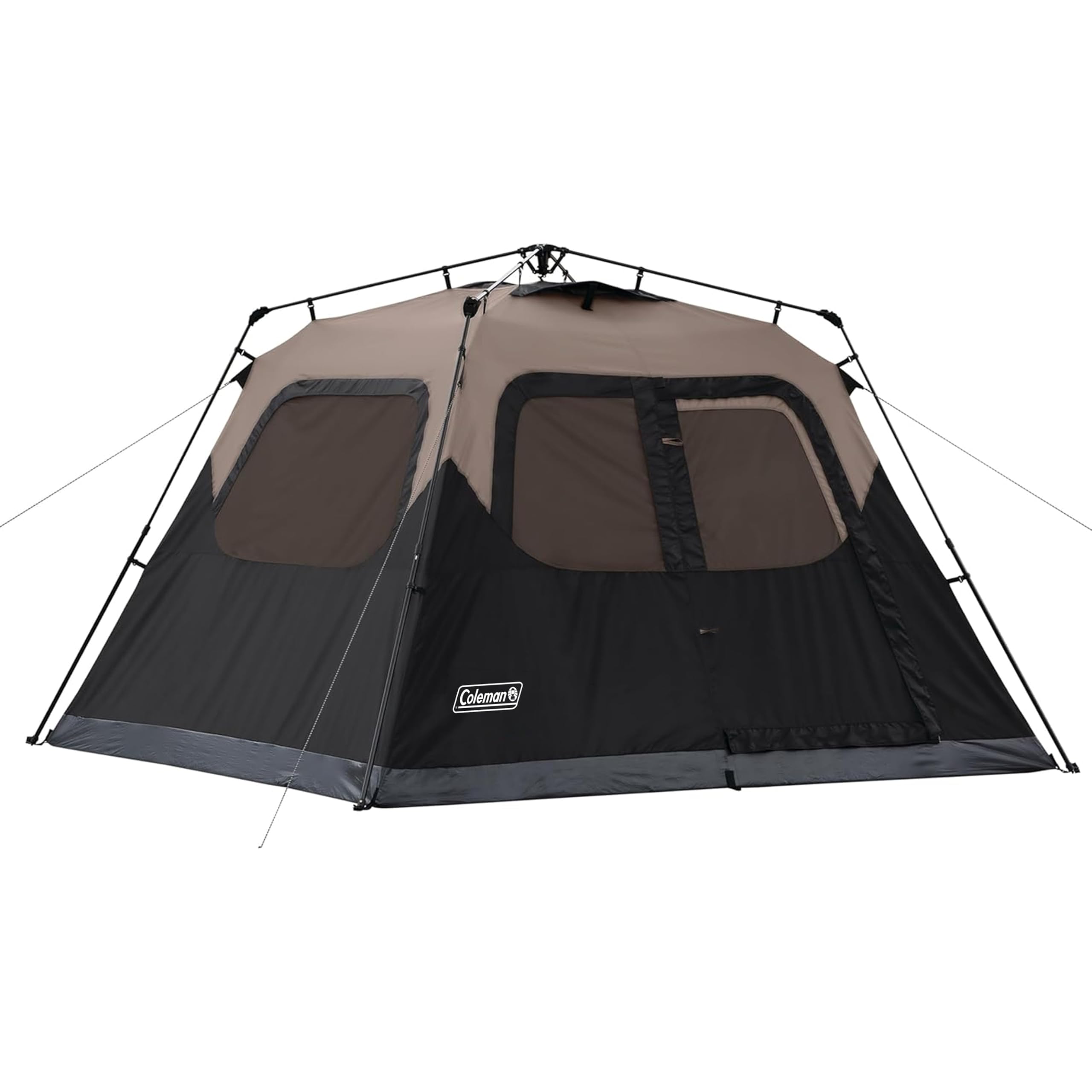
Ten by nine feet, six feet of standing height, and a frame that opens in a minute.
Speed is the headline. The instant frame stands up in as fast as 1 minute with no separate pole assembly — unfold, extend, secure. The floor is 10 by 9 feet at 90 square feet, the center height hits 6 feet so most adults stand in the middle, and it fits 2 queen-size air beds. WeatherTec welded corners and inverted seams work with an integrated rainfly and double-thick Polyguard 2X fabric to keep water out, and it carries a 1-year limited warranty.
Where this Coleman gives up ground to the taller cabins above is at the edges and in the wet. Six feet of center height is the low end of standing room, so you stoop near the walls. Feedback on water resistance is the weakest on this list, with reports of material soaking through in light rain and condensation forming on the sides and floor — so treat it as a fair-weather tent and seam-seal it before rainy trips. Durability is a mixed picture too, with some frames breaking during setup.
Its real value is the one-minute pitch for a quick weekend or a first-timer who does not want a wrestling match. Just budget for a tarp underneath and a dry forecast.
The one-minute win: The instant frame and 6-foot center height get you standing in your shelter before most tents are even half-assembled.
The wet-weather caveat: Water resistance is the soft spot here, so this one is for dry trips.
Grab it for: Quick dry-weather weekends where setup speed beats everything else.
Pass on rainy trips: If you camp in wet climates, the soaking reports make a different pick safer.
7. OneTigris Rock Fortress Hot Tent
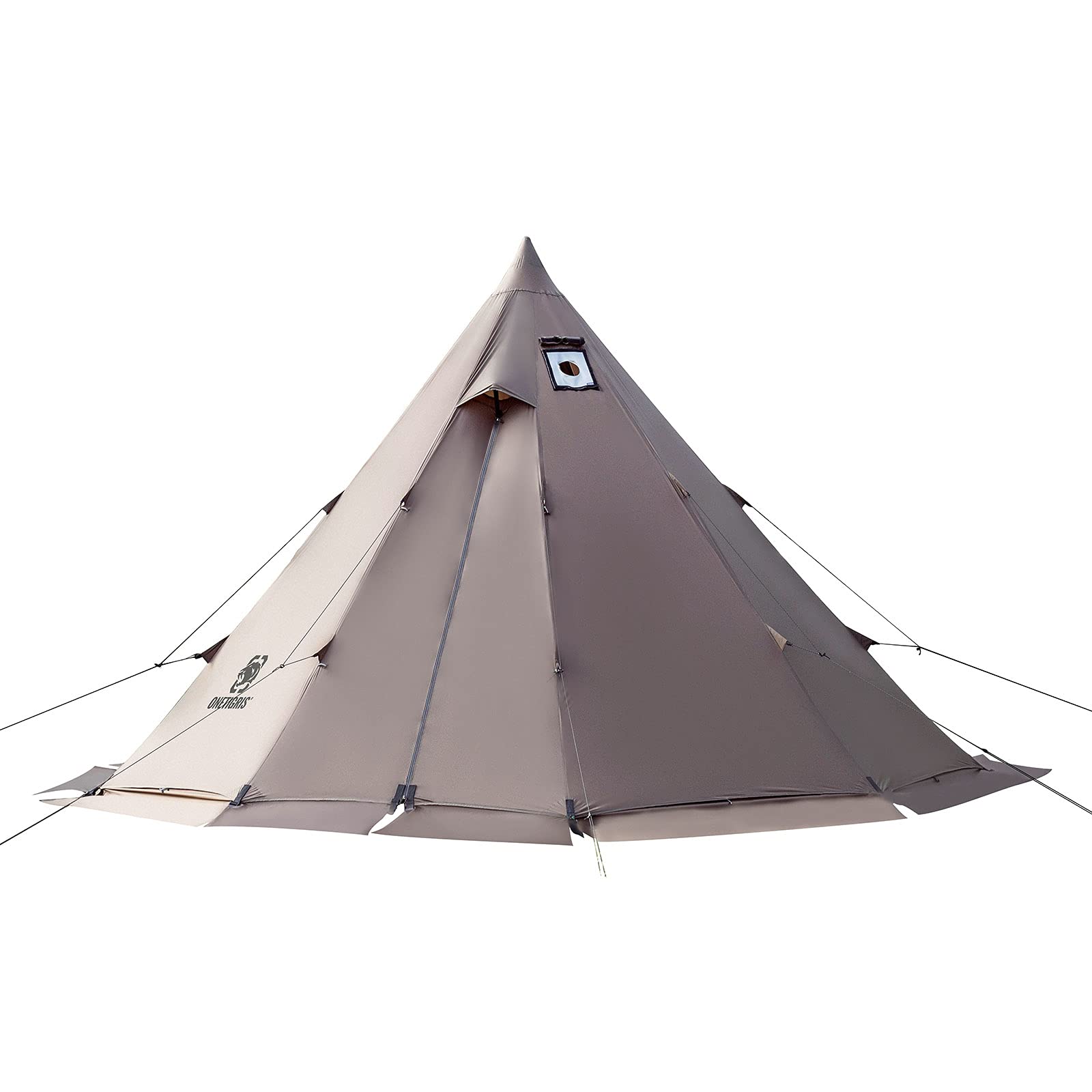
A 7.8-foot teepee with a stove jack, built for cold nights around a fire.
This is not a summer family cabin — it is a shelter for hunters, anglers, and winter campers. The teepee rises to 7.8 feet at the peak, measured on a 12.4-foot base diameter, so you can stand in the center and move comfortably. It runs 4 seasons with a stove jack for a wood-burning tent stove, and a wind-proof snow skirt that traps heat while the double-door design and foldable skirt open up for summer ventilation. The kit includes the pole, stove jacket, 24 pegs, and 10 guy lines, at 9.2 pounds packed.
What owners like most is the quality of the build, and the stove compatibility earns unreserved praise — it heats up fast and stays warm, holding against strong wind and heavy rain. Weather resistance and stove compatibility both come through as generous, and setup is straightforward with the included instructions. The nylon shell and polyethylene base keep it light for a shelter this tall.
The catch is footprint shape. A teepee tapers inward, so the 7.8-foot peak is only available dead center, and the 60.84 square feet of floor is the smallest here against the CORE straight-wall’s 176. Size feedback splits, with some finding room for two adults plus cots and gear and others finding it tighter than expected and the base wide to place. Ducking near the edges is part of the design, not a fault.
Why winter campers pick it
- Stove jack and snow skirt for cold-weather warmth
- 7.8-foot peak and 12.4-foot base for standing room
- Holds against strong wind and heavy rain
- 9.2 pounds packed with a full peg and guy-line kit
What to expect
- 60.84 square feet is the smallest floor here
- The taper limits headroom away from the center
- Reports of rips at the top seam
Built for the cold: Ideal for stove-users and winter hunters who want heat and wind protection over floor space.
Not for the crowd: If you need to bunk a large family, the small taped floor will not do it.
8. CORE Lighted Cabin Tent

Ceiling LEDs built into the poles, so camp lights are one less thing to pack.
The lighting is what makes this cabin memorable. LEDs are built into the ceiling poles with three levels — high, low, and a night light — flipped by a wall switch. That saves you fumbling for a lantern when the sun drops. The instant frame uses pre-attached poles that lock in place in 60 seconds or less, so you are set up almost as fast as the Coleman. The 11 by 9 foot floor gives 99 square feet with a 72-inch center height, fitting two queen air beds, or 3 people with gear and up to 6 without.
Quality and easy setup are the twin strengths that come through strongest, and the built-in lights are appreciated for their dimming. Weather protection is the familiar CORE package: H20 Block Technology on 1200mm fabric, a fully taped rainfly, sealed seams, and fully zipped windows, with guylines and steel stakes. Lower vents pull cool air in from the ground and the mesh ceiling lets hot air climb out. A hanging organizer keeps small gear off the floor.
The limitation is durability and, occasionally, the lights themselves — some units report seams opening at the ceiling and poles giving way in light wind, and a few find the LEDs do not work at all. Check the lights before your first trip and pitch it fully staked. At 72 inches it stands a bit lower than the 80-inch cabins, so a very tall camper wants to test the fit.
The light-up draw: Pole-integrated LEDs plus a 60-second instant frame make this the easiest cabin to use after dark.
The durability note: Seams and poles are the soft spot, so set it up sheltered from strong wind.
For the dark-pitched arrival: Perfect for late check-ins who want light the moment the frame is up.
Test before you travel: Confirm the LEDs work on arrival, since a few units ship with lighting faults.
9. Naturehike Village Instant Tent
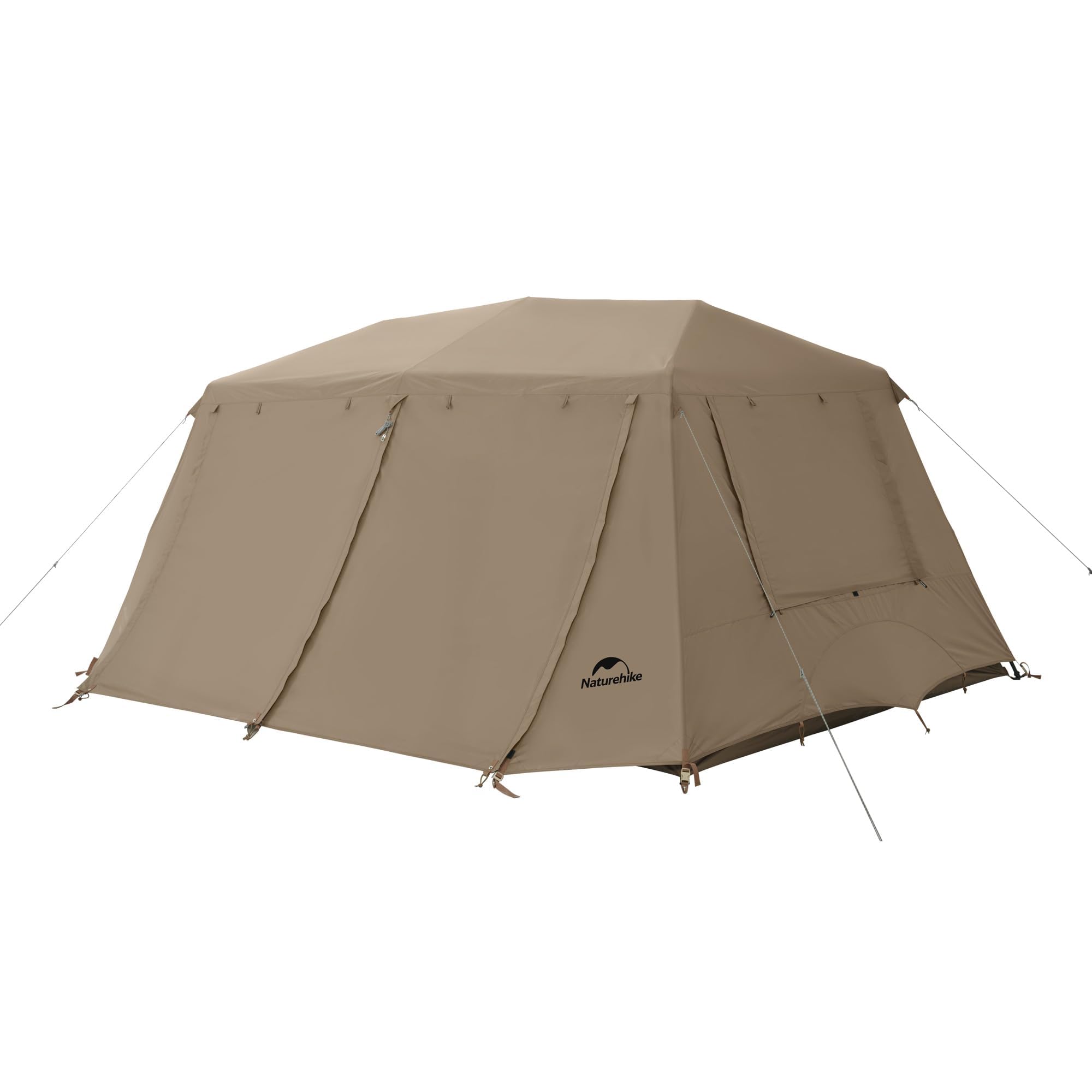
Blackout fabric, UPF 50+, and 72 inches of height for serious shut-eye.
Two things define this cabin: its fabric and its speed. The shell is 150D Ti Black Technology fabric rated UPF 50+ and 2000mm+ waterproof, and it blocks 99.9% of harmful UV. That darkout layer keeps the inside comfortably cooler than an ordinary blackout tent and much lighter to carry. The frame is instant — pre-attached poles and an automatic structure go up within 60 seconds. The 12.96 by 8.86 foot layout yields 140 square feet with a 72-inch center height, roomy for 4 with two air mattresses and up to 8 on ultralight pads.
The quality of the build is what people keep coming back to, and the five-sided ventilation — top windows plus four-sided windows — keeps the 360-degree view open while you stay inside. Blackout feedback is strong, with the tent going pitch black at night and blocking light from outside as well. It holds up well in higher winds and rain storms, and there are built-in USB lights you power from your own bank, plus an AC port for running a cable inside.
The trade-off runs to durability at the edges — corners can rip during setup and small tears appear near the floor, so take your time extending the frame. It is 140 square feet, against the CORE straight-wall’s 176, which buys you easier packing and a faster pitch. A 2-year limited warranty softens the durability risk.
The darkout cabin: UPF 50+ blackout fabric and a 60-second instant frame make this a genuinely cool, quick shelter.
The fragile edges: Corners and the floor are the wear points, so extend the frame carefully.
The fit: Anyone who wants blackout sleep and an instant pitch in one tall cabin.
The caution: Rough handling of the corners is where this one wears, so gentle setup matters.
10. Night Cat 8-Persons Hot Tent
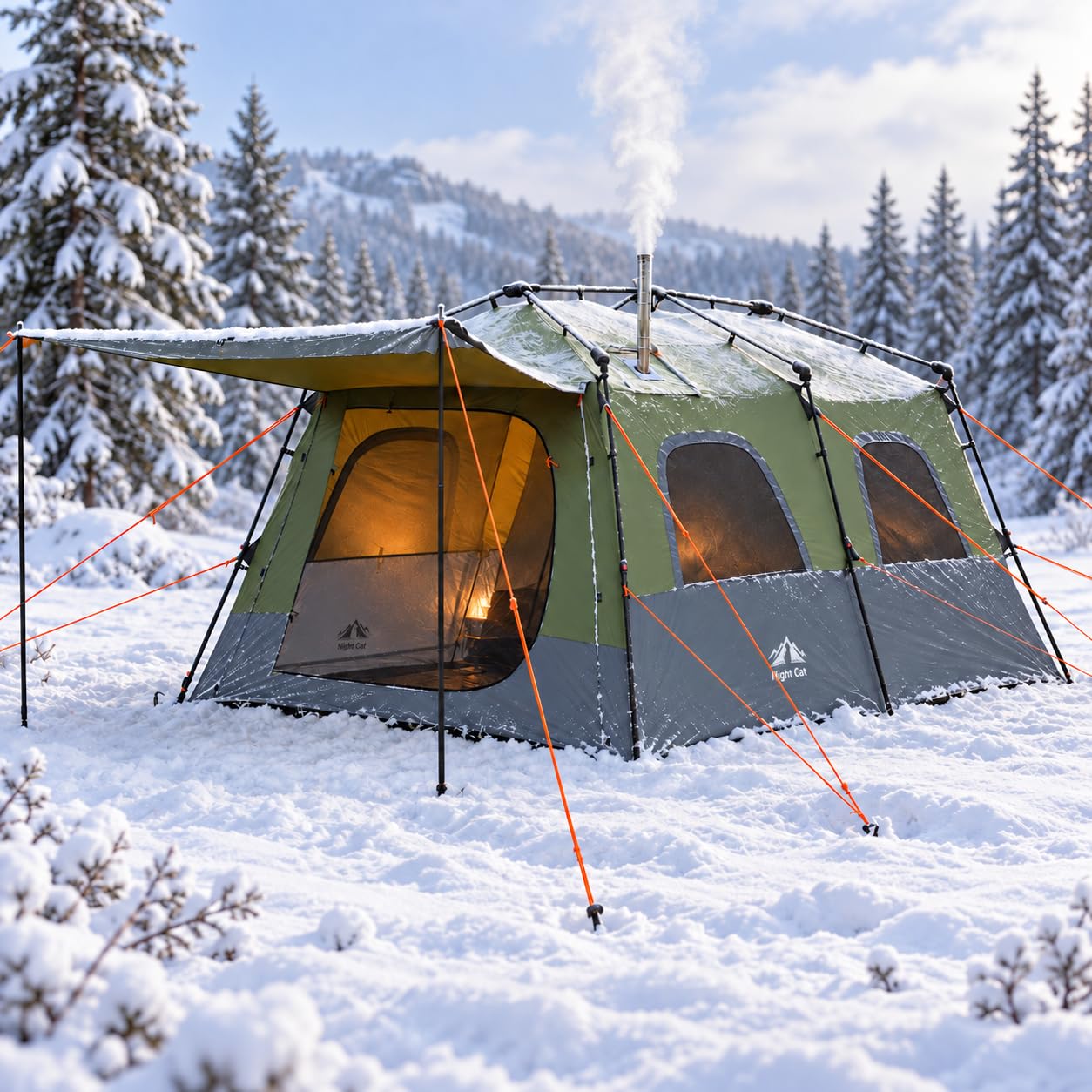
A four-person inner room plus a stove-ready vestibule that sleeps four more.
This is a one-room-one-living-room design. The fully enclosed inner tent sleeps 4, and the front vestibule converts to a stove-cooking or activity space or a second sleeping area for up to 4 more, for 8 sleepers total when conditions allow. It has an integrated stove jack with fire-retardant fabric around the stove area. The 14 by 8 foot overall layout and 80-inch peak height give you room to stand, move, and relax, with dual-layer mesh windows and triangular vents for airflow.
Setup runs about 5 minutes for two people with the straightforward pole structure, and the included carry bag makes packing easy. The inner tent has a waterproof floor and sealed seams to keep the sleeping area dry in rain, while the vestibule uses a removable groundsheet for flexible use. At 40 pounds it is a car-camping tent rather than a backpacking one — weigh that against the 9.2-pound OneTigris if you plan to carry it in.
The honest note is value. Feedback here is thin and splits, with some calling the price stellar and others feeling it is not worth the money. That makes it a buy-it-for-the-layout tent: if the inner-plus-vestibule split and stove jack match how your family camps, it earns its keep. If you only need a plain stand-up cabin, the basics here cost you weight and money for features you will not use.
Where the layout sings
- 4-person inner room plus a vestibule for up to 4 more
- Integrated stove jack with fire-retardant cloth around it
- 80-inch peak and 14 by 8 foot footprint
- Waterproof inner floor and sealed seams
Where to weigh it
- 40 pounds is a two-person lift, not a carry
- Value feedback is split
- Vestibule needs waterproof gear protection in rain
For the stove family: A smart pick when you want a sleeping room and a cooking room with heat in one shelter.
For the light camper: A plain cabin will save you weight and cost if you never use the stove.
11. Kodiak Canvas Cabin Lodge Stove-Ready Tent
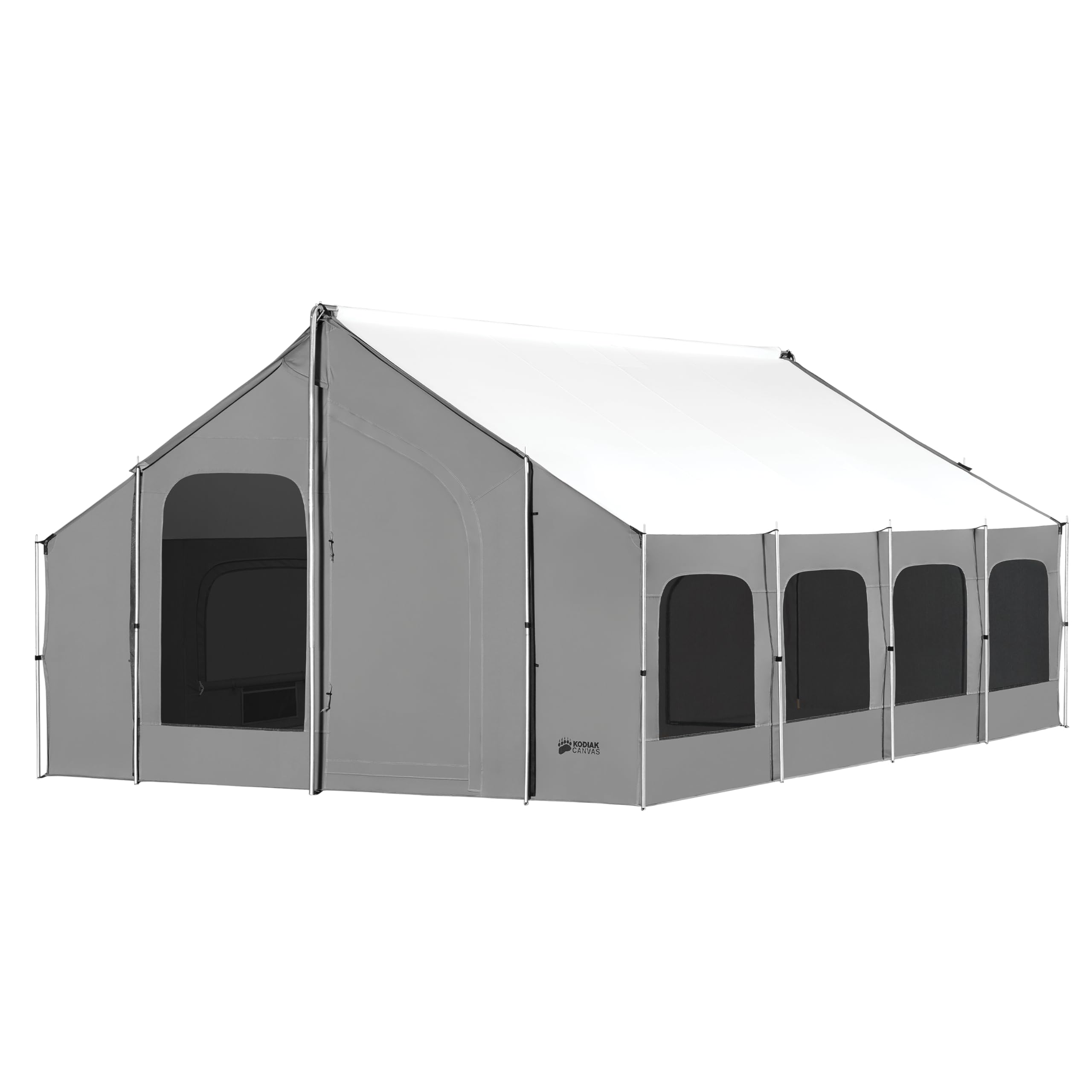
A cotton-canvas lodge with vertical walls, a 7.5-foot peak, and a stove jack.
This is the heavyweight — a 12 by 16 foot canvas lodge with a 7.5-foot peak ceiling and vertical walls that stand 4 feet at the sides. That vertical-wall design is what separates it from the tapered shapes, because the walls go straight up rather than sloping away, giving you walk-around space right out to the edges. The floor is 192 square feet, the largest here and bigger than the CORE straight-wall’s 176, and it sleeps up to 10 people, or 8 when using a stove.
The build is what owners rave about, and the canvas is the reason. It is Hydra-Shield 100% cotton duck canvas that is watertight yet breathable, which minimizes the condensation common to synthetic tents. The floor is a 13.5 oz vinyl sewn in with welded seams, staked with heavy-duty 12-inch steel rods. Nine large windows with no-see-um mesh, 2 vents, and 2 D-shaped doors handle ventilation. A 5-inch stove jack takes a wood stove for cold trips, sold separately.
The reality check is weight and time. Setup requires two adults and runs about 30 minutes, far longer than the instant cabins. It is canvas, so it is heavy and demands care to keep dry and clean between trips. But for a basecamp you return to season after season, the breathable Hydra-Shield shell and 192 square feet of floor are the reasons to accept the effort.
The basecamp anchor: Hydra-Shield canvas, vertical walls, and 192 square feet make this a long-haul shelter rather than a weekend pop-up.
The time cost: Half an hour and two adults to pitch, so it rewards the stay-long camper.
For the long-haul camper: Ideal for a fixed seasonal site where breathable canvas and space beat setup speed.
For the weekend mover: The 30-minute canvas pitch will feel like a chore if you break camp daily.
Know the Specs
Center Height and Peak Ceiling
Center height is the floor-to-peak distance in inches, and it is your stand-up number. At 72 inches you clear six feet in the middle but duck near the walls. At 80 inches and above you walk and stretch. The shape matters as much as the number: straight-wall cabins keep height out toward the edges, while teepees and tunnels taper, so their peak is only dead center. For a tall camper, the center height number matters more than the sleeper rating.
Floor Area and Sleeping Capacity
Floor area in square feet tells you the true usable space; the people rating is optimistic. A 176 square foot cabin reads 12-person, but it is comfortable for 6 with gear. A 60.84 square foot teepee sleeps 2 adults with cots. Subtract space for bags, cots, and a dog from the stated floor area, then pick the square footage that matches how you actually camp.
Fabric Coating and Waterproofing
The millimetre rating on fabric tells you how much water pressure the shell resists before it lets moisture through. The CORE tents use 1200mm H20 Block fabric and the Naturehike steps up to 2000mm+. Pair that with a fully taped rainfly, sealed seams, and zipped windows, and the tent stays dry through real rain. A removable rainfly lets you open the mesh for sky views and close it back for storms.
Stove Jacks and Four-Season Use
A stove jack is aheat-safe port in the tent wall where a wood-burning stove pipe passes through, letting you heat the shelter in cold weather. Both the OneTigris teepee and the Kodiak lodge use one, and the Night Cat adds fire-retardant fabric around its stove area. Stove sold separately on the listed models, and only use stoves rated for tent use with the pipe fully seated.
Common Questions
How tall does a tent need to be to stand up in?
Will a tall cabin tent fit in a car trunk?
What is the difference between a teepee tent and a cabin tent for standing room?
Can you use a wood stove inside a camping tent safely?
How many people does a 12-person tent really sleep?
Do blackout tents get too hot in summer?
How long does it take to set up a tall instant tent?
Is canvas better than synthetic fabric for a tall tent?
Should I add a groundsheet under a tall cabin tent?
What is a rainfly and do I always need it?
The Bottom Line
If standing up without ducking is the whole point of your search, the CORE Family Camping Straight Wall Cabin Tent is the one to buy. It pairs the tallest ceiling here at 86 inches with near-straight walls that carry that height out to the edges, and it holds the largest floor at 176 square feet — enough for 6 people plus gear. The mixed reports on fiberglass poles and the front zipper are the trade-off, but it is the most room to stand and move in on this list.
If you want a split floor plan and a porch more than maximum square footage, the PORTAL instant cabin gives you two private rooms under an 80-inch ceiling. For sleeping past sunrise, the EVER ADVANCED blackout cabin blocks 90% of light and pitches in 60 seconds. And if your camping runs cold, the OneTigris Rock Fortress adds a stove jack and a 7.8-foot teepee peak for heat in winter.
Here is the one nudge worth making: if you only remember a single number from this whole page, make it center height — check it against your own height, then check the floor area against how many people actually sleep inside. Match those two numbers to your height and your real sleeper count, and any pick above will serve you well.
How we choose
We do not accept paid placement. Every pick is matched to a real buyer and a real use-case; we do not hands-on test units.
Sources
Specifications: manufacturer listings and product documentation. Review insights: verified customer reviews, as of November 2026. Pricing: not shown on this page (it changes often); check the current price via the retailer link.
As an Amazon Associate, Tactical Gear Guy earns from qualifying purchases. This does not affect which products we feature.