Specs are compiled from manufacturer listings and verified buyer reviews and can change over time — please confirm the key details on the product page before buying.
A kinked copper line is wasted copper. The right tubing bender holds the tube round through a full 90-degree bend and lets you pump the handle one-handed in a joist bay. This guide covers eight ratcheting benders that HVAC techs and refrigeration installers actually use, with the die sizes, weights, and real trade-offs spelled out so you can pick once and stop shopping.
This guide is built by comparing the manufacturers’ published specifications and the patterns across verified customer reviews, so you get each pick’s real strengths and trade-offs instead of marketing spin.
Below you will find the picks ranked from the do-everything kits down to the lean single-purpose sets, plus what each die range really covers on soft copper, aluminum, and thin-wall steel. Every pick here has the die range, ratchet action, and case to survive daily work on a service truck.
Top Picks


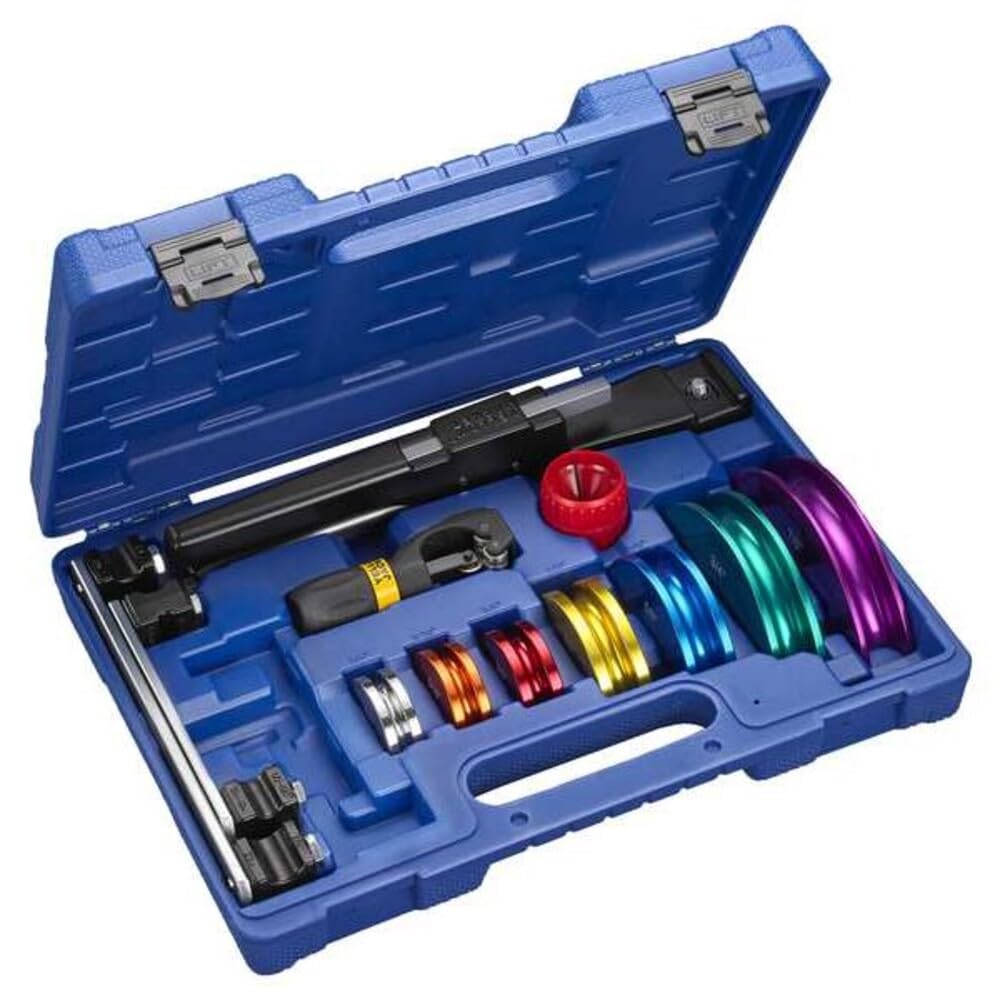
How To Choose The Best HVAC Tubing Bender
Most first-time buyers assume a bender is a bender and pick the cheapest seven-die kit on the shelf. Then they crush a 3/4″ line on a mini-split install and learn the real lesson: the tool has to match the tubing size, the metal softness, and the space you can reach. Here is what separates a bender that gets used every day from one that stays in the case.
Start with the die range, not the price tag
A die is the curved shoe that wraps the tube and sets the radius of the bend. If your die set stops at 5/8″ outer diameter (O.D. — the measurement across the outside of the pipe), it simply cannot form a clean bend on a 7/8″ line set. The kits here mostly cover 1/4″ through 7/8″ O.D., which handles the common residential and light commercial sizes. Check the smallest die too, because brake line and instrumentation work often lives down at 3/16″ to 1/4″.
Reverse bend earns its keep in tight ceilings
A reverse bend lets you form the curve with the handle pointing away from the wall instead of into it. In a joist bay or against a block wall, that is the difference between a finished run and a scrapped section of copper. If you bend against finished walls or inside tight mechanical rooms, buy a kit with the reverse attachment.
Ratcheting versus plain lever
A ratcheting mechanism (a toothed pawl that grabs and releases as you pump the handle) lets you bend in short strokes instead of one long heave. That means one-handed operation in a confined space and far less hand strain over a full day. Longer handles add leverage, which matters most on the stiffer thin-wall stainless and steel tubing. Soft copper bends easily on almost anything; hard tubing is where the ratchet and the handle length prove themselves.
Weight, case, and the stuff that gets lost
These kits run from roughly 8.66 pounds to 11.22 pounds, which is the difference between a case you carry up a ladder without thinking and one you leave in the van. A molded case keeps seven loose dies and a crossbar from scattering across a job site. Also look at what ships in the box: a tube cutter and a deburring tool (the reamer that smooths the cut edge) save you a second trip to the truck.
Side-by-Side Comparison
| Model | Best For | Die Range | Reverse Bend | Weight | Amazon |
|---|---|---|---|---|---|
| CPS BLACKMAX BTB300★ Best Overall | All-around pro pick | 1/4″–7/8″ (7 sizes) | Yes | — | Amazon |
| Hilmor CBKRB Compact Bender KitTight-Space Pick | Tight-space one-handed work | 1/4″–7/8″ (7 sizes) | Yes | 10.4 lb | Amazon |
| Yellow Jacket 63331Premium Pick | Consistent bends, pro brand | — | — | 9.39 lb | Amazon |
| Super Stars Tubing Bender Kit | Hard and soft tubing | 1/4″–7/8″ (7 sizes) | Yes | 10.89 lb | Amazon |
| VEVOR Pipe Tube Bender | Best value full kit | 1/4″–7/8″ (7 dies) | Yes | 10.7 lb | Amazon |
| Ratcheting Tube Bender Kit (Wostore 1512) | Occasional light duty | 1/4″–7/8″ (7 heads) | No | 8.66 lb | Amazon |
| 15PCS Copper Pipe Bender Tool Set | Full starter kit | 1/4″–7/8″ (7 heads) | Yes | 11.22 lb | Amazon |
| Imperial Tool 470FH Triple Head | Small-diameter line work | 3/16″–3/8″ | No | 0.6 kg | Amazon |
Detailed Reviews
1. CPS BLACKMAX BTB300 Premium Ratcheting Tube Bender
Our pick — 4.5+★ from 800+ verified ratings; the strongest balance of quality and price.
Seven color-coded mandrels and a reverse bend, in one compact body.
If you bend soft copper and aluminum tube for a living, the BTB300 is the one to beat. It carries seven quick-change mandrels (the curved forming shoes) for 1/4″ through 7/8″ O.D. tube, color coded so you grab the right size without reading a spec sheet in a dark mechanical room. The reverse bend function lets you form the curve with the handle swung away from a wall, which is what you need in a tight joist bay.
The patented compact body measures 12 inches long, so it drops into a tool bag instead of demanding its own shelf. It comes in a molded plastic carrying case that keeps the dies and crossbar together. The alloy steel body has a powder-coated black finish that shrugs off the usual scrapes and chemical drips.
What wins people over is the quality — it is the praise repeated most across owner feedback by a wide margin. Bends come out clean and the ratchet action is smooth enough for one-handed pumping. The honest catch is durability: a share of buyers report the mechanism giving out over time, so treat the tool as a precision instrument rather than something to drop off a ladder. The aluminum mandrels and metal dies also draw mixed comments on feel, though most are satisfied with how they form tube.
What earns the top spot
- Seven color-coded mandrels cover 1/4″ to 7/8″ O.D. tube in one compact body
- Reverse bend handles tight joist bays and finished walls
- Molded carrying case keeps the dies and crossbar organized
- Ratchet action rated smooth and easy for one-handed work
The honest trade-offs
- Durability is the most-mixed point — some units give out over heavy repeated use
- Aluminum mandrels feel lighter in hand than a full steel die set
Reach for this if: you want one compact kit that covers the full residential line-set range with a reverse bend for tight spaces.
Look elsewhere if: you only bend the occasional line and prefer to spend less — a leaner single-purpose set will do fine.
2. Hilmor Compact Bender Kit with Reverse Bending Attachment
A compact body that fits where full-size benders simply won’t reach.
The Hilmor earns its spot on reach and control. Its proprietary design is built to fit into places other benders can’t get into, without giving up the quality of the finished bend. You get mandrels for 1/4″, 5/16″, 3/8″, 1/2″, 5/8″, 3/4″, and 7/8″ tube, plus a reverse bending attachment for work where the handle has to swing away from the surface.
Setup is a sequence you can do half-asleep: set the universal crossbar and color-coded mandrel on the handle, snap it into place, click the pumping lever into the ready position, and lay the tube between the bar and mandrel. Pump the lever up to 90 degrees, then press the release trigger above the lever to retract the mandrel and free the tube. That release trigger is the standout — it eases the tube out without marking the copper.
Owners rave most about the overall quality, with the bending ability close behind. The metal construction wins consistent approval — the body feels like tool steel, not plastic, and the whole kit weighs 10.4 pounds. The recurring gripe is durability: a minority report the tool breaking under use. Sized against the bulk of happy owners, that reads as a caution to pump smoothly rather than horse the lever. Set against the CPS above, it is the more space-friendly body of the two.
Where it wins: the release trigger and compact body make this the pick for finished walls, joist bays, and any bend where the handle fights the surface.
Where to be careful: pump the lever in smooth strokes and treat the mechanism gently — a minority of units fail with heavy-handed use.
Your call: this is the tool for anyone who keeps running into fixtures that block a full-size bender.
Worth knowing: it weighs 10.4 pounds in the kit — noticeable on a ladder carry if you are used to a lighter bag.
3. Yellow Jacket 63331 Alloy Ratchet Tube Bender Kit
Ball-dent mandrel mounts that lock in once and stay put for repeat bends.
Yellow Jacket built its name in refrigeration tooling, and the 63331 carries that reputation into a hand bender. The design promise here is simple and specific: smooth, consistent bends every time. The mandrel attachments snap in with a ball-dent feature — a small dimple that locks the die firmly onto the handle — so the die does not shift mid-pump and throw your angle off.
It weighs 9.39 pounds, making it the lighter of the premium picks. That matters if you carry it up a ladder alongside gauges and a recovery machine. Consistency is the whole sell: for a refrigeration tech making the same bend ten times a day, a die that locks the same way every time beats a flashier feature set.
What earns the most praise is outright quality — the kit reads as one of the better ratchet benders available. Functionality follows close behind, with owners describing it as working great. Value for money is the one mixed note: some are delighted, others less so, which is normal for a premium-priced professional tool. Compared with the CPS above, it trades the seven-die color coding for a simpler, locked-in feel.
The core appeal: repeatable, consistent bends from a ball-dent mandrel mount that holds its position.
The trade-off to weigh: value is judged mixed by owners, so buy it for the consistency rather than on cost grounds.
Best suited to: refrigeration and HVAC pros who bend the same sizes repeatedly and need the same round result every time.
Not for you if: you are outfitting a van on a tight budget and would rather put the savings into tubing.
4. Super Stars Tubing Bender Kit 1/4in-7/8in Ratchet

A two-stage design that pushes past 90 degrees without crossing handles.
Most ratchet benders stop at 90 degrees. The Super Stars kit has a two-stage design that reaches from 90 degrees to 180 degrees without ever crossing the handles — the trick that makes a tight U-bend possible without your knuckles meeting. It handles both hard and soft tubing, including copper, stainless steel, steel, and titanium, up to that 90-degree maximum on the main range.
Seven interchangeable heads cover 1/4″, 5/16″, 3/8″, 1/2″, 5/8″, 3/4″, and 7/8″ tube. The ratchet mechanism plus an innovative release lever let you bend with one hand, and the compact body fits into confined spaces. It weighs 10.89 pounds in the kit, so it is a truck tool rather than a pocket carry.
Quality is the thing owners praise most, with functionality right behind it. Bending performance is the mixed note — a few report the bend not landing as cleanly as they hoped, which tends to track with stiffer stainless and steel rather than soft copper. For soft copper line sets it does the work. For the price point it sits between the bulk value pick below and the premium tier above.
Why it stands out
- Two-stage design reaches 90° to 180° without crossing handles
- Handles hard tubing — copper, stainless steel, steel, and titanium
- Release lever and ratchet allow one-handed bending in tight spaces
- Seven heads cover 1/4″ to 7/8″ tube sizes
Points to weigh
- Bending results are mixed on stiffer steel and stainless tubing
- 10.89 pounds in the kit — a solid carry, not a light one
Pick this when: your work runs to U-bends and past-90-degree shapes on hard line.
Pass if: you only bend soft copper to 90 degrees — a simpler kit covers that for less.
5. VEVOR Pipe Tube Bender 1/4″-7/8″ O.D. 7 Dies

Seven dies, a cutter, a reamer, and a reverse attachment in one case.
For the money, this VEVOR kit is the value leader of the group. You get seven interchangeable bending dies spanning 1/4″, 5/16″, 3/8″, 1/2″, 5/8″, 3/4″, and 7/8″ tube, plus a bearing-type pipe cutter, a deburring tool, and an inner/outer reamer. That is a full job in one case — no second trip around the truck for a deburring tool.
The reverse bending tool lets you bend in forward and reverse configurations for hard-to-reach spots. The extra-long handle boosts leverage and cuts hand fatigue, and the compact body still allows one-handed bending in narrow spaces. It handles soft copper and aluminum pipe up to 90 degrees. It weighs 10.7 pounds, within a couple of ounces of the 15-piece kit above at 11.22 pounds but noticeably lighter in the hand than its bulk suggests.
Functionality is what owners praise most — it works very well, full stop. Quality follows as a close second, and value gets strong marks too. The honest caveat is that bending performance splits: some make clean 90-degree bends with ease, while others find the bend does not stay perfectly round. Durability and kink resistance also land mixed. For soft copper line sets in a residential setting, it does the job most of the time. The replaceable wheels and support blocks are a genuine plus — you can service it rather than replace it.
The value case: seven dies plus a cutter, reamer, and reverse attachment in one case, with replaceable wear parts.
The honest limit: kink resistance and durability are mixed, so go slow on 7/8″ and stiff material rather than pushing through a hard bend.
Ideal for: the tech or serious DIYer who wants a complete kit that covers the full range without a premium-tier spend.
Think twice if: you bend thin-wall stainless daily and need repeated perfect-round results.
6. Ratcheting Tube Bender Kit (Wostore 1512)
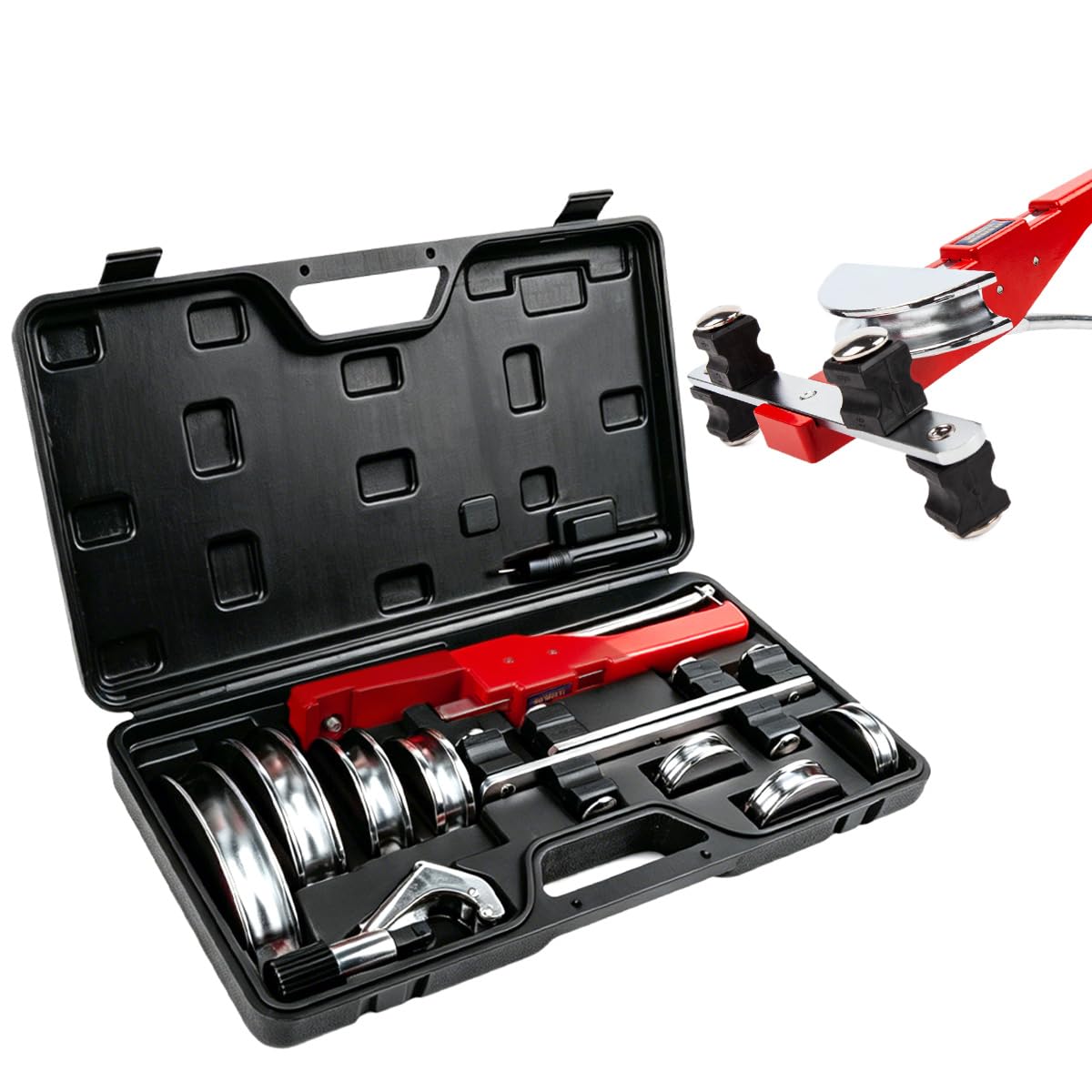
The lightest kit here, built for occasional jobs and light line work.
At 8.66 pounds, this Wostore kit is the lightest of all eight — a real point in its favor if the bender rides in a small service bag rather than a full van. Seven aluminum alloy heads fit 1/4″, 5/16″, 3/8″, 1/2″, 5/8″, 3/4″, and 7/8″ O.D. tubing (6, 8, 10, 12, 16, 19, and 22mm), and the solid alloy construction is built to resist damage and prevent tube deformation.
You get the bender, a pipe cutter sized 1/8″ to 1-1/8″ O.D. (3–28mm), a deburring tool with an extra blade, two fixed supports, the seven heads, and a hard blow-molded ABS case that keeps it all together. The pro ratchet system bends soft copper, aluminum, and thin-walled steel to 90 degrees. The extra-long handle adds leverage to cut the effort. One note: this version ships without the reverse tool, so it is for forward bends only.
Owners praise the functionality most, with value close behind — it works well for the money. The honest limits show up on 90-degree work: some find it will not reach a clean 90 without kinking, and a few describe it as a pain to operate. Durability is the weak spot — a share report it breaking quickly. That lines up with a light-duty design, so treat it as the occasional-use tool rather than the one you reach for on a full install day.
Strongest angle: the lightest kit in this lineup at 8.66 pounds, with a cutter and deburrer in the case.
The fair caveat: no reverse tool, and reaching a clean 90° on stiffer tube is where buyers most often struggle.
Suits you if: you bend the odd soft-copper line and want a complete, light kit without heavy spend.
Steer away if: you need reverse bends or you are on new installs where the bender gets used all day.
7. 15PCS Copper Pipe Bender Tool Set for 1/4″-7/8″ O.D.
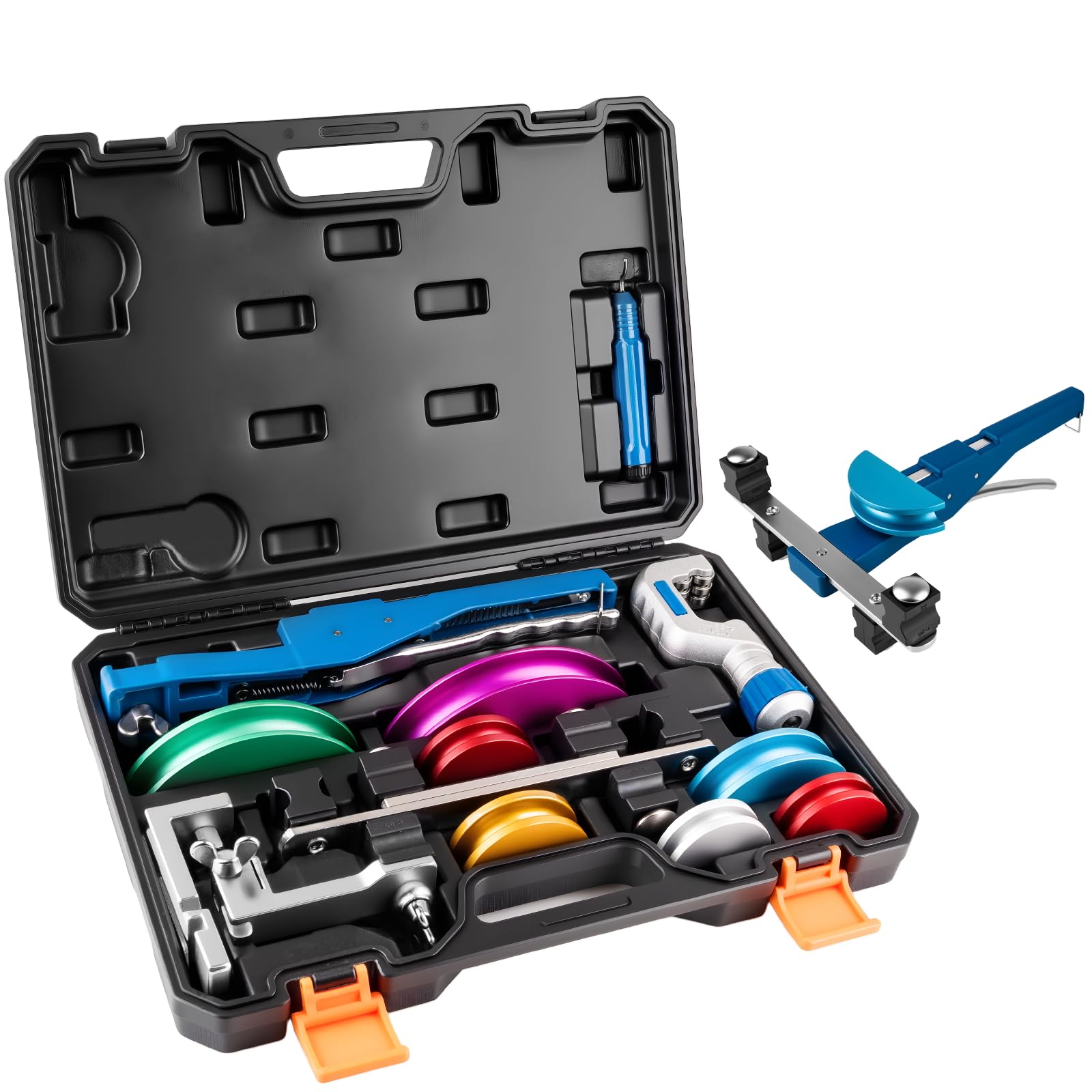
Fifteen pieces, seven heads, and a reverse adapter for a full tool roll.
This is the biggest box in the group: 15 pieces covering the bender, seven colorful aluminum alloy bending heads for 1/4″ to 7/8″ pipe, a tube cutter, a deburring tool, two reverse bender adapters, two universal crossbars, and a rigid storage case. The reverse adapters let you bend up to 90 degrees in forward or reverse to get into tight spaces.
The extra-long handle adds leverage to reduce hand strain, and the smooth ratchet allows controlled one-handed bending in confined areas. It handles soft copper, aluminum, thin-walled stainless steel, and PVC. For stiffer material, the maker notes the tubing may need warming before bending. The whole kit weighs 11.22 pounds — the heaviest here, a case you feel on a long carry.
Where it wins people over is functionality — it works great for the money, and value gets full approval. Quality gets mixed feedback, and durability is the concern: a share report the ratchet mechanism failing on first use. Bending performance also splits, with some getting the bend they needed and others struggling with 3/4″ copper. For light DIY and occasional repairs it fits the bill. For daily pro use, the premium picks above are the safer bet.
What you get in the box
- 15 pieces including cutter, deburring tool, and two reverse adapters
- Seven color-coded heads span 1/4″ to 7/8″ pipe
- Smooth ratchet supports one-handed bending in tight spots
- Handles soft copper, aluminum, thin-wall stainless, and PVC
Where it falls short
- Durability is the concern — the ratchet can fail on first use
- Bending 3/4″ copper is where users most often struggle
- 11.22 pounds, the heaviest kit in the lineup
Good fit for: a DIYer or apprentice who wants every accessory in one case to learn on.
Not the one for: daily install duty where the ratchet has to survive heavy repetitive bending.
8. Imperial Tool 470FH Triple Head 180 Degree Tube Bender

A light triple-head lever built for brake lines and small-diameter tube.
This one plays a different game. The Imperial 470FH bends 1/4″, 5/16″, and 3/8″ O.D. tubing, and you use the 1/4″ slot for 3/16″ tube. It is a compact lever style rather than a ratchet, in a lightweight die-cast aluminum body with cushion grips. At 0.6 kg, it is by far the lightest tool here — the one you tuck in a drawer for brake-line and instrumentation work.
The patented Roto-Lok indexing lever is the headline: it lets you make smooth, tight 180-degree bends with less effort and better control. Calibrated markings help you nail left-hand, right-hand, and offset bends without guesswork, and the adjustable hook keeps the tube seated. It bends soft copper, brass, aluminum, and thin-wall stainless steel — four common materials with one tool.
Quality is what owners praise most, and it works well for line work in particular — an area where buyers are fully satisfied. The honest catch is the 3/16″ claim: some report it does not bend 3/16″ tubing as advertised, so count on the 1/4″ slot for that size. Durability and value both split, with a few finding it less sturdy than expected. It is not a substitute for a full 1/4″–7/8″ kit — it is the specialist you add alongside one.
Why it earns a slot: 180-degree Roto-Lok bends on a 0.6 kg die-cast aluminum lever, with calibrated markings for offsets.
The catch to plan around: some find the 3/16″ capacity overstated — use the 1/4″ slot for that tube size.
Best for: brake-line, instrumentation, and small-diameter work where a featherweight lever beats a bulky ratchet.
skip it if: you need to bend anything above 3/8″ — this one stops well short of a full line-set kit.
Know the Specs
Die Range and O.D. Sizing
The die range is the set of tube sizes a bender can form — usually written in outer diameter (O.D., the measurement across the outside of the pipe). A 1/4″–7/8″ range covers most residential and light commercial line sets. A bender that stops at 3/8″ is a small-line specialist, not a full kit. Match the range to the tube you actually bend, because a die cannot form a size it does not come in.
Ratchet vs. Plain Lever
A ratchet uses a toothed pawl that grabs and releases in short strokes, so you can bend one-handed and in confined spaces. A plain lever, like the Imperial triple-head, forms the bend in one motion and is lighter and simpler. Ratchets suit full install days; levers suit occasional and small-diameter work.
Bend Radius and Kinking
Every die sets a fixed radius — a tighter radius means a sharper bend and more stress on the tube wall. Soft copper follows the die easily; thin-wall stainless and steel resist and can kink. Warming stiffer tubing before bending, as the maker of the 15-piece kit notes, helps the metal flow instead of collapsing.
Reverse Bend and Reach
A reverse attachment bends the tube with the handle swung away from the surface, which is what you need against a wall or in a joist bay. Kits without a reverse tool are forward-only — fine in open space, awkward in tight ceilings. If you bend against finished walls, buy a kit with a reverse attachment.
Common Questions
Will a 1/4″ to 7/8″ bender handle a mini-split line set?
Can I bend 3/16″ brake line with the Imperial 470FH?
What is a reverse bend and do I really need one?
Will these benders work on stainless steel and hard tubing?
How do I stop the tubing from kinking at 90 degrees?
Is a ratcheting bender better than a plain lever bender?
What is the difference between the CPS BTB300 and the Hilmor compact kit?
Do these kits come with a tube cutter and deburring tool?
How much does a tubing bender weigh, and does it matter?
Can I bend PVC pipe with these benders?
The Bottom Line
For most HVAC work, the winner is the CPS BLACKMAX BTB300 — seven color-coded mandrels across 1/4″ to 7/8″, a reverse bend for tight bays, and a 12-inch body that fits a tool bag. If you need to reach places a full-size bender can’t, the Hilmor compact kit wins on space and its release trigger. And for brake lines and small-diameter tube, the featherweight Imperial 470FH is the one to keep in the drawer. If you want the full kit at a value price, the VEVOR seven-die set earns its case with a cutter, reamer, and reverse attachment in one box.
How we choose
We do not accept paid placement. Every pick is matched to a real buyer and a real use-case; we do not hands-on test units.
Sources
Specifications: manufacturer listings and product documentation. Review insights: verified customer reviews, as of November 2026. Pricing: not shown on this page (it changes often); check the current price via the retailer link.
As an Amazon Associate, Tactical Gear Guy earns from qualifying purchases. This does not affect which products we feature.