Specs are compiled from manufacturer listings and verified buyer reviews and can change over time — please confirm the key details on the product page before buying.
You want the tiny hairs on a bee’s back, the engraving on a wedding ring, or a coin’s mint mark — all from the phone already in your pocket. A macro lens gets you that close-up, and the difference between a blurry grey smudge and a sharp, frame-filling shot usually depends on one thing: how far the lens sits from your subject. Too close and you scare the insect off or block your own light. Too far and nothing is in focus. The picks below cover a wide spread of shooting distances and magnification strengths, so you can choose the one that matches what you actually photograph.
This guide is built by comparing the manufacturers’ published specifications and the patterns across verified customer reviews, so you get each pick’s real strengths and trade-offs instead of marketing spin.
A clip-on glass element turns your everyday handset into a close-up tool, and the seven options here span 10x to 15x magnification, 0.8-inch to 110mm working distances, and clip, clamp, or 17mm thread mounts. The right pick hinges on your subject, your phone, and how much control you want — the essentials of a phone macro lens laid out for you below.
Top Picks

How To Choose The Best Phone Macro Lens
Most people buy a macro lens expecting to get closer to a subject. The truth is the opposite problem: these lenses force you into a fixed, very short range, and your job is to find one whose range you can actually live with. Nail the working distance and glass quality, mount style, and magnification become secondary.
Start With Working Distance, Not Magnification
Magnification tells you how big the subject appears. Working distance tells you how far the lens must sit from that subject to focus. A 15x lens often needs to sit under an inch away, which is fine for a coin on a table but hopeless for a live butterfly. A lens with a longer range — the Kase reaches 40-85mm — lets you stay back far enough that your subject does not bolt. Decide which matters more for your subjects before you compare power numbers.
Clip, Clamp, or 17mm Thread
A spring clip grabs the phone body and works with almost any handset, but it can slide and it often will not clear a thick case. A 37mm clamp tightens a threaded lens onto the phone with more grip. A 17mm thread mount screws the lens into a compatible case or cage for the most solid connection of the three, though it needs matching hardware. If you shoot often, the thread mount saves fiddling; if you shoot occasionally, a clip is simpler.
Glass, Coatings, and Element Count
More glass elements in more groups generally mean better correction of glare and ghosting. HD optical glass beats resin, and multi-layer coatings cut reflections that ruin a close-up. You will see specs like “2 elements in 2 groups” or “5 elements in 4 groups” — those numbers describe how much correction the lens designer built in.
Side-by-Side Comparison
| Model | Best For | Magnification | Shooting Distance | Mount | Amazon |
|---|---|---|---|---|---|
| NEEWER Basics LS-69★ Best Overall | All-round starter pick | 15x | 0.8″–1.6″ / 2–4 cm | 37mm clamp | Amazon |
| 4BLANC External Macro Lens KitBest for Nail Art | Nail art and texture work | — | — | Clip-on | Amazon |
| MARTVSEN 120MM Macro Lens | Jewelry and shine | 10x | 120mm focal | Universal clip | Amazon |
| Xenvo Pro Lens Kit | Macro plus wide-angle kit | 15x | ~1/2 inch | TruGrip clip | Amazon |
| APEXEL 100Ultra | Shooting insects at a distance | 10x | 50–110mm | Universal clip | Amazon |
| ULANZI CL-003 | Cage and case rigs | 10x | 45–90mm | 17mm thread | Amazon |
| Kase HD Master Macro | Skittish subjects, long reach | — | 40–85mm | 17mm thread + clip | Amazon |
Detailed Reviews
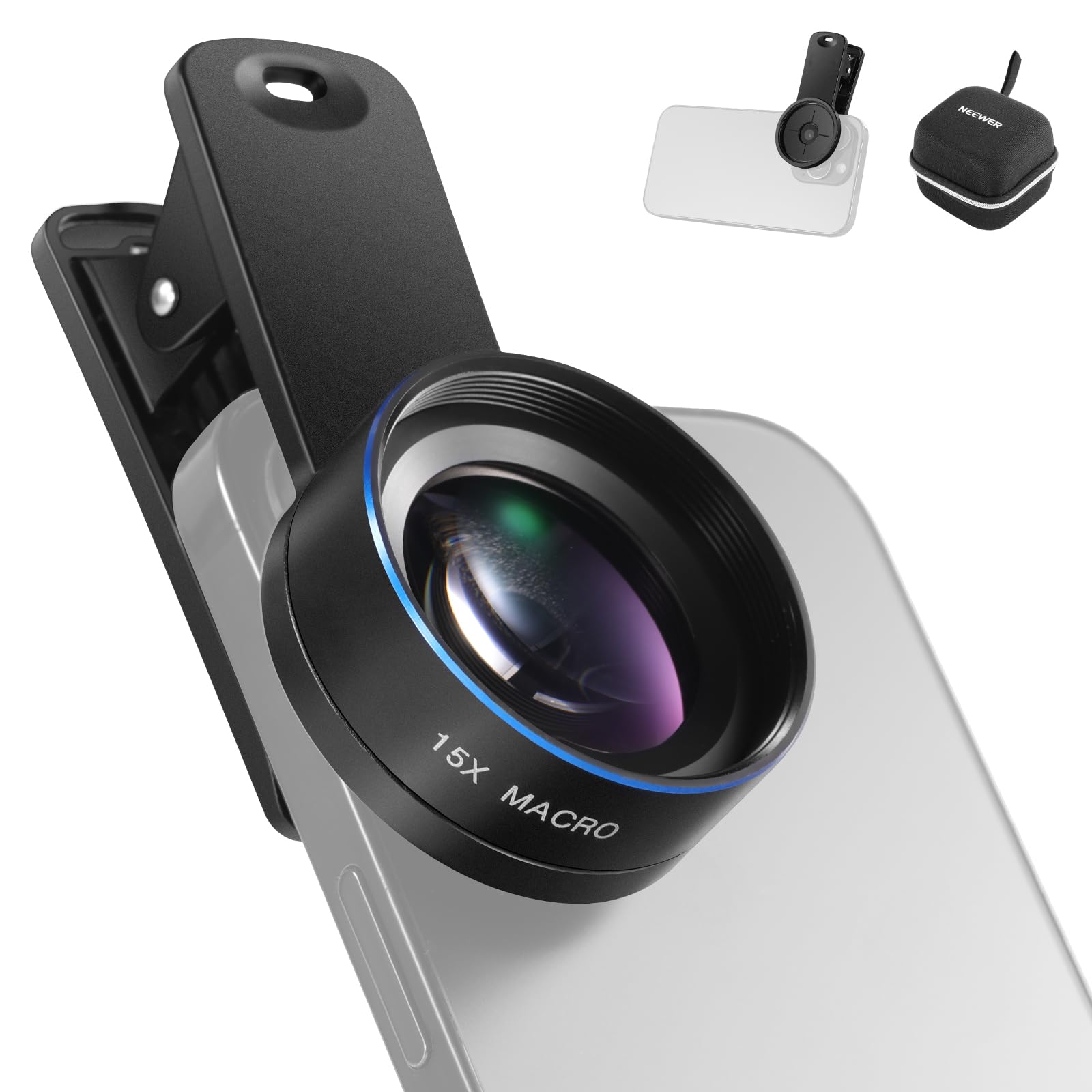
1. NEEWER Basics LS-69 15x Macro Phone Lens Kit
Our pick — 4.0+★ from 100+ verified ratings; the strongest balance of quality and price.
Fifteen times the detail from a lens that clamps on and stays put.
You get real glass quality without spending much. The lens pulls 15x magnification (your subject appears fifteen times its normal size on the frame) out of a 37mm threaded element (the screw-on ring that mounts it). That is enough to fill the picture with a coin’s date or the veins of a leaf. The working range is tight and honest: your subject sits 0.8″ to 1.6″ away (2 to 4 cm), so plan on a steady hand and good light. Compared with the 4BLANC’s 30mm figure, this one is built around that 37mm thread, which gives the clamp something solid to grip.
What wins people over here is the optics build — HD optical glass rather than resin, arranged as 2 elements in 2 groups to cut glare, reflections, and ghosting. That is the difference between a close-up that looks washed out and one with clean detail. The aluminum alloy shell survives being tossed in a bag and used outdoors, and the coating resists water, fingerprints, and scratches. A cleaning cloth ships in the box, along with front and back caps and a storage bag.
The 37mm clamp fits iPhones through recent models and Samsung Galaxy handsets, so it is not picky about your phone. The catch is vignetting — dark corners — which varies by phone. If you see it, the fix is built in: disable macro mode, tighten the lens, and set your camera zoom to 1.1X or higher. Expect a small learning curve while you dial that in, and remember this is fixed-focus, so the working distance is your only focus control.
What earns the top spot
- 15x magnification reveals fine detail on insects, jewelry, coins, and plants
- HD optical glass with 2 elements in 2 groups keeps glare and ghosting down
- 37mm clamp fits recent iPhone and Samsung Galaxy handsets
- Aluminum alloy body with water-, fingerprint-, and scratch-resistant coatings
Where it asks more of you
- Working distance of 0.8″–1.6″ means very close shooting
- Fixed focus gives you no autofocus safety net
- Vignetting can appear depending on your phone model
Reach for this if: you photograph coins, jewelry, plant detail, or still insects and want solid glass without overthinking the setup.
Think twice if: your subjects move — that 0.8″ minimum gap rules out anything skittish.
2. 4BLANC External Macro Lens Kit with Mount
Built for the salon bench, where surface texture is the whole story.
If your close-ups are manicures, polish layers, or the grain of a finished surface, this is your lens. It enlarges small and micro-objects and reveals material structures and surface textures, which is exactly the job for nail art photography. Its listed focal length is 30 millimeters, tighter than the NEEWER’s 37mm figure, giving it a slightly different framing feel for tabletop work. It is built to reveal surface texture and micro-detail the naked eye skips.
The build is specified for macro work with multicoating to tame reflections, and the focus is manual, so you move the phone until the subject snaps into sharpness. There is no autofocus and no image stabilization, which is normal for this class of lens. The real convenience sits in the box: lens, lens cap, clamp, lens brush, and a microfiber bag, plus tweezers that are handy for holding small items steady while you shoot.
Compatibility is broad — it clips to all smartphone models, so you are not locked to one brand. The honest limit is the same one every clip-on shares: a manual-focus lens rewards patience and punishes wobble. Photographing a moving pet or a live insect is a fight. Tabletops, nails, and products that sit still are where this kit feels natural.
Where it shines: dedicated close-up framing for nails, textures, and small products, with multicoating to keep reflections down and a microfiber bag to carry it all.
Best matched to: nail technicians, crafters, and product sellers who photograph still subjects on a bench.
One real limit: manual focus with no stabilization means a steady surface is basically required.
3. MARTVSEN 120MM Macro Lens for iPhone

A 120mm reach that lets you frame a ring without hovering over it.
Longer focal length changes how you shoot. This lens runs a 120mm focal length at 10x magnification, and the point of that length is that you cover a larger area in frame without crowding your subject. If you have ever startled a bug or missed a shot trying to get in close, that distance buys you a cleaner composition. It also gives you shallow depth of field automatically — the background blurs away and your subject stands out.
The glass is the headline: 4-tier SLR-grade optical glass with HD coating, built to image clearly without the distortion and vignetting that cheap elements throw in. The Starlight Filter is a nice touch for jewelry — it scatters light so stones catch and sparkle rather than flat-line. Owners consistently praise the glass quality, and compatibility is reported to work well across devices. The shell is aircraft-grade aluminum alloy, and dual front and rear covers protect the glass between shoots.
Here is the honest part. The Starlight Filter only pays off when you light the subject — the maker says plainly to illuminate what you photograph with strong direct light, like your phone’s flash. Shoot in dim conditions and the sparkle vanishes. It also attaches to devices under 0.5″ (1.3 cm) thick with an original camera lens diameter within 0.6″ (1.5 cm), so check your phone before committing.
The standout: 120mm focal length at 10x with 4-tier SLR-grade glass and a Starlight Filter tuned for jewelry.
The trade-off: the Starlight effect depends on strong direct light, and the fit is limited to devices under 0.5″ thick with a camera lens within 0.6″ diameter.
Choose this when: jewelry and reflective pieces are your main subject and you can control the lighting.
Look elsewhere if: your phone is thick or its camera bump sits wider than 0.6″.
4. Xenvo Pro Lens Kit for iPhone and Android

Two lenses, a fill light, and a case that turns your pocket into a kit bag.
This is the one to pick if you are not sure a macro lens alone is enough. The Clarus macro gives you 15x magnification, and the maker positions it about 1/2 inch from your subject for razor-crisp close-ups. That is a shorter working gap than the 4BLANC’s manual setup asks for, so it rewards a disciplined hand. Pair it with the TruView 0.45x wide-angle element and you cover both the tiny and the sweeping in one purchase.
The wide lens pulls in 45% more of the scene per shot, which is handy for landscapes, architecture, and group selfies. The GlowClip rechargeable LED clips anywhere on your phone and runs at three brightness settings — low, medium, and high — to light a dark subject with warm continuous light instead of the harsh built-in flash. Multi-element coated glass minimizes ghosting, reflection, and lens flare, and the body is aircraft-grade aluminum and premium optical glass. A quick-release lanyard and DuraCase round out the package.
It holds 4.0+ stars across tens of thousands of owners, with build quality and ease of use drawing the warmest words. The macro lens is fixed and not meant for zooming on distant subjects, so do not expect it to double as a telephoto. And the wide-angle, while useful, is a bonus rather than the main event. Buy it for the macro and treat the rest as the value.
Why it earns its keep: a 15x macro and a 0.45x wide-angle in one kit, plus the GlowClip LED with three brightness settings and a travel case to hold it all.
The honest catch: the macro is fixed-focus and meant for subjects about 1/2 inch away, so distant subjects are off the table.
Good fit for: photographers who want macro and wide coverage with lighting in one box.
Not the pick if: you only ever shoot macro and would rather put your budget into a single stronger lens.
5. APEXEL 100Ultra Macro Lens

Stay back and still fill the frame with a bee’s wing.
Insects are the hardest macro subject because getting close is exactly what makes them leave. The 100Ultra solves this with a 50-110mm telephoto macro focal range (a longer working distance) that lets you shoot from a comfortable distance. The NEEWER’s 37mm focal length sits well below that, so reaching for this one is how you gain room to work. It shoots at 10x magnification with lossless magnification technology (the maker’s term for keeping detail at that distance), so the extra distance does not cost you detail.
The optical package is serious: an ultra-large F1.05 aperture delivers shallow depth of field and softer backgrounds, and it helps manage low light. A multi-lens combination boosts light transmittance to 99.5% per lens, cutting reflections and lens flare for brighter, sharper images. Build is sturdy and the universal clip attaches in seconds with no tools — compatible with a wide range of iPhones, Samsung Galaxy, and Pixel handsets.
The honest catch is fit. Compatibility comes up as the most-discussed sticking point, with reports that it does not work with the 17 Pro Max model, and mounting can be finicky for some. Ease of use is a mixed picture: many find it simple, others hit a learning curve. Check your exact phone model before ordering, and plan on a little practice with the clip.
What it delivers: a 50-110mm focal range, 10x lossless magnification, and an F1.05 aperture for shooting tiny subjects from a distance without spooking them.
What to verify: some phones, notably the 17 Pro Max, are reported not to work, and the clip can need patience to seat.
The one for you if: bugs, flowers, and skittish subjects are why you bought a macro lens.
Check first if: you own a phone model with reported fit problems — confirm compatibility before ordering.
6. ULANZI CL-003 Phone Macro Lens

A DSLR-style focusing barrel in a pocket-sized screw-on lens.
For anyone who has used a real camera lens, this feels familiar. The ULANZI brings back a tele-focusing operation — you twist to set your distance across a 45-90mm focusing range — and that is how you dial in sharpness instead of shuffling the phone back and forth. It delivers 10x optical magnification with HD coating and a 17mm adapter that either screws into a compatible phone case or cage, or uses the included cold shoe lens clip.
Build is part of the appeal. The aluminum alloy body carries a non-slip texture and a design borrowed from professional camera lenses, so it feels like gear rather than a toy. Owners describe it as high quality and easy to mount, and it captures crisp, clear close-ups. The 17mm thread mount is the most solid connection in this lineup — closer to the Kase than to the spring-clip options — so it stays put during a session.
Compatibility is the honest weakness. Reports note it will not fit over iPhone 16 Pro models and cannot be used with a phone case, so plan on a bare phone or a matching thread case. Some also report functionality that does not perform as expected. Given its heavier build, it is the lens for a photographer who likes the process, not the quick-snap user.
The case for it: 10x optics, HD coating, a 45-90mm tele-focusing range, and a 17mm thread mount that holds firm.
The trade-off: it will not fit over iPhone 16 Pro models and will not work with a phone case.
Buy it if: you shoot from a phone case or cage and want a secure, twist-to-focus lens.
Pass if: you use a thick case or an iPhone 16 Pro — the fit is the deal here.
7. Kase HD Master Macro Lens

The long-reach lens for photographers who chase live insects.
The hardest part of insect macro is not the optics — it is not scaring the subject away. The Kase answers this with a 40-85mm shooting distance, which buys you space without losing the shot. Its glass is the serious part: 5 elements in 4 groups of low-dispersion optical glass with anti-reflective multi-layer coatings to cut reflection, glare, and ghosting while boosting saturation. At that element count it is the most optically corrected lens here, and the aluminum body with frosted metal finish resists scratching and wear.
Build quality draws the warmest words, and it is earned — the aluminum body feels like professional camera gear. It mounts two ways: with the included clip for nearly all smartphones, or via the 17mm thread (M17 mount) onto a compatible case or cage for a screw-in fit. The package includes a carry bag, front and rear caps, and the clip. Focus is manual, and the distance control is the entire skill you will learn.
The honest limit is focus. Reports are split — some get clear close-ups with great detail, others find it does not always land on the right spot. That is the nature of a manual macro lens held at 40-85mm: miss the range and nothing is sharp. Practice pays off, but if you want point-and-shoot simplicity, a clip with a forgiving range is easier to live with.
Why it commands the top tier: a 40-85mm shooting distance, 5 elements in 4 groups, and multi-layer coatings for professional close-up work.
The honest catch: manual focus means you have to hit the distance precisely — miss the range and the frame stays soft.
The right call for: photographers who want the longest reach and the most optical correction on the list.
Not for you if: you want the lens to find focus for you — this one is all manual.
Know the Specs
Magnification (10x, 15x)
Magnification describes how much larger the subject appears through the lens — a 15x lens makes the subject fifteen times bigger on the frame. More power is not automatically better. Higher magnification usually forces you closer to your subject, which makes lighting harder and scares off live insects. Match the power to what you shoot: 15x is great for coins and jewelry, while 10x with a longer reach suits insects.
Working Distance vs. Focal Length
Working distance is the gap between lens and subject where the lens will focus. Focal length is the lens’s optical property that shapes how far back you can stand while filling the frame. A longer focal length like 120mm lets you stand farther away and still get a full-frame close-up — ideal for skittish subjects. Shorter focal lengths like 37mm or 30mm pull you in tighter. Always check both numbers, because a powerful lens with a tiny working distance is harder to use than a modest one with breathing room.
Optical Glass, Elements, and Coatings
More glass elements in more groups mean better correction of glare, ghosting, and distortion. HD optical glass outlasts resin and holds sharpness better. Multi-layer coatings reduce reflections that wash out close-ups. When you see “5 elements in 4 groups,” that is a lens designer’s note that more of the optical problems have been solved — often the difference between a crisp shot and a soft one.
Mount Style: Clip, Clamp, or Thread
A spring clip grabs the phone body and works with most handsets but can slide and often will not clear a case. A clamp tightens a threaded lens for more grip. A 17mm thread mount screws the lens into a matching case or cage and is the most solid option, though it needs compatible hardware. If you shoot often, thread mount saves fiddling; if you shoot occasionally, a clip gets you there with less setup.
Common Questions
Will a phone macro lens work with a phone case on?
What magnification should I pick for photographing insects?
Is a phone macro lens better than my phone’s built-in macro mode?
Why is there darkening or vignetting around the edges of my macro photo?
Do these macro lenses autofocus?
Can I use a phone macro lens with an iPhone 16 Pro or 17 Pro Max?
Do I need extra light for macro photography on a phone?
How many glass elements do I actually need in a macro lens?
Can I use a phone macro lens to photograph jewelry and coins?
What is the difference between a 17mm thread mount and a clip?
The Bottom Line
For most people, the phone macro lens winner is the NEEWER Basics LS-69. It balances 15x magnification, 2-element HD optical glass (two glass elements for sharper detail), and a 37mm clamp that fits recent iPhones and Galaxy handsets — plus a built-in fix for vignetting (the dark corners some clip-on lenses add). If insect and flower detail is your mission, reach for the Kase HD Master Macro and its 40-85mm shooting distance, or the APEXEL 100Ultra with its 50-110mm focal range for staying back without losing the shot. And for jewelry that needs sparkle, the MARTVSEN 120MM pairs its 120mm length with a Starlight Filter — just light the subject directly. For a do-everything kit, the Xenvo pairs its 15x macro with a 0.45x wide-angle and the GlowClip LED.
How we choose
We do not accept paid placement. Every pick is matched to a real buyer and a real use-case; we do not hands-on test units.
Sources
Specifications: manufacturer listings and product documentation. Review insights: verified customer reviews, as of November 2026. Pricing: not shown on this page (it changes often); check the current price via the retailer link.
As an Amazon Associate, Tactical Gear Guy earns from qualifying purchases. This does not affect which products we feature.