Specs are compiled from manufacturer listings and verified buyer reviews and can change over time — please confirm the key details on the product page before buying.
You want power in the woods without the roar of a gas engine or the sting of fumes in your tent — and that is exactly what a solar-capable power station gives you. The short answer: buy on usable watt-hours first, then check that the unit accepts a solar panel input at a wattage you can actually carry. Everything else — outlets, app control, cycle life — sorts itself out once those two numbers fit your trip.
This guide is built by comparing the manufacturers’ published specifications and the patterns across verified customer reviews, so you get each pick’s real strengths and trade-offs instead of marketing spin.
Below you will find ten solar-chargeable stations sorted by what they are genuinely good at, from a daypack-sized unit to a home-backup monster. Every pick will charge from a panel, which is the one line that separates a real camping generator from a wall-only battery box, and this breakdown of the solar powered generator for camping covers capacity, panel input and honest trade-offs.
Top Picks
How To Choose A Solar Powered Generator For Camping
The mistake almost every first-timer makes is shopping the wattage number. A 2,000W rating tells you what the station can push out at one instant — it says nothing about how long it lasts. The number that decides your weekend is watt-hours, the size of the tank.
Start with watt-hours, not watts
Watt-hours (Wh) is stored energy — think of it as litres in a fuel can. A 220Wh station will top up phones and a headlamp for a few days. A 2,000Wh station runs a campsite fridge and a laptop through a long weekend. Read the Wh figure before anything else, then check the running watts against the biggest thing you plan to plug in.
Match the solar input to a panel you can carry
Every station here accepts a solar panel, but the input ceiling varies widely. A 40W panel bundled in the box trickles. A 400W or 800W input ceiling means a folding panel can refill the battery in an afternoon of good sun. Carry weight of the panel matters as much as the station — a big folding panel is a separate bag on your back.
Battery chemistry and cycle count
LiFePO4 (lithium iron phosphate) is the chemistry to look for on a multi-season purchase. It is rated in charge cycles — one full fill-and-drain — and the better cells here carry four- and five-figure cycle ratings. Older lithium-ion packs are lighter for the same energy but usually rated for fewer cycles.
Who is carrying it, and how far
A 5 lb station rides in a daypack without a thought. A 44 lb or 99 lb unit is a vehicle item — you lift it from the truck bed to the picnic table, not from the trailhead to the summit. Be honest about the last 50 yards between your car and your camp before you buy big.
Side-by-Side Comparison
| Model | Best For | Capacity | AC Output | Weight | Amazon |
|---|---|---|---|---|---|
| BLUETTI Elite 200 V2★ Best Overall | Basecamp and home backup | 2080 Wh | 2600 W | 44.5 lb | Amazon |
| Anker SOLIX S2000Smallest Footprint | Fridge backup in a small footprint | 2,010 Wh | 1,500 W | 35.7 lb | Amazon |
| Jackery Explorer 1000 v2 + 100W PanelPanel Included | Panel-included car camping | 1,024 Wh | 1,500 W | 23.4 lb | Amazon |
| EF ECOFLOW DELTA 3 Max | High-draw appliances off-grid | 2048 Wh | 2400 W | — | Amazon |
| ABOK Ark2000 + 200W Panel | Expandable long-stay basecamp | 1536 Wh | 2000 W | 29.8 lb | Amazon |
| Jackery Explorer 2000 v2 | Quiet RV and cabin power | 2042 Wh | 2200 W | 39.5 lb | Amazon |
| Anker SOLIX C2000 Gen 2 | RV hookup via TT-30 port | 2,048 Wh | 2,400 W | 41.7 lb | Amazon |
| EF ECOFLOW DELTA Pro | Whole-campsite and home power | 3600 Wh | 3600 W | 99 lb | Amazon |
| GRECELL 500W | Tight-budget essentials | 519.48 Wh | 500 W | 18 lb | Amazon |
| Apowking HP200L + 40W Panel | Lightest panel-included kit | 220 Wh | 300 W | 5 lb | Amazon |
Detailed Reviews
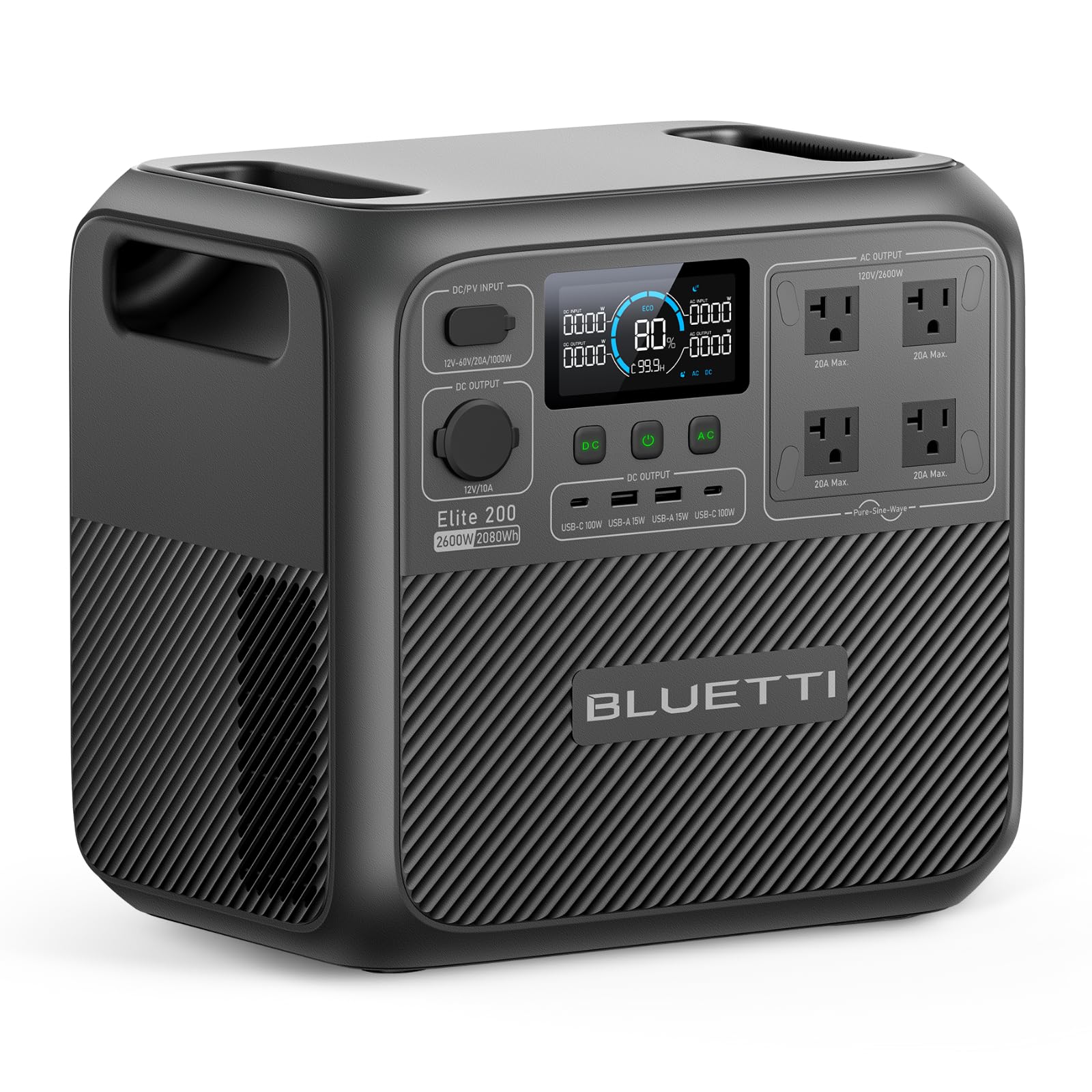
1. BLUETTI Elite 200 V2 Portable Power Station 2080Wh 2600W
Our pick — 4.5+★ from 950+ verified ratings; the strongest balance of quality and price.
The basecamp powerhouse that sips power while it waits, then runs a fridge all day.
Two numbers explain why this sits at the top. It stores 2080 Wh — about nine and a half times the 220 Wh in the Apowking kit further down the list — and it pushes 2600W of continuous AC power, against 300W from that same small unit. For a campsite that includes a fridge, a coffee maker or a diesel heater, that gap is the whole ballgame.
The quiet engineering is the part you notice at 2 a.m. Standby draw is just 10W, which BLUETTI says is three times lower than similar power stations, so the battery is not slowly bleeding itself overnight. Charging is adjustable through the app across Turbo, Standard and Silent modes: Turbo refills 0–80% in one hour at 1800W AC, while Silent tops up in three hours at 16–30dB. Buyers report a 120V 60W diesel heater running 10 hours a day for 3.3 days on a single charge.
What wins people over is raw performance — running a refrigerator for 24 hours shows up again and again in the feedback, and the cold-weather behavior holds up. The LiFePO4 pack is rated past 6,000 cycles with a stated 17-year lifespan, and the 44.5 lb unit measures 13.78″L x 9.84″W x 12.74″H. That is 2.5 times the 18 lb of the GRECELL below — a deliberate trade of portability for capacity.
Where it earns the crown
- 2080 Wh of storage with 2600W continuous output and 3,900W lifting mode for motor starts
- 6000+ cycle LiFePO4 rating with multi-layer protection for extreme temperatures
- 10W standby draw keeps the tank full between uses
- 9 outlets at once, so the whole camp can plug in without a power strip
The honest math
- 44.5 lb is a two-hands lift — this lives in a vehicle, not a backpack
- Heaviness is the recurring gripe, and it is fair at this size
- Full solar recharge needs 1000W of panels for the quoted 2.4 hours
Reach for it if: your camp has a fridge, a heater or a family’s worth of devices and you drive to the site.
Leave it on the shelf if: you are hiking in with your kit — the weight will end the argument fast.
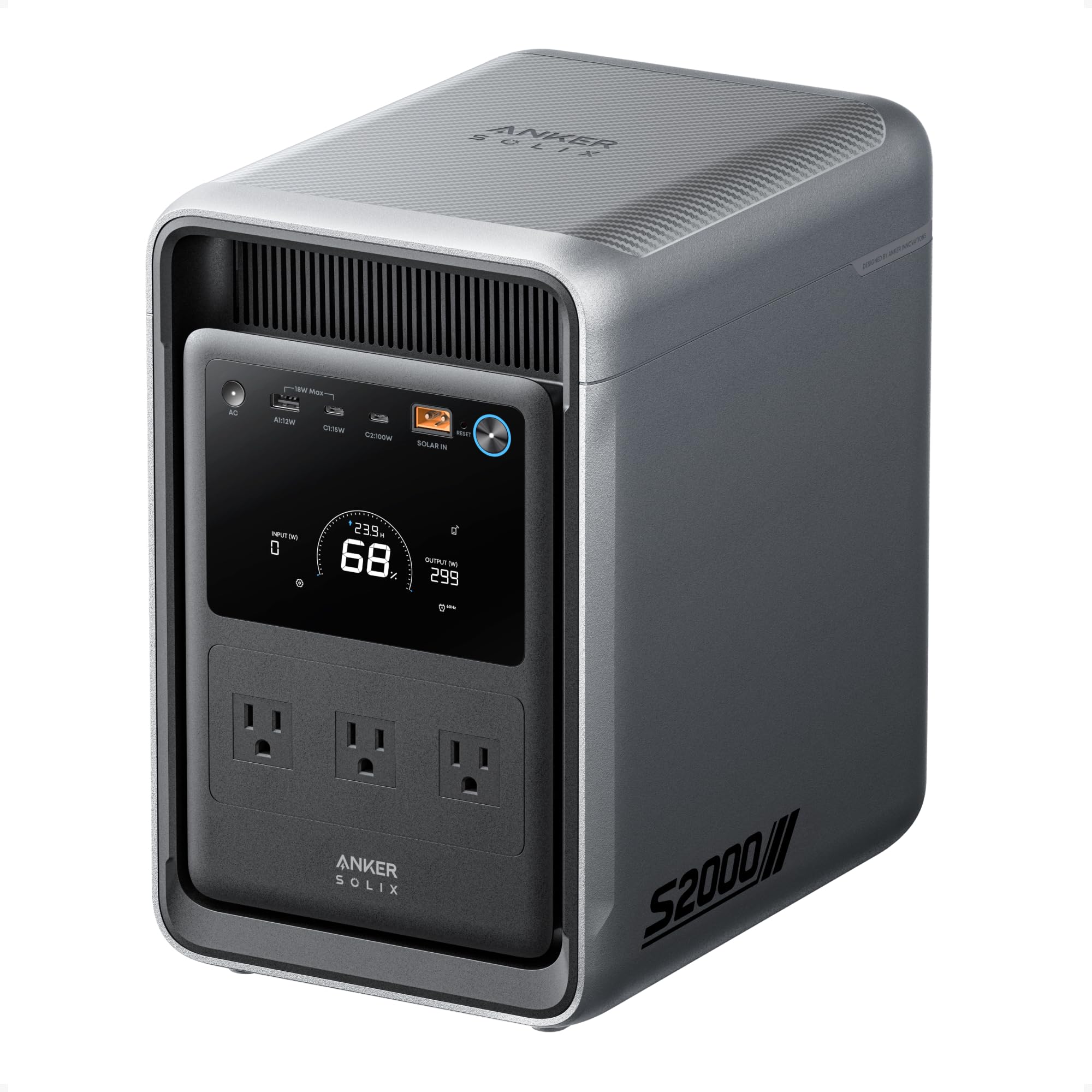
2. Anker SOLIX S2000 Solar Powered Generator, 2,010Wh, 1,500W
Two kilowatt-hours that fit where a bulkier station would not.
Anker’s trick here is density. The S2000 packs 2,010 Wh into a body measuring 8.19″L x 11.1″W x 12.7″H at 35.7 lb, which is 22% smaller and lighter than the 44.5 lb BLUETTI Elite 200 V2 above while carrying a nearly identical tank. For a car camper who has to slide the station under a sleeping platform, that footprint difference is the purchase.
It runs 1,500W continuous with a 3,000W peak, which covers the essentials rather than everything. The claim note is fridge runtime: a 6W idle draw and a stated 10% efficiency edge keep a refrigerator running for 35 hours. The battery is 314Ah LFP cells rated for 10,000 cycles, so you are unlikely to wear it out before the tech moves on. Recharging is flexible, with up to 400W solar input plus AC, generator, alternator or car options, and eight outlets split front and rear.
Performance is what carries the reputation, with power capacity close behind — a 20 cubic foot refrigerator for up to nine hours is the marquee real-world result, and setup is simple enough that nobody mentions a manual. There is no 12V DC port, so plan your car-powered accessories around USB or AC. Anker’s densest 2kWh: if your constraint is floor space rather than cash, this is the one.
Best fit: van and car campers with limited storage who still want a full 2kWh tank.
Second thought: no 12V DC port means older car-style accessories need an adapter.
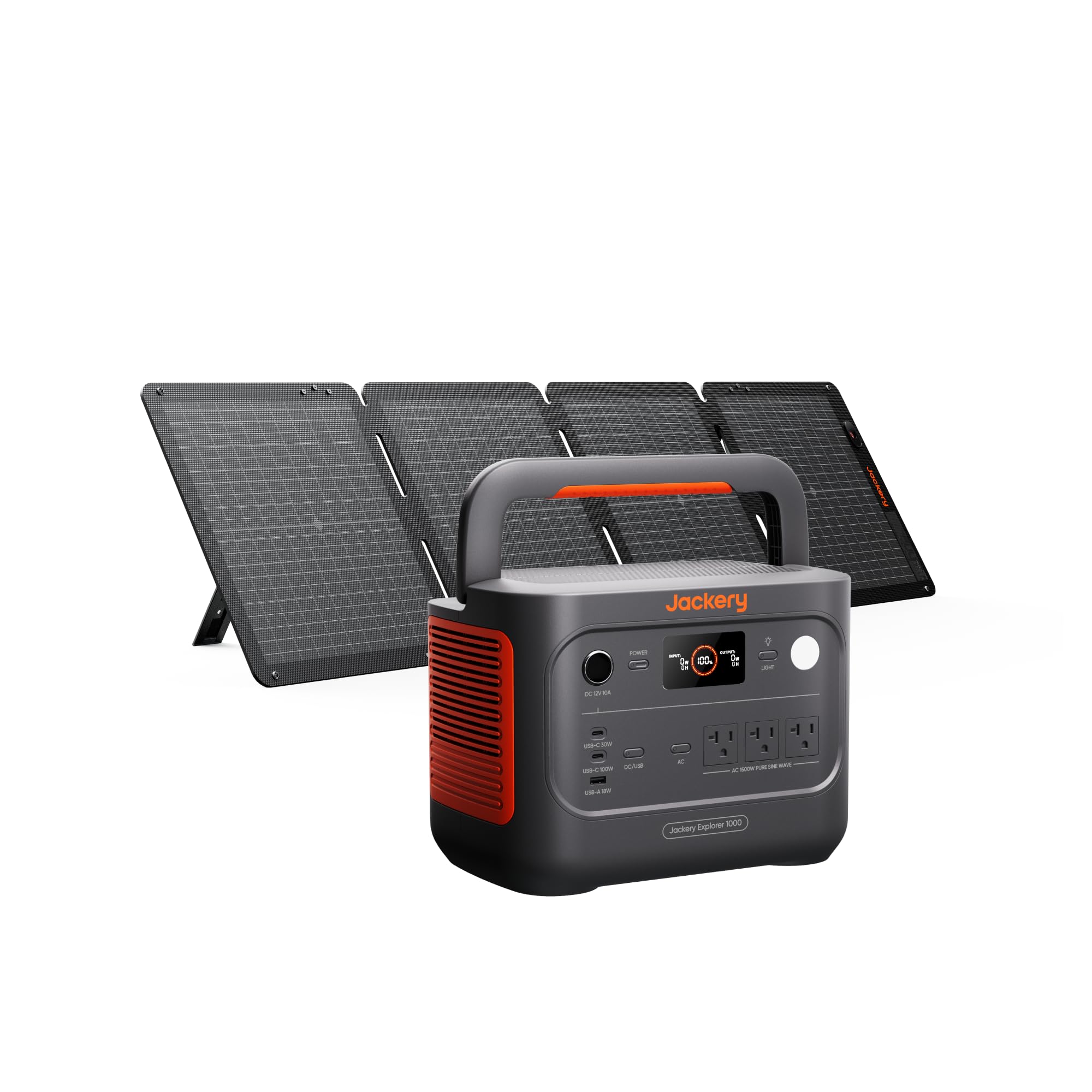
3. Jackery Solar Generator 1000 v2 and 100W Solar Panel
The one-box answer for a car camp that wants sun charging without shopping for a panel.
The panel ships in the box — a 100W folding solar panel alongside the 1,024 Wh Explorer 1000 v2 — so you can be charging off sunlight on day one without decoding connector types. At 23.4 lb with a foldable handle and a 1,500W AC output with 3,000W surge, it slots into the middle of this list without asking anything of your back.
Charging is where it punches above its class. A 50-minute run from 0 to 100% is available through the Jackery app’s emergency mode, while the default is 1.25 hours to protect battery health. The LFP pack is rated to hold over 70% of capacity after 4,000 cycles, a stated working life beyond 10 years. You also get a 10ms UPS switchover and PD 100W USB-C, so laptops charge at full speed.
Build quality is the theme that comes through strongest, with reliability and fast charging close behind — the solar cells do their job and the unit reads as well-made in hand. The honest caveat: some find it less powerful than the headline suggests when running bigger appliances, and the 50-minute charge requires arming emergency mode in the app before each session. The Explorer 1000 v2 is the sensible first solar setup for a family tent.
Suits you if: you want a matched station-and-panel kit without a second research project.
Not for you if: you plan to run air conditioning or high-draw tools off it.
4. EF ECOFLOW DELTA 3 Max Portable Power Station, 2048Wh, 2400W
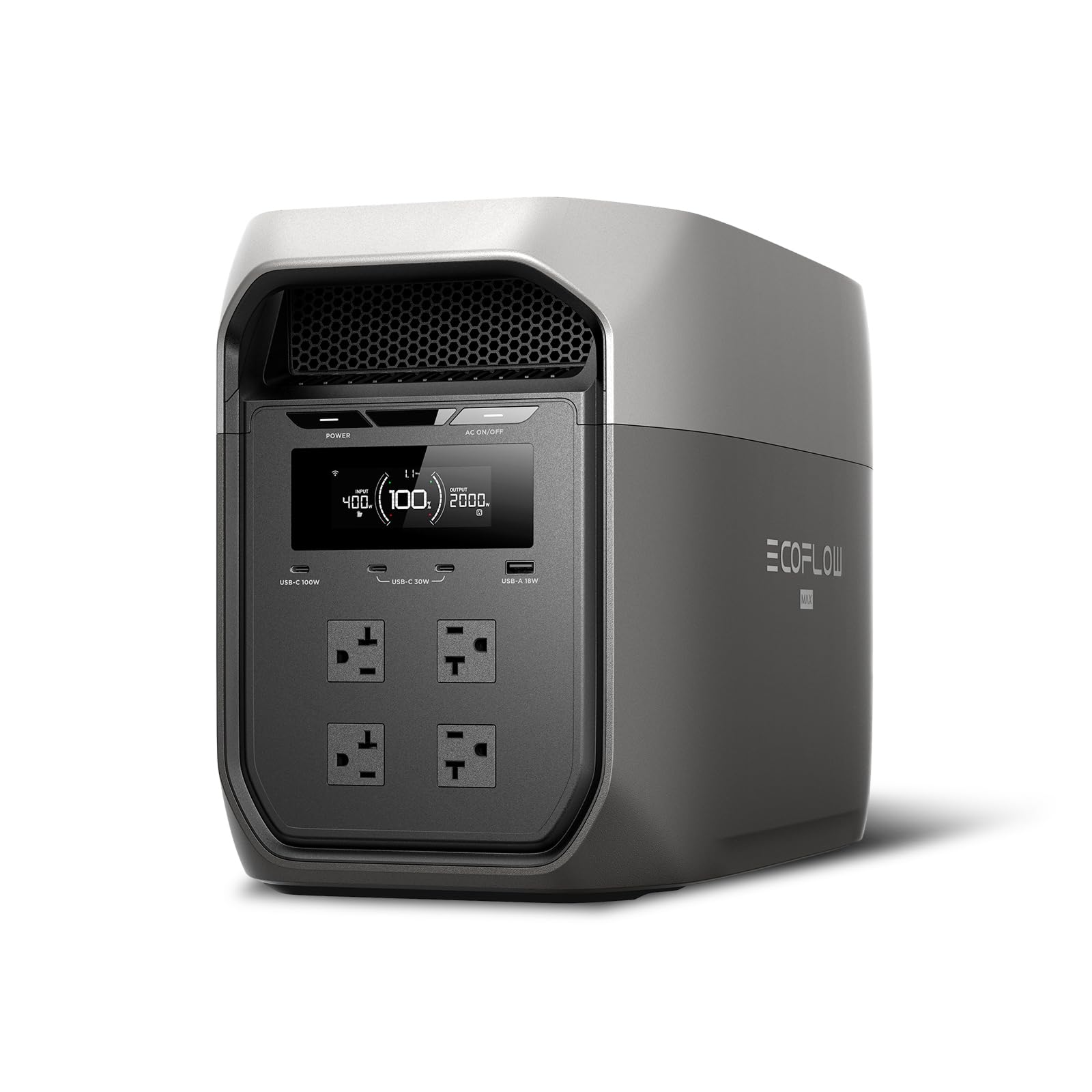
Built for the moment someone plugs in a microwave at a campsite.
X-Boost is the headline: a claimed 3400W output that lets the DELTA 3 Max drive high-demand gear like fridges, microwaves and power tools on a 2048 Wh LFP pack. If your camp menu involves a coffee machine, this is the shortlist entry.
Recharging is fast by any standard — 0–80% in 1.13 hours via EcoFlow’s X-Stream tech — and the 10ms transfer time keeps sensitive electronics alive during a flicker, which is a home-backup feature borrowed for camp duty. The LiFePO4 battery is rated for 10 years of daily use, and the unit carries a 5-year service term. App control lets you watch energy use and set charge schedules.
What gets praised most is the overall build and reliability — it reads as a top-quality system rather than a compromise — with battery life and rapid charging right behind. One honest note: EcoFlow lists no weight for this model in the specs, so size up your carry plan from the 9.4″L x 12″W x 19.44″H body rather than a stated figure. 2400W of usable muscle: the pick when a campsite fridge and a tool charger share the same battery.
What it delivers
- 3400W X-Boost for 99% of appliances, per EcoFlow
- 0–80% in 1.13 hours; ultra-quiet running with 10ms transfer
- LiFePO4 rated for 10 years of daily use plus 5-year service
What to plan around
- Solar panel is optional, not included — budget a folding panel separately
- No published weight figure means you cannot pre-plan the lift
Buy this one if: high-draw appliances are non-negotiable at your site.
Pause if: you need a panel in the box to make the setup complete.
5. ABOK Ark2000 Portable Power Station with 200W Solar Panel

A 200W panel bundled in, with room to grow the battery later.
Start at 1536 Wh and add one Ark2000E expansion battery to reach 3072Wh, or two to hit 4608Wh — without replacing the station itself. That upgrade path is the reason this sits mid-list: it grows with your setup instead of forcing a second purchase. The 200W solar panel is included, and the unit accepts up to 1200W of solar input, with two 600W panels in series or parallel supported.
Output is 2000W continuous with A-Boost up to 2400W and 3500W peak for startup surges, delivered as pure sine wave — the clean AC shape that keeps laptops and sensitive electronics happy. It charges 0–80% in 55 minutes on 1500W AC, or in about 1.2 hours from 1200W of solar. The EVE LiFePO4 cells carry a 4000+ cycle rating, and the shell is UL94 V-0 fire-resistant with a 3W LED in steady, flashing and SOS modes for camp emergencies.
Eight ports cover the whole site — 3 AC outlets, USB-A and USB-C in both 20W and 100W flavors, plus a 12V car port. At 29.8 lb it splits the difference between the 23.4 lb Jackery and the 35.7 lb Anker above. One practical note: ABOK flags both station and panel as out of stock at times, with shipping expected mid-December, so check the listing date before a trip. Growable by design: a basecamp battery you can double or triple without a new purchase.
6. Jackery Explorer 2000 v2 Portable Power Station, 2042Wh

Charges through the night at a whisper, which matters when the tent is right there.
Silent Charging Mode runs at under 30dB — the volume of a quiet bedroom — while refilling in five hours. That single feature separates it from every other 2kWh unit here, because a charging station humming at a campsite at midnight is the thing nobody warns you about. The 2042 Wh LFP pack with 2200W AC output across three ports covers fridges, coffee makers and a garage air conditioner.
Weight is the design story: 39.5 lb, which Jackery says is 41% lighter and 34% smaller than typical 2kWh LFP stations, built on the same cell-to-body tech used in EVs. Fast charging is genuinely fast — 0–80% in 66 minutes on AC, or a full charge in 102 minutes via emergency mode in the app. Solar fills it in as few as six hours from 400W panels, and the UPS switchover lands at 20ms, UL1778 test certified.
The recurring theme in feedback is quality that outruns expectations, with battery life and reliability right behind — powering fridges, freezers, microwaves and lamps without drama. Durability draws mixed words, so treat the moving parts with ordinary care. Silent at 30dB: the pick for anyone sleeping within arm’s reach of the charging station.
Worth buying for: cabin and RV trips where you sleep beside the gear.
Think twice if: you want the lightest possible 2kWh — 35.7 lb units exist above.
7. Anker SOLIX C2000 Gen 2
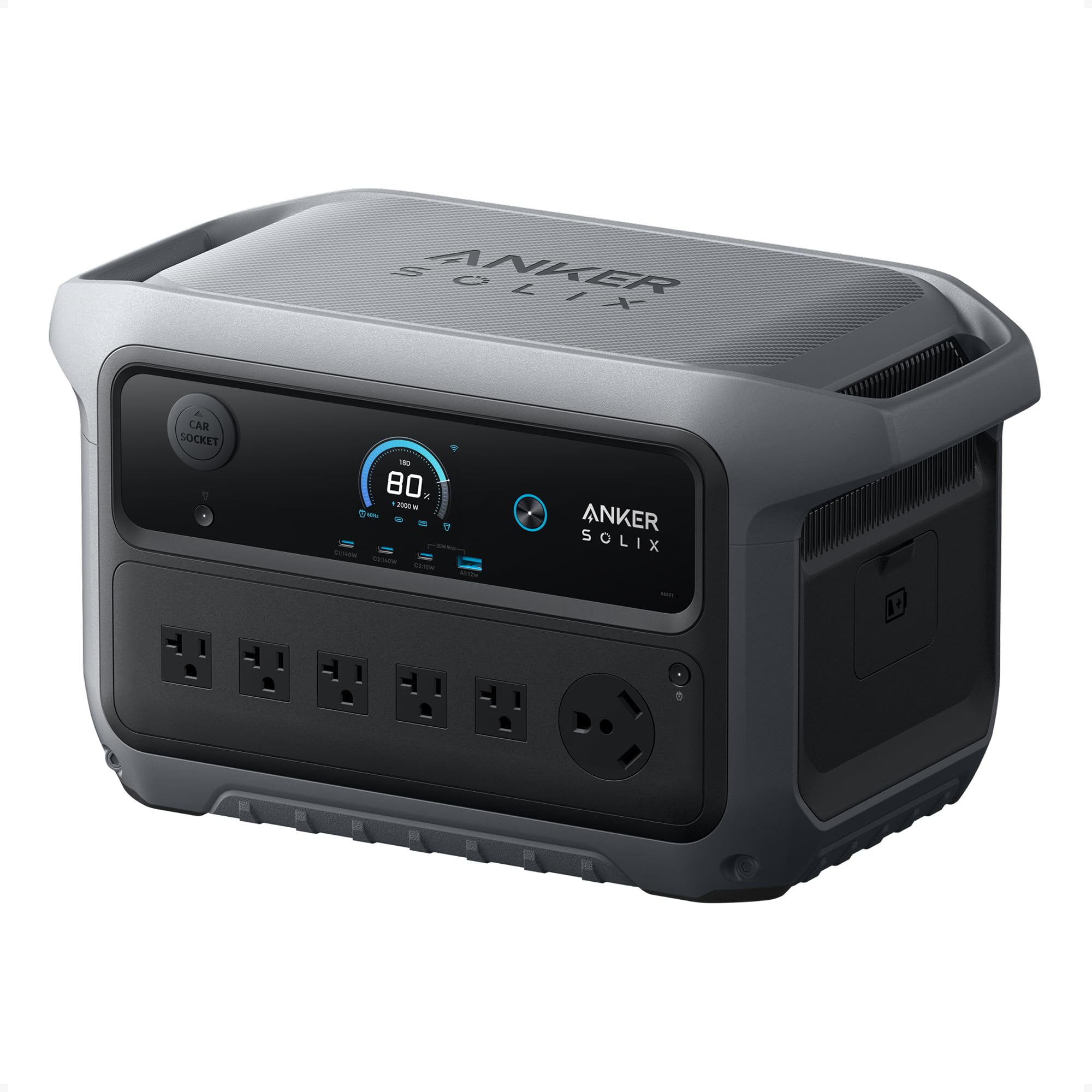
The one with a real RV socket, so the camper plugs in directly.
A TT-30 socket is the 30-amp RV outlet your camper already expects, and the C2000 Gen 2 is the only station on this list that has one. Plug the rig straight in instead of daisy-chaining adapters. Behind that port sits 2,048 Wh of LiFePO4 with 2,400W rated and 4,000W peak output — enough for most window and RV air conditioners, which is a taller order than most 2kWh units clear.
Six recharge paths keep it fed: AC and solar together hit 100% in 58 minutes, an 800W alternator charger fills it in three hours while you drive, and solar works solo as well. Idle draw is just 9W, which is why Anker quotes a portable fridge running seven days or a dual-door fridge up to 32 hours. Add an expansion battery to reach 4kWh and the dual-door fridge figure stretches to 64 hours. At 41.7 lb and 18.1 × 9.8 × 10.1″ it is 25% lighter and 29% smaller than similar units, per Anker.
Performance is the clear strength in the feedback, with reliability close behind — it charges to 100% fast and runs a TV, fridge and WiFi for over 10 hours without strain. Weight draws split opinions, so plan a permanent home for it rather than a daily carry. RV-ready from the start: the direct socket saves the adapter hunt.
Matches you if: you tow or drive a camper with a 30-amp inlet.
Look on if: you need a backpack-friendly station — this is a 41.7 lb fixture.
8. EF ECOFLOW DELTA Pro Portable Power Station 3600Wh, 3600W
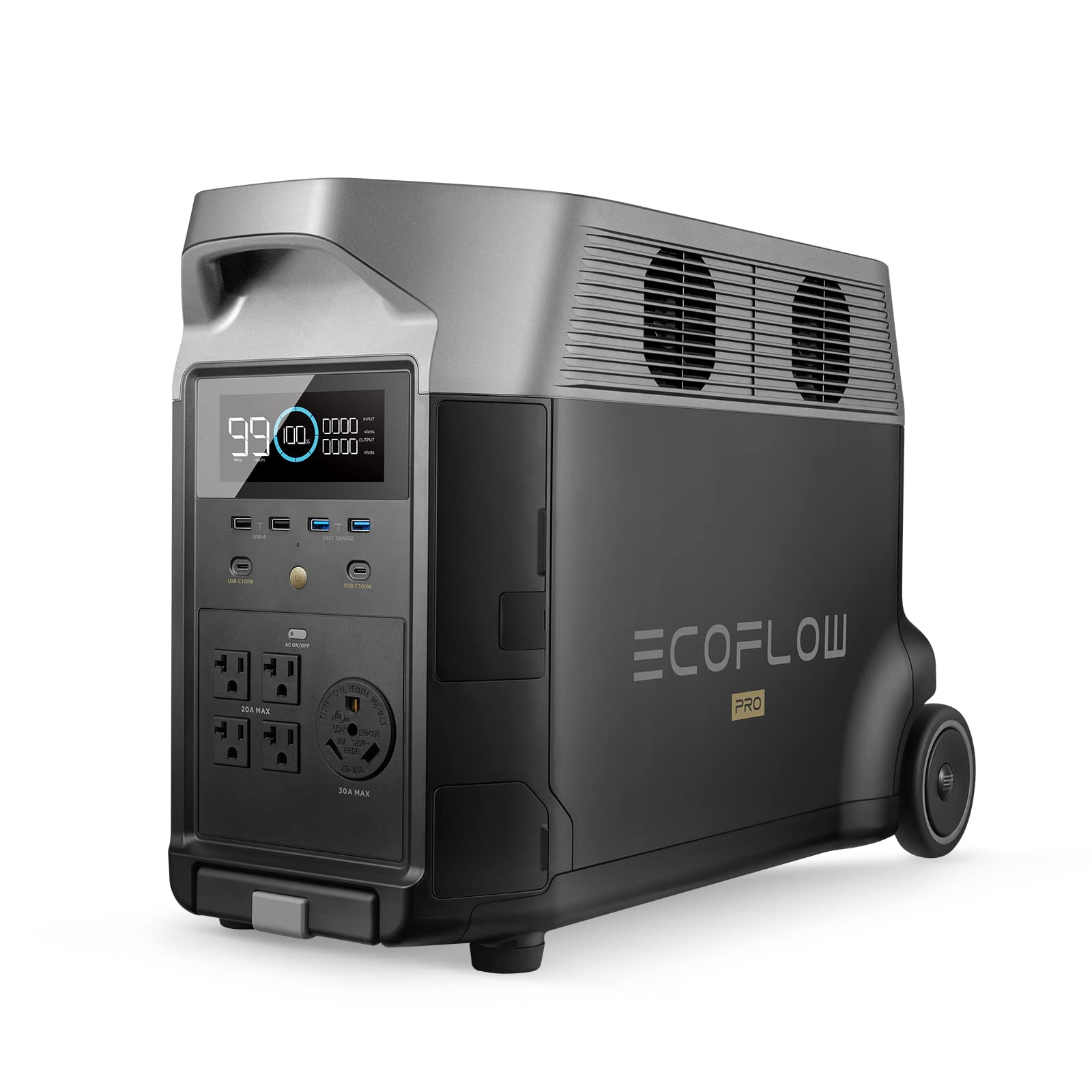
Camper-sized power that turns a basecamp into a small substation.
At 3600 Wh this is the largest tank here, and it goes further — add DELTA Pro Extra Batteries or Smart Generators and capacity climbs from 3.6kWh to 25kWh. The AC output is 3600W, expandable to 4500W with X-Boost, and two units can pair for 7200W. Fifteen output methods cover everything: 2 USB-A, 2 USB-A Fast Charge, 2 USB-C at 100W, 5 AC outlets, 2 DC outlets, a car port and an Anderson port.
Charging is fast for the size — 1.8 hours on 240V at 3000W, 2.7 hours on 1800W wall outlets, or 2.8 hours from four 400W solar panels thanks to conversion efficiency up to 23%. Five charging routes include EV station, solar, wall, smart generator and car outlet. The app gives Wi-Fi and Bluetooth control over charge level, temperature and discharge timing. At 99 lb, this is not a carry item; it is a truck-bed resident.
Quality is what stands out in owner feedback, with charging speed and value close behind — the 2.7-hour recharge and hours of appliance runtime get consistent credit. Reliability draws mixed notes, so test it at home before a trip. 3600Wh of headroom: the choice when camp power needs to match a household circuit.
Why it earns its tier
- 3600Wh base, expandable to 25kWh with add-on batteries
- 3600W AC output, 4500W X-Boost, 7200W when paired
- 15 output ports and five charging routes
Where it costs you
- 99 lb rules out any carrying — vehicle transport only
- Reliability feedback is split; verify early
Reserve it for: long basecamp stays or serious home backup where the truck is always nearby.
Skip the lift: if the station has to travel more than a few feet by hand.
9. GRECELL Portable Power Station 500W, 519.48Wh
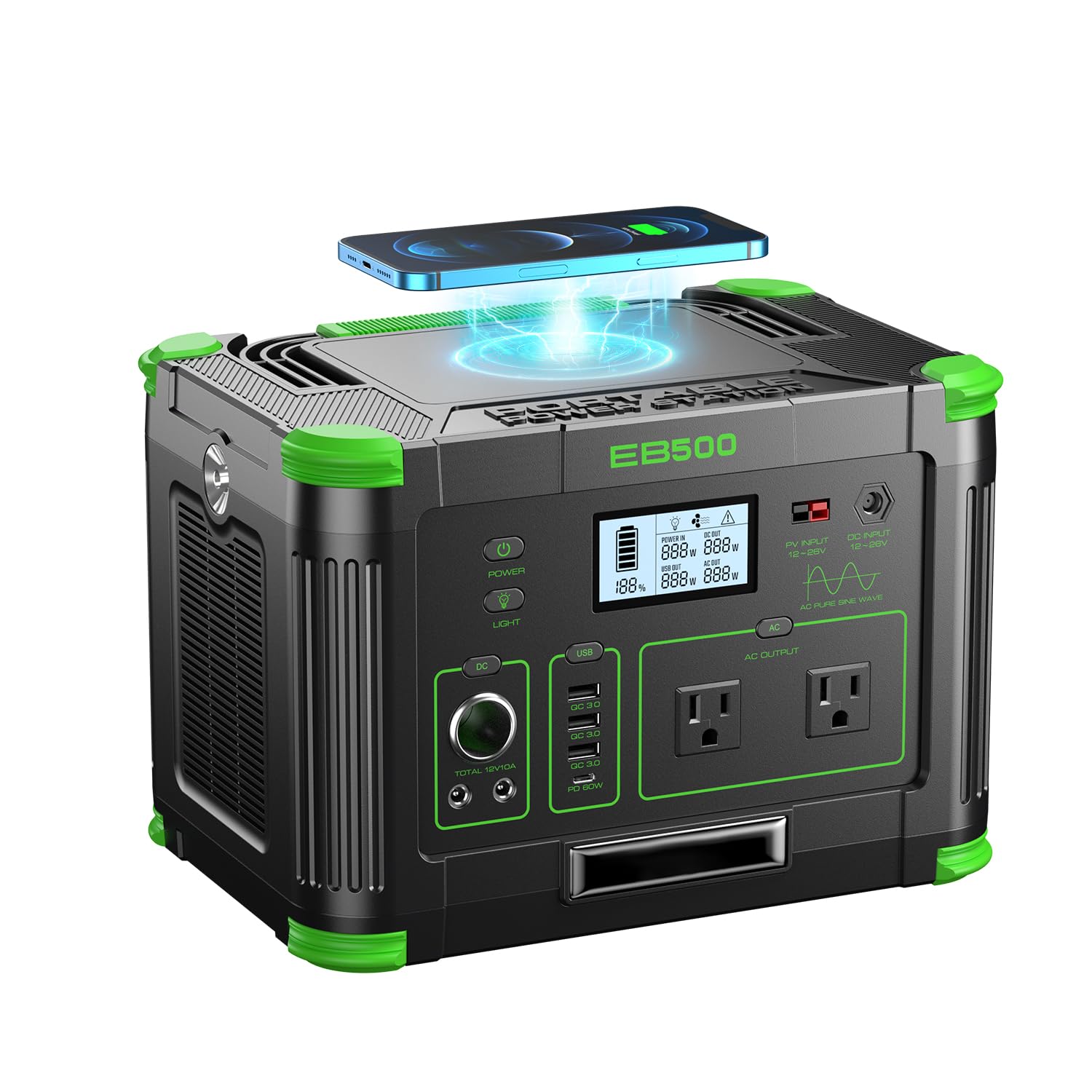
The budget station that covers phones, laptops and a fan without breaking the trip fund.
At 519.48 Wh and 500W of pure sine wave output, this is built around the essentials rather than the whole campsite. Phones, laptops, tablets, a fan, a TV, a small blender and a car fridge all fall under its 500W ceiling. It runs silently — no gasoline, no fumes — which is the point of the whole category.
Ten outputs is generous for the tier: 2 pure sine wave AC ports at 110V/500W, 3 USB-A QC3.0 at 18W, 1 USB-C PD at 60W, 2 DC ports and a 12V/10A car port. Solar recharge takes six to nine hours from a 100W panel (not included), 7–8 hours from a car charger, or 6–7 hours on the wall. At 18 lb with a carry handle, it moves between car and tent without complaint.
Performance and reliability are the two things buyers keep coming back to, and portability is never questioned — one reviewer described it as perfect for camping. The catch worth knowing: charging speed splits opinion, with some finding it slow from solar. GRECELL also warns to recharge it at least once every three months, so it does not want to sit forgotten in a garage.
Picks you up if: you need a first solar station for phones, lights and a laptop.
Step up if: a fridge or heater is on your packing list.
10. Apowking Portable Solar Generator, 300W with 40W Solar Panel

Five pounds, panel included, small enough to disappear into a daypack.
No point pretending this competes with a 2kWh unit on capacity — at 220Wh it holds roughly a tenth of what the BLUETTI above stores. What it does is travel. The station measures 6.7″L x 4.1″W x 8.5″H at 5 lb, and the 40W folding solar panel ships in the box with ten DC connectors to suit most power stations.
The panel uses 24% high-efficiency monocrystalline cells that keep working in low light — dawn, dusk or overcast — which is exactly when a small setup earns its keep. Inside is a 220Wh (60000mAh) pack rated for 15 phone charges or 5 hours of laptop backup. Seven ports include 2 AC outlets at 300W rated with 600W peak, USB-C PD, USB-A and a DC carport. There is also a 5000K, ~300-lumen LED floodlight that runs 30+ hours per charge.
Tent and truck campers are where this finds its people — compact size and genuine usefulness come up again and again. Honest framing: solar recharge from a 40W panel takes patience, and the small output suits lights, phones and a CPAP rather than appliances. 5 lb with a panel in the box: the right entry point for a minimalist camp.
Go here if: your load is phones, a headlamp, a CPAP and a laptop.
Go bigger if: you expect to run anything with a heating element.
Know the Specs
Watt-hours (Wh) — the real measure of time
Watt-hours is stored energy, and it decides how many hours you get. A 220Wh unit and a 3600Wh unit both run a 100W device, but one lasts about two hours and the other much longer. Check the Wh figure first, then divide by the draw of what you plan to run.
Rated watts vs peak watts
Rated watts is what the inverter sustains, while peak covers a brief startup surge — a fridge compressor or a microwave pulling hard for a moment. A 300W-rated station with a 600W peak behaves very differently from one with no surge headroom at all.
Pure sine wave output
Pure sine wave is clean AC, the same shape a wall outlet delivers. Sensitive gear — laptops, CPAP machines, cameras — prefers it. Modified wave can cause buzz or refusal on some electronics, so check for the pure sine wording on anything you plug in expensive gear to.
Idle draw
Idle draw is what the station sips while powered on with nothing plugged in. A 6W or 9W or 10W standby figure sounds tiny until it runs for a week in a tent. Lower idle draw means more of your stored energy goes to actually running things.
Cycle life and chemistry
A cycle is one full charge and discharge, and LiFePO4 cells are rated in the thousands. That rating tells you the working life of the battery, not the speed of the charge. It is the number to weigh when the station will see regular seasonal use.
Solar input ceiling
The solar input maximum is the most watts of panel the station can accept. A 40W bundled panel on a 300W ceiling trickles, while a 400W ceiling or higher lets you use larger folding panels for faster sun charging. Match the panel to the ceiling, not the other way around.
Common Questions
Can a solar camping generator run a campsite fridge overnight?
How long does it take to recharge from solar panels alone?
What is the difference between LiFePO4 and regular lithium-ion batteries?
Do I need a pure sine wave inverter for a CPAP machine?
How heavy is too heavy for camping?
Can I charge a power station from a car while driving?
What does 2,000W output actually power on a campsite?
Can a solar generator be used indoors or in a tent?
What happens if I leave the station unused for months?
Do these stations include a solar panel in the box?
The Bottom Line
For most camping setups, the solar powered generator for camping winner is the BLUETTI Elite 200 V2 because it pairs 2080 Wh of storage with 2600W of continuous output and a low 10W standby draw, so a fridge and a heater both fit the plan. If floor space is the constraint, the Anker SOLIX S2000 packs a near-identical tank into a smaller body. And for a camper with a 30-amp inlet, the Anker SOLIX C2000 Gen 2 plugs the rig in directly. Match capacity to your site and weight to your back, and the rest is sunlight.
How we choose
We do not accept paid placement. Every pick is matched to a real buyer and a real use-case; we do not hands-on test units.
Sources
Specifications: manufacturer listings and product documentation. Review insights: verified customer reviews, as of November 2026. Pricing: not shown on this page (it changes often); check the current price via the retailer link.
As an Amazon Associate, Tactical Gear Guy earns from qualifying purchases. This does not affect which products we feature.