Specs are compiled from manufacturer listings and verified buyer reviews and can change over time — please confirm the key details on the product page before buying.
An insulated tent with AC is only worth buying if the cold air actually stays inside the walls — and that is exactly where most cheap shelters fail. The four picks below all pair real insulation with a genuine AC port, duct hole, or vented climate setup, so you are not pumping cold air into a hot canvas bag. The short answer: the Obsidian is the strongest do-everything shelter, the inflatable Mohuihui canvas house is the most comfortable for families, and the two hard-shell rooftop models are for people who sleep on top of a vehicle. Here is how they actually differ.
This guide is built by comparing the manufacturers’ published specifications and the patterns across verified customer reviews, so you get each pick’s real strengths and trade-offs instead of marketing spin.
Insulation thickness, AC port count, and setup time decide whether a shelter keeps its cool at midday. This breakdown of the insulated tent with ac options shows which one fits how you camp.
Top Picks

How To Choose The Best Insulated Tent with AC
Treat it as cooling a room, not a tent. That shift changes what you check before buying. A single-layer canopy leaks cold air through the fabric within minutes, so the insulated wall or panel is the part that makes your AC worth hauling out there.
Insulation decides how long the cold air lasts
Look for insulated walls, a blacked-out interior liner, or a honeycomb panel layer — those help hold temperature so your unit is not running flat out all night. Insulation also keeps you warm when the temperature flips cold, which is why the four-season label keeps showing up on these shelters.
The AC port, duct hole, or vent has to match your hose
A dedicated AC port lets you route the cold-air hose through a sealed opening instead of leaving a door cracked open. Two ports give you more placement freedom. A single duct hole on a hard shell means you hook the hose up to one fixed spot, so check that spot lines up with where you want the unit sitting.
Setup time and where you can pitch it
Pop-up and inflatable shelters go up where you park the car. A rooftop model only works if your roof rack can carry it — and those shells sit up high, so you climb a ladder to bed. Decide the campsite style first, then the setup speed.
Floor and cleaning
Muddy boots, spilled coffee, and fish slime all end up on the floor. A removable zip-off floor turns cleanup into a hose-down job instead of a scrub-in-place job.
Side-by-Side Comparison
| Model | Best For | Sleeping Capacity | AC Setup | Setup Time | Amazon |
|---|---|---|---|---|---|
| Obsidian 4 Season Pop-Up Shelter★ Best Overall | All-round four-season base camp | 6–8 person | Dual AC ports | 1 minute | Amazon |
| Mohuihui Inflatable Canvas House | Family glamping comfort | 6–10 people | AC port plus stove jack | 8 minutes | Amazon |
| SanHima Hotham Side Rooftop Tent | Vehicle-based touring | 2 adults (side-open shell) | Air conditioner duct hole | — | Amazon |
| Naturnest Sirius 1 Plus Rooftop Tent | Quick-deploy rooftop sleeping | 2–3 person | Dedicated heater/cooler vent | 10 minutes | Amazon |
Detailed Reviews
1. Obsidian – Heavy Duty 4 Season Camping Shelter
Our pick — 4.5+★ from 20+ verified ratings; the strongest balance of quality and price.
Throws open in under a minute and still runs two AC hoses through insulated walls.
If you want one shelter that handles summer heat and a cold snap without swapping gear, start here. It is a hexagonal pop-up with insulated 600D walls (a heavy woven fabric with a temperature layer baked in) that keep the cold air from bleeding straight through the canvas. Two AC ports let you run hoses into the shelter rather than propping a door open. A blacked-out interior liner blocks the morning sun that turns a tent into an oven by 8 a.m.
Setup is where it beats the rooftop options. All poles stay inside the structure, so it opens in 1 minute — the Naturnest hard shell asks for 10 minutes by comparison. You get 107 square feet of floor, a 13-foot by 13-foot base, and 6-foot-6-inch height, which is real stance-up room for a family. A zip-off 1200D polyester floor sits underneath, so you can pull it out, hose it down, and turn the same shell into an ice fishing shelter in seconds. The 360° no-see-um mesh windows and four rooftop vent ports keep airflow moving when the AC is off.
The catch is the weight. This is a substantial four-season build, and the heft shows up as the recurring gripe in the reviews. Quality is the thing that wins people over most — 11 buyers call it out, with several calling it the best shelter they have owned — and easy setup follows close behind at 6. Weight comes up 6 times, and most of those comments are less flattering. Plan to move it with two people or a cart, not on your back.
Where it earns its keep
- Two AC ports plus four rooftop vents give you real airflow control
- Opens in 1 minute with poles stored inside the shell
- 107 square feet and 6-foot-6-inch interior height fits 6 to 8 sleepers
- Zip-off 1200D floor converts it to an ice fishing shelter
What to weigh first
- Heavy enough that setup and takedown is a two-person job
- Insulated 600D walls are the point — and the bulk that comes with them
Reach for this if: you want a four-season base camp that sleeps six to eight and runs AC in summer, heat in winter.
Think twice if: you plan to carry the shelter any distance from the vehicle — the weight is real.
2. Luxury Large Inflatable Tent with Stove Jack & AC Port
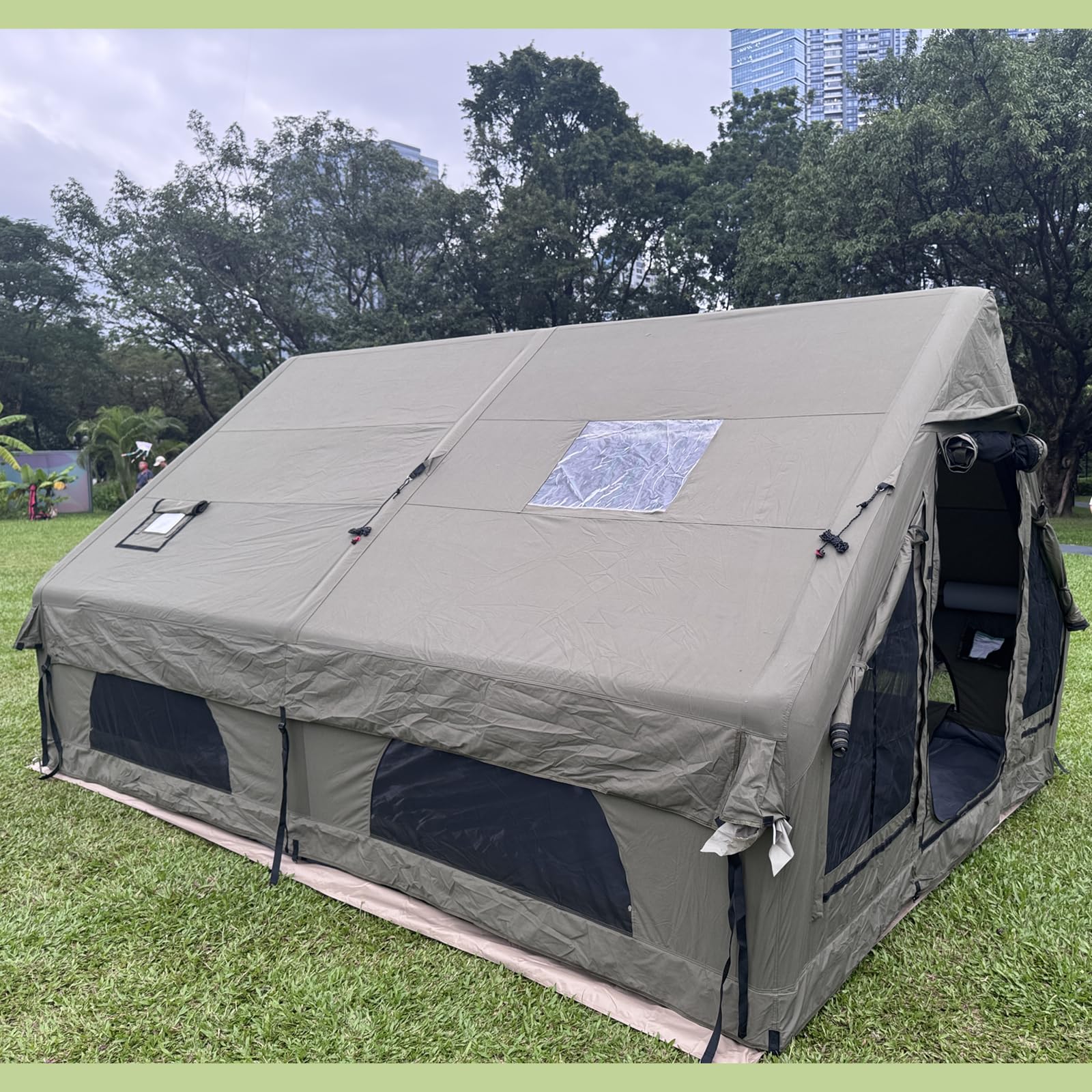
A canvas house you inflate instead of build, with a clear skylight overhead and an AC port on the wall.
Picture a 12-square-meter room standing in a field — that is the pitch here. Four meters long by three meters wide gives you space for beds, a table, and gear without stacking anything. The tech-cotton canvas breathes, sheds rain, and resists wind, which is the fabric choice that makes AC feel comfortable instead of clammy. There is a clear skylight window overhead and a built-in stove jack (a heat-safe opening for a camping stove or heater), so the same shelter that takes an AC port in July can take a heater in November.
Setup is inflate-to-build. Lay it flat, hook the included air pump to the air beams, and fill until the columns harden or the gauge reads 6 bar. Assembly time is listed at 8 minutes — a bit longer than the Obsidian’s 1-minute pop-up, but you are trading that minute for four meters of floor and standing height. Ground pegs and tie-down points hold the base in place once it is up.
The caveat: this is an air-beam shelter, so it depends on the pump and the seams. If a beam loses pressure overnight you feel the wall soften, and a puncture in the field means you are re-inflating by hand. It also asks for a flat, clean pitch so the floor does not tear. For family glamping, festivals, and backyard stays, those are easy trade-offs — for a rocky alpine pitch, they are not.
Room to spread out: 12 square meters of floor and clear skylight overhead make this the pick for families who want a base-camp living room, not just sleeping bags on the ground.
Pressure matters: the 6 bar inflation target and 8-minute setup are the details that keep the walls stiff — skip either and the shelter sags.
Right call for: families and groups who want a roomy glamping shelter with both an AC port and a stove jack for year-round use.
Look elsewhere if: you want a shell you can pitch on uneven, rocky ground without worrying about air-beam punctures.
3. SanHima Rooftop Tent Hard Shell
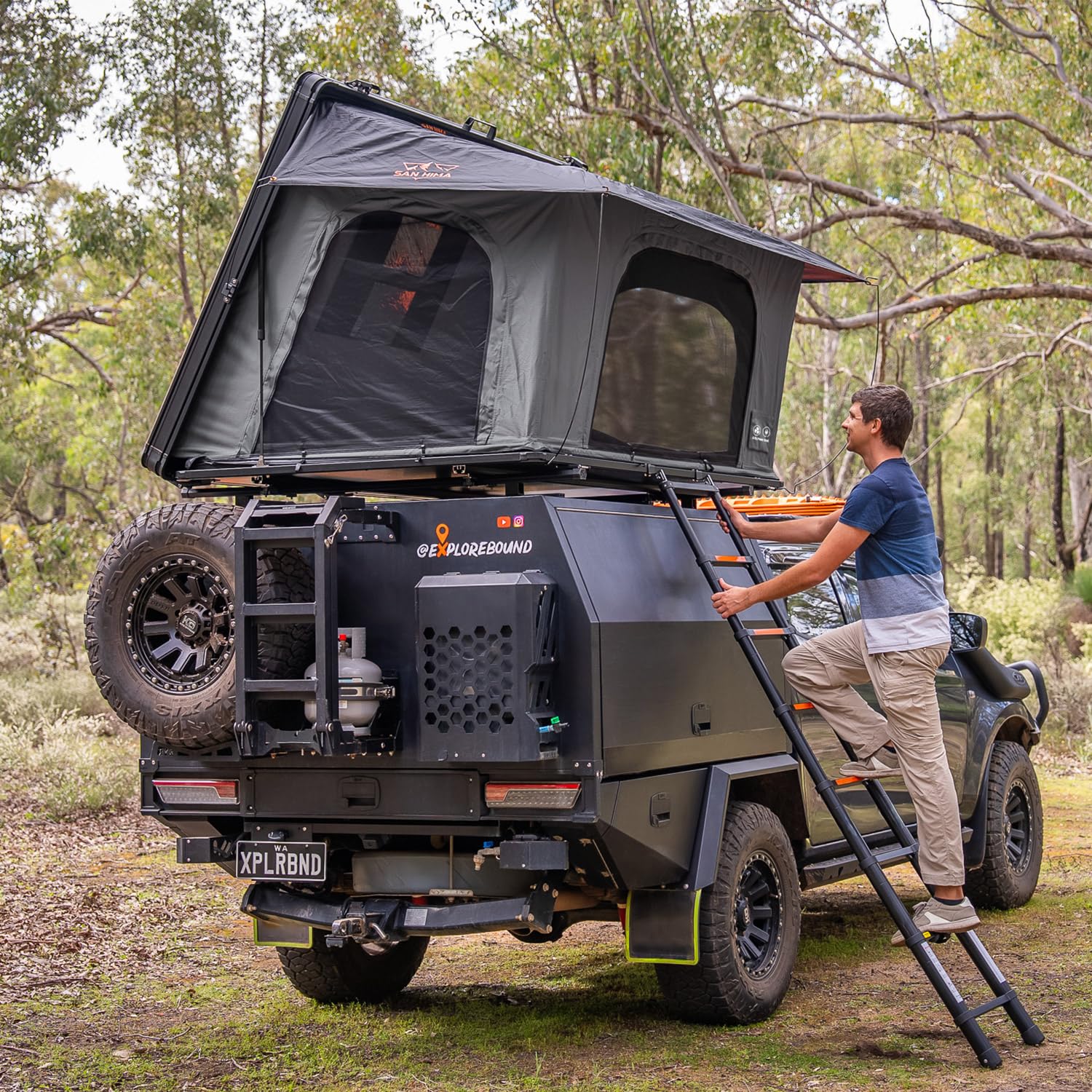
A 4.5-inch-thick aluminium shell that hides an AC duct hole behind a digital charging panel.
This is the vehicle-based answer to cooling. The SanHima is a side-opening hard shell built on an aluminium honeycomb base and floor — a grid of hollow cells that traps air, so the floor stays cooler than bare metal in the sun and warmer in the cold. An air conditioner duct hole on the panel lets you thread the AC hose straight in. That same panel carries USB-C, USB-A, and a CIG socket, so a phone or tablet charges in the same spot you plug in the hose.
The fabric is 420D Oxford and 280G poly-cotton, waterproof to 5,000mm and rated UV50+ — that UV number means most of the sun’s burn is blocked before it reaches the fabric. The 1.6-inch cloud foam mattress handles sleep. A skyview window with breathable mesh runs overhead. The whole shell weighs 145.50 lbs and sits 4.5 inches thick closed, which keeps it low enough for most garages and quiet on the highway.
The trade-off is the roof-rack check every hard shell requires. The tent weighs 145.50 lbs before you add occupants and gear, and the closed dimensions run up to 83.9 by 59.4 inches, so measure the roof before you order. It is also a fixed-position setup — the AC hose goes where the duct hole is, so the cooler has to sit on that side.
Built around the roof: a 145.50 lb aluminium-honeycomb shell, 4.5 inches closed, with an AC duct hole and a USB-C/USB-A/CIG panel in the same spot.
Measure before you buy: 145.50 lbs plus occupants and gear is a real load for a factory crossbar, and the 83.9 by 59.4 inch closed footprint must fit your roof.
The fit is: touring rigs and SUV owners who want to climb into a hard shell and run an AC hose through a dedicated port.
The limits are: a fixed duct position and a roof-rack weight check you have to do before ordering.
4. Naturnest Rooftop Tent Hard Shell
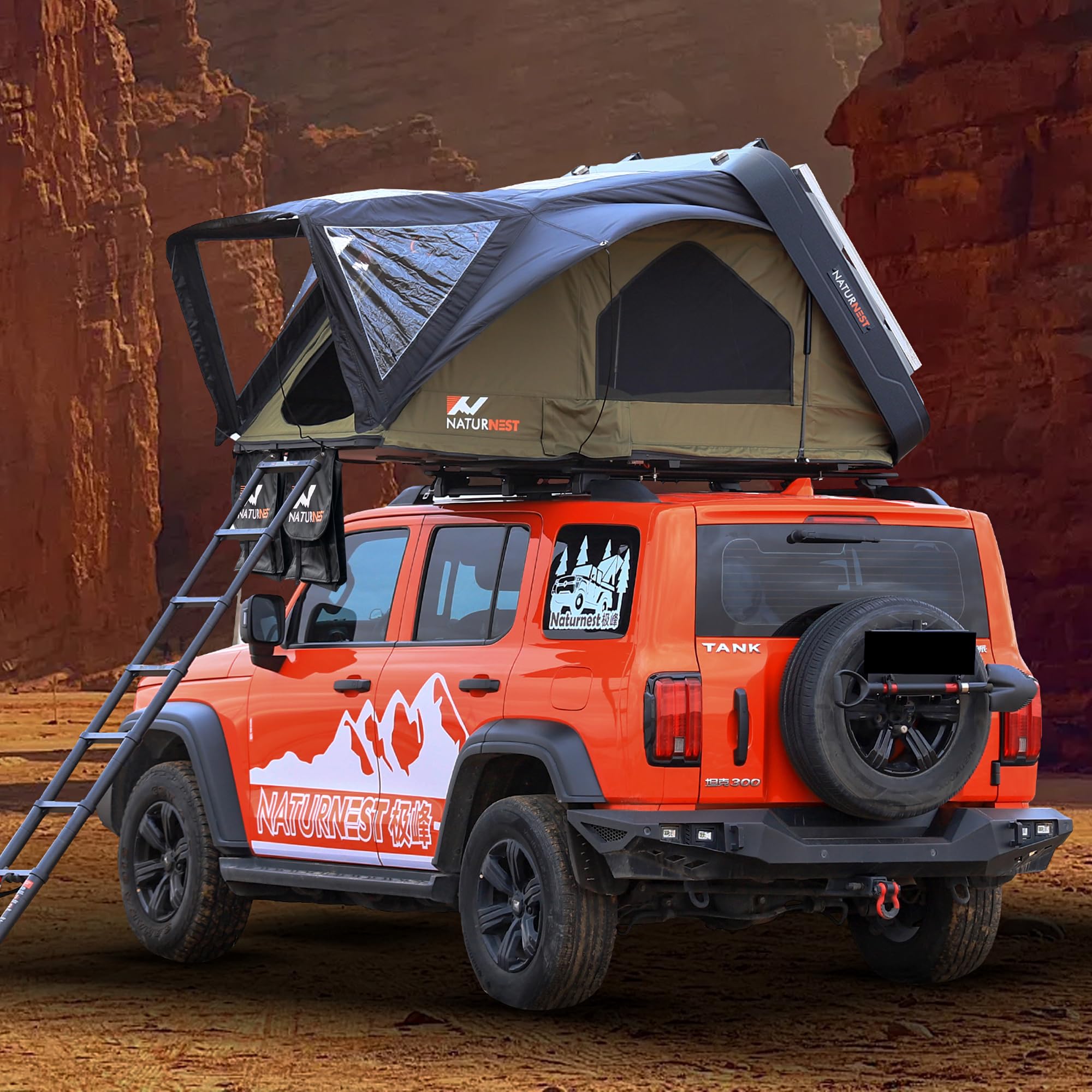
Locks off and deploys in about 30 seconds, with honeycomb panels holding the temperature inside.
The opening move here is speed. Release the locks, pull down the ladder, and the Naturnest is camp in roughly 30 seconds — though the install instructions give 10 minutes for 1 to 2 people to complete mounting. The shell is high-strength ABS over an aluminium frame, lined with sound and thermal insulating honeycomb panels that do the real work in keeping the interior cool or warm. A dedicated vent connects to a heater or cooler, so the AC setup is a fixed port rather than a propped-open door.
Inside is a 82.7 by 63-inch floor with a 1.97-inch non-deformed mattress — two adults and one child fit with room to stretch. Blackout fabric blocks the morning sun, and 316 stainless steel gas struts paired with YKK zippers are the parts that should outlast cheap alternates. It ships with extension ladder, support rods, shoe bags, and roof crossbars for skis, bikes, or a solar panel.
What might give you pause: durability and build quality both read mixed in the buyer feedback. Most of it is positive — people find it sturdy — but some reports point to brittle mounting brackets and stripped threads. It also asks more of your vehicle than the SanHima does on paper, since it is the larger shell at 82.7 by 63 inches of floor. If you mount it yourself, set aside that 10-minute window and torque the brackets carefully.
The storage payoff: roof crossbars mean skis, bikes, or a solar panel ride on top, which is storage the SanHima does not offer.
The honest thread: durable enough for most, but mounting brackets are the part to inspect on arrival and re-check after the first trip.
Best match: off-grid travelers who want the fastest rooftop setup and a heater/cooler vent already built in.
Worth noting: the ABS shell shows mixed durability feedback, so inspect the brackets before you trust them in the field.
Know the Specs
AC Port vs Duct Hole vs Vent
An AC port is a zippered sleeve on a soft shelter that your cold-air hose slides through and seals around. A duct hole is the hard-shell version — one fixed round opening on the shell wall. A vent is a generic term shelters use for any airflow opening, which may or may not fit a hose. If you are routing an AC hose, look for the first two.
Why Insulation Changes the Runtime
Insulated walls, a blackout liner, or a honeycomb panel layer slow how fast outside heat moves through the fabric. That means your AC unit runs less and you feel cold air longer. It works the other way in cold weather, which is why the same shelters carry four-season labels.
Common Questions
How does an AC hose connect to an insulated tent?
Can you sleep in an insulated tent with AC running all night?
Is a rooftop tent hard shell insulated enough for hot weather?
How much roof rack weight do I need for a rooftop tent?
Will a stove jack and an AC port work in the same tent?
How long does the Obsidian pop-up take to set up?
Do I need a flat surface to pitch an inflatable tent?
What is a removable floor good for in an insulated tent?
Is an insulated tent with AC better than a plain canopy tent?
How many people fit in each of these shelters?
The Bottom Line
For most campers, the insulated tent with ac winner is the Obsidian — insulated 600D walls, two AC ports, a 107-square-foot floor, and a 1-minute pop-up that no other shelter here matches. It is the crowd favorite at 4.5+ stars, and the only real caveat is that you will need help carrying it. If family comfort is your goal, the Mohuihui inflatable canvas house gives you a 12-square-meter room with both an AC port and a stove jack for year-round use. And if you sleep on your vehicle, the Naturnest Sirius 1 Plus deploys in about 30 seconds with honeycomb panels and a dedicated vent for a cooler — the fastest rooftop option on the list.
How we choose
We do not accept paid placement. Every pick is matched to a real buyer and a real use-case; we do not hands-on test units.
Sources
Specifications: manufacturer listings and product documentation. Review insights: verified customer reviews, as of November 2026. Pricing: not shown on this page (it changes often); check the current price via the retailer link.
As an Amazon Associate, Tactical Gear Guy earns from qualifying purchases. This does not affect which products we feature.