Specs are compiled from manufacturer listings and verified buyer reviews and can change over time — please confirm the key details on the product page before buying.
You already know the pain: one pass tears out the brush and hauls half your topsoil away with it. A root rake grapple fixes that by clamping a load and letting the dirt sift back down through the tines. The trick is matching the jaw opening, the tine spacing, and the mount to the machine you actually own — get that wrong and a good attachment sits in the yard. This guide walks through five Titan Attachments grapples and what each one genuinely suits.
This guide is built by comparing the manufacturers’ published specifications and the patterns across verified customer reviews, so you get each pick’s real strengths and trade-offs instead of marketing spin.
The range runs from a compact unit for mini skid steers to a wide skeleton frame built for rock work. Below you’ll find the exact widths, weights, and loader ratings that decide whether a grapple fits your machine — and a plain read on which of these is the best root rake grapple for your ground.
Top Picks
How To Choose The Best Root Rake Grapple
Two numbers decide everything before you look at steel thickness. First, your loader’s rated operating capacity — the weight it can safely carry at the pins, not the weight it can lift off the ground. Second, the mounting system on your machine. Everything after that is about the work you plan to do.
Start with your loader’s rated operating capacity
A grapple that weighs more than your machine can comfortably handle turns into a liability. The units here are rated for loader operating capacities spanning 1,798 LB up to 3,500 LB, so read your loader’s spec plate before anything else. If your capacity number sits near the bottom of a grapple’s range, expect to work slower and lift less per bite.
Match the mounting system exactly
A universal SSQA mount (the standard skid steer quick attach plate) fits most skid steers and many tractors with the same plate. John Deere hook-and-pin tractors use a different pin arrangement and need a dedicated fitment, which is why one pick here lists specific loader series. Mini skid steers like Toro Dingo, Boxer, and Ditch Witch run their own compact quick tach and will not accept a full-size SSQA attachment.
Then think about what you are actually moving
Clearing brush and roots wants long tines and a tall opening so the load sits deep in the jaws. Moving rock wants a skeleton frame with tight tine spacing so the smaller material drops through while the big pieces stay put. Sifting soil out of a load is a third job, and one a solid bucket cannot do at all.
Side-by-Side Comparison
| Model | Best For | Width | Weight | Loader Capacity Rating | Amazon |
|---|---|---|---|---|---|
| Titan Attachments 84″ Root Grapple Rake★ Best Overall | Wide land clearing on a full skid steer | 84″ | 910 LB | 1,798 LB – 2,900 LB | Amazon |
| Titan Attachments 72″ Extreme Root Grapple RakeBiggest Jaw Opening | Heavy lifting with maximum jaw opening | 72″ | 970 LB | 1,860 LB – 3,500 LB | Amazon |
| Titan Attachments 82″ Skeleton Rock Grapple Rake | Sifting dirt from rock and debris | 82″ (83″ outside) | 1,200 LB | — | Amazon |
Detailed Reviews
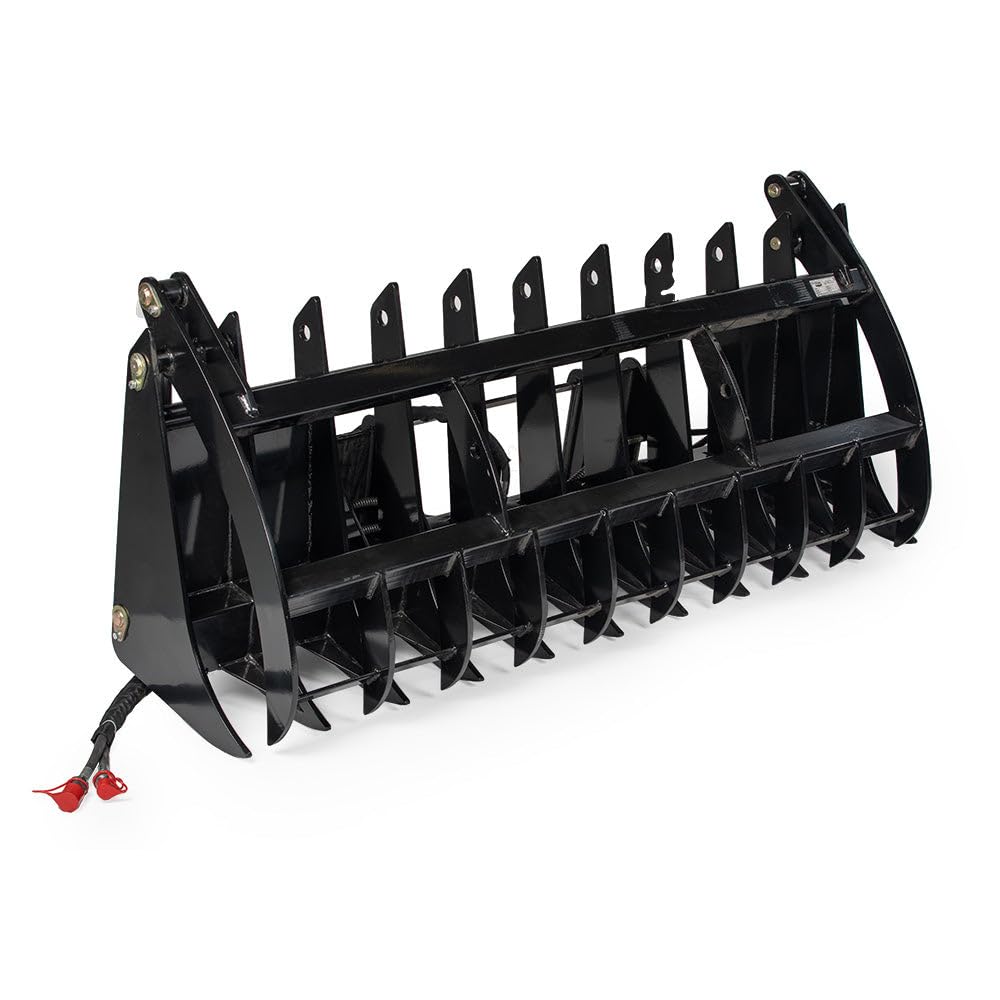
1. Titan Attachments 84″ Root Grapple Rake
Our pick — 4.0+★ from 40+ verified ratings; the strongest balance of quality and price.
An 84-inch jaw that swallows brush in one bite instead of three.
If your ground is a mess of brush piles, dead saplings, and half-buried rock, the 84″ Root Grapple Rake is the one to start with. The extra-wide 48″ opening lets you push into a pile and close on a load big enough that you make fewer trips across the lot. That width is the whole argument: you cover more ground per pass, and fewer passes means less time burning diesel and more time actually clearing.
Behind the width sits serious clamping hardware — twin hydraulic 3,000 PSI cylinders doing the gripping. In plain terms, those are two hydraulic rams that squeeze the jaw shut, and doubling them spreads the clamping force across the load so a heavy log does not slip out mid-lift. The unit runs 910 LB and is rated for loaders with an operating capacity between 1,798 LB and 2,900 LB. Check your plate against that band before you buy — a lighter loader will struggle to work it efficiently, and a heavier one leaves capability on the table.
Fitment is the easy part, because the universal skid steer mount (the standard SSQA quick attach plate) drops onto any skid steer or tractor running that same plate. Owners rate its performance and build quality about equally high — owners describe the steel as sturdiest with no cracks turning up, and owners repeatedly say they would buy it again. The honest limitation is the weight band: at a top rating of 2,900 LB it will not suit the biggest loaders in the yard, and that is a fit question rather than a fault.
Where It Earns Its Keep
- 84″ of working width means fewer passes over the same brush pile
- Twin 3,000 PSI cylinders spread clamping force across the load
- Universal SSQA mount fits any skid steer or tractor with the standard plate
- 910 LB build with a reputation for holding up without steel cracks
Before You Hitch It Up
- Rated ceiling of 2,900 LB rules out the largest loaders
- Wide frame needs a clear approach — trees and fences limit where it swings
- No dedicated pin set, so John Deere hook-and-pin tractors need a different pick
Reach for this if: you run a mid-size skid steer at 1,798 LB to 2,900 LB capacity and want the widest bite in this lineup.
Look elsewhere if: your loader pushes past that capacity rating or your tractor uses hook-and-pin mounting.
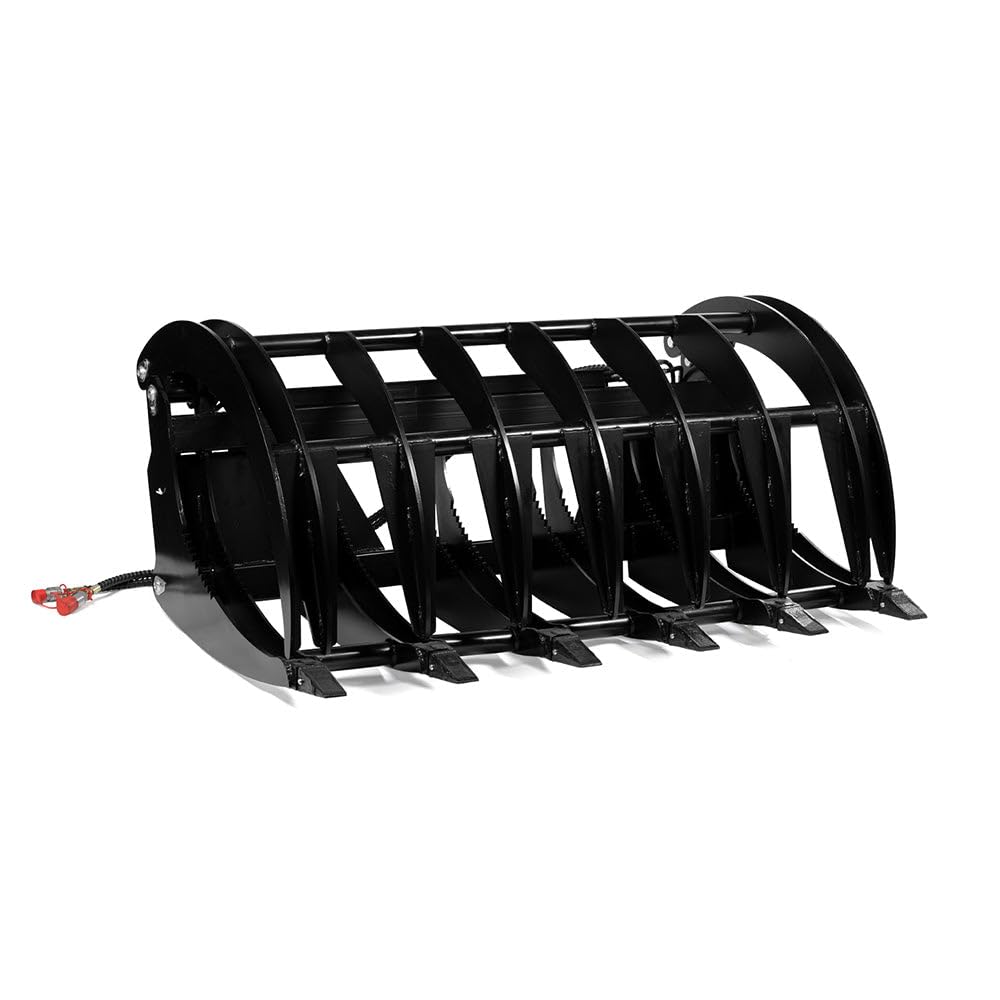
2. Titan Attachments 72″ Extreme Root Grapple Rake
Half a foot more jaw height than the 84-inch pick — and that gap matters.
Logs and bulky stumps are the reason this one exists. The 72″ Extreme opens to 50″ tall, against the 35.5″ maximum opening on the 82″ Skeleton Rock Grapple Rake. That extra 14.5″ of jaw height lets you close the grapple over a big trunk instead of wrestling it up onto the tines.
The frame is built for that kind of load, with 0.5″ steel sides and teeth measuring 35.5″ in length. Twin 3,000 PSI cylinders supply the clamping power, and the teeth are heat-treated forged steel that you can replace when they finally wear down — replacement teeth are sold separately, so the attachment keeps working instead of becoming scrap. Loader rating spans 1,860 LB to 3,500 LB, a wide window that catches most full-size skid steers.
Weight is the trade-off you should walk in knowing about. At 970 LB it is 60 LB heavier than the 84″ clamshell, and heavier again than the 60″ HD unit — an amount that a large machine shrugs off and a smaller one notices in the lift. The universal quick tach hookup means setup takes minutes on any skid steer with the standard plate. For a machine with the capacity to carry it, this is the pick that handles the awkward, oversized debris the others have to push around.
What the extra height buys you: a 50″ opening against a 35.5″ ceiling elsewhere means tall, awkward loads go in cleanly. Combined with forged steel teeth you can swap out, the wearing parts stay serviceable.
The honest catch: it tips the scale at 970 LB, so a compact loader with a modest capacity rating will feel the weight before it feels the grip.
Best match: a full-size skid steer rated near the top of the 1,860 LB to 3,500 LB window, working stumps and large logs.
Not the one: if your loader sits at the bottom of that capacity range, the 84″ or 60″ frame will be easier to live with.
3. Titan Attachments 60″ HD Root Grapple Rake
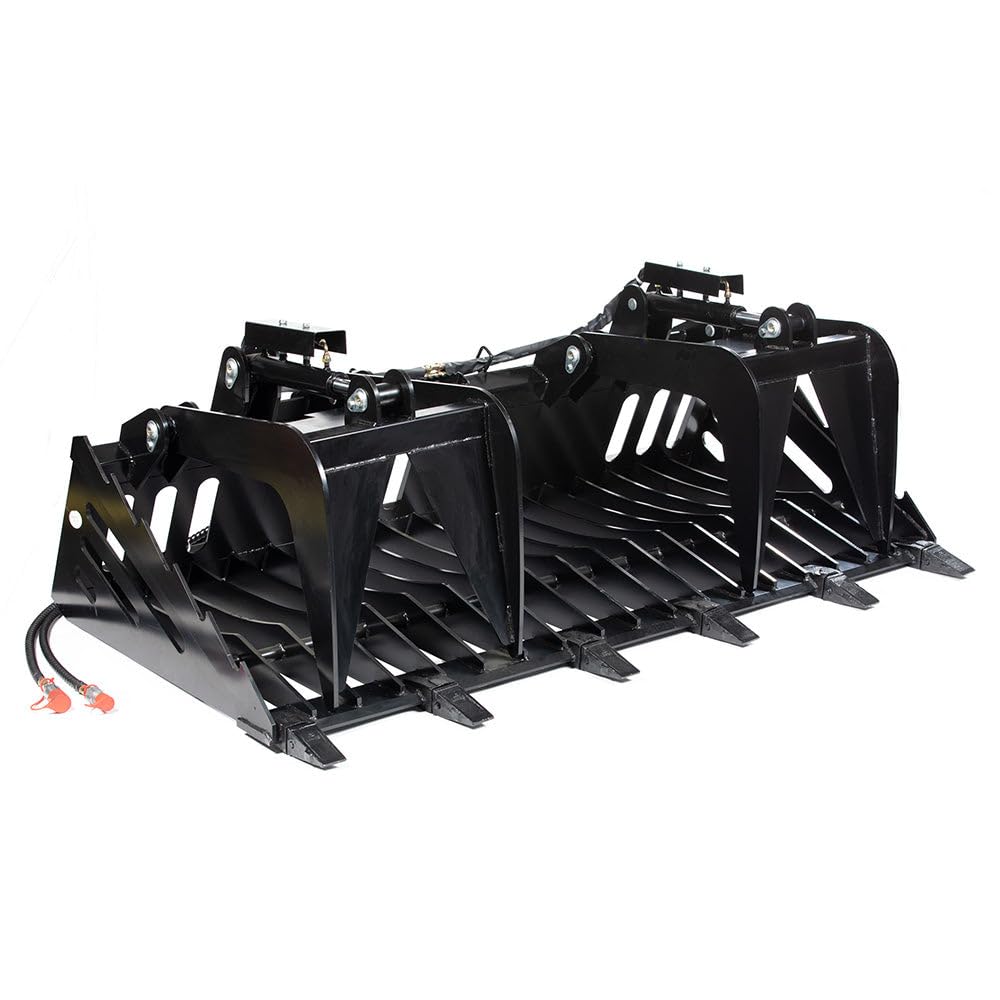
The sifting machine: rock stays, dirt leaves, and you keep your topsoil.
When the job is pulling rock out of ground you still want to use, this is the attachment that respects the soil. The skeleton frame with tines spaced 4″ apart lets the fines drop straight back down while the rock, thick brush, and large debris ride on top. A solid bucket cannot sift, which is exactly why skeleton frames exist.
The cutting edge measures 1″ x 82″, the teeth are replaceable, and the jaws open to 35.5″ maximum. Outside width is 83″ with a 72″ inside width and 49″ depth, and hoses and couplers come in the box. The universal skid steer hookup drops onto any machine with the standard plate.
Reviewers rank build quality first and functionality a close second. The honest picture is more layered on durability: some buyers report the steel holding up well, while others have run into hydraulic hose crimping, welds tearing at the grapple, or a bent mounting plate. Value gets a split read too, for the same reason — downtime costs money. That is the real trade-off on a frame this size, and it is why the hose routing and loading habits deserve attention from day one.
Pick it for: rock clearing and soil sifting where you need the dirt back, on a loader with the capacity to carry 1,200 LB of attachment.
Think twice if: you are working near the edge of your loader’s limits or want a low-maintenance hydraulic setup — the frame is heavy and the hoses need care.
Know the Specs
Opening Height vs. Overall Width
Width tells you how much ground one pass covers. Opening height tells you how tall a load the jaw can swallow. For logs and stumps, height wins — the 72″ Extreme opens to 50″ against 35.5″ on the 82″ Skeleton, which is the difference between clamping a trunk and shoving it. For brush piles spread across a lot, width wins instead.
Twin 3,000 PSI Cylinders
These are the hydraulic rams that drive the jaw shut, rated to handle 3,000 PSI of oil pressure. Running two instead of one spreads the clamping force across the load so a heavy piece does not slip out mid-cycle. Every pick in this lineup uses the same twin-cylinder setup, so clamping hardware is not what separates them.
Loader Rated Operating Capacity
Your loader’s rated operating capacity is the load it can safely carry while moving, not what it can briefly lift. A grapple that eats too much of that number leaves you with little margin for the material itself. Check the number on your machine against each attachment’s stated rating band before ordering.
Skeleton Tines vs. Clamshell Jaws
A clamshell jaw is solid on the bottom and grabs a load whole. A skeleton frame spaces the tines apart, commonly 4″ apart, so soil and small material fall through while rock and brush stay. If you want to keep your topsoil on site, skeleton tines do that job. If you want maximum grip on bulky debris, the clamshell is the more direct tool.
Common Questions
Will a universal skid steer grapple fit my tractor or only a skid steer?
What loader capacity do I need to run a root rake grapple?
Does a mini skid steer grapple work on a full-size skid steer?
What is the difference between a root rake grapple and a skeleton rock grapple?
How do I know which John Deere loaders the 60″ HD grapple fits?
Are the teeth on these grapples replaceable?
How heavy are these attachments and does weight matter?
Can a grapple rake move rock without losing all my topsoil?
Do these grapples include hoses and couplers?
The Bottom Line
The best root rake grapple for most buyers is the Titan Attachments 84″ Root Grapple Rake — an 84″ wide clamshell on a universal SSQA mount, rated for loaders of 1,798 LB to 2,900 LB, that clears brush piles in fewer passes than anything else here and holds the strongest owner reputation across the collection. If tall, awkward debris is the problem, the 72″ Extreme opens to 50″ at the jaw against the 84″ unit’s 48″, so it clamps logs the 84″ has to shove. And if you are pulling rock out of ground you want to keep, the 82″ Skeleton Rock Grapple Rake with 4″ tine spacing gives the dirt back while the rock rides on top.
How we choose
We do not accept paid placement. Every pick is matched to a real buyer and a real use-case; we do not hands-on test units.
Sources
Specifications: manufacturer listings and product documentation. Review insights: verified customer reviews, as of November 2026. Pricing: not shown on this page (it changes often); check the current price via the retailer link.
As an Amazon Associate, Tactical Gear Guy earns from qualifying purchases. This does not affect which products we feature.