Specs are compiled from manufacturer listings and verified buyer reviews and can change over time — please confirm the key details on the product page before buying.
If you are building or repairing an exhaust system at home, the one thing that decides whether the job sounds right and flows right is the bend. A mandrel bent exhaust keeps the pipe’s inner diameter the same right through the curve, so exhaust gas never hits a pinched bottleneck. Crush-bent pipe squeezes shut at the corner, and that is where you lose flow, power and that clean tone you were after. The seven kits below cover straights, 90s, 45s and 180-degree U-bends in 2.5-, 3- and 4-inch mild steel and T304 stainless, so you can match diameter and material to your car.
This guide is built by comparing the manufacturers’ published specifications and the patterns across verified customer reviews, so you get each pick’s real strengths and trade-offs instead of marketing spin.
Start with pipe diameter and material, then match the bend assortment to the routing you have in mind. Every kit here is genuinely mandrel bent, and the list below breaks down which one suits your project in the clearest possible terms: best mandrel bent exhaust.
Top Picks

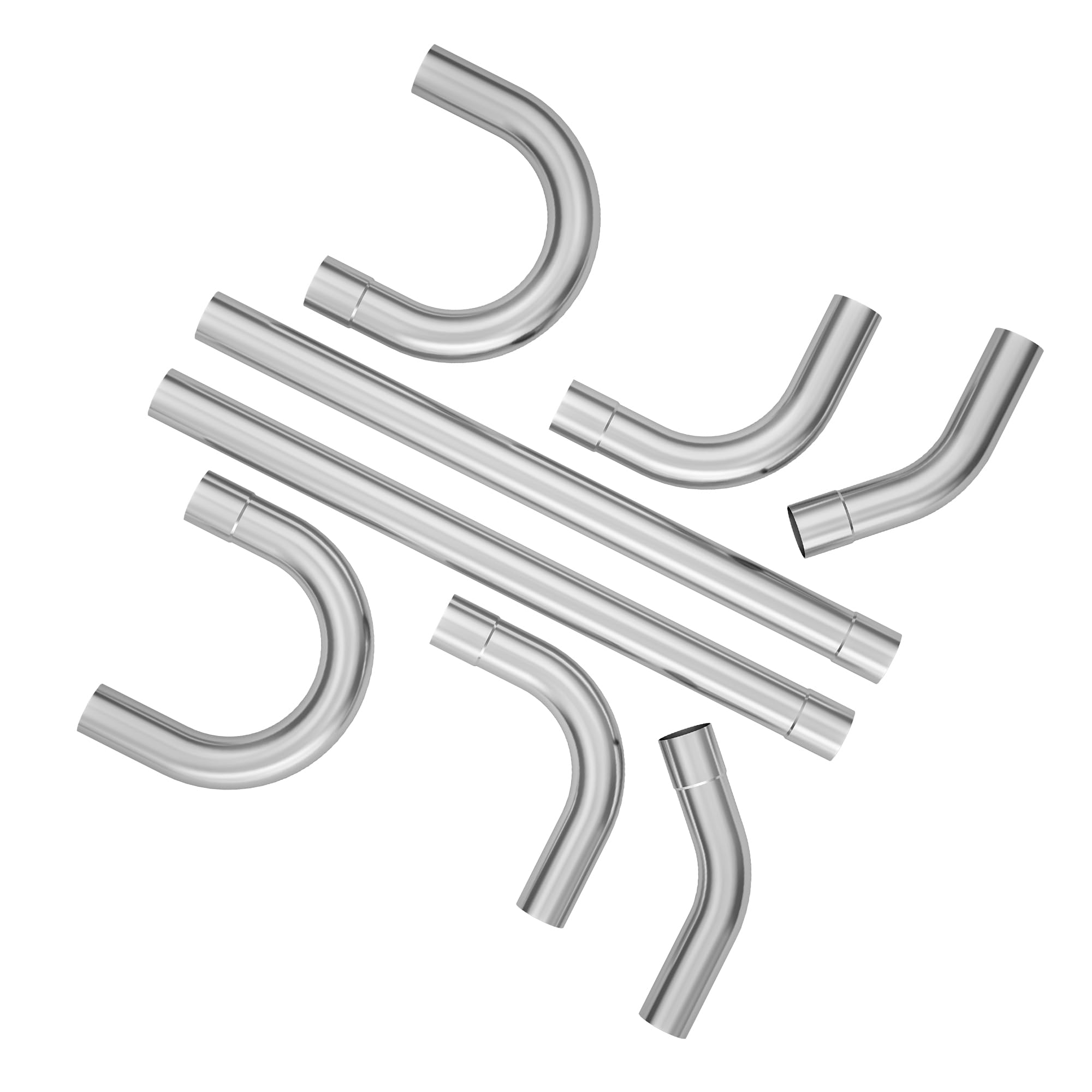
How To Choose The Best Mandrel Bent Exhaust Kit
Your first decision is pipe diameter, because every other choice hangs off it. A 3-inch outside-diameter kit moves more exhaust volume and suits bigger, higher-output engines. A 2.5-inch kit is the common middle ground for daily drivers and mild builds, and it keeps ground clearance a little better underneath. Measure your existing piping or your header collector outlet before you order anything — mixing a 3-inch elbow into a 2.5-inch run means a reducer you did not plan for.
Outside diameter and wall gauge rise together in importance
Gauge is the wall thickness of the pipe, and it works backwards from what most people expect: a 16-gauge wall is thicker and heavier than an 18-gauge wall. Thicker walls weld with more forgiveness and resist burn-through when you are learning. They also dull the tinny ring that thin pipe can produce. The catch is weight and cost, which is why 18-gauge kits stay popular for lighter builds.
Mild steel versus T304 stainless
Low-carbon mild steel is the budget-friendly route: easy to weld, easy to shape, and it takes paint or high-temp coating well. Stainless steel costs more but brings built-in corrosion resistance, which matters if your car sees road salt or wet weather. Either way, mandrel bends keep the diameter constant through the curve — the whole point of buying a bend kit instead of letting a shop crush-bend generic pipe.
Count the bends against your actual routing
Look at where your exhaust has to travel. An 8-piece kit with straights plus 45, 90 and 180-degree pieces covers most rear-section work. If you are running a full system from the headers back, a 16-piece kit saves you from ordering a second box halfway through the job. Flared or expanded ends make the pieces slip together for tack welding, which speeds up mock-up enormously.
Side-by-Side Comparison
| Model | Best For | Pipe Diameter | Wall Gauge | Material | Amazon |
|---|---|---|---|---|---|
| DNA MOTORING ZTL-30RAW-8P★ Best Overall | Full 3-inch builds on a budget | 3.0″ OD | 18-Gauge | Mild Steel | Amazon |
| Jaxilyn 8PCS Mild Steel KitBest Value | Longer straight runs up front | 3″ OD | 16 gauge | Mild Steel | Amazon |
| LCGP 2.5 Inch 8 Pcs Kit | Smaller-diameter daily drivers | 2.5″ OD | — | Mild Steel | Amazon |
| JY PERFORMANCE T304 Kit | Rust resistance in a 2.5″ build | 2.5″ OD | 16-Gauge | T304 Stainless | Amazon |
| DNA MOTORING ZTL-25SS-8P | The all-rounder starter kit | 2.5″ OD | 18-Gauge | Stainless Steel | Amazon |
| FGJQEFG 4 Inch 4PCS Kit | Big 4-inch diesel and custom runs | 4″ OD | — | T304 Stainless | Amazon |
| A-KARCK Mild Steel 16 Pcs | A whole system in one box | 2.5″ OD | — | Mild Steel | Amazon |
Detailed Reviews
1. DNA MOTORING ZTL-30RAW-8P Exhaust Tubing Kit
Our pick — 4.5+★ from 250+ verified ratings; the strongest balance of quality and price.
Eight pieces of 3-inch mild steel that cover almost any routing you sketch out.
For a 3-inch build that still has to make sense on a real budget, this is the box to open first. You get 2 straight pipes at 48 inches, 2 ninety-degree, 2 forty-five-degree and 2 one-hundred-eighty-degree U-bends, all with a 3.0″ outside diameter and 18-gauge walls.
The computerized mandrel bends keep that 3-inch inner diameter steady right around the curve — no pinched corner, no bottleneck where flow drops. Every end is slip fit, so you can mock the whole system up and tack it before you commit to a full weld. Weldability is clearly why this kit keeps its reputation: the low-carbon steel takes a bead cleanly and the pieces join up predictably.
The honest catch is corrosion: 18-gauge mild steel has no built-in rust protection. These are mild steel, so if your car lives through salted winters, plan on a high-temp coating or accept surface rust down the line — this is the one area where buyers flag weathering. Fit it, weld it, coat it, and this 3-inch mild-steel kit covers the same bend shapes as a pricier stainless set for far less money.
What earns its place up top
- Eight-piece spread covers straights plus 45, 90 and 180-degree bends in one order
- 3.0″ OD with 18-gauge walls gives solid weld forgiveness for DIY hands
- 48-inch straights mean fewer splices on long runs
- Slip-fit ends make mock-up and tack welding quick
The trade-off to know about
- Low-carbon mild steel will surface-rust — a coating is smart
- Universal kit, so expect to cut and trim to your own lengths
Built for: anyone running a full 3-inch system at home who wants every bend shape in a single buy.
Think twice if: you need a bolt-on finish with zero fabrication — this is raw fabrication material.
2. Exhaust Pipe Kit 3 Inches 8PCS
Thicker 16-gauge walls that soak up amateur weld heat without burning through.
Wall thickness is where this Jaxilyn kit separates itself. The 16 gauge walls are heavier than the 18-gauge tubing on the DNA kits above, which means more metal at the joint and a pipe that stands up better to a hot arc. If your welding is still developing, that extra thickness is forgiving in the exact spot where beginners blow a hole. The trade is a bit more weight in the box and a slightly duller ring when you tap the 16-gauge pipe.
You still get the full spread: 2 straights at 43 inches, 2 ninety-degree, 2 forty-five-degree and 2 one-hundred-eighty-degree U-bends, all in 3″ OD with flared ends for slip fit. The bends are smooth and mandrel-formed, so the diameter tracks true through every curve. Working with the pieces is straightforward once the ends are expanded, and the smooth spin of the mandrel bend makes tacking up a clean line easy.
Mild steel means the same reality as the DNA kit — surface rust is on you to manage with a coating. Coat it or keep the car dry, and it will last. The thicker wall is the reason to pick this one over a cheaper 18-gauge set if you are welding with a hobby-grade machine.
Why the thickness matters: 16-gauge walls take more heat before they warp, so a beginner’s bead stays truer on the 3-inch tubing.
One plain caveat: it is low-carbon mild steel with no built-in rust protection, so plan a coating step into the job.
Hop on this one if: you want the extra weld margin of 16-gauge in a 3-inch DIY kit.
Leave it for the stainless crowd if: salt-weather driving is in your car’s future.
3. 2.5 Inch Exhaust Pipe 8 Pcs
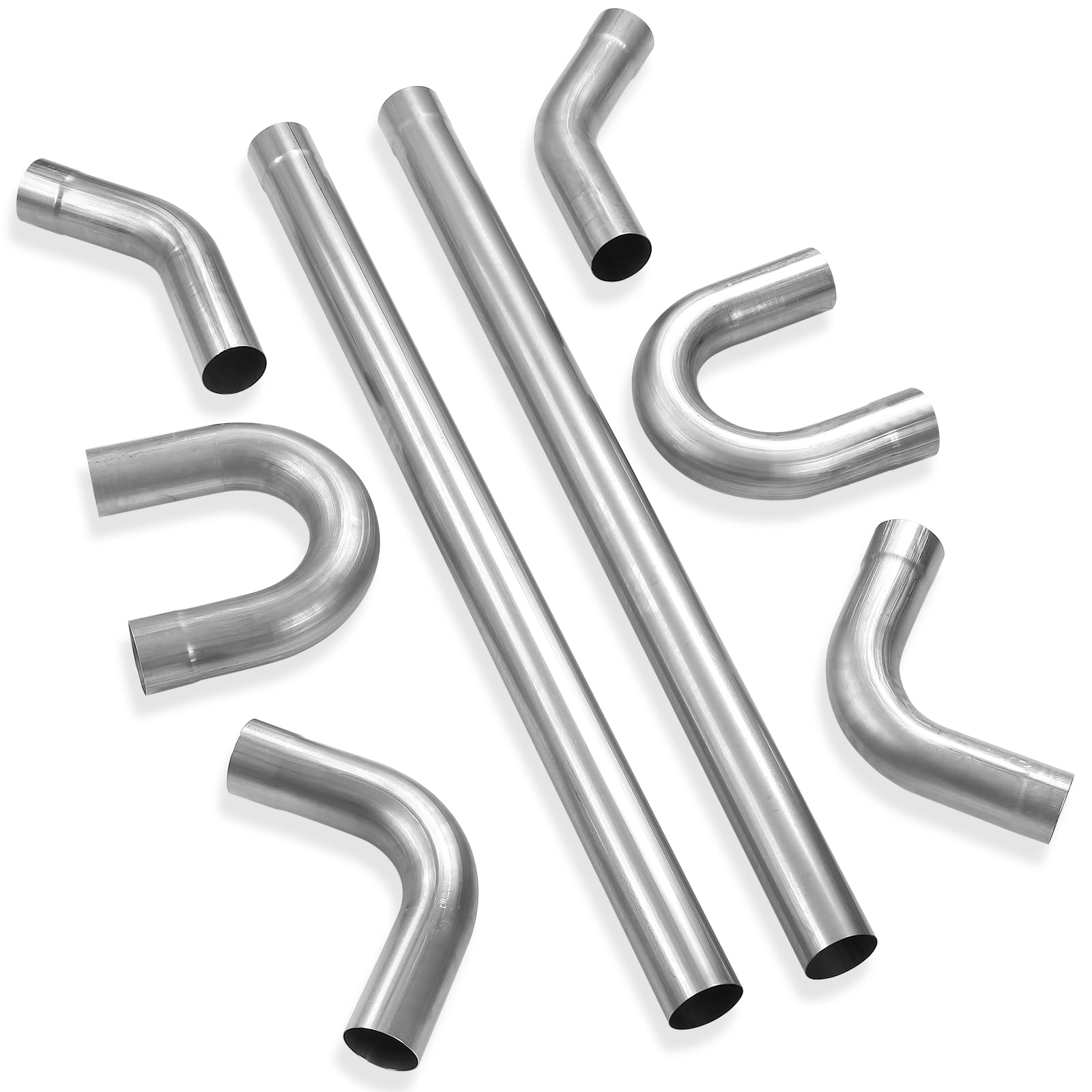
The kit that slips together with a satisfying click before you even strike an arc.
Where this LCGP set wins people over is how the pieces meet. Each pipe has a flared end, so the male and female ends slide into each other cleanly during mock-up instead of fighting you. You get 2 straight tubes, 2 ninety-degree, 2 forty-five-degree and 2 one-hundred-eighty-degree U-bends in 2.5″ OD along with the matching inside diameter at one end, all built with computer-controlled mandrel bending so the curve keeps its shape.
For a smaller-diameter daily-driver build, 2.5 inches is the sensible middle. It keeps the pipe tucked out of the way better than a 3-inch run and still flows plenty for a mild street setup. Assembly is the standout here — the flared ends and honest fit are what buyers praise most, and welders find the low-carbon mild steel easy to put a bead on.
Material is the mixed note in the reviews, with some picking up that this is mild steel and expecting more. That is the honest fit note: it is a mild-steel kit, so treat rust prevention as your job, not the kit’s. Coated and kept dry, the 2.5-inch diameters and clean 45s and 90s make a tidy exhaust run.
What people sing about
- Male and female flared ends slide together neatly for easy mock-up
- 2.5″ OD suits mild street builds and keeps clearance tight
- Computer-controlled mandrel bends hold the diameter
- Simple, confidence-building fit and weld ability
Where it asks more of you
- It is mild steel, so rust protection is on you
- A few would like more 45-degree pieces in the box
If tidy fitment is your priority: this is the one — the flared slip-on ends do the heavy lifting.
Not the one for you if: you need stainless rather than mild steel.
4. 2.5 Inch T304 Stainless Steel Exhaust Pipe Kit

Real T304 stainless with 16-gauge walls, built to shrug off road salt.
If rust was the worry that kept you up at night with the mild-steel kits, this JY Performance set answers it with genuine T304 stainless steel. It comes with 2 straights at 47.3 inches, 2 ninety-degree, 2 forty-five-degree and 2 one-hundred-eighty-degree U-bends in 2.5″ OD, all with 16-gauge walls. The finish comes through with a shine — the straight sections look almost polished, and the whole thing is heavier built than a mild-steel kit of the same shape.
Functionality is where it earns its keep. The expanded slip-fit ends make it easy to tack pieces together, and the stainless holds up without the constant worry of surface rust. On the bend side, the mandrel bends are not perfect — the recurring gripe is a wavy or haggard look on some corners, and a few find the joints loose enough to need careful fitting. It is worth checking each bend before you weld and accounting for a smidge of extra file work.
For a 2.5-inch street exhaust that sees salted winter roads, the T304’s built-in rust resistance pays off over the years. Expect to do a little more dry-fitting than on a cheaper 18-gauge mild set, but the metal itself is what you are buying here.
The material payoff: T304 stainless with 16-gauge walls means rust resistance is built in, so wet-weather driving is far less of a worry.
The bend caveat: the mandrel bends are the weak spot, so inspect every corner and be ready to file a sloppy joint before welding.
The winter-proof choice: T304 stainless in a 2.5-inch kit for anyone driving through salted roads.
skip it if: perfect out-of-the-box bends are your top demand — you will fiddle more here.
5. DNA MOTORING ZTL-25SS-8P Exhaust Tubing Kit

Stainless at 2.5 inches with the longest straights of any 8-piece kit here.
Comparing straight pipes is a quick way to see where this DNA kit pulls ahead. Its straights run 48 inches, against the 40-inch straights on the FGJQEFG 4-inch kit — 20% more tube on the long runs, so fewer splices on a full system. That matters when you are laying exhaust from the headers back, since every extra seam is another weld to clean up and another potential leak point.
You get 2 straights at 48 inches, 2 ninety-degree, 2 forty-five-degree and 2 one-hundred-eighty-degree U-bends in a 2.5″ OD with 18-gauge stainless steel walls. The computerized mandrel bends hold the diameter consistent around each curve, keeping flow smooth. Slip-fit joints make fabrication easy, and the stainless steel resistance to rust is the reason buyers gravitate here — it holds up without the surface-rust nag of the low-carbon kits. Welding with a MIG setup is the usual route, and it behaves well on that front.
One piece of housekeeping: this is stainless steel tubing, but it is still thin-wall material, so treat it like the fabrication stock it is. It is a strong all-rounder rather than a rugged commercial-grade pipe. For most home builders running 2.5-inch stainless, that balance of durability and workability is exactly right.
Standout strengths
- 48-inch straights give more length than the 40-inch FGJQEFG kit
- Stainless steel resists rust for wet-driving cars
- 18-gauge walls weld clean with a MIG setup
- Full set of 45, 90 and 180-degree mandrel bends
Honest limitations
- Still thin-wall fabrication tubing, not heavy commercial pipe
- Universal fit means cutting to your own lengths
The safe all-rounder: stainless durability, full bend assortment and the longest straights here.
Not for you if: you need a 3-inch or 4-inch diameter rather than 2.5.
6. 4 Inch Mandrel Exhaust Pipe 4PCS

Four big 4-inch stainless pieces for diesel stacks and custom fat-pipe runs.
This is the diameter play. At 4″ OD, it is 60% wider than the 2.5″ OD on the LCGP and DNA stainless kits, and that size is what big diesel and high-volume builds need. You get a compact 4-piece assortment — 1 straight at 40 inches, 1 forty-five-degree, 1 ninety-degree and 1 one-hundred-eighty-degree piece — all in T304 stainless steel with a polished finish that looks sharp as it goes on.
Compared to the 8-piece kits, the piece count is the thing to plan around. It is 4 pieces against the 8 in the DNA ZTL-25SS-8P, so you get a full mix of bend angles but half the spare tubing. Measure your routing in advance so you know a 4-piece set covers it. The polished T304 resists corrosion and oxidation, and the mandrel form keeps the 4-inch diameter intact through the curve.
Two things to note before you commit. The bends themselves get mixed feedback — some of the ninety-degree pieces come in a few degrees shy of a true 90, so check your angles before welding. And the durability chatter includes fast-rust reports, which is worth weighing if the pipe is staying bare. Test-fit, coat bare metal, and this delivers serious diameter for a custom build.
The draw: a genuine 4″ OD in polished T304 stainless, at 60% wider than the 2.5-inch kits — real volume for diesel and custom systems.
Plan around this: only 4 pieces come in the set, and some of the 90-degree bends run a few degrees off true.
For the big-bore builder: diesel and custom fat-pipe runs that need a true 4-inch diameter in stainless.
Look elsewhere if: a full-system routing needs more than 4 pieces, or if you want perfect 90s straight from the box.
7. Mild Steel Mandrel Bends 16 Pcs
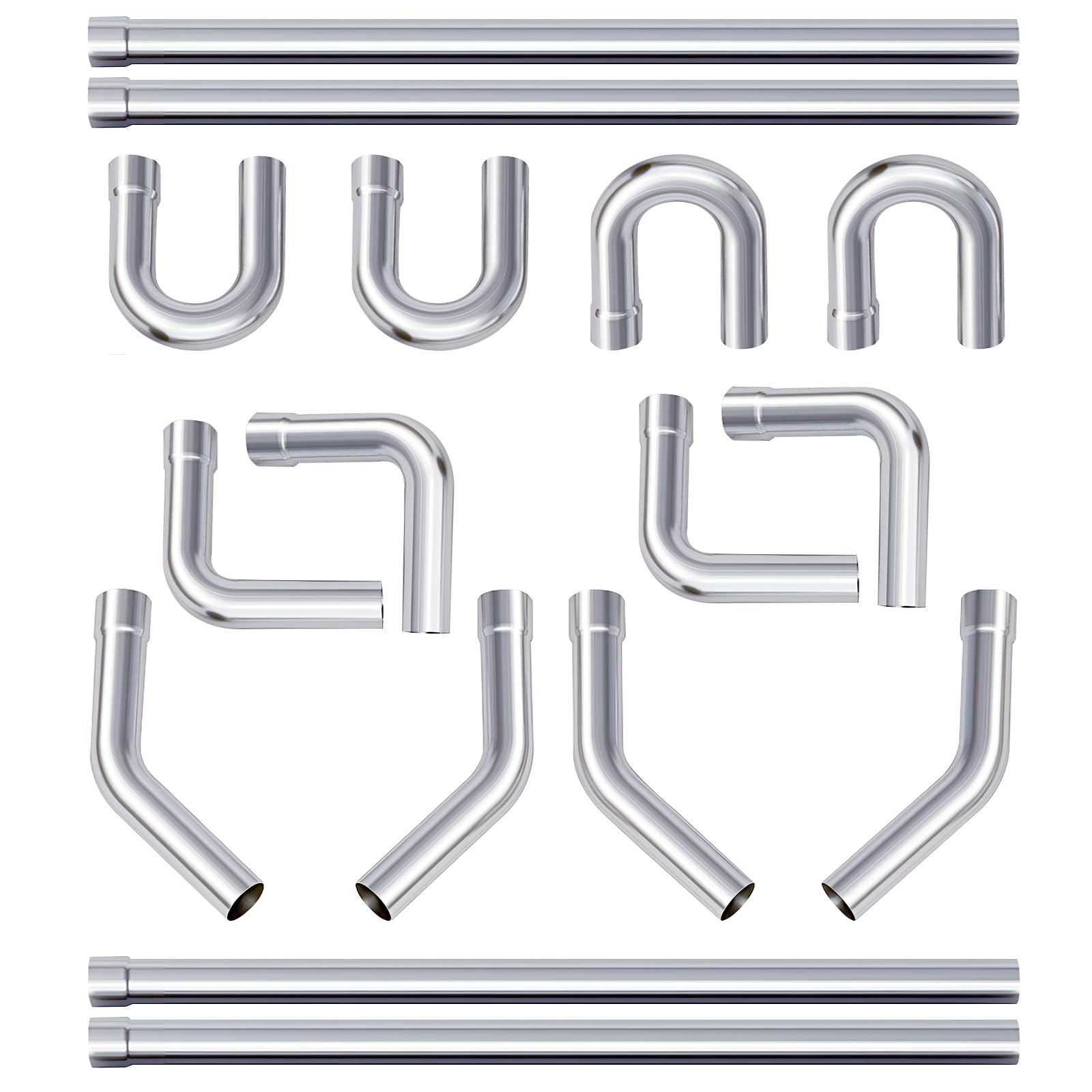
Sixteen pieces in one box — enough mild steel to run a whole system your way.
Piece count is the whole pitch here. You get 4 straights at 30 inches, 4 ninety-degree, 4 forty-five-degree and 4 one-hundred-eighty-degree U-bends, all in 2.5″ OD low-carbon mild steel with computer-controlled mandrel bends. That is the largest assortment on this list, and it means you can tackle a full exhaust run without a second order interrupting the job. The flared ends slide on for easy mock-up, and every pipe can be cut and welded to whatever length you need.
The 30-inch straights are shorter than the 48-inch runs on the DNA kits, so plan on joining a couple of pieces for the long sections. What you trade in single-piece length, you gain in raw variety — four of each angle leaves room for mistakes and re-cuts, which is exactly what a first full build tends to need.
It is mild steel, so rust prevention is part of the job, same as any low-carbon kit. Coat it once it is built and it holds. For anyone who wants a big pile of mandrel-bent pieces to design freely around, this is the practical pick.
The bulk-builder advantage: four of every bend angle plus 30-inch straights gives you room to cut, re-cut and experiment across a full system.
The mild-steel reality: no built-in rust protection, so a coating step goes in the plan.
The setup for a first full build: 16 pieces in 2.5-inch gives you variety to spare and mistakes to learn from.
Opt for stainless instead if: your car faces wet, salted roads year-round.
Know the Specs
Mandrel Bend Versus Crush Bend
A mandrel bend is formed by pulling a flexible mandrel through the pipe as it curves, so the pipe keeps its inside diameter all the way around the corner. That means exhaust gas never pinches into a narrow neck at the bend. A crush bend is just squeezed, and the wall collapses inward at the corner — fine for a lawnmower, wrong for a performance exhaust. Every kit on this list uses computerized mandrel bends, which is why they all hold their shape through the 45, 90 and 180-degree pieces.
Gauge, Diameter and Material
Gauge measures wall thickness, and a lower number means thicker metal — 16-gauge is heavier than 18-gauge. Thicker walls weld with more forgiveness and resist warping under heat, at the cost of weight. Outside diameter (OD) sets how much exhaust the pipe can move, and mixing 3-inch and 2.5-inch pieces means adding reducers. Mild steel is easy to weld but needs coating to stop rust, while T304 stainless brings corrosion resistance and costs more. Match material to the weather your car sees and the diameter to your engine’s output.
Common Questions
What is the difference between mandrel bent and crush bent exhaust pipe?
Should I pick a 2.5-inch or 3-inch exhaust kit?
Is mild steel or T304 stainless better for a DIY exhaust?
What does 16-gauge versus 18-gauge mean for exhaust tubing?
Will a universal exhaust kit fit my specific vehicle?
Can I weld these exhaust pipes at home?
How do I stop mild steel exhaust pipe from rusting?
Why are some 90-degree bends not a true 90 degrees?
Do I need flared or expanded ends on my exhaust tubing?
Is a 4-inch exhaust kit too big for a standard car?
The Bottom Line
For most home builders, the mandrel bent exhaust winner is the DNA MOTORING ZTL-30RAW-8P because eight pieces of sturdy 3-inch 18-gauge mild steel cover straights, 45s, 90s and 180s in one order at a fair outlay. If you want stainless durability without chasing a bigger diameter, the DNA MOTORING ZTL-25SS-8P gives you 2.5-inch stainless with the longest straights here. And for a whole-system build with room to spare, the A-KARCK 16-piece mild steel kit is the one to reach for. One last nudge: buy the diameter and material that match your car, coat any mild-steel pieces, and these kits’ weldability and fit will hold up.
How we choose
We do not accept paid placement. Every pick is matched to a real buyer and a real use-case; we do not hands-on test units.
Sources
Specifications: manufacturer listings and product documentation. Review insights: verified customer reviews, as of November 2026. Pricing: not shown on this page (it changes often); check the current price via the retailer link.
As an Amazon Associate, Tactical Gear Guy earns from qualifying purchases. This does not affect which products we feature.