Specs are compiled from manufacturer listings and verified buyer reviews and can change over time — please confirm the key details on the product page before buying.
Here is the short answer: buy the unit with the higher star score, not the biggest BTU number on the box. A portable air conditioner rated 14,000 BTU can still leave a room sticky if it breathes through a single hose, and a well-built 10,000 BTU model can cool a bedroom beautifully. What actually matters is hose design, the decibel rating, and whether the app holds a connection two walls from your router.
This guide is built by comparing the manufacturers’ published specifications and the patterns across verified customer reviews, so you get each pick’s real strengths and trade-offs instead of marketing spin.
You will see the hose count, the square-footage rating, and the decibel figure side by side, so the trade-offs are obvious before you commit. Below is a practical rundown of the best portable WiFi air conditioner for a real bedroom, office, or apartment.
Top Picks

How To Choose The Best Portable WiFi Air Conditioner
The WiFi part is the easy part — almost every unit here talks to an app. The hard part is picking the machine behind that app. Get these four right and the unit holds its set temperature; get them wrong and you spend August fighting a hot box.
Count the hoses before you count the BTU
A single-hose portable air conditioner pulls room air in, cools it, and blows the hot exhaust out the window. That exhaust has to be replaced, so outside air gets sucked back in through every gap around your door. A dual-hose design separates the intake and exhaust, so it stops dragging conditioned air outside with it. The ZAFRO and the Whynter 14,000 BTU both run dual hoses, and the Midea Duo goes a step further with a hose-in-hose design.
Match the square-footage number to the room you actually have
Every listing here states a floor area in square feet, and that figure is the one to compare against your measured room. The 14,000 BTU Temprium claims 750 square feet, while the DREO 14,000 BTU states 200 square feet — same BTU badge, wildly different claimed coverage. BTU figures get measured under different standards, so read the square-footage line, not the badge.
Read the decibel figure the way you read a whisper
Decibels are a sound-pressure measure, so a smaller number is quieter. A normal conversation sits around 60 dB, so anything in the low 40s is genuinely quiet for a compressor-driven appliance. The ZAFRO lists 42 dB, the Temprium lists 41 dB, and the DREO claims 42 dB. Check whether the number is quoted for Silent Mode or Sleep Mode, because that is the setting you will actually sleep through.
Know when self-evaporation stops working
A self-evaporating system throws collected moisture onto the hot condenser coil so it evaporates out the exhaust. That works well in ordinary summer humidity and stops being enough when the air gets truly muggy. The ZAFRO is rated drainage-free for 72 hours below 90% humidity and ships a drain hose for the rest of the time. The DREO makes the same under-90%-humidity promise. Keep the drain hose handy either way.
Side-by-Side Comparison
| Model | Best For | Cooling Power | Floor Area | Noise Level | Amazon |
|---|---|---|---|---|---|
| ZAFRO Smart Inverter 14,000 BTU★ Best Overall | Whole-room cooling in a bedroom | 14,000 BTU | 550 sq ft | 42 dB | Amazon |
| SereneLife 10,000 BTU WiFiBudget Champion | Budget-friendly bedroom coverage | 10,000 BTU | 450 sq ft | — | Amazon |
| Temprium 14,000 BTU 4-in-1Most Coverage | Large open-plan rooms | 14,000 BTU | 750 sq ft | 41 dB | Amazon |
| Westinghouse 14,000 BTU with Heat | Year-round heating and cooling | 14,000 BTU | 700 sq ft | 52 dBA | Amazon |
| Whynter ARC-1030WN 12,000 BTU | Smaller rooms and tight spaces | 12,000 BTU | 500 sq ft | — | Amazon |
| GrowthWing 14,000 BTU Smart | Fast cool-down in a large room | 14,000 BTU | 700 sq ft | 42 dB | Amazon |
| Whynter ARC-1230WN 14,000 BTU | Big rooms that need real airflow | 14,000 BTU | — | — | Amazon |
| Midea Duo 14,000 BTU with Heat | Four-season use with low running cost | 14,000 BTU | — | — | Amazon |
| DREO 14,000 BTU Dual-Hose Inverter | Drainage-free summer in a bedroom | 14,000 BTU | 200–300 sq ft | 42 dB | Amazon |
Detailed Reviews
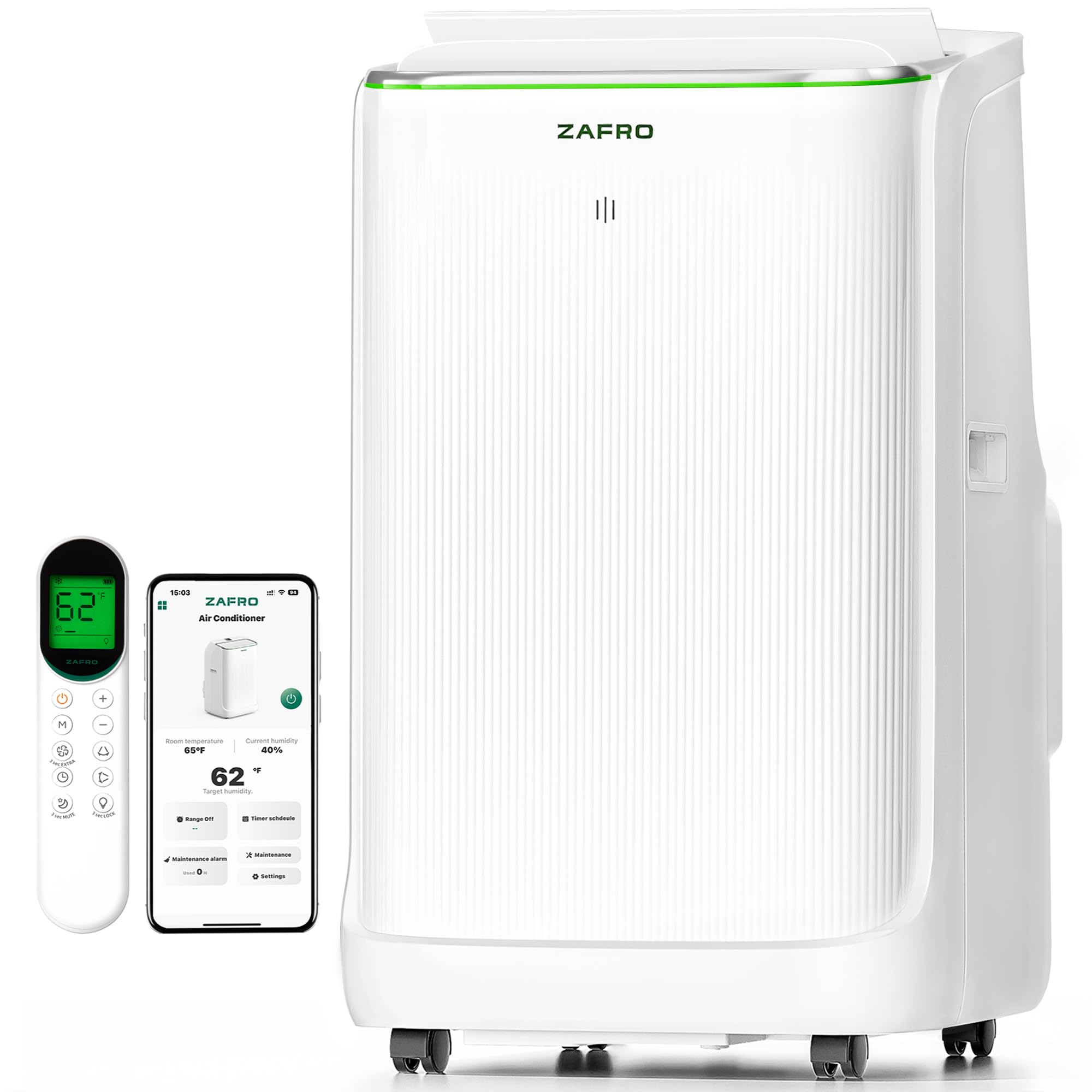
1. ZAFRO Smart Inverter Portable Air Conditioners 14000 BTU
Our pick — 4.0+★ from 500+ verified ratings; the strongest balance of quality and price.
The inverter dual-hose unit that cools a bedroom in about two hours without waking it.
For a bedroom you want cold and quiet at the same time, this is the pick. It runs 14,000 BTU through a dual-hose setup, which means the intake and exhaust are separate hoses — so it stops pulling your already-cooled room air out the window. Airflow is rated at 390 cubic meters per hour, and owners describe a bedroom reaching its target temperature in about two hours. The Extra Mode is the emergency button: it locks the temperature at 61 degrees Fahrenheit and runs full power when a heat wave wins.
The inverter compressor is the reason the power draw stays sane. Instead of slamming on and off all day, it modulates frequency to hold your set temperature, and the unit earns a CEER of 12.8 — a cooling efficiency ratio that sits well above the 7.83 standard the maker cites. Annual energy consumption is listed at 942 kilowatt hours per year. Compare that to the Temprium at 938 kilowatt hours per year and you can see the two are running neck and neck on running cost, though the ZAFRO does it while covering 550 square feet against the Temprium’s 750.
Two practical things set it apart from the cheaper picks. First, the self-evaporating system is rated drainage-free for 72 hours in humidity under 90%, and a drain hose is in the box for the muggy days. Second, control is genuinely four-way: the ZAFRO app, a physical remote, the touch panel, and scheduling through a 24-hour timer. Owners even run it from a Galaxy Watch. Meanwhile the Westinghouse lists 52 dBA, so at 42 decibels this one is the quieter machine for a room you sleep in.
What wins people over
- Dual-hose design keeps conditioned air inside the room instead of venting it
- 42 dB operation plus a Sleep Mode that drops compressor and fan speed together
- Drainage-free for 72 hours below 90% humidity, with a drain hose included
- App, remote, touch panel and 24-hour timer cover every control habit
- Inverter compressor rated at a CEER of 12.8
Where it asks for patience
- 550 square feet of coverage sits below the 700 and 750 square foot claims on two rivals
- Full-power Extra Mode is loud by design, so it is a daytime tool rather than a sleep setting
- The window panel kit is a multi-piece install, not a single slide-in plate
Reach for this if: you want one machine to cool a bedroom quietly, hold a temperature overnight, and start cooling before you get home from the app.
Look elsewhere if: your room is closer to 700 square feet, where the Temprium or GrowthWing claim more coverage.
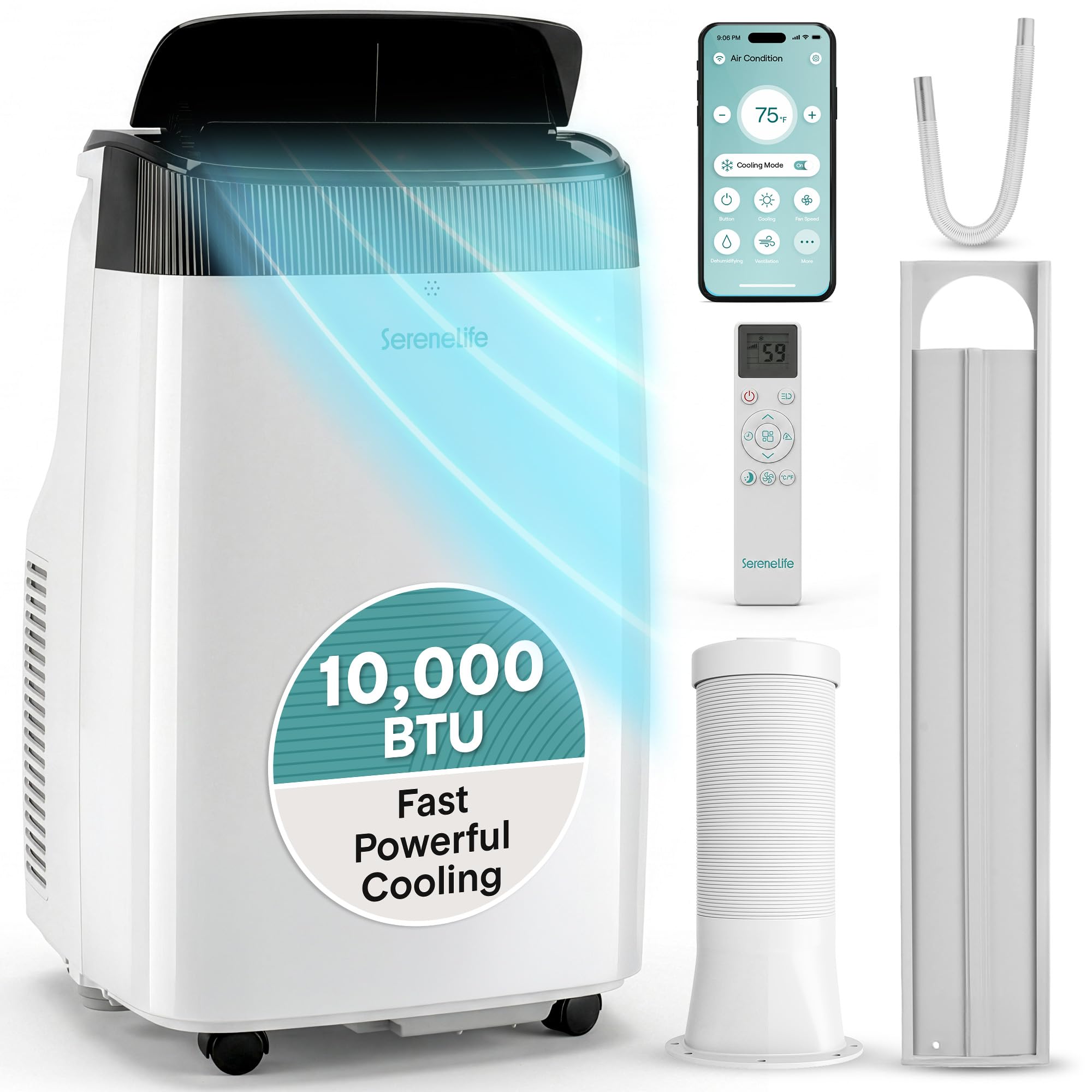
2. SereneLife Portable Air Conditioner 10000 BTU
Ten thousand BTU, three modes, and wheels — the entry ticket to app-controlled cooling.
Here is the honest arithmetic on this one. It delivers 10,000 BTU across 450 square feet, which makes it the smallest coverage claim in this lineup. The Temprium covers 750 square feet from 14,000 BTU, and the Whynter dual-hose model covers 500 from 12,000. So buy this for a bedroom, an office, or a single room — not for an open-plan living area. What you get in exchange is a genuinely simple machine: cool, fan, and dehumidify from one freestanding box, pulling up to 1.2 liters of moisture out of the air per hour.
Installation is where this earns its keep. The window kit, exhaust hose, hose connector, and drain pipe all come in the box, and it plugs into a standard outlet with no mounting. Casters let you roll it between rooms, and the whole body is 14 x 15 x 24 inches, so it tucks into a bedroom corner. The washable filter pulls out for a rinse, and the metal control box is there for fire and explosion protection — a detail note if you are nervous about a compressor running overnight.
Set your expectations on sound. Noise is the split verdict here, with plenty of owners saying it runs quietly and a real share finding it loud. Treat it as a normal portable AC, not a silent one. Cooling and ease of install are what carry the machine. There is also a 24-hour timer and a remote, so you can program it to shut off after you fall asleep.
Where the money goes: the three-in-one mode set, the rolling casters, and a complete window kit — not BTU headroom. If your room is under 450 square feet, you are not paying for capacity you cannot use.
The one honest caveat: running sound splits opinion, so plan on Sleep Mode and a closed bedroom door rather than expecting library silence.
Suits you if: a single bedroom or home office needs affordable app-controlled cooling and you want it running the same afternoon.
Think twice if: your space runs past 450 square feet, where you need more cooling power than 10,000 BTU provides.
3. Temprium 14,000 BTU Portable Air Conditioner
Seven hundred fifty square feet from a 41-decibel box — the biggest cooling claim here.
If your room is large, start here. This is the only unit in the lineup claiming 750 square feet. That is the number that pushes the SereneLife’s 450 square feet and the ZAFRO’s 550 out of contention for an open-plan space. It gets there with a dual motor compressor pushing 400 CFM, which is a measure of how much air moves through the unit per minute. The 14,000 BTU matches the ZAFRO, but the airflow volume is what spreads that cold across a bigger room.
The noise claim is the standout spec. It runs at 41 decibels in Silent Mode — lower than the ZAFRO’s 42 and well under the Westinghouse’s 52 dBA. Sleep Mode goes further and dims every light, including a display you can switch off entirely, then holds your set temperature through the night.
Control is the other strength. You get the TEMPRIUM app, Alexa and Google Assistant voice commands, a remote, and an LED touch panel — four routes to the same settings. The no-drill window kit fits frames from 20.5 to 50 inches, so renters can install it without touching the frame. The self-evaporating system cuts down on manual draining in normal cooling conditions, and the washable mesh filter pops out for a rinse. One caveat worth knowing: some buyers report trouble with Google Home compatibility, so if your smart home runs on Google, plan on using the app instead.
The coverage argument: 750 square feet at 41 decibels is the strongest combination of reach and quiet in this group. Nothing else here claims both.
Set-up reality: the no-drill window kit and 360-degree wheels make it a ten-minute job, which is why owners rate the setup so highly.
Worth flagging: Google Home pairing is the weak link in the smart chain — the app itself is the reliable route.
Built for: a living room or open-plan space where the unit has to push cold air across real distance.
Not the pick if: you live entirely inside the Google Home ecosystem and want voice control to be your main interface.
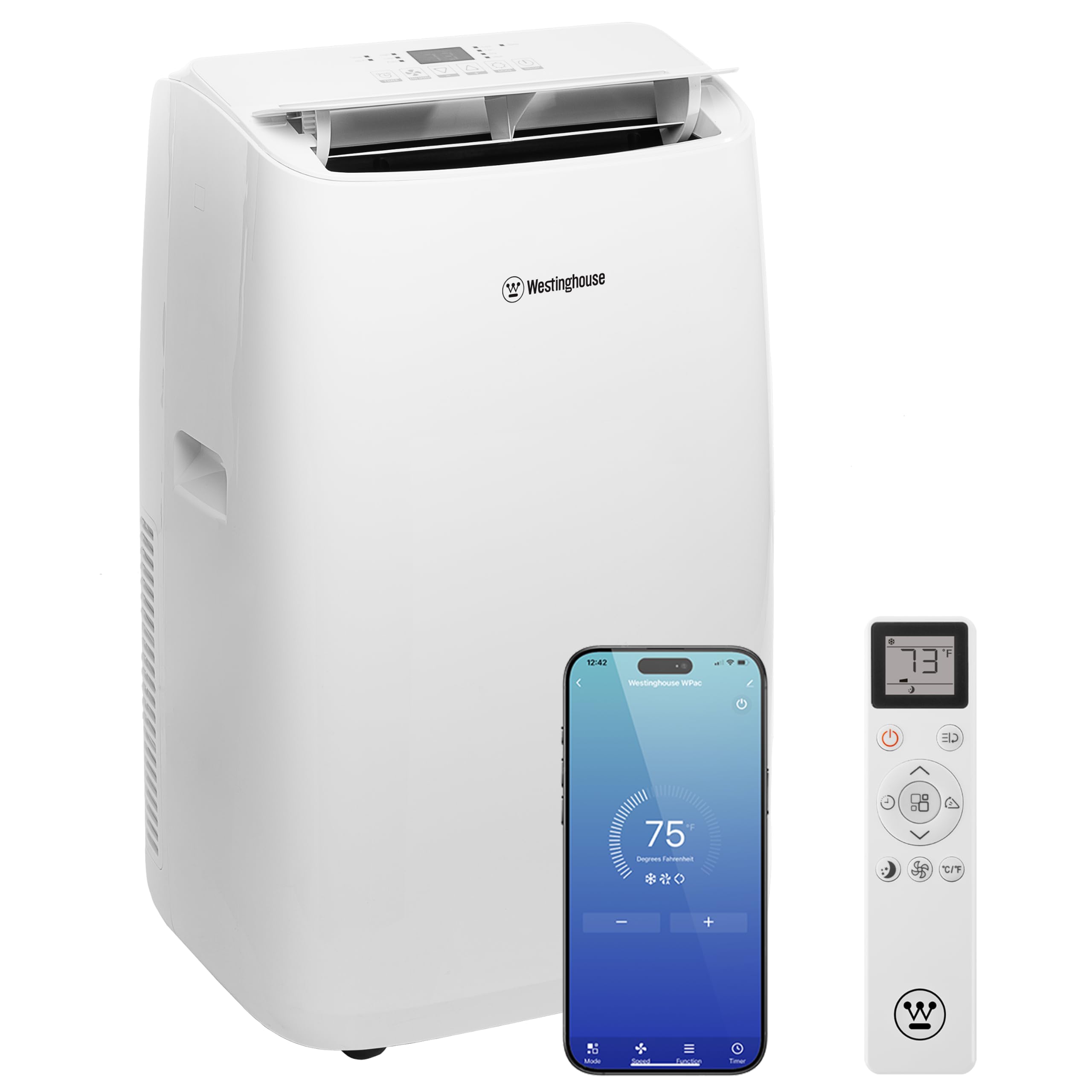
4. Westinghouse 14,000 BTU Air Conditioner with Heat Mode
A four-mode box that cools in July and heats in October from the same footprint.
Most portable ACs are one-season machines. This one runs four modes — cool, fan, dry, and heat — so it earns floor space all year. That four-mode range is the whole case for it if you have a cabin, an RV, or a room that gets cold as well as hot. Coverage is 700 square feet, which puts it ahead of the ZAFRO’s 550 and behind only the Temprium’s 750. As a dehumidifier it pulls 90 pints of moisture per day in spaces up to 4,000 square feet, so a damp basement is within its job description too.
Setup is genuinely quick: connect the exhaust hose to the unit and the window panel, tighten the quick-adjust knob, and you are done in about five minutes. The window panel is built for double-hung or sliding windows. Control comes three ways — a remote with a stated 20-foot range, a smartphone app, or the top touch panel. Annual energy consumption is listed at 500 kilowatt hours per year, which is the lowest figure in this entire lineup against the ZAFRO’s 942 and the Temprium’s 938.
The trade-off is honestly reported and worth taking seriously. Some owners mention reliability trouble — units that stop working, or a heater that does not function correctly — and a smaller group mentions durability concerns. Given this is a heat pump doing double duty, treat the warranty as part of the purchase and register it. Noise is also split: some find it super quiet, others find it very noisy, and at 52 dBA it is the loudest unit here by its own spec sheet.
The four-season case: cooling, fan, dehumidifying, and heating from one unit that plugs in like a fridge.
Running cost: 500 kilowatt hours per year is the lowest annual figure on this list by a wide margin.
The honest catch: reliability reports run mixed, and at 52 dBA this is not the machine for a light sleeper’s bedroom.
Go here for: an RV, cabin, or bonus room that needs both warm and cool air from the same box.
Skip it for: a bedroom where silence is the priority and you only ever need cooling.
5. Whynter ARC-1030WN Portable Air Conditioner

The tower-shaped inverter that keeps a smaller room steady instead of blasting it.
Twelve thousand BTU into 500 square feet is a sensible ratio — enough capacity that the compressor is not permanently redlined, small enough that a modest bedroom is genuinely covered. The dual-hose setup is the headline engineering choice. Separate intake and exhaust hoses mean the unit stops pulling your conditioned indoor air outside, which is the single biggest reason a portable AC fails to hold its set temperature. The inverter compressor then modulates output smoothly instead of cycling hard on and off all day.
Its form factor is what separates it from everything else here. This is a tower-format unit, not a wide box, so it fits into the narrow gap beside a dresser or the sliver of floor next to a desk. Cooling speed is the spec owners call out most — it gets a room down quickly rather than grinding away for an hour. There is a built-in dehumidifier, so a humid room gets handled without buying a second appliance, and the washable filter pulls out for cleaning.
Smart control covers the phone through the WiFi app, plus voice control, which means a temperature change without getting off the couch. The area where buyers split is installation: some find it easy to set up, others wish the instructions were clearer. Budget a little extra patience for the window panel and the two hoses, especially if your window is an unusual size. Energy consumption is listed at 1,000 kWh per year.
The footprint play: a tower body plus dual hoses is a combination none of the wide-box units here can match.
Cooling behaviour: rapid pull-down, then a stable hold — which is exactly what an inverter is for.
Read the manual twice: the hose and window assembly is where patience gets tested.
Pick this when: floor space is tight and you still want dual-hose efficiency in a 500 square foot room.
Don’t pick it if: you want a single-hose, ten-minute install with no second hose to route.
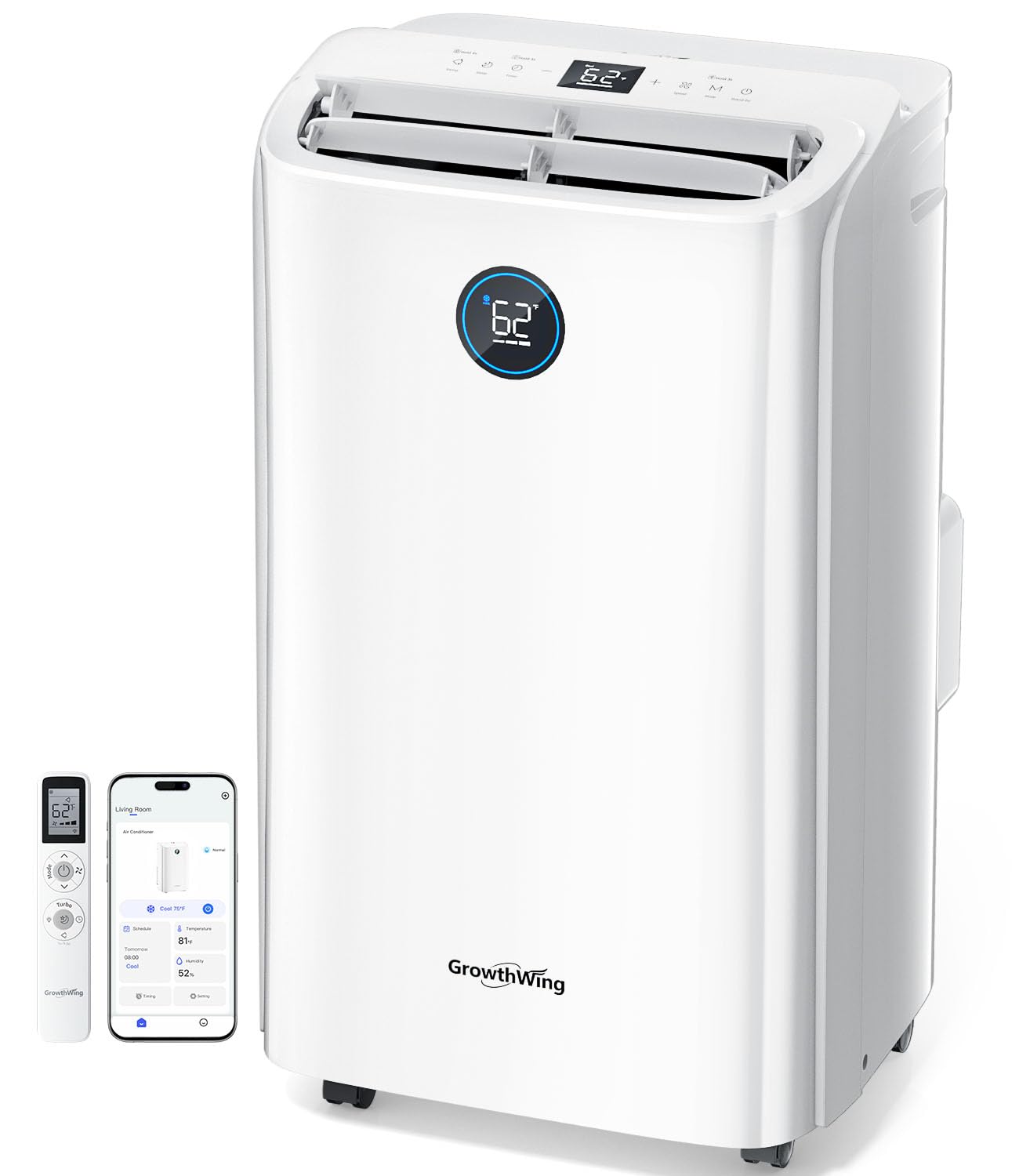
6. GrowthWing 14,000 BTU Smart WiFi Portable Air Conditioner
A wide 77-degree air outlet that turns a hot room cold in five to eight minutes.
The number that stands out here is 77 degrees — the arc of the air outlet at the front. A wider sweep spreads cold air across a room instead of firing it down one narrow lane, and owners describe rooms cooling down within 5 to 8 minutes. Cooling power is 14,000 BTU ASHRAE with an upgraded compressor and R32 refrigerant, rated for up to 700 square feet. Against the ZAFRO’s 550 square feet, that is meaningfully more reach from the same BTU badge.
The maintenance story is simple. The self-evaporating system gives up to 72 hours of drainage-free cooling in most environments, and a drain hose comes included for when you switch it to longer dehumidifying runs. Sleep Mode drops to 42 decibels and dims the display automatically while holding temperature — so the room stays cool and the light stops glaring. That combination is what makes it a bedroom candidate rather than a living-room-only machine.
Setup is the part buyers talk about most warmly. The included window kit fits horizontal and vertical sliding windows from 20.39 to 67 inches, and it goes in without tools. Owners describing the process land around ten minutes, and one detail that comes up is how manageable the setup is for older users. Control runs through the app, voice commands, or the included remote, covering temperature, fan speed, modes, and schedules. The one thing to plan for: this is a single-hose unit, so it does not get the hold-your-temperature benefit the dual-hose ZAFRO and Whynter models deliver.
The fast-cooling argument
- 77-degree air outlet spreads cold air across the room, not down one lane
- 72 hours of drainage-free cooling in most conditions, drain hose included
- 42 dB Sleep Mode with a display that dims itself
- Window kit fits sliding frames from 20.39 to 67 inches with no tools
What to plan around
- Single hose, so it works harder to hold a set temperature than dual-hose rivals
- Annual energy consumption is listed at 946 kWh per year, the highest on this list
- The 700 square foot claim and the product title’s 650 figure do not line up
Matches your needs if: you want a hot bedroom cold within minutes and a setup you can finish before dinner.
Choose another model if: you need the temperature-holding efficiency of a second hose.
7. Whynter ARC-1230WN Portable Air Conditioner
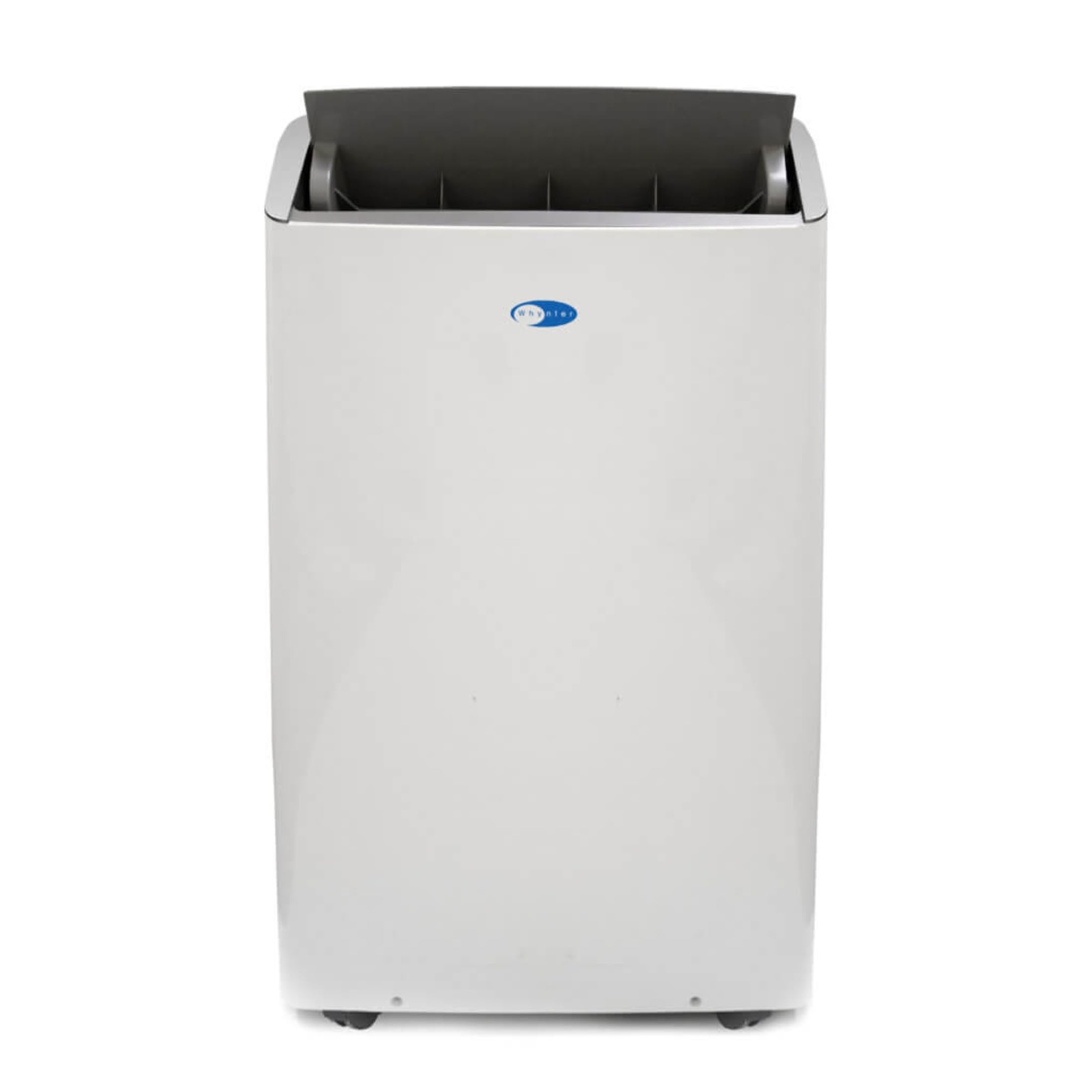
The dual-hose inverter that drops a whole house temperature by eight degrees.
Of everything in this lineup, this is the machine with the most cooling muscle behind it. It carries 14,000 BTU through two hoses, uses an inverter compressor that modulates instead of slamming on and off, and holds an efficiency rating of 12.3. Air flow efficiency sits at 244 cubic feet per minute per watt, which tells you how much air movement you get for each unit of power drawn. Owners describe it pulling a house temperature down by eight degrees — that is a whole-home result, not a single-bedroom one.
The dual-hose design is doing the heavy lifting again: separate intake and exhaust keep your cooled indoor air from escaping out the window, so the unit holds a set temperature with far less effort. Cooling and moisture removal run from one freestanding box, so a humid room is handled without buying a separate dehumidifier. The washable filter pulls out for a rinse, and control covers the app, physical buttons, and voice.
Two things to weigh before committing. Installation splits opinion — some find it straightforward, others want better instructions, and two hoses take more routing than one. Durability reports also run mixed, with some units described as staying strong over time and others failing relatively quickly. Since a dual-hose inverter is a bigger investment than a single-hose unit, check the warranty terms carefully and keep the receipt. Energy consumption is listed at 1,000 kWh per year.
The power case: 14,000 BTU, dual hoses, and a 12.3 efficiency rating add up to the most airflow here.
The comfort dividend: eight degrees of temperature drop is the kind of result you feel in every room of the house.
Be realistic about it: two hoses need routing space, and long-term durability is the honest unknown.
Fits you if: you want the strongest cooling and airflow in this group and will take the time to route two hoses properly.
Better to pass if: you want a simple single-hose install and a shorter warranty exposure.
8. Midea Duo 14,000 BTU Portable Air Conditioner

One hose inside another, and a heat pump that works from 41 to 86 degrees Fahrenheit.
Midea’s trick is the hose-in-hose design — a single outdoor connection that carries both the intake and the exhaust inside one sleeve. It does the same job as the two separate hoses on the Whynter and the ZAFRO, but it leaves you one window slot and one line to manage. Balanced air circulation indoors stops hot outside air seeping in through the gaps, which is the failure mode of a single-hose unit. Around that core, the inverter compressor, tune air duct, and variable-speed tech push cooling that the maker describes as stronger and faster than a standard portable.
The second reason to pick it is heat. This is a heat pump, not just an AC, and it operates between 41 and 86 degrees Fahrenheit — so shoulder season, a cold snap, or a chilly basement fall are covered by the same box. Midea claims the inverter saves more than 40% energy versus the U.S. federal standard — a manufacturer figure, not an independent test. Either way, the inverter is what makes it quieter than a fixed-speed compressor, and owners confirm the low running noise.
Control is app-based through the SmartHome app for iOS and Android, plus Alexa and Google Assistant voice. One practical note the listing buries: the remote needs two AAA alkaline batteries, which are not the kind of thing you want to discover on a 90-degree evening. Installation is where opinions part — some call it simple, others find it a bit of a pain, largely because the hose-in-hose panel takes careful alignment with the window frame.
The design win: one hose sleeve handles intake and exhaust, so installation is one window slot instead of two.
Four-season value: a heat pump covering 41 to 86 degrees Fahrenheit means the unit never becomes closet clutter in October.
Buy batteries: the remote ships without AAA cells, so add them to the order.
Right for you if: you want cooling and heating from one appliance and only have one window to spare.
Consider a different unit if: you never need heat and would rather avoid the hose-in-hose alignment work.
9. DREO Inverter Portable Air Conditioners 14000 BTU
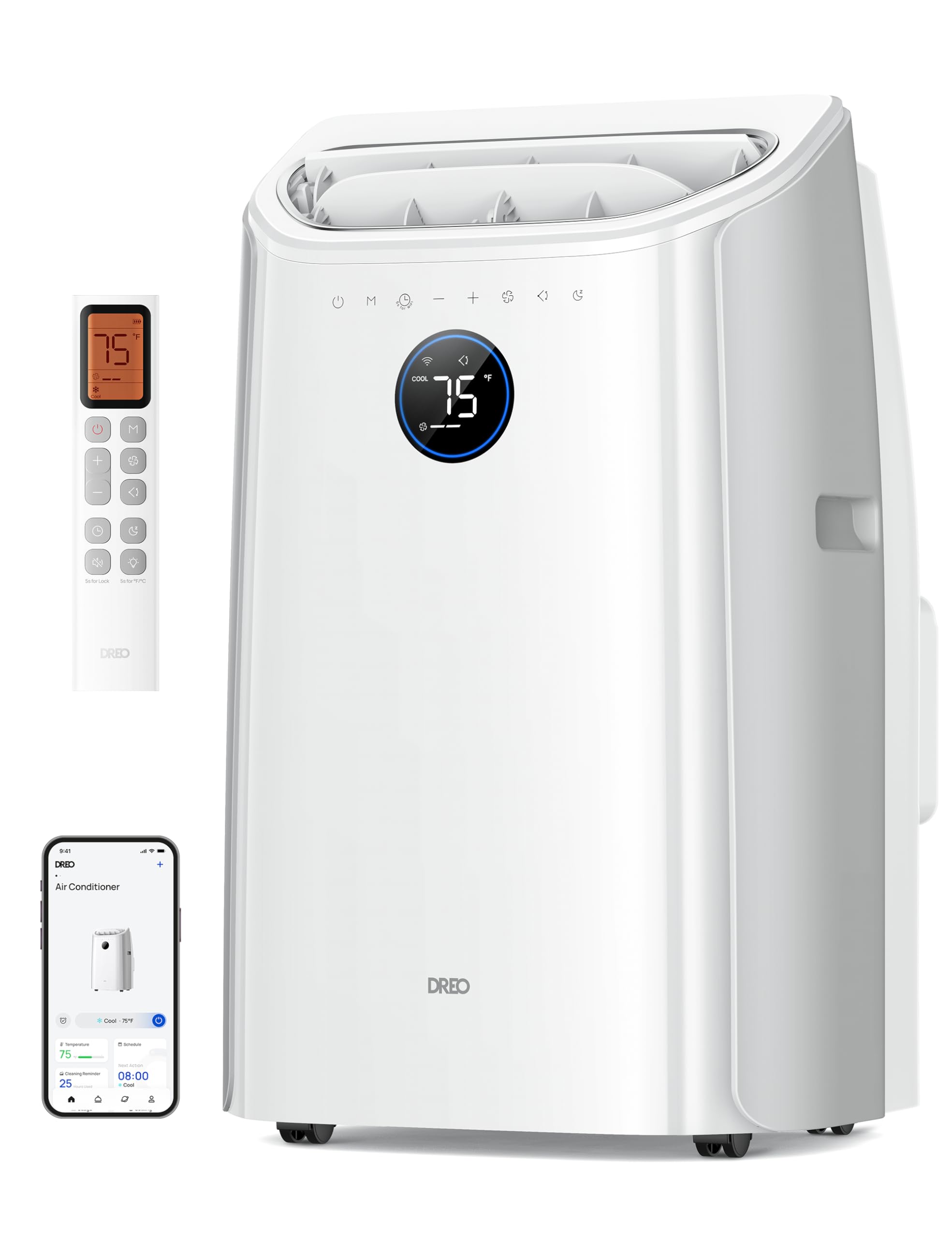
Patented drainage-free tech and two hoses, aimed squarely at a bedroom in summer.
Read the coverage number before anything else. DREO rates this 14,000 BTU unit for 200 to 300 square feet — the most conservative claim in the lineup, and far below the 700 and 750 square feet the Temprium and GrowthWing claim from the same BTU badge. That is not a flaw so much as a design brief: this is a bedroom air conditioner, and the dual-hose inverter is tuned to cool a smaller space quickly and hold it there. If your room is genuinely 200 to 300 square feet, the capacity is right-sized rather than oversized.
The drainage system is the real differentiator. Patented self-evaporating sensors and a pump push excess water out automatically, and the unit is rated drainage-free in environments under 90% humidity. That removes the chore that owners of manual-drainage units know well: emptying a tank every few hours. Two hoses separate intake and exhaust to cut hot-air backflow, and the noise isolation system keeps operating volume at 42 decibels. The window kit fits hung and sliding windows between 20 and 53 inches.
Control is three-way — app, remote, and Alexa voice — which is what makes the machine usable by a kid or a grandparent without a walkthrough. DREO claims the inverter is 32% more efficient than traditional models, though annual consumption is listed at 1,540 watts, the highest here. Note that the raw number and the efficiency claim measure different things. Cooling performance and daily reliability are what owners talk about with the most enthusiasm.
What it does best
- Patented self-evaporating pump removes the manual drain routine entirely below 90% humidity
- Dual-hose inverter design with a 42 dB noise isolation system
- App, remote, and Alexa control that anyone in the house can use
- Window kit spans 20 to 53 inches of hung or sliding frame
The fine print
- Rated for 200 to 300 square feet only — the smallest coverage claim here
- Annual consumption listed at 1,540 watts, the highest in this lineup
- The 14,000 BTU badge will look oversized against the claimed square footage
Made for: a bedroom or small office where never emptying a drain tank is worth more than extra square footage.
Not right if: your space is a large living area needing coverage past 300 square feet.
Know the Specs
BTU and the two different standards
BTU stands for British thermal unit — a measure of how much heat the machine can remove from a room per hour. The trap is that BTU gets quoted under two standards. ASHRAE numbers are higher, and SACC numbers are lower, so a unit badged 14,000 BTU may actually be a 10,000 BTU SACC machine, which is exactly how the ZAFRO is described. Compare like with like, and lean on the stated square footage instead. When a listing quotes one number and titles itself with another, trust the square footage line.
Decibels at night
A decibel is a measure of sound pressure, and the scale is not linear — a small drop means a real difference. Normal conversation sits around 60 dB, so a unit running at 41 or 42 dB is quiet enough to hold a conversation over. The catch is that these figures are often quoted in Silent Mode or Sleep Mode, not at full blast. Sleep Mode usually drops the fan speed and compressor frequency, and the numbers quoted here — 41 dB on the Temprium, 42 dB on the ZAFRO and DREO, 52 dBA on the Westinghouse — are those low settings. Expect a louder machine the moment you press Turbo or Extra Mode.
Single hose versus dual hose
A single hose has one path: it blows hot exhaust out the window and relies on room air to replace it. A dual hose splits intake and exhaust into separate paths, so it stops dragging your cooled indoor air outside. The practical result is that a dual-hose unit holds a set temperature with less compressor effort. The ZAFRO, both Whynter models, the DREO, and the Midea Duo all go the dual route. The Midea takes it further with a hose-in-hose sleeve that keeps both paths inside one line.
Inverter compressors and CEER
An inverter compressor varies its speed instead of switching fully on and off. That smooth modulation holds temperature steadier and avoids the surge of a hard restart. CEER is the efficiency number attached to that performance — the ZAFRO is rated 12.8 against the 7.83 standard the maker cites, and the Whynter ARC-1230WN sits at 12.3. Higher is more efficient. Annual energy consumption figures give you the real-world picture, and on this list they range from 500 kilowatt hours per year on the Westinghouse up to 1,540 watts on the DREO.
Common Questions
Do I need a window for a portable WiFi air conditioner to work?
How many square feet will a 14,000 BTU portable AC actually cool?
Will a WiFi portable AC connect to my Google Home or Alexa setup?
How often does a self-evaporating portable AC need draining?
Is a dual-hose portable air conditioner worth the extra hose to route?
Can I run a portable air conditioner in an apartment without drilling the window frame?
Does a portable AC with heat mode cost more to run than a cooling-only unit?
How loud is 42 decibels compared to a normal conversation?
What does SACC mean on a portable air conditioner listing and why does it differ from ASHRAE?
The Bottom Line
For most buyers, the portable wifi air conditioner that earns the top spot is the ZAFRO Smart Inverter 14,000 BTU because the dual-hose inverter design, the 42 dB operation, and the 72-hour drainage-free rating cover the three things a bedroom unit has to get right. It carries 4.0+ stars and the most owner reviews of any dual-hose pick here. If your room runs closer to 700 or 750 square feet, the Temprium 14,000 BTU claims more floor area and drops to 41 dB in Silent Mode. And if you need heat as well as cooling from the same footprint, the Westinghouse with Heat Mode covers four modes from 500 kilowatt hours per year. All three will cool the room; the ZAFRO is the one that balances quiet, coverage, and drainage-free running.
How we choose
We do not accept paid placement. Every pick is matched to a real buyer and a real use-case; we do not hands-on test units.
Sources
Specifications: manufacturer listings and product documentation. Review insights: verified customer reviews, as of November 2026. Pricing: not shown on this page (it changes often); check the current price via the retailer link.
As an Amazon Associate, Tactical Gear Guy earns from qualifying purchases. This does not affect which products we feature.