Specs are compiled from manufacturer listings and verified buyer reviews and can change over time — please confirm the key details on the product page before buying.
You want footage on a card you can pull out and hand over — not a live feed that vanishes when you close the app. That is the whole job here. Every camera on this list writes video somewhere you control, either to a microSD card inside the unit or to local storage built into the body. The one thing that separates a camera you trust from a camera you forget about is what happens when the Wi-Fi drops in the middle of the night.
This guide is built by comparing the manufacturers’ published specifications and the patterns across verified customer reviews, so you get each pick’s real strengths and trade-offs instead of marketing spin.
The picks below range from entry-level pan-and-tilt units to premium 4K models with optical zoom, and each one records locally without demanding a subscription. If you are shopping for indoor cameras that record, this breakdown covers storage limits, night vision range, and what owners actually deal with.
Top Picks


How To Choose The Best Indoor Cameras That Record
Start with the storage question, because it decides everything else. A camera that records to a microSD card keeps working when your internet goes down — it just writes to the card. A camera that only records to the cloud stops capturing the moment the connection fails. Check the maximum card size the camera accepts, because that number sets how many days of footage you can hold before the oldest files get overwritten.
Card capacity is your real recording runway
The card ceiling matters more than most buyers expect. The Imou dual-lens unit takes up to a 512 GB card, while the GNCC four-pack tops out at 128 GB. That gap decides whether you are reviewing yesterday or last month. A larger card also means fewer trips to the app to clear space.
Pan and tilt versus a fixed lens
A fixed lens watches one slice of the room and never moves. A pan-and-tilt head sweeps the whole space, and the numbers vary widely — the Tapo C210P2 covers 360 degrees horizontally with 114 degrees vertically, and the GNCC turns 340 degrees across and 80 degrees up and down. If you need to follow a toddler or a dog around a room, the moving head earns its keep.
Night vision range and what it buys you
Night vision distance is given in feet, and it tells you how far the infrared light reaches in total darkness. Thirty feet covers a normal bedroom. The Imou pushes full-color night vision out to 49 feet. If your camera sits across a long living room, that extra reach is the difference between a shape and a face.
Resolution in plain terms
1080P is fine for spotting that someone walked in. 2K and 4K are what let you read a logo on a jacket or identify a face. The eufy E30 records in 4K, and it notes that HomeKit is limited to 1080P — so if you run Apple’s smart home, you will not get the full resolution through that app. Match the resolution to what you need to see, not to the biggest number on the box.
Side-by-Side Comparison
| Model | Best For | Max Resolution | Local Storage | Night Vision | Amazon |
|---|---|---|---|---|---|
| Tapo C210P2★ Best Overall | Whole-room coverage on a budget | 2K | microSD (card not included) | 30 ft | Amazon |
| Imou Dual-LensTwo Lenses, One Camera | Two views at once | 6MP dual-lens | microSD up to 512 GB | 49 ft color | Amazon |
| GNCC 4-PackFour Rooms, One Box | Covering several rooms | 2K | microSD 16–128 GB | 10 m | Amazon |
| Geeni Vivid 2-Pack | Shelves and desks | HD | Micro SD slot | Low-light only | Amazon |
| REOLINK E1 Pro | Sharp stills on a card | 3K 5MP | microSD up to 512 GB | Infrared | Amazon |
| youkey S320 | Renters, no wiring | 2K | Built-in 8 GB | IR and color, dual spotlights | Amazon |
| Tapo C100 4-Pack | Kitchen and nursery, four rooms | 1080P | microSD up to 512 GB | 40 ft | Amazon |
| REOLINK E1 Zoom | Reading detail at distance | 4K | microSD up to 512 GB | Infrared, F1.6 aperture | Amazon |
| eufy E30 | No-subscription 4K with Apple Home | 4K | SD card (sold separately) | Color with spotlight | Amazon |
Detailed Reviews
1. Tapo 2K Pan Tilt Security Camera C210P2
Our pick — 4.5+★ from 23,500+ verified ratings; the strongest balance of quality and price.
It sweeps the whole room, records it in 2K, and quietly sells for entry-level money.
The number that earns this camera the top slot is 2K — roughly double the sharpness of plain 1080P, and enough to tell what your baby is holding across the nursery. The head rotates 360 degrees across and 114 degrees up and down, so one unit covers an entire room instead of one corner of it. You get that sweep with a corded power adapter running from 100–240 V, which is why the camera can pan all day without a battery to recharge.
The footage side is where it stays flexible. You park a microSD card inside (sold separately) and record without paying anything monthly, or you take the Tapo Care cloud subscription if you want a copy off-site. Alerts are split by type — motion, person, and baby crying — so you can stop jumping at the dog walking past the lens. Night vision reaches 30 feet in infrared, which covers a standard bedroom from the dresser to the crib.
The honest catch is Wi-Fi. This camera runs on the 2.4GHz band only, not the faster 5GHz band, and dropped connections are the recurring theme in owner feedback. The camera quality itself wins people over — it is the most-praised element by a wide margin — but if your router sits behind two walls, plan on a plug-in Wi-Fi extender. Set-up is genuinely quick thanks to the app walking you through it.
What works in its favor
- 2K resolution that keeps faces and labels readable
- 360° horizontal and 114° vertical sweep from one unit
- Person, motion and baby-crying alerts with no fee for the baby monitor function
- microSD recording undercuts cloud-only rivals on running cost
Where it asks patience
- Runs on 2.4GHz Wi-Fi only, so a weak band means dropouts
- Card is not included, so you buy storage separately
Make this your pick: a first indoor camera for a nursery, living room, or pet corner where one moving head needs to cover everything.
Pause before buying: if your Wi-Fi signal is thin where the camera will sit, the 2.4GHz-only radio will test your patience.
2. Imou 6MP Dual-Lens Indoor Security Camera
Two 3MP lenses in one housing means the doorway and the far corner stay in frame together.
Most cameras make you choose between a fixed watch on the entrance and a sweeping patrol of the room. This one delivers both: one lens holds steady on a critical spot while the second pans and tilts around the space, and the app shows the two feeds side by side. The combined resolution is 6MP, and an 8x digital zoom lets you push in on a sleeping child or a pet without losing the wide view.
Storage is the standout. It accepts a microSD card up to 512 GB, which is dramatically more headroom than the GNCC four-pack’s 128 GB ceiling — if you want weeks of footage before anything overwrites, that difference matters. Its All-day Saving Recording mode drops to 1fps when nothing is moving and records at full frame rate during events, which the maker says cuts card usage by up to 85%. Night vision in full color reaches 49 ft, well beyond the Tapo C210P2’s 30 ft — a real advantage in a long hallway.
Dual-band 2.4/5GHz Wi-Fi with Wi-Fi 6 is the other reason it lands high. Wi-Fi 6 reduces interference in a house full of connected gadgets, so the stream holds steadier. What deserves a caution flag is set-up feedback, which splits down the middle — some find it easy, others hit friction configuring the camera. Give yourself a calm twenty minutes on first install rather than doing it in a rush.
Best reason to choose it: you want two simultaneous views and months of local recording without a subscription plan hanging over you. Built-in lights and a mic let a child or an older parent tap to call your phone directly.
Worth noting: the owner base is small so far, and the set-up comments are genuinely split — it rewards a patient first install.
Choose it if: you want a fixed watch on one spot plus a roaming view, with a card capacity that dwarfs most rivals.
Look at the Tapo instead if: you would rather have a simpler single-lens set-up and a much longer track record behind it.
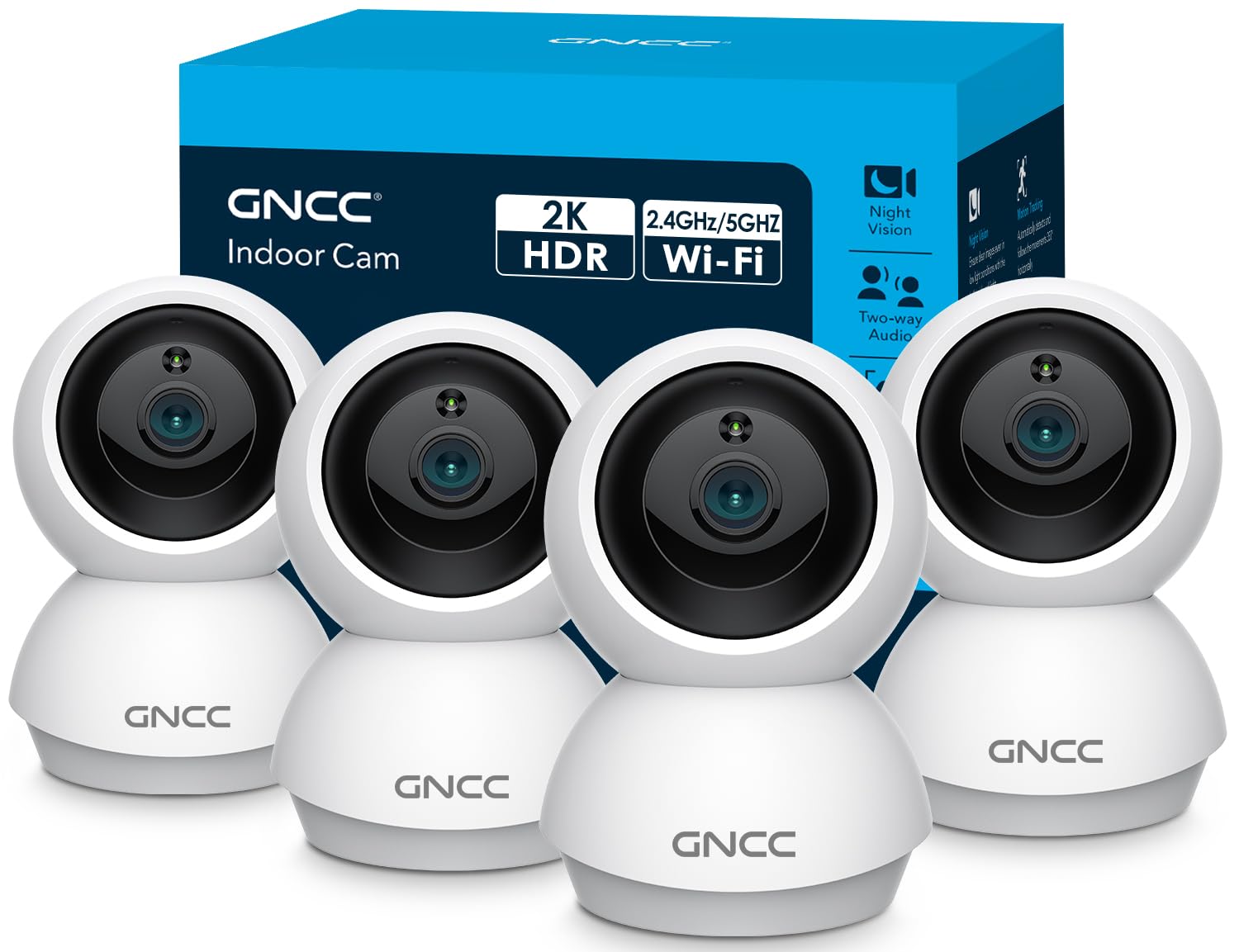
3. GNCC 5G 360° PTZ Indoor Security Camera 4-Pack
Four cameras in one box, so the nursery, the back door and the garage all get watched at once.
If your problem is coverage across a whole house rather than a single room, four 2K cameras in one purchase solves it faster than buying singles. Each unit turns 340 degrees horizontally and 80 degrees vertically and uses AI motion tracking to follow whatever moves. Bluetooth pairing gets each one onto your network in minutes, and one app controls all four.
Recording runs two ways: 24/7 continuous capture to a microSD card, or cloud storage with a 14-day free trial. Read the fine print before you buy — without a card or the cloud plan, you can watch live but you cannot pull up past footage. The card slot hides under the lens, which rotates out of the way, and accepts cards from 16 GB to 128 GB.
Night vision covers 10 meters in the dark, putting it in the same neighborhood as the Tapo C210P2’s 30 ft. The strength here is simple: excellent quality per camera across a bundle. The friction points are real but specific — the head can tilt upward and need repositioning, and connectivity gripes center on people expecting a wireless camera when these run on a power adapter. Treat this as a multi-room system, not a wire-free one.
Where it earns its place: you are wiring up several rooms in one go and want a matched set that shares a single app. Set-up earns consistent praise for how quickly each camera connects.
Plan your storage before you buy: add microSD cards (small memory cards that hold the footage) to your budget, or decide up front if you want the cloud subscription.
The right buy for: a family outfitting four rooms at once who want one app and one matched set.
Not the one for: you if you need a single camera, or if you expect it to run on batteries.
4. Geeni Vivid Indoor Smart Security Camera 2-Pack
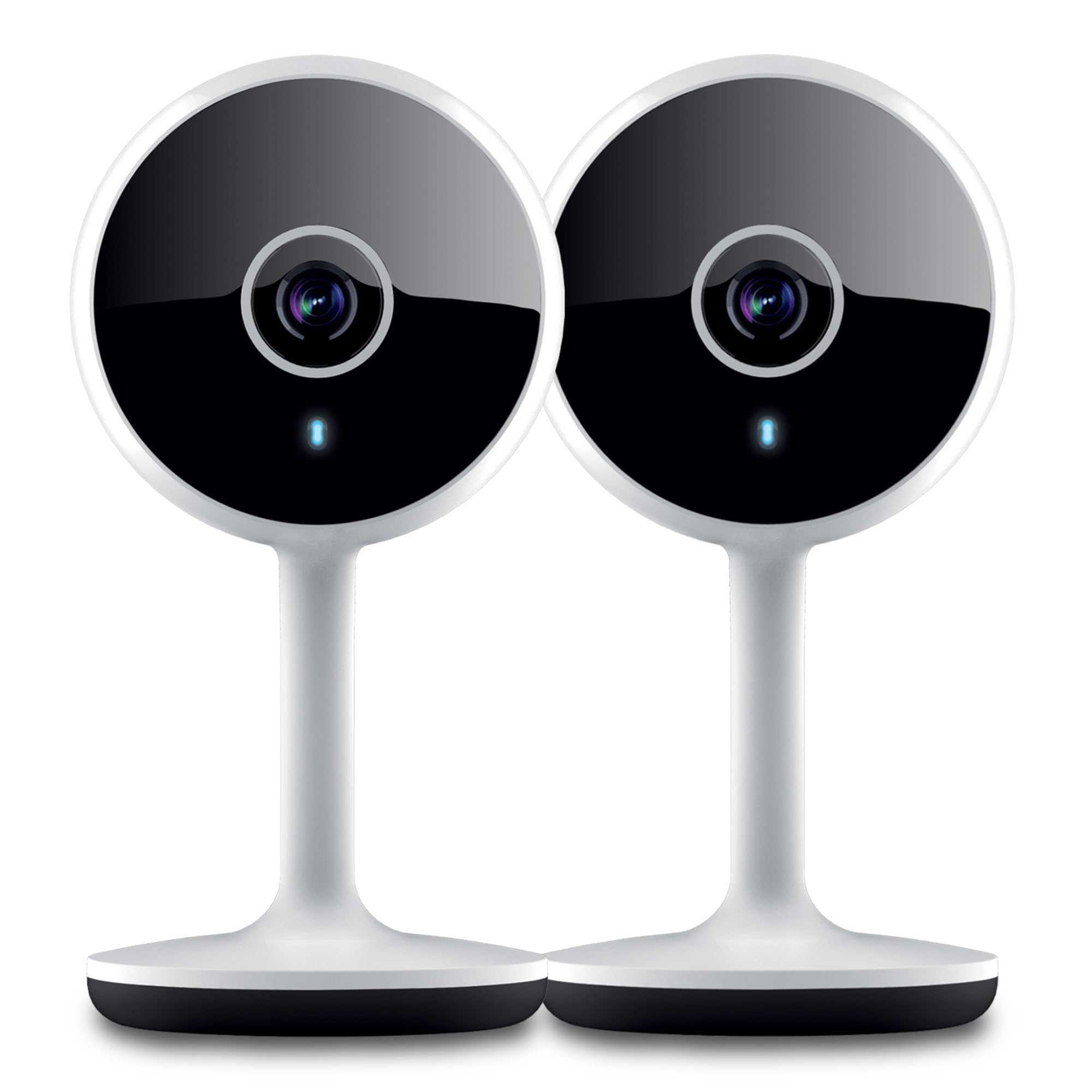
The bendy stem turns a plain shelf camera into something you can aim precisely where you want it.
Physically, this is the most adaptable of the bunch. A flexible stem lets you bend the lens toward a doorway, a crib, or a pet bed without drilling a mount, and the compact body weighs 0.38 kg so it sits happily on a shelf or desk. You get two cameras in the pack, and the Micro SD slot means your recordings stay on your own card rather than in someone else’s cloud.
The picture is HD with night vision for low-light rooms, motion alerts push to your phone, and two-way audio lets you talk back through the camera. On the layout front, the flexible stem earns a following — it is the kind of thing that makes an awkward corner workable. Keep expectations realistic on resolution, though: this is HD, not the 2K or 4K the premium picks deliver, so it is better for confirming activity than reading small print.
What you should know going in is that this camera wants the Geeni app specifically and can be fussy about connecting. Owner feedback on reliability splits, and some report the connection fighting them during set-up. The trade is worth weighing: you get a bendable, card-recording camera that fits almost anywhere in the room, as long as you are comfortable inside the Geeni ecosystem.
The case for it
- Flexible stem bends to aim at exactly the spot you need
- Micro SD slot keeps recordings local
- Two cameras in one pack for multi-spot coverage
- Motion alerts and two-way audio built in
The honest trade-offs
- HD resolution, not 2K or 4K
- Locks you into the Geeni app with a sometimes-fussy connection
Best suited to: shelf and desk placement where you need to angle the lens just so, and want recordings on your own card.
Think twice if: you need the sharpest detail or want your cameras to live inside a smart-home ecosystem beyond Geeni.
5. REOLINK E1 Pro 3K Dual-Band Wi-Fi Indoor Camera

The 3K lens reads a face across the room, and it records to a card when the Wi-Fi quits.
The detail lives in the numbers. A 2880×1616 resolution from a 5MP sensor, paired with an F1.6 lens aperture that pulls in more light, keeps the image clean even in dim rooms. The head pans and tilts for 360-degree coverage and auto-tracks people, pets and a baby on the move. You get dual-band 2.4/5GHz Wi-Fi and Bluetooth initialization, so connecting is not the chore it is on single-band rivals.
On storage it is generous: a 512 GB microSD card holds eight days of continuous recording at the default 3072kps bitrate, and it keeps writing even during a Wi-Fi drop. It also feeds a Reolink NVR, Home Hub, or FTP/NAS server over RTSP/ONVIF if you run a larger system. No monthly fee is required for the core functions, which is the point of this whole list.
Here is the part that needs saying plainly. This camera’s owner feedback flags Wi-Fi connectivity as the most common complaint, by a wide margin, and connection dropouts are the recurring theme. When it connects, the picture quality competes with cameras that cost noticeably more — that reputation is well earned. Buy it for the sharp lens and the local recording, and be ready to troubleshoot your network if it flakes.
The standout: a 3K 5MP sensor with an F1.6 aperture is a serious imaging package in an indoor camera, and the 512 GB card ceiling backs it up.
The reality check: connectivity is this camera’s weak spot, so a strong router signal should be a precondition, not an afterthought.
Bring it home for: the sharpest still images on a microSD card, and dual-band Wi-Fi when your router supports it.
Walk past it for: a simpler single-band camera if you have had connectivity trouble with other devices in the same spot.
6. youkey S320 Magnetic Indoor Security Camera
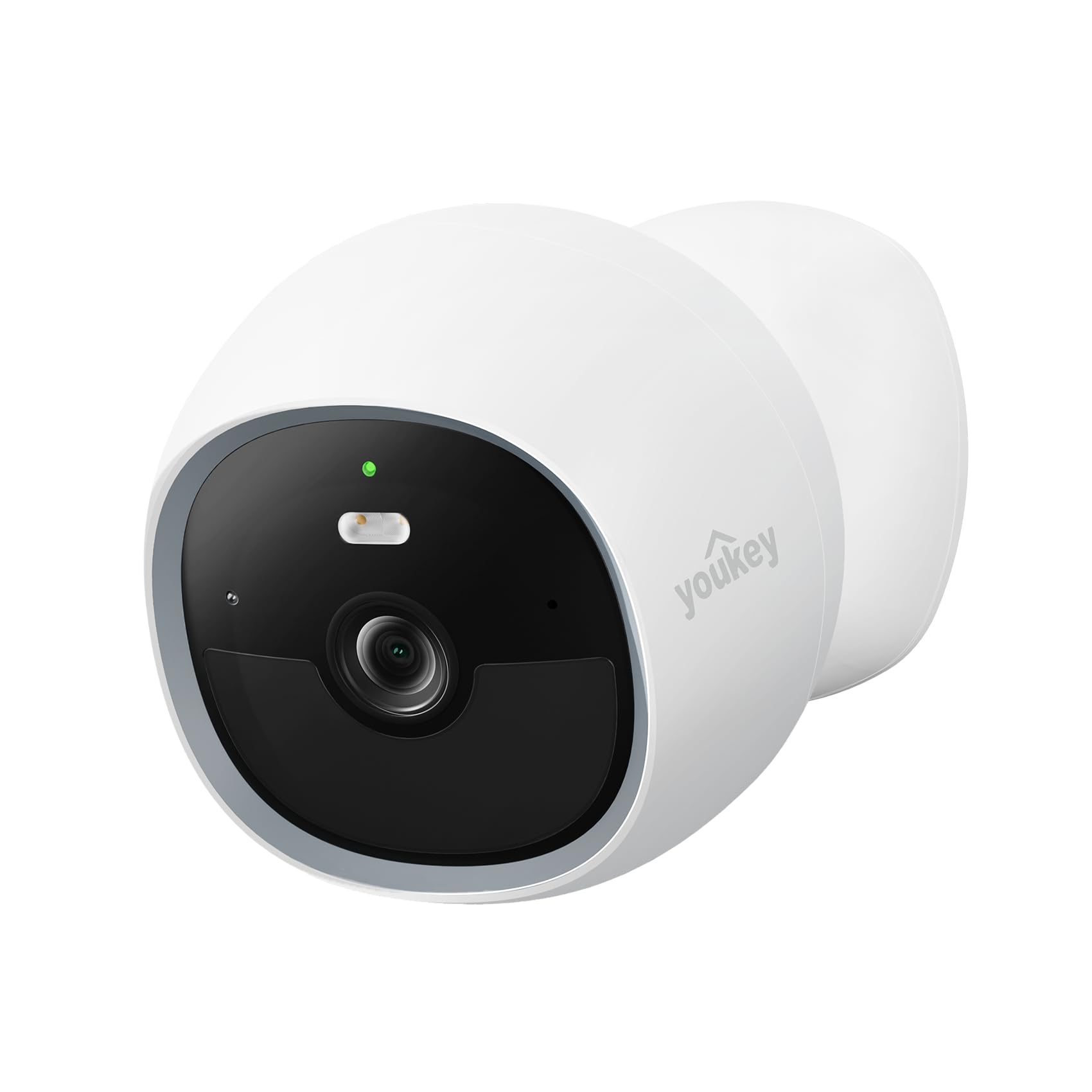
It snaps to a metal surface with no screws, no tools, and nothing to repair when you move out.
For renters, this is the camera that solves the problem nobody talks about: you cannot drill into the wall. A built-in magnet on the base holds the camera to any metal surface, and for non-metal spots there is a wall-mount bracket in the box. Because it has no power cord, you can carry it from the bookshelf to the hallway to the closet and re-aim it in seconds.
Recording doesn’t need a card or a subscription. Built-in 8 GB eMMC storage holds the footage and free playback lives inside the app, so you never buy storage separately. On-device AI tells people from pets, and PIR smart wake-up means the camera only rouses itself for human or animal movement, which keeps the 6400mAh battery going. The image is 2K with IR and color night vision, and dual spotlights stretch full-color mode further. IP65 weatherproofing means it also handles a covered patio or garage.
What owners split on is battery life: some find it genuinely impressive, others run it down faster than expected. That is the trade for going wire-free — how long a charge lasts hinges on how much motion the camera sees. Snapping it off the magnetic base for a recharge is as easy as it sounds, so it is a manageable routine rather than a hassle.
Why renters love it
- Magnetic base mounts with zero screws and zero wall damage
- 8 GB built-in storage records with no card and no subscription
- 6400mAh battery and PIR wake-up make it genuinely portable
- IP65 rating lets it work on a covered patio or in a garage
What to keep in mind
- Battery runtime varies widely with how much motion it detects
- 8 GB built in is less headroom than a 512 GB card
Ideal for: renters and anyone who wants to move the camera room to room with no wiring and no wall damage.
Look elsewhere if: you need weeks of stored footage, since 8 GB internal storage fills faster than a big card.
7. Tapo 1080P Indoor Security Camera C100 4-Pack

Four 1080P cameras that record to a card and stay simple — the workhorse pick for a whole house.
If you want to watch four rooms without paying four subscriptions, this pack gets you there. Each camera shoots 1080P Full HD at 30 frames per second across a 117-degree field of view, so a wide kitchen or nursery stays in frame. Night vision reaches 40 feet, a touch farther than the 30-foot Tapo C210P2 — handy if the camera sits on a far wall.
Recording is the backbone: a microSD card up to 512 GB stores footage at no cost, so no monthly plan is needed. If you want cloud backup, Tapo Care is the optional path. Motion, person, and baby-crying alerts arrive by push notification, with no added charge for baby-monitor use. Two-way audio and a built-in siren let you talk to your pet or warn off an intruder from the app.
Weigh this: 1080P (1,920 x 1,080 pixels) is the entry resolution in this group. It is fine for seeing that someone walked in, but less so for reading a logo across the room, where the 3K and 4K picks pull ahead. Like its sibling, reliability and connectivity come up as mixed in owner reports, so a solid 2.4GHz signal matters. For the price-per-room, though, four cameras from a well-known name is a hard combination to beat for straightforward home monitoring.
What it does well: four matched 1080P cameras with 512 GB card support and no subscription is the most economical way to cover a whole house.
Where to set expectations: 1080P is the floor of this list’s resolution range, and the 2.4GHz-only radio rewards a strong signal.
Pick this for: outfitting four rooms on a tidy budget with recording to your own cards.
Choose a sharper pick if: you need to read fine detail — 1080P will not give you the faces the 3K and 4K models do.
8. REOLINK E1 Zoom 4K Indoor Camera

A 3X optical zoom is the rare feature that lets you read detail from across the room without blur.
Optical zoom beats digital zoom every time, because it moves the glass instead of enlarging pixels — that is why the E1 Zoom’s 3X optical lens matters. Combined with 4K resolution from an 8MP sensor and an F1.6 aperture, it pulls crisp detail from a distance and stays useful in low light. The head pans 355 degrees and tilts, with auto-tracking for people and pets and up to 64 preset monitoring points for jumping to a key view.
Wi-Fi 6 with dual-band 2.4/5GHz keeps the stream stable in a busy smart home, and Bluetooth handles the initial setup so you are not fighting a browser wizard. Detection covers people, pets, and crying sounds with no monthly fee. Storage is the same generous setup as its stablemate: a 512 GB microSD card for up to 12 days of recording, plus compatibility with Reolink NVR, Home Hub, and FTP/NAS over RTSP/ONVIF.
What keeps it honest is the connectivity picture. Owner feedback flags connection failures and setup friction alongside genuine praise for the picture, so this is a camera that rewards a good router and a careful install. Value opinions split slightly too — at this price you are paying for the optical zoom specifically. If reading a distant face inside a long room is the goal, that lens earns it.
Why it earns the premium: 3X optical zoom plus 4K from an 8MP sensor is a combination few indoor cameras offer, and the 64 preset points make a big room navigable.
What you accept: setup and connection can take some coaxing, so this suits someone comfortable tuning a network.
Reach for this if: you need to read detail at distance and want a card-based 4K camera with optical zoom.
skip it if: a wide room is not your challenge — the standard 4K eufy does the resolution without the zoom complications.
9. eufy Security 4K Indoor Camera E30
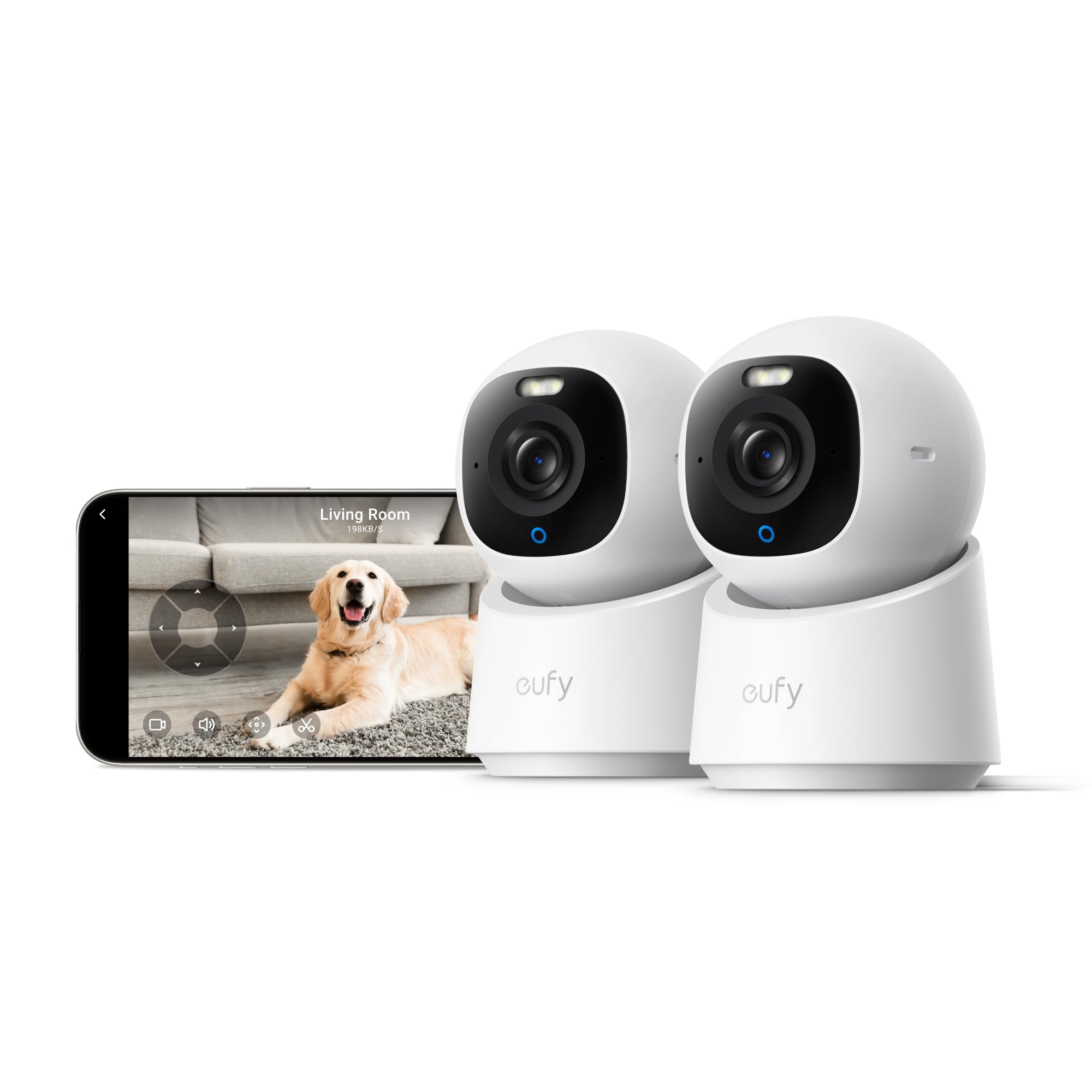
The premium pick records 4K to a card with every core feature free of monthly fees.
If you are paying top of the range, you want the actual top of the range. This camera records in 4K ultra-clear detail, 24/7, with on-device AI that distinguishes humans, pets, audio cues, and crying. The head spins for a 360-degree panoramic view, and app features like Quick Focus Tap and Panoramic View let you jump to any spot by tapping your screen. Auto-tracking follows a person or pet through the room.
Night vision is where it pulls ahead of the cheaper units: a built-in spotlight switches between color and infrared night vision, and it doubles as a deterrent. It records locally to an SD card (sold separately) with no subscription for the core functions — which is exactly the promise this list is built around. Smart-home compatibility runs wide, supporting HomeKit, Alexa, and Google Assistant, which gives you more control paths than the app-only cameras.
Know this before you commit: HomeKit (Apple’s smart-home system) is limited to 1080P resolution. So if your home runs on Apple’s system, that is the picture you will see through it — the 4K footage stays at the card level. That is a compatibility limit, not a flaw in the camera. For a nursery or nanny setup that needs the sharpest recording and the widest smart-home reach, this is the finish-line unit.
Where the premium shows
- 4K recording with no subscription for core functions
- Color night vision via a built-in spotlight that doubles as a deterrent
- 360° panoramic view with Quick Focus Tap and auto-tracking
- HomeKit, Alexa, and Google Assistant support
What the spec sheet hides
- HomeKit caps resolution at 1080P
- SD card is sold separately
Made for: buyers who want 4K recording, local storage, and no subscription, with Apple Home support in the mix.
Only caveat: if you live inside HomeKit, expect 1080P there — the full 4K lives on the card.
Know the Specs
Record-to-card vs record-to-cloud
Local recording means the camera writes the video onto a microSD card inside the unit. The footage stays under your control and keeps capturing even when the internet drops. Cloud recording needs the camera online and usually a paid subscription, and an outage means no new footage. Cameras here like the Imou and the Tapo C100 support cards up to 512 GB, so a big card buys weeks of history without a monthly bill.
Resolution: 1080P, 2K, 3K and 4K
Resolution is the amount of detail in each frame. 1080P Full HD is enough to spot activity; 2K sharpens faces and labels; 3K and 4K let you read fine detail from a distance. Higher numbers mean sharper evidence, but also larger files that fill a card faster. Match the resolution to what you need to identify — a pet cam is fine at 1080P, while a nanny cam benefits from 2K or 4K.
Night vision range in feet
Night vision distance tells you how far the camera can see in total darkness using infrared light. A 30 ft reach covers a typical bedroom; 40 ft or more suits longer rooms and hallways. Color night vision uses built-in spotlights to keep colors visible at night, which helps identify faces and clothing, while plain infrared gives a clearer but grayscale image.
Optical versus digital zoom
Optical zoom physically moves the lens to magnify a subject without losing detail, so a 3X optical zoom keeps faces sharp from across a room. Digital zoom enlarges the pixels in an existing frame, which blurs as you push in. If you need to read detail far away, optical zoom is the feature worth paying for — and only the E1 Zoom here offers it.
Common Questions
Do indoor cameras still record when the Wi-Fi goes down?
How many days of footage can a microSD card hold in an indoor camera?
Do these indoor cameras require a monthly subscription?
Can a battery-powered indoor camera record 24/7?
Does 4K resolution work with Apple HomeKit on these cameras?
Why do some indoor cameras disconnect from Wi-Fi?
What is the difference between pan-tilt and fixed indoor cameras?
Do I need a microSD card for a camera with built-in storage?
How far can an indoor camera see at night?
Will a nanny or pet camera filter out false alerts?
The Bottom Line
For most homes, the indoor cameras that record winner is the Tapo C210P2 — its 2K pan-tilt sweep covers a whole room, and it records to a card without a subscription. If you want two simultaneous views and a 512 GB card ceiling, the Imou dual-lens is the one to reach for. And for the sharpest 4K recording with Apple Home support, the eufy E30 is the finish-line pick. Whichever you choose, put a strong Wi-Fi signal near the camera and a big enough microSD card first — those two decide whether your footage survives the night.
How we choose
We do not accept paid placement. Every pick is matched to a real buyer and a real use-case; we do not hands-on test units.
Sources
Specifications: manufacturer listings and product documentation. Review insights: verified customer reviews, as of November 2026. Pricing: not shown on this page (it changes often); check the current price via the retailer link.
As an Amazon Associate, Tactical Gear Guy earns from qualifying purchases. This does not affect which products we feature.