Specs are compiled from manufacturer listings and verified buyer reviews and can change over time — please confirm the key details on the product page before buying.
You bought the generator, you have the RV, and the two plugs don’t match. That mismatch is the entire reason adapters like these exist — and the fix is to match the prong count and amperage on both ends before you buy anything. Get those two right and the power flows; get them wrong and you own a cord that fits nothing. Quick note on how this list was built: the picks below use flexible, same-type matching, so not every option is the exact number you searched — the nearest same-purpose size and wattage serves the same job. A 30-amp adapter does the work of a 30-amp adapter, whichever brand name sits on the jacket.
This guide is built by comparing the manufacturers’ published specifications and the patterns across verified customer reviews, so you get each pick’s real strengths and trade-offs instead of marketing spin.
We’ll walk you through prong counts, amp ratings and cord length so you stop guessing at the pedestal. This breakdown covers each pick’s real fit for your rig.
Top Picks

How To Choose The Best RV Generator Plug
The whole job of an RV generator plug is to sit between two connectors that don’t speak the same language. One end goes to your generator’s outlet, the other end goes to your RV’s shore power inlet or to a household appliance. Everything else — wire thickness, handle shape, weather jacket — is support for that one handshake. So the first thing you do is look at both outlets on your own equipment and write down what they are.
Start with the prong count, not the brand
Count the blades on your generator outlet and on your RV inlet. Three prongs and four prongs are different systems and they do not cross over without an adapter built for exactly that. A three-prong RV plug like the TT-30 style is the common 30-amp campground connection. A four-prong L14-30 is the locking plug you find on many portable generators. An adapter only works when one end matches your generator and the other end matches your RV — so the label you are reading should name both codes.
Match the amperage on the inlet side
The amp rating tells you how much current the cord is built to carry. Your RV inlet is either a 30-amp or a 50-amp setup, and the adapter has to reach that number on the RV end. A 30-amp to 50-amp adapter lets a smaller generator feed a bigger inlet, which is exactly the situation most people are in when their generator output and their RV inlet disagree. Never expect an adapter to create more power than the generator makes — it just reshapes the connection.
Look at the wire gauge and the jacket
Wire gauge is the thickness of the copper inside, and a lower number means thicker wire. A 10-gauge cord is the standard for these RV adapters because it handles the load without getting hot. The jacket matters just as much outdoors: look for terms like STW, flame retardant, UV-resistant, and oil or abrasion resistant. A cord that stays flexible in cold weather is easier to coil and less likely to crack at the plug body.
Think about handles, length, and breakers
A grip handle on the female end sounds like a small detail until you are yanking a stiff plug out of a pedestal in the rain. Length is a trade-off: a 1-foot pigtail reduces strain right at the inlet, while a slightly longer cord gives you slack to reach an awkward outlet. If the adapter splits one big outlet into several household sockets, a built-in circuit breaker is worth looking for, since it protects the smaller household devices downstream.
Side-by-Side Comparison
| Model | Best For | Connector Pair | Amperage | Length | Amazon |
|---|---|---|---|---|---|
| RVGUARD 30A to 50A Adapter Cord★ Best Overall | Feeding a 50A RV from a smaller generator | L14-30P to 14-50R | 30 A input / 50 A output | 12 inches | Amazon |
| ELEGRP 30A to 110 3-Way SplitterBest for Small Loads | Running three household devices off a 30A pedestal | TT-30P to 3X 5-15R/5-20R | 30 A input | 12 inches | Amazon |
| HOZHEM 30A to 20A Distribution AdapterExtended Reach | Jobsite and campsite power splits | TT-30P to 3X 5-15R/5-20R | 30 A input | 1.6 feet | Amazon |
| Champion 2 ft. 30A Adapter Cord | Extra reach off an RV outlet | TT-30P to three 5-20R | 30 A / 125 V | 2 feet | Amazon |
| M1A2 TT-30 to L14-30 Transfer Adapter | Hooking a generator to a transfer switch | TT-30P to L14-30 | 30 A / 125 V | 12 inches | Amazon |
| Malxs L14-30P to TT-30R Adapter | Four-prong generator into a 30A RV cord | L14-30P to TT-30R | 30 A / 125 V | 12 inches | Amazon |
| MECMO 50A to 4X Household w/ Breaker | Big 50A generator feeding four household outlets | 14-50P to 4X 5-20R/15R | 50 A input / 20 A per side | 18 inches | Amazon |
| MECMO L14-30P to SS2-50R Marine Adapter | Marine and locking 50A shore power inlets | L14-30P to SS2-50R | 30 A / 125–250 V | — | Amazon |
| MECMO L5-30P to 3-Way Household | Three-prong locking generator to household sockets | L5-30P to 3X 5-15R/5-20R | 30 A / 125 V | 24 inches | Amazon |
Detailed Reviews
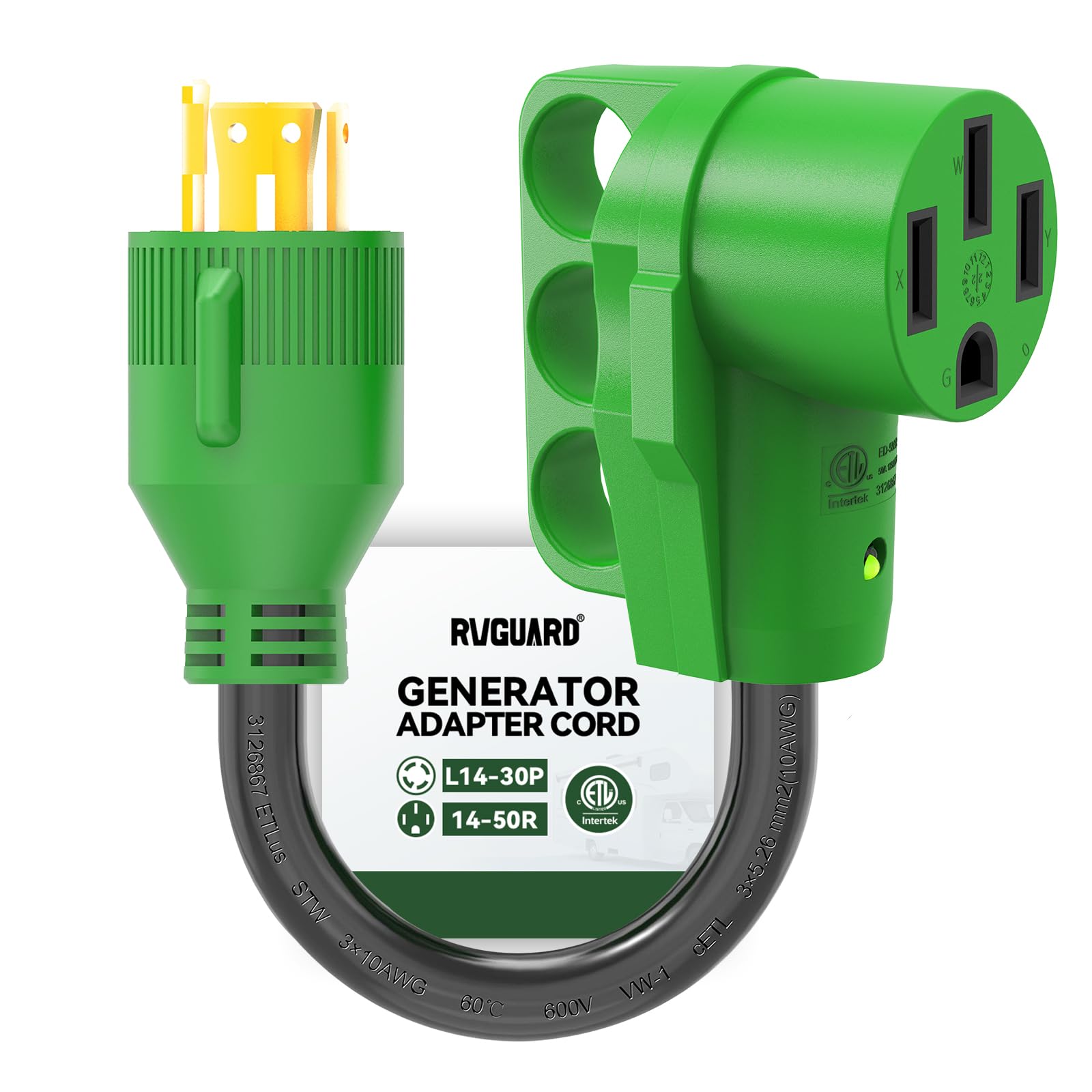
1. RVGUARD 4 Prong 30A to 50A RV Generator Adapter Cord
Our pick — 4.5+★ from 550+ verified ratings; the strongest balance of quality and price.
The adapter that lets a modest generator pour power into a big 50-amp RV inlet.
The situation this cord solves is specific: you have a generator pushing 30 amps and an RV inlet built for 50. The RVGUARD takes that mismatch and bridges it with a NEMA L14-30P male end on the generator side — the four-prong locking plug that twists and stays put — and a NEMA 14-50R female end on the RV side. The lock is the part that earns its keep. It seats into the generator outlet and resists vibrating loose, which is the failure you actually care about at a campsite.
Inside sits 10-gauge, 100% copper wiring wrapped in a flame-retardant and UV-resistant PVC sleeve — plain terms, that’s thick copper that carries the load and a jacket that won’t crack after a summer parked in the sun. A disconnect handle makes unplugging easier on your hands and on the cable, and an LED indicator glows to confirm power is live before you go hunting for a tripped breaker. At 12 inches it’s a true pigtail, so it flexes at the joint instead of levering on your inlet. Compare it to the Malxs adapter further down, which reads 30 A input to 30 A on the RV end — this RVGUARD is the one to reach for when the inlet is a 50-amp socket, since its listed input current is 50 A against the Malxs’s 30 A.
Build quality is the most-cited strength in the feedback, and buyers repeatedly note it arrives exactly as pictured and seats cleanly against a 50-amp generator cord. It also carries the lineup’s top rating at 4.5+ stars across 580+ reviews, with repeated reports that the L14-30P lock holds and the 14-50R end seats cleanly.
Where this cord shines
- L14-30P male end locks into the generator outlet instead of backing out
- 10-gauge copper with a flame-retardant, UV-resistant PVC sleeve for outdoor duty
- LED indicator confirms live power at a glance
- Disconnect handle makes routine unplugging gentler on the cable
What to keep in mind
- Built for the 50A inlet side — not the answer if your RV uses a 30A inlet
- 12-inch length leaves little slack if your pedestal sits far from the inlet
Reach for this if: your generator ends in a four-prong L14-30 outlet and your RV wants 50 amps — this is the clean bridge.
Look elsewhere if: your inlet is a 30-amp TT-30 socket, since the female end here is a 14-50R.
2. ELEGRP 30 Amp to 110 RV Adapter Plug, 3 Way Outlet Splitter
One 30-amp pedestal outlet becomes three household sockets, fanned out so bulky plugs fit.
Sometimes you don’t need to feed the whole RV — you need a mini-fridge, a coffee maker and a laptop charger all running from one campground pedestal. That’s what this does. It takes a NEMA TT-30P, the standard 30-amp RV and generator plug, and fans it into three 5-15R/5-20R household outlets.
The build is 10AWG copper under a rugged STW jacket, and the listing notes it stays flexible in cold weather and shrugs off abrasion, moisture and sunlight. Grip handles on the plug end let you pull it from a tight box without yanking the cord. Tested to UL Specifications, it’s a 12-inch pigtail by design, so it flexes rather than fights your RV inlet.
There’s one hard rule printed right on the product: this is an adapter, not a fuse. It will happily pass more than 30 amps unless you watch your total draw, so add up the appliances before you plug in the third one. Reviewers consistently praise its 10AWG copper build and the grip handles that pull free of a tight pedestal box. If your plan is a small appliance setup off a 30-amp source, this is a tidy fit.
Why it earns a spot: 10AWG copper, a strong outdoor jacket and an ergonomic grip in a 12-inch package built to UL Specifications.
The catch worth naming: it does not limit current for you — keep the combined load under 30 amps yourself or the protection is on your shoulders.
Best for: tailgates, campsites and small-run appliances where a TT-30 outlet needs to feed three standard plugs.
Skip if: you need the adapter itself to cap the amps — this one passes whatever you draw.
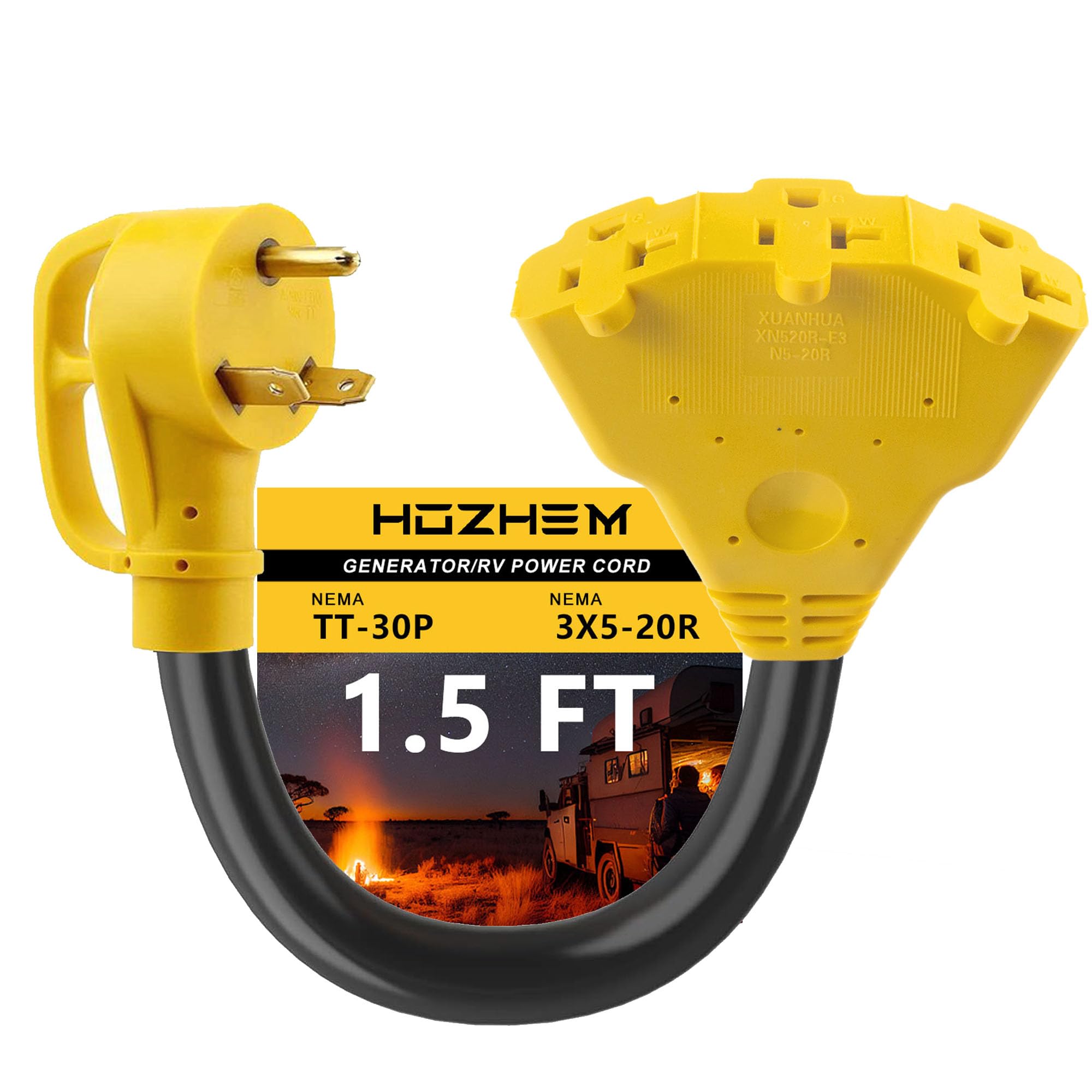
3. 30 Amp to 20 Amp Adapter 110V RV Distribution Adapter
A longer distribution pigtail that splits a 30-amp feed into three standard outlets.
The numbers on the two ends tell you the whole story. The generator side is a NEMA TT-30P rated to a maximum of 30A, 125V, 3750W. The appliance side is three standard household outlets rated to a maximum of 20A, 125V, 2500W each. That gap is the point — you get campground-level power chopped into everyday sockets for tools or small appliances.
Length is where it separates from the ELEGRP above. At 1.6 feet this one reaches noticeably farther than the Champion’s 2-foot run is short — 1.6 feet against 2 feet, so it is the more compact of the two when your outlet is close — and the extra slack over a one-foot pigtail helps when the pedestal sits off to the side. The molded body is 100% pure copper under a flame-retardant, UV-resistant PVC sleeve. It’s ETL Listed, and the yellow body stands out in a cluttered bin or dim light, which is a small thing that saves time.
Owners consistently call it well constructed and a strong value for a jobsite and campsite splitter. Nothing flashy, nothing to complain about.
The practical read: 1.6 feet of molded 100% copper, ETL Listed, splitting a 30A feed into three 15/20-amp household outlets.
One honest limit: the 2500W per-outlet ceiling means big draw appliances should be spread across sockets, not stacked.
Pick this when: you want a slightly longer, budget-friendly splitter for jobsite tools or camp appliances.
Not the one for: anyone who needs a single high-amp RV connection rather than three household sockets.
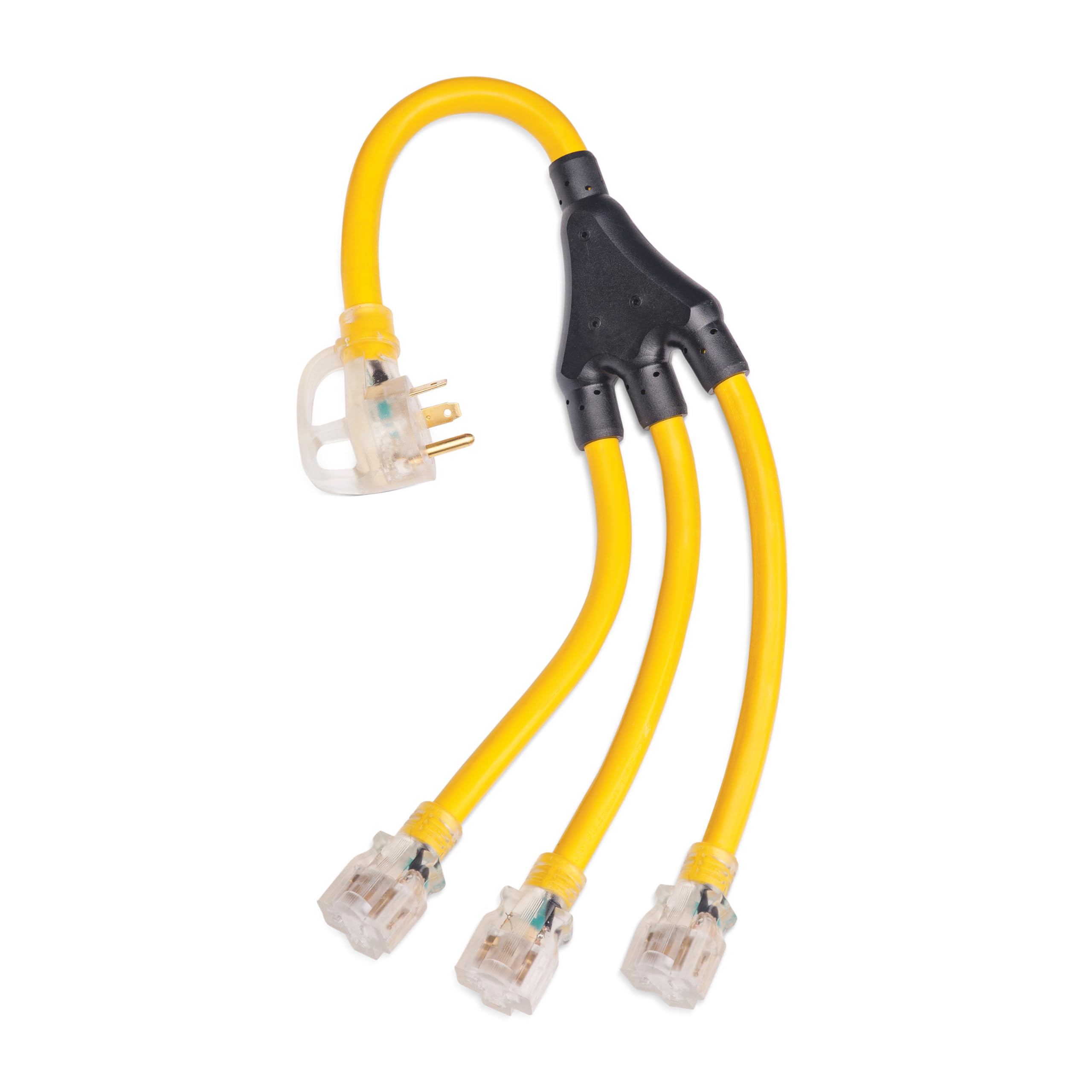
4. Champion Power Equipment 2 ft. 30A 125V Generator Adapter Cord
Built to stay soft when the temperature drops and reach a bit farther than a stubby pigtail.
Two feet of 10-gauge wire rated for 125-volt use, converting a TT-30P RV plug into three 5-20R household outlets. The specification worth pausing on is the cold and heat resistance — Champion states the high-capacity wire stays flexible in extreme temperatures. If you’ve ever fought a stiff cord in near-freezing weather at a late-season campsite, that one trait is the difference between a two-minute setup and a wrestling match.
It’s also the heavier option here at 2.3 pounds, which is the trade-off for service-grade, abrasion and weather-resistant insulation. Integrated LED power indicators show live current at each point, and the extra length over the one-foot adapters gives you slack to a pedestal that isn’t parked right beside the inlet. A 1-year limited warranty backs it up.
Owners praise its cold-weather flexibility and the 2-foot reach as often as its three-outlet function. If you want brand-name backup and you plan to camp in shoulder seasons, this earns its keep.
What stands out
- Stays flexible in cold and heat, so it coils instead of cracking
- 2 feet of reach beats a one-foot stub when the pedestal is offset
- LED indicators at each outlet show power is live
- 1-year limited warranty from a recognized generator brand
Where it costs you
- 2.3 pounds is the heaviest in this lineup — real weight in a gear bag
- Longer than a pigtail, so it takes more room to store
Go for it if: you camp in cold weather and want a cord that flexes and reaches.
Think twice if: you want the smallest possible pigtail that tucks into a small compartment.
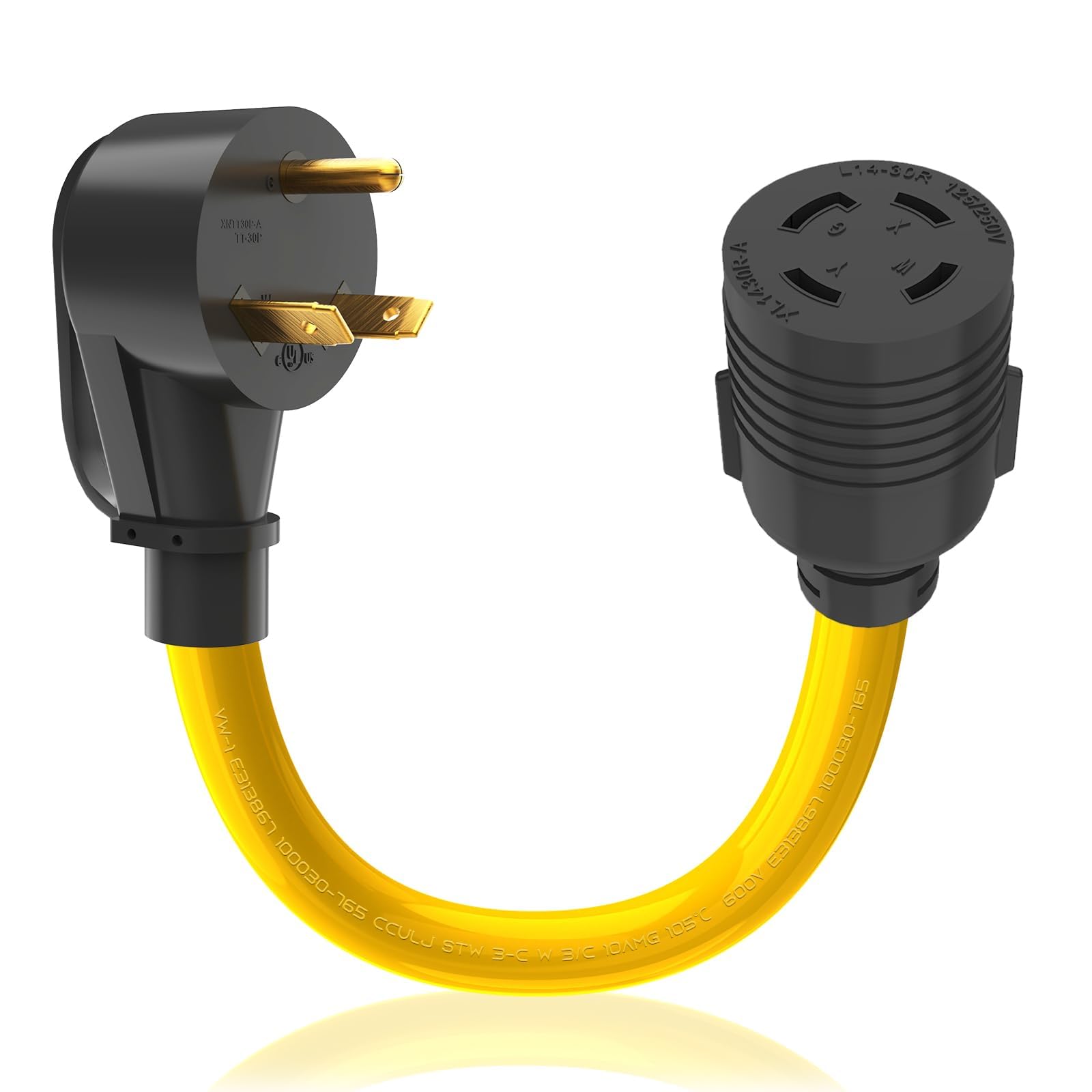
5. Generator Transfer Switch Adapter Cord TT-30 RV 30Amp to L14-30
The one for going from a three-prong generator into a four-prong transfer switch.
Home backup is a different job from campground hookup, and this cord is built for it. One end is a three-prong NEMA TT-30 plug, the other a four-prong L14-30 locking generator outlet connector. That’s the bridge between a typical small generator and a transfer switch inlet. Rated for 125V with a maximum of 3750 watts, it’s 1 foot of 10-gauge wire and it’s UL Listed, which is exactly the sort of credential you want between a generator and your house wiring.
The STW jacket wraps four all-copper wires under UL 62 standards, and the molded plug-in meets UL 817. An ergonomic handle on the female end lets you grip and pull the connector safely rather than tugging the cable. The maker backs it with a 12-month money-back guarantee and a 24-month quality warranty, which is longer coverage than almost anything else on this list.
Buyers point most to fit — the TT-30 plug seats properly on the generator outlet and the L14-30 end locks into the transfer switch as it should. If your setup runs through a transfer switch rather than straight into an RV inlet, this is the specific shape you need.
Why it fits the backup job: UL Listed, 10-gauge copper under a UL 62 STW jacket, and a locking L14-30 end that bridges a TT-30 generator into a four-prong inlet.
Caveat to plan around: at 1 foot it’s a short pigtail, so tight switch-box layouts leave little slack.
Suits you if: your generator ends in TT-30 and your transfer switch or inlet wants an L14-30.
Not for: a 50-amp RV inlet, since this pairs a 30-amp source to a 30-amp-rated output.
6. 30 Amp Generator to RV Power Adapter NEMA L14-30P to TT-30R

The four-prong-to-30-amp RV bridge that people keep buying year after year.
Flip the direction of the RVGUARD and you get this. Instead of feeding a 50-amp inlet, the Malxs takes a four-prong L14-30P portable generator plug and adapts it down to the common 30-amp TT-30R RV receptacle — the socket your regular RV 30-amp power cord plugs into. The spec line spells it out: 30 amp, 125 volt, 3750 watt, 12-inch STW 10AWG/3C cord. That’s the setup for a camper, motor home or travel trailer running its AC, microwave or water heater off a portable generator.
Construction is an ETL-listed molded body in heavy-duty polyvinyl plastic with 100% copper contacts, and the PVC jacket is rated STW and both heat and cold resistant. A grip handle on the female end makes disconnecting from an outlet or another cord easier on your hands. The one thing the listing stresses is to check your generator’s outlets and confirm your combined load, because 30 amps goes fast with an air conditioner in the mix.
Functionality and quality each draw well over forty mentions in the feedback, and the compatibility praise centers on clean pairing with Honda 3000-class generators and standard 30-amp RV plugs. It’s the popular, known-good pick for a four-prong generator into a 30-amp RV.
The reason it’s everywhere: ETL listed, 10AWG copper, a heat- and cold-resistant STW jacket, and a grip handle — a proven shape for L14-30 generators into 30A RVs.
Keep in mind: it caps at 30 amps on the RV side, so a 50-amp inlet is not its job.
For you if: your portable generator has the four-prong L14-30 outlet and your RV runs on a standard 30-amp plug.
Not ideal if: you need to feed a 50-amp RV inlet — that’s a 14-50R job.
7. MECMO 50 Amp to 20 Amp 110V RV Distribution Adapter
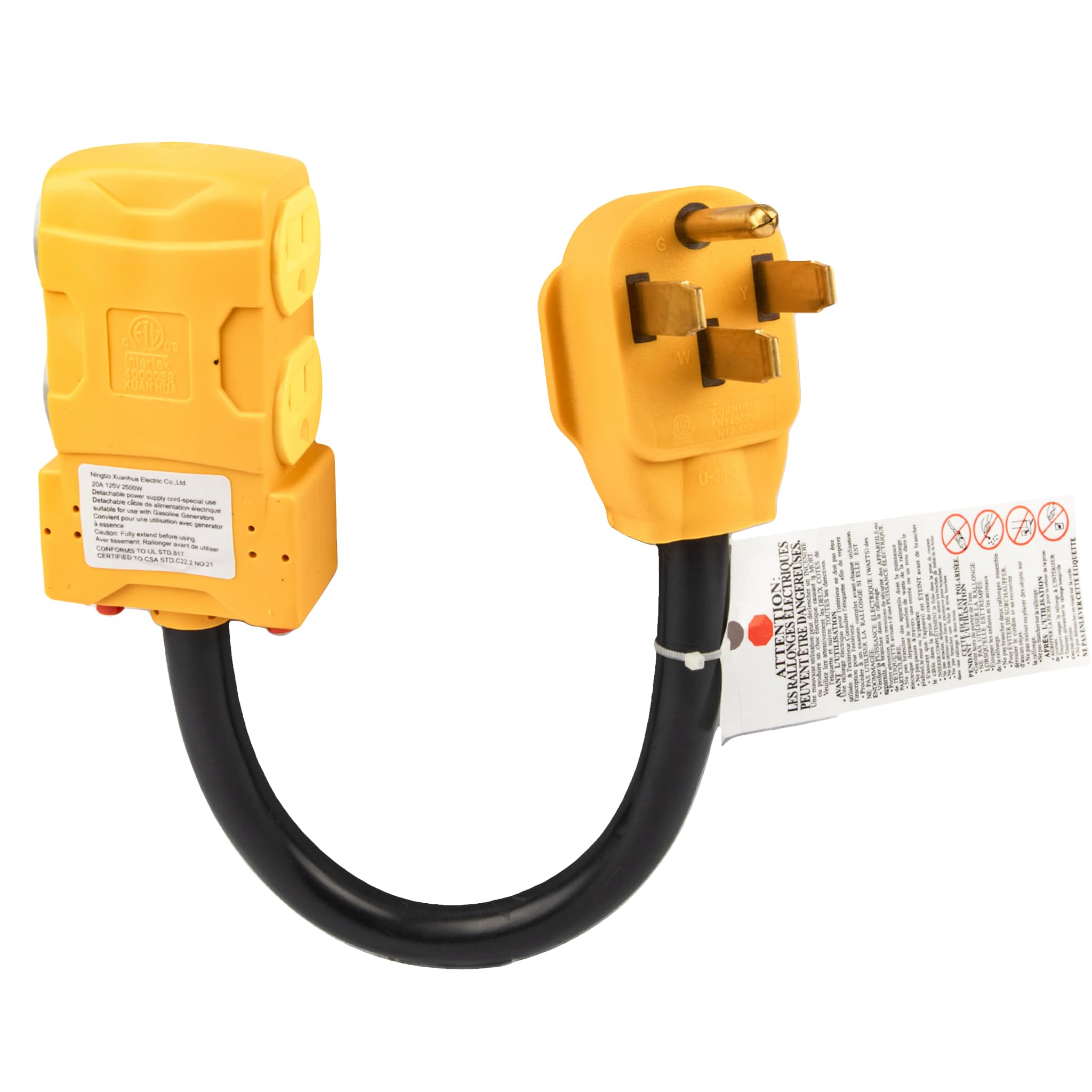
A 50-amp generator outlet split into four household sockets, each side guarded by its own breaker.
This is the most serious distribution cord on the list. The NEMA 14-50P plugs into a 50-amp generator or campground socket, then fans out to four 5-15/20R household outlets at 125 volts. Each side carries its own 20-amp circuit breaker — so a portable heater or power tool on one half can’t take the other half down with it. Per-side output tops out at 20A / 250V / 5000W, with all four outlets together rated to 10000 watts.
At 1.5 feet of standard pure copper, it’s built for RV campgrounds, residential range outlets, generators and jobsites alike. The 50-amp, 125/250-volt straight-blade connection is the same one you find in RV parks and EV charging stations. What buyers notice most is function — it just works — with quality and durability close behind, and the power-capacity split from 240 volts down to four 120-volt outlets is the feature people single out.
The one wrinkle is fit: a few find the plug engagement not to their liking, so check your specific outlet before you commit. For running a spread of household loads off one big generator, the twin breakers are a genuine safety upgrade over a dumb splitter.
The strong points
- Two 20-amp breakers, one per side, protect devices and the cord
- Four household outlets from a single 50-amp source
- 10,000 watts total across all four outlets
- Converting 240 to 120 volts is exactly what people praise it for
The honest catch
- Fit is the point of complaint — a few find the plug engagement fussy
- It’s a chunky 18-inch assembly, not a limber pigtail
Built for you if: you have a 50-amp generator and want to run several household devices at once with breaker protection.
Look elsewhere if: your goal is a slim inline adapter rather than a splitter box.
8. NEMA L14-30P to SS2-50R RV Marine Power Generator Adapter

For marine inlets and locking 50-amp shore power, where a plain straight-blade plug won’t do.
Some 50-amp inlets don’t take a 14-50R — they take the marine-style SS2-50 twist-lock connector, the one with the locking ring that screws down over the connection. That’s the female end here. The male end is the familiar four-prong L14-30P that plugs into a 30-amp locking generator, with electronic power supporting a max 30-amp overload at 125/250 volts. If your rig or boat uses an SS2-50R inlet, few adapters line up correctly — this is one of them.
The female connector’s locking ring is the detail that matters on the water: once it’s twisted and threaded down, the connection resists pulling free and keeps moisture out of the joint. The molded plug body is built to take on wind, rain, snow, soil and rocks, made for the sort of weather a boat or an exposed inlet actually sees.
This lands as a problem-solver for the specific owner whose inlet is SS2-50 — it fits perfectly on both ends, works as it should, and the build quality is what people notice. If you’ve been staring at a marina-style inlet wondering what connects to it, this is your answer.
Where it wins: a threaded locking ring on the SS2-50R end, for a secure, moisture-resistant joint on marine and locking shore power.
Value check: at 30 amps it passes campground-level current, not the full 50 amps your inlet might be rated to handle.
Right match if: your RV, motorhome, trailer or boat has a built-in SS2-50P inlet and your generator is a 30-amp L14-30.
Wrong pick for: a standard 14-50 straight-blade inlet — that needs a 14-50R end instead.
9. MECMO Shore Power NEMA L5-30P to 3X 5-15R/5-20R RV Generator Adapter
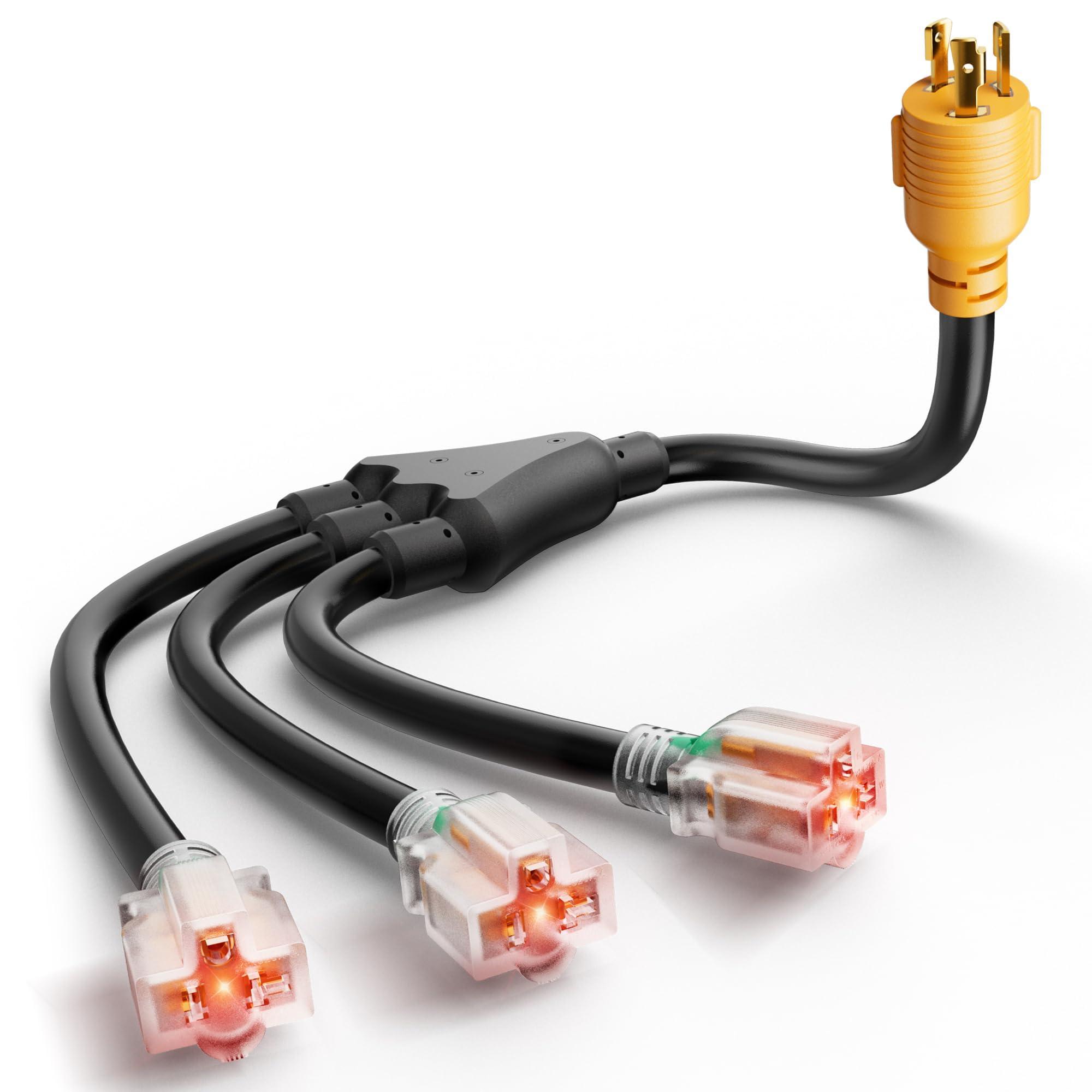
A two-foot three-way splitter for the locking L5-30 outlet, built to clear some distance.
The distinguishing feature here is the male plug: a NEMA L5-30P, the three-prong locking connector you find on certain generators, dock-side power and marine shore connections. It’s not the TT-30 that most campgrounds use — it’s the twist-lock cousin. From there it splits into three 5-15R/5-20R household outlets, rated 20 amp, 125 volts, 2500 watts. If your generator has the locking L5-30 outlet and you’ve been stuck trying to run normal plugs off it, this resolves exactly that.
Length is the other reason to pick it. At 24 inches it’s the longest of the three-way splitters here, well past a one-foot pigtail, which lets you set the outlet block down off the generator rather than hanging it. Inside runs 100% copper conductor under an oil- and abrasion-resistant PVC jacket (SOTW), with a comfortable molded casing for a firm grip. A built-in red LED lights the body so you can find it in the dark.
Quality and durability drive the feedback, and the working-with-generators reports are uniformly good. Between the locking connection and the extra reach, this is the tidy solution for a dock-side or locking-outlet setup.
What earns it the spot
- NEMA L5-30P locking male fits dock-side and locking generator outlets
- 24 inches of reach keeps the outlet block off the ground and away from the generator
- 100% copper conductor in an oil- and abrasion-resistant PVC jacket
- Built-in red LED makes it findable in the dark
The tradeoff
- L5-30 is a niche male plug — it won’t fit a standard TT-30 campground outlet
- Each household outlet is capped at 20 amps, so heavy loads need spreading
Made for: a generator or dock outlet with the locking L5-30 plug that needs to feed three household devices with some reach to spare.
Pass on it if: your outlet is the common TT-30 — you need a different male end entirely.
Know the Specs
Reading the NEMA code
Every connector here has a code like TT-30P, L14-30R or SS2-50R. The number in the middle is the amperage, and the P or R at the end tells you male plug (P) versus female receptacle (R). The L prefix means a locking, twist-style connector; the SS prefix means a marine-style twist lock. Match the code on the adapter’s male end to your generator outlet and the female end to your RV inlet, and it will fit. Get one of them wrong and it won’t seat no matter how hard you push.
Amperage and wattage ceilings
Amps and watts go together, and both appear on these labels. A 30-amp, 125-volt adapter is rated around 3750 watts; a 20-amp, 125-volt household outlet is capped near 2500 watts. The adapter carries whatever your generator supplies on the source end, but the outlet side is always limited by the smaller rating. That’s why you add up your appliances before plugging in several — three 2500-watt sockets don’t add up to 7500 watts of available power if the source is only 30 amps.
Wire gauge and jacket
Gauge is wire thickness, and a lower number is thicker, which carries more current with less heat. 10-gauge is the standard here, written as 10AWG. The jacket description — STW, SOTW, PVC, flame retardant, UV-resistant — tells you how it survives outdoors. STW is a heavy-duty outdoor rating; UV resistance protects against sun damage; cold-weather flexibility keeps it from cracking in winter. A cord that stays flexible is genuinely easier to coil and store.
Pigtail length and breakers
Short pigtails (a foot or so) cut the physical strain on your RV inlet and pedestal, while longer cords (two feet or more) give you slack to reach. If the adapter splits one source into several household outlets, a built-in circuit breaker protects the smaller devices from an overload upstream. Bear in mind that these are adapters, not fuses — the ones without a breaker pass current straight through, so the amperage ceiling is your responsibility.
Common Questions
What is the difference between a TT-30 and an L14-30 plug?
Can I plug a 50-amp RV into a 30-amp generator with an adapter?
Will an adapter let me run my AC and microwave at the same time?
Do I need a splitter with a built-in circuit breaker?
What wire gauge should an RV generator adapter have?
Can I use these RV adapters for a boat or marine inlet?
Should I buy a one-foot pigtail or a two-foot cord?
Is an L5-30 plug the same as a TT-30?
Can these adapters handle 240 volts as well as 120?
Do the locking plugs actually hold better than straight-blade ones?
What does ETL or UL Listed mean on an RV adapter?
The Bottom Line
For most rigs the winner is the RVGUARD 30A to 50A Adapter Cord, because it bridges the most common mismatch — a four-prong generator feeding a 50-amp RV inlet — with a locking male end, 10-gauge copper and an LED that confirms live power, and it holds the lineup’s highest score at 4.5+ stars across 580+ ratings.
If your generator is a four-prong L14-30 but your RV runs on the standard 30-amp plug, the Malxs L14-30P to TT-30R Adapter is the proven, widely-praised bridge in that direction. And if you simply want to turn one 30-amp pedestal into three household sockets, the ELEGRP 3-Way Splitter does it cleanly with 10AWG copper and grip handles.
Whichever you pick, confirm both connector codes before you order — the male end to your generator, the female end to your inlet — because that handshake is the only thing standing between a humming generator and a cold RV. The RVGUARD’s locking connection and crowd-proven build make it the safe first choice for most setups.
How we choose
We do not accept paid placement. Every pick is matched to a real buyer and a real use-case; we do not hands-on test units.
Sources
Specifications: manufacturer listings and product documentation. Review insights: verified customer reviews, as of November 2026. Pricing: not shown on this page (it changes often); check the current price via the retailer link.
As an Amazon Associate, Tactical Gear Guy earns from qualifying purchases. This does not affect which products we feature.