Specs are compiled from manufacturer listings and verified buyer reviews and can change over time — please confirm the key details on the product page before buying.
If your earbuds slide out mid-run, the fix is the shape of the hook or wing, not the brand on the case. Open-ear hooks sit over your ear and skip canal pressure entirely. Wingtip designs instead brace a rubber fin inside your ear. The nine sets below use one of those two approaches, so none should need a mid-run shove back into place. What separates them is weight, battery endurance, and how well the hook adapts to your own ear shape.
This guide is built by comparing the manufacturers’ published specifications and the patterns across verified customer reviews, so you get each pick’s real strengths and trade-offs instead of marketing spin.
Battery claims run from 8 hours per charge up to a 90-hour case, and hook designs range from fixed alloy frames to arms that rotate. That spread is why the list starts with the lightest open-ear set and works down through the heavier, noisier, longer-lasting options. Use it to match the hook style to your own ears before you commit to running earphones that don’t fall out.
Top Picks

How To Choose The Best Running Earphones That Don’t Fall Out
A pair that stays in place is not a matter of luck. It is the hook shape, the per-ear weight, and the ear tip holding hands together. Get those three right and you stop touching your ears at every crosswalk. Get them wrong and no amount of bass will save the run.
Hook type decides everything
An over-ear hook wraps above the ear and holds the whole pod in place from the outside, so nothing has to jam into your canal. That suits runners who get sore ears from plugs. A wingtip instead uses a small soft fin that presses into the curve of your ear. It is lighter and quieter but depends on that fin matching your own ear ridge. If your ears are shallow, a fin can slip and the pod pops loose. Hook sets like the JBL Endurance Peak 3 and the Powerbeats Pro 2 are built around a nickel titanium arm that bends to your ear, so they hold without canal pressure.
Weigh the pod, not the case
Per-ear weight is the number that ruins a long run. A 7.2g pod and a 6g pod feel different by mile ten, because the hook has to hold that mass steady for hours. Heavier pods have more room for battery and drivers but tug harder at the top of your ear. If you log half marathons or long trail days, favor the lighter pod even if the case offers less total playtime. Sweat also loosens a heavy pod faster than a light one, since the hook has more mass to steady on wet skin.
Read the water rating in plain words
An IPX rating is a two-part code: the IP means ingress protection (how well it keeps stuff out), and the number after it describes water resistance. IPX4 means splashes from any direction are fine, which covers sweat and light rain. IPX7 means it survives being dunked in water briefly. IP68 adds dust to the water claim, so grit and sweat both stay out. For running, IPX4 handles daily sweat, but if you run in rain or on dusty trails, look for IPX7 or IP68. Never assume a higher number also means better sound, because the two have nothing to do with each other.
Match playtime to your longest week
Single-charge playtime is what you feel on a long run. Total playtime with the case is what saves you from charging every night. An 8-hour earbud covers a marathon plus warm-up. A 6-hour earbud needs a top-up after a long session. If you charge weekly, favor a case with more total hours, and check the quick-charge claim, since a short top-up before a run can rescue a low pod.
Side-by-Side Comparison
| Model | Best For | Fit Style | Playtime Per Charge | Water Rating | Amazon |
|---|---|---|---|---|---|
| SHOKZ OpenFit Air 2★ Best Overall | All-day wear and long runs | Open-ear ear hook | 8 hours (36 with case) | Water resistant | Amazon |
| Soundcore V20iCrowd Favorite | Value on a big-crowd favorite | Open-ear, four positions | 8 hours (36 with case) | IP55 | Amazon |
| WHYKJTEK BX30Longest Playtime | Marathon-length playtime | Flexible ear hook | 90 hours total | IPX7 | Amazon |
| bmani Over-Ear Hook | Budget backup pair | Adjustable ear hook | 8 hours (80 with case) | Sweat resistant | Amazon |
| TOZO QuietFit | Noise cancelling on a budget | Memory-wire ear hook | 11 hours (100 with case) | Waterproof | Amazon |
| Soundcore Sport X20 | Gym noise and hard training | Rotating ear hook | 12 hours (48 with case) | IP68 | Amazon |
| JBL Endurance Peak 3 | Rain and poolside sessions | Over-ear enhancer hook | 10 hours (50 with case) | IP68 | Amazon |
| Beats Fit Pro | Apple owners who want wingtips | Flexible wingtips | 6 hours (24 with case) | IPX4 | Amazon |
| Beats Powerbeats Pro 2 | Heart-rate training | Alloy ear hook | 45 hours total | IPX4 | Amazon |
Detailed Reviews
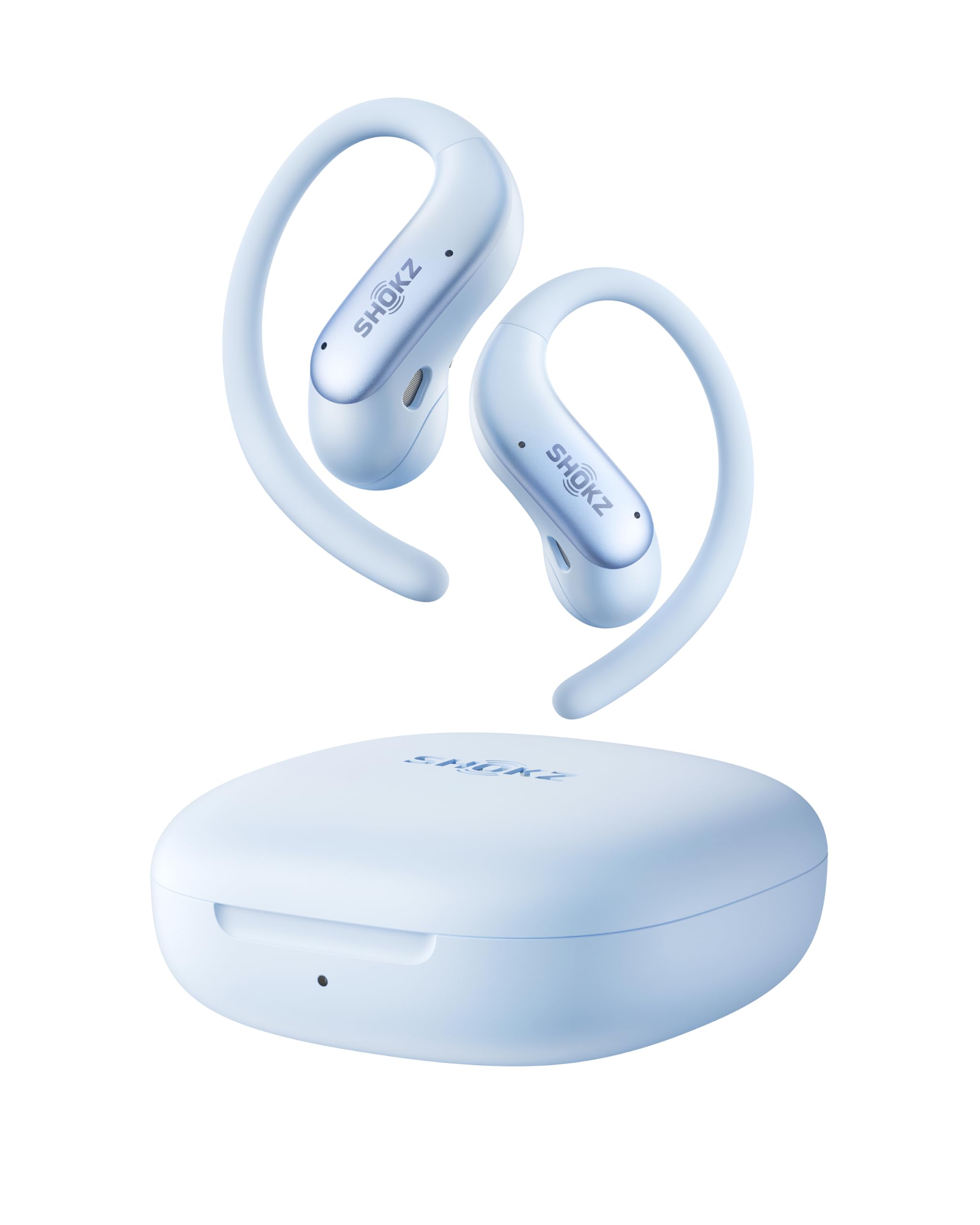
1. SHOKZ OpenFit Air 2
Our pick — 4.5+★ from 300+ verified ratings; the strongest balance of quality and price.
The featherweight open-ear that hangs your canal out to dry and still holds through a sprint.
At 7.2g per ear, the OpenFit Air 2 barely registers on top of your ear, which is the whole reason it holds. The frame is built from 0.75mm Ni-Ti alloy (a memory metal that bends back to shape instead of staying deformed), so the hook curves to your ear and stays there. That keeps the pod steady without pushing anything into your canal. Runners who get sore ears from silicone plugs get a completely different feel here: no heat, no swelling, no pressure point to nag at mile eight.
The open-ear shape also means you hear the car behind you and the cyclist calling out. Shokz calls its privacy tech DirectPitch, which aims the audio toward you and keeps leakage low so the person next to you at the start line is not listening along. Sound is the thing that wins people over most, and the dual-driver bass holds up better than the open design suggests. Battery runs 8 hours on a single charge and 36 total with the case, plus a 10-minute top-up buys 3 hours, which is enough to save a run when you forgot to plug in.
The honest catch is fit, and it splits opinion. Owners who love it say the hook wraps their ear securely; a smaller group finds the pod feels like it wants to slide off, most often when the hook sits too far forward. Treat the hook placement as something to set carefully on your first run, not something the box sorts out for you. Bluetooth 6.1 is the newest spec on this list, and multipoint pairing lets you jump between a phone and a laptop without repairing.
Why Runners Keep Them On
- 7.2g per ear means the hook has almost nothing to hold steady over long distances
- Open-ear design leaves your canal clear, so heat and pressure never build up
- 0.75mm Ni-Ti alloy frame bends to your ear shape and springs back
- 8 hours per charge, 36 total with the case, and 10 minutes of charging gives 3 hours of listening
- Pressure-sensitive buttons ignore sweat and stray hair, so a wet hand does not skip a track
Where It Gives Ground
- The hook fit is divisive — placement matters more than the box suggests
- Open-ear audio means wind and traffic come through along with your music
- Bass is solid for the design but will not satisfy anyone chasing sealed-canal thump
Reach for this if: you want a hook so light you forget it is there and an open ear for traffic awareness.
Look elsewhere if: you need deep noise isolation in a loud gym, since this design deliberately lets the room in.
2. Soundcore V20i by Anker
An open-ear set with four rotation points, so you can dial the hook to your own ear instead of hoping.
The V20i earns its spot with a hook that rotates through four positions, so you can find the angle where the pod sits flat on your ear instead of hovering. If one-size hooks have never fit your ears, that range targets the exact problem that makes other sets slide. The 16mm drivers (the part that moves air to make sound) match the size on much pricier open-ear models. A titanium coating plus Anker’s BassUp processing pushes low end harder than the open design normally allows, so bass is fuller than typical open-ear sound, though not skull-shaking.
Anker’s own spec sheet puts this at 8 hours per charge and 36 with the case, with a 1.5-hour full recharge. That is the same single-charge number as the Shokz above, but it recharges slower and the case holds one fewer hour. Where it pulls ahead is price-to-performance, since it delivers the same open-ear awareness and the same sweat rating (IP55 covers sweat and dust) for far less. The four-mic array with AI enhancement is the other quiet win: calls on a windy street day come through legible on the other end.
Two honest notes. Reliability splits both ways — a slice of buyers reports one earbud giving out or the case failing to charge after months of use, so treat the charging contacts as something to wipe dry after a sweaty session. And the sound leans bright on default EQ, which the app’s HearID tuning fixes for most people. It is also worth knowing that the fit is praised heavily and the pod does stay put, so the core promise of this list holds. The person who should hesitate is anyone who wants a featherlight pod: this one carries more heft than the Shokz.
What you actually get: four hook positions, 16mm drivers, 36 hours of case playtime, and IP55 sweat protection in an open-ear set that competes on price with far less adjustable designs.
The trade-off to know: the 1.5-hour recharge is slower than the quick top-ups some rivals advertise, and the charging case wants to be kept dry for long life.
Best fit: ears that have never quite matched a fixed hook, and buyers who want maximum spent-per-feature.
Think twice if: you want the lightest possible pod on your ear, since this one is heavier than the open-ear leader above.
3. WHYKJTEK BX30 90H Earhooks
Ninety hours in the case and a hook that clips over the ear instead of plugging the canal.
The number that jumps out here is 90: that is total playtime with the case, enough to go weeks of workouts between wall charges. Each pod runs 8 hours alone, and a 10-minute top-up buys 2 more hours. For anyone doing double sessions or who just hates hunting for the cable, that case is the reason to pick it. It pairs that with IPX7 (survives a brief dunk), which is a real step above the IP55 of the V20i for wet runs and heavy sweat.
The fit relies on flexible earhooks that cradle the ear contour instead of the canal, so there is no pressure point to nag. Per-ear weight is 6g, the lightest number on this list, which explains why it stays put through burpees and hill sprints without needing a re-seat. Three tip sizes (S, M, L) come in the box, so you can pick the seal that fits your own ear. Active noise cancelling up to 45dB is on tap for the gym, and a tap on the right pod flips to Transparency Mode when you are back on the street.
What does not hold up is the six-hour figure the brand lists for case charging. Owners who love the battery still find the case slow to fill, so plan a full overnight top-up rather than a lunchtime one. Reliability also splits both ways: some buyers report one side going silent after a stretch. The 10mm drivers are the smallest on this list alongside another 10mm set, so do not expect the bass weight the 16mm open-ear delivers. It stays in place, though, which is the job you hired it for.
Why the hook holds: flexible earhooks cradle the ear contour, not the canal, and 6g per side is the lightest load on the whole list.
Where it asks patience: the case charges slowly and a small group of owners reports one earbud quitting over time, so keep it dry and expect a full slow fill.
Take this one home: if you want maximum playtime between charges and a light hook that survives a downpour.
Leave it on the shelf: if you want the smallest drivers replaced with something that punches low end harder.
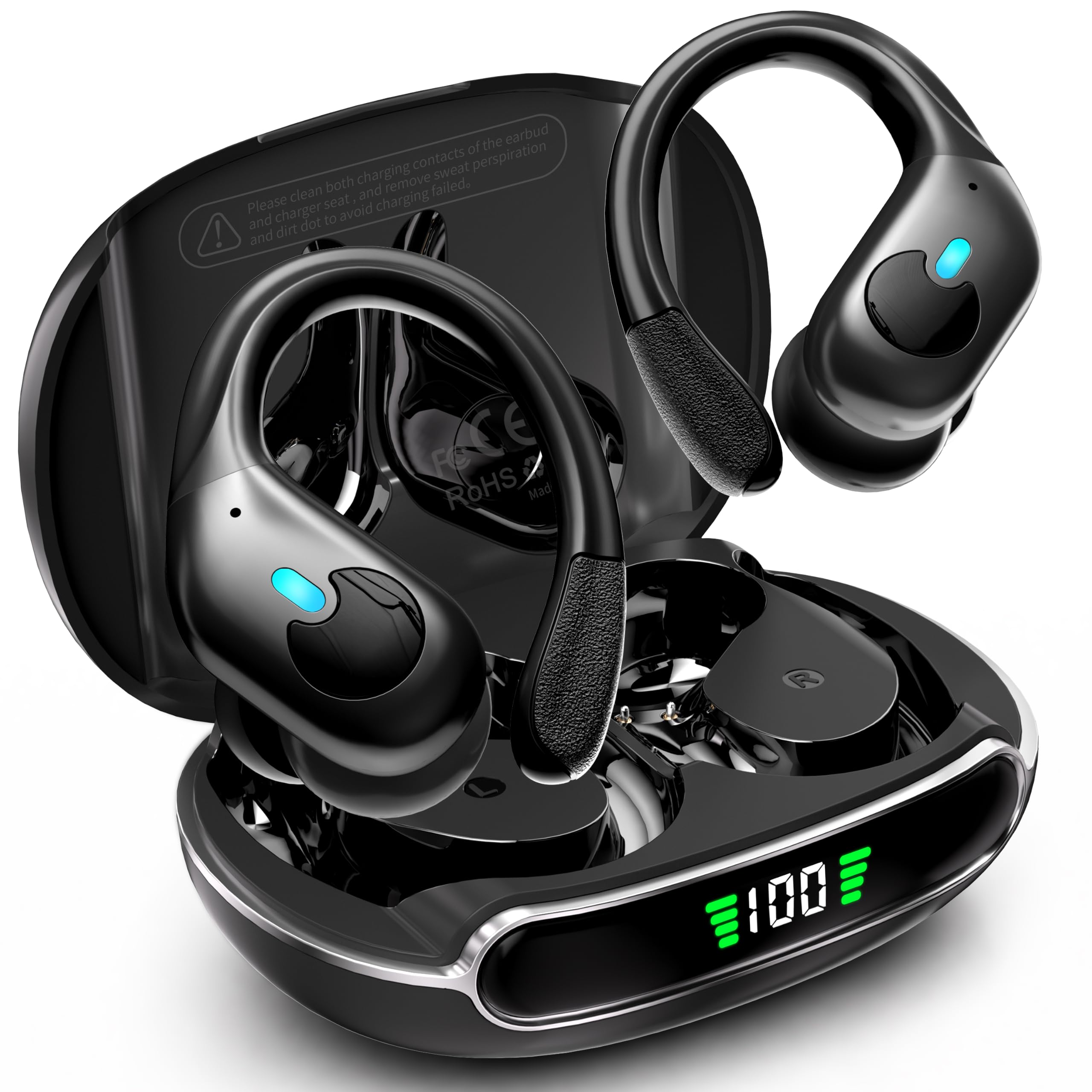
4. bmani Over-Ear Hook Earbuds

A bright pink hook design that looks cheap on paper and overdelivers exactly where runners need it.
Color first, because that is why people stop scrolling: this one comes in a bold pink finish alongside the standard shades. Under the paint is a proper adjustable ear hook that bends to different ear shapes, and it works — owners say the pod sits firmly through runs and cycling. The 10mm dynamic drivers and dual mics handle stereo sound and calls well enough for the price tier, and separate main and volume buttons mean you are not fumbling with touch gestures while sweating. A dedicated button also means accidental taps from water are far less likely.
The two other hooks in this tier play the same game with numbers, but the bmani stacks up on playtime: 8 hours per pod, 80 total with the case. That is 80 hours of case battery, and the dual LED display shows the case’s remaining power on the left and the pods’ charging status on the right, so you know exactly when to plug in. Bluetooth 5.0 handles the connection and re-pairs automatically when you pull a pod out of the case. The 35ms audio latency keeps lip-sync tight on streamed workout classes.
Long-term reliability is where it draws the line. A slice of owners reports the pair giving out over months, and the charging connection is the most common soft spot. The pink finish is just the color of the case and hook shell, not a durability claim. If you run weekly and want one pair for everything, treat these as a backup to a set with a longer track record. If you want a value pair that stays put through the run itself, the buy is straightforward.
Worth Every Mile
- Adjustable ear hooks that hold the pod through running and cycling
- 8 hours per charge, 80 total with the case, and a dual LED display that shows both power levels
- Button controls beat touch on wet hands and reduce accidental skips
- Low latency for streamed classes and games
Read Before You Buy
- Long-term reliability is the weak spot, with one side giving out on some pairs
- The build is simple, so treat the charging connection gently
- 10mm drivers keep low end modest compared with the 16mm open-ear sets
Suits: the runner who wants a secure hook and a large case battery at a budget tier.
Skip if: you plan to make this your only pair and expect it to last through a full year of hard training.
5. TOZO QuietFit Sports Headphones

Memory-wire hooks and hybrid noise cancelling at a price that undercuts anything else here with ANC.
These hold on with a hook made of memory wire wrapped in a light alloy frame, so it settles onto your ear and stays there with no break-in period. That is the anti-drop mechanism, and it suits running, cycling and HIIT. Flick back to Transparency Mode (which pipes outside sound in) and traffic comes through for the run home.
The playtime numbers are strong for the tier: 11 hours per pod alone, 100 hours total with the case, and the case fills in roughly 2 hours over USB-C. That 11-hour single charge is the second-longest per-pod time on the whole list. Drivers are 13mm dynamic with TOZO’s BASS+ tuning, so the low end carries a gym-friendly punch without the thin sound some budget sports earbuds deliver. The TOZO app adds 32 preset EQ modes, which is far more than most people will ever touch but enough to nail your own curve.
Several small honest points. Latency drops to 0.08 seconds in gaming mode, which matters if you stream workouts with on-screen cues. Dual-device connection lets a laptop call and a phone call switch without a repair. But wind noise, while reduced, still reaches you in Transparency mode on a fast bike. And a 13mm driver will not match the bass depth a 16mm delivered on the open-ear leader. For focused training, though, the package is unusually complete.
What stands out: a memory-wire hook that settles in place, 11 hours per pod, 100 total with the case, and -45dB hybrid ANC at a budget-tier price.
What to know: wind noise still reaches you in transparency mode, and the smaller driver keeps the low end less weighty than a 16mm open-ear set.
Go for it when: you want real noise cancelling and a hook that grips without a break-in, all without premium spend.
Hold back when: your route is mostly open road on windy days and you need to hear traffic without wind roar cutting in.
6. Soundcore Sport X20 by Anker
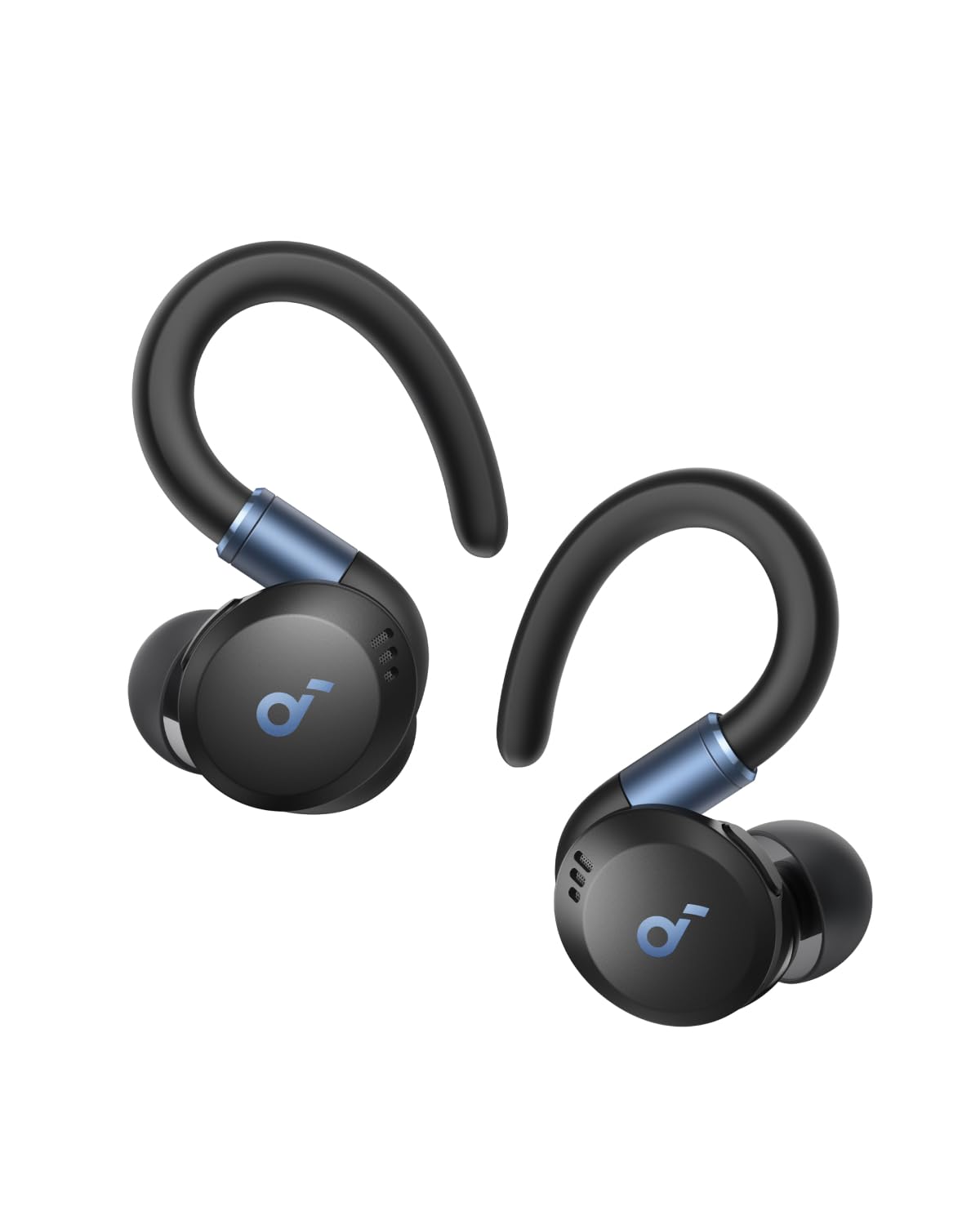
Adjustable hooks that rotate 30 degrees and extend 4mm, so the fit is genuinely yours to tune.
Most hooks ask you to pray your ear matches their fixed curve. The Sport X20 hands you a dial instead: 30 degrees of rotation and 4mm of extension on the arm, so you can point the pod exactly at your canal entrance and lock it there. For someone whose ears have never fit standard hooks, that is the whole reason to choose this set. IP68 (dust-tight and dunk-proof) adds a submarine-inspired seal and Anker’s SweatGuard coating to keep the internals dry through heavy training.
Battery is a 12-hour single charge, the longest per-pod figure on the entire list, plus 48 hours total with the case and a 3-hour case fill. That 12-hour run covers a marathon plus warm-up plus the walk home. Active noise cancelling turns a clanging weight room into a quieter one, and Manual and Adaptive ANC modes let you tune how hard it cancels. BassUp processing on 11mm drivers (smaller than the 16mm on the V20i) keeps the low end punchy without overdoing it.
The honest caveats: reliability splits both ways, and a group of owners reports a failure after a month of use. The battery life is also the most divided topic on this set, with some finding the case stops charging and the pod dropping to about 6 hours instead of the advertised 12. And 11mm drivers bring less bass weight than the 16mm competition. Treat the arm adjustment as the key to a secure fit, and treat the charging case with care, and the Sport X20 gives you a genuinely tunable hook for gym work.
Fit you can tune: 30 degrees of rotation plus 4mm extension on the hook arm, 12 hours per pod, and IP68 protection for the dirtiest sessions.
The catch worth knowing: some units report a case that stops charging and the battery dropping closer to 6 hours, so buy expecting a careful charging habit.
The pick for: gym training, hard intervals, and any ear that needs the hook rotated to hold properly.
Not the pick for: a rider who wants a light, low-heft pod, since the tunable arm brings extra structure.
7. JBL Endurance Peak 3

The IP68 hook set built to survive a dip, with an over-ear arm instead of a silicone fin.
JBL’s selling point is durability, and it puts its numbers where its mouth is: IP68 dust and water proof, plus a claim it endures 30 minutes at depths up to 1.5 meters in salt or fresh water. That is more than sweat protection — it is built for rain and surf. The over-ear enhancer arm wraps around the ear and holds through the motion, which is why owners say it stays put through a run. Pure Bass sound from a 10mm driver keeps the low end present, and the TalkThru plus Ambient Aware modes flip you between music and conversation without pulling the pod out.
Battery runs 10 hours per pod and 50 total with the case, and Speed Charge buys a fast top-up between sessions. Bluetooth 5.2 is a generation behind the 6.1 on the Shokz above, and the case weights 2.7 ounces. Four mics split two per ear to keep calls legible on a windy bike trail. All of that adds up to a set that is built for wet and hard use, not just a sweaty one.
This set is genuinely divisive. Some love it, others rank it low among JBL products, and the specific gripe is volume: it can feel too quiet and even amplify outside noise, the opposite of what you want in a tunnel or on a busy road. Fit splits too, since some owners mention the pod slipping where the hook should sit tight. If you need loud and have shallow ears, this is not the safer call. If you surf or trail-run in rain and want a set that takes abuse, the IP68 rating (full dust protection and safe to dunk in water) is real.
The Case for the Peak 3
- IP68 survives a dunk, and the brand claims 30 minutes at 1.5 meters in salt or fresh water
- Over-ear enhancer arm holds through running motion
- 10 hours per pod and 50 total with the case
- Ambient Aware and TalkThru modes for street and conversation without re-seating
Where It Splits Buyers
- Volume runs low on some units, and outside noise can creep in
- Fit is not universal — some ears feel the pod slide
- Bluetooth 5.2 is a step behind the newest sets
Go here when: water and grit are your real enemy and you want the toughest IP68 rating on the list.
Look elsewhere for: loud rock-solid volume and a hook that fits every ear from the start.
8. Beats Fit Pro (1st Gen)

A wingtip design instead of a hook, for the iPhone owner who wants locked-in and laced to Siri.
This is the only wingtip on the list, and that is the point. Instead of an arm over your ear, it presses a soft flexible fin into your ear ridge to hold the whole pod. If your ears match that fin shape, the hold is excellent and the sound is sealed in. The custom acoustic platform delivers balanced sound with real low end. The H1 chip (Apple’s audio chip) gives you Automatic Switching across your iPhone, plus Audio Sharing and hands-free “Hey Siri.” For an Apple household, this is a smoother fit than any Android-first set.
Battery runs up to 6 hours per pod and up to 24 with the case, which is the shortest per-charge time on this list — enough for a half-marathon, not a full marathon. Three listening modes (Active Noise Cancelling, Transparency Mode and Adaptive EQ) and Spatial Audio with head tracking are on tap. Class 1 Bluetooth is the longest-range class, so dropouts are rarer when you leave the phone on a bench across the gym. IPX4 covers sweat and light rain, which is enough for daily training but not for a downpour.
The caveat is that a wingtip is not a hook. A hook holds from outside the ear, while a wingtip depends on the fin pressing inside it. Ears that do not match the fin shape will feel the pod loosen or fall out during workouts. Some owners also report discomfort after an hour of training. So this is a fit-first decision, not a spec decision. If your ears suit the fin, you get excellent sound and a secure hold. If they do not, the hook sets above are the safer choice.
Why Apple owners bite: H1 chipping, 6-hour pods with 24-hour case, and wingtip hold that lets you tune ANC, Transparency and Spatial Audio in one place.
What to weigh: the wingtip fin is not a universal fit, and an hour in the ear can start to sting — the strongest hold is only for ears that match the fin’s shape.
Best for: iPhone owners with ears that suit a wingtip fin and who want strong sound plus Siri baked in.
Not right if: you have shallow ears or want a hook-style hold you can be sure of before your first run.
9. Beats Powerbeats Pro 2

An alloy earhook with a heart-rate sensor in it, for the runner who wants hands-free training data.
This is the one set here with a sensor inside, and that is its whole reason to exist. The nickel titanium alloy earhook bends to your ear and springs back, which is how the pod holds through a sprint or a heavy lift. Beats says it tested the fit across athletes of every ear shape. The second differentiator is the heart-rate sensor built into the pod, pulsing 100 times per second to track without a chest strap or watch. If you train by heart rate and hate the strap, this is your set.
Battery runs up to 45 hours total with the charging case, and it is the first Beats set with a wireless Qi-charging case. Fast Fuel buys 1.5 hours of playback on a 5-minute charge, which rescues a run when you forgot to plug in. The Apple H2 chip handles the connection, with one-touch pairing on both Apple and Android, and class 1 Bluetooth holds range. Adaptive EQ measures your ear and listening space to tune frequencies, and Personalized Spatial Audio with head tracking works on Apple devices. Six microphones (three per ear) keep calls legible on a run.
Where it gets cloudy is the same place as most premium sets: the fit and comfort split. Some owners say the alloy hook hugs the ear well; others find it hurts behind the ear on longer sessions. Noise cancelling is praised by some and criticised as barely there by others, and wind noise is the specific gripe. Treat the heart-rate tracking as a convenience, not a replacement for a calibrated chest strap. And at 1.76 ounces across the pair, it is heavier than every hook set above. Still, it is the only set here with a heart-rate sensor, and that is the case it answers.
The headline: heart-rate sensors in the pod, a Qi-charging case, and 45 hours total, all inside an alloy earhook that bends to your ear.
The honest catch: the alloy hook feels heavier than the featherweight sets above, and the fit splits between ears that love and ears that ache behind the ear.
Worth it for: heart-rate-led training without a chest strap, plus a hook that holds through a lift.
Skip when: what you want most is the lightest pod on the ear or the safest bet for ear shapes that never fit hooks.
Know the Specs
Ear Hook vs Wingtip
An ear hook is an arm that wraps over the top of your ear and holds the pod from the outside. A wingtip is a soft fin that presses inside your ear’s curve. Hooks work well for shallow ears because they do not rely on the canal; wingtips are lighter and quieter but only work when the fin matches your ear shape. The hook sets here bend to your ear (Ni-Ti alloy or memory wire), while a wingtip is fixed. That is why a wingtip feel more secure only in ears that suit it.
IP Ratings in Plain Words
IP stands for ingress protection. The letters after the number describe what is being kept out — IPX means water only, while IP6X adds dust. A higher number means more protection on that axis. So IPX4 covers sweat and splashes, IP55 covers sweat plus some dust, IPX7 survives a brief dunk, and IP68 handles both dust and a dunk. None of these describes audio quality, so a higher number never means better sound.
Per-Ear Weight
Per-ear weight (in grams) is how much each pod mass your hook has to hold. A 7.2g pod and a 12-hour battery pod feel different by mile ten, because the hook carries that weight the whole way. Lighter pods hold better through sweat because there is less mass to dislodge. Heavier pods bring more battery and drivers but tug harder at the top of the ear.
Total Playtime vs Per-Pod
Per-pod playtime (the hours you get from one charge) is what covers a single run. Total playtime is what you get when you alternate pods and recharge from the case. A 6-hour per-pod set needs a midweek top-up; a 12-hour set covers a marathon. If you charge weekly, the total playtime with the case matters more than the single charge.
Common Questions
Will an ear hook set stay in if my ears are small or shallow?
Is a wingtip safer than a hook for running?
Does IP68 mean sweat will not damage the earbuds?
Can I run a marathon on one charge with these earbuds?
Why do my earphones fall out during running even with a hook?
Do open-ear earbuds work for noisy gyms?
How long does the charging case last between charges?
Can I wear these running earphones for cycling and the gym too?
Do I need a phone app to get good sound from these?
The Bottom Line
For most runners, the running earphones that don’t fall out winner is the SHOKZ OpenFit Air 2. At 7.2g per ear, its 0.75mm Ni-Ti alloy hook holds without any canal pressure, and it keeps 8 hours per charge and 36 with the case. If you want an adjustable hook and a crowd-favorite value set, grab the Soundcore V20i with its four rotation positions. For long-distance training where playtime beats everything, reach for the WHYKJTEK BX30, at 6g per side and 90 hours with the case.
The one honest nudge: the V20i has the biggest review history of the group, but the OpenFit Air 2 holds the higher score at 4.5+, so pick on hook style and weight rather than by popularity alone.
How we choose
We do not accept paid placement. Every pick is matched to a real buyer and a real use-case; we do not hands-on test units.
Sources
Specifications: manufacturer listings and product documentation. Review insights: verified customer reviews, as of November 2026. Pricing: not shown on this page (it changes often); check the current price via the retailer link.
As an Amazon Associate, Tactical Gear Guy earns from qualifying purchases. This does not affect which products we feature.