Specs are compiled from manufacturer listings and verified buyer reviews and can change over time — please confirm the key details on the product page before buying.
You press the button, the little light blinks, you drill — and you hit air, or worse, a pipe. A steadier hand will not fix it. It is a scanner with more than one or two sensors inside it, because a single sensor can only guess at a stud’s edge. The picks below are all center-finding electronic stud finders, the kind that show you where the middle of a stud sits so you can hang a shelf or a TV mount and actually hit wood.
This guide is built by comparing the manufacturers’ published specifications and the patterns across verified customer reviews, so you get each pick’s real strengths and trade-offs instead of marketing spin.
Some units read through plaster and tile, some only drywall, and a few trade depth for a phone screen. Below you get the plain-English breakdown of each, so you can match the tool to the walls you actually own and pick the right pro stud finder without paying for depth you will never use.
Top Picks


How To Choose The Best Pro Stud Finder
Most bad stud-finder experiences come from buying a tool that does not match the wall in front of you. A unit that shines on fresh half-inch drywall can go silent on old plaster over lath. So start with your walls, then work backward to the sensor count, the depth rating and the display.
Sensor count is the real accuracy lever
One or two sensors can only tell you something is nearby. A 13-sensor array reads across a wide strip and lights up the whole stud, including its edges and its center. That is what stops the classic false positive where you mark a spot and drill into nothing.
Match scan depth to your wall build-up
Standard drywall scanning often tops out around 3/4 inch of depth. If your wall has two layers of drywall, OSB sheathing or thick tile over it, you need a deeper mode — one model here reaches 2.5 inches. Skip the deep feature if every wall in your house is a single layer.
Decide if you want a beep, a light bar, or a screen
LED bars are instant and need no phone. A visual scanner that pairs with your phone shows a picture of what is behind the surface, which helps when you are tracing a pipe run. The trade-off is setup time and a connection that has to hold.
Check the small stuff before you commit
A built-in bubble level saves a second tool on shelf work. A finger guard and felt backing keep the wall free of scuff marks. And calibration — either automatic or a held button — decides how quickly you can move from one wall to the next.
Side-by-Side Comparison
| Model | Best For | Max Wood Depth | Detection Modes | Weight | Amazon |
|---|---|---|---|---|---|
| Franklin Sensors ProSensor 710+★ Best Overall | All-round drywall and plaster scanning | 1.6 in | Single deep mode (wood and metal) | 6.4 oz | Amazon |
| FNIRSI WD-01 6 in 1Most Modes | Mixed material hunting on a budget | 1.5 in | 6 modes incl. AC and copper wire | 9.3 oz | Amazon |
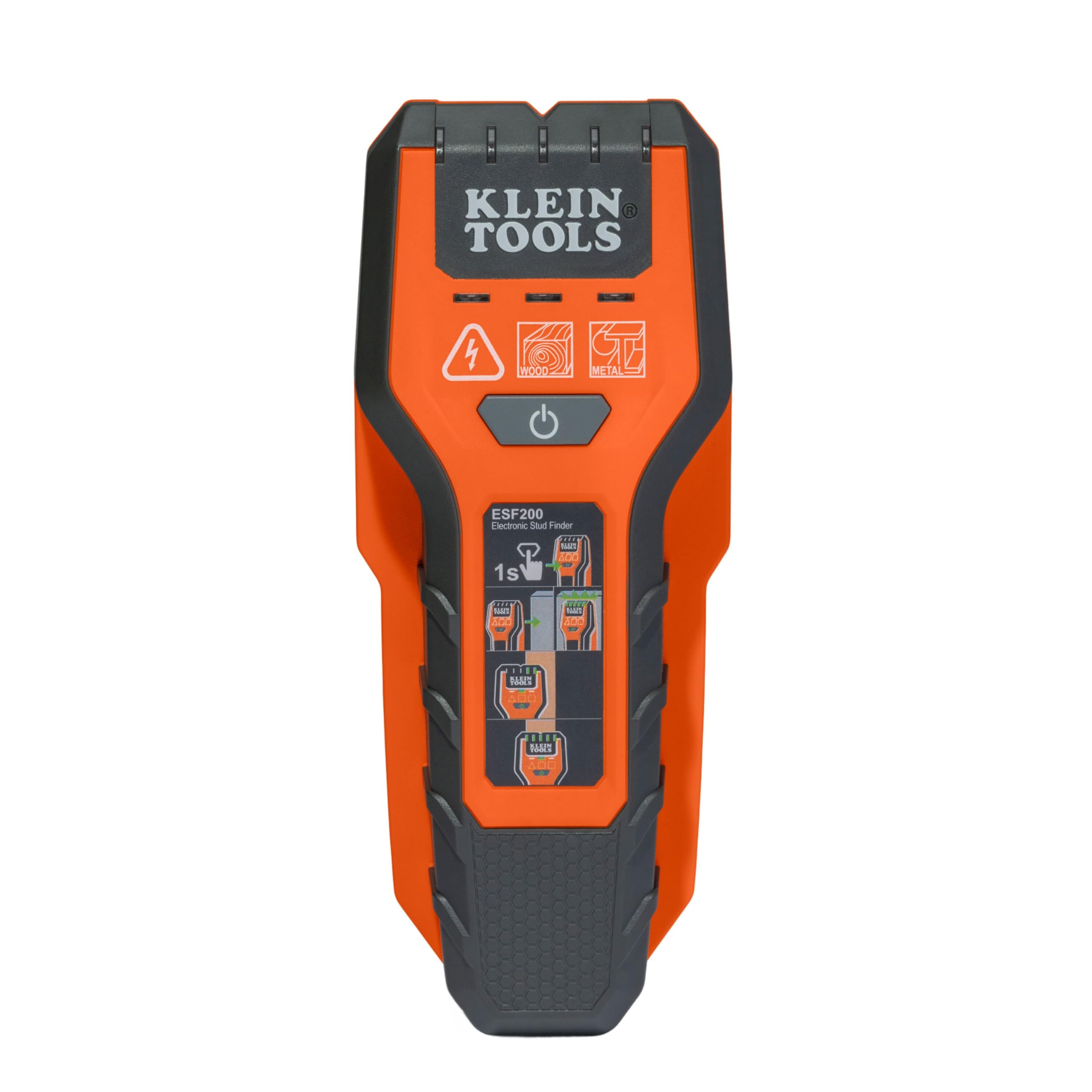
| Klein Tools ESF200Featherweight Pick | One-handed work on ladders | 3/4 in | Wood, metal, AC in one scan | 5 oz | Amazon |
| Zircon MultiScanner A200 | Marking stud centers with a pointer | 1-1/2 in (DeepScan) | 3 modes plus WireWarning | 0.37 kg | Amazon |
| Zircon MultiScanner i520 | Drywall studs plus electrical tracing | — | Stud, metal, AC scanning | 6.88 oz | Amazon |
| Bosch GMS 120-27 | Construction-site durability | 30 mm | Metal, live cable, wood | 0.24 kg | Amazon |
| Franklin Sensors ProSensor MAX | Double drywall, OSB and thick tile | 2.5 in | 2 modes (standard and deep) | 1.1 lb | Amazon |
| Walabot DIY 2 | Seeing a picture of pipes and studs | 4 in sensing depth | Visual imaging via phone app | — | Amazon |
| Bosch D-tect 120 | All-material radar scanning | — | 3 settings: drywall, concrete, universal | 2.3 lb | Amazon |
Detailed Reviews
1. Franklin Sensors ProSensor 710+ Stud Finder
Our pick — 4.5+★ from 10,500+ verified ratings; the strongest balance of quality and price.
Thirteen sensors across one bar — the reason this reads a whole stud instead of a mystery blip.
Most stud finders hide one or two sensors behind the plastic. This one runs 13 of them in a row, so when you press the button it lights up the entire width of the stud at once — both edges and the middle. The middle LED turns green when you are on the center. That full-width read is why it holds the top spot: mark the green center LED and drill.
Depth runs to 1.6 inches, which covers standard drywall and gets you through a fair amount of plaster without switching modes. There is only one mode, and it stays on permanently, so there is no menu to scroll through on a ladder. A built-in bubble level and an integrated ruler are molded into the body, so a shelf job does not need a second tool in your pocket. The whole unit weighs 6.4 ounces and takes batteries (not included), and it will not run on rechargeables.
It averages 4.5+ stars across 10,000+ owner reviews. Buyers report it keeps finding studs on sheet rock, plaster and drywall alike. Durability is the weak spot: some long-term owners mention the unit failing after about a year. Value splits opinion too — plenty call it worth it, plenty think it is steep for a stud finder. Neither complaint touches the accuracy, which is the job.
Where it earns its keep
- 13 sensors light the full stud width, edges and center in one pass
- No calibration step — press anywhere, even right over a stud
- 1.6-inch deep detection handles wood and metal studs
- Bubble level and ruler built into the body
What to weigh before buying
- Runs on standard batteries only, and rechargeables are not supported
- Long-term durability draws the most negative feedback of any aspect
- Cost draws mixed feelings among owners
Reach for this one: if your walls are a mix of drywall and plaster and you want to skip calibration entirely.
Look elsewhere: if you need deep scanning through double-layer drywall or OSB, where its 1.6-inch reach tops out.
2. FNIRSI WD-01 Stud Finder
Six separate detection modes, a rechargeable battery, and a positioning hole for marking edges.
This is the tool you buy when you are chasing more than studs. Exact scan mode finds the center and edges of wood and metal studs up to 0.75 inches deep, and depth scan pushes that to 1.5 inches. Beyond that you get non-ferrous metal detection to 3.9 inches, ferrous metal to 4.7 inches, live AC wires to 2 inches and copper wire to 1.6 inches. If you have ever wanted to trace a pipe run before drilling a cabinet anchor, those extra modes are the point.
The positioning hole is a small but smart touch. It lets you mark the center or edge directly through the housing instead of holding a pencil at a moving light. A digital LCD plus an audio alarm give you both a readout and a beep. The rechargeable lithium-ion cell means no battery runs to the store mid-project. It weighs 9.3 ounces, so it is a bit heavier in the hand than the Klein below.
Here is the honest part: accuracy is the split opinion on this model. Some owners call it very accurate, others report nothing but bad readings, and the easy-to-use and value angles are what actually get praised. That pattern says it rewards a slow, careful scan rather than a quick sweep. If you need a tool that performs on the first pass every time without you thinking about it, this is the wrong pick.
Best use case: a homeowner who wants one device to find studs, pipes and wires on many surfaces — lath, wallpaper, wood flooring, acoustic ceiling and painted walls are all listed — and likes never buying batteries again.
Pick it when: you want mode variety and a rechargeable cell over a single-purpose scanner.
Think again if: you want a fast, confidence-first read on drywall and nothing else.
3. Klein Tools ESF200 Stud Finder
Five ounces, one thumb, no holding the button down — a scanner built for a ladder.
At 5 ounces, the ESF200 is the lightest tool on this list — and that is not cosmetic. It is 4.3 ounces lighter than the FNIRSI in this guide, which matters when you reach overhead with one arm and hold a pencil in the other. The power button glows green and stays on until you turn it off or it powers down, so your finger is free to mark.
Scan depth lands at 3/4 inch for wood, 1-1/2 inches for ferrous metal and 2 inches for AC voltage. One mode covers live AC wires, wood and metal, so there is no switching back and forth depending on what you are hunting. Automatic calibration happens each time you move walls — fast, though you still need a flat surface to start from. A finger guard keeps the nose off the wall and a felt backing stops scuff marks on fresh paint.
On the small tool’s footprint: it measures 6.74 x 2.72 x 1.2 inches, so it drops into a tool bag or a jacket pocket without a case. Owners lean on how well it works and how solid it feels in the hand, with one-handed use singled out as the standout. Accuracy is the split note — some find it spot on, others not — and that 3/4-inch wood ceiling means it is not the tool for thick wall build-ups.
The ladder argument: a stay-on power button plus 5 ounces is exactly what you want when both hands are busy overhead.
Honest limit: if your walls carry two layers of drywall or thick tile, this one will run out of depth before it finds the stud — pick the ProSensor MAX instead.
Good match: one-handed jobs, tight spaces and single-layer drywall.
Not your tool: deep scanning through OSB, plaster over lath or double wallboard.
4. Zircon MultiScanner A200 Stud Finder
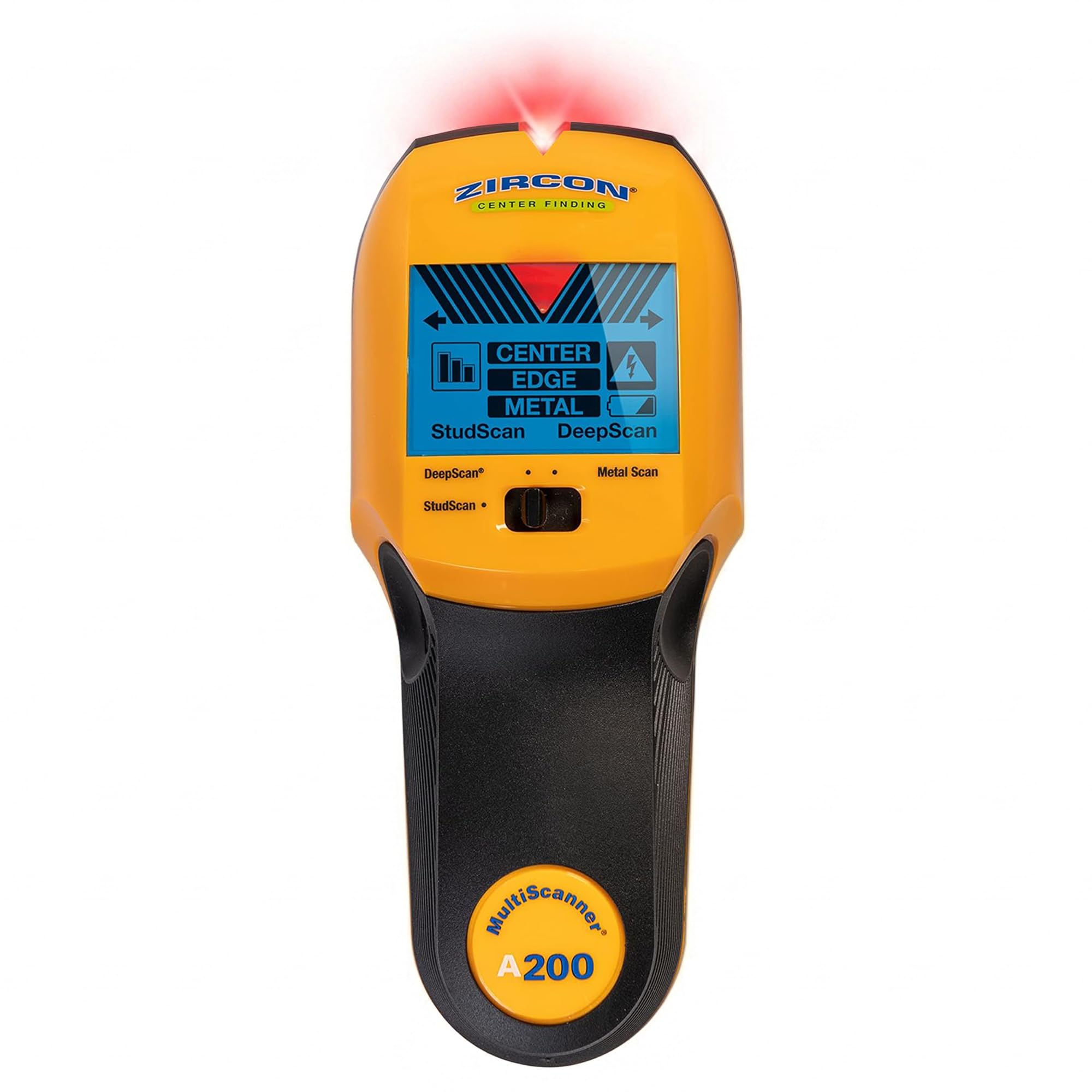
A beam of light that paints the stud center right where you need to put the pencil.
Three modes give the A200 range. StudScan finds wood or metal stud edges and centers up to 3/4 inch deep, DeepScan pushes that to 1-1/2 inches for tougher walls, and Metal Scan locates metal behind the surface before you drill. The SpotLite Pointer throws a light mark onto the wall, so the center point is visible at arm’s length instead of being another line on the screen.
WireWarning detection is the safety piece you actually want when a TV mount is going up on a wall near an outlet — it alerts on hot electrical wires behind the surface. Calibration is deliberate: press flat and hold, wait one to two seconds for the short beep, and do not move the unit until it finishes. The LCD, the audio tone and the pointer all work together during the scan.
Owners like that the scan needs almost no setup thought. The recurring split is detection: the unit sometimes misses smaller metal items like a copper pipe, so treat it as a stud and wire scanner with a metal bonus, not a substitute for checking before you drill. Depth and marking precision are what it does well. The 9V battery arrangement is worth knowing about, and the low battery indicator tells you when a fresh 9V alkaline is due.
Reasons owners hang onto it
- DeepScan reaches up to 1-1/2 inches for thicker surfaces
- SpotLite Pointer lights the center mark on the wall
- WireWarning flags hot wires before the bit goes in
- Stud direction is shown, not just the location
Fair warnings
- Detection of smaller metal objects draws the mixed feedback
- Calibration takes a held button and a still hand
- Battery life is a recurring note from longer-term owners
Best fit: mounting a TV or cabinet where you want a visible center mark and a wire alert.
Skip the shortcut: do not count on it alone for thin copper pipe runs.
5. Zircon MultiScanner i520 Stud Finder

A drywall specialist with a backlit LCD and an electrical locator that earns its keep.
The i520 is the model owners point to when the wall is standard drywall and the job is ordinary. It finds wood and metal studs, hidden metal and live AC wiring in one tool, and the electrical wiring alert is the feature that keeps coming up as the reason people trust it near outlets. The backlit LCD display is there for dim closets and under-cabinet work.
Battery life averages 5 hours, so pack spares for a full day of scanning. It weighs 6.88 ounces, so it hangs in the hand comfortably through a few dozen scans. The IP52 rating means it shrugs off dust and light drips rather than surviving a rainstorm.
What owners come back to is the build: it feels like a tool that will keep working, and on smooth drywall it reads studs with little drama. The friction point is the electronics themselves — the display gets mixed reactions, and value is genuinely split between people who find it worth the outlay and people who think it is priced high for what it does. Neither touches how it reads a normal wall.
Nice touch: the electrical locator turns a basic stud scan into a wire check, which is worth a lot on any wall near a panel or outlet.
Take this route: standard drywall walls, ordinary mounting jobs, and you want the wiring alert built in.
Hold off if: you are scanning thick plaster or want a long run time between changes.
6. Bosch Professional GMS 120-27 Detector
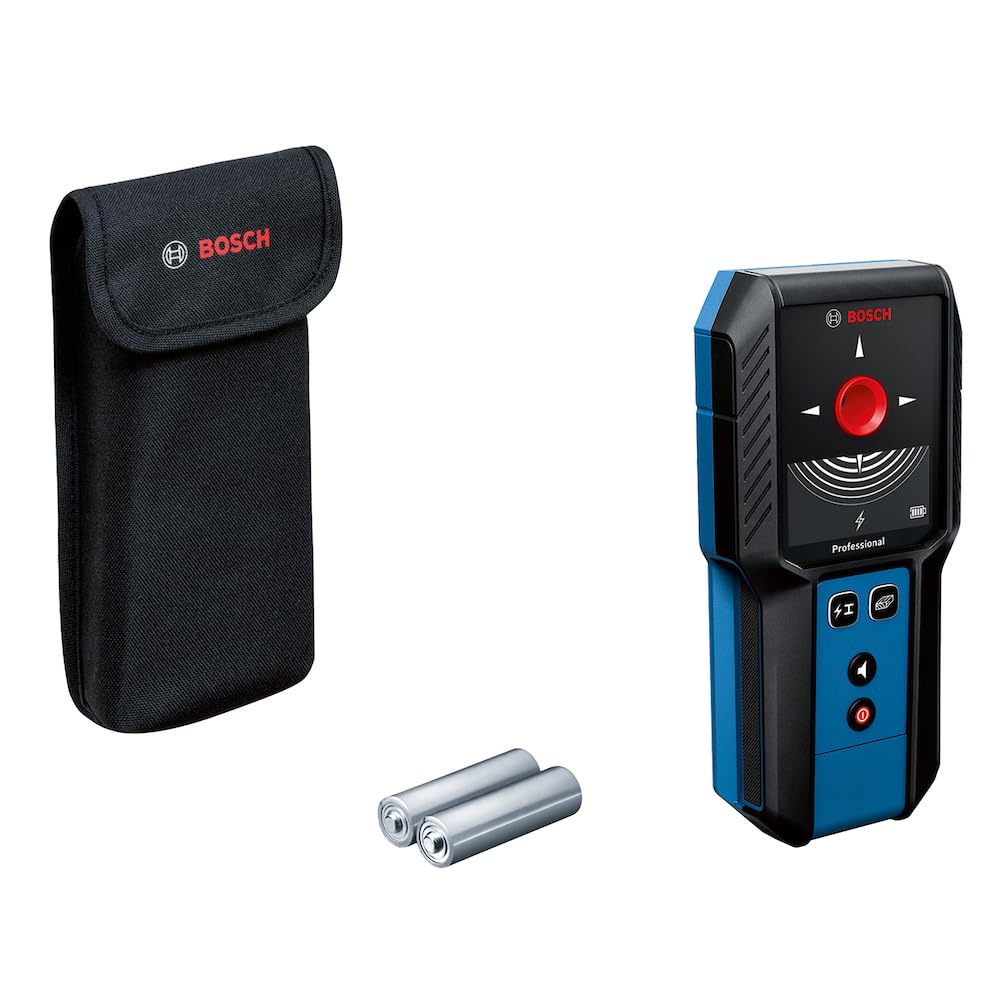
Rubber-armoured, IP54 rated, and lit by a ring that changes colour as you close in.
Two details set the GMS 120-27 apart from the plastic-bodied scanners. The first is the housing: shock-absorbing rubber and an IP54 rating mean dust and splashes are not a problem, which is why it is built for construction sites rather than a tidy garage. The second is the tri-colour LED ring around the marking opening — red when an object is detected, yellow as you approach one, green when nothing is there. You read the ring, not a number.
Depth figures run in metric: 120 mm for non-magnetic metal, 100 mm for magnetic metal, 50 mm for voltage-conducting cable and 30 mm for wood. The unit also tells you what it thinks it found — magnetic metal, non-magnetic metal, a live line or a non-metallic material — so you are not guessing whether the blip is a stud or a pipe. It weighs 0.24 kg, and the box includes the detector, a protective bag and two AA alkaline batteries.
This is the pick when the tool rides in a van and gets knocked around. The mode selection is simplified and the material identification does the interpreting for you. The trade-off is that 30 mm of wood depth is shallower than the deep-scan models here, so very thick wall build-ups are not its territory. For ordinary drywall and masonry work, the ring makes the scan almost reflexive.
Why it holds up: the rubber housing plus IP54 protection is the difference between a tool that survives a jobsite and one that lives in a drawer.
Good match: contractors and anyone who needs a scanner that shrugs off dust and knocks.
Not the one: if you need to punch through multiple wall layers — its wood limit is 30 mm.
7. Franklin Sensors ProSensor MAX Stud Finder
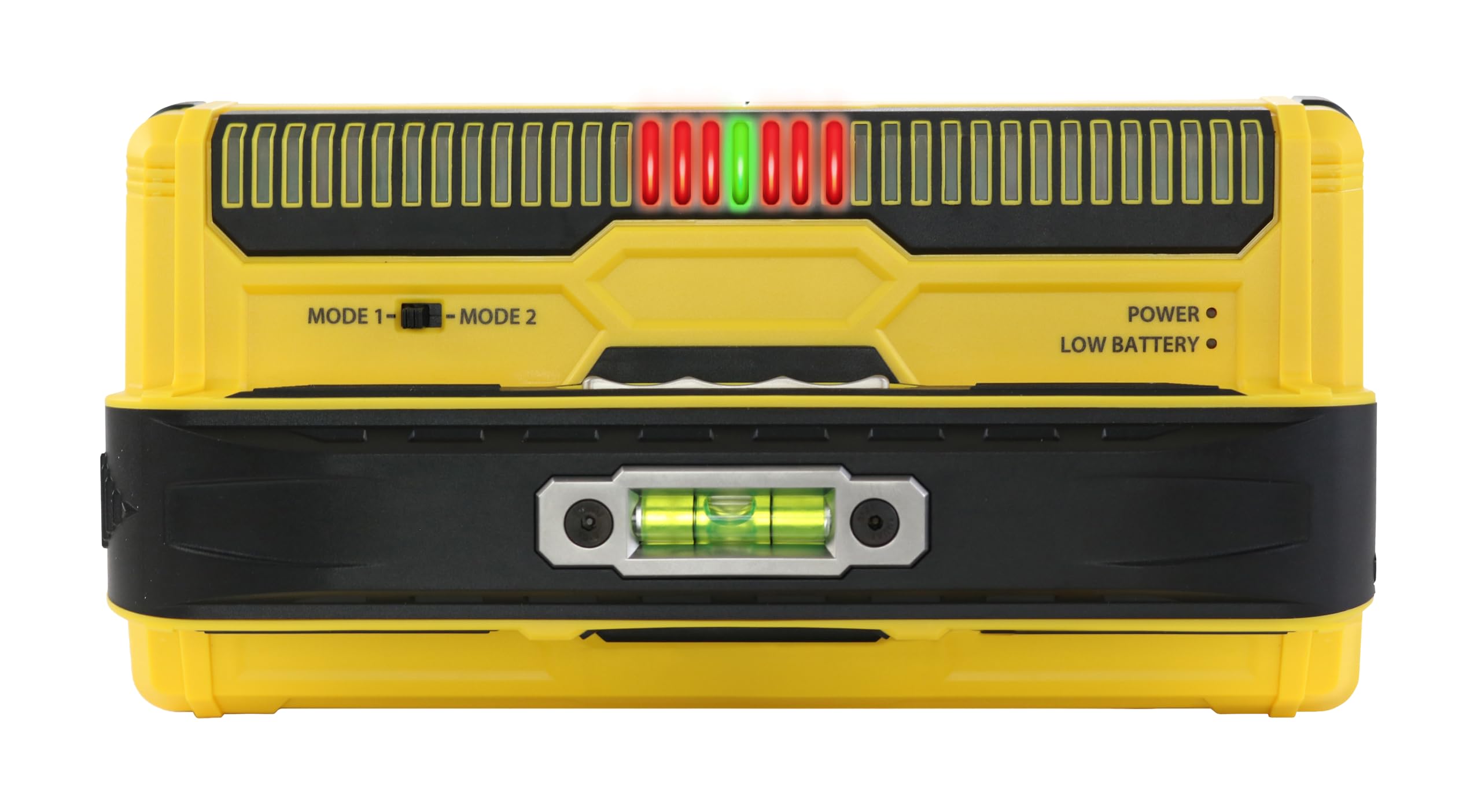
The deep-scan sibling with 2.5 inches of reach and larger sensors inside.
Where the 710+ stops at 1.6 inches, the MAX pushes to 2.5 inches with 13 larger sensors. That reach is built for walls that stack up: two or more layers of drywall, plaster, OSB, plywood, MDF or large tile. If you have ever had a finder go blank on a tiled bathroom wall, this is the model that was designed for that exact frustration.
Two modes cover the work. Mode 1 behaves like a normal stud finder on standard drywall; mode 2 is the deep setting for thick or tough walls. No calibration is needed — press and hold and you can start scanning anywhere, even directly over a stud. The LED display lights the full width of single or double studs, with the middle LED turning green at the center.
Owners are emphatic about where it works: OSB and old plaster walls come up repeatedly as the jobs it rescued. The genuine complaint is physical — it is a 1.1-pound tool at 9 x 4.5 x 3.1 inches, described as bulky and heavy, and worth is the other split opinion. Neither affects the reading, but the size is real if you do a lot of overhead work.
Why it wins the hard walls
- 2.5-inch detection through multi-layer drywall, OSB, MDF and large tile
- 13 sensors show full stud width and green-light the center
- No calibration — scan anywhere, including over a stud
- A second deep mode for thick or tough builds
Genuine trade-offs
- 1.1 pounds and a large body — heavy for overhead scanning
- Size is the most-cited downside across owners
- Worth is a split call among buyers
Go here when: your wall is tiled, sheathed in OSB or doubled up and nothing else will see through it.
Pick the 710+ instead if: your walls are ordinary and you want less tool in your hand.
8. Walabot DIY 2 Stud Finder

Instead of a beep, you get a picture of what sits behind the wall.
This one works differently from everything else here. The Walabot DIY 2 connects to your phone over its own built-in Wi-Fi — no home network needed — and shows a visual map of wood and metal studs, plastic and metal pipes, and live or non-live wires. Sensing runs to 4 inches or 10 centimeters deep. It works with both iOS and Android.
The practical upside is speed once you are set up. Setup itself is where attention is needed: calibration has to be done each time the device reconnects to your phone, and that is the step that generates the most frustration. The tool reads drywall and plywood only — not lath and plaster, concrete, tile, brick, metal-backed walls, stucco or concrete with furring strips. Owners on those surfaces need one of the sensor-bar models instead.
The honest read on this pick is that it works beautifully on the surfaces it was built for and badly on the ones it was not. On plain drywall it can trace a pipe run as a visible line on your screen, which no beeper can do. Between the false readings some customers note and the connection drops other reviewers point out, it is a tool for someone who values seeing over listening and is willing to calibrate patiently.
What it adds: a visual record of the wall instead of a single point — good for planning a layout before you commit to a drill hole.
Right when: your walls are plain drywall or plywood and you want to see the cavity before drilling.
Wrong when: the wall is plaster, tile, brick or concrete — this scanner is not built for those.
9. Bosch D-tect 120 Wallscanner Professional

Radar that finds the water-filled pipes and live cables a beeper cannot see.
The D-tect 120 uses Bosch-patented radar to detect every object type it lists — live and non-live cables, water-filled plastic pipes, and both magnetic and non-magnetic metal. That is a different class of detection from the coil sensors in the earlier picks. Three settings tune it to the wall in front of you: drywall, concrete, or universal when the material is unknown.
The Spot View feature puts results on the screen fast even when there is barely room to slide the unit along the wall — a kitchen cabinet corner, for instance. Arrows and a signal strength bar guide you toward the object, and a center finder indicator marks when you are over the middle. Power is flexible: it runs on a 12 V Li-ion battery or on standard AA batteries via the adapter.
It is a 2.3-pound tool with an IP54 rating, so it is built for rough handling. The natural buyer is the contractor scanning walls for hidden infrastructure before cutting, where the radar’s ability to spot non-metallic objects is worth every bit of the bulk. For a homeowner hanging one shelf, it is far more tool than the job asks for — a plain 13-sensor bar reads faster and lighter.
Where radar pays off: water-filled plastic pipe is nearly invisible to standard stud finders, and this unit is built to see it.
The trade: 2.3 pounds and a boxier body make it a two-handed tool compared with the 5-ounce Klein.
Built for: contractors scanning for pipes and cables in walls of any material before a cut.
More than you need: if every wall you touch is a single layer of drywall.
Know the Specs
Scan depth in inches and millimetres
Depth is how far into the wall the scanner can read. Standard drywall jobs sit around 3/4 inch of wood depth, while deep-scan models reach 1.5 to 2.5 inches through plaster, OSB or tile. Bosch units list depth in millimetres, so 30 mm of wood is close to 1-1/4 inches of reach. Buy only the depth your walls demand; extra depth comes with a heavier body.
Sensor count and full-width detection
Sensor count is how many reading points sit behind the bar. One or two sensors give you a single blip to interpret. Thirteen sensors read a whole strip, so the display can light the stud’s edges and its center at the same time. That is the number to check when you want to mark a center in one pass instead of shuffling the tool back and forth.
Live wire alerts and wire depth
A live wire alert is a separate sensor that beeps or lights when it senses AC voltage behind the surface. Depth figures vary: 2 inches on some models, 50 mm on a Bosch, and the A200 adds a dedicated WireWarning. It is not a substitute for switching off a circuit before drilling, but it does tell you where to keep the bit away from.
Calibration and modes
Calibration sets a zero point so the scanner ignores the wall itself and only reports what is inside it. Some units calibrate automatically as you press the button; others need you to hold still for one to two seconds while a beep sounds. More modes — drywall, concrete, universal, deep — mean more tuning to your wall, but they also mean a learning curve per surface.
Common Questions
Will a stud finder work on plaster and lath walls?
How far behind drywall can a stud finder actually detect?
Do I need to calibrate a stud finder every time?
Can a stud finder detect plastic pipes or only metal?
Is a 13-sensor stud finder better than a two-sensor one?
Will a stud finder tell me where live electrical wires are?
Do these stud finders take standard batteries or are they rechargeable?
What does IP54 or IP52 mean on a stud finder?
Can a stud finder find a stud through tile or ceramic?
Is a phone-based visual scanner worth it over a light-bar model?
The Bottom Line
The pick that suits most walls is the Franklin Sensors ProSensor 710+, because 13 sensors light the whole stud and the center in a single pass without any calibration step. If your walls are tiled, doubled up or built from OSB, the Franklin ProSensor MAX reaches 2.5 inches where the 710+ stops at 1.6. And for reaching overhead on a ladder with one free hand, the 5-ounce Klein Tools ESF200 is the one to grab.
Start with the top pick: 10,000+ owners have already tested it on plaster, drywall and sheet rock. The wider line-up here covers everything from a plain drywall scan to radar through concrete.
How we choose
We do not accept paid placement. Every pick is matched to a real buyer and a real use-case; we do not hands-on test units.
Sources
Specifications: manufacturer listings and product documentation. Review insights: verified customer reviews, as of November 2026. Pricing: not shown on this page (it changes often); check the current price via the retailer link.
As an Amazon Associate, Tactical Gear Guy earns from qualifying purchases. This does not affect which products we feature.