Specs are compiled from manufacturer listings and verified buyer reviews and can change over time — please confirm the key details on the product page before buying.
Buying a microphone for your camera is mostly a decision about where your voice will be picked up from, not how many features the box lists. A tight, directional mic keeps your voice front and center and pushes street noise, wind and room echo into the background. That single difference separates a clip that sounds professional from one that sounds like it was filmed in a stairwell.
This guide is built by comparing the manufacturers’ published specifications and the patterns across verified customer reviews, so you get each pick’s real strengths and trade-offs instead of marketing spin.
One thing to know before you scroll: this list uses flexible, human-like matching for camera-mountable on-camera microphones, so not every pick is the exact model number you searched — the nearest same-type option serves the same purpose. Here is the honest shortlist of the vlogging camera microphone options that make your voice the loudest, cleanest thing in the frame.
Top Picks


How To Choose The Best Vlogging Camera Microphone
Start with the connector on your camera, because that single port decides which mics you can even plug in. Then decide how much control you want over the sound at the moment you hit record. Everything else — battery, filters, display — is refinement on top of those two choices.
Match the plug to your camera body first
A 3.5mm jack is the small headphone-style socket most mirrorless and DSLR bodies carry, and it is what nearly every on-camera mic here uses. If your camera has one of those, a compact shotgun like the Deity or the RØDE VideoMicro plugs straight in. If you shoot on a camcorder or a pro rig with an XLR port — the chunky three-pin connector that locks in place — you want a mic built for that instead, such as the Sennheiser MKE 600.
Decide if you want battery power or plug-in power
Some mics draw their electricity from the camera through the same cable, which means one less thing to charge. Others run on their own rechargeable cell, which usually buys you a hotter output signal and extra features. The trade-off is simple: plug-in power is zero-maintenance, while a built-in battery asks you to remember the charging cable.
Look hard at the pickup pattern and the low-cut switch
A super-cardioid pattern (a narrow listening cone aimed where the mic points) is the reason a shotgun mic ignores the conversation happening behind you. For outdoor shooting, a low-cut filter is the second most useful control you can buy. It trims the low rumble that wind and traffic push into the recording, which is where most outdoor audio goes wrong.
Weigh the wind kit that ships in the box
A foam windscreen handles a light breeze. A faux-fur windshield or a wind muff (the fuzzy slip-on cover) is what you want for a gusty day. Check what comes included, because buying the fuzzy cover later as an accessory adds a step you did not plan for.
Side-by-Side Comparison
| Model | Best For | Connector | Power | Frequency Range | Amazon |
|---|---|---|---|---|---|
| RØDE VideoMic Pro+★ Best Overall | Run-and-gun shooting | 3.5 mm Jack | LB-1 battery, 2 x AA or Micro USB | 40Hz – 20kHz | Amazon |
| Deity V-Mic D4 MiniFeatherweight Pick | Phone-first vlogging | 3.5 mm Jack | Passive, 1-5V plug-in power | 20 KHz | Amazon |
| Rode VideoMicroCrowd Favorite | Travel and everyday vlogs | 3.5 mm Jack | Plug-in power, min 3V | 100 hz – 20 khz | Amazon |
| RØDE VideoMic GO II Helix | Camera and phone in one rig | 3.5mm TRS, USB Type-C | No battery required | 20Hz – 20kHz | Amazon |
| COMICA VM20 | Long event days | 3.5 mm Jack | 300mAh rechargeable lithium | 15 KHz | Amazon |
| Sennheiser MKE 400 | Monitoring your own audio | 3.5 mm TRS and TRRS | Wired | — | Amazon |
| COMICA VM40 | Wired or wireless shoots | 3.5 mm Jack, USB Type-C | Built-in rechargeable lithium | 20Hz-20KHz | Amazon |
| Sennheiser MKE 600 | Camcorder and XLR rigs | XLR | Phantom or battery powered | 18 KHz | Amazon |
Detailed Reviews
1. RØDE VideoMic Pro+ Premium On-camera Shotgun Microphone
Our pick — 4.5+★ from 800+ verified ratings; the strongest balance of quality and price.
The do-everything shotgun that switches itself off when you unplug it.
The VideoMic Pro+ is the pick here for anyone who films on the move and does not want to babysit gear. Its automatic power function turns the mic off the moment it leaves the camera, so a forgotten switch cannot flatten the battery between shoots. Add the included RØDE LB-1 lithium-ion cell, and you also have the option of 2 x AA batteries or continuous Micro USB power when you are nowhere near a charger.
Two specs carry the audio story. It records across a 40Hz – 20kHz frequency range, which is wide enough to hold the deep warmth in a voice alongside the crisp detail up top. Its published audible noise figure is 74 db. The included Rycote Lyre suspension system isolates the capsule from handling thumps, so a hand brushing the camera body does not land in your audio track.
It delivers clean, broadcast-ready voice tracks, but its side rejection is weaker than the spec sheet implies. The mic is superb at rejecting vibration and rumble (low-frequency shake and thumps), yet it still picks up sound from all directions in a busy space. Treat it as a directional tool, not a magic eraser, and you will be delighted. It holds a 4.5+ star rating across a large buyer base, with a higher score than several pricier mics on this list.
What earns it the top slot
- Automatic power on/off tracking your camera, so the cell is never drained by mistake
- Three power routes: LB-1 battery, 2 x AA, or Micro USB
- Rycote Lyre suspension keeps handling noise out of the recording
- 40Hz – 20kHz range captures both voice weight and fine detail
Where it asks for your patience
- It is a directional mic, not an isolator — noisy rooms still leak in from the sides
- The built-in battery means one more cable in your bag on a long trip
Reach for this if: you shoot solo, move between setups fast, and want the mic to look after itself.
Look elsewhere if: your whole day happens in crowded rooms where side noise is constant.
2. Deity V-Mic D4 Mini Supercardioid On-Camera Mic
A 0.15 kg mic that earns its keep in open air.
If your vlog rig is a phone and a small cage, the Deity V-Mic D4 Mini was built for exactly that. It weighs 0.15 kg, it runs passively off 1-5V of plug-in power from whatever you connect it to, and the box includes both a TRS camera cable and a TRRS phone cable. Swap cables and the same mic follows you from camera to handset. It also carries a 20mph wind rating, which matters when you film outdoors instead of in a studio.
What lands well is the sound character. It aims the pickup narrowly at the speaker’s voice, and outdoor recordings come back noticeably focused. The supercardioid pattern is doing the heavy lifting there, and it is why dialogue reads clearly even with traffic in frame. Durability is the honest question mark — a small share of units have failed after a couple of months of use, so a padded case is not optional.
Some owners get clean, usable tracks, while others hit hiss and noise. Compatibility is similarly patchy: it behaves with many phones and recorders but stumbles on specific handsets. Check your exact device against the cable kit before you commit.
The size-to-payload math: at 0.15 kg it adds almost nothing to a handheld rig, and passive power means no charging routine at all.
The fair warning: a few units have failed early, so store it protected and buy from a seller with easy returns.
Suits you if: you vlog on a phone outdoors and want a tiny directional mic with both cables included.
Pause if: your handset is one of the models owners have flagged as incompatible.
3. Rode VideoMicro Compact On-Camera Microphone
The tiny metal workhorse that just stays clipped to your camera.
Flip this against the VideoMic GO II and the difference is hard to miss. The VideoMicro’s frequency range runs 100 hz – 20 khz, while the GO II stretches down to 20Hz, so the GO II reaches deeper into the low end. The VideoMicro counters with an audible noise figure of 20 db against the GO II’s 79 db. In plain terms, the VideoMicro presents a much cleaner published noise floor, while the GO II covers more bass territory.
For a vlogger, the practical upside is that this mic asks nothing of you. It is 80mm long and 42gm, it is powered entirely by your camera’s plug-in power (min 3V), and there is no battery to charge, ever. The all-metal body shrugs off bag life. It ships with a shoe mount, a deluxe wind screen and an SC2 patch cable, so the box is genuinely ready to shoot.
Buyers praise the all-metal build first and the sound second, at a price that stays modest. The honest catch lives in the mount: the Rycote-style shock mount is the flimsier part of the package, and it can break if you handle the rig roughly. Noise rejection is also a split verdict, so a quiet environment still matters.
The real-world read: no battery means it is always ready, and 42gm means it never tips your camera forward on a gimbal.
What to handle gently: treat the shock mount as the fragile piece and the mic itself will outlast plenty of cameras.
Best fit for: anyone who wants a permanently attached, zero-maintenance mic for everyday vlogs.
Less ideal if: you need deep low-end pickup or you regularly shoot in loud crowds.
4. RØDE VideoMic GO II Helix Ultra-Compact Shotgun Microphone

One mic that covers a camera today and a phone tomorrow.
Cameras and phones do not share a port, and this is the mic that sidesteps the whole argument. It outputs through 3.5mm TRS for a camera body, and through USB Type-C for a smartphone, tablet or computer. No battery, no switches, no menu diving — plug it into whichever device is in front of you and record. It weighs 57 g, so it will not unbalance a compact rig.
Its 20Hz – 20kHz frequency range is the widest reach on this list, and that lower boundary is what makes voices sound fuller rather than thin. The HELIX isolation mount is the other genuinely useful piece: it shields the capsule from knocks, bumps, handling noise, wind and plosives (the popping burst of air on hard P and B sounds). A deluxe windshield is included, and the RØDE Connect and RØDE Central software open up advanced controls like a high-pass filter and high-frequency boost.
Note the one number that argues against it: an audible noise figure of 79 db, well above the VideoMicro’s 20 db. In practical terms that describes a mic that is easier to drive but comparatively noisier on paper. Buyers rate it highly because it connects easily and cuts background noise noticeably when aimed correctly.
Why it earns a place
- Two outputs in one body — 3.5mm TRS and USB Type-C
- No battery and no switches means it is always ready
- 20Hz – 20kHz range gives vocals real body
- HELIX mount handles knocks, wind and plosive pops
The honest counterweight
- A 79 db noise figure is the highest here against the VideoMicro’s 20 db
- The advanced filters live behind RØDE’s software rather than on the mic
Pick it when: your kit mixes a mirrorless body and a phone and you refuse to own two microphones.
Think twice when: you shoot in very quiet rooms where a low noise floor matters more than bass reach.
5. COMICA VM20 Shotgun Microphone for Camera
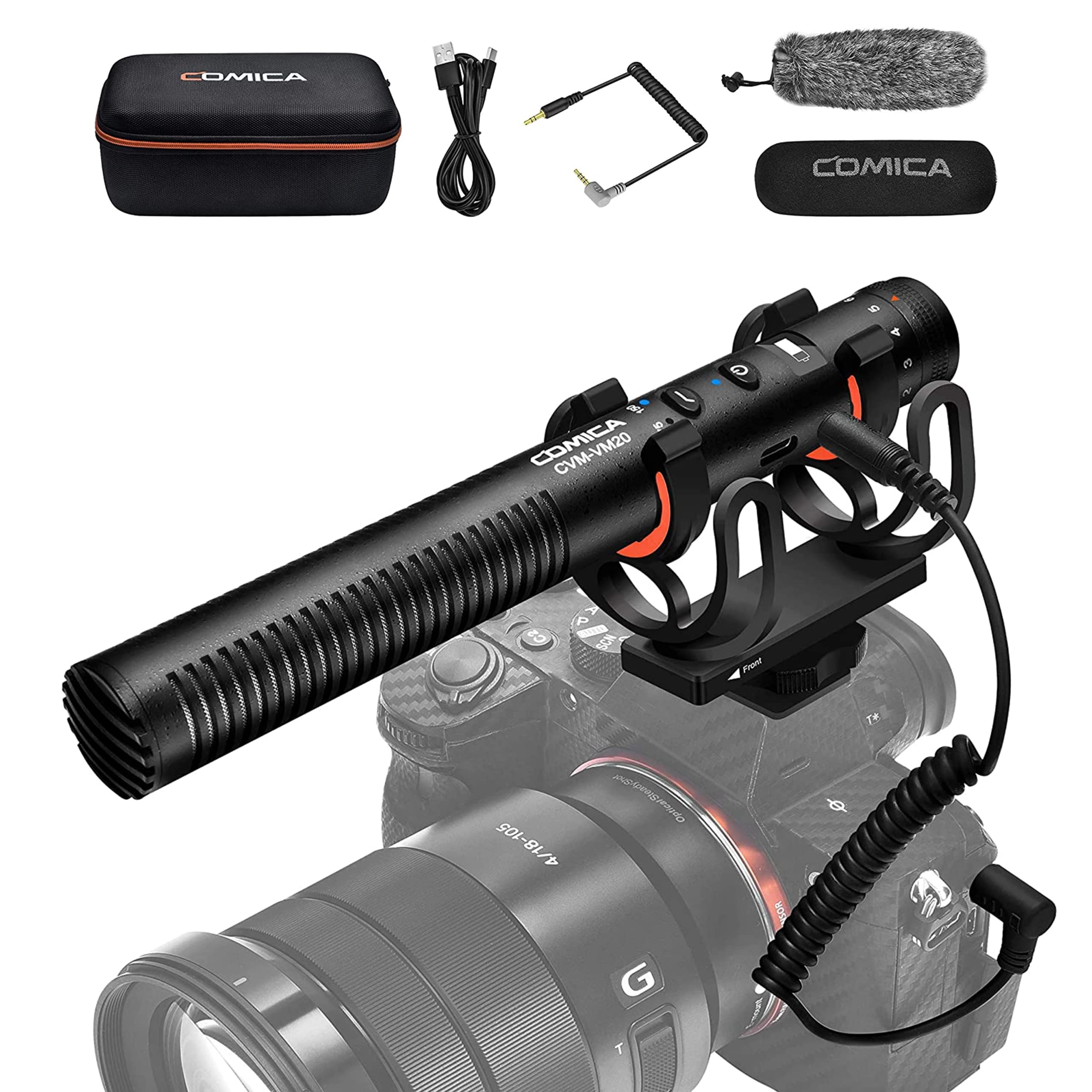
A 300mAh cell, an OLED readout, and a gain knob you can actually turn.
Long event days are where the VM20 makes its case. Its internal 300mAh rechargeable lithium battery is quoted at up to 60 hours from a 3-hour charge, and it supports charging while in use through USB-C. If you are filming a wedding or a full-day conference, that is a real advantage over mics that depend on camera power. At 84 grams with a full metal body, it stays light on the shoe without feeling cheap.
The controls are the reason to choose it over a plug-and-play alternative. A stepless gain knob spans ten levels with a sensitivity range of -43dB to -23dB, so you can trim the level rather than fix it in editing. The low-cut button flips between 75 Hz and 150 Hz to knock down hum and outside rumble. An OLED screen shows the battery state in real time, which removes the guessing game mid-shoot.
The caveat sounds like a wiring problem rather than a mic problem. A handful of units arrived dead on arrival, and the noise rejection splits between owners who praise the wind suppression and those who pick up interference. Buy from a seller with a straightforward replacement path and run a test recording before the important day. Sound quality is the strong suit — buyers rate its event audio and its value highly.
The 60-hour argument: one charge covers the longest day you will ever shoot, and USB-C means you can top it up between takes.
The pre-flight check: test before you rely on it — a small number arrive faulty, and interference is a real report.
Buy it for: all-day event work where battery anxiety is the enemy.
Pass if: you want set-and-forget simplicity without a pre-shoot test run.
6. SENNHEISER MKE 400 Microphone

The one you can actually listen to while you record.
Most on-camera mics leave you guessing whether the audio is clean until you get home. The MKE 400 closes that gap with an integrated headphone output and a volume adjustment, so you hear what is being captured in real time. That single feature changes how you work on a shoot: a rumbling air conditioner gets caught in seconds rather than in the edit.
Its super-cardioid pattern is highly directional, which isolates your voice and pushes the rest of the room down. The 3-step sensitivity switch lets you set the input for a loud street or a quiet room without touching camera menus, and the built-in low-cut filter trims low-end rumble. Integrated wind protection and an internal suspension mount are built into the body rather than bolted on, which is why it stays compact on a small rig. Its audible noise figure is 25 db, a lower published number than the VideoMic GO II’s 79 db.
The mixed signals are worth knowing. Noise cancellation draws divided opinions, and the noise floor is the recurring criticism — some owners find it audible. Build quality is likewise split between sturdiness and durability complaints. You also need to supply your own headphones to use that killer monitoring feature, and a unit at this level ships without them.
What you are paying for: real-time headphone monitoring plus an interchangeable TRS and TRRS connector set that follows your device.
What to plan around: bring headphones, and test your noise floor in your own room before a paid shoot.
Strong choice for: shooters who want to hear the take as it happens and will bring a pair of headphones to do it.
Reconsider if: a low self-noise floor is your top priority above all else.
7. COMICA VM40 Microphone
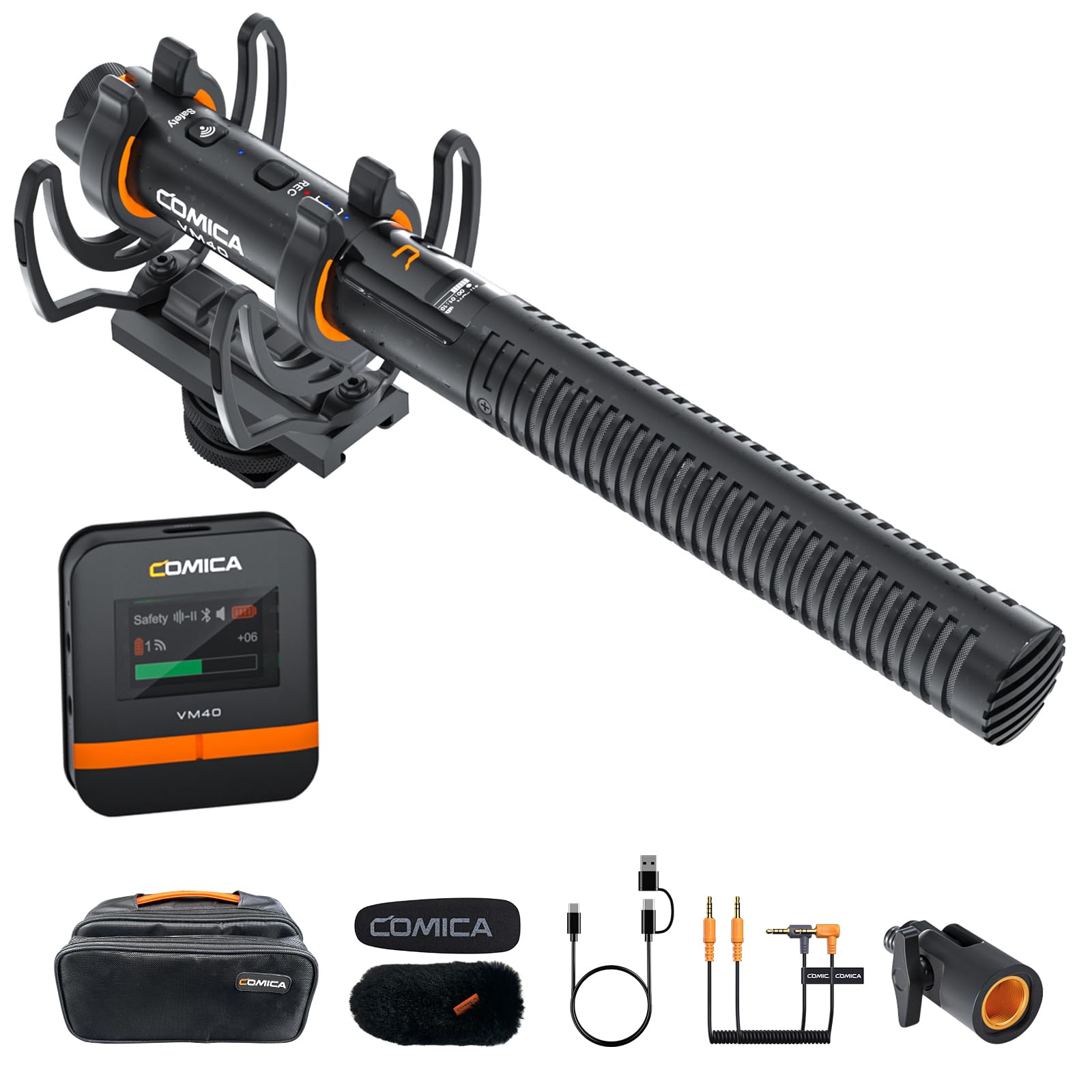
A shotgun that records its own backup copy while you shoot.
This is the most ambitious mic on the list, and the ambition is aimed at the thing that scares every creator: losing a take. It records internally to 32GB of built-in storage for up to 40 hours, so there is a backup file even if the camera card fails. It runs on 48kHz/32-bit float recording, a format that captures a wide dynamic range so loud peaks and quiet speech survive post-production more gracefully.
It works in both wired and wireless modes through a built-in 2.4GHz RF module (a radio link that cuts the cable between mic and receiver). Safety mode is the smartest feature here: it splits the recording into two tracks, with the second sitting 6dB below the main one as an emergency backup. Real-time monitoring feeds the audio back to you as you go, and the Comica Audio App lets you adjust settings and check status from a phone. CalMix noise reduction, a 100Hz low-cut and a high-frequency boost round out the processing.
Runtime is the number to read carefully. The built-in rechargeable lithium battery runs up to 32 hours wired and up to 10 hours in wireless mode. Wired vs wireless is therefore a genuine planning decision, not a formality. Owners describe clear, crisp audio, and the included shock mount keeps handling noise out of the take.
The insurance policy: dual-track safety mode plus 32GB of internal recording means one bad cable cannot kill your shoot.
The planning point: wireless mode drops to 10 hours, so a long wireless day needs a mid-shoot charge.
Worth it for: filmmakers who can’t afford to re-shoot and want an onboard backup of every take.
Skip if: you need all-day wireless runtime without a charging window.
8. Sennheiser MKE 600 Microphone

The camcorder-grade option for anyone with a proper XLR port.
This is the one pick here that will not plug into a consumer camera, and that is the point. The MKE 600 connects over XLR — the locking three-pin connector found on camcorders, mixers and pro rigs — so it is built for a serious audio chain rather than a 3.5mm socket. It can run on phantom power from the recorder or on its own battery, and a low battery indicator tells you when that cell is running dry. At 128 g it carries more heft than the compact picks, which fits its camcorder role.
Its 18 KHz frequency response and highly directive pattern keep a subject’s voice tight while shrinking the space around it. A switchable low-cut filter removes low rumble, and the Auray universal shock mount and windshield included in the bundle handle the handling thumps and breezes that would otherwise wreck a take. Reviews single out the high-end tone as excellent, backing it with a 4.5+ star buyer rating and praise for its solid build.
Do check the power route before you buy. Phantom power is the cleanest option, and the internal battery is the fallback when your recorder has none. Whichever you use, confirm the rest of your chain can feed it, because an XLR mic with no phantom supply and no battery is a brick. Wind noise cancellation is well liked, and the shielding from the included windshield is repeatedly credited with keeping outdoor dialogue usable.
The XLR reality: this is the highest-ceiling audio option here, and the one that requires a matching recorder or camcorder.
The set-up condition: make sure the device feeding it can supply phantom power or that the battery is fresh every shoot.
Made for: camcorder and XLR-rig shooters who want a directional mic with a switchable filter and battery fallback.
Not for: mirrorless or phone vloggers without an XLR port and phantom power.
Know the Specs
Pickup Pattern: Super-Cardioid vs Cardioid
The pickup pattern describes the shape of the listening field around the capsule. A super-cardioid pattern is a narrower cone aimed straight ahead, so a voice on axis dominates while the chatter behind the camera drops away. Wider cardioid patterns pick up more of the room. For talking-head vlog work, the narrower pattern usually gives you a cleaner voice track with less of the space around it.
Power: Plug-In vs Built-In Battery
Plug-in power means the microphone draws its electricity through the same cable that carries the audio — in these mics, usually a small 3V or higher supply from the camera. That means no battery to charge and no dead-mic surprises. A built-in rechargeable lithium cell buys you extra features like gain control, an OLED display and long runtimes, at the cost of one more charging habit. Match the power style to how often you forget to charge things.
Low-Cut Filter and Frequency Range
A low-cut filter removes low-end sound below a set point — the 75 Hz and 150 Hz settings on the Comica VM20 are a working example. It exists to strip out rumble, wind thump and distant traffic that would otherwise smear your dialogue. The frequency range describes the window of pitches a mic captures; a wider range reaching down toward 20Hz keeps more depth in a voice, while a narrower band can sound thinner.
Connectors: 3.5mm, TRRS, USB-C and XLR
The 3.5mm TRS plug is the camera-side standard; a TRRS version adds a contact so the same signal can feed a phone’s headset socket. USB-C carries a digital audio stream straight into a phone, tablet or computer, bypassing the camera entirely. XLR is the locking professional standard that runs over long cable lengths and pairs with phantom power. Buy to match your device, because the wrong plug has no workaround short of an adapter.
Common Questions
Will a shotgun microphone work on my mirrorless camera’s 3.5mm jack?
Do I need a battery microphone or a plug-in power one?
Can I plug an on-camera shotgun mic into my phone?
What is the difference between a super-cardioid and a cardioid microphone for vlogging?
Does a low-cut filter help with wind noise outdoors?
How long does a rechargeable camera microphone battery last?
Will a camera-mounted mic pick up my voice if I turn my head away?
Do I need an XLR microphone for vlogging?
What does 32-bit float recording actually do for a vlogger?
Should I record audio on the microphone or straight into the camera?
The Bottom Line
For most vloggers, the strongest choice in this vlogging camera microphone lineup is the RØDE VideoMic Pro+, because its automatic power function, three power options and Rycote Lyre suspension (a shock mount that isolates the mic from handling noise) keep it reliable on the run without extra fuss. If you shoot on both a camera and a phone, grab the RØDE VideoMic GO II Helix for its dual 3.5mm and USB-C outputs (standard audio and modern digital connectors). And when an all-day event is on the calendar, the COMICA VM20 is the one to reach for, with a 300mAh battery quoted at up to 60 hours. One genuine nudge: the compact RØDE VideoMicro has earned its huge following for good reason, so if you want zero-charge simplicity at a sensible point in the line-up, it is the safest small bet here.
How we choose
We do not accept paid placement. Every pick is matched to a real buyer and a real use-case; we do not hands-on test units.
Sources
Specifications: manufacturer listings and product documentation. Review insights: verified customer reviews, as of November 2026. Pricing: not shown on this page (it changes often); check the current price via the retailer link.
As an Amazon Associate, Tactical Gear Guy earns from qualifying purchases. This does not affect which products we feature.