Specs are compiled from manufacturer listings and verified buyer reviews and can change over time — please confirm the key details on the product page before buying.
If you want sound that lands above and behind you instead of straight at your face, the short answer is this: buy a system with real up-firing or rear speakers, not just a bar with an Atmos logo on the box. A plain soundbar can decode the Atmos signal, but a channel count that includes height and surround speakers is what actually puts a helicopter over your sofa. Everything below is grouped by how much real speaker coverage you get for the room you own.
This guide is built by comparing the manufacturers’ published specifications and the patterns across verified customer reviews, so you get each pick’s real strengths and trade-offs instead of marketing spin.
You will see channel layouts, up-firing driver counts and subwoofer sizes side by side, so the trade-offs of each system are easy to read at a glance. Here is my honest shortlist for the best dolby atmos surround sound.
Top Picks

How To Choose The Best Dolby Atmos Surround Sound
The biggest mistake buyers make is assuming that any bar with “Dolby Atmos” printed on it will throw sound at the ceiling. Many can decode the format but fire only forward. You get a wider front wall of sound, not an overhead one. Atmos overhead effects come from up-firing drivers or speakers mounted high, so look for that count in the spec list before anything else.
Count the channels, especially the third number
A layout written as 5.1.2 or 11.1.4 reads as speakers-left, subwoofers, height-channels. That last figure is the number of overhead effects channels. A 5.1.2 bar has two height channels, while an 11.1.4 system has four. More height channels generally spread overhead sound wider across your seating, which matters if you sit off-centre.
Decide if you want a bar or a receiver
A soundbar bundles the amplifier, speakers and subwoofer into one box you connect with a single HDMI cable to your TV’s eARC port (the audio-return channel that sends TV sound down one cable). A separate AV receiver like the Yamaha or Denon units here powers speakers you supply yourself, which means real wires to the back of the room but a genuine upgrade path. Bars suit living rooms; receivers suit dedicated rooms.
Match the subwoofer and the room
Bass output comes from the sub driver size, listed in inches. A 10-inch wireless subwoofer is the common size in mid-range bars, while premium systems step up to dual subs. If you have close neighbours or a small flat, a big sub is wasted headroom. In a detached house with a large room, more low-end cabinet volume is what makes an explosion feel physical.
Check the connections before you buy
You want an HDMI eARC port on the bar and a matching eARC port on your TV. That single cable carries uncompressed Dolby Atmos from the TV to the system and passes video back through. If your TV is older, you will rely on an optical cable instead, and optical cannot carry the Atmos bitstream. Confirm your TV’s port label before you commit.
Side-by-Side Comparison
| Model | Best For | Channel Layout | Subwoofer | Power / Output | Amazon |
|---|---|---|---|---|---|
| Samsung HW-Q990C★ Best Overall | Full-room Atmos with rear speakers included | 11.1.4 ch | Included subwoofer | — | Amazon |
| JBL Bar 500MK2Best Value | Value Atmos bar with big bass | 5.1 ch | 10″ wireless | 750 W | Amazon |
| Yamaha RX500AWired Build-Out | Wired home-theatre build-out | 7.2 ch (5.2.2 with height) | — | 70 W per channel | Amazon |
| Denon AVR-X1700H | 8K-ready receiver for mixed rooms | 7.2 ch | — | 80 W per channel | Amazon |
| Polk MagniFi Max AX SR | Dialogue clarity with rear satellites | 7.1.2 ch | 10″ wireless | — | Amazon |
| Denon AVR-X1800H | HEOS multi-room plus Atmos | 7.2 ch (5.2.2) | — | 80 W per channel | Amazon |
| Sonos Arc Ultra | One-box Atmos with clean design | 9.1.4 ch | Optional add-on | — | Amazon |
| LG S95TR | LG TV owners wanting rear speakers | 9.1.5 ch | Included subwoofer | — | Amazon |
| JBL Bar 1000 | Detachable rears without wires | 7.1.4 ch | 10″ wireless | 880 W | Amazon |
| Samsung HWQ990F | Certified refurbished flagship | 11.1.4 ch | Included subwoofer | — | Amazon |
| Nakamichi Dragon | Cinema-scale room pressure | 11.4.6 ch | Dual opposing 8″ | Up to 3000 W max | Amazon |
Detailed Reviews
1. Samsung HW-Q990C 11.1.4ch Soundbar
Our pick — 4.5+★ from 500+ verified ratings; the strongest balance of quality and price.
Four height channels and rear speakers in the box, so nothing needs adding later.
This is the one to buy if you want the overhead effect working on day one with no extra purchases. The layout is 11.1.4 channels — eleven front and surround speakers, one subwoofer, and four up-firing height channels that bounce sound off your ceiling so a passing jet feels genuinely above your head. The rear speaker kit ships in the box, which is the part most competing bars charge extra for. Contrast that with the JBL Bar 500MK2 at 5.1 channels: the Samsung gives you rear and height coverage the JBL simply does not have.
Setup is friendly for a system this large. A single HDMI cable goes to your TV’s eARC port, and the rear speakers connect without a receiver. SpaceFit Sound Pro uses the bar to analyse your room and tune itself, so a sofa against one wall and an open kitchen on the other both get corrected. Adaptive Sound lifts quiet dialogue at night, and AVA (Active Voice Analyzer) works the same angle by breaking down room noise to keep on-screen voices out front. Owners consistently single out speech clarity, describing the sound as crisp and calibrated rather than boomy.
The honest catch is wireless stability. Connection is the one area where experiences split, so wired HDMI between the bar and sub, and a clean line of sight between the rears and the bar, will save you frustration. The other point to know: Q-Symphony only fires on all cylinders when you pair it with a Samsung TV, where the TV speakers and bar run as one. On another brand of TV it still works as a normal Atmos bar. It holds a 4.5+ star rating, the highest score among the large-room systems here.
What earns it the crown
- 11.1.4 channels with four up-firing height drivers for real overhead effects
- Up and side firing rear speakers included, not sold separately
- SpaceFit Sound Pro calibrates the bar to your room automatically
- AVA and Adaptive Sound keep dialogue clear at low volume
- Hands-free voice control plus AirPlay 2 for music
Where it asks for patience
- Wireless connectivity is the recurring gripe — a wired HDMI link to the sub helps
- Q-Symphony’s combined TV-plus-bar mode needs a Samsung TV
Buy this when: you want a full Atmos bubble with rears and heights out of one box, and your TV has an eARC port.
Think twice if: you cannot run a clean HDMI line, because the sub and rears lean on a stable wireless link.
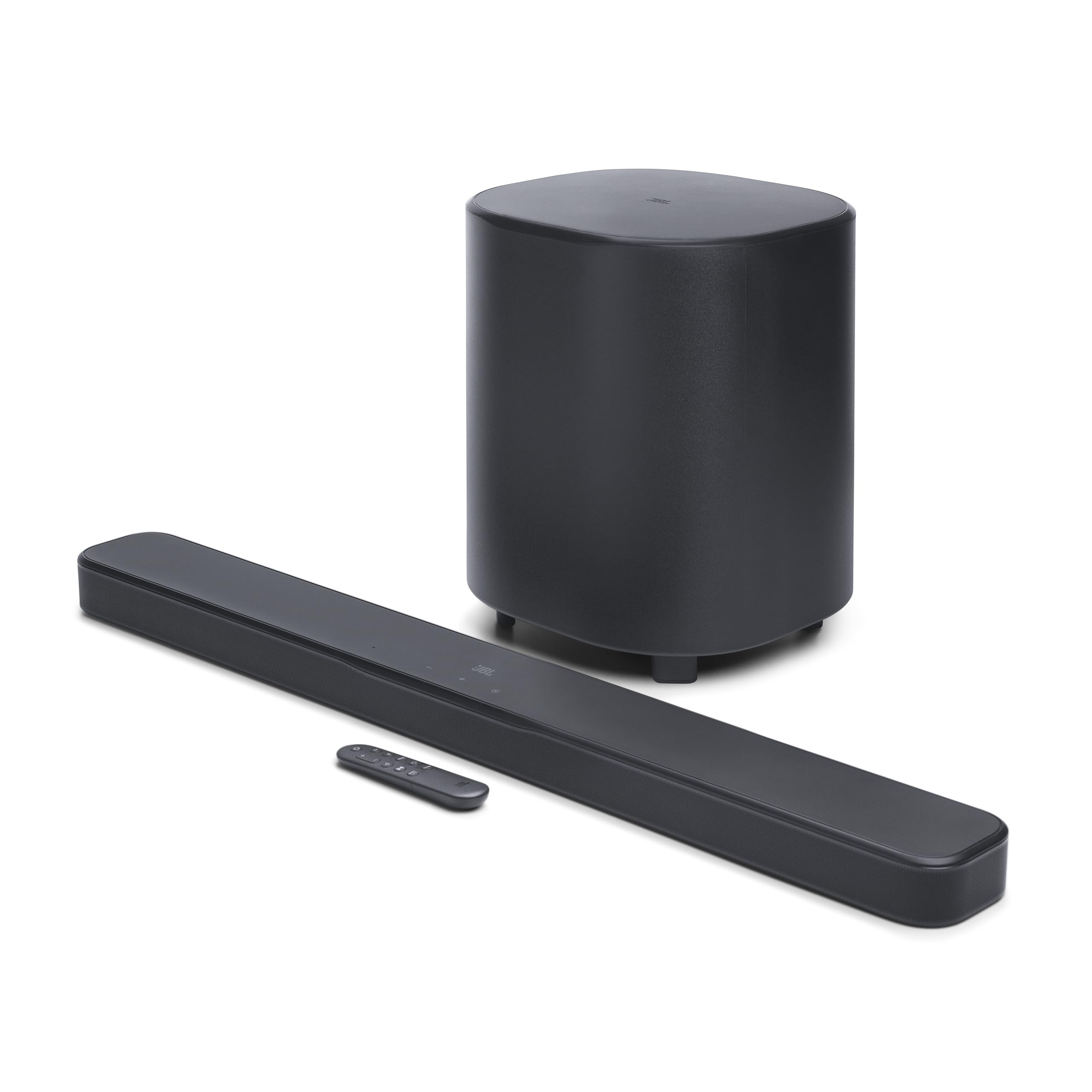
2. JBL Bar 500MK2 5.1 Channel Soundbar
A wide Atmos stage and a 10-inch sub, for buyers who want impact without a speaker farm.
The number that stands out on this bar is 750 W of total system power, with a 10-inch wireless subwoofer to turn that into chest-level bass when something explodes on screen. That power figure is far above the Yamaha RX500A receiver’s 70 W per channel, but remember you are comparing a self-contained bar system to a box that powers passive speakers you supply. For a single-box setup, the JBL is built to fill a normal living room loudly and easily.
At 4.1″D x 37″W x 2″H it slips under most wall-mounted TVs, and it is dramatically more compact than the Yamaha receiver’s 12.5″D x 17.13″W x 6.13″H chassis. MultiBeam 3.0 is the technology that spreads the front soundstage wider than the bar’s own width, so side-to-side pans reach past the speaker edges. Dolby Atmos handles the overhead cues, and PureVoice 2.0 raises dialogue automatically based on scene ambience and volume, so whispered lines do not vanish under music. Easy sound calibration measures how sound bounces off your walls and furniture to tune the 3D effect to the actual room.
What wins people over is the sheer output for a 5.1 layout — loud and strong, with clear voices and a 10-inch sub that fills the space. The bar also handles AirPlay, Google Cast, Spotify Connect and an HDMI eARC input with 4K Dolby Vision passthrough, so your games console keeps its picture quality through the bar. The honest limit is the channel count: at 5.1 you get Atmos decoding and a wide front wall, but no dedicated rear speakers, so the bubble stays in front of you. Wireless connection otherwise is the one thing worth checking on your network if you plan to stream heavily.
My read: this is the pick where a mid-range budget buys real bass and a wide front stage, not a full surround ring. Expect voices to stay clear thanks to PureVoice 2.0, and expect the sub to do the heavy lifting on movie nights.
Reach for it if: your room is small-to-medium and you want strong Atmos sound with minimal kit.
Leave it if: you specifically want sound behind your head, since 5.1 channels put everything up front.
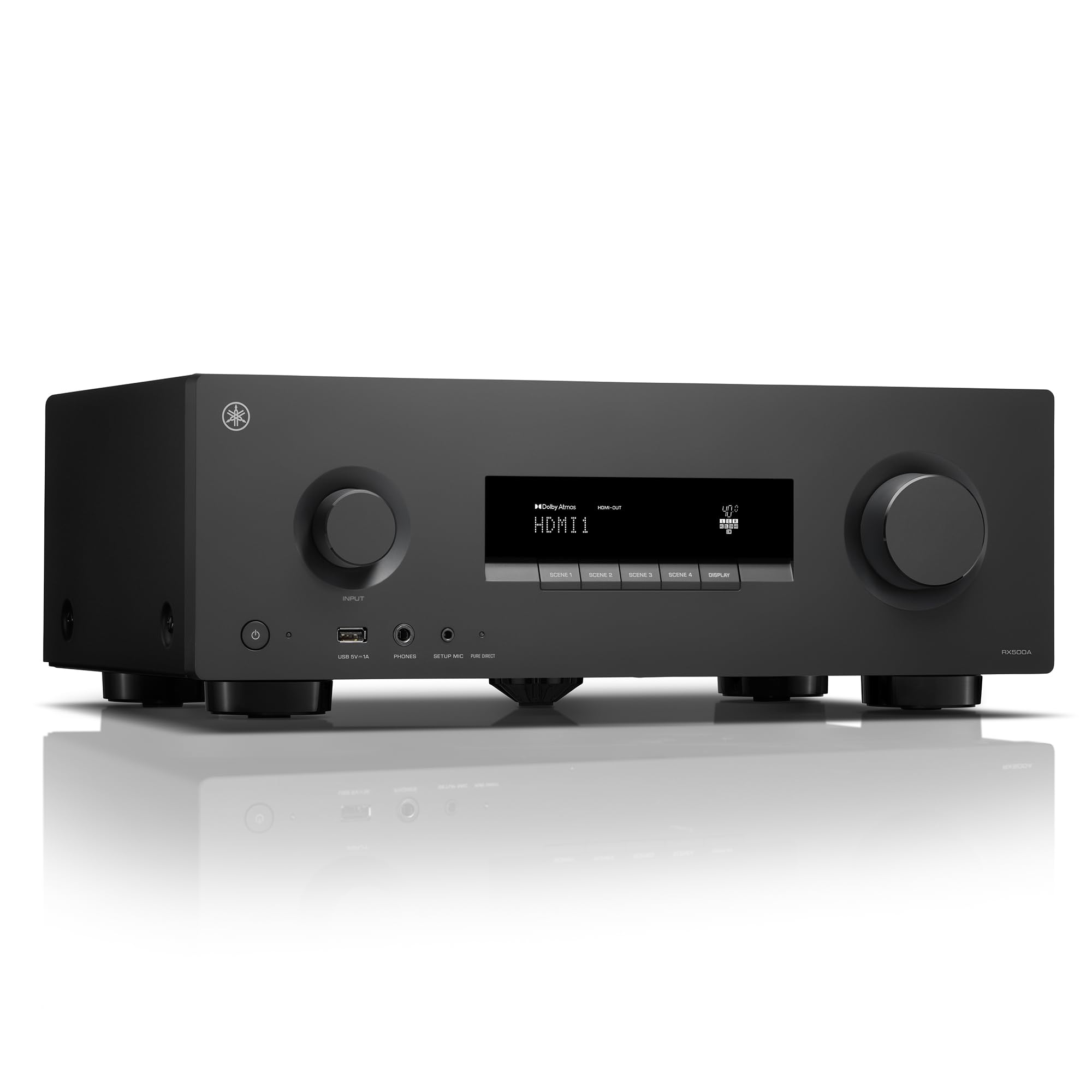
3. Yamaha RX500A 7.2-Channel AV Receiver
The receiver route, where you pick the speakers and it puts 70 W behind each one.
If you already own, or plan to own, separate speakers, this is the box that drives them. It pumps 70 W of power per channel across a 7.2-channel layout, which you can arrange as 5.2.2 with up-firing or in-ceiling height speakers for the Atmos effect. Dolby Atmos and DTS:X both decode here, and the height channels are where the overhead sound comes from. It is a fundamentally different purchase from the JBL Bar 500MK2: that bar is a finished system, while this is the engine of one you build.
It measures 12.5″D x 17.13″W x 6.13″H and weighs 17.6 pounds, so plan shelf or cabinet depth for it — that chassis is roughly three times the depth of the slim JBL bar. The video side is well specified: 4K/120 and 8K/60 support, Dolby Vision and HDR10+ pass-through, HDMI eARC/ARC, and gaming features ALLM and VRR so a console keeps its smoothness. A setup microphone is included to measure your room’s acoustics and correct the speakers automatically, and the Quick Guide walks you through speaker connections and input selection step by step.
Streaming is covered with Wi-Fi, Spotify Connect, Google Cast, AirPlay, TIDAL Connect, Qobuz Connect, plus Bluetooth Multipoint that holds two source devices and switches between them. Four Scene buttons store your own presets, so movie, game and music settings are one press away. The trade-off is commitment: you have to run speaker wire, place height speakers correctly, and buy the speakers themselves, which is work a soundbar hides from you. Owner feedback on this receiver is still too thin to judge long-term reliability, so buy from a seller with a clear return window.
The upgrade argument: every speaker you own becomes part of the system, and the amplifier keeps serving you through future speaker upgrades.
The honest cost: the receiver is only half a system — you supply and wire the speakers and the subwoofers.
Pick it if: you have a dedicated room, spare speaker wire, and want height channels mounted where Atmos actually works best.
Pass if: you want surround sound out of one box and one cable.
4. Denon AVR-X1700H 7.2 Channel AV Receiver

Three 8K inputs and 80 W a channel, for a receiver you will not outgrow next year.
Movie night with a console and a game PC is where this unit makes sense. It runs 80 W per channel over 7.2 channels with Dolby Atmos, DTS:X and DTS Virtual:X, and it adds Dolby Atmos Height Virtualization — a processing mode that creates height effects even without ceiling or up-firing speakers. That virtual mode is the practical bit: if you cannot mount height speakers right now, the receiver still produces an overhead impression from a conventional layout. Owners praise the chassis build most, describing it as solid and well-made.
The video section carries three dedicated 8K inputs and one output, with 8K/60Hz and 4K/120Hz pass-through and 8K upscaling on all six inputs. It handles HDR10, HDR10+, Dolby Vision, HLG and 4:4:4 Pure Color Sub Sampling, plus QMS and HDCP 2.3. In plain terms, the picture going through it stays as good as the picture your source produces, which is why this unit suits a modern TV rather than an aging one. The colour-coded back panel and on-screen quick setup guide are aimed at making the wiring legible on your first attempt.
Streaming runs through built-in HEOS with Wi-Fi, AirPlay 2 and Bluetooth, and the multi-zone design lets one room watch a film while another streams Spotify or Amazon Music HD. Alexa and Siri voice control adjust volume and inputs hands-free, and IP control makes it integrate with home automation. Where it asks for care is reliability and connections — receivers in this class generate mixed experiences, and Bluetooth discoverability is an area where some setups need retries. Pair it with a strong home network and you will avoid most of that.
Why it stays on the list: three 8K inputs, 80 W per channel, and height virtualization that gives overhead sound before you buy extra speakers.
Set-up truth: this is a multi-input receiver, so budget an evening for wiring, and keep the colour-coded guide handy.
Best match: a modern TV plus a console plus plans for wired surround speakers over the next year.
Not ideal for: anyone who wants zero configuration — a soundbar does this job with far less effort.
5. Polk Audio MagniFi Max AX SR 7.1.2 Soundbar
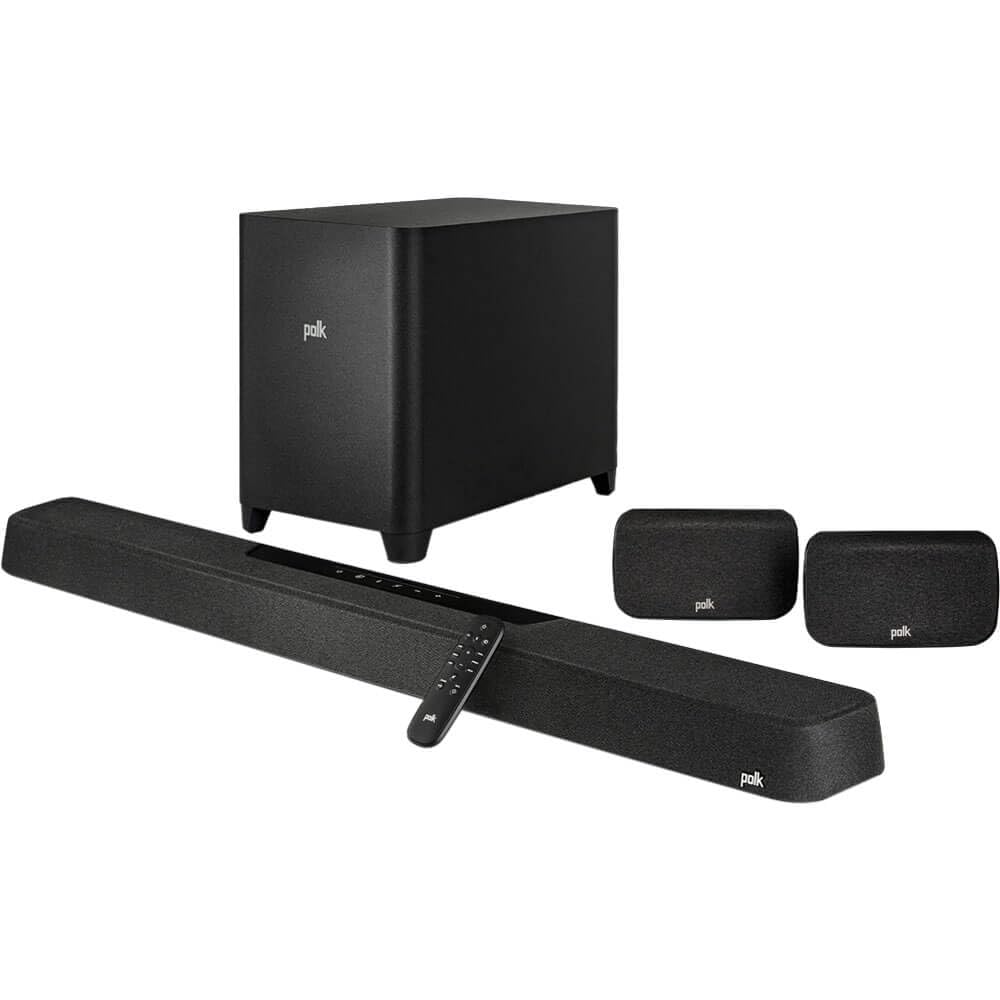
The system built around making muffled TV dialogue understandable again.
If your household keeps hitting the subtitles button, this bundle addresses that directly. VoiceAdjust technology works with the integrated centre channel speaker to lift vocal levels without dragging the rest of the soundtrack up with them. The channel count is 7.1.2, with two up-firing speakers providing certified Dolby Atmos and DTS:X height effects. The SR2 surround speakers and the 10-inch wireless subwoofer both come in the bundle, so the rear corners and the low end are covered without a separate shopping list.
Polk’s SDA 3D technology is the engine behind its surround presentation, and the wireless subwoofer pairs the moment you power it on, delivering deep bass at levels that feel larger than the cabinet suggests. Streaming is broad: Wi-Fi, Bluetooth, Apple AirPlay 2, Chromecast and Spotify Connect, with Alexa multi-room music support. Inputs include an HDMI eARC port, an optical input, a USB-A port for firmware updates and three 4K HDMI inputs, so you can route a console and a streaming box through the bar rather than the TV. Buyers praise the sound quality and build quality of this 7.1.2 package most.
Reliability is the place to go in with eyes open, because this is the one system here where dropped connections and speaker faults show up in the feedback. Treat the wireless link between bar, sub and surrounds as the thing to set up carefully, and use the return window to confirm yours behaves. For a buyer who mostly watches dialogue-heavy drama and wants clearer speech from a full 7.1.2 layout, the VoiceAdjust approach is worth testing in person.
Aims and advantages
- VoiceAdjust centre channel is built to lift dialogue without lifting the whole track
- 7.1.2 channels with certified Dolby Atmos and DTS:X
- SR2 surround speakers and a 10-inch wireless sub both included
- Three 4K HDMI inputs plus eARC and optical
Before you commit
- Wireless pairing between bar, sub and surrounds is the recurring weak point
- Occasional speaker and sub faults appear in owner reports, so check yours early
Suits you if: clear speech matters more than maximum channel height, and you like the rears included.
Different pick if: you want the most bulletproof wireless link in the list — the Samsung or JBL bars are safer there.
6. Denon AVR-X1800H 7.2 Channel AV Receiver

ATmos in the lounge, Spotify in the kitchen, from one 80 W-per-channel box.
The reason this receiver earns a slot is the multi-room layer on top of the movie layer. It drives 80 W across 7.2 channels and supports a 7.2 or 5.2.2 speaker arrangement for Dolby Atmos and DTS:X, with Height Virtualization available if you have not mounted overhead speakers yet. Then built-in HEOS extends the same amplifier into other rooms, streaming to HEOS speakers with Spotify, Tidal, Amazon Music HD and more over Wi-Fi, AirPlay 2 or Bluetooth.
Video matches the ambitions of a modern room: three dedicated 8K inputs and one output, 8K/60Hz and 4K/120Hz pass-through, Dolby Vision, HLG, HDR10+ and Dynamic HDR pass-through up to 40Gbps bandwidth. That bandwidth figure is what keeps a high-frame-rate game looking smooth through the receiver. The colour-coded connections and on-screen quick setup guide handle first-time wiring, and the included Audyssey microphone and stand measure your room so the receiver can correct for it.
Where this unit needs a considered setup is the software side — owner experience with HEOS and input discovery is genuinely split, with some finding it all works and others hitting configuration snags. The quality and reliability threads in the feedback divide the same way. Go in expecting to spend an hour on setup and firmware, keep your network tidy, and the payoff is an Atmos receiver that doubles as a whole-home streaming hub. It is the more advanced setup sibling of the AVR-X1700H, trading a little simplicity for HEOS scope.
Strength worth the effort: genuine multi-room audio plus a 5.2.2 Atmos layout from one chassis.
Patience required: HEOS setup and device discovery are the steps that test owners most.
Right for: a home that wants movie Atmos and music in other rooms from the same receiver.
Wrong for: someone who values plug-and-play over flexibility.
7. Sonos Arc Ultra Soundbar

The one-box Atmos bar people buy partly so the living room still looks like a living room.
You get a single box that places sound around the room without rear satellites, thanks to Sound Motion technology (the brand’s name for its spatial audio processing) spread across a 9.1.4-channel layout (nine ear-level channels, one subwoofer channel, four height channels). If your space will not accept speakers behind the sofa, that single-box approach is the whole argument. Owners keep coming back to the sound itself, described as among the best available in this form, with speech handled exceptionally well thanks to AI-driven Speech Enhancement (software that hunts down the human voice and clarifies it).
Setup is a two-cable affair — power and a single HDMI eARC link to the TV — and the Sonos app walks you through the calibration. Trueplay fine-tunes the sound to your room’s particular shape, and you can control everything from your TV remote, the app, voice, or Sonos Voice Control and Amazon Alexa. Streaming covers Wi-Fi, Bluetooth, Apple AirPlay 2 and Spotify Connect. The finish is metal, and what people notice about the appearance is its refinement — it disappears into your setup rather than shouting about itself.
The honest limit is what you do not get at this tier: a subwoofer or rear speakers are separate add-ons, and you can only get the full surround dome by buying more Sonos pieces. The wireless connection is the other thing to verify against your own network. As a design-and-dialogue bar with a wide Atmos stage, it is a considered pick — but you are paying heavily for the engineering, and a buyer who wants big bass on day one will need to budget for the sub.
The case for it: a 9.1.4 spatial layout, AI speech enhancement and a metal finish that fits a living room.
Know before you buy: the subwoofer and rear speakers are add-ons, and connectivity is worth testing on your Wi-Fi.
Choose the Arc Ultra if: design and dialogue clarity outrank raw bass and you want one slim bar.
Choose a pack-in system instead if: you want a sub and rears without buying twice.
8. LG S95TR 9.1.5 ch Soundbar

Five height channels, up-firing rears, and a wide stage for an LG TV living room.
The 9.1.5-channel layout is the reason this system is on a shortlist, because five height channels is the most overhead coverage in a bar-plus-rears setup here. That fifth height channel is an up-firing centre, aimed specifically at dialogue clarity, and the triple up-firing channels on the bar itself spread that overhead sound more widely. The rear speakers use true wireless connectivity — no receiver or secondary amplifier needed — so they only need an outlet, and they calibrate themselves for where you place them.
Its best trick is the built-in microphone. Advanced Room Calibration measures your room dimensions and detects where the rear speakers are, then adjusts audio for that spatial layout. If you have an LG TV, the WOW Orchestra and WOWCAST features combined with WOW Interface let the TV and soundbar run as one system with one remote, and WOWCAST streams Dolby Atmos wirelessly between the two. The 8-inch driver anchors the front, and VRR/ALLM support through the passthrough handles console gaming at up to 120Hz.
Where this drops below the higher-rated picks is sound consistency. The sound-quality feedback is genuinely mixed — some owners find it cinematic; others are less convinced, and connectivity with the subwoofer and rear pairing show up as the recurring friction. Room calibration is easy; keeping the wireless links stable is the work. If an LG OLED TV is already in your room, that synergy is a real benefit and the reason to look here. If your TV is another brand, the bar still works, but you lose the WOW pairing advantages.
The best of it
- 9.1.5 channels, the highest height-channel count in a bar-and-rears system here
- Up-firing centre channel dedicated to dialogue
- True wireless rear speakers with room and placement calibration
- WOW pairing and wireless Atmos with an LG TV
The friction
- Sound quality is the most divided aspect in owner reports — demo it if you can
- Subwoofer and rear pairing are the recurring connection issues
Made for: households already running an LG TV, where the wireless Atmos handshake pays off.
Not the safe bet if: you have a different brand TV and want pure plug-in reliability.
9. JBL Bar 1000 7.1.4-Channel Soundbar

Two surround speakers that lift off the bar and sit behind you with no wires at all.
This is the system for the renter who cannot drill walls or run cables across a floor. The 7.1.4 setup includes two detachable battery-powered surround speakers that you charge on the bar and then place behind your seating, completely wireless. With two up-firing drivers in the main bar and two more in the detachable speakers, it produces true Dolby Atmos and DTS:X with genuine height effects from the rear. The 880 W output and 10-inch wireless subwoofer give it enough muscle to make the overhead cues feel connected to the action on screen.
Wi-Fi is on board with AirPlay, Alexa Multi-Room Music and Chromecast built-in, opening over 300 streaming services, and the Wi-Fi link also handles software updates automatically. The 10-inch sub handles the low end, and MultiBeam spreads the front stage wider than a standard bar. What owners rate most is sound quality, followed by how easy the JBL One app makes setup, and the detachable rears are the feature people single out as the standout. The truly wireless connection between rears and bar is a genuinely welcome change from the cable mess you’d get with a receiver setup.
The thing to plan around is charging. The detachable rear speakers need regular recharging, and that is the most common practical gripe — on long movie marathons you will want them fresh before you hit play. Occasional units reportedly power off unexpectedly, so test yours thoroughly in the early weeks. If you need rears without drilling a single hole, though, nothing else on this list gives you a proper 7.1.4 layout this cleanly.
Standout spec: 7.1.4 channels with battery-powered detachable rears that charge on the bar itself.
The maintenance detail: those rear speakers need charging, so make that part of your viewing routine.
Ideal when: you cannot run cable to the rear of the room but still want sound behind your head.
Look elsewhere if: you would rather set up once and never think about charging rear speakers.
10. Samsung HWQ990F 11.1.4 Channel Soundbar

A refurbished 11.1.4-channel flagship with a 90-day warranty instead of a new-unit price.
If the top pick’s layout appeals but the new-unit cost does not, this is the same 11.1.4-channel architecture, offered as a manufacturer-refurbished unit. That means it has been tested and inspected, shows limited or no wear, and ships with the essential components and a 90-day warranty. The channel layout is the same True 11.1.4 configuration with wireless Dolby Atmos and DTS:X, plus Active Voice Amplifier Pro and SpaceFit Sound Pro Plus room calibration. An 8-inch driver anchors the bar, and gaming gets Game Mode Pro with 3D sound.
What the feedback confirms is straightforward: the audio lands, the vocals stay clear, and setup is quick. The sound quality and compatibility are the two strengths owners keep coming back to, and it is reported to get plenty loud before it starts to strain. Compatibility is also praised — it works across a range of TVs and sources, so you are not locked into Samsung to get a good result.
The realistic caveats are the refurb status and the tuning depth. Some owners want finer control than the app’s sound-tuning offers and find they cannot independently adjust every satellite. Treat the warranty period as your test window and run the full configuration — dialogue, Atmos demos, music, game — during those 90 days, and keep the documentation handy. For a buyer who wants flagship channel count without paying flagship-new money, that is a fair trade to accept.
Smart-money angle: full 11.1.4 channels, wireless Atmos and DTS:X, and a 90-day warranty on tested hardware.
Fair warning: it is refurbished, and the app’s per-speaker tuning has limits.
Good fit for: buyers who want the flagship layout and can accept refurbished status with a 90-day window.
Skip if: you need a brand-new unit or want deep per-channel fine-tuning.
11. Nakamichi Dragon 11.4.6 Soundbar
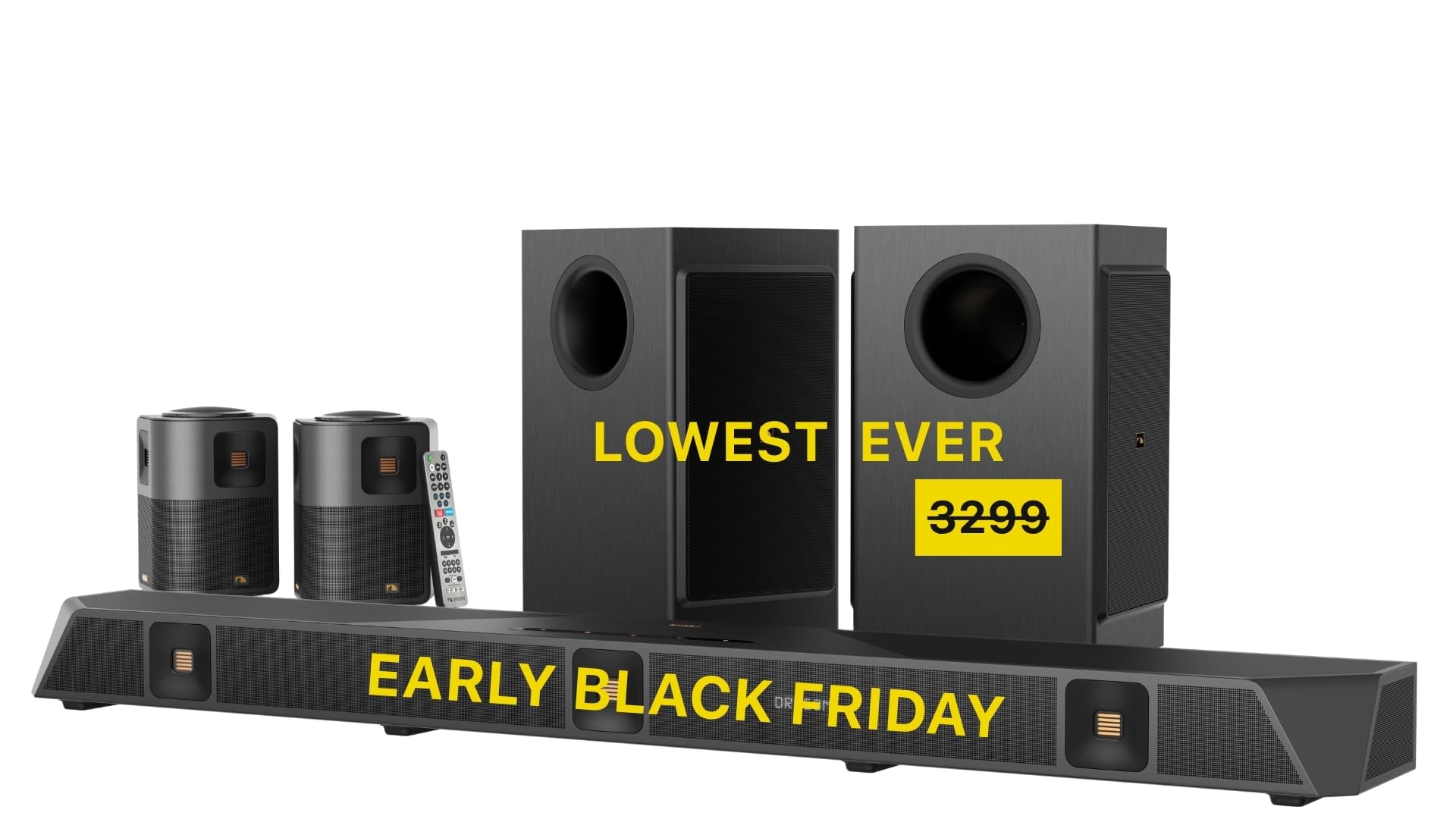
A 58-inch bar with two opposing 8-inch subs and up to 3000 W behind it.
You are not really buying a soundbar here — the chrome-badged main unit measures 58.1 inches wide, and it ships in three boxes. This is a full home-theatre replacement built on a no-compromise 11.4.6-channel architecture, with 6 up-firing speakers and an onboard Pro Cinema Engine. The 3000 W maximum output drives a pair of dual-opposing 8-inch subwoofers, and each sub is a substantial cabinet you have to place. In other words, check your room and your cabinet space before you click buy.
Where it earns its place is scale. HiFi Air Motion Tweeters (a tweeter design that keeps high frequencies and dialogue focused) stay clear even as volume and impact rise, and Bipolar height surrounds (speakers that project sound from both sides and above) fill the room. The PerfectHeight Mechanism locks overhead effects to the balance so height cues stay fixed as you move around the room. There is also an AHD Ultra engine (the brand’s processing chip) and the ability to scale to 4 sub enclosures. Cinema-grade sound is the entire point, and the buyers here describe it as one of the best systems they have heard in a home, with an undeniable big-room presence.
What will test you is size and cost, not competence. If your room is small, these subs and the 58-inch bar will dwarf your TV wall. If your budget is realistic, the value question is genuine — a buyer wanting maximum cinematic scale earns it; a buyer wanting clean convenience may find the same money buys a much tidier system. Setup is actually described as fast, with owners reporting a 10-minute hook-up, and the versatility of the inputs — three HDMI 2.1 inputs (the latest HDMI standard for 4K/120Hz and more), eARC (Enhanced Audio Return Channel, which sends uncompressed audio from your TV to the bar), Bluetooth 5.0 with aptX HD (a codec for higher-quality wireless audio) — makes it useful for everything from film to games.
Where it dominates
- 11.4.6 channels with six up-firing speakers for full overhead coverage
- Dual opposing 8-inch subs and up to 3000 W max output
- Air Motion Tweeters keep dialogue focused at high volume
- Three HDMI 2.1 inputs with 4K 120Hz Dolby Vision passthrough
What it demands
- A 58.1-inch bar and two large sub cabinets need real floor and wall space
- Value is divisive — the price reflects cinema-grade hardware
- Setup is fast, but placement ofthe two subs needs planning
Built for: a large dedicated room where a cinema-size front stage is the goal, not a tidy corner.
Not for: small flats or anyone who cannot place two big sub cabinets.
Know the Specs
Channel Layout (the three numbers)
A layout like 11.1.4 is written as speakers, subwoofers, height channels. That final number is the one that controls overhead effects — the sounds that should move above your ears. A 5.1.2 bar can do some overhead work, while 11.1.4 gives you four height channels to spread sound across the whole ceiling. When you compare two systems, weight the height count more heavily than the wattage figure, because it is the height drivers that create the Atmos effect.
Up-Firing vs. Wired Hidden Speakers
Up-firing drivers sit on top of the bar or the rear speakers and bounce sound off your ceiling toward the seats. They work best with a flat, hard, low ceiling and a seating position a few feet back. In-ceiling or wired hidden speakers — which a receiver can power — give a more precise overhead effect but require installation. A receiver like the Yamaha or Denon pair supports 5.2.2 with height speakers, and both also offer virtualization if you cannot install them yet.
Subwoofer Size and Placement
The sub driver figure, usually 8 or 10 inches, tells you how much air the low end can move. A bigger sub plays deeper and louder, and a wireless sub can be placed near a corner where bass builds naturally. Dual subs — as on the Nakamichi Dragon — spread low frequencies and can even out boominess in a room. Match the sub to your space: a 10-inch sub in a small room gives you plenty of headroom, while dual subs in a large room reduce the chance of a dead spot.
HDMI eARC and Video Passthrough
eARC is the port that lets one cable carry uncompressed Dolby Atmos audio from your TV to the system, and it is the connection that makes the overhead effect possible without a pile of cables. If your TV’s port is labeled eARC, the bar can receive full-quality Atmos. Video passthrough (4K120, 8K, Dolby Vision, HDR10+) means the picture going through the bar to the screen keeps its quality, which matters most when you route a console or player into the bar rather than the TV.
Common Questions
Do I need rear speakers for Dolby Atmos to work?
What does the third number in 5.1.2 or 11.1.4 mean?
Will a soundbar deliver Atmos without an eARC TV port?
Is an AV receiver better than a soundbar for Atmos?
What ceiling do up-firing speakers need to work?
How big a subwoofer do I need for movie bass?
Can I add a Sonos Sub and rear speakers to the Arc Ultra later?
Do detachable rear speakers need charging?
What is HEOS and do I need it?
Is a certified refurbished soundbar worth considering?
The Bottom Line
For most people, the dolby atmos surround sound system to buy is the Samsung HW-Q990C, because its 11.1.4 layout with rear speakers and four height channels included gives you the full overhead-and-behind effect without buying add-ons. If you want the shape of a full Atmos system for a modest budget, the JBL Bar 500MK2 delivers 750 W and a 10-inch sub in a compact bar. And if you are building a wired room where you choose every speaker, the Yamaha RX500A is the engine to start from.
One last honest note: the Samsung pick has fewer ratings than several systems here, and the Polk and Denon AVR-X1700H both carry larger owner bases — but the Samsung holds the highest score among the full-surround bar systems on this list, and it is the one that gives you heights and rears in the box.
How we choose
We do not accept paid placement. Every pick is matched to a real buyer and a real use-case; we do not hands-on test units.
Sources
Specifications: manufacturer listings and product documentation. Review insights: verified customer reviews, as of November 2026. Pricing: not shown on this page (it changes often); check the current price via the retailer link.
As an Amazon Associate, Tactical Gear Guy earns from qualifying purchases. This does not affect which products we feature.