Specs are compiled from manufacturer listings and verified buyer reviews and can change over time — please confirm the key details on the product page before buying.
Your Pixel’s built-in zoom turns a distant bird, a stage performer, or a dewdrop on a leaf into a mushy smear. A clip-on lens fixes that one frustration. But the clip matters as much as the glass: the wrong clip slides off your camera, and the best optics cannot help you then. This guide narrows it to nine kits and tells you which one fits how you actually shoot.
This guide is built by comparing the manufacturers’ published specifications and the patterns across verified customer reviews, so you get each pick’s real strengths and trade-offs instead of marketing spin.
Most people overbuy magnification and underbuy stability, which is why so many kits end up in a drawer. Below you will find the glass, the clip style, and the shooting distance that actually decide whether a lens earns its place in your pocket. Here is the straight answer on the lens for pixel that suits how you shoot.
Top Picks


How To Choose The Best Lens for Pixel
Your Pixel already shoots a sharp main-camera frame. What it cannot do is squeeze more light through a tiny lens or get physically closer to a bug without casting a shadow over it. Every lens in this guide solves one of those two problems, and almost none solve both. Pick the problem you actually have.
Understand the clip before you admire the glass
A spring clip is a piece of plastic with rubber pads that squeezes your phone and holds the lens over the main camera. It works, it travels well, and it fits almost any handset — but it can drift a millimetre out of alignment, and a millimetre at high magnification is the difference between a sharp shot and a soft one. A 17mm threaded mount (a screw-on thread, 17mm across, built into a phone case or a metal cage) locks the lens in place with no slip, though it needs that backplate, case, or cage to attach to. If you shoot hand-held and casually, take the clip. If you shoot deliberately and hate re-aligning, take the thread.
Shooting distance decides whether macro works for you
Macro lenses need to sit a set distance from your subject to snap into focus. Some need you almost touching the thing; others let you hang back a few centimetres. Shorter distances give you more magnification but scare off insects and block your own light. Longer distances give you breathing room and easier focus, which matters more than raw magnification when the subject has legs.
Telephoto length versus steadiness
A strong telephoto lens magnifies every wobble of your hand right along with your subject. Any fixed long lens benefits hugely from a tripod or a firm surface, and several kits bundle one for exactly that reason. If you plan to shoot handheld, a modest reach will serve you better than a dramatic one.
Filters are a different job entirely
Neutral density filters cut the light entering your phone so you can blur moving water or shoot a long exposure in daylight. A circular polariser kills glare off water and glass. A starburst filter turns streetlights into star points. None of these magnify anything — they change the look of the light.
Side-by-Side Comparison
| Model | Best For | Lens Type | Mount Style | Extras Included | Amazon |
|---|---|---|---|---|---|
| APEXEL 36X Telephoto★ Best Overall | Distant subjects, birds, sports | Fixed 36X telephoto | Universal clip | Metal tripod | Amazon |
| Xenvo Pro Lens KitCrowd Favourite | All-round macro and wide shooting | 0.45x wide + 15x macro | TruGrip clip | LED fill light, lanyard, case | Amazon |
| NEEWER HD 85MM LS-59Cage Shooter’s Pick | Cage and case shooters wanting reach | 85mm telephoto, 2.5x zoom | 17mm thread only | 72mm front filter thread | Amazon |
| Kase HD Master Macro | Insects and flowers at a safe distance | Macro, 40–85mm shoot distance | Clip plus 17mm thread | Carry bag, front and rear caps | Amazon |
| ULANZI CL-003 Macro | Product, jewelry, and detail close-ups | 10x macro, 75mm | 17mm thread plus cold shoe clip | Aluminum alloy body | Amazon |
| NEEWER 67mm 7-Pack Filter Set | Landscape, water, and light effects | CPL, ND32, starlight, 4 GND | Adjustable screw clip | Carrying case | Amazon |
| APEXEL 6 in 1 Kit | One bag covering every lens type | 22X tele, 205° fisheye, 120° wide, 25X macro | Sliding ring clip | Metal tripod, zip case | Amazon |
| SHUTTERMOON Camera Lens Kit | Creative effects on a tight budget | 2x tele, 198° fisheye, 0.63X wide, 15X macro | Universal clip | CPL, kaleidoscope, star lens, case | Amazon |
| 52MM Variable ND2-ND400 | Dial-in light control for video and motion | Variable ND, 1–9 stops | Universal clip plus ø52mm thread | Lens cap, cleaning cloth, storage box | Amazon |
Detailed Reviews
1. APEXEL 36X Telephoto Lens for iPhone and Android Phones
Our pick — 4.0+★ from 70+ verified ratings; the strongest balance of quality and price.
The long-reach kit that brings the far side of the field into your frame.
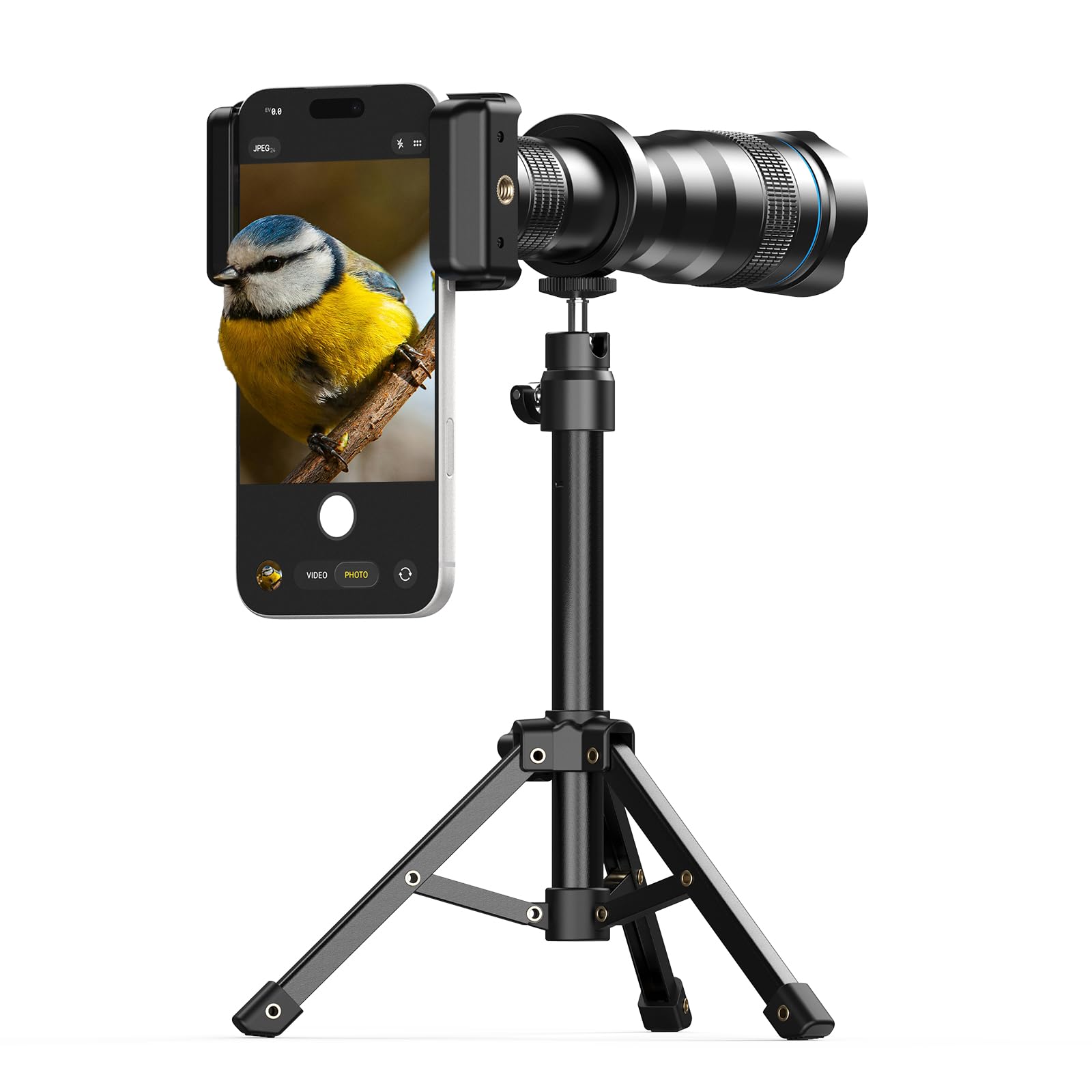
If your frustration is distance — a bird on a high branch, a cabin across a valley, a player on the far touchline — this is the lens to start with. The fixed 36X telephoto multiplies what your Pixel’s main camera sees, so a subject you could barely identify becomes the whole frame. Fixed means it does not zoom in and out; you get one strong magnification and you frame by moving your feet.
At that much magnification, a hand tremor throws your subject clean out of view, which is why the kit ships with a metal tripod. Set it on a firm, level surface, steady the phone, and your hands are free to work the focus ring. Focus is manual: you spot your subject, centre it on screen, then slowly turn the ring until a detail snaps sharp — a bird’s eye, the edge of a distant roof. The multi-coated optical glass is there to cut reflections when you shoot into bright outdoor light. The clip fits phones measuring 2.6–3.7 in (66–95 mm) wide, which covers Pixel bodies, but compatibility depends on where your camera sits and how thick your case is, so align the lens with the main rear camera. If you see dark circular edges at 1X, nudge the phone to 1.2X–1.5X digital zoom for a fuller view. It also works as a handheld monocular when your phone is away.
Where it earns its keep
- Fixed 36X magnification fills the frame with subjects you cannot walk up to
- Metal tripod in the box solves the shake that ruins long-range shots
- Doubles as a handheld monocular for watching without your phone
- Multi-coated glass keeps reflections down in bright daylight
What to plan around
- Manual focus takes a slow, deliberate hand — not a point-and-shoot lens
- Clip fit depends on your case thickness and camera placement
- Single fixed magnification, so no zooming out for a wider scene
Made for: the backyard birdwatcher, the traveller who wants a long view without hauling binoculars, and anyone shooting sport from the stands.
Think twice if: you want a quick pocket lens for close-ups — this one lives on a tripod and rewards patience.
2. Xenvo Pro Lens Kit
Two lenses, a light, and the clip that holds all of it steady.
This two-lens kit has quietly become the default recommendation for phone photographers, and. What wins people over is the macro work. The Clarus 15x macro pulls out the veins on a leaf or the grain on a ring, and the guidance to hold it roughly half an inch from your subject is what makes the difference between a sharp frame and a soft one. It is not built for distant subjects; that is a different lens’s job.
The TruView 0.45x wide angle goes the other way, widening your frame for group shots, architecture and scenery without the dark corners cheaper glass throws in. Both lenses are multi-element, coated optical glass in aircraft-grade aluminum bodies, which is why the kit feels like gear rather than a toy. The TruGrip clip is the quiet hero here — it clamps firmly enough to hold alignment while you frame a shot.
The GlowClip mini LED light clips anywhere on the phone and gives you warm continuous light with three brightness settings, which beats your phone’s built-in flash for darker rooms and evening shots. A quick-release lanyard and a DuraCase round out the kit, so it travels without loose parts rattling around a bag. One practical caution: the macro lens only works close, so treat it as a dedicated detail tool and reach for the wide angle for anything at arm’s length.
The macro is the reason: the 15x Clarus lens and its roughly half-inch working distance deliver the close-up detail this kit is known for.
One thing to remember: the two lenses split the job cleanly — macro for near, wide for far — and neither magnifies a distant subject the way a dedicated telephoto would.
Pick this if: you want one kit that covers close-ups, wide scenes, and dim rooms without carrying four separate lenses.
Look elsewhere if: reaching distant subjects is the whole point of your purchase.
3. NEEWER HD 85MM Telephoto Phone Lens LS-59
A screw-on telephoto built for cages, not clips.
Read the first line of the specs before anything else: this lens twists onto a 17mm threaded backplate. It has no clip and it does not want one — the maker advises against clip mounting outright. That is a feature, not a limitation, if you already run a phone cage or a threaded case, because a screwed-down lens cannot drift off your camera mid-shoot. If you shoot from a bare handset, this is not your lens.
The glass is 8 elements in 6 groups giving 2.5x optical zoom, and the HD coating keeps the frame clear and sharp on close subjects at that reach. The shell is black anodised aviation-level aluminum alloy, built to shrug off rust and scratches. There is a genuinely useful addition on the front: a standard 72mm thread, so you can screw a ND, VND, CPL, UV or effect filter straight onto this lens rather than clipping something over your phone. For anyone building a serious phone rig, that is the detail that matters.
Its 2.5x reach is a gentler pull than the APEXEL 36X on this list — a completely different tool for a completely different job. If you want a subject across a valley filling your frame, go long. If you want a clean, controlled 2.5x step with a filter mount on the front, this is the more precise instrument.
The mount is the whole point: a 17mm thread locks the lens rigid, and the 72mm front interface lets you stack filters directly onto the glass.
The catch is the gear: no backplate, cage or threaded case means no usable lens, so budget for that before you commit.
Right for you if: you already shoot through a 17mm cage or threaded case and want a filter-ready telephoto.
Not for you if: you want to clip something onto a bare Pixel in ten seconds.
4. Kase HD Master Macro Lens

Macro that lets you keep your distance from the thing with legs.
Here is the problem with most phone macro lenses: to focus, you have to get so close that you shadow your own subject, and any insect with survival instincts is gone. Kase’s answer is shoot distance — this lens focuses with the subject 40–85mm away from the front element. That is enough room to light the subject properly and to photograph a bee without the bee leaving. The maker is blunt about the rule: outside that 4–8.5cm window, it will not focus at all. Learn the range and it becomes reliable.
The optics are 5 elements in 4 groups of low-dispersion optical glass with anti-reflective multi-layer coating, which is there to reduce reflection, glare and ghosting while lifting saturation. The body is aluminum alloy with a frosted finish, chosen so it resists scratches and wear. It mounts by the included clip, and also through its 17mm thread onto a threaded case or cage if you have one.
Owners praise the build most — the aluminum body feels like optical equipment, not a plastic add-on. The honest trade-off is focus: it is manual, and the focus point does not always land where you wanted on the first twist, so expect a couple of tries on a moving subject. Bring patience and you get the background bokeh that makes a close-up look deliberate.
Why it stands out
- 40–85mm working distance lets you shoot insects without scattering them
- Aluminum alloy body with frosted finish resists scratches and wear
- Multi-layer coating cuts reflection, glare and ghosting
- Mounts by clip or by 17mm thread, so it fits either workflow
Where it asks more of you
- Completely manual focus — you turn, check, adjust, and shoot again
- Outside the 4–8.5cm distance window it simply will not focus
The matching buyer: a nature shooter who wants insects, flowers and jewelry with background blur and a working distance.
The mismatch: a run-and-gun shooter who wants one twist and a guaranteed sharp frame.
5. ULANZI CL-003 Phone Macro Lens, HD 75mm for 17mm Thread

DSLR focus behaviour, shrunk down to a phone clip.
Most phone macro lenses make you hunt for focus by sliding the phone back and forth. This one brings back the way a proper camera lens works — you set your distance, then turn a ring. The tele-focusing operation gives you a 45–90mm focusing range, so you pick where you stand and dial in the sharpness from there. For photographing jewelry, handicrafts, plants or insects, that control is the difference between a lucky shot and a repeatable one.
The optics deliver 10x optical magnification with natural background blur, and the updated lens combination is built for more light throughput and less distortion. The body borrows the look of a professional camera lens in aluminum alloy with a non-slip texture, so it handles like the gear it is imitating. Mounting is the 17mm screw port — either on the included cold-shoe lens clip, or screwed straight onto a 17mm case or rabbit cage.
Owners single out the aluminum build and the crisp close-ups, which fits a lens aimed at product and detail work. The honest limit is that it is a macro specialist with no interest in distant subjects, and its weight means it is not the lens you forget is in your pocket. It is the one you pack on purpose.
What it does best: 10x magnification with a 45–90mm focusing range gives you ring-driven precision instead of guesswork.
Worth knowing: at 400g it is a deliberate addition to a bag, not a featherweight slip-in.
For the detail obsessive: makers, sellers and hobbyists photographing small objects who want repeatable focus.
Not the one for: anyone wanting a pocket lens for landscape or distance.
6. NEEWER 67mm 7 Pack ND Filter Set, FL-P11
Seven filters that change the light, not the distance.
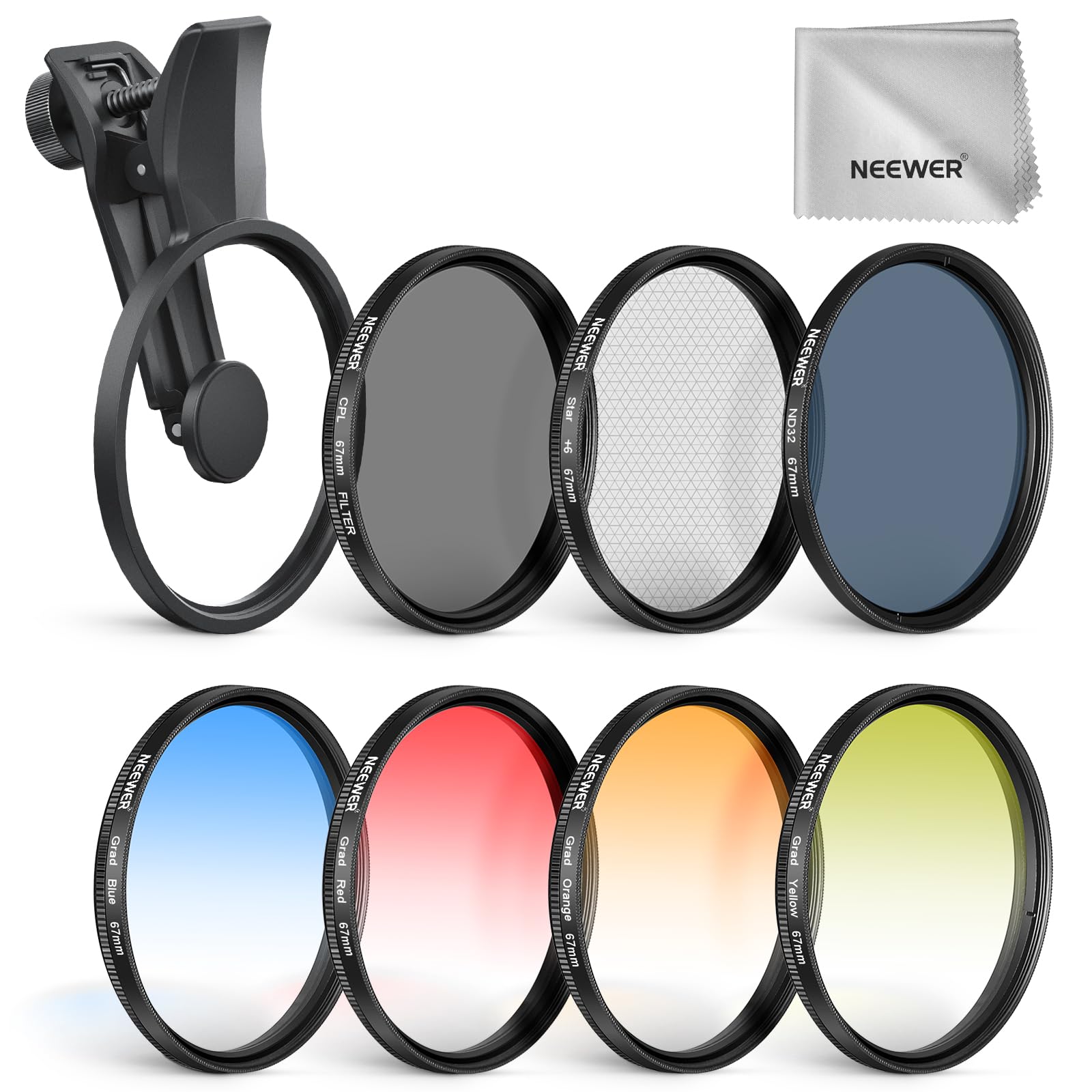
This set solves the other half of phone photography. The ND32 cuts the light entering your camera by 5 stops, which is what lets you blur a waterfall or a passing car in bright daylight. The circular polariser lifts saturation and contrast while cutting glare off water, glass and other nonmetallic surfaces. The starburst filter turns any bright point — streetlights, headlights, candlelight, reflections — into a 6-point star. And four graduated color filters in red, orange, yellow and blue balance exposure and add color transitions across the sky for landscapes and sunrises.
The clip is the upgraded kind: an adjustable screw lets you set the opening width so it grips firmly, and soft nonslip rubber pads protect your phone from scratches. The frame here measures 2.64″L x 2.64″W — compare that to the 52mm variable filter below at 2.05″L x 2.05″W, and you can see this set sits wider on the phone, which suits a larger clip and a bigger grip surface. All seven filters also screw onto any camera lens with a 67mm thread, so they follow you to a dedicated camera later. Everything packs into the included carrying case.
The creative range: a polariser, a 5-stop ND32, a 6-point starburst and four graduated colors in one kit covers most daylight tricks.
None of them zoom: if your goal is magnification, skip this entirely — filters change light, not reach.
Reach for this if: you shoot landscapes, water and night lights on a Pixel and want the effects without buying glass one at a time.
Pass if: you want to bring a distant subject closer.
7. APEXEL 6 in 1 Phone Lens Kit
Four lenses, one bag, and a tripod to hold the long one steady.
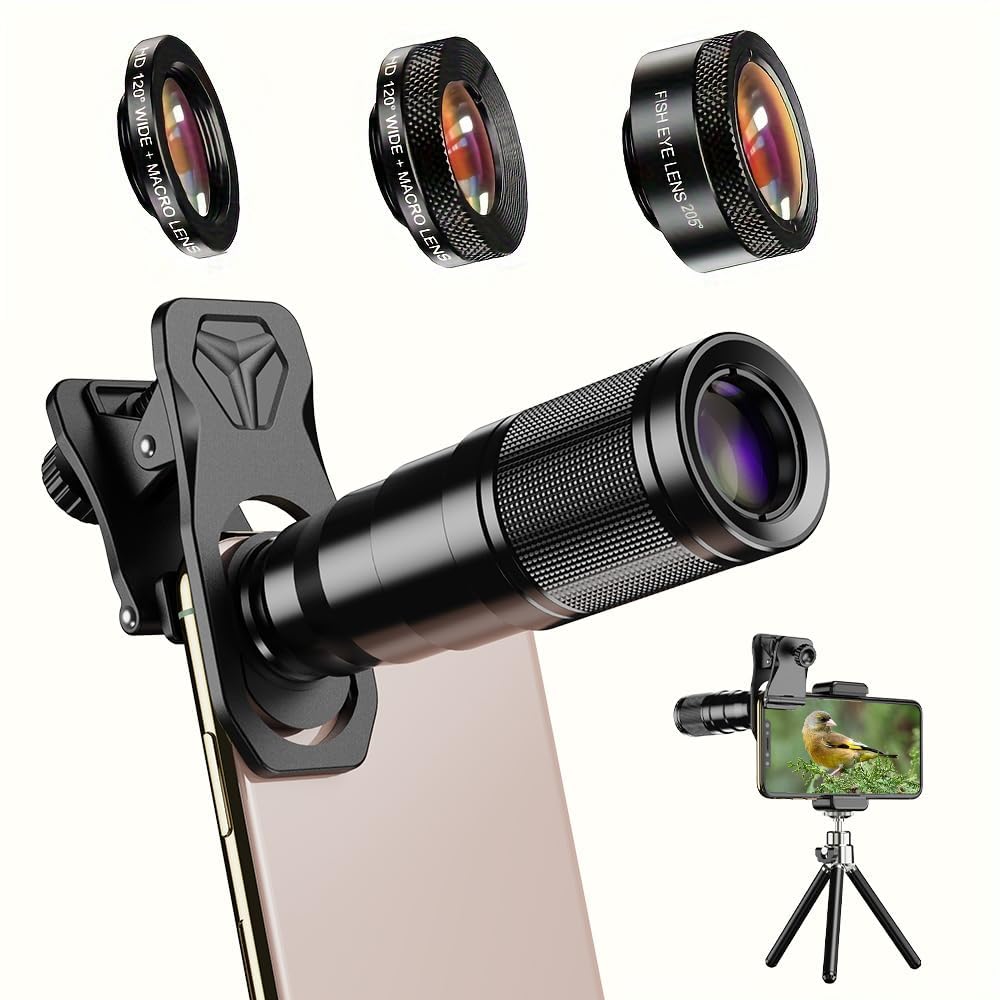
This is the kit you buy when you have not decided what kind of phone photographer you are. Four lenses cover the main jobs: a 22X telephoto for distant subjects at matches, concerts and wildlife, a 205° fisheye for the fishbowl look, a 120° wide angle for city scenes and group shots, and a 25X macro for flowers, insects and small objects. A metal tripod, a flexible clip and a zip case come along too.
One mechanical detail worth knowing before you shoot: the macro and wide angle lenses are screwed together, and you unscrew them to use the wide angle on its own. The ring on the clip slides so you can line it up with the main camera on a multi-camera phone. Each lens carries multi-layer green coating on both faces, aimed at clarity and cutting vignetting — those darkened corners that give cheap phone glass away.
Owners get the most satisfaction from the 25X macro, which pulls a flower petal or a coin’s edge into sharp detail. Where the kit asks for care is mounting: the clip needs lining up properly, and the long telephoto lives on the tripod, not in your hand. For a kit that covers this many jobs in one case, the trade-offs are honest ones.
What you get in one case
- Four lens types — telephoto, fisheye, wide angle and macro — in a single kit
- 25X macro is the part owners enjoy most for close-up work
- Metal tripod included to steady the long telephoto
- Multi-layer green coating on both faces to cut vignetting
Set-up notes
- Macro and wide angle screw together, so you must separate them to switch jobs
- Clip alignment takes care — the sliding ring must sit over the main camera
- Reliability reports are mixed on the zoom side of the kit
Buy this when: you want to experiment across every lens type before committing to one specialist lens.
Hold off when: you only ever shoot one subject and want that one job done without compromise.
8. SHUTTERMOON Camera Lens Kit for Smartphones

The effects box that turns a phone into a playground.
What this kit sells is variety. Alongside a 2x telephoto, a 198° fisheye, a 0.63X wide angle and a 15X macro, you get a CPL lens, a kaleidoscope lens and a star lens, plus a universal clip and a carrying case. The fisheye opens wider than the 180° lenses in many competing sets, which makes the fishbowl effect more pronounced and the frame more curved at the edges.
The build is the point of pride here — metal rather than plastic, and multi-element glass rather than the single-element lenses cheaper kits use, with multi-coating to cut reflections and ghosting. The clip grip is designed to hold firm without scratching your handset, and it will clamp most phones. Owners rate the lens quality well, and the sheer number of effects in one case is what sells it.
The honest caveat is compatibility. Reports on phone fit are mixed, with some handsets reported as not working with the kit, so check the clip will sit squarely over your Pixel’s main camera before you rely on it. Picture quality also splits opinion — a creative fisheye or kaleidoscope frame is not meant to be a technically perfect one. Treat this as a fun set to experiment with, and you will get plenty from it.
Why it’s fun: a 198° fisheye plus kaleidoscope and star lenses gives you effects your Pixel cannot produce on its own.
Check before you buy: clip fit varies by handset, so confirm alignment with your particular Pixel.
Best for: the shooter who wants to play with fisheye curves, kaleidoscope frames and starbursts on a small budget.
Skip if: you need guaranteed clip fit and technical sharpness above all else.
9. 52MM Variable ND2-ND400 Filter, Ultra Slim Multi-Coated

One dial from clear to dense, without swapping filters.
A variable filter is the practical choice for anyone shooting video on a Pixel outdoors. Instead of carrying several fixed filters, you rotate this one to step through 1 to 9 stops of light reduction, so you can dial the exposure down as the sun shifts. That range is what lets you keep motion blur on a river or a light trail, or hold a longer exposure for a sunrise without washing the frame out.
The glass is multi-coated to repel moisture, oil, dust and scratches, and the frame is aluminum alloy with double-sided rubber pads that protect the phone underneath. It is compact next to the NEEWER filter set on this list — this one measures 2.05″L x 2.05″W against that set’s 2.64″L x 2.64″W, so it sits tighter on the phone. The large-diameter universal clip fits phones and tablets across single, dual and triple camera setups, and the 52mm thread means it also screws onto a DSLR lens threaded ø52mm.
Two things to know going in. First, the maker warns that a black X shape can appear in the frame at the densest setting under certain light — avoid rotating all the way to the darkest position and it settles. Second, this filter’s weak spot in owner reports is image clarity, with blurry results noted by some, so a careful, steady setup matters. Use it deliberately and it earns its place in a video bag.
What it solves
- 1–9 stops of adjustment from a single rotating dial
- Aluminum frame with double-sided rubber pads to protect the phone
- Universal clip covers single, dual and triple camera phones
- 52mm thread also fits a ø52mm DSLR lens
Where care is needed
- A black X can show at the densest setting under certain light
- Owner reports flag blurry results when the setup is not steady
- Fit varies by handset, with some phones reported as awkward
Suits: the video shooter who wants to control daylight on the fly without juggling fixed filters.
Does not suit: you if you shoot mostly stills in good light and want tack-sharp results with zero fiddling.
Know the Specs
Magnification and optical zoom
A number like 36X or 10x describes how much the lens enlarges what your phone’s main camera sees. Optical means the glass does the work, so detail stays real instead of being invented by software interpolation. The higher the multiplication, the more a tiny hand movement is magnified too — which is why long lenses pair with a tripod.
Shooting distance in millimetres
For a macro lens, shooting distance is the space between the front of the lens and your subject when it focuses. A range like 40–85mm is generous and lets you light the subject and avoid scaring it. A very short distance gives more magnification but less breathing room. Outside the stated window, a manual macro lens simply will not snap into focus.
ND stops and filter effects
A stop is a doubling or halving of the light reaching your camera. An ND32 with 5 stops is a fixed reduction; a variable ND from 1–9 stops lets you dial the density up and down. A CPL (circular polariser) cuts glare and boosts contrast, while a starburst filter turns a bright point into a star shape. These are effects, not magnification.
Clip versus 17mm thread
A clamp-style clip works on almost any handset straight from the box and needs nothing else. A 17mm thread is a screw mount built into a phone case, cage or backplate — rigid and drift-free, but useless without that base. If you shoot deliberately with a rig, the thread wins on stability; if you shoot casually on a bare phone, the clip is the practical choice.
Common Questions
Will a universal clip lens fit my Google Pixel without a case?
Why is my macro lens refusing to focus on a flower?
Do I need a tripod for a telephoto phone lens?
What does a black X shape in my filtered photo mean?
Is a 36X lens better than a 2.5x one?
Can I use these phone lenses with a Pixel in a thick case?
Do ND filters work on a Pixel’s main camera through a clip?
Will one kit cover both close-ups and distant subjects?
Are filters and lenses the same purchase?
Do I have to focus these lenses by hand?
The Bottom Line
For most people hunting a lens for pixel, the APEXEL 36X Telephoto is the one to start with, because it pairs serious long-range reach with the metal tripod that keeps a 36X shot steady. If close-up detail is your real interest, the Xenvo Pro Lens Kit covers macro and wide in one case and is the crowd favourite for good reason. And for landscape and video shooters, the NEEWER 67mm 7-Pack Filter Set is the one to reach for, since a polariser, a 5-stop ND and graduated colors carry you across a whole day of changing light.
How we choose
We do not accept paid placement. Every pick is matched to a real buyer and a real use-case; we do not hands-on test units.
Sources
Specifications: manufacturer listings and product documentation. Review insights: verified customer reviews, as of November 2026. Pricing: not shown on this page (it changes often); check the current price via the retailer link.
As an Amazon Associate, Tactical Gear Guy earns from qualifying purchases. This does not affect which products we feature.