Specs are compiled from manufacturer listings and verified buyer reviews and can change over time — please confirm the key details on the product page before buying.
If you laminate all day, the machine you want is the one that keeps eating pouches without wrapping film around its rollers. Roller count, warm-up time, and infeed width decide whether it does. Every pick below is rated for continuous commercial duty.
This guide is built by comparing the manufacturers’ published specifications and the patterns across verified customer reviews, so you get each pick’s real strengths and trade-offs instead of marketing spin.
Below you’ll find six commercial-grade machines compared on roller count, warm-up, and width, so you can match the right one to your actual daily volume. Every machine below is compared on those three specs, so you can buy once and buy right.
Top Picks
How To Choose The Best Industrial Laminator Machine
A commercial laminator is a heated machine with rollers that must stay straight under constant load. You are buying a heated machine with rollers that must stay straight under constant load, and the spec sheet tells you most of what you need before you ever plug it in. Here is what to weigh.
Rollers decide the finish
A roller is the heated cylinder that presses the pouch flat as it passes through. More rollers means the pouch gets squeezed in more stages, which is why a 6-roller machine tends to give a flatter, bubble-free result than a 2-roller unit. If you laminate menus, signs, or certificates that customers will look at closely, favor the higher roller count.
Warm-up and throughput set your day
Warm-up time is how long the machine takes to reach working temperature — quoted in minutes. Speed is quoted in inches or feet per minute, and it tells you how fast pouches feed through once you are running. A machine that warms in 2 minutes and runs at 81 inches per minute keeps a print shop moving; a slow warmer costs you idle minutes every single morning.
Pouch thickness in mil
“Mil” is a thousandth of an inch, and it rates how thick the laminating pouch is. The 3-10 mil range on these machines covers everything from a thin ID card sleeve to a stiff 10 mil sign. If your work mixes thin and thick pouches in the same shift, look for a machine that switches between them without a cooldown wait.
Width and film type
Infeed width caps the biggest document you can run. An 18.5 inch tray handles a true 18 inch map pouch; a 27 inch roll machine handles wide posters that a 13 inch unit simply cannot. Also check whether the machine takes pouches (sealed sleeves you feed one at a time) or roll film (a continuous roll that feeds and trims) — the two are not interchangeable.
Side-by-Side Comparison
| Model | Best For | Max Width | Warm-Up | Rollers | Amazon |
|---|---|---|---|---|---|
| Apache Professional 18.5″★ Best Overall | Wide pouches and thick stock | 18.5 in | ~4.5 min (3 mil) | 4 | Amazon |
| SINCHI 13-Inch 6-RollerTop Performer | Fast production sealing | 13 in | 2 min | 6 | Amazon |
| SINCHI sturdy LCD 6-Roller | Custom presets and memory | 13 in | 1.5 min | 6 | Amazon |
| GBC Foton 30 | Hands-off pouch-free runs | Letter / oversize | 3 or 4 min | 1 | Amazon |
| GBC Pinnacle 27 EZLoad | Wide-format roll film | 27 in | 8-10 min | 1 | Amazon |
| GBC Ultima 65 | Schools and posters | 27 in | Under 10 min | 2 | Amazon |
Detailed Reviews
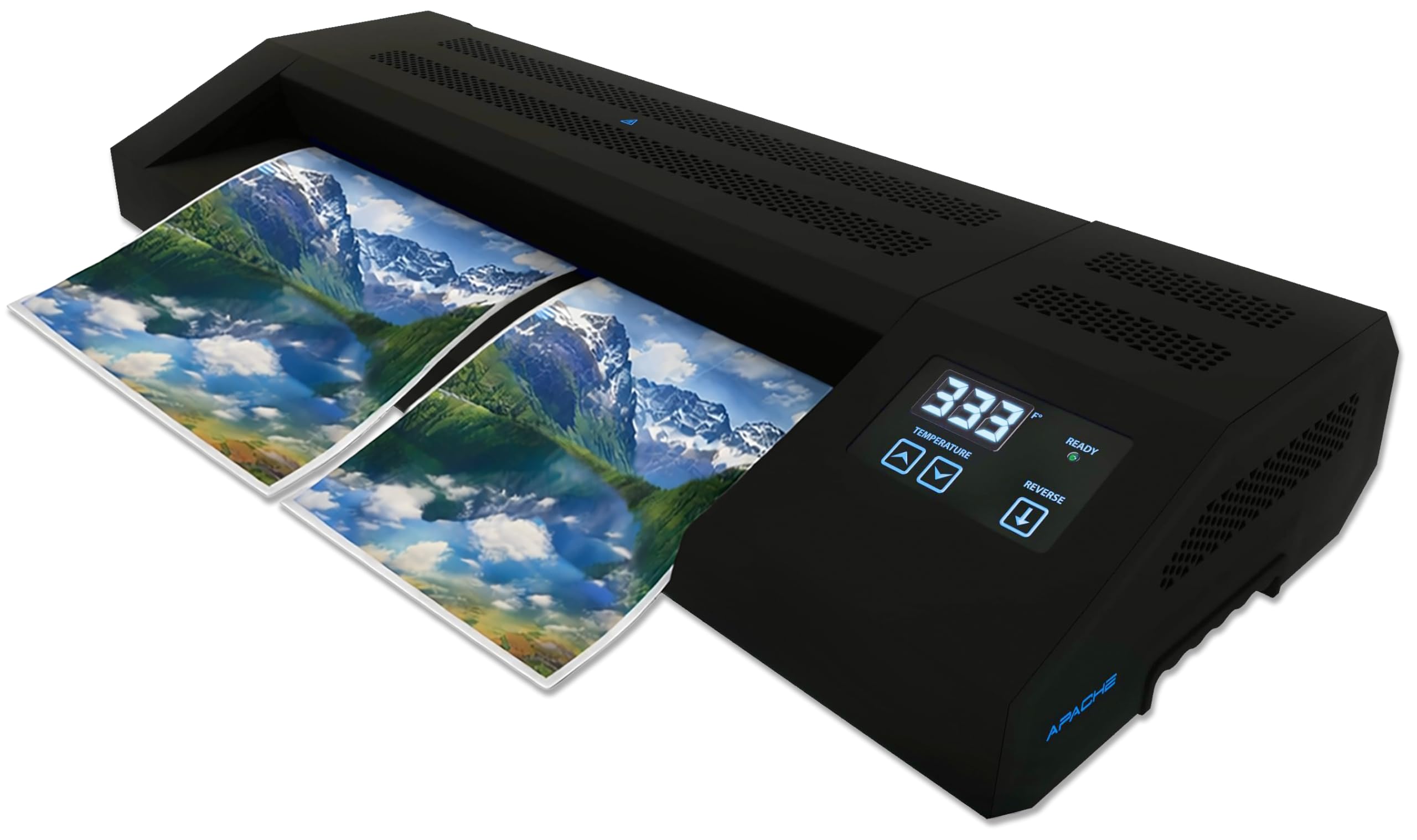
1. Apache Professional Laminator 18.5 Inch
Our pick — 4.0+★ from 70+ verified ratings; the strongest balance of quality and price.
The widest infeed and widest film range on this list, built to swallow the jobs other machines reject.
If your work is genuinely wide — full 18×24 map pouches, oversize signage, or two letter sheets feeding side by side — this is the machine that fits. The infeed tray is 18.5 inches, which takes a true 18-inch pouch instead of forcing you to trim. Two 9×11.5 letter pouches sit side by side in the tray for double throughput, which is how a busy copy room keeps the queue from building.
What separates the Apache from the SINCHI machines below is the film range. It laminates 1.5 to 20 mil pouches and handles a project up to 1.1 mm thick — a far broader window than the 3-10 mil the SINCHI units accept. High-temperature work up to 400°F is in the spec sheet too, and warm-up runs about 4.5 minutes for 3 mil stock and about 8.5 minutes at max temp. Its anti-jam system is built to prevent wrap-arounds, not just reverse after one.
Speed is quoted at 23.62 feet per minute with a nominal 600 mm/min feed — noticeably quicker than the 6.75 feet per minute of the SINCHI 13-inch unit. That speed gap is why the Apache ranks first. Priced as a premium machine, it makes sense when wide or thick work is the core of your jobs.
The Real Draw
- 18.5-inch tray takes full 18-inch pouches and two letter sheets at once
- 1.5-20 mil range plus up to 400°F heat for thick stock
- 23.62 feet per minute speed versus 6.75 on the SINCHI 13-inch model
- Anti-jam tech built to stop wrap-arounds, not just react to them
What You Give Up
- This is a heavy computer — 28.6 pounds — so plan a permanent spot
- Warm-up stretches to about 8.5 minutes at max temperature
- Overkill if you only ever run letter-size 3 mil pouches
Reach for this if: wide maps, thick stock, or side-by-side letter feeding matches your daily work.
Look elsewhere if: your jobs stay small and letter-sized — a 13-inch machine will do it cheaper.
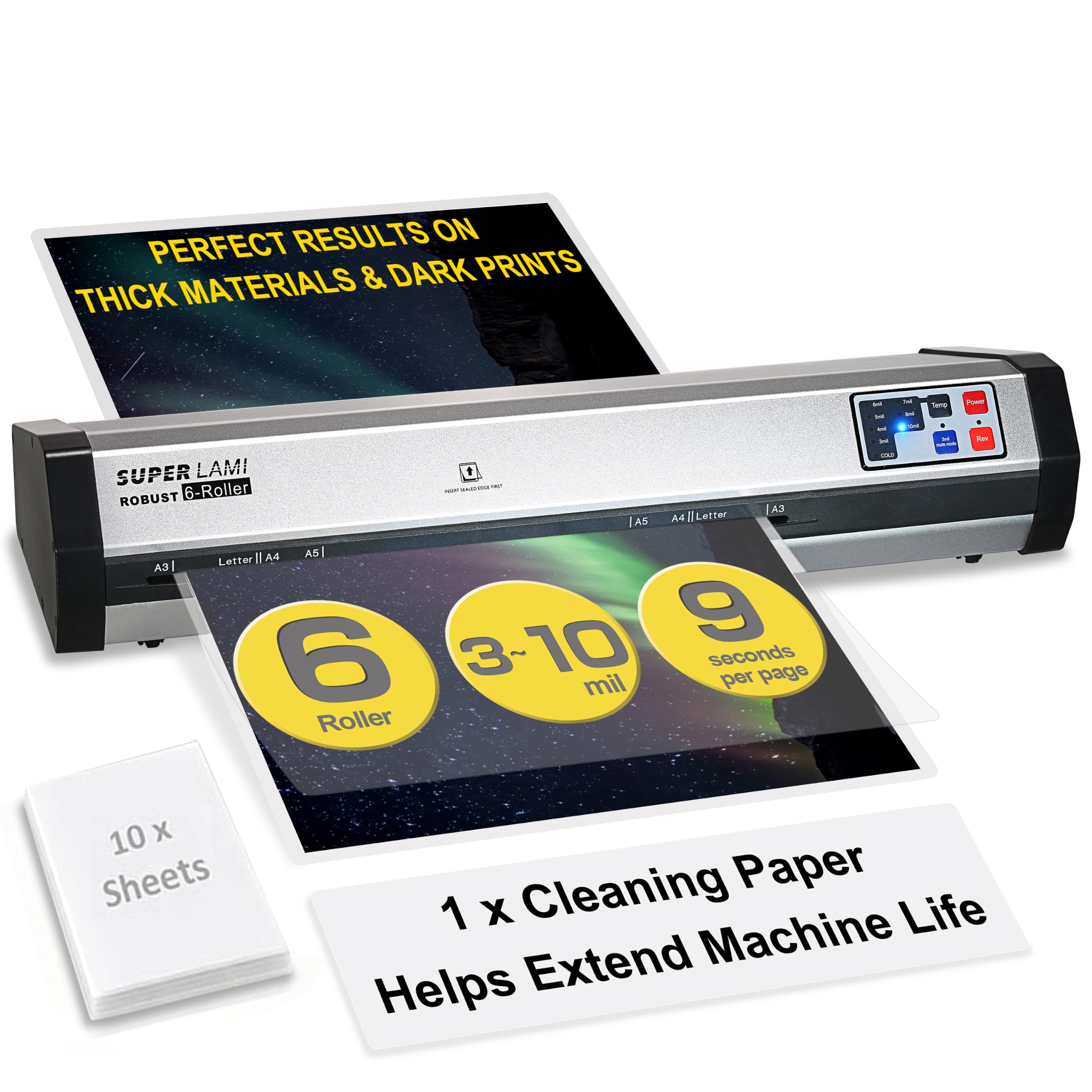
2. SINCHI 13-Inch, 6-Roller Commercial Laminator, 3–10 Mil
Ten letter sheets sealed in the time a slow warmer is still blinking at you.
The number to notice is 81 inches per minute. That is the feed speed of this 6-roller machine — just under 9 seconds per page — and it belongs to a unit that warms up in 2 minutes flat. For a school office that batches permission slips on a Monday morning, that combination means ten letter-size sheets are done before a slower machine has even reached temperature.
Six rollers, four handling the heated side and two the cold, press the pouch in more stages than a 2-roller unit. The payoff is sealed edges without bubbling or curling. A commercial-grade metal gearbox and aluminum housing back that up for continuous use, and the machine shuts itself off after 30 minutes of inactivity to protect the heaters.
Where this falls short of the Apache is width. Its 13-inch infeed swallows an ID card or a 13×19 poster, but not an 18-inch map pouch. It also accepts only 3-10 mil pouches, so the 20 mil ceiling of the Apache is out of reach. And note the maker’s own caveat: this is a pouch-only machine, not built for DTF decals, sublimation films, or vinyl rolls.
What wins people over: the roller count and the 81 inches per minute feed — this is a production machine that happens to fit a bench.
The honest catch: it is 120V and North America only, and the warranty runs 12 months against manufacturing defects.
Best for: schools and print shops running steady letter and poster batches on a tight clock.
Think twice if: your jobs need 18-inch width or thicker than 10 mil pouches.
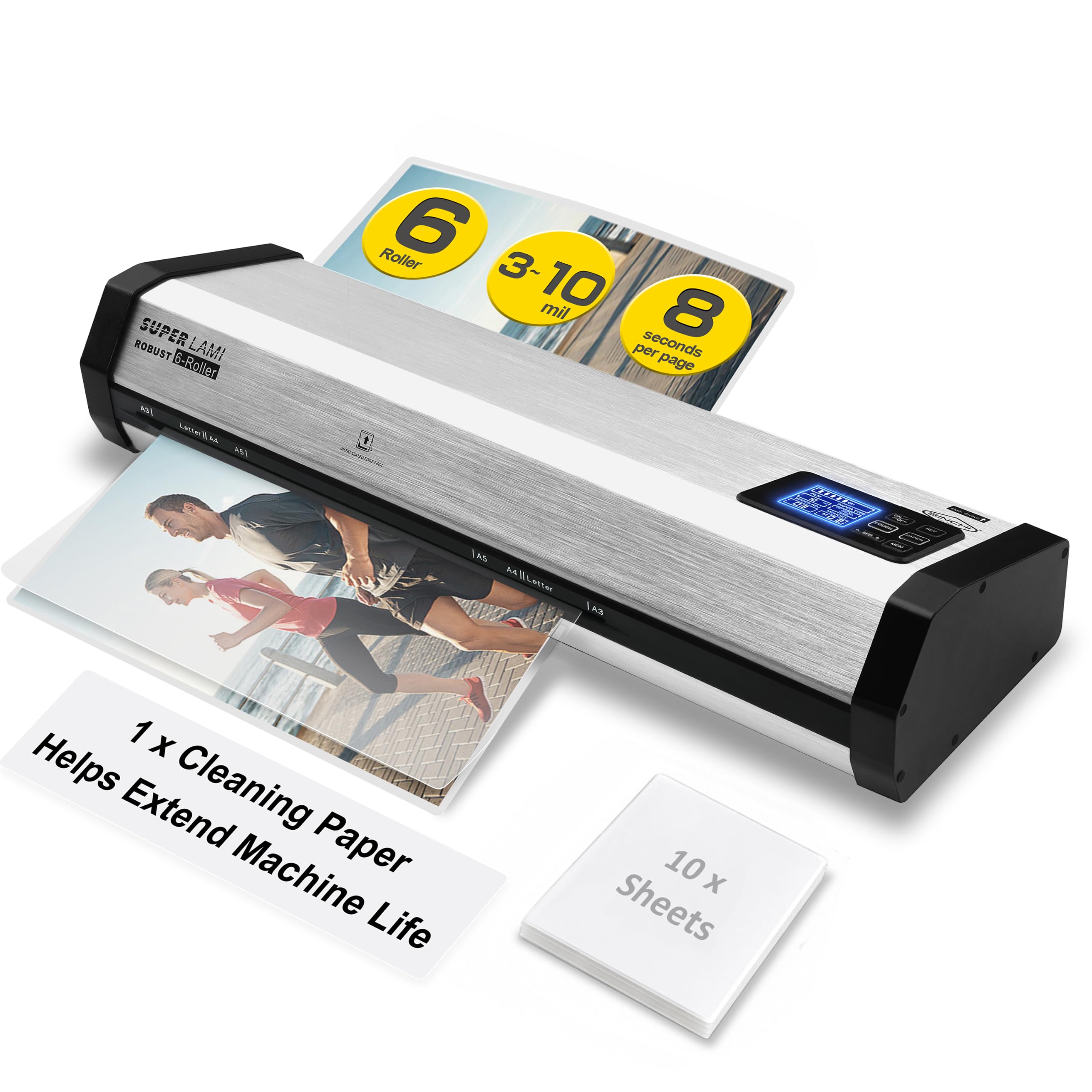
3. SINCHI sturdy 6-Roller Laminator Machine with LCD Display
Build a setting once, save it, and stop fiddling with dials before every job.
This is the machine for the shop that runs a dozen different jobs in a week. An LCD control panel gives you 105 separate settings to tune to pouch thickness and document type, and the machine holds up to 99 memories to record the ones you use. That means the exact setup for your 5 mil certificates is one button away the next time you run them.
Warm-up is 1.5 minutes — the fastest on this list, and quicker than the 2 minutes of the SINCHI 13-inch unit and the 8-10 minutes of the GBC Pinnacle 27. Six rollers (four hot, two cold) plus micro-adjustable speed keep output consistent, and the maker claims ten 3-mil letter pouches done in three minutes from a cold start. The 13-inch inlet takes everything from an ID card to a 13×19 poster, at 3-10 mil per side.
Be clear-eyed about the noise. The maker says plainly this is not a quiet machine — the heavy-duty metal gearbox is loud, and it is not built for a home or a quiet office. If your laminator sits beside someone doing phone work, that is a real friction point. Otherwise it is a close twin of the SINCHI 13-inch on specs, with the control panel as the difference.
Where it earns its keep: the LCD panel, the 105 settings, and the 99 memories make repeat jobs a one-touch affair.
Before you commit: the metal gearbox is loud by design, and the 30-minute auto-shutdown is there to conserve energy and protect the machine.
Choose this one if: you laminate varied jobs all week and want saved presets instead of guesswork.
Keep looking if: the machine lives near quiet workspace — the gearbox noise is part of the design.
4. GBC Foton 30 Automated Pouch-Free Laminator

Load a stack, press run, and walk away while it feeds, laminates, and trims on its own.
The Foton 30 attacks the labor problem head-on. You load up to 30 letter-size sheets into the auto-feeder, press run, and the machine handles feeding, lamination, and trimming without you standing over it. That hands-off cycle is the whole pitch, and it suits an office where nobody has time to feed pouches one at a time.
It uses film cartridges instead of pouches — 3-5 mil reloadable cartridges that thread themselves. Each cartridge handles up to 230 documents, and a sensor controls spacing between sheets to cut film waste and head off jams. Auto deskew straightens pages so they feed evenly, and mil thickness detection takes the guesswork out of film choice. Warm-up is 3 or 4 minutes. Three modes cover letter pages, oversize documents, and odd shapes.
Reliability is the most-discussed theme in owner feedback, and it splits both ways. Some machines run for years, but a share of buyers report theirs gave out after about a year of use. That is a real consideration on a machine at this price. The cartridges are also exclusive to the Foton 30, so film comes from GBC and refills are sold separately.
Why it appeals: a 30-sheet auto-feeder and auto-trimming turn lamination into a background task instead of a standing job.
The trade-off to weigh: owner experience on long-term reliability is split, and the 2-year or 5,000-laminate warranty is your real safety net.
Worth it for: offices that laminate in stacks and want a machine that runs unattended.
Pass if: you need long-term certainty above all — read the warranty terms carefully first.
5. GBC Pinnacle 27 EZLoad Thermal Roll Laminator

Twenty-seven inches of roll film — poster width that no pouch machine on this list can touch.
When a 13-inch machine will not do, the Pinnacle 27 is the answer. Its 27-inch maximum width doubles the 13-inch infeed of the SINCHI units, so bus tags, game cards, and full classroom posters run in one pass. It laminates from roll film rather than pouches, feeding at up to 10 feet per minute for high-volume jobs.
Loading is the clever part. EZLoad color-coded end caps show you the correct film orientation, which eliminates the loading errors that otherwise lead to costly service calls. A footage counter tracks how much film you have left, and a digital temperature readout keeps the heat honest. Auto reverse corrects a feeding mishap, and a built-in trimmer cuts finished documents straight off the roll.
Plan around two things. First, this is a 105-pound machine that wants a permanent, sturdy home. Second, warm-up is 8-10 minutes — far slower than the 1.5 minutes of the SINCHI sturdy — so it is built to stay on between classes rather than power up per job. It enters standby after 2 hours idle and shuts off at 3. Film is GBC EZLoad Gray Cap only, up to 3 mil, sold separately.
The spec that sells it: a 27-inch width and 10 feet per minute, paired with EZLoad caps that make film changes simple to use.
Know before buying: film is proprietary, slow to warm, and the machine is heavy enough to need its own table.
Go here if: wide poster work from roll film is your routine and the machine can stay powered between jobs.
Do not go here if: you want fast single-job warm-up or you only run letter-size sheets.
6. GBC Ultima 65 Laminator

One-touch AutoSpeed picks the right feed rate so the teacher does not have to.
Schools laminate in bursts — thirty bus tags before the field trip, a wall of posters before open house. The Ultima 65 is built for exactly that. Its one-touch AutoSpeed feature reads your document and sets the optimal speed on its own, which removes the guesswork that produces bubbled or under-sealed results. Quality is what buyers praise most here, and the 27-inch width covers posters as easily as handouts.
Film loading is flexible. It takes 25-inch or 27-inch EZ Load Gray Cap NAP I film as well as standard 1-inch core NAP I film up to 3 mil. Color-coded EZ Load end caps show the correct orientation, and a pivoting table opens quick access to the rollers while AutoGrip shafts make swapping standard film easier. Front and back stop buttons pause lamination for loading or cutting, and a footage counter tracks what is left. Warm-up is under 10 minutes at 8 feet per minute.
The trade-off worth knowing is durability confidence. Reliability is the topic owners split on most in the feedback, so treat the short limited 90-day warranty as a real factor and register the machine the day it arrives. It also runs roll film only and sits on a large footprint at 111 pounds — this is a machine with a designated table, not a portable unit. For a school that wants one-button film handling across wide posters, though, it is a natural fit.
Standout Strengths
- One-touch AutoSpeed chooses the right setting for the document
- 27-inch width handles posters, bus tags, and handouts in one pass
- Accepts EZ Load Gray Cap film or standard 1-inch core NAP I film up to 3 mil
- Front and back stop buttons simplify loading and cutting
Points To Ponder
- Limited 90-day warranty is short for a machine this size
- Roll film only — no pouch feeding
- Warm-up under 10 minutes means leaving it on between classes
Matches best with: schools wanting automatic speed control over wide roll-film posters.
Second-guess it if: you expect a long factory warranty or need to laminate pouches.
Know the Specs
Roller count and what it means for the finish
Rollers are the cylinders inside that press and heat the pouch as it feeds through. A 6-roller machine like the SINCHI units passes the pouch through more stages of pressure, which is why the maker promises sealed edges without bubbling or curling. A 2-roller machine can still do good work but relies more on steady temperature. If your documents are viewed up close — menus, certificates, signage — more rollers usually means a cleaner finish.
Mil, width, and speed in plain terms
Mil rates pouch thickness, in thousandths of an inch, and it sets how stiff and protective the finished piece is. Width is the biggest sheet or pouch the infeed will accept — an 18.5-inch tray handles wide maps, a 27-inch roll machine handles posters. Speed, quoted in inches or feet per minute, tells you how fast documents feed once the machine is warm. Match all three to your largest and thickest routine job, not your smallest.
Common Questions
Will an 18.5-inch laminator take a full 18×24 map pouch?
What does mil mean and do I need 10 mil pouches?
Can these laminators run DTF decals or vinyl rolls?
Do I need a slow or fast warm-up machine?
Will a 13-inch laminator do everything I need?
Do the roll-film machines use the same film as the pouch laminators?
Are these machines loud enough to matter in an office?
Do I need to switch settings when changing pouch thickness?
How do the warranties compare across these machines?
Do these machines run on 120V and work outside North America?
The Bottom Line
For most working shops, the industrial laminator machine that earns its spot is the Apache 18.5-inch. Its 18.5-inch tray, 1.5-20 mil range, and 23.62 feet per minute speed cover the widest spread of real jobs in one machine. If fast letter-and-poster batching is your rhythm, the SINCHI 13-Inch 6-Roller gets ten sheets done in minutes. And for hands-off, stack-at-a-time work, the GBC Foton 30 is the one to reach for — just verify the warranty terms match that automation confidence. One practical nudge before you buy: check your widest and thickest routine pouch first, since width and mil range are the two specs you cannot upgrade later.
How we choose
We do not accept paid placement. Every pick is matched to a real buyer and a real use-case; we do not hands-on test units.
Sources
Specifications: manufacturer listings and product documentation. Review insights: verified customer reviews, as of November 2026. Pricing: not shown on this page (it changes often); check the current price via the retailer link.
As an Amazon Associate, Tactical Gear Guy earns from qualifying purchases. This does not affect which products we feature.