Specs are compiled from manufacturer listings and verified buyer reviews and can change over time — please confirm the key details on the product page before buying.
A chewed-up screw head is a small problem that ruins an entire afternoon. You lean on the screwdriver, the tip spins out, and the cross slot turns into a smooth crater. The good news: most stripped heads come out in seconds with jaw pliers that clamp the fastener’s outside edges instead of its ruined slot. That one choice separates a two-minute extraction from a drill-and-tap disaster. Below you will find the extractor types that actually work — pliers-style jaw tools, socket extractors, and spiral extractor sets — matched to the jobs they handle best.
This guide is built by comparing the manufacturers’ published specifications and the patterns across verified customer reviews, so you get each pick’s real strengths and trade-offs instead of marketing spin.
You will see which tools grip a tiny screw head, which ones handle a rusted bolt, and which sets simply are not worth the shelf space. Here is the honest shortlist of the tool to remove stripped screws that earns its place in your box.
Top Picks
How To Choose The Best Tool to Remove Stripped Screws
The first decision is not brand or budget — it is whether the head still has metal above the surface. A screw sitting proud of the wood, plastic, or metal can be grabbed from the outside. A screw snapped flush or buried below the surface needs a hole drilled into it first. Those two situations need two different tools, and buying the wrong one is the most common way people waste money here.
Proud heads: grab the outside, skip the drill
When the damaged screw still sticks up, a jaw tool is the fastest path. Pliers-style extractors squeeze the head from both sides with serrated jaws, so the ruined slot stops mattering. Look for jaws with both vertical and horizontal serrations — that crosshatch pattern is what stops the head from skating out sideways. A slim jaw profile also helps, because you often cannot see the screw head straight on in a recessed hole.
Flush and buried screws: you need a socket or a drill
A rounded bolt or a head snapped off below the surface needs an extractor that fits over the outside of the fastener. Socket extractors with left-hand spiral flutes work by biting deeper as you turn counter-clockwise. The harder you twist a left-hand spiral socket extractor, the deeper its flutes bite into the rounded head. Socket extractors are specified by the sizes they cover, so match that range to the fasteners on your vehicle or project before you buy.
Material and hardness — the numbers that decide survival
Steel choice is the difference between a tool that lasts and one that snaps. Chrome-molybdenum steel (Cr-Mo) is the alloy used in most serious extractor sets because it resists twisting forces without shattering. High-carbon steel is common in plier-style tools and offers good hardness for cutting edges. Hardness ratings appear as an HRC figure, and a higher number means a harder cutting edge — but very hard steel can also be more brittle, which is why some extractor sets trade hardness for toughness.
Size range and the small-fastener trap
Most general sets skip the tiny end. If you work on laptops, small appliances, or electronics, check that the smallest extractor or jaw opening reaches down to the tiny screws you actually deal with. A larger set with a wide range sounds better on paper, but if the jump between sizes is too big the smallest extractors skip the tiny screws you need — fit matters more than piece count.
Side-by-Side Comparison
| Model | Best For | Tool Type | Pieces / Sizes | Material | Amazon |
|---|---|---|---|---|---|
| ENGINEER PZ-58★ Best Overall | Tiny and shallow screw heads | Jaw pliers | Ø3 – 9.5mm | High Carbon Steel | Amazon |
| GRLCOOD 14-Piece Bolt Extractor KitBudget Champion | Budget socket extraction | Socket extractors | 14 pcs | Alloy Steel | Amazon |
| Mayhew Pro 36968Precision Pick | Large seized and broken screws | Fluted extractor | 21/32″ to 1-1/8″ | Tool Steel | Amazon |
| GEARWRENCH 84787 | Bi-directional tightening and loosening | Socket extractors | 4 pcs | Alloy Steel | Amazon |
| VEVOR 49-Piece Set | One box for every fastener size | Socket + drill bits | 49 pcs | CR-MO, HSS | Amazon |
| DUNDOO 27-Piece Set | Wrench-direct hex sockets | Socket extractors | 27 pcs | Chromium Molybdenum Steel | Amazon |
| THINKWORK 39-Piece Set | Widest size coverage | Socket + drill bits | 39 pcs, 2mm to 21mm | Cr-Mo + HSS 6542 | Amazon |
| XEWEA 49PCS Set | Left-hand drill bit backup | Socket + LH drill bits | 49 pcs | Chrome Molybdenum Steel | Amazon |
| toolant 46-Piece Set | Heavy automotive bolt work | Socket + hand extractors | 46 pcs | Cr-Mo Steel | Amazon |
Detailed Reviews
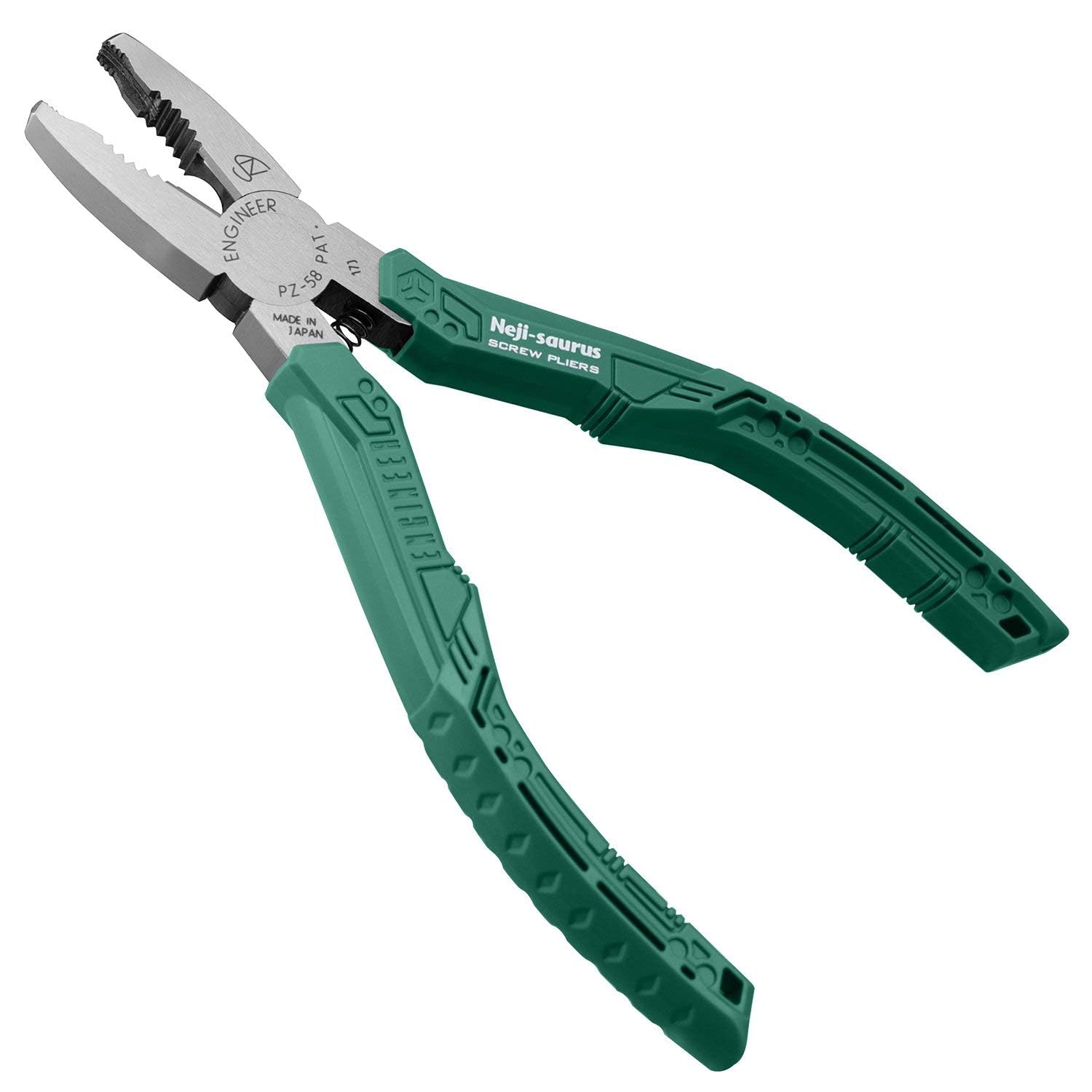
1. ENGINEER PZ-58 Screw Removal Pliers Stripped Screw Extractor
Our pick — 4.5+★ from 10,000+ verified ratings; the strongest balance of quality and price.
The jaw tool that grabs a chewed screw head from the outside and ends the argument.
This is the pick for the screw that is stripped but still standing proud of the surface — a laptop back panel, a cabinet hinge, an appliance cover. Instead of trying to re-cut a ruined slot, the PZ-58 clamps the head from both sides with jaws cut in vertical and horizontal serrations. That crosshatch pattern is the whole trick: it bites into what is left of the head so the plier does not skate off under pressure. One tool covers screw heads from Ø3mm up to Ø9.5mm, which is the small-to-mid range where most household stripping happens.
What wins people over is how fast the whole job becomes. The jaws are slim enough to work in a recessed hole where you cannot see the head straight on, and the reach is quicker than setting up a fluted extractor and a drill. The pliers also carry a side cutting blade rated at HRC60±2 for copper wire up to Ø3.2mm and steel wire up to Ø2.6mm, so it stays useful after the screw comes out. The tool runs 160mm long with a 17.5mm tip width and 28mm tip length, with a TPR (thermoplastic rubber) handle that keeps your hand steady during a hard twist.
The honest catch is durability on the cutting edge rather than the grip. A share of long-term owners find the jaws lose their bite over heavy repeated use, so treat it as a precision extraction plier, not a demolition tool. And it only works when there is head left to grab — a screw snapped flush below the surface is not this tool’s job. For any screw head still standing above the wood or metal, it turns a wrecked afternoon into a two-minute job.
Why This One Leads The List
- Jaws grip a stripped head from the outside, so a ruined slot no longer matters
- Vertical and horizontal serrations stop the plier slipping off under load
- Covers Ø3mm to Ø9.5mm heads — the everyday small-screw range
- Slim jaws reach into confined, recessed holes
- Built-in side cutter rated HRC60±2 keeps it useful after the extraction
Where It Stops Short
- Needs some head above the surface — flush or buried screws need another tool
- Heavy repeated use can dull the biting edge; it is a precision tool
- Does not include a drill bit for snapped shafts
Made for: anyone fighting a stripped screw that still sticks out — the fastest pass through the whole job.
Know the limit: it cannot start a hole in a snapped-off shaft, so keep a drill-based set for that case.
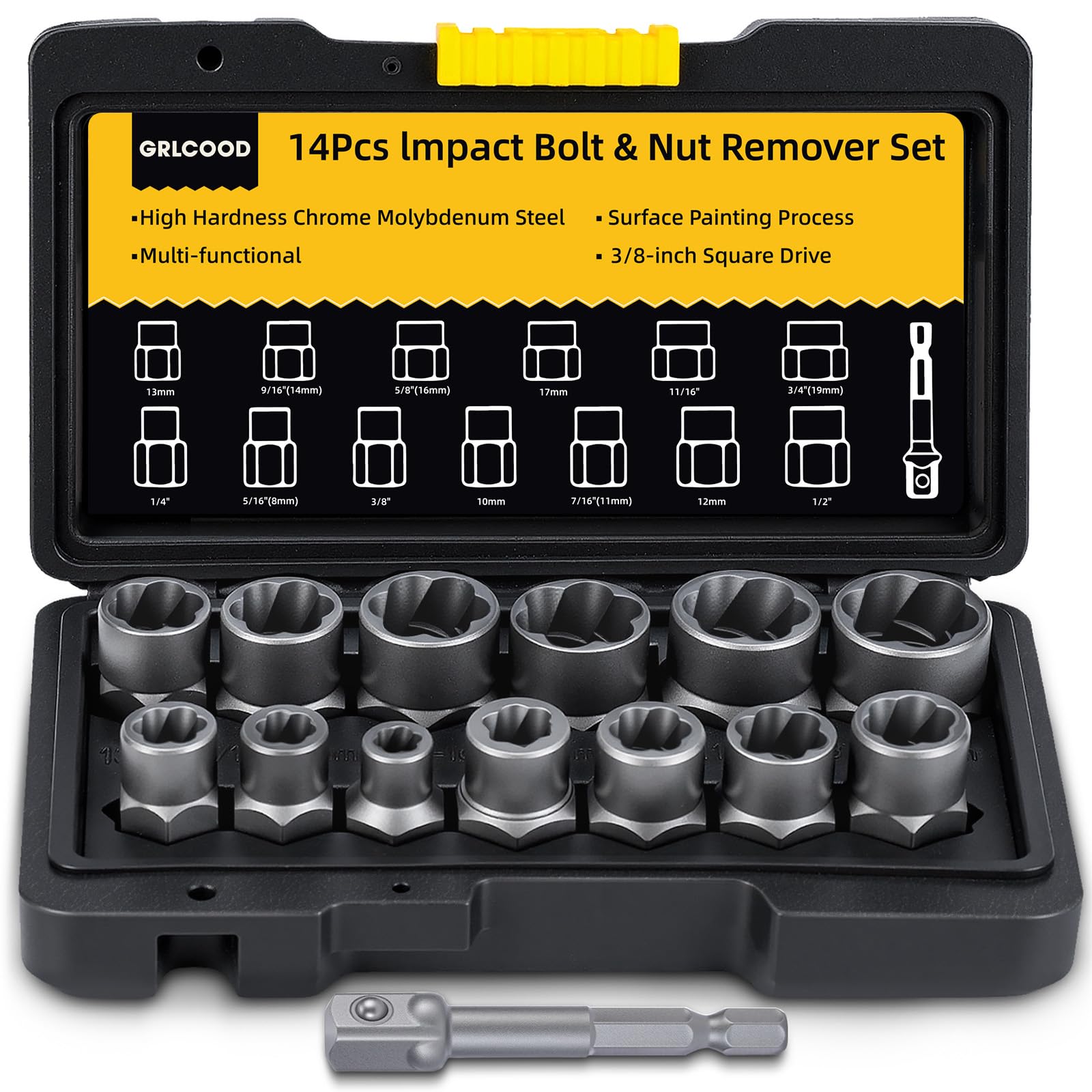
2. Bolt Extractor Kit, 14 PCS Impact Bolt & Nut Remover Set
An entry-level socket set that lets you test the extractor approach without committing much.
When a bolt head is rounded instead of slotted, a socket extractor (a socket that grips the outside of the head) slides over it and bites. This GRLCOOD set gives you 13 extractors plus a hex adapter in a palm-sized blow-molded case. At 1.57 pounds it is the lightest kit on this list — light enough to keep under a seat or toss into a toolbag. The internal left-hand spiral does the work: turn counter-clockwise and the flutes (the cutting ridges) dig in harder the more the fastener resists. The 3/8 inch adapter takes both hand tools and power tools, so it fits the ratchet you already own.
The steel is a high-hardness alloy with a sandblasted surface, and the makers say that finish is what extends life against wear. For light automotive jobs and home repairs — lug nuts, drain plugs, damaged studs — it covers the usual ground without fuss. Compare it to the VEVOR set further down and the weight difference is stark: 1.57 pounds here versus 3.1 pounds there, which is the trade you make for a kit that carries 14 pieces instead of 49.
Be realistic about the ceiling. The recurring gripe is grip on very tight, heavily seized bolts — this kit handles moderately stuck fasteners better than the truly rusted-solid ones. A few heavier users report an extractor breaking under load, so lean on steady pressure rather than brute force. If your bolts are usually seized hard, spend up; if you want a compact kit for the occasional rounded nut, this is the sensible entry.
The value read: 14 socket extractors and an adapter in a pocket-sized case, at the lowest rung of the price ladder — a low-risk way to find out how often you actually need this tool.
The honest ceiling: saved for moderate jobs; rust-welded bolts want a beefier set.
Reach for this if: you face the odd rounded nut and want a compact kit on hand.
Look elsewhere if: your fasteners are seized solid and need serious torque.
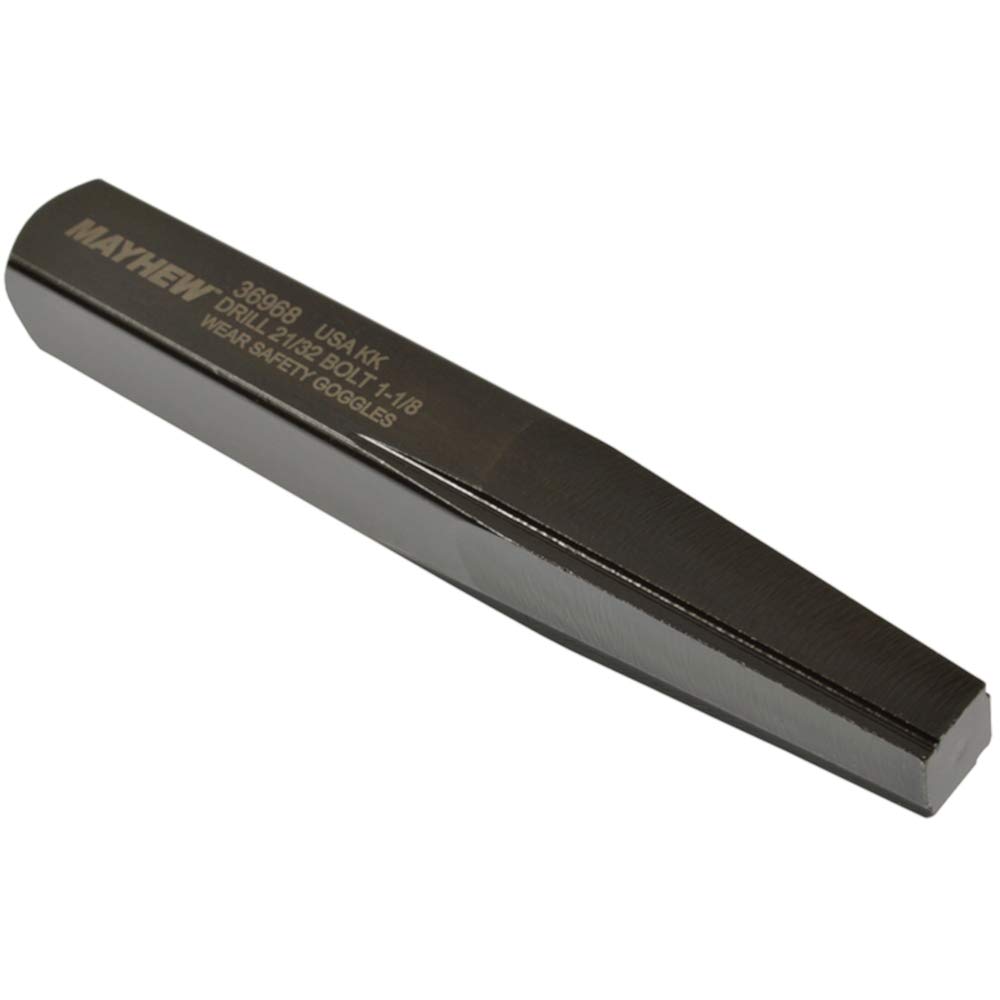
3. Mayhew Pro 36968 21/32-Inch S 1-1/8-Inch Screw Extractor
One single big extractor for large seized screws, built to cut its own bite.
This is not a kit — it is a single fluted extractor spanning 21/32 inch to 1-1/8 inch, aimed at broken or seized screws big enough to need real leverage. The fluted cutting edges are designed to cut down into the screw shaft as you turn, and the edge is hardened steel so it holds that bite. A black oxide finish adds rust protection, which matters for a tool that may sit in a drawer between jobs. It is made in the USA and weighs just 0.32 ounces in the hand.
Compare it to the multi-piece sets above and the difference is focus. The PZ-58 pliers grab the outside of a head; this Mayhew cuts into the body of a larger fastener that is already damaged. If your work is plumbing, machinery, or structural fasteners in that large range, a single well-made extractor that does its one job cleanly beats a 49-piece case of sizes you will never touch.
The trade-off is the obvious one: one size, one tool. It cannot touch anything outside 21/32 inch to 1-1/8 inch, so it is a specialist addition rather than a first purchase for a general toolbag. It is also hand-powered, so expect to put your shoulder into a stubborn screw.
The specialist angle: a single hardened fluted extractor for large broken screws, with rust protection already built into the finish.
Buy only if: your stripped fasteners run large and you want one solid tool instead of a case full.
Best matched to: machinery, plumbing, and structural work where the damaged screw is big.
Not the starter tool: general household stripping happens well below this size range.
4. GEARWRENCH 4 PC. Bolt Biter Screw Extraction Set – 84787
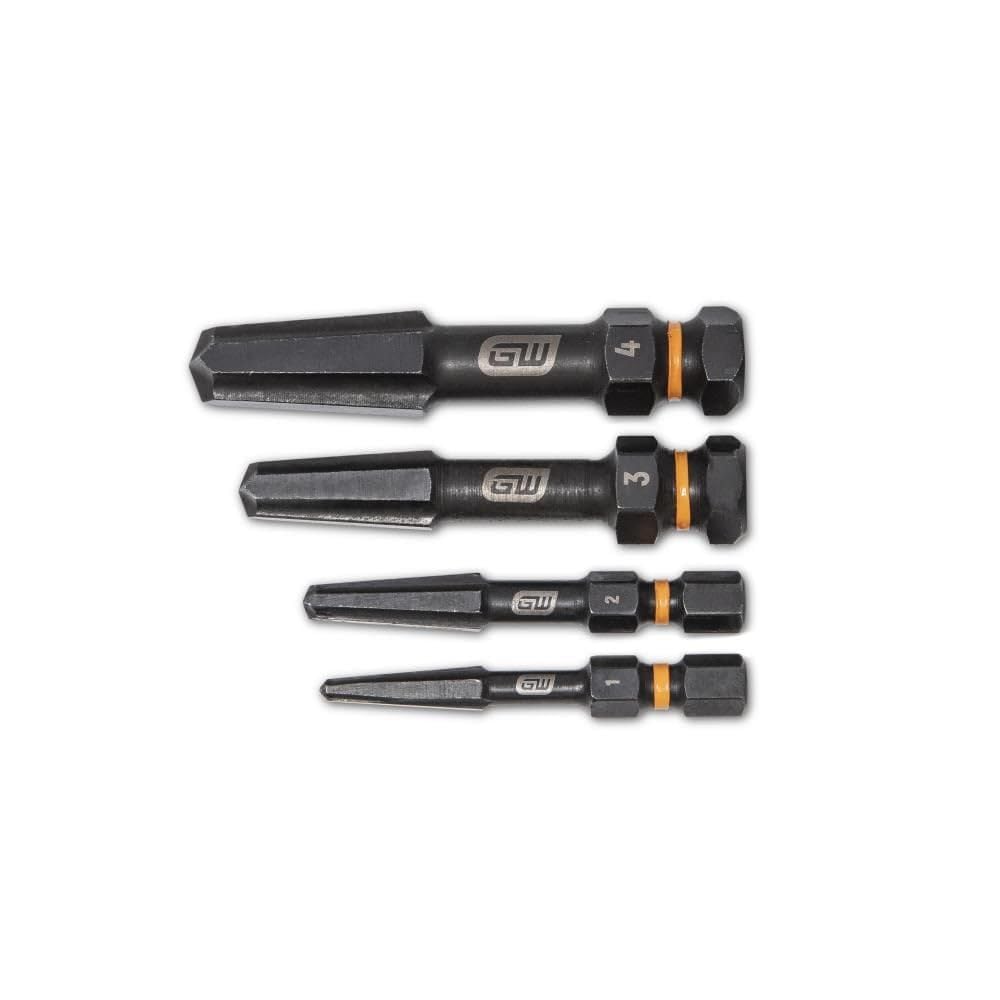
Four sockets that turn both ways, so they loosen a damaged nut and tighten a fresh one.
The Bolt Biter is a four-piece set with tapered side and tip cutting edges, designed so the bite stays consistent through the whole turn. Its real standout is the bi-directional design: unlike a standard left-hand extractor that only loosens, this one tightens or loosens damaged fasteners. If you strip a bolt, remove it, and need to seat a replacement without hunting for another socket, that saves real time. The hex base fits hand and power tools, and high-visibility laser markings make each size easy to pick out of the case in a dim garage.
Stack this against the GRLCOOD budget kit and the count tells the story: four pieces here against fourteen there, a 12.2x difference in piece count. What you give up in coverage you gain in per-piece build and the two-way function — four well-made sockets with a defined angle of attack versus a broad assortment.
The honest caveat, and it is worth weighing: quality and value opinions are genuinely split, and the tool’s toughness under hard torque is the recurring question — some find it strong, others report it giving way. Treat it as a precision set for moderate fasteners rather than a breaker-bar tool. Buyers wanting maximum coverage per dollar will likely prefer a larger kit.
What it changes: a two-way extractor socket means one tool handles both removal and reinstallation, which is rare in this category.
The fair question: with durability opinions split, keep it to normal torque ranges.
Pick this if: you want a small, bi-directional set that removes and reseats damaged fasteners.
Skip the upgrade for: heavy breaking torque — needs a stronger set than a 4-piece.
5. VEVOR Screw Extractor Set 49-Piece
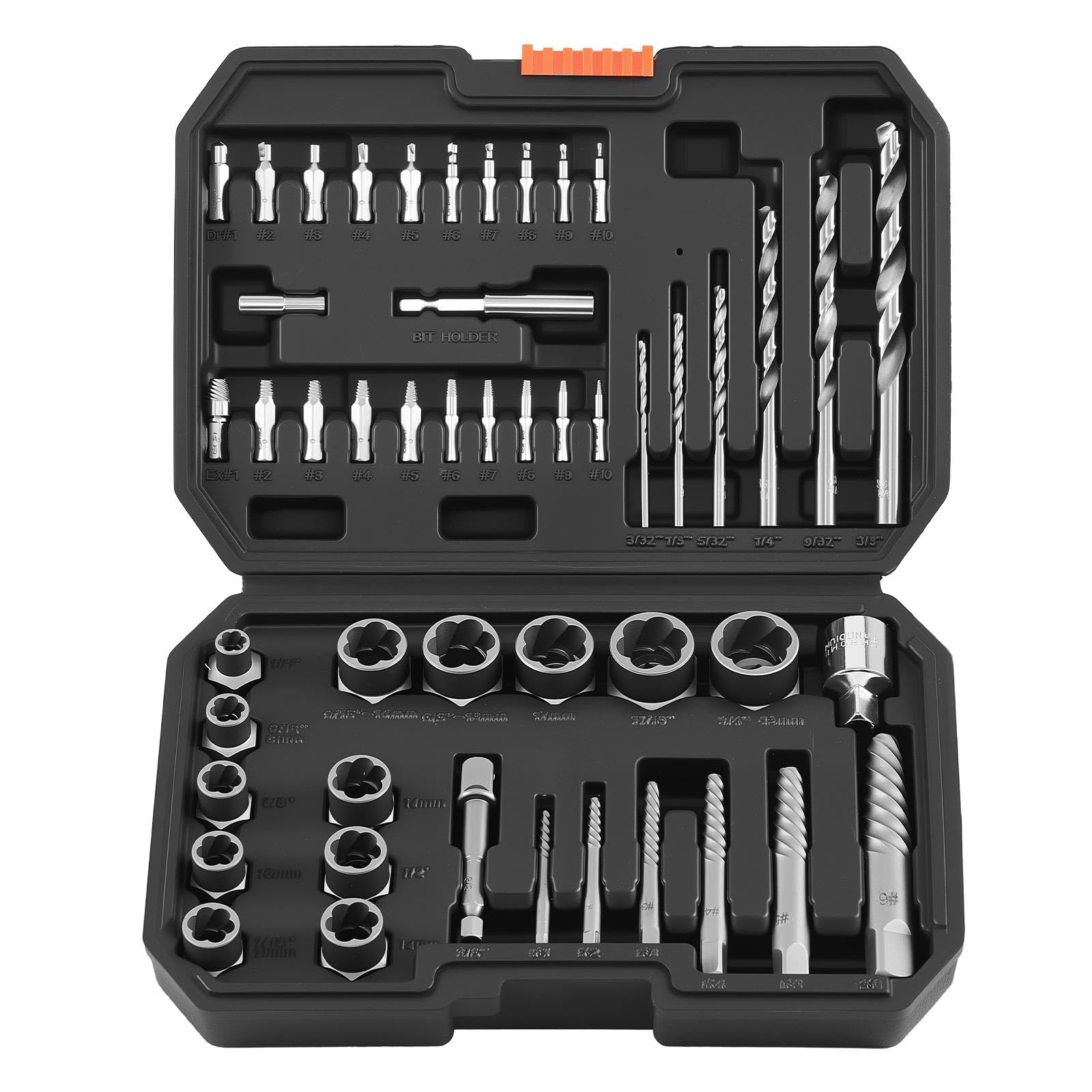
The one box that has a size for nearly every rounded or rusty fastener in the house.
Fifty pieces minus one is the number that matters here: 49 individual tools in one organized case. That breaks down into 13 nut extractors, 10 screw extractors, 6 spiral screw extractors, 10 small drill bits, 6 drill bits, and 4 adapters. With that mix you can drill a pilot hole into a snapped shaft and then use an extractor to back it out — the two-step job that a pliers-based tool simply cannot do. The steels are selected with controlled hardness to balance grip, strength, and durability under repeated torque, and laser-etched markings mean you can pick the right size fast in low light.
The functional edge shows in the field: the extractors are built to grab rounded, rusted, broken, or seized fasteners that standard sockets just spin on. It works with both hand tools and power tools, so you are not locked into a long ratchet handle for tight space. Compared to the budget GRLCOOD kit at 1.57 pounds, this one runs 3.1 pounds — heavier, but that weight is the case, the drill bits, and the adapters a bigger job demands.
What keeps it from a perfect score is a familiar one for extractor sets: the recurring complaint centers on threads giving way on a first hard use. It also is not the tool for a delicate, tiny electronics screw, because the smallest sizes here are still meant for fasteners with real mass. For the home mechanic who faces everything from a rounded oil-pan plug to a separated lawnmower bolt, the coverage justifies the shelf space.
Why The 49 Pieces Earn Their Case
- Drill bits and extractors in one set handle a snapped shaft, not just a rounded head
- 13 nut extractors, 10 screw extractors, and 6 spiral extractors cover most standard sizes
- Controlled hardness steel balances grip and durability under torque
- Laser-etched markings stay legible in low light
- Works with both hand and power tools
The Real Downgrades
- Some threads give way on a first hard use — treat as a normal-torque set
- Overkill for tiny electronics screws
- The 3.1 pound case is heavy for a compact bag
The broadest single buy: from rounded lug nuts to broken lawnmower bolts, one case handles it.
Steer clear if: your screws are micro-sized — the small end here is not built for electronics.
6. DUNDOO 27Pcs Screw Extractor Set
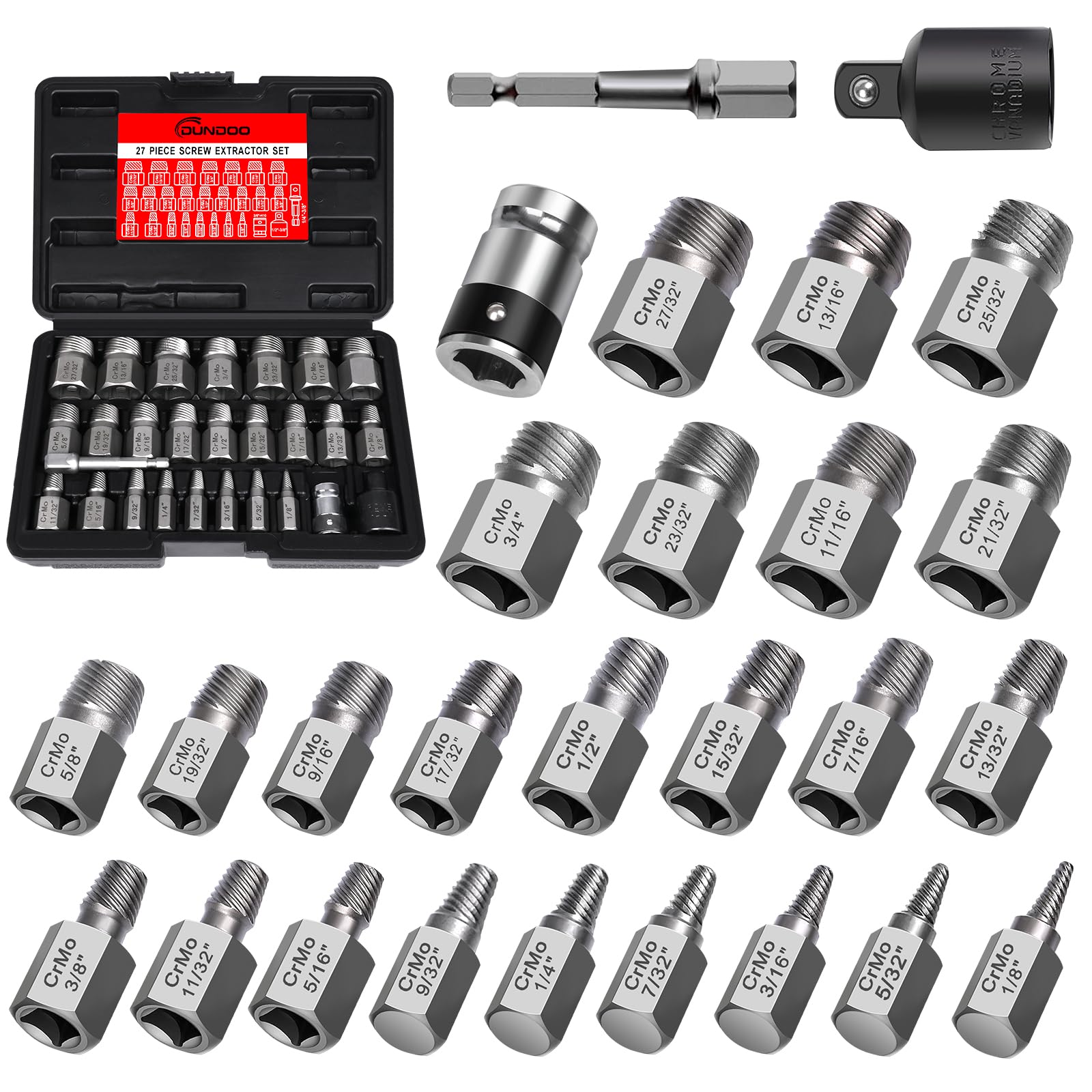
Twenty-seven hex-head sockets that connect straight to a wrench, no sleeve needed.
You get a faster setup on a damaged bolt thanks to the double-head hex. Unlike an extractor that needs a connecting sleeve before it fits a wrench, these hex heads plug straight onto your wrench or socket handle — one less link in the chain. The set runs 27 pieces from 1/8 inch up to 27/32 inch, and each size is engraved clearly on the socket so you can find it fast. The steel is heat-treated chromium molybdenum (a hard alloy steel), picked for hardness that resists damage.
The left-hand spiral inside each spline provides grip and, as the maker puts it, faster threading as you back the fastener out. The spiral pattern also builds more grip the more force you apply, which is the whole principle behind this style of extractor. It handles both power and hand tools, and the high-density spiral helps back out broken, frozen screws, bolts, nuts, studs, fittings, threaded pipes, and pins.
Durability is the catch — a notable share of buyers report units giving way immediately during use. Value opinions run mixed, too. So this set suits moderate torque on damaged bolts, not an unyielding, rust-welded fastener that fights back hard. If you need one-off recovery of a rounded nut on ordinary home gear, the 27 sizes and direct wrench fit earn it a spot. If you expect to fight rust-welded bolts, spend your money elsewhere.
The direct-fit advantage: hex heads that connect to a wrench without an adapter save setup time on a rounded bolt.
The fit mismatch: not a breaker-bar tool — the durability reports say keep it to moderate torque.
Worth grabbing if: you want a wide hex size range that snaps straight onto your wrench.
Move on if: every job involves heavily seized, high-torque bolts.
7. THINKWORK 39-Piece Screw Extractor Set

The set that stretches down to 2mm, where most extractor kits simply stop.
The number to fix on here is the range: 2mm to 21mm, delivered across 39 pieces. That is wider than the typical 6.35mm-to-19mm spread most sets offer, and the low end is what makes it useful on small, stubborn fasteners that larger tools cannot reach. The reverse spiral flute works the same way as its peers — left-hand bite into the damaged head. The kit uses chrome-molybdenum steel alongside HSS 6542 drill bits rated 68 HRC, which the maker sets against HSS 4341 as the tougher choice.
It ships with a knockout pin, drill adapter, extractor adapter, and bit holder for expanded use, plus laser-etched markings legible in low light and a heavy-duty blow-mold case that keeps the pieces sorted. Compared with the Mayhew single extractor above, this set trades that tool’s focused large size for a full spread of sizes, and adds drill bits for working into a snapped screw.
Now the part to weigh honestly. Durability feedback splits — some bits break during use — and effectiveness and value opinions divide, with a share of owners finding bits struggle to bite into hard screws. It is a broad-coverage kit for mixed jobs rather than a guarantee on every problem screw. For the buyer who wants one case to cover both a small electronics screw and a mid-size automotive bolt, that spread is the reason to pick it.
Where The Range Pays Off
- 2mm to 21mm coverage beats the common 6.35mm to 19mm spread
- 39 pieces including adapters and a knockout pin for two-step drilling
- HSS 6542 (68 HRC) drill bits with a reverse spiral for backing out
- Laser-etched markings and a blow-mold case keep sizes readable
The Caveats To Weigh
- Bits can break under use, and some struggle to bite hard screws
- Split views on value mean it is a broad set, not a guaranteed extractor
- Not the focused single-size strength of a dedicated extractor
For mixed-size jobs: a small electronics screw and a mid-size bolt in one case.
Consider the single: if you only ever face large screws, a dedicated extractor like the Mayhew above does one job better.
8. XEWEA 49PCS Screw & Bolt Extractor Set
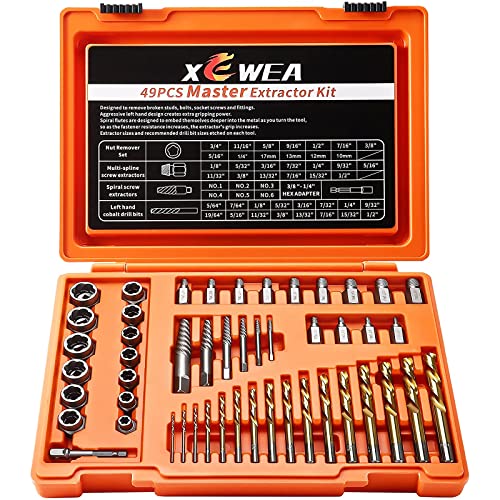
Forty-nine pieces built around sixteen left-hand cobalt bits that dig in the wrong way — on purpose.
You drill and pull the screw in one motion, because of the left-hand drill bit. Its reverse spiral groove (a groove that spirals the opposite way) is cut so the bit grabs and bites downward as it turns. The 49-piece box splits into 13 multi-spline screw extractors, 16 left-hand cobalt drill bits, 6 spiral screw extractors, and 13 bolt extractors. Sizes span 5/64 inch up to 1/2 inch for the drill bits and up to 3/4 inch for the extractors. The maker notes plainly that the cobalt bits should not be used on stainless steel — read that before you drill.
Against the GRLCOOD socket kit, the difference is the drill bits. Where the budget set is sockets and an adapter, this XEWEA box lets you drill into a snapped stud and back it out without grabbing a second drill. For car repair and home fixes, the 13 multi-size nut extractors up to 3/4 inch give generous coverage on lug nuts and larger fasteners.
The honest caution sits with the drill bits. Reports of bits snapping and some users finding the quality poor are common enough that you should treat the bits as the wear item in this set and use a low, steady drill speed. For a mixed shop that needs both extraction sockets and left-hand drilling, the count and variety are the draw; for precision work, go slow.
The two-tool trick: left-hand cobalt bits let you drill and extract in one motion, a step the socket-only budget set skips.
Watch the bits: durability is the soft spot, so keep drill speed low and never use the cobalt bits on stainless steel.
Suits: a shop that wants left-hand drilling plus socket extraction in a single kit.
Look past it if: you need production-grade drill bits that survive heavy continuous use.
9. toolant 46-Piece Impact Bolt Extractor Set

The heaviest-duty kit here, with bolt, screw, hand, and deep extractors all in one case.
For automotive work, the toolant set gives you four extractor families in one 46-piece kit: standard bolt extractors, multi-spline screw extractors, hand extractors numbered #1 through #6, and deep bolt extractors. There is also a diamond-tip Phillips bit set and both a 3/8 to 1/2 inch and a 3/8 inch hex adapter for power-tool use. The thread structure has been reworked with tune engagement geometry to hold damaged fasteners without slipping — a real concern when the head is already rounded. Cr-Mo steel construction and a phosphated, blackened finish resist corrosion, so the set survives a toolbox that sees oil, dirt, and moisture.
What buyers rave about is speed: the toolant extractors bite almost instantly and back a stuck automotive bolt out within roughly 30 seconds of setting up. Against the lighter socket kits above, the toolant is the one to reach for when the fastener is not just rounded but genuinely frozen. Its 7.24 pounds is the heaviest case on the list — that weight is the wide assortment and the deep sockets that chew through automotive bolts.
The grey area is durability on first hard use: some units break right away, and grip opinions split between performing as expected and slipping. So it is best on normal automotive seized bolts with steady pressure — not an excuse to hang a breaker bar off a rounded muffler nut and go swinging. The one-year manufacturer warranty is the safety net worth knowing about.
The speed claim: the whole point of this set is the moment of bite — stuck bolts come out almost immediately with the right socket seated.
Respect the torque: grip and durability opinions split, so ease into the turn rather than forcing it.
Built for: the home or pro mechanic who needs bolt, hand, and deep extractors in one heavy case.
Overkill if: your stripped screws are household-size — a compact set will cover those.
Know the Specs
Flute Design — Where the Grip Comes From
Flutes are the spiral grooves cut into an extractor’s sides. They bite into the damaged fastener as you turn counter-clockwise, and the harder the fastener resists, the deeper the flutes dig. Left-hand spiral is the standard for loosening; a bi-directional socket like the GEARWRENCH can turn either way to also tighten. More splines across a range mean more size options to fit your specific bolt.
Steel and Hardness — Why Cr-Mo and HRC
Chrome-molybdenum steel (Cr-Mo) is the alloy most quality sets use, because it resists twisting without shattering. High-carbon steel and tool steel appear in pliers and single extractors where edge hardness matters more than flex. The HRC number is a hardness rating — higher means a harder cutting edge. A very hard bit can be brittle, so check what the tool is designed for before putting heavy torque on it.
Size Range in mm and Inches
Extractors are sold by the sizes they cover. A set that starts at 2mm reaches small screws that a set starting at 1/8 inch might skip. Larger ends handle lug nuts and bolts. Match the low end to your smallest problem screw and the high end to your largest bolt, so you are not buying a case full of sizes irrelevant to your work.
Drill Bits vs Extractors — Two Steps
A snapped shaft with no head needs a hole before an extractor can bite. Left-hand drill bits are cut so that as they turn, the bit grabs and backs the screw out. Some sets bundle both bits and extractors; others sell extractors only. If you face snapped screws often, a combined set saves you hunting for a matching drill.
Common Questions
Will the ENGINEER PZ-58 damage the screw further?
What is the difference between an extractor socket and a spiral extractor?
Can I use left-hand drill bits on stainless steel?
How do I choose between a 27-piece and a 49-piece extractor set?
Why do extractors break during use?
Does a bi-directional extractor like the GEARWRENCH actually help?
What size extractor do I need for a car lug nut?
How long should an extractor last, and how do I keep it sharp?
Is a single large extractor like the Mayhew better than a kit?
What should I check before buying any extractor set?
The Bottom Line
If a chewed-up screw still sticks above the surface, buy the ENGINEER PZ-58. Its vertical and horizontal serrated jaws grab the head from the outside, so a ruined slot stops being the problem. It covers Ø3mm to Ø9.5mm, the everyday small-screw range. If your fasteners are rounded nuts and clipped bolts, reach for the VEVOR 49-piece set. Its 13 nut extractors, 10 screw extractors, and 6 spiral extractors plus drill bits cover the widest ground in one case. And for one big seized screw that has already snapped, the Mayhew Pro 36968 does that single job with a hardened fluted edge.
The one honest nudge: buy the extractor type that matches the screws you actually face rather than the biggest case on the shelf. A jaw tool for proud heads, a socket set for rounded nuts, and a fluted extractor for large broken screws each solve a different problem. Match the extractor type to the fastener, and the stripped screw stops being a project.
How we choose
We do not accept paid placement. Every pick is matched to a real buyer and a real use-case; we do not hands-on test units.
Sources
Specifications: manufacturer listings and product documentation. Review insights: verified customer reviews, as of November 2026. Pricing: not shown on this page (it changes often); check the current price via the retailer link.
As an Amazon Associate, Tactical Gear Guy earns from qualifying purchases. This does not affect which products we feature.