Specs are compiled from manufacturer listings and verified buyer reviews and can change over time — please confirm the key details on the product page before buying.
You want a real trail bike, not a heavy lump that fights you on every climb. Every pick here stays under $2000, and several cost far less. The nine picks below cover everything from a budget-friendly fat-tire starter to a full carbon-fiber XC build, and each one earns its place for a specific kind of rider. Each pick suits a specific rider, so match the frame size and wheel diameter to your height and terrain before ordering.
This guide is built by comparing the manufacturers’ published specifications and the patterns across verified customer reviews, so you get each pick’s real strengths and trade-offs instead of marketing spin.
A trail bike only works when the frame, gearing and rider height line up, so measure your inseam before you buy. This breakdown matches each bike to the rider it truly suits, which is the whole idea behind finding the Top Mountain Bikes Under $2000 that actually fit you.
Top Picks

How To Choose The Best Top Mountain Bikes Under $2000
Picking a mountain bike starts with your height, not the price tag. A bike that is too big or too small is uncomfortable on every ride and tricky to control on the trail. Once you have locked your height, the next questions are frame material, wheel size and how many gears you can put to real use.
Match rider height to frame and wheel size first
Every listing states a rider height range, and it matters more than any brand name. A 29-inch wheel rolls over rocks more easily but needs a taller frame to keep the standover height safe. A 27.5-inch wheel is more nimble on tight, twisty trails and suits shorter riders better. Write your height down, then read each spec line against it.
Understand the suspension fork before you climb
A suspension fork is the shock-absorbing front section that swallows bumps and roots. Lockable forks let you stiffen the front for climbing and road stretches, then loosen it for descents. If most of your riding is fire roads and gentle trails, a rigid fork with wide tires can feel surprisingly smooth and saves weight.
Gearing: speed count versus usable range
More speeds are not automatically better — they give you smaller steps between gears. A 7-speed drivetrain is simpler and easier to keep tuned, which matters when you are buying your first trail bike. A 12-speed or 21-speed setup spreads the gear range wider so you can spin up steep climbs and still carry momentum on flats.
Side-by-Side Comparison
| Model | Best For | Frame Material | Wheel Size | Speeds | Amazon |
|---|---|---|---|---|---|
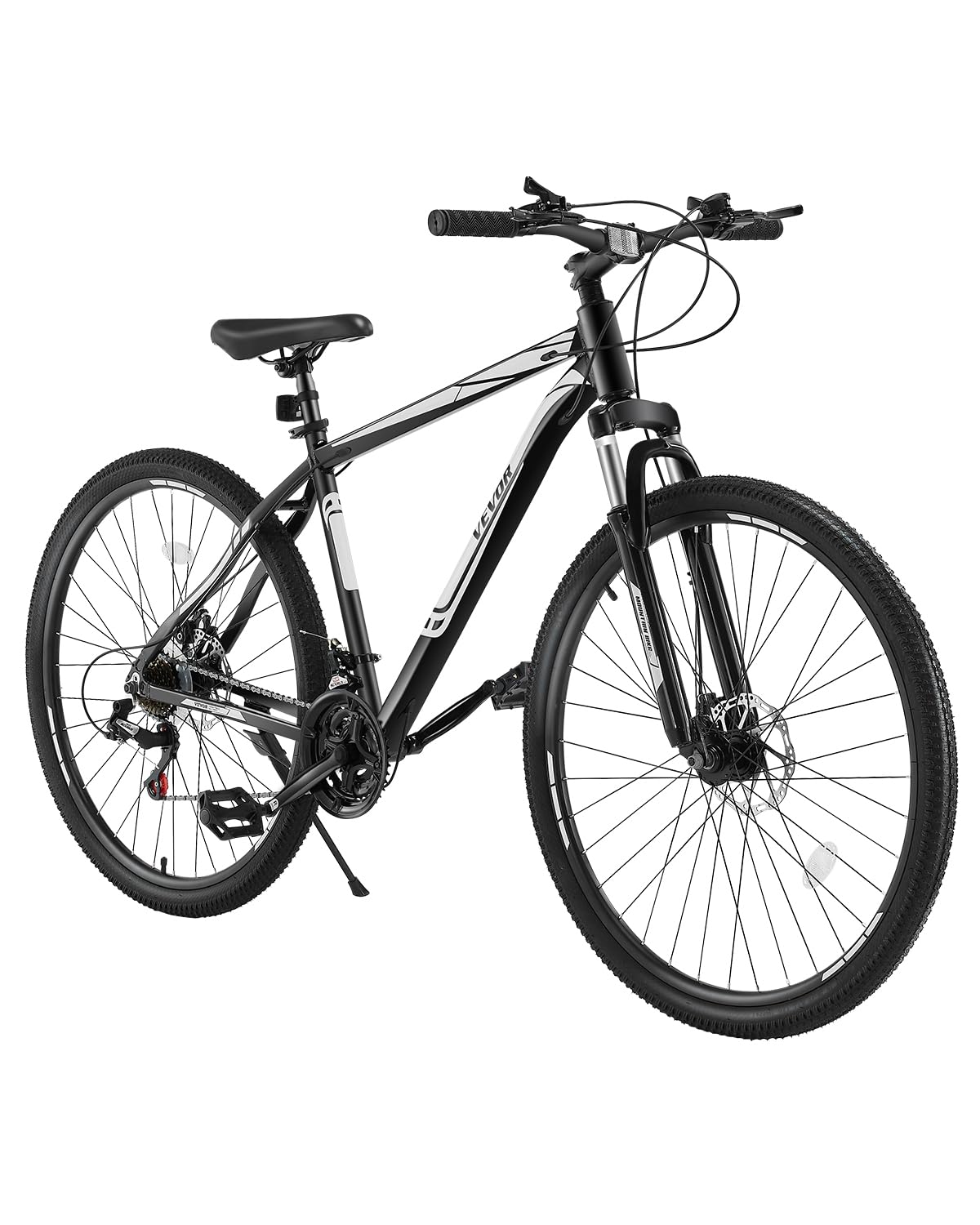
| VEVOR Mountain Bike 29 in★ Best Overall | Budget-friendly trail entry | Aluminum | 29 in | 21 | Amazon |
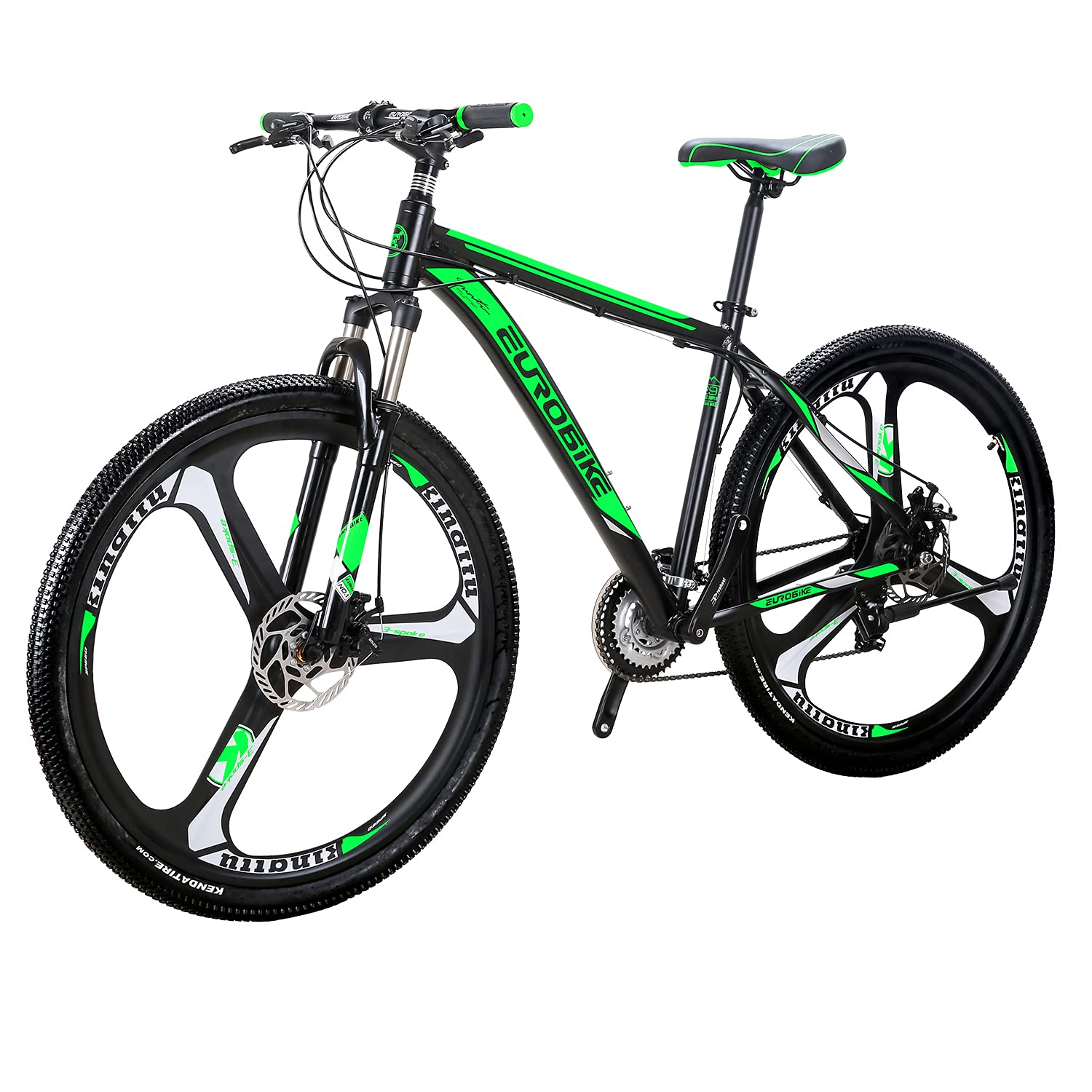
| EUROBIKE YH-X9Best Alloy Value | Taller riders wanting alloy lightness | 6061 Aluminum | 29 in | 21 | Amazon |
| Mongoose Argus TrailBest Fat Tire | Sand, snow and loose terrain | Alloy Steel | 26 in | 7 | Amazon |
| Schwinn High Timber | Shorter riders on neighborhood trails | Aluminum | 26 in | 21 | Amazon |
| Gravity FSX 29 LTD | Full-suspension trail comfort | Aluminum | 29 in | 21 | Amazon |
| Mongoose Impasse | Wide 2.6-inch tire grip | Aluminum | 27.5 in | 7 | Amazon |
| TRIFOX M2 Carbon | Lightweight XC performance | T800 Carbon Fiber | 29 in | 12 | Amazon |
Detailed Reviews
1. VEVOR Mountain Bike
An aluminum 29er with 21 gears that keeps the entry price honest and the ride smooth.
The frame is the first thing to know here: an aluminum alloy build that VEVOR pairs with a shock-absorbing front fork. That fork is the front suspension section that soaks up rocks and roots, so rough gravel does not rattle straight up your arms. It is sized for adults 5’10” and taller, so measure your height before you commit — a 29-inch wheel needs a taller standover to stay safe and comfortable.
You get 21 speeds through a Shimano twist-grip shifter, where you rotate the grip to change gear rather than click a lever. That is the friendlier setup for newer riders, and it gives you a wide range for climbing fire roads and spinning out on flats. Stopping power comes from front and rear disc brakes, which stay consistent in wet or dusty conditions. The extra-wide double-layer alloy rims add lateral stiffness, so the wheels hold their shape when you push through a rocky section.
Two practical touches stand out. The saddle uses thick foam padding to spread pressure over longer rides, and 85% of the bike arrives pre-assembled with basic tools in the box. You fit the remaining parts by following the instructions, and the ride is ready soon after. The honest catch is that fitting is on you — if you are not comfortable adjusting a front wheel and handlebar, budget for a shop to finish the build.
Where the VEVOR earns its keep
- 29-inch wheels roll over obstacles with less fuss than a smaller wheel
- 21-speed Shimano twist shifting suits riders new to geared trail bikes
- Dual disc brakes bring consistent stopping in wet or dusty conditions
- 85% pre-assembled with tools included, so setup is genuinely quick
What to weigh before buying
- Sized for riders 5’10” and up, so shorter buyers should look elsewhere
- Final assembly and tuning is still your job
- Twist shifters are simple but less precise than trigger setups
Reach for this if: you are a taller rider wanting a full-size 29er with proper gearing without stretching the budget.
Think twice if: you stand under 5’10”, because the frame sizing will leave you reaching.
2. EUROBIKE YH-X9 Mountain Bike
A 19-inch 6061 aluminum frame that sheds weight and handles 5’8″ to 6’2″ riders comfortably.
The 19-inch frame is the headline number, and it is a real step up in capacity over the Schwinn High Timber’s 16.5-inch frame. That extra frame size suits taller bodies better and gives the cockpit more room. The 6061 aluminum build is much lighter than a steel frame, which you notice the moment you lift it onto a rack or pedal up a long climb.
Wheel size runs to 29 inches, and it is larger than the Mongoose Argus Trail’s 26-inch wheels. A bigger wheel carries momentum over bumps and rolls more smoothly across rutted ground. The distinctive three-spoke mag wheel design is also a talking point — the wheels look sharp and clean up easily, and the green colorway stands out on the trail.
The bike ships 85% assembled, and the manufacturer lists a recommended height of 5’8″ to 6’2″, with a minimum user height of 58 inches. You install the front wheel, pedals, handlebar and seat, then pump the tires. Mechanical disc brakes front and rear give crisp, predictable stopping on descents, and the 21-speed shifter gives you a wide spread for varied terrain. The trade-off to know: the mag wheels are striking but heavier than a traditional spoked wheel, and the minimum height means shorter riders will not fit it well.
Rider fit in plain numbers: it targets 5’8″ to 6’2″ with a 58-inch minimum height, which puts it squarely in true adult sizing rather than a one-size compromise.
The wheel question: go with the mag wheels if you love the look and want low-maintenance cleaning, but expect more rotating weight than a spoked setup.
Suits you best when: you are a taller adult who wants a light aluminum frame and a 29-inch roll without paying carbon money.
Skip past if: you stand close to 5’8″ or below, since the 58-inch minimum height puts you right at the edge.
3. Mongoose Argus Trail or ST Fat Tire Mountain Bike
Four-inch-wide knobby tires that turn loose sand and deep snow into rideable ground.
If your trails turn to mush, sand or slush, this is the bike that keeps going. The 4-inch-wide knobby fat tires deliver grip where a standard tire slides out, so you stay in control on loose sand, deep snow, gravel and sketchy trails. Wheels are 26 inches and sized for riders from 5’7″ to 6’1″ tall. The steel hardtail frame and rigid fork are built to take a beating, and paired with those fat tires they keep the wheels feeling planted.
Owners consistently praise how the fat tires float over sand and snow where standard tires bog down. Value is close behind, with plenty of owners saying they would buy it again. Assembly earns praise too, and the copper paint draws its own compliments. The bike rolls on a 7-speed Shimano twist-shifter setup with a rear derailleur, which keeps gear changes simple and easy to maintain.
The recurring fit note is the gearing and adjustability. Some owners find the shifting does not land perfectly and needs adjustment from the start, and a few find the seat hard on long rides. That is a tuning and comfort question, not a reason to walk away — plan a quick derailleur tweak after assembly and budget for a saddle swap if you ride long distances.
Why fat-tire fans keep coming back
- Ride quality is the standout — loose sand, snow and gravel stop being obstacles
- Steel hardtail frame and rigid fork hold up to rough use
- Simple 7-speed drivetrain is easy to live with and maintain
- Copper finish and knobby profile give it real presence
Gear and comfort notes
- Shifting sometimes needs adjustment from the start
- Seat divides opinion on longer rides
- Fat tires add rolling weight for paved climbing
This is your bike if: your riding involves sand, snow or gravel and you want a fun, sturdy machine to take it on.
Look elsewhere if: you want fast pavement miles, since fat tires trade speed for traction.
4. Schwinn High Timber Mountain Bike

A compact 16.5-inch aluminum frame that fits 5’3″ to 5’8″ riders on neighborhood trails.
Height is the reason to pick the High Timber. Its 16.5-inch aluminum frame is smaller than the EUROBIKE’s 19-inch frame, and it is built for 26-inch wheels that fit riders from 5’3″ to 5’8″ tall. If most adult bikes leave you stretching, this is the sizing that meets you where you are. The alloy crank gives smooth gear changes and needs little maintenance, and the quick-release seat post means you can adjust saddle height without tools.
Twist shifters with a rear derailleur make gear changes quick, and the wide knobby tires are paired with lightweight alloy wheels for balance on mixed ground. The bike arrives 80% assembled, which means the front wheel, seat and handlebar are on you, plus a handful of common tools. Front suspension smooths out curb edges and trail chatter, and the dual disc brakes give you confident stopping.
The honest picture is a mixed one on build and value. Some riders find it great for the money while others find the gear shifters and fittings lighter than they expected, and assembly guidance divides people too. On the balance of things, treat this as a dependable neighborhood-and-flat-trail bike and check each fitting after the first ride, rather than a hardcore downhill machine.
Sizing is the selling point: a 16.5-inch frame for 5’3″ to 5’8″ riders fills a real gap that many adult bikes ignore.
Set expectations realistically: it is a solid flat-trail and neighborhood bike, so go in expecting that class of components and you will be pleased.
Made for you if: you are a shorter adult or teen who needs 26-inch wheels and a frame that actually fits.
Wrong tool for: aggressive downhill riding, where the lighter fittings will feel out of their depth.
5. Mongoose Montana

Front and rear suspension plus a lockout fork make rough descents feel far less punishing.
Dual suspension is the reason this bike exists. The rear shock and lockout front fork absorb bumps from both ends, which is a different feel from the hardtail single-suspension bikes most of this list. You can stiffen the fork for climbing and smooth stretches, then let it work on the way down. The 29-inch wheels and aluminum frame complete a package tuned for full-suspension handling.
Shifting runs through a 21-speed drivetrain with front and rear derailleurs and trigger shifters, so you have a wide gear spread. Powerful disc brakes handle stopping. The minimum user height is a full 73 inches — taller than the EUROBIKE’s 58-inch minimum — so this bike is built for tall riders and demands a height check before ordering.
The thing to weigh honestly is trail versatility. The handling draws mixed feelings — some find it nimble and easy to steer over small obstacles, while others say it struggles on small roadway hills and is not suited to true off-road use. Treat the FSX as a comfort bike for rough paths and descents, and you will get the ride the suspension promises. The Mat Ti Gray finish earns its share of compliments too.
Where the suspension shines: front and rear shocks plus a lockout fork give you real soak-up on choppy ground, which hardtails cannot match.
Where it stays honest: handling is mixed for aggressive off-road use, so it is best on rough paths and rolling descents rather than steep technical terrain.
Right call for: tall riders who want full suspension comfort on rough paths and downhill stretches.
Not the one if: you ride steep technical singletrack, where the handling reports fall short.
6. Mongoose Impasse

2.6-inch knobby tires and 27.5-inch wheels for riders who want extra grip on varied trails.
The tire width is the draw here. Those 2.6-inch-wide knobby mountain tires give extra grip and stability on loose, uneven terrain, and the suspension fork absorbs the bumps beneath them. Wheels are 27.5 inches and sized for riders from 5’3″ to 6’0″ tall. The aluminum hardtail frame keeps it light enough to handle varied conditions without wearing you out.
Drivetrain spec is a 1×7 setup — a single front chainring with a 7-speed rear, using an L-Twoo 1×7 drivetrain with a 14-38 freewheel and a 30-tooth narrow/wide chainring. That narrow/wide gearing is designed to hold the chain steady on rough ground. Trigger shifters make the change quick, and mechanical disc brakes bring the stopping. A kickstand is included.
Where it needs care is the setup and the brakes. Owners like the suspension, but the brake feel and derailleur tuning are recurring trouble spots — the rear derailleur can slip out of gear and the brakes sometimes arrive loose. Plan a careful post-assembly tune or have a shop check it over. Budget a derailleur and brake check after assembly, and the 2.6-inch tire grip still justifies the price.
Best for: riders who put a premium on wide tire grip and want a light aluminum hardtail for mixed trails.
Consider alternatives if: you would rather not spend time tuning a drivetrain and brakes after assembly.
7. TRIFOX M2 Carbon Fiber Mountain Bike
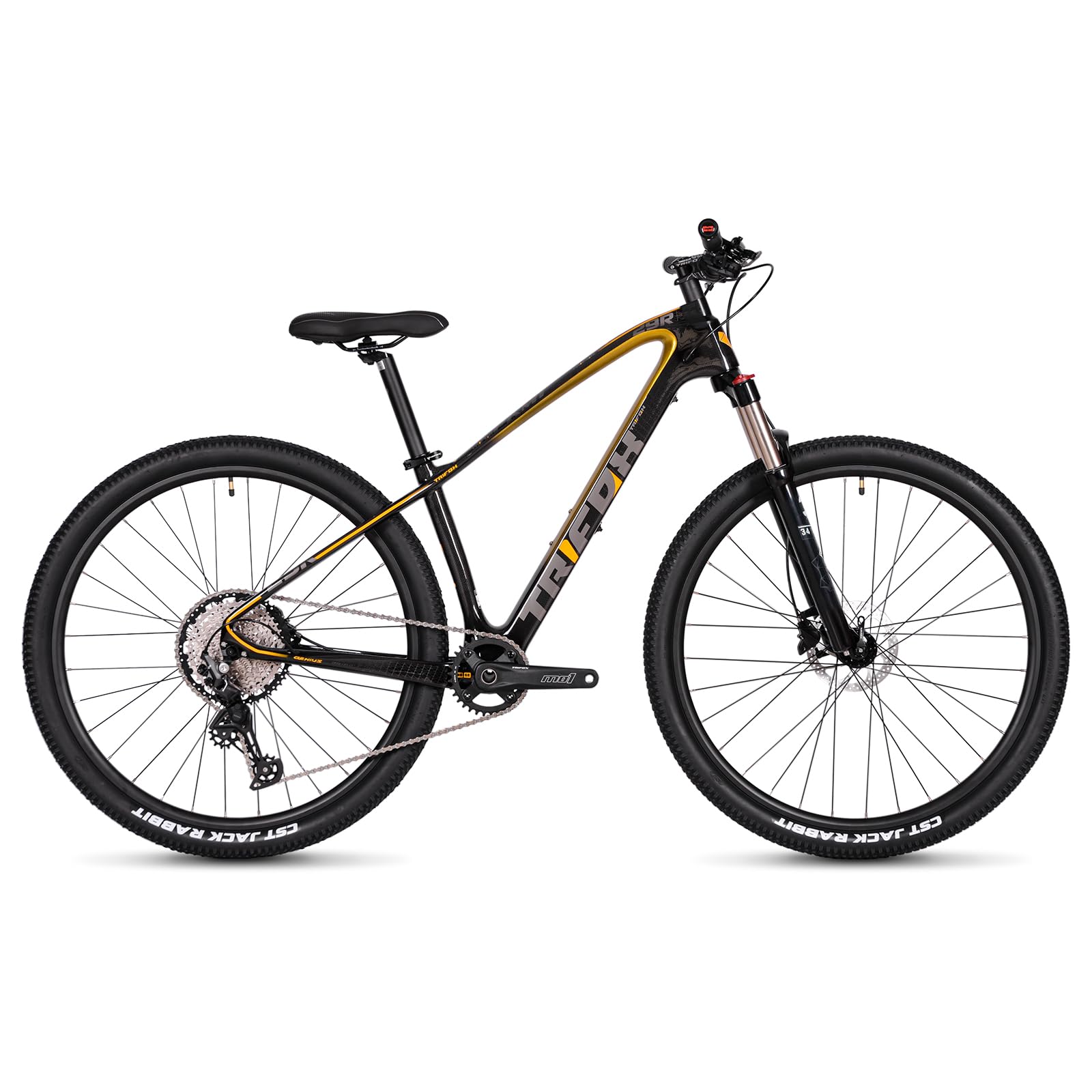
A T800 carbon frame and 12-speed Deore kit that drop total weight to 26 lbs.
The headline number is 26 lbs — a full carbon-fiber package that is dramatically lighter than the steel and aluminum bikes on this list, and you feel that difference on every climb. The T800 carbon frame uses a tapered head tube to stiffen the front end for sharper steering, and fully internal cable routing keeps airflow clean over the whole bike. A T800 carbon frame with a tapered head tube and full internal routing is rare at this price.
You get 130mm of travel (how far the suspension compresses) to soak up bumps, and the fork locks out so you can switch the suspension off on smooth ground. A full Shimano M6100 Deore 12-speed groupset (the gears and shifter set) handles shifting, so gear changes stay precise and confident. Shimano PR-MT200 hydraulic oil disc brakes (brakes that push fluid to the pads) give strong emergency stopping in all weather. The 29 x 2.1-inch mountain tires add traction and stability across terrain, so loose dirt and roots feel steadier under you.
Assembly is minimal: the bike arrives 85% assembled with tools and can be finished and checked against a video in roughly 20 minutes. The catch is the track record — a very small owner base means less field feedback than the established picks have built, so the spec sheet is doing a lot of the convincing. It sizes in 15.5, 17 and 19 inches, so confirm your frame before ordering.
What the carbon build delivers
- 26 lbs total makes climbing and lifting noticeably easier
- Full Shimano M6100 Deore 12-speed drivetrain for precise shifting
- 130mm lockable hydraulic fork lets you tune to the terrain
- Hydraulic oil disc brakes give strong all-weather stopping
What to keep in mind
- Small owner base means less real-world feedback so far
- Carbon frames need careful handling on hard impacts
- Sizes run 15.5, 17 and 19 inches, so fit needs checking first
Made for the performance buyer: a rider who wants carbon lightness, Deore gearing and hydraulic brakes on a serious 29er.
The real caveat: the owner record is thin, so lean on the detailed spec sheet and a careful frame fit before committing.
Know the Specs
Frame Material and Weight
Aluminum, steel and carbon fiber each change the ride. Aluminum is light, stiff and affordable; steel soaks up trail chatter but adds weight; carbon fiber is the lightest of the three — the TRIFOX M2 comes in at 26 lbs total. Lighter frames climb and lift more easily, but carbon still needs careful handling on hard impacts.
Suspension Travel and Lockout
Travel is how far a fork compresses to absorb bumps — the TRIFOX fork offers 130mm. More travel means a cushier ride on rough ground. A lockout lets you stiffen the fork for climbing so you do not lose energy to bobbing. Full dual-suspension bikes like the Gravity FSX add a rear shock for extra bump absorption.
Speed Count and Drivetrain
Speeds describe how many gear combinations your drivetrain offers. A 7-speed setup is simple and easy to keep tuned. A 12-speed Deore group or a 21-speed setup spreads the gear range wider so you can climb and still carry speed on flats. More speeds mean smaller steps between gears, not automatically easier riding.
Brakes and Tire Width
Mechanical disc brakes use a cable to squeeze the pads against a rotor; hydraulic disc brakes use fluid for stronger, smoother stopping. Wider tires — like the 4-inch fat tires on the Mongoose Argus or the 2.6-inch tires on the Impasse — add grip on loose ground but also roll heavier on hard surfaces. Match tire width to the terrain you actually ride.
Common Questions
What height rider fits a 29-inch mountain bike?
Is a 21-speed bike better than a 7-speed for trail riding?
Do fat tires make a mountain bike slower on pavement?
What does suspension travel mean on a mountain bike fork?
Are mechanical disc brakes good enough for trail riding?
How much assembly does a mountain bike need from the start?
Should I choose an aluminum or carbon fiber frame?
What is a lockout fork used for?
Can I adjust the seat height easily between riders?
Why do some mountain bikes need a drivetrain tune right after assembly?
The Bottom Line
Your best buy in the top mountain bikes under $2000 is the VEVOR 29 in MTB. It gives you a light aluminum frame, 21 speeds and dual disc brakes in one complete 29er (a bike with 29-inch wheels) that fits tall riders. The modest price also leaves room for a tune-up or a saddle upgrade. Want carbon lightness and premium parts instead? The TRIFOX M2 Carbon brings a 26 lb build with full Shimano Deore 12-speed and hydraulic brakes. For sand, snow and loose ground, reach for the Mongoose Argus Trail and its 4-inch fat tires. Check your height against each frame’s listed range before you buy — a 16.5-inch frame and a 19-inch frame fit very different riders.
How we choose
We do not accept paid placement. Every pick is matched to a real buyer and a real use-case; we do not hands-on test units.
Sources
Specifications: manufacturer listings and product documentation. Review insights: verified customer reviews, as of November 2026. Pricing: not shown on this page (it changes often); check the current price via the retailer link.
As an Amazon Associate, Tactical Gear Guy earns from qualifying purchases. This does not affect which products we feature.