Specs are compiled from manufacturer listings and verified buyer reviews and can change over time — please confirm the key details on the product page before buying.
If you only buy one set of weighted balls, buy a set that steps up in small weight jumps and has real seams you can grip — that combination is what lets you build arm strength without wrecking your throwing motion. Everything else (shell material, carry bag, instruction sheet) is a bonus. The nine sets below cover every training style, from a six-ball beginner pack to a full velocity program.
This guide is built by comparing the manufacturers’ published specifications and the patterns across verified customer reviews, so you get each pick’s real strengths and trade-offs instead of marketing spin.
You will see which weight ranges suit youth arms, which shells survive daily cage work, and where a soft inflatable shell beats hard rubber. Every pick here is a real training tool, so the job is matching one to your throwing program — not talking you out of any of them. These are the sets worth building a throwing routine around when you shop for weighted balls for baseball.
Top Picks

How To Choose The Best Weighted Balls for Baseball
Weighted balls work on one principle: a heavier ball forces your arm and shoulder to work harder through the same throwing motion. Get the weight ladder right and your arm adapts. Get it wrong — too heavy, too soon — and you are asking for a sore elbow. So the first thing you check is not the ball’s shell or its bag. It is the weight spread inside the set.
Start with the weight range, not the ball count
A set that runs from 3.5 oz up to 32 oz gives you a full ladder — light balls for warm-ups and long toss, heavy balls for short-toss strength work. A set that only covers 16, 18 and 20 oz is a strength-only tool. That is fine for an experienced hitter who wants overload work, but it leaves a young pitcher with nowhere to start. Match the lightest ball in the set to the thrower’s age and arm history, then climb.
Seams and surface texture decide your grip
You are throwing these hundreds of times, often with sweaty hands. Raised seams and a textured finish are what stop the ball from slipping out of your release. Smooth plastic balls can work for batting drills and cage work. For pitching mechanics, seams that mimic a regulation baseball give you a repeatable grip, which is the whole point of throwing a weighted ball in the first place.
Shell material sets where you can train
A soft inflatable shell or rubber casing can be thrown indoors against a net or a padded wall. A hard PVC ball is best kept on the field or in a cage. If you plan to work in a garage or a gym, lean toward the softer shells — they are the ones that bounce instead of ricochet.
Know what the carry bag and program add
A carry bag keeps six loose balls from rolling under your car seat, which matters more than it sounds when you train three times a week. A printed or QR-linked throwing program is worth more than the bag, because a structured progression is what keeps you from overloading your arm on day one.
Side-by-Side Comparison
| Model | Best For | Weight Range | Ball Count | Shell Material | Amazon |
|---|---|---|---|---|---|
| GoSports Plyometric Training Balls, 6 Pack★ Best Overall | Beginner-to-intermediate all-around set | 100g–450g | 6 | Heavy duty rubber shell | Amazon |
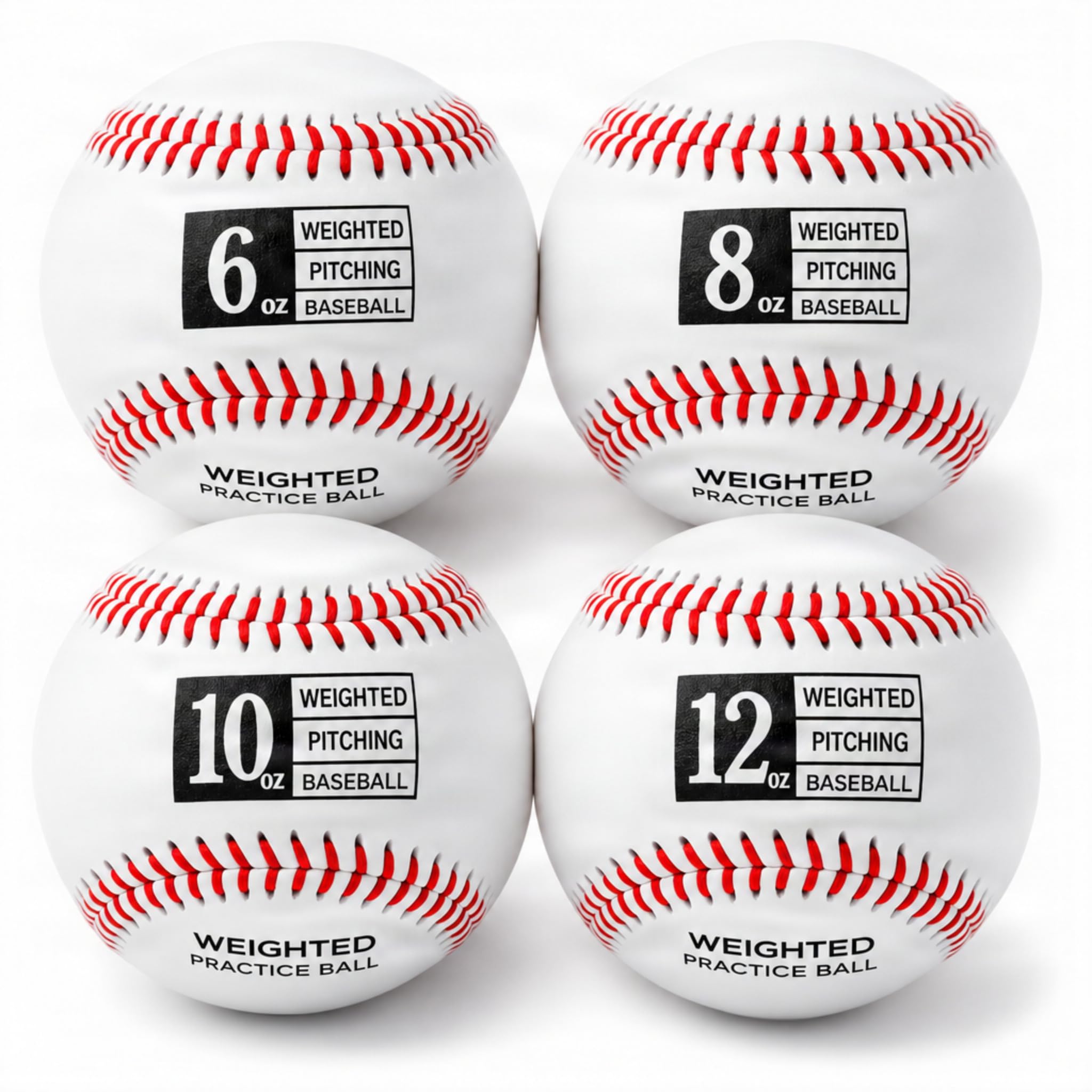
| Thorza Weighted BaseballsRegulation Feel | Pitchers who want a regulation feel | 6–12 oz | 4 | Leather with red double stitching | Amazon |
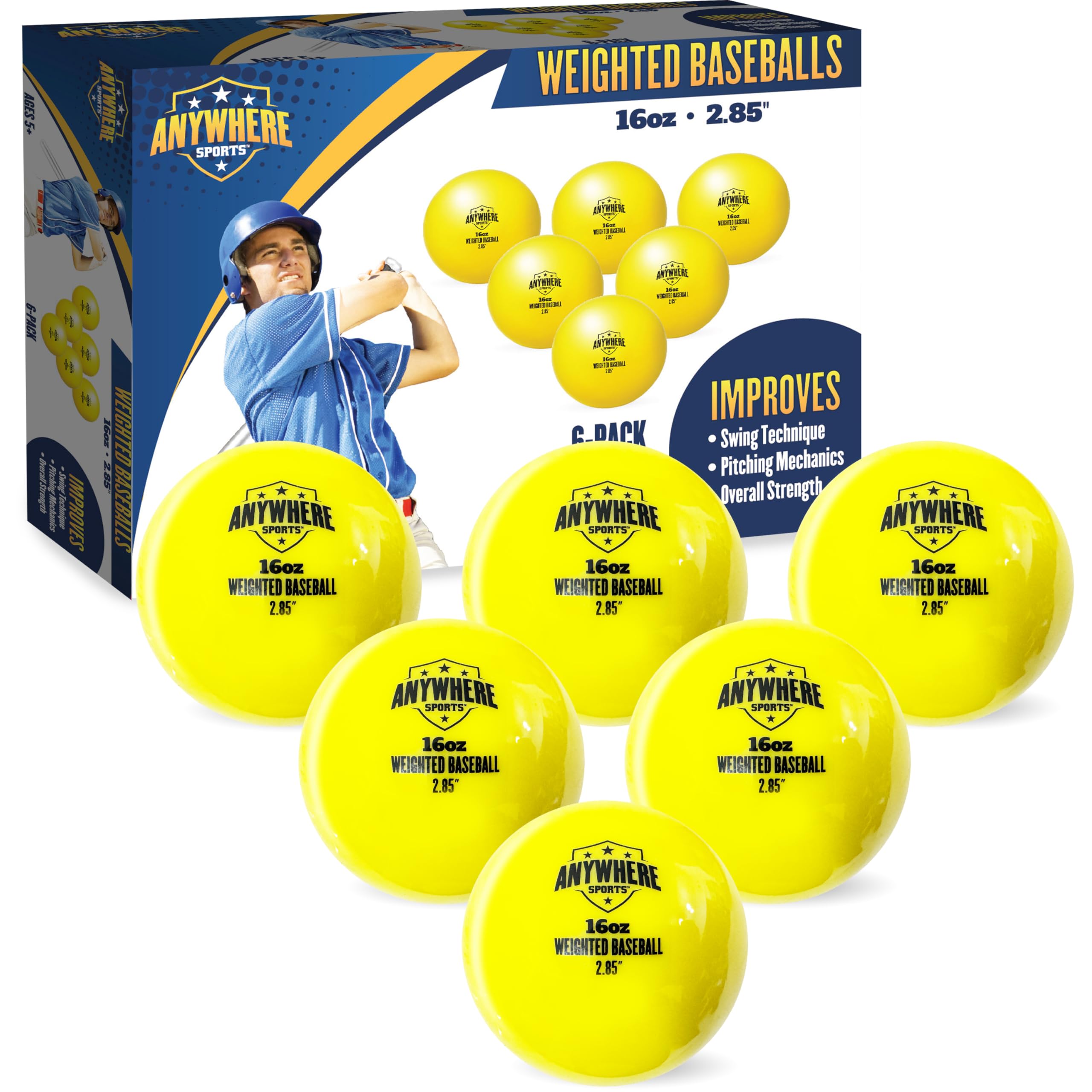
| Anywhere Sports 16 oz Training BaseballsTee-Work Favorite | Hitting and tee work | 16 oz (single weight) | 6 | Rubber | Amazon |
| PodiuMax Weighted Baseballs, 6-Pack | Progressive strength training | 3.5–32 oz | 6 | PVC | Amazon |
| SHOP PLAY 9 Plyometric Baseballs | Indoor and outdoor throwing | 3.5 oz–2 lb | 6 | Rubber, hand-stitched | Amazon |
| QUICKPLAY Weighted Pitching Baseballs | Pitching mechanics and velocity | 6–12 oz | 4 | Leather cover, weighted core | Amazon |
| Set of 6 Weighted Balls with Seams | Structured throwing programs | 3.5–32 oz | 6 | Inflatable soft shell | Amazon |
| PowerNet 3.2″ 9 Pack Weighted Training Balls | High-volume batting and throwing | 16, 18, 20 oz | 9 | Pliable plastic | Amazon |
| Marv Balls Velo Set | Serious velocity development | 3.5 oz–2 lb | 6 | Inflatable soft shell plastic | Amazon |
Detailed Reviews
1. GoSports Plyometric Training Balls 6 Pack
Our pick — 4.5+★ from 600+ verified ratings; the strongest balance of quality and price.
The do-it-all starter set that gets a whole throwing ladder into one bag.
Six balls spanning 100g, 150g, 200g, 250g, 350g and 450g give you a full range in one purchase. In plain terms, you get a light ball for warm-up throws and a 450g ball for short-toss strength work, with four steps in between. That spread is what makes it the pick for a household with more than one player, or a player still finding their working weights.
The shell is a soft-but-durable rubber casing, which means you can throw it at a net in a garage without worrying much about what it hits. Every ball in the set measures 2.8 inches across — GoSports lists this at 2.8 inches, noticeably more compact than the 4-inch PodiuMax balls — so the grip stays close to a real baseball in your hand. Store the six in the included tote bag and they stay together between sessions.
The thing that wins people over is the overall build quality, and the versatility gets close behind — it handles baseball and softball workouts without feeling like a compromise for either. Where the set asks for a little care is on the weights: a few players want the heavy end to climb higher than 450g. If you are an experienced thrower hunting max-resistance overload, the PodiuMax or Marv sets go further up the ladder. For everyone from a first-year player to a high school arm working on mechanics, this is the straightforward buy.
What earns it the top spot
- Six distinct weights from 100g to 450g cover warm-up through strength work.
- Soft rubber shell tolerates cage, gym and backyard sessions.
- Tote bag keeps the whole ladder organized in one place.
- 2.8-inch diameter keeps the grip feeling like a real baseball.
Where it tops out
- The heaviest ball is 450g, so max-overload throwers need a bigger set.
- Six loose balls mean you will want the bag every session.
GoSports, without hesitation: the best first weighted-ball purchase for a single player or a whole family sharing one bag.
But know this: if your program calls for 21 oz or 32 oz resistance, this set stops short.
2. Thorza Weighted Baseballs for Pitching & Throwing Training
Leather and double red stitching — the set that feels closest to a game ball.
Four balls running 6, 8, 10 and 12 oz make this the simplest velocity ladder on the list. It mirrors the QUICKPLAY weight spread exactly, but where QUICKPLAY uses a synthetic cover, Thorza builds the ball from leather with red double stitching. That matters at release: your fingers find the same seam pattern you throw with on the mound, so weighted reps reinforce your real grip instead of teaching a new one.
Each ball goes 16 ounces on the shipping weight, and the set is a 4-count. The pitch here is a familiar, game-like feel rather than the widest weight spread, which is why it is a fit for pitchers working mechanics and arm strength on a moderate overload. Hitters can use it, but the 12 oz ceiling is gentle for serious bat-speed work.
Build quality is what buyers latch onto — the leather holds shape and consistent weight distribution through repeated drills, and durability earns steady praise for surviving long use. The honest catch is that 6 to 12 oz is a narrow window; if you want to reach the 20 oz and 32 oz range, you will need a second set. Think of this as the mechanics-and-arm-care set rather than the max-overload tool.
Where it pulls ahead: real leather and red double stitching give you a grip that transfers straight to the mound, and four weights keep the ladder uncomplicated.
The limiting factor: 12 oz is the top of the range, so power-focused overload throwers will outgrow it.
The pitcher’s pick: buy it if your throwing program lives in the 6-to-12-oz band and you want leather in your hand every rep.
Look past it if: your plan calls for heavy-ball resistance beyond 12 oz.
3. Anywhere Sports Weighted 16 oz Training Baseballs
One weight, six identical balls — built for reps, not for weight ladders.
Every ball in this set tips the scale at 16 oz, and each one measures 2.85 inches across. That is a different philosophy from the progressive sets: instead of stepping through six weights, you get six copies of one heavy ball. For a hitting session or a tee drill, that means fewer trips to chase balls and more swings per round. Yellow coloring makes them easy to spot in grass or a cage.
The rubber construction suits cage, gym and backyard use, and a printed instruction sheet comes in the box to help plan sessions. The set is rated for youth players and up, and it works for solo reps or team practice. If you are coaching a group of hitters and want a bucket of heavy balls to work through, this is the shape that makes sense.
Owners point to the quality first and the training value second, with tee practice singled out as the place these shine. The trade-off is obvious once you see it: with no lighter balls in the set, there is no warm-up weight and no progression. For a pitcher trying to build velocity through a stepwise ladder, this is the wrong tool. For a hitter or a team running heavy-ball bat drills, it is exactly right.
Made for the cage: six matching 16 oz balls that keep a hitting group swinging instead of chasing.
Not your set if: you need a warm-up weight or a full progression ladder — there is only one weight here.
4. PodiuMax Weighted Baseballs 6-Pack

A six-rung weight ladder that runs from a 3.5 oz warm-up to a full 32 oz overload.
This is the set to buy when you want the long climb in one bag. The six balls run 3.5, 5, 7, 14, 21 and 32 oz, so you can open with a light warm-up throw and finish with a resistance ball heavy enough for an experienced thrower. That is the widest single-set spread here, matching the 3.5-to-32 oz range of the Stadium Sports set but at a lower place on the ladder’s top end only in the sense that it stops at 32 oz like that set does — both top out at 32 oz.
PodiuMax takes a different tack on size, too. The set mixes three ball diameters: 2.8-inch for warm-ups and throwing mechanics, 3.2-inch for extra grip variety, and 4-inch for a bigger hitting target. That 4-inch ball is larger than the 2.8-inch GoSports balls, which gives hitters a more visible target during bat drills. The PVC shell is built for daily practice, with simulated raised seams to add texture on the surface.
The one thing to plan around is the jump on the ladder: there is a real gap between the 7 oz and the 14 oz ball, so the step-up feels sharper than a set with more even increments. The carrying bag keeps all six together between field, gym and backyard. If you are building a structured program and want a top-end resistance ball without buying two sets, this is the value route.
The case for it: a 3.5-to-32 oz ladder plus three ball diameters means one purchase covers warm-ups, strength drills and hitting targets.
Plan for this: the jump from 7 oz to 14 oz is steep, so ease your arm into the middle rungs.
Buy it for range: if you want one set that covers warm-up all the way to heavy overload, the six-weight spread delivers.
Expect a sharp step: the 7 oz to 14 oz gap is not a gentle climb, so gauge your arm carefully.
5. SHOP PLAY 9 Plyometric Baseballs

A textured matte surface and engraved raised seams — built for sweaty hands.
Six weights — 2 lb, 1 lb, 11 oz, 7 oz, 5 oz and 3.5 oz — give you a full ladder that climbs from a light warm-up ball up to a heavy 2 lb overload. The standout feature is the surface: a textured matte finish that keeps a secure grip through sweaty hands, humidity or light rain, with engraved raised seams that replicate a game-like feel. If you train outside in the summer heat, that finish is the difference between confident reps and a slipping ball.
The rubber shell is hand-stitched and built with what the maker describes as 20% extra rubber for durability. Engraved seams give you a tactile reference on every release, which is what you want when you are drilling a repeatable pitch grip. A carry bag keeps the six balls together for indoor work against a net or outdoor sessions on the field.
Owners flag build quality as the headline and seam quality right behind it, with the weight variety rounding out the praise. The honest limit: the ball is large at 12 inches in the listed spec, which is worth confirming against a regulation baseball if hand-feel is critical to you. Outside of that size note, this is the set for a thrower who works outdoors and needs grip they can trust when their hands are wet.
What stands out: a matte textured finish and engraved seams give a secure grip in humidity, rain or a sweaty late-inning session.
Check before you buy: the listed 12-inch spec is worth confirming against a regulation ball if exact hand-feel matters to you.
For the outdoor thrower: reach for this if your sessions happen in heat, humidity or light rain and grip is your concern.
Confirm the size first: that 12-inch listing is worth double-checking against a real baseball.
6. QUICKPLAY Weighted Pitching Baseballs 4-Pack
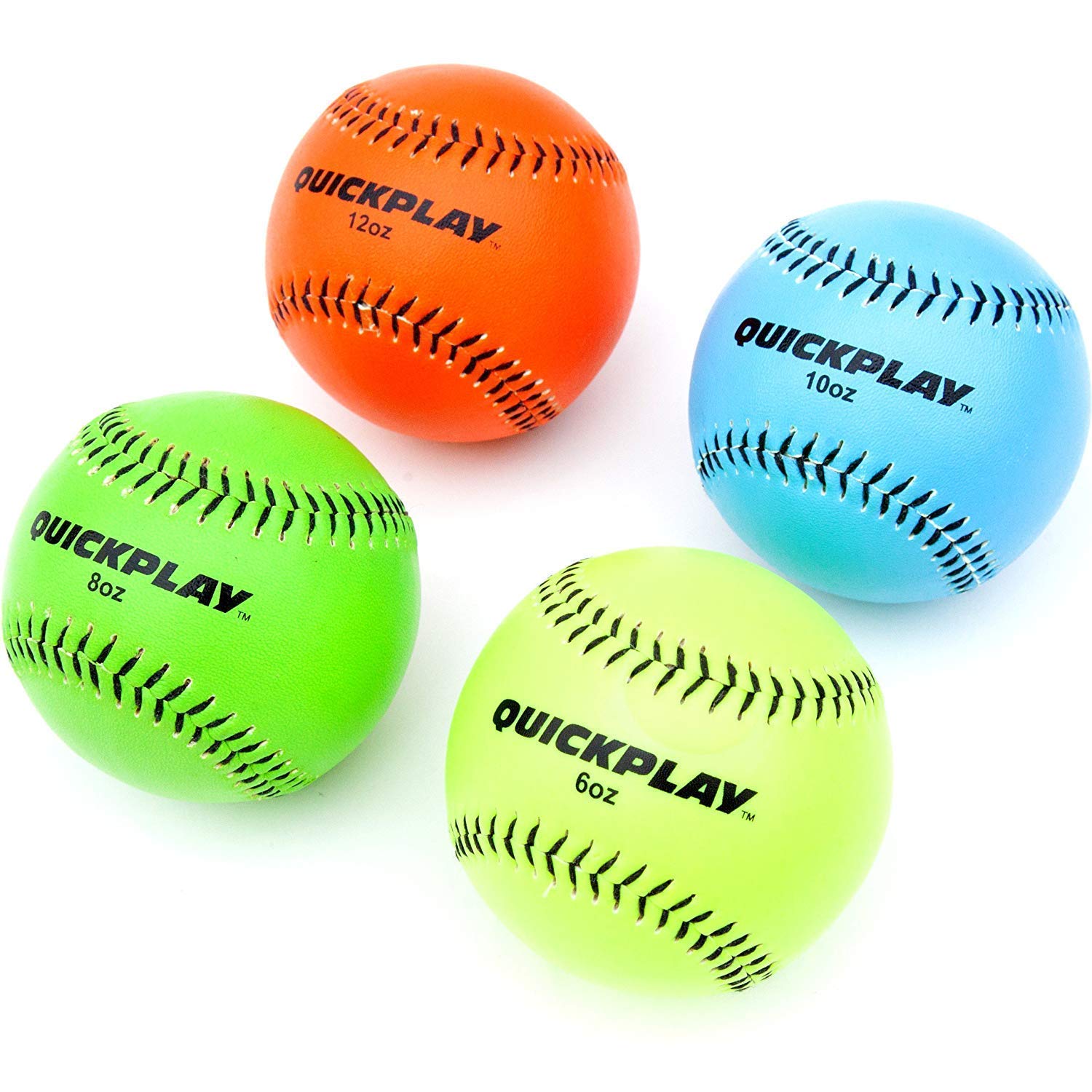
Four balls, four weights, one clear job — build arm strength and throwing speed.
The four balls run 6 oz, 8 oz, 10 oz and 12 oz, a clean stepwise ladder for arm-strength and velocity work. The leather cover over a weighted core keeps the feel close to a game ball, and raised seams give you a repeatable release point. A mesh carry bag comes with it so the four stay sorted between sessions.
This is a pitching-first set. The weights are tuned for strength and throwing-speed work rather than heavy overload, and the maker pitches it at beginners learning form through advanced players chasing velocity. Softball players can use it too, since the weight range is gentle enough to suit either sport. Compare it to the Thorza set and the weight spread is the same 6-to-12 oz; the QUICKPLAY edge is the leather-over-weighted-core build, while Thorza leans on red double stitching for its game-like grip.
Build quality is the repeated theme in owner feedback, with arm-strength results running a strong second. The one thing to accept is the ceiling: 12 oz is the heaviest ball here, so this will not carry a max-overload program. For a pitcher building up through a moderate ladder, four weights and a leather feel are a tidy package.
Why pitchers reach for it
- Four progressive weights — 6, 8, 10 and 12 oz — make the ladder easy to follow.
- Leather cover over a weighted core holds a game-like feel.
- Mesh carry bag keeps the four balls together.
- Raised seams support a repeatable release.
Set your expectations
- Top weight is 12 oz, so there is no heavy overload ball.
- Four balls means fewer reps per round than a six-pack.
For the mechanics-first pitcher: a clean 6-to-12-oz ladder with a leather feel suits arm-strength and velocity work.
Skip the heavy overload: if 16 oz-plus resistance is in your plan, this set ends at 12 oz.
7. Set of 6 Weighted Balls with Seams and Free Throwing Program
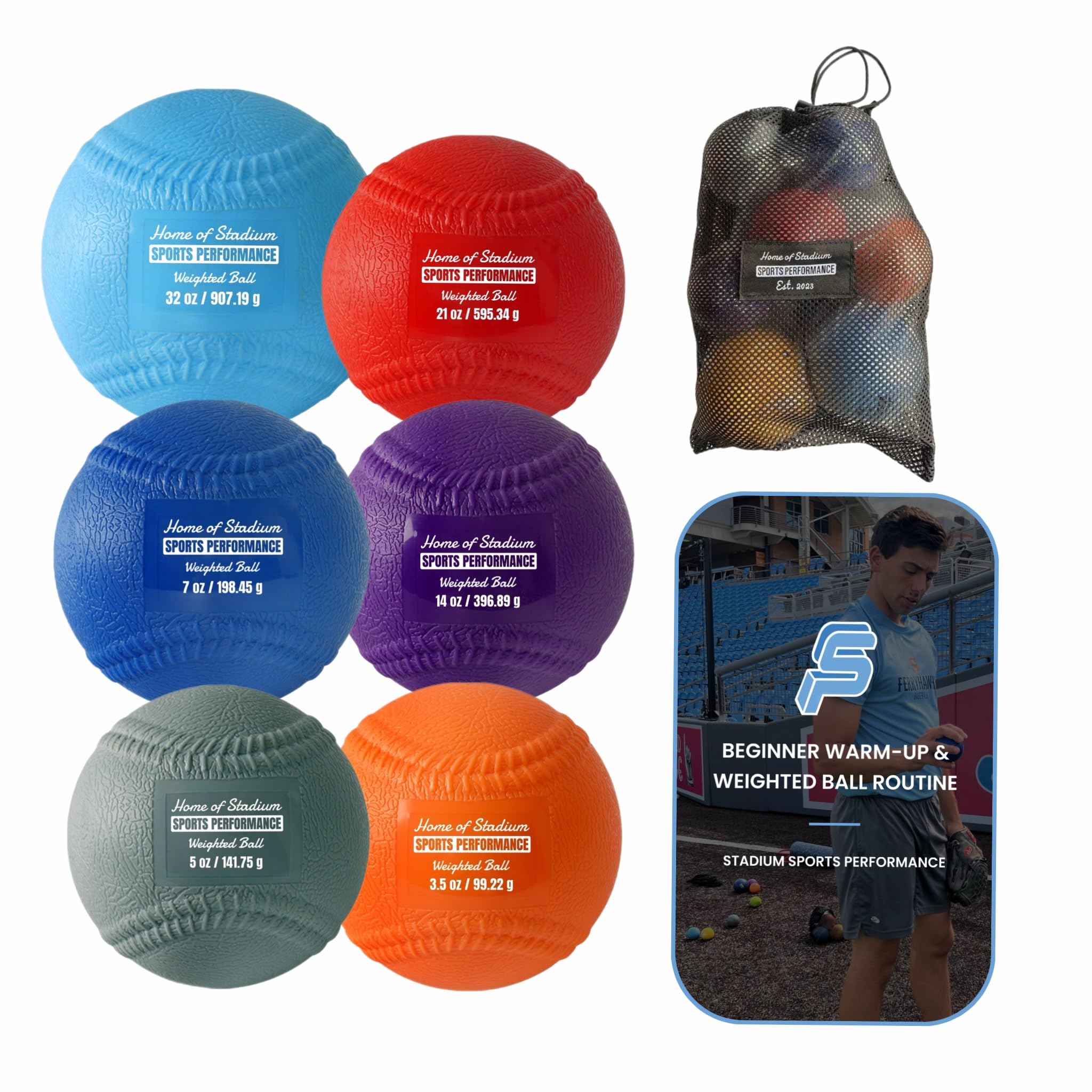
The set that hands you the plan along with the balls — 30 days, six weights.
Six balls run 3.5, 5, 7, 14, 21 and 32 oz, and each one is labeled in both ounces and grams so you always know which rung you are on. What separates this set is the included 30-day throwing program, built with experienced players and throwing-program providers and reachable through a QR code on the carry bag. If you have ever bought weighted balls and then stalled because you did not know what to do on day two, that program is the reason to pick this one.
The seams and a leather-like elephant print texture are designed to mimic a regulation baseball and keep your grip secure and consistent. The soft-shell inflatable construction is built for high-volume work and varied weather, and is tune for throwing against hard, flat surfaces — think a wall or a rebounder indoors. A carrying case holds all six balls and the program materials.
Owners call the quality high and the grip a real plus, noting the seams and texture prevent a slick feel in the hand. The one caveat is that these are inflatable soft-shell balls, so a hard PVC ball will feel denser in hand if that is what you are used to. For a thrower who wants a structured, well-gripped set with a plan attached, this earns its spot.
Why it earns a look: a 30-day throwing program plus weight labels in ounces and grams turns six balls into an actual routine.
Know the feel: an inflatable soft shell is designed for rebound work and will feel lighter-density than a hard PVC ball.
Best for the program-seeker: buy this if you want a plan, not just a bag of weights, and you like training against a wall.
skip it if: you prefer the denser hand-feel of a hard shell ball for heavy overload throws.
8. PowerNet 3.2″ 9 Pack Weighted Training Balls
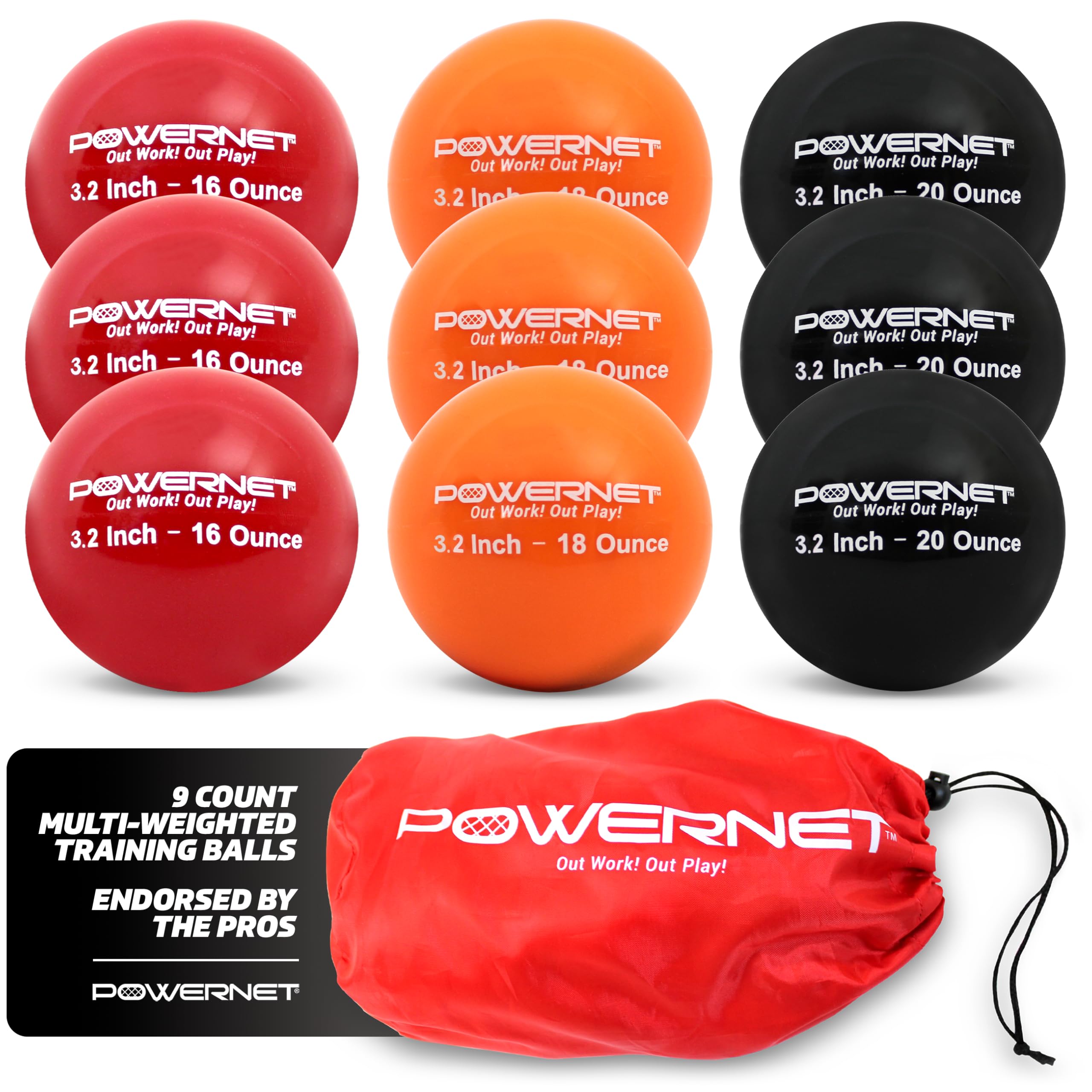
Nine balls at 16, 18 and 20 oz — a heavy-ball volume pack for hitters.
Nine balls split across three weights — 16, 18 and 20 oz — with each ball measuring 3.2 inches across. That 3.2-inch diameter is a bit larger than a standard baseball, which gives hitters a fuller target and adds a bit of grip variety during bat drills. The plastic shell is thick and pliable, built to take high reps and intense sessions.
The heavy end of the range is where this set lives, so it suits strength and muscle-memory work rather than light warm-ups. It doubles as a warm-up and cool-down aid, giving a player a way to loosen up before a game or work through recovery afterward. For a coach stocking a cage with enough balls to keep a line of hitters swinging, nine balls goes further than six.
Strength training is what people talk about most with this set, followed by its value for the money and the spread of weights. Durability is the one topic where a few accounts strike a different note, so treat the balls well and inspect after heavy cage sessions. If you are a young hitter learning the swing path, the 16-to-20 oz range can be a lot of ball — this is more a high school and up hitter’s tool.
Why a hitter reaches for it
- Nine balls keep a hitting group swinging with fewer interruptions.
- Three heavy weights — 16, 18 and 20 oz — build strength and muscle memory.
- 3.2-inch diameter gives a fuller target during bat drills.
- Works as a warm-up and post-game cool-down aid.
What to keep in mind
- No light warm-up weights in the set.
- Inspect after hard cage sessions, since durability gets mixed notes.
Built for a cage full of hitters: nine heavy balls at 16, 18 and 20 oz keep swings coming.
Not a young arm’s set: with no light weights and a heavy floor, it suits older hitters more than beginners.
9. Marv Balls Velo Set 6 Weighted Baseballs

The soft-shell original built for velocity drills — and for working multiple pitches.
Marv’s Velo Set packs 3.5 oz, 5 oz, 7.5 oz, 10 oz, 1 lb and 2 lb balls into one carry bag. That is a full climb from a light warm-up ball to a 2 lb overload, and the step pattern is fine enough that your arm eases up the ladder rather than jumping. Realistic seams and a leather-like texture let you work on multiple pitches with a repeatable grip, with better spin efficiency as the aim.
The shell is inflatable soft-shell plyometric material, which suits plyo drills against a wall or net and keeps the ball from punishing you on a rebound. The seams let you throw a fastball grip, a breaking-ball grip and more, so the same set can serve velocity work and pitch development. Six balls and a carry bag cover individual sessions as well as team work.
Owners land on quality first and durability second, with baseball suitability rounding out the feedback. The honest note is that soft-shell balls are a particular taste — some throwers prefer a hard PVC ball in hand for max-resistance work. But if your program is built around plyo drills and you want a fine-grained weight ladder with real seams, this is the set that fits that job.
The standout: a 3.5-oz-to-2-lb ladder with realistic seams lets you work multiple pitch grips in one set.
One caveat: the inflatable soft shell feels different from a hard PVC ball, so try a friend’s set first if hand-feel matters.
For the drill-focused thrower: reach for this if you want a fine weight ladder and seam grips for pitch development.
Think twice if: you want the density of a hard shell for max-overload throws.
Know the Specs
Weight Range and Progression
The weight spread inside a set decides what it can do for you. A set climbing from around 3.5 oz to 32 oz (or from 3.5 oz to 2 lb) covers warm-ups, mechanics work and heavy overload in one bag. A narrow set — say 6 to 12 oz — is a mechanics-and-arm-strength tool alone. Smaller jumps between rungs are easier on the arm, so a fine ladder like Marv’s 3.5, 5, 7.5, 10 oz, 1 lb and 2 lb eases you up more gently than a set with a big gap.
Shell Construction
The shell decides both durability and where you can safely throw. A hand-stitched rubber shell (as on the SHOP PLAY 9) takes high-volume work and holds up outdoors. A PVC shell (PodiuMax) is built for daily practice. An inflatable soft shell (Stadium Sports, Marv) is designed for throwing against hard, flat surfaces and rebounding indoors. A thick pliable plastic (PowerNet) is built for high reps in a cage. Match the shell to your training space and the ball will last.
Ball Diameter and Seams
Diameter affects target size and hand-feel. Sets on this list range from 2.8 inches (GoSports) to 3.2 inches (PowerNet) up to 4 inches (the PodiuMax hitting ball). Raised, textured, or leather-like seams give you a secure grip and a repeatable release point — critical when your hands are sweaty or you are throwing in light rain. Smooth plastic balls are fine for pure bat drills but offer less grip feedback for pitching work.
Ball Count and the Carry Bag
More balls means more reps per round and less time chasing. A nine-ball pack (PowerNet) suits a coach stocking a cage, while a four- or six-ball set fits an individual thrower. A carry bag is a real usability factor — six loose balls rolling around a trunk get lost fast. Some sets also add an instruction sheet or a QR-linked throwing program, which helps you actually follow a structured progression instead of guessing at day one.
Common Questions
What weight should a youth player start with on weighted baseballs?
Are weighted baseballs safe for a young pitcher’s arm?
What is the difference between a plyo ball and a weighted baseball?
Can I throw weighted baseballs indoors?
How many weighted balls do I actually need?
Do weighted balls really improve throwing velocity?
What diameter weighted ball matches a regulation baseball?
Can I use weighted baseballs for softball training too?
Do weighted baseballs come with a training plan?
How do I store weighted baseballs between sessions?
The Bottom Line
For most players, the weighted balls for baseball winner is the GoSports Plyometric Training Balls 6 Pack, because it puts a full 100g-to-450g ladder in one bag with a soft rubber shell that survives cage, gym and backyard sessions. If you want a leather feel and a clean pitching ladder, grab the Thorza Weighted Baseballs. And for a fine 3.5-oz-to-2-lb progression with real seams for pitch development, the Marv Velo Set is the one to reach for.
Match the set to your throwing program, not to the heaviest ball in the bag. Start light, step up gradually, and store the set in its carry bag between sessions.
How we choose
We do not accept paid placement. Every pick is matched to a real buyer and a real use-case; we do not hands-on test units.
Sources
Specifications: manufacturer listings and product documentation. Review insights: verified customer reviews, as of November 2026. Pricing: not shown on this page (it changes often); check the current price via the retailer link.
As an Amazon Associate, Tactical Gear Guy earns from qualifying purchases. This does not affect which products we feature.