Specs are compiled from manufacturer listings and verified buyer reviews and can change over time — please confirm the key details on the product page before buying.
You want the lights, the fridge and the router to keep running without pouring gas, hearing a roar, or dragging a generator outside in the rain. That is exactly what a solar-charged inverter power station does, and the real deciding factor is not the label on the box. It is how much usable battery you get, how many watts of solar it can actually swallow, and how hard you can push it before it trips.
This guide is built by comparing the manufacturers’ published specifications and the patterns across verified customer reviews, so you get each pick’s real strengths and trade-offs instead of marketing spin.
There is no single winner for everyone here, because a 14.8-pound weekend box and a 92-pound whole-home anchor solve completely different problems. Below you will find each unit’s honest job, its real limits, and who should actually buy it — a straight read on the solar powered inverter generator shelf.
Top Picks
How To Choose The Best Solar Powered Inverter Generator
Most buyers walk in staring at the headline wattage and walk out with the wrong machine. The number that keeps your food cold overnight is watt-hours, and the number that decides how fast the sun refills it is solar input watts. Get those two right and the rest is comfort features.
Start with watt-hours, not watts
Watt-hours (Wh) is the size of the tank — how long it can pour power at a given draw. A 576Wh unit and a 3584Wh unit can both run a fridge, but the bigger tank does it for far more hours. Match capacity to the job: a camping weekend, a router-and-fridge blackout, or a multi-day home outage are three different sizes of tank.
Check the solar input ceiling
Solar input is measured in watts of panel the unit can accept, and it caps your recharge speed no matter how many panels you own. A unit that takes 400W of solar refills far faster than one limited to a smaller input. If you plan to live off the sun rather than the wall, this single figure decides whether you are topped up by lunch or waiting two days.
Know your continuous and peak output
Continuous watts is what the unit can hold all day; peak (or surge) watts is the short burst a motor needs to start. Fridges, pumps and air conditioners pull a big spike on startup, so the surge rating matters as much as the steady one. Always leave headroom above the appliance’s running draw.
Battery chemistry and cycle count
LiFePO4 (a lithium iron phosphate battery) is the long-life chemistry most of these units use. Its cycle count tells you how many full charge-and-drain rounds it survives before capacity drops. Higher cycle counts stretch the years of service, which is where the real long-term value sits.
Side-by-Side Comparison
| Model | Best For | Capacity | AC Output | Weight | Amazon |
|---|---|---|---|---|---|
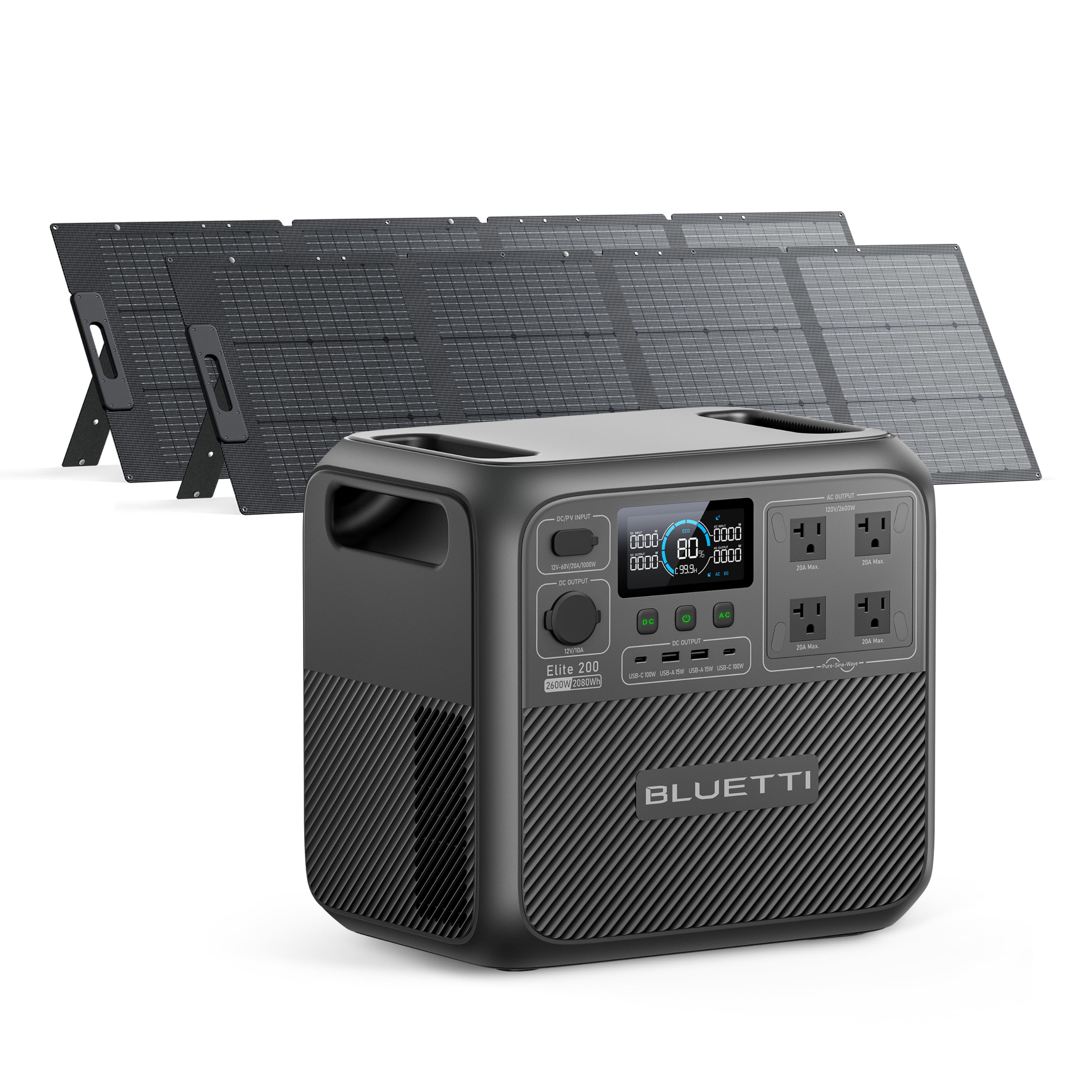
| BLUETTI Elite 200 V2 + 2x200W Panels★ Best Overall | All-round home and off-grid backup | 2080Wh | 2600W (3900W lifting) | 44.5 lb | Amazon |
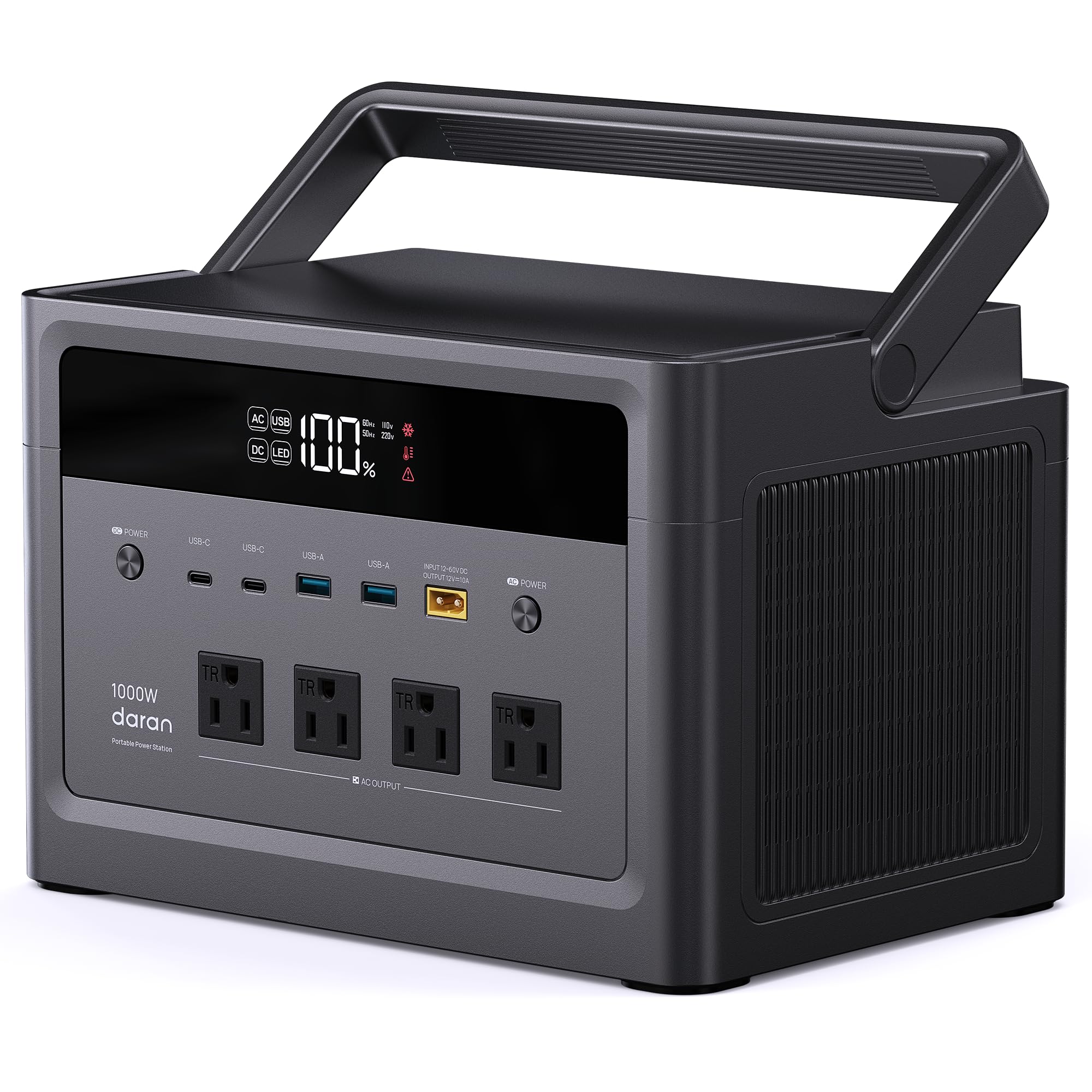
| Portable Power Station 1000W (576Wh)Featherweight Pick | Lightweight camping and car power | 576Wh | 1000W (2000W peak) | 14.8 lb | Amazon |
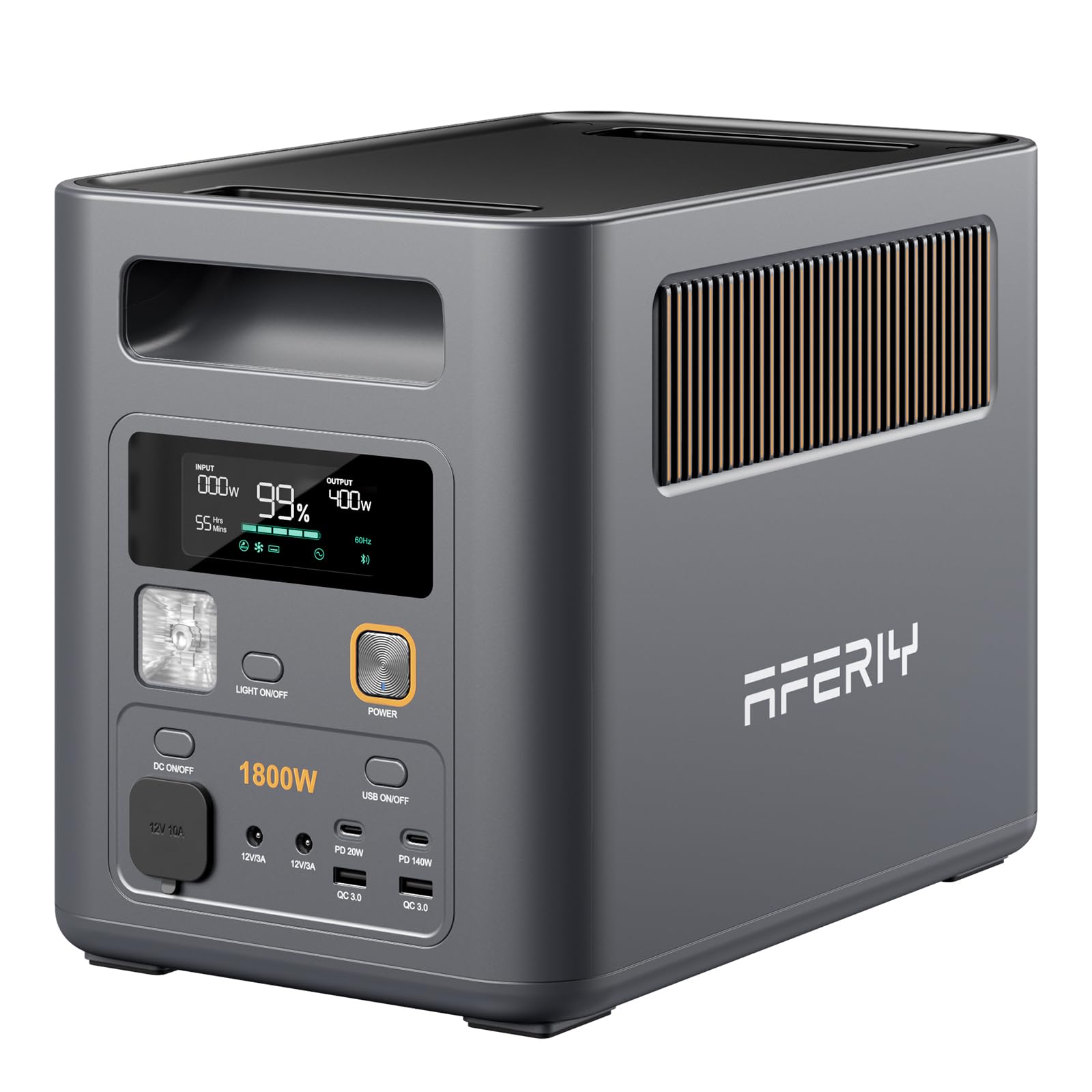
| AFERIY 1024Wh Solar GeneratorExpandable Value | Expandable mid-size backup | 1024Wh (to 5120Wh) | 1800W (3600W peak) | 28 lb | Amazon |
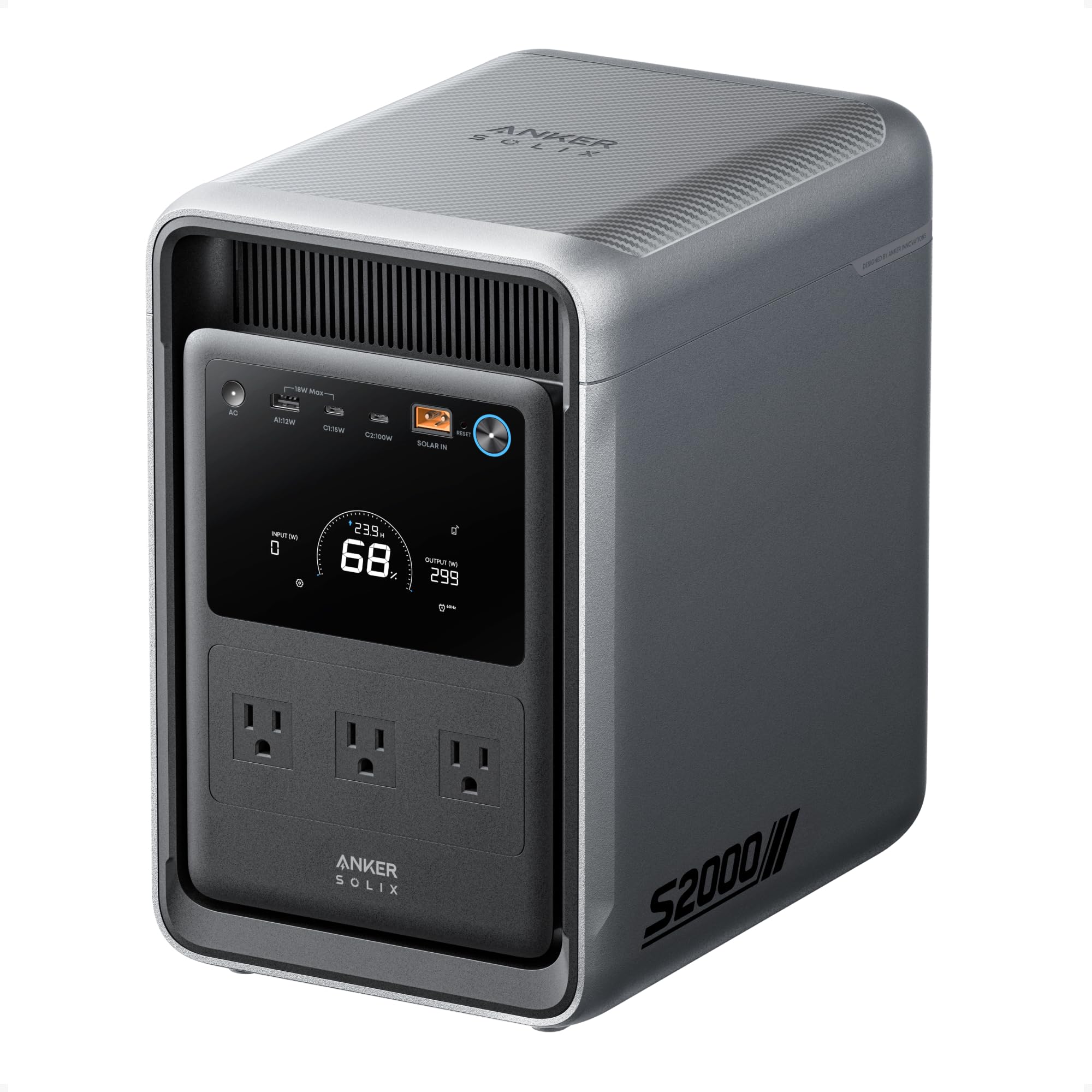
| Anker SOLIX S2000 | Compact 2kWh home fridge backup | 2010Wh | 1500W (3000W peak) | 35.7 lb | Amazon |
| Jackery Solar Generator 1000 v2 + 100W Panel | Campers wanting a panel in the box | 1024Wh | 1500W (3000W surge) | 23.4 lb | Amazon |
| EF ECOFLOW DELTA 3 Max | High-surge appliance running | 2048Wh | 2400W (3400W X-Boost) | — | Amazon |
| ABOK Ark3600 | Whole-home anchor with wheels | 3840Wh (to 11520Wh) | 3600W (4500W peak) | 92 lb | Amazon |
| BLUETTI Elite 300 + 2x200W Panels | RV-ready 3kWh kit | 3014.4Wh | 2400W (4800W surge) | 58 lb | Amazon |
| Anker SOLIX C2000 Gen 2 + 400W Panel | Fast-recharge panel bundle | 2048Wh (to 4kWh) | 2400W (4000W peak) | — | Amazon |
| EF ECOFLOW DELTA Pro | Expandable whole-home storage | 3600Wh (to 25kWh) | 3600W (4500W X-Boost) | 99 lb | Amazon |
| Jackery HomePower 3600 Plus | Rolling home backup station | 3584Wh (to 21kWh) | 3600W (7200W parallel) | 77.2 lb | Amazon |
Detailed Reviews
1. BLUETTI Elite 200 V2 Solar Generator
Our pick — 4.5+★ from 950+ verified ratings; the strongest balance of quality and price.
The kit that arrives with its own solar panels and still swallows the whole house load.
This is the pick that stops the argument before it starts. You get 2080Wh of stored energy plus two 200W panels in the box, so a 400W array can pull the battery from empty to full in about 5.5 hours of decent sun. No separate panel shopping, no guessing at connector types. For an off-grid cabin or a garage that loses power a few times a year, that bundled solar is the reason this sits at the top.
On output, the 2600W continuous rating handles a fridge and a coffee maker side by side. Flip into its 3900W power-lifting mode and it starts heavier loads like a hair dryer or a small heater. The standby draw is just 10W, which is the energy the unit sips while switched on and idle — BLUETTI’s own example is running a 120V 60W fan for three hours a day for 11 days. BLUETTI rates the LFP battery at over 6,000 cycles, which it frames as a 17-year lifespan of everyday use.
The honest trade-off is the number on the scale: 44.5 pounds. That is roughly three times the 14.8 pounds of the compact pick below, and it is the single most-cited gripe in the feedback. It rolls into a car boot fine with the built-in handle but you will not want to hike it to a campsite. Otherwise the overwhelming verdict is a machine that simply performs — it shrugs off cold weather and keeps a refrigerator running a full day. The crowd agrees, holding 4.5+ stars across 900+ ratings.
What earns it first place
- Two 200W panels included, so solar charging works on day one
- 2600W continuous and 3900W lifting for heavy startup loads
- 6,000+ cycle LFP battery rated at a 17-year service life
- 10W idle draw keeps wasted energy low between uses
- Runs 9 devices at once — fridge, router and phones together
Weigh it before you lift it
- 44.5 lb is the heaviest complaint in the reviews — car-bound, not backpack-bound
- Panels ship separately, so the kit can land in two deliveries
Reach for this if: you want a complete solar-plus-battery kit that can run real appliances without buying anything extra.
Leave it if: you need to carry your power on foot — 44.5 lb is a two-hand lift.
2. Portable Power Station 1000W 576Wh
Fifteen pounds of portable power you can sling into a tent with one hand.
Where the BLUETTI above is a house anchor, this one is a hiking companion. At 14.8 pounds it is 29.7 pounds lighter than the Elite 200 V2, and the difference shows up the moment you try to carry it alone. That weight buys you a 576Wh battery, which is about a quarter the storage of the Elite’s 2080Wh. So this is a machine for laptops, phones, a camera charger and a mini-fridge on a warm evening — not a home backup that runs the whole kitchen in a blackout.
The 1000W continuous output (2000W peak) is enough for a 700W microwave or a 1000W coffee maker, and the nine ports mean you can plug a lot in at once. There is a 100W USB-C that charges most laptops to 80% in about half an hour, plus four 110V AC outlets, a 120W DC port and USB-A. The LiFePO4 battery is rated at 3000+ cycles to 80% capacity, which the maker frames as a 10+ year life. Solar input tops out at 300W, so a sunny recharge is on the table if you add panels.
Two things to weigh before you commit. First, the panels are sold separately — this price buys the station only. Second, owner feedback on charging is genuinely split, with some units charging to 80% in roughly 1.7 to 2 hours and a handful reporting slow or failed charging. That mixed chatter is why it holds a lower score than the top pick at 4.0+ stars across 700+ ratings. For a lightweight camping box used within its comfort zone, it earns its place.
Where it shines: portability is the runaway strength — it is the lightest full-featured unit on this list, and the compact footprint makes it easy to tuck into a boat locker or truck bed.
Know before you buy: budget for panels separately, and treat it as a device charger and small-appliance box rather than an overnight fridge anchor.
Pick it for: weekend camping, tailgates and boat trips where every pound counts.
Skip it for: whole-home storm backup — 576Wh drains fast under heavy loads.
3. AFERIY Portable Power Station 1024Wh
The starter battery you can grow later instead of replacing outright.
Most power stations lock you to the capacity you bought. This one starts at 1024Wh and expands to 5120Wh with add-on batteries, which means the day your needs outgrow it, you buy more tank instead of a whole new machine. That flexibility is the real argument here, especially for an RV or a cabin where the fridge load climbs as you add appliances.
At 28 pounds it hits a middle ground — lighter than the house anchors, heavier than the camping boxes — and the maker calls it about 16% more compact and 25% lighter than similar-capacity models. The 1800W output (3600W peak) runs most household essentials, and the LiFePO4 battery is rated at 4000+ cycles for a claimed 10-year lifespan. Its UPS switchover is under 10ms, so when the grid drops, sensitive gear like a computer or a security camera keeps humming without a reboot. You also get 14 output ports, which cuts the plug-juggling.
There is a wrinkle in the battery feedback worth naming. While the long-life chemistry is the headline, a minority report the unit failing to charge past 21% capacity — a real issue if it hits you, though it is a rare case rather than the norm. Charging itself is quick by most accounts, with 0-80% in about 45 minutes on AC and under 30dB of fan noise in daily use. It holds 4.5+ stars across 100+ ratings, and the expandability is what serious buyers tend to latch onto.
The growth play: expansion to 5120Wh turns a mid-size station into a long-outage system without a second purchase of the base unit.
The honest catch: a few units report a charge ceiling well below full — test yours early and use the 7-year support window if it misbehaves.
Best for: RV owners and off-grid setups that expect to add capacity over time.
Think twice if: you want plug-and-forget — the expandable path asks you to manage extra batteries.
4. Anker SOLIX S2000 Solar Powered Generator, 2,010Wh, 1,500W
A full 2kWh of fridge backup squeezed into a footprint that fits a closet shelf.
Anker treats size as the whole pitch here, and it holds up: 30% smaller and 25% lighter than the industry average, at 8.2 × 11.1 × 12.7 inches and 35.7 pounds. That is a 2kWh tank you can actually store in a hall cupboard rather than reserve a garage corner for. The battery uses 314Ah LFP cells rated for 10,000 cycles — the highest cycle count on this list — which Anker frames as a 15-year lifespan.
Runtime is the other selling point. With a 6W idle draw and what Anker calls 10% higher efficiency, it runs a fridge for 35 hours — and the owner feedback backs up the long-haul claims, with full-size refrigerators coasting for days. Output is 1500W continuous and 3000W peak, enough for the essentials Anker targets. Solar input goes up to 400W, and there are eight outlets split front and rear so always-on appliances stay plugged in the back.
There is no 12V DC port, which is worth flagging if you were planning to run a car-style fridge or DC gear off it — that is the one gap in an otherwise tidy package. On the positives, owners are unanimous that setup is simple and the whole thing just works, especially as a home-office UPS with its under-10ms switchover. It lands at 4.5+ stars across 500+ ratings, and the compact footprint is what wins people over.
Standout spec: 10,000 cycles is the highest battery-longevity rating on this entire list, and it pairs with the smallest 2kWh body here.
Fit note: no 12V DC port means DC appliances need a different solution.
Choose it when: space is tight and you want a fridge-capable 2kWh unit that tucks away.
Look elsewhere if: you need DC output for a car fridge or similar 12V gear.
5. Jackery Solar Generator 1000 v2
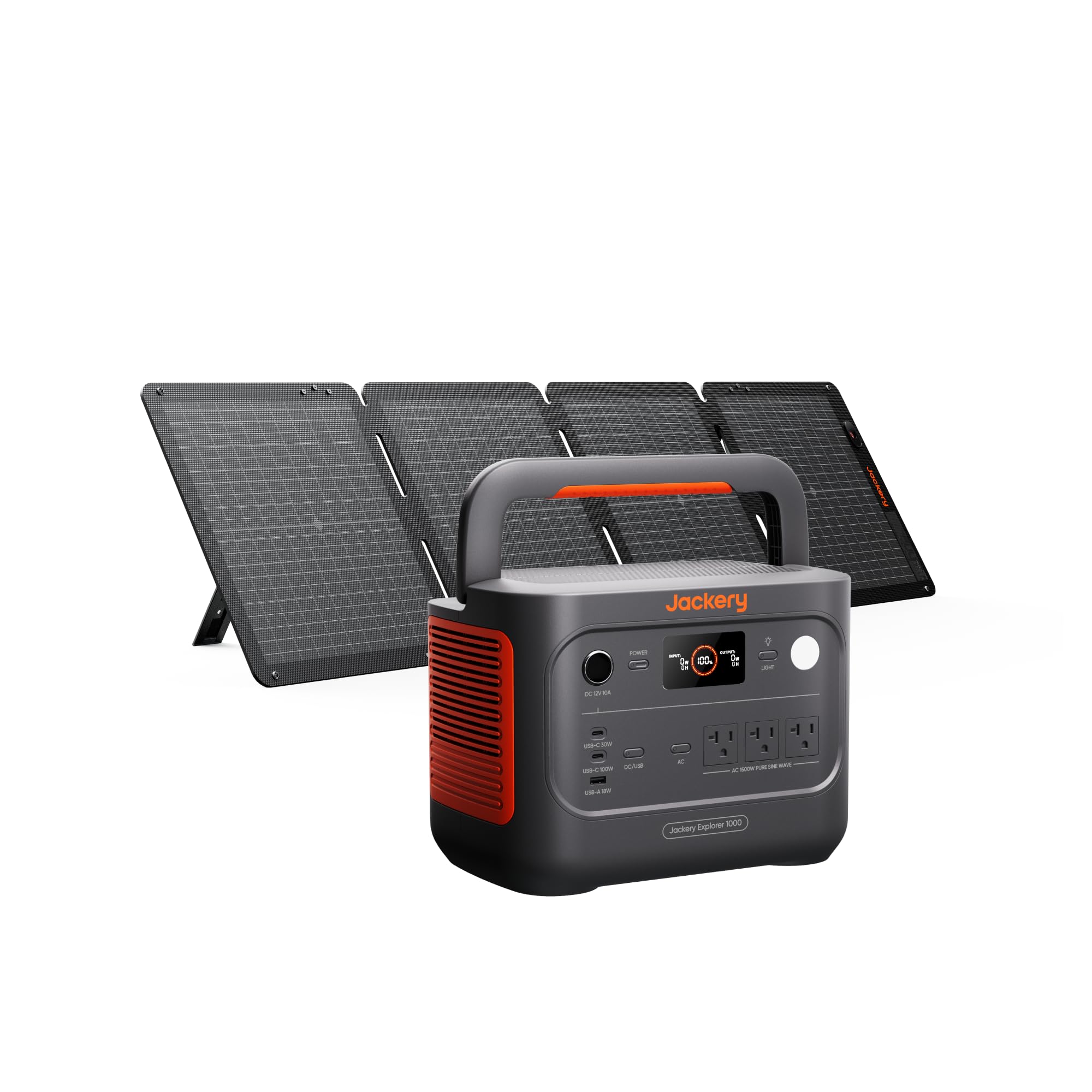
A ready-to-camp bundle with the solar panel already in the box.
If you would rather not research panel specs and connector sizes, this arrives as a matched set: the Explorer 1000 v2 plus a 100W solar panel. At 1024Wh and 23.4 pounds, it splits the difference between a camping box and a home backup — light enough to load in a trunk, big enough to keep a fridge alive through a long evening. The 1500W output (3000W surge) covers AC units, fridges and electric pots.
Charging speed is the headline that makes people look twice. With the Jackery App’s emergency charging activated, the Explorer 1000 v2 goes from 0 to 100% in 50 minutes on AC; left in default mode it takes 1.25 hours to protect battery health. The LFP battery holds over 70% of its capacity after 4,000 cycles, which Jackery pegs at over 10 years. There is a 10ms UPS switchover, two USB-C ports, a USB-A, a DC car port, two pure-sine AC ports and a light panel built in.
The bundled panel is smaller than the big-array kits, so solar recharging here is steadier than it is fast — a trade-off against the BLUETTI two-panel kits that can pull far more sun. In daily use the feedback is warm on quality and speed, with the fast charging and lighter weight the most-appreciated traits. It settles at 4.5+ stars across 200+ ratings, and the note about enabling emergency charging each time is a small routine to learn.
Why campers like it: the panel is included and matched, so you skip the compatibility homework entirely.
The one caveat: 100W of solar is gentle — expect a slower top-up than the multi-panel kits, and remember to switch on emergency charging before fast AC fills.
Great match for: weekend campers who want a complete, tidy solar set without piecing it together.
Not the pick for: anyone chasing maximum solar input wattage for rapid off-grid recharges.
6. EF ECOFLOW DELTA 3 Max
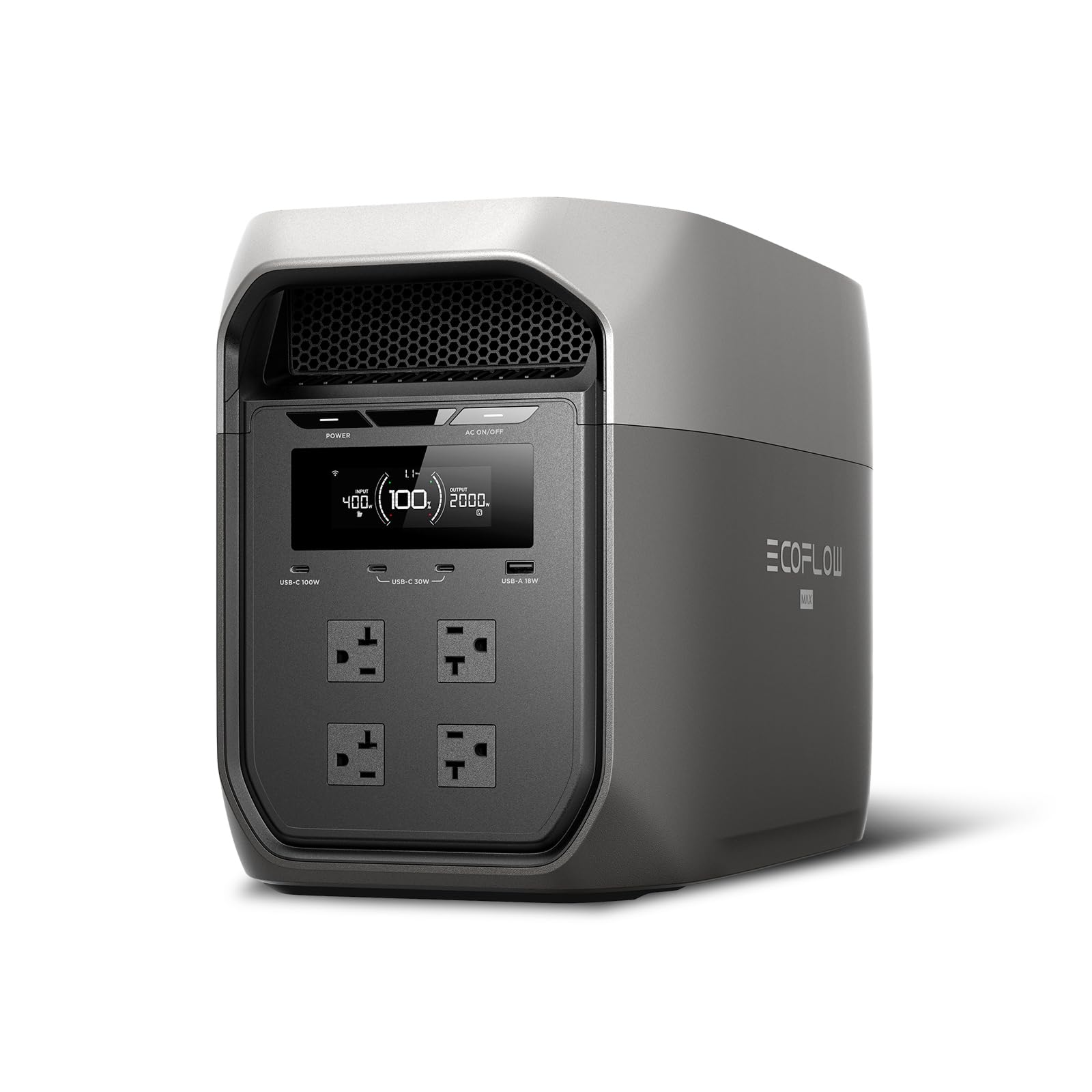
The 2kWh unit that punches hard enough to start heavy appliances without tripping.
EcoFlow’s X-Boost mode is the reason this pick exists. Its 3400W X-Boost output lets it run high-draw gear like fridges, microwaves and even power tools that would otherwise trip a smaller station. The rated output is 2400W, so the boost is the reserve tank you call on for a stubborn startup spike. With 2048Wh of LFP storage, this is a genuine home-backup unit that can still be carried to a campsite.
Recharging is quick by the numbers: 0-80% in 1.13 hours on its X-Stream charging, which means a blackout-prep top-up is a coffee-break job rather than an all-afternoon wait. The under-10ms transfer keeps sensitive electronics like computers safe during an outage, and it runs quietly enough for overnight use. A 5-year service window and EcoFlow app control round it out, letting you set charge schedules and watch energy use in real time.
The spec sheet does not list a weight figure in pounds, so plan on treating it as a two-hand carry rather than a throw-in-a-backpack box. What the feedback does make clear is that quality is the standout — owners describe it as a top-tier system that simply performs, and the fast charging is a recurring favorite. It holds 4.5+ stars across 600+ ratings. If you need to start heavy appliances, this is the pick here that leads on surge headroom.
The muscle: 3400W X-Boost gives you more startup room than the S2000’s 3000W peak, which matters for tools and motors.
Trade-off to know: X-Boost is a boost reserve, not a continuous rating — sustained heavy loads should stay near the 2400W mark.
Suits you if: you want a 2kWh station that can jump-start demanding appliances on demand.
Pass if: you need an easily carriable box — this one rewards a fixed indoor spot.
7. ABOK Ark3600 Portable Power Station
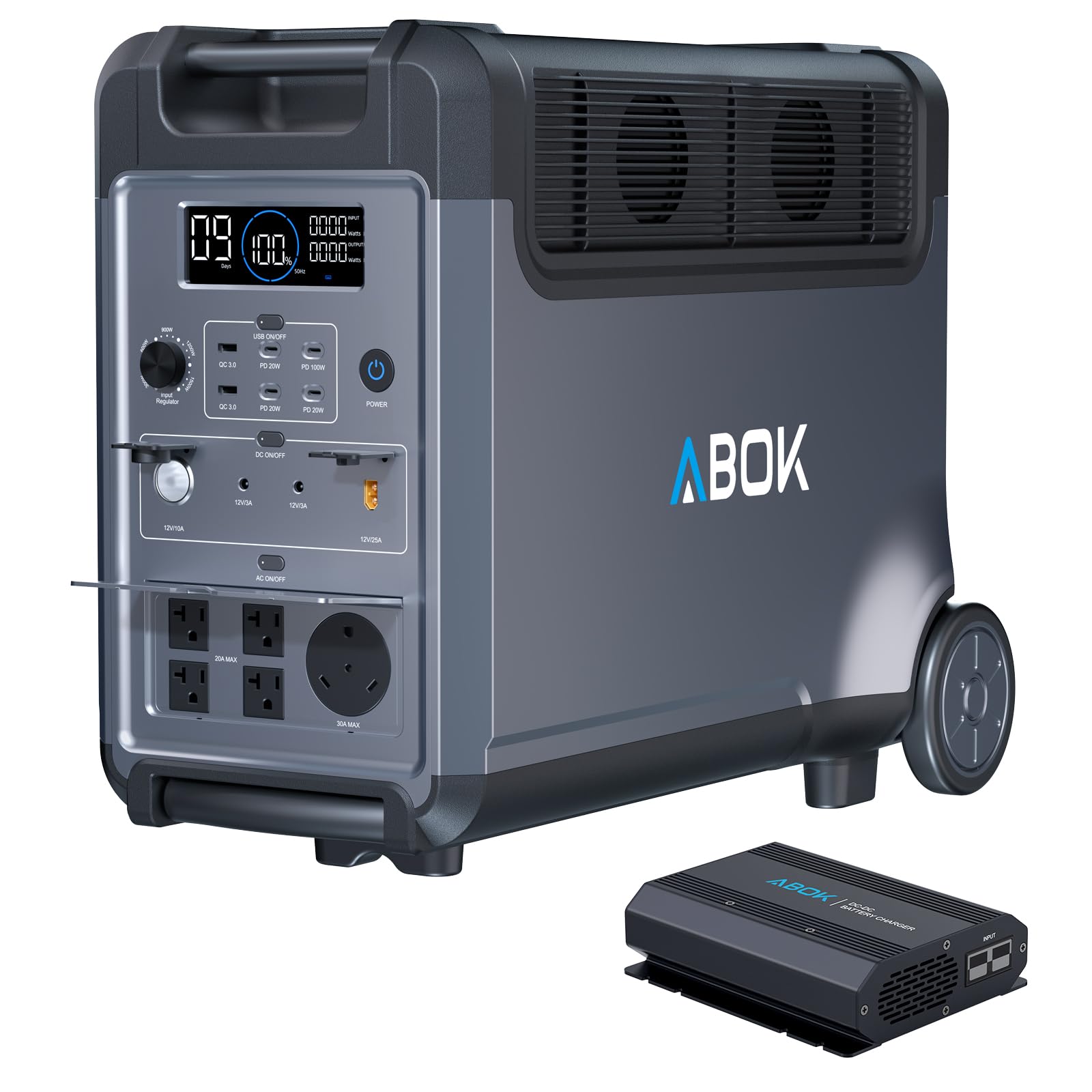
A wheeled 3.8kWh anchor that rolls to the appliance instead of you hauling it.
At 92 pounds, this is no grab-and-go box — and ABOK knows it, which is why the Ark3600 has a telescoping handle and durable wheels. You roll it from garage to kitchen for an outage rather than lift it. That weight buys 3840Wh of storage, expandable to 11520Wh, so a multi-day blackout becomes a real possibility rather than a scramble. The EV-grade LiFePO4 battery is rated for over 4000 cycles, which ABOK frames as up to a 10-year life.
Output is heavy-duty: 3600W rated and 4500W peak, which ABOK says covers 99% of household appliances. Charging is flexible across AC (1500W), solar (2000W) and car (120W), and AC plus solar together can fill it in about 1.29 hours. There are 15 output ports, from a 30A AC down to USB-C and DC5521, so you can plug in a whole shelf of devices at once. A Bluetooth app lets you watch performance remotely.
This machine makes most sense for someone who needs serious stored energy at home or in a workshop and will keep it on the ground. On the road it is a different story — 92 pounds up a set of camping steps is nobody’s idea of fun, and weight is the split point in the feedback. Otherwise quality carries it: owners call it an incredible generator that just works, charging to full in about 3 hours and serving hours of AC power per charge. It holds 4.5+ stars across 100+ ratings.
The capacity argument: 3840Wh expandable to 11520Wh is the biggest base tank here short of the DELTA Pro’s expansion path.
The weight trade: 92 lb wants to stay on its wheels, so treat this as a stationary home anchor.
Built for: home backup and workshop duty where the unit stays put and you roll it out for storms.
Not for: tent camping or trunk life — the wheels can’t help on rough ground.
8. BLUETTI Solar Generator Elite 300
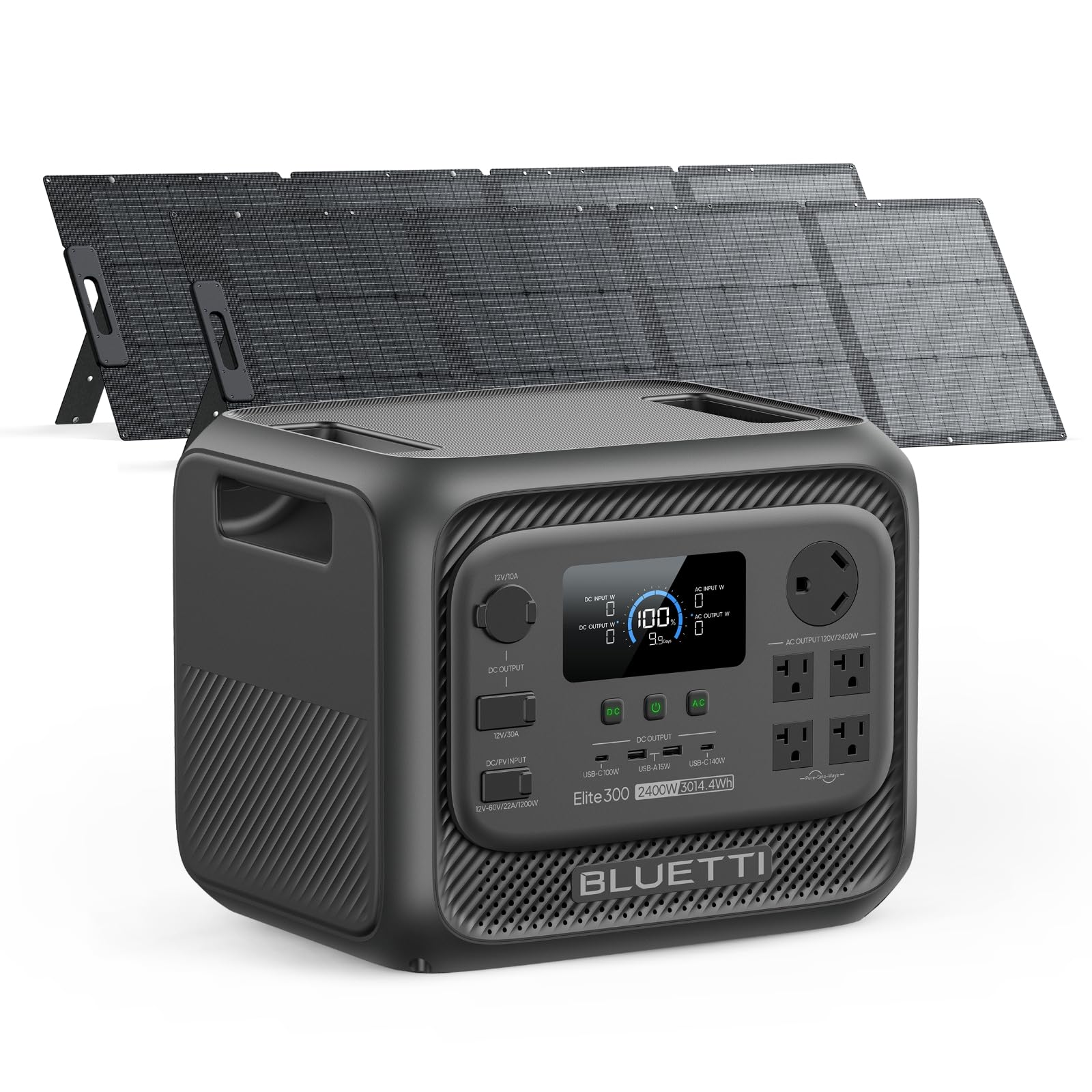
The one with the RV plug built in, so your travel trailer connects without an adapter.
If you own an RV, the detail that sells this is the dedicated TT-30 outlet plus a 12V/30A DC port. Those let you plug your rig’s fridge and AC straight in — no adapter dongles, no guessing. Around that plug sits 3014.4Wh of LFP storage with 2400W continuous output and a 4800W surge, which BLUETTI says is enough to start resistive loads like a kettle. It ships with two 200W panels that recharge the battery from empty to full in about 7 to 15 hours of sun.
BLUETTI calls its Elite 300 the world’s smallest 3kWh portable power station — a claim independently recognized by Frost & Sullivan — and nearly 59% smaller than traditional large stations. The LFP battery is rated for 6000+ cycles, and BLUETTI claims an 80% charge in 78 minutes at best. For storm-season home backup it will keep a fridge, router, lights and a CPAP machine running.
The catch is the carry weight. At 58 pounds it is heavier than the compact 2kWh units, and there is a measure of grumbling about that in the feedback — this is an RV-parked or garage-stored unit, not a hike-in box. Where it earns its keep is reliability and charge speed, with owners reporting it fills in roughly two hours and runs steadily through camping and outages alike. Well worth its premium for the RV crowd, and rated 4.5+ stars across 200+ ratings.
Straight into the rig: the TT-30 and 12V/30A ports mean a camper van connects natively, with no adapter tax.
Weight reality: 58 lb is a two-person lift, so plan its home base before it arrives.
Made for: RV and travel-trailer owners who want a native plug and a bundled solar kit.
Skip if: portability on foot is the priority — 58 lb sits in the park-and-stay class.
9. Anker SOLIX C2000 Gen 2

A 400W panel that also soaks sun from its back side, paired to a 58-minute charger.
The bundling here is smart: a 2048Wh station paired with a 400W bifacial panel. “Bifacial” means it gathers power from both the front and rear surfaces, and Anker says that yields up to 10% more output than a single-sided panel. The panel itself is IP68-rated (sealed against rain, mud and dust) and folds down to 22.3 × 38.7 × 3.2 inches at 21.9 pounds, which Anker notes is 50% lighter than comparable 400W panels.
The station is no slouch either. It recharges from AC and solar in 58 minutes to 100%, with 80% in 45 minutes, and delivers 2400W rated and 4000W peak — enough to run most window and RV air conditioners. Idle draw is a mere 9W, letting it run a portable fridge for a week or a dual-door fridge for up to 32 hours. Add an expansion battery and the capacity grows to 4kWh.
This is a premium kit, and its weight is the recurring mixed note — some find it manageable, others feel the heft. But the panel bundle plus the fast recharge is exactly what an off-grid buyer wants: you can refill the tank in a single sunny afternoon. Performance and reliability are what owners praise most, and it stands at 4.5+ stars across 700+ ratings. If solar self-sufficiency is the goal, few kits on this list refill as quickly.
Solar speed standout: a 400W bifacial panel means more power from the same footprint, and the station tops off in under an hour on combined charging.
The honest note: this is a heavy kit — expect to move the panel and station separately.
The one for: off-grid users who want the fastest solar refill and a weatherproof panel.
Not ideal for: buyers who want the lightest possible footprint — the bifacial panel adds bulk.
10. EF ECOFLOW DELTA Pro 3600Wh
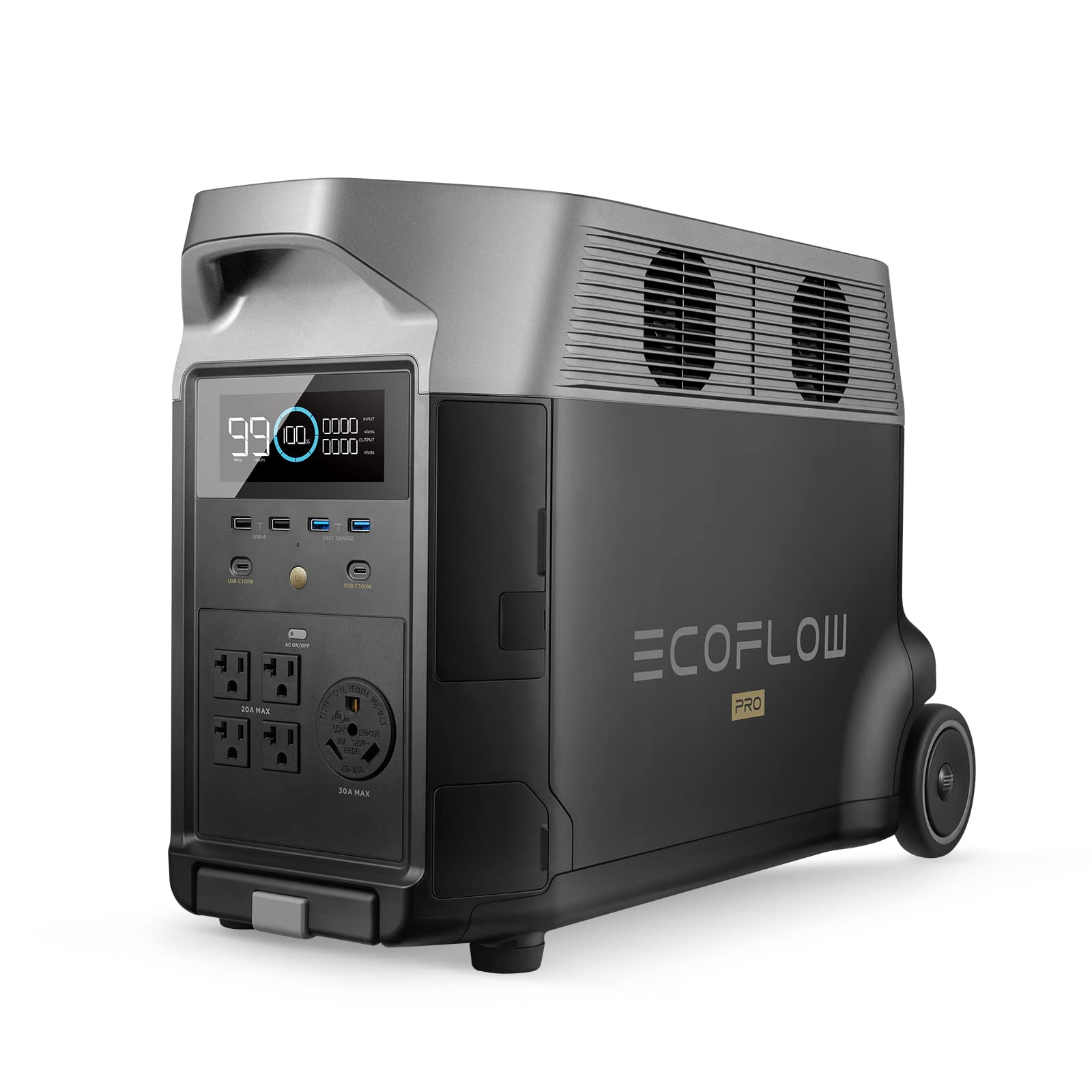
Start at 3.6kWh and keep stacking batteries until you hit 25kWh.
The DELTA Pro’s whole identity is scale. You begin with 3600Wh and can expand all the way to 25kWh by adding extra batteries or smart generators — a path that turns a single unit into whole-home storage. A 3600W AC output expands to 4500W with X-Boost, and pairing two units gets you to 7200W. EcoFlow says that covers 99.99% of heavy-duty devices, and there are 15 output methods including USB-C 100W, five AC outlets and an Anderson port.
Charging is fast and multi-source: 1.8 hours on 240V, 2.7 hours on 1800W wall outlets, or 2.8 hours from four 400W solar panels thanks to a solar conversion efficiency of up to 23%. The 3600Wh LFP battery pairs with that speed, and all of it runs through EcoFlow’s X-Stream charging tech with battery management baked in.
At 99 pounds this is the heaviest unit here, so it is a set-down-and-stay fixture, not a portable pick. That is the honest limit, and the reason to choose it is capacity and expandability rather than grab-and-go. Feedback is strongly positive on quality and the 2.7-hour recharge, with the unit running gear for hours and maintaining most of its charge over long stretches. It holds 4.5+ stars across 700+ ratings, and the expandable path is what serious home-backup buyers reward.
The scale play: 25kWh of expansion tops this entire list, making it the most future-proof home-backup base.
The weight fact: 99 lb earns it the heaviest-single-unit tag here — it lives where you place it.
Right for: households planning to grow into whole-home backup over several years.
Weigh the lift: at 99 lb, factor in where it will sit permanently before you order.
11. Jackery HomePower 3600 Plus

The luggage-style home station you roll around instead of breaking your back.
Jackery built this one for the house. It delivers 3600W output (7200W in parallel) with dual voltage 120V and 240V when run in parallel, enough to drive pumps, heaters and dryers — and 3584Wh that expands to 21kWh per unit or 43kWh across multiple units. Jackery says that is enough for a three-person household for over two weeks, which frames it as a whole-home backup rather than a camping toy.
It handles heat and cold by design. The ceramic membrane cells are tested at 302 °F and rated to resist thermal runaway, and Jackery claims operation down to -4 °F in a blizzard. Jackery pegs the 6000-cycle battery at a 10-year lifespan. Charging is flexible: 0-100% in just 2 hours on hybrid AC+DC, 2.5 hours on AC, 4 hours on solar, or 2.5 hours from a gas generator. A plug-and-play design paired with an MTS powers your home without complex installation.
Despite the whole-home ambition, it is the lightest 3.6kWh LFP station in Jackery’s line — 34% smaller and 29.3% lighter than other models — and the wheels and telescopic handle let you roll it from kitchen to garage. At 77.2 pounds it is still a two-hand lift up stairs. The feedback is warm on how simple it is to use and move, plus charging that tops off quickly and keeps fridges and freezers running for up to 12 hours. It holds 4.5+ stars across 200+ ratings, and the parallel expansion is what home owners value most.
Whole-home ambition: dual 120V/240V parallel output and expansion to 43kWh make this the most home-oriented build here.
Weight caveat: 77.2 lb rolls easily on flat ground but resists stair carries.
Suits you if: you want a rolling, whole-home backup with parallel expansion for larger loads.
Second-guess it if: you are carrying up stairs or into a van — the wheels only help on the level.
Know the Specs
Watt-Hours (Wh) — the tank size
Wh is the total energy stored, which sets how long the unit runs before it needs a refill. A bigger number means the fridge keeps going longer during an outage. Match it to your job rather than the biggest number on the shelf.
Continuous vs peak watts
Continuous watts is what the unit holds all day; peak (surge) watts is the short burst motors need to start. Fridges, pumps and air conditioners draw a big spike at startup, so leave headroom above your appliance’s running draw.
Solar input watts
This is the most panel power the unit can accept, and it caps your recharge speed. A higher ceiling refills faster from the same sunny day, which matters most for off-grid use.
LiFePO4 and cycle life
LiFePO4 is a long-life lithium battery, and its cycle count tells you how many full charge-and-drain rounds it survives before capacity falls. Higher counts stretch the years of service and the long-term value.
UPS switchover speed
UPS switchover is the gap between the grid dropping and the battery taking over, measured in milliseconds. A faster switchover (under 10ms is common on these units) keeps computers, routers and sensitive gear running without a reboot during a brief outage.
Common Questions
How long will a solar inverter generator run a fridge during an outage?
Do these units come with solar panels included?
Can I charge these units from the car while driving?
What is LiFePO4 and why does it matter for these generators?
Will a solar inverter generator run a microwave or a space heater?
What does UPS switchover mean for home backup?
How fast can these recharge from a wall outlet?
Are these safe to run indoors during a power outage?
Can I expand capacity later, or am I stuck with what I buy?
Why do some solar generators weigh so much more than others?
The Bottom Line
If you want one machine that covers the most ground without extra shopping, the BLUETTI Elite 200 V2 is the strongest all-round buy here. It pairs 2080Wh with two 200W panels in the box, holds 2600W continuous with 3900W lifting, and carries a 6,000+ cycle battery. The honest cost is 44.5 pounds, so it lives in a car or garage rather than a backpack.
For the opposite need — power that travels light — the Portable Power Station 1000W at 14.8 pounds is the carry-anywhere choice. If home backup is the priority, the Anker SOLIX S2000 squeezes a full 2kWh into the smallest footprint on this list. And for whole-home storage that grows over years, the DELTA Pro expands to 25kWh.
One honest nudge before you decide: figure out your largest appliance’s starting surge first, then pick a unit whose continuous and peak watts both clear it with room to spare. Buy the tank size that fits your worst outage, not your best weekend, and the solar side will take care of the rest.
How we choose
We do not accept paid placement. Every pick is matched to a real buyer and a real use-case; we do not hands-on test units.
Sources
Specifications: manufacturer listings and product documentation. Review insights: verified customer reviews, as of November 2026. Pricing: not shown on this page (it changes often); check the current price via the retailer link.
As an Amazon Associate, Tactical Gear Guy earns from qualifying purchases. This does not affect which products we feature.