Specs are compiled from manufacturer listings and verified buyer reviews and can change over time — please confirm the key details on the product page before buying.
Picking a cam kit for a small block Chevy is where a lot of good engine builds go sideways. The cam decides where your power actually lives — down low where a street car drives, or up high where a strip car screams. Get that profile wrong and you end up with a lumpy idle, weak brakes and a converter that flashes past the powerband.
This guide is built by comparing the manufacturers’ published specifications and the patterns across verified customer reviews, so you get each pick’s real strengths and trade-offs instead of marketing spin.
Everything below is a hydraulic flat tappet kit that fits the Gen 1 small block, so the real decision is duration, lift and where each cam makes its power. Here is the honest breakdown of the best sbc cam kit for a street-driven 350.
Top Picks

How To Choose The Best SBC Cam Kit
A cam kit is not a bolt-on you pick by brand name. It is the part that sets your engine’s personality, and every other choice — converter, gears, intake, exhaust — either supports that profile or fights it. Start by deciding how the car actually gets driven, then pick the cam that matches.
Duration at.050″ tells you where the power lives
Duration is how long, in crankshaft degrees, the valve stays open. The.050″ figure is the industry’s standard measuring point, and it is the number that matters most for comparing cams. A shorter duration keeps the power low and the idle calm. A longer one pushes the power up and makes the idle choppy, which is why a 218 duration and a 243 duration feel like two different engines even in the same block.
Lobe separation angle sets the idle and your vacuum
Lobe separation is the angle between the intake and exhaust lobe centers. A wider separation, like 112 or 114 degrees, tends to idle smoother and hold more vacuum. A tighter 107 degrees gives you that hard, thumping exhaust note — and less vacuum for power brakes and computer sensors. It is the trade-off you feel in the seat and hear at the tailpipe.
Match the RPM range to your converter and gears
Every cam here publishes a powerband, and it is not a suggestion. A range that starts at 2,500 RPM wants a 2,800+ stall converter and steeper rear gears, or you will drive through the soft spot every time you leave a light. A range that starts at 1,300 or 1,600 RPM is far kinder to a stock converter and highway gears.
Know whether you are buying a kit or a K-Kit
A standard CL kit gives you the camshaft, a set of lifters, instructions and assembly lubricant. A K-Kit goes further and generally includes valve springs, retainers, locks, valve seals, a timing set and decals — check the individual listing, because K-Kit contents do vary. If your heads need matched springs anyway, the fuller kit can save you a second order.
Side-by-Side Comparison
| Model | Best For | Duration @.050″ | Valve Lift | RPM Range | Amazon |
|---|---|---|---|---|---|
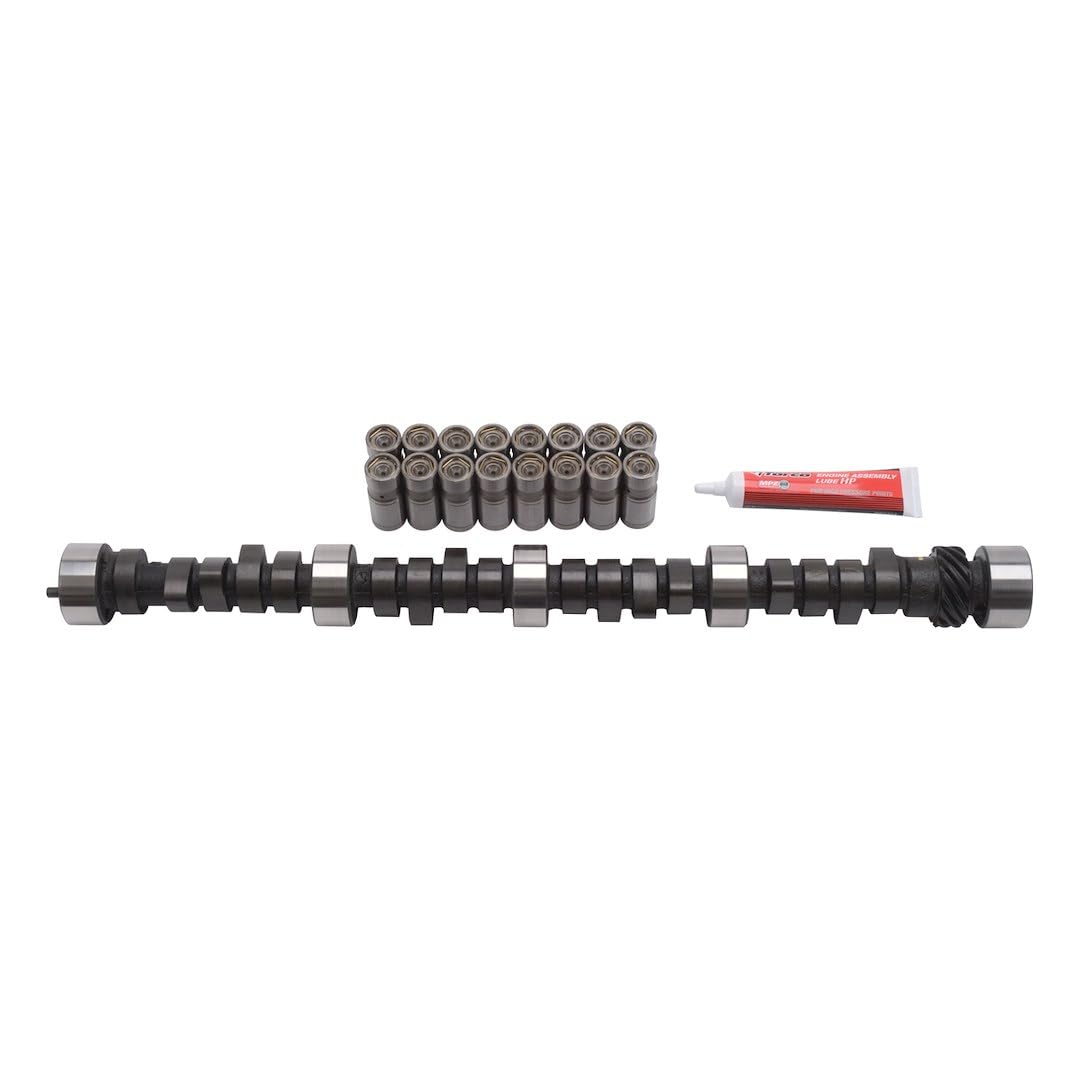
| Edelbrock 2102 Performer-Plus★ Best Overall | Stock-converter street manners | 204 intake / 214 exhaust | 0.42″ intake / 0.442″ exhaust | — | Amazon |
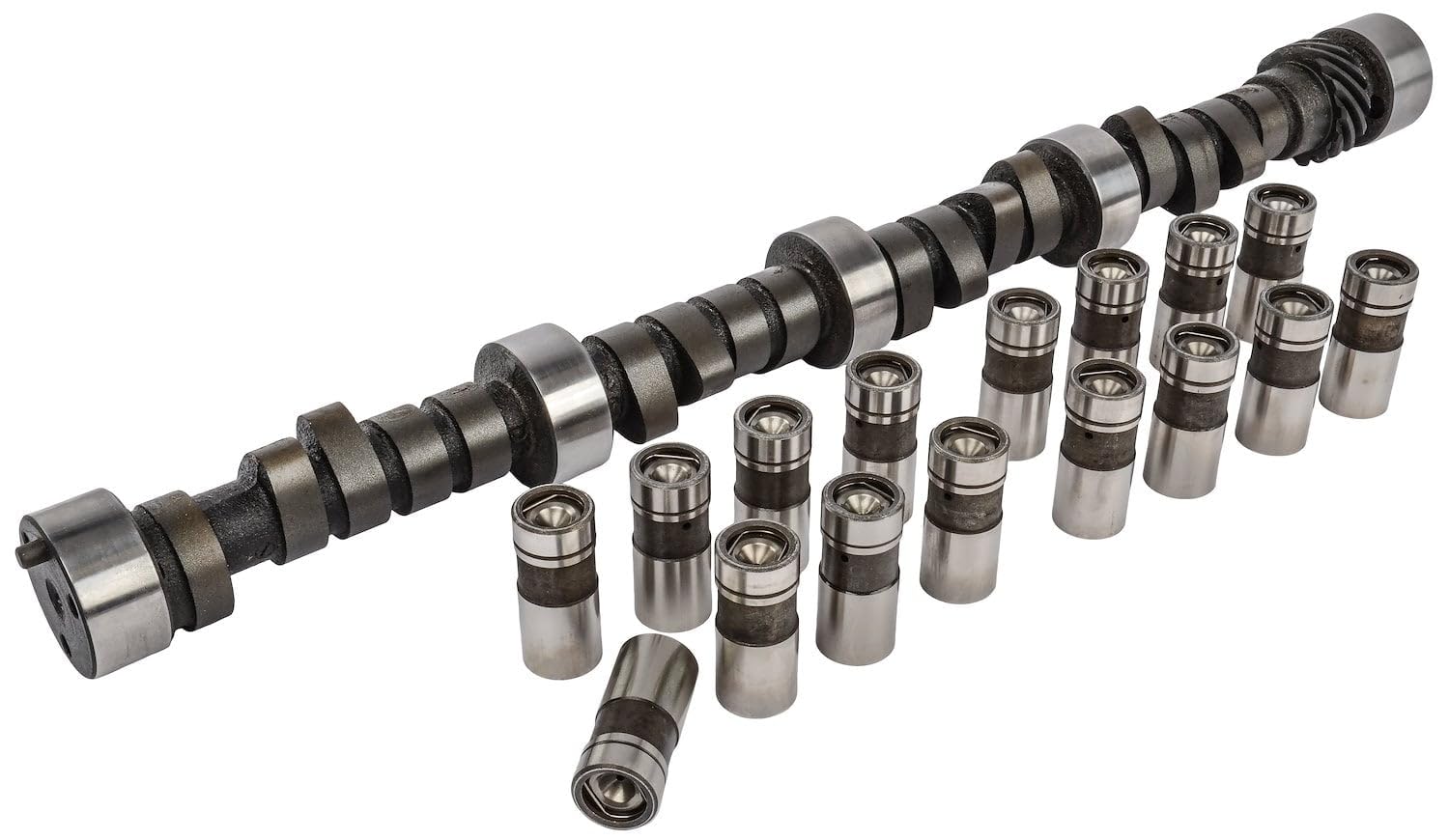
| JEGS Hydraulic Flat Tappet & LiftersBroadest Torque | Broad mid-range torque | 234 intake / 244 exhaust | 0.488″ intake / 0.510″ exhaust | 3,000–6,500 RPM | Amazon |
| COMP Cams CL12-212-2 MagnumStreet Machine Grind | Street machine with a stall | 230 intake / 230 exhaust | 0.480″ intake / 0.480″ exhaust | 2,000–6,000 RPM | Amazon |
Detailed Reviews
1. Edelbrock 2102 Performer-Plus Camshaft and Lifter Kit
Our pick — 4.0+★ from 100+ verified ratings; the strongest balance of quality and price.
The mild-mannered grind that adds torque without turning your idle into a lope-fest.
If your small block is a weekend cruiser with a stock converter (the factory fluid coupling between engine and transmission) and highway gears, this cam works with your setup instead of fighting it. Its 204-degree intake and 214-degree exhaust duration at.050″ (how long the valves stay open, measured in crank degrees) keep the power low in the RPM range, right where you actually drive. The 112-degree lobe separation (the angle between intake and exhaust lobe centers) is the widest here, so it holds the most vacuum and keeps power brakes and sensors working. Lift is 0.42″ intake and 0.442″ exhaust (how far the valves open), the gentlest of this group, so your valvetrain sees less stress.
Reviewers single out the build quality of this kit, and the torque gains they report back it up. Behind a stock intake and exhaust manifold, this Edelbrock grind starts and idles cleanly on a cold morning. If you are refreshing a tired 350 and want it to feel stronger without sounding angry, this is the natural fit.
The catch is that this is the lowest-lift, shortest-duration cam in the lineup, so it will not chase a big horsepower number up top. And compared with the Big Mutha’ Thumpr’s 0.500″ intake lift, this one sits at 0.42″ — deliberately calm. If your goal is a choppy idle and a strip launch, this is the wrong cam. It is a kit built for driveability, and that is exactly the trade you are making.
What earns it the top slot
- The widest lobe separation here at 112 degrees, so vacuum stays strong for power brakes
- Duration of 204/214 at.050″ keeps the powerband low and street-friendly
- Cam and lifters ship together with instructions and assembly lube
What to weigh before buying
- Lowest valve lift of the group at 0.42″ intake, so top-end gain is modest
- No published RPM range on the listing to plan your converter around
Reach for this if: you want a stock-converter cruiser that idles smooth and pulls from idle.
Look elsewhere if: you are chasing a hard lope and big top-end numbers.
2. Hydraulic Flat Tappet Camshaft & Lifters 57-85 SBC
A 3,000-to-6,500 RPM grind that trades idle manners for horsepower upstairs.
There is one number that defines this cam: the powerband starts at 3,000 RPM and runs to 6,500. That is the highest starting point in this lineup, which means it wants a looser converter and steeper gears or it will feel soft off the line. Duration hits 234 intake and 244 exhaust at.050″, with advertised figures of 292 and 302 degrees. Lift measures 0.488″ intake and 0.510″ exhaust — the highest exhaust lift among these kits.
The 114-degree lobe separation is the wide-angle choice for a bigger cam, and the manufacturer’s own pitch is a broader torque range over a stock camshaft. It covers 1957 through 1985 small blocks — the 262, 283, 307, 327, 350 and 400 among them — so the fitment list is long. Weighing 12.9 pounds, it also arrives as a noticeably lighter package than the COMP Cams K-Kit at 21.1 pounds.
The honest trade-off is that this is the least street-polite kit here. A 3,000 RPM starting point is real, and a stock converter will not let the engine settle into the power. If your car is a weekend toy with a stall and gears, it makes sense. If it is a daily driver, this cam will frustrate you at every light.
Where it makes its case: the 0.510″ exhaust lift edges past the Big Mutha’ Thumpr’s 0.486″ and towers over the Edelbrock’s 0.442″, so it breathes hard on the exhaust side without going full strip-cam.
The honest limit: a 3,000 RPM floor needs converter and gear support, so plan those into the build or the cam underperforms.
Built for: a geared, stalled street-and-strip small block that spends real time above 3,000 RPM.
Think twice if: your car still runs a stock converter and tall highway gears.
3. COMP Cams CL12-212-2 Magnum Cam and Lifter Kit
The Magnum with a rough idle and a 2,000-to-6,000 pull that rewards headers and gears.
Head-to-head with the milder Magnum above, this one is the more aggressive twin: 230/230 duration at.050″ against 224/224, both on a 110-degree lobe separation. Lift sits at 0.480″ on both sides. COMP’s own guidance is blunt — it needs a 2,500+ stall, headers and gears, and it idles rough. That is the whole personality of the cam in one sentence.
It carries the same 9.5:1 compression target as its stablemates and is built to be easy on valvetrain parts, working with mild ratio rocker arms and traditional performance valve springs. The 2,000-to-6,000 RPM range puts it squarely in street-machine territory, and the kit arrives as a cam, lifters, instructions and assembly lubricant. Made in the USA.
Check fitment before you buy: this cam fits Gen 1 small blocks from 262 through 400 cubic inches, but it does not fit LT1/LT4 engines or factory roller small blocks (engines with roller lifters) built from 1985 and newer. If your block is a later roller unit, stop here and look at a different cam family entirely.
Why the street crowd likes it
- 230/230 duration pairs a rough idle with a strong 2,000–6,000 RPM spread
- Works with mild ratio rocker arms and traditional performance springs
- Ships as a complete cam, lifter, lube and instruction kit
What it asks of you
- The maker calls for a 2,500+ stall, headers and gears, which adds cost
- Will not fit LT1/LT4 or factory roller blocks from 1985 and newer
Pick this one if: you are building a proper street machine and already own the stall and gears.
Pass on it if: the car still has its stock converter and manifolds.
4. COMP Cams CL12-211-2 Magnum Cam and Lifter Kit
COMP’s own words: the biggest cam you can run with a stock converter.
That claim is the reason to look here first. The 224/224 duration at.050″ and 0.470″ lift on a 110-degree lobe separation deliver a mild rough idle and an 1,800-to-5,800 RPM powerband — the broadest window in this lineup on the bottom end. Y,800 RPM, and COMP rates it as accepting a stock converter, though it is best with a 2,000+ converter and gears.
Set it against the Big Mutha’ Thumpr: that cam stretches to 243/257 duration, while this one stays at 227/241 — noticeably tamer on paper, yet it keeps the 107-degree separation and the aggressive exhaust note. The early intake valve opening and long exhaust duration are what create the overlap and the sound, and the full K-Kit adds the springs, retainers, locks, seals, timing set and lube. Made in the USA.
Two limits worth saying plainly. It shares the Thumpr line’s fitment boundary — Gen 1 small blocks only, no LT1/LT4 or factory roller blocks from 1985 and newer. And at 21.2 pounds it is the heaviest box here, again because it is a complete valvetrain kit rather than a cam alone. If that suits your build, it is the tidy one-stop option for a muscle car.
This is your kit: if you want the Thumpr idle and prefer one order that covers cam, springs, seals and timing set.
Keep shopping if: your block is an LT1, LT4 or a 1985-and-newer factory roller unit.
Know the Specs
Duration at.050″ — where the power lives
Duration is how long the valve stays open, measured in crankshaft degrees, and the.050″ figure is the standard lift point used to compare cams apples to apples. A shorter figure, like the Edelbrock’s 204 degrees on the intake, keeps power down low and the idle calm. A longer one, like the Big Mutha’ Thumpr’s 257 degrees on the exhaust, pushes the power up the rev range and makes the idle rough. When you read a duration number, think of it as a dial that moves your powerband up or down.
Lobe separation angle — the idle and the vacuum
Lobe separation is the angle between the intake and exhaust lobe centers. A wider number, like the 112 or 114 degrees on the Edelbrock and the JEGS kit, tends to smooth the idle and preserve vacuum for power brakes. A tighter number, like 107 degrees on the Thumpr cams, produces more overlap, the choppy note, and less vacuum. It is the choice that decides how your car sounds at a stoplight and how well its accessories behave.
Valve lift — how far the valve opens
Lift is the maximum distance the valve opens, listed for intake and exhaust separately. Higher lift lets more air and fuel into the cylinder and more exhaust out, which is why the Big Mutha’ Thumpr’s 0.500″ intake lift sits at the top of this group while the Edelbrock’s 0.42″ is the mildest. Increased lift usually comes paired with the springs a kit should supply, which is one reason a full K-Kit exists.
RPM range — matching converter and gears
The published RPM range tells you where the cam actually makes power. A range starting at 1,300 RPM, like the K12-238-2, works with a stock converter. A range starting at 3,000 RPM, like the JEGS hydraulic kit, wants a looser stall and steeper rear gears so the engine does not fall out of the powerband between shifts. Match that range to your drivetrain before anything else, and the build stays pleasant to drive.
Common Questions
Will these cam kits fit a 350 small block from the mid-1970s?
Do I need a higher stall converter for these cams?
What is the difference between a CL kit and a K-Kit?
Will a bigger duration cam hurt my power brakes?
What compression ratio do these cams need?
Can I install one of these cams in an engine with a factory roller block?
How do I choose between the two Magnum cams, 224/224 and 230/230?
Which cam gives the choppiest idle for a muscle car?
Do these kits include lifters and assembly lube?
What is the difference between the street carbureted cams and the strip cams here?
The Bottom Line
For most small block owners chasing better driveability, the sbc cam kit winner is the Edelbrock 2102 Performer-Plus, because its 112-degree lobe separation and 204/214 duration keep vacuum strong and put the power where a stock-converter car actually uses it. If you want the biggest cam you can run without changing your converter, grab the COMP Cams CL12-211-2 Magnum. And for the deepest lope on a street-and-strip build, the COMP Cams CL12-602-4 Big Mutha’ Thumpr is the one to reach for.
Whichever grind matches your drivetrain, order the cam and its supporting hardware together — a cam that out-runs its springs, converter or gears never gets to work.
How we choose
We do not accept paid placement. Every pick is matched to a real buyer and a real use-case; we do not hands-on test units.
Sources
Specifications: manufacturer listings and product documentation. Review insights: verified customer reviews, as of November 2026. Pricing: not shown on this page (it changes often); check the current price via the retailer link.
As an Amazon Associate, Tactical Gear Guy earns from qualifying purchases. This does not affect which products we feature.