Specs are compiled from manufacturer listings and verified buyer reviews and can change over time — please confirm the key details on the product page before buying.
You already know the sickening feeling: you pull a cut of beef out of the freezer and it is pale, dry, and tasting faintly of cardboard. A food sealing machine exists to stop that — it pulls the air out of the bag and heat-welds the plastic shut, so the food you paid for stays the food you paid for. The trick most buyers miss: not every sealer pulls hard enough on wet food, and the difference between a bag that holds and one that quietly leaks is usually the heating strip, not the price tag.
This guide is built by comparing the manufacturers’ published specifications and the patterns across verified customer reviews, so you get each pick’s real strengths and trade-offs instead of marketing spin.
Below you will find seven machines laid out by what they actually do well — wet-food sealing, bulk speed, quiet operation, or simple one-button running — with the honest limits of each spelled out. Every pick here earns its spot on real suction pressure, seal-strip width, and how the machine behaves with a juicy steak instead of a dry cracker: a practical food sealing machine shortlist you can shop from with confidence.
Top Picks

How To Choose The Best Food Sealing Machine
Start with what you actually seal. If your freezer fills up with chicken breasts, ground beef, and salmon, you need a machine that handles moisture without letting liquid creep into the seal. If you mostly bag dry goods, jerky, or coffee, a simple dry mode will do and you can spend your attention elsewhere. The single biggest beginner mistake is assuming every sealer is “just a vacuum” — the wet-food path is where cheap pumps and thin strips fail.
Suction pressure in kPa decides how much air actually leaves
kPa (kilopascals) is the measure of how hard the pump pulls. Higher kPa means a tighter collapse on the bag and less residual air, which is what keeps a steak red instead of grey. A sealer around 80 kPa is respectable for everyday work; jump to 95 kPa and the bag pulls flatter against the food, which matters most on awkward shapes like a whole tenderloin.
Seal-strip width is the quiet hero
The heating strip melts the bag shut. A wider strip puts more welded plastic between your food and the outside air, so a moist surface has a harder time sneaking into the seam. A 0.2-inch widened strip is a real upgrade over a thin wire, and it shows up most when you seal something wet. Thin strips are fine for dry rice and nuts; wide strips are for meat.
Pulse and extended-seal modes are for anything juicy
A normal automatic cycle sucks until the sensor says stop. On a marinade or a stew that pulls liquid toward the seal. Pulse mode lets you pull suction in short bursts so you control how far it goes, and extended seal simply runs the heating strip longer to weld through any moisture at the seam. That combination is what separates a sealer you trust with raw meat from one you only trust with crackers.
Counter space and bag cost add up over a year
A sealer that stores on its side or tucks under a cabinet gets used; a bulky one stays in the pantry. Likewise, a sealer that locks you into one brand of bag quietly costs more every month. A built-in roll, cutter, and roll-storage slot cut bag waste enough to pay back the price gap within a couple of refill boxes.
Side-by-Side Comparison
Every row uses the same three dimensions so you can scan trade-offs in one pass: suction pressure (how hard the pump pulls), seal-strip width (how much welded plastic holds the bag shut), and bag throughput (how many bags it can run back to back).
| Model | Best For | Suction | Seal Strip | Bag Throughput | Amazon |
|---|---|---|---|---|---|
| Bonsenkitchen VS5100★ Best Overall | All-round wet and dry sealing | 4 pumps, 135W | 3.3 mm widened | 50 bags in 20 min | Amazon |
| FRESKO V2Hands-Off Automatic | Automatic hands-off operation | 95 kPa | 0.2 in widened | 30 bags in 15 min | Amazon |
| Bonsenkitchen VS3201 | Budget entry with drip tray | 80 kPa | — | 40 bags in 15 min | Amazon |
| POTANE VS2690 | Preset-driven multi-food sealing | — | Enhanced heating wire | — | Amazon |
| FoodSaver VS100 | Vertical storage in tight kitchens | — | — | — | Amazon |
| FRESKO V8-2 | High-volume bulk sessions | 140W motor | Extra-wide strip | 40 bags in 20 min | Amazon |
| JLHSWENND VS9312 | Quiet, compact, double-sealed | 95 kPa | Dual heat wires | — | Amazon |
Detailed Reviews
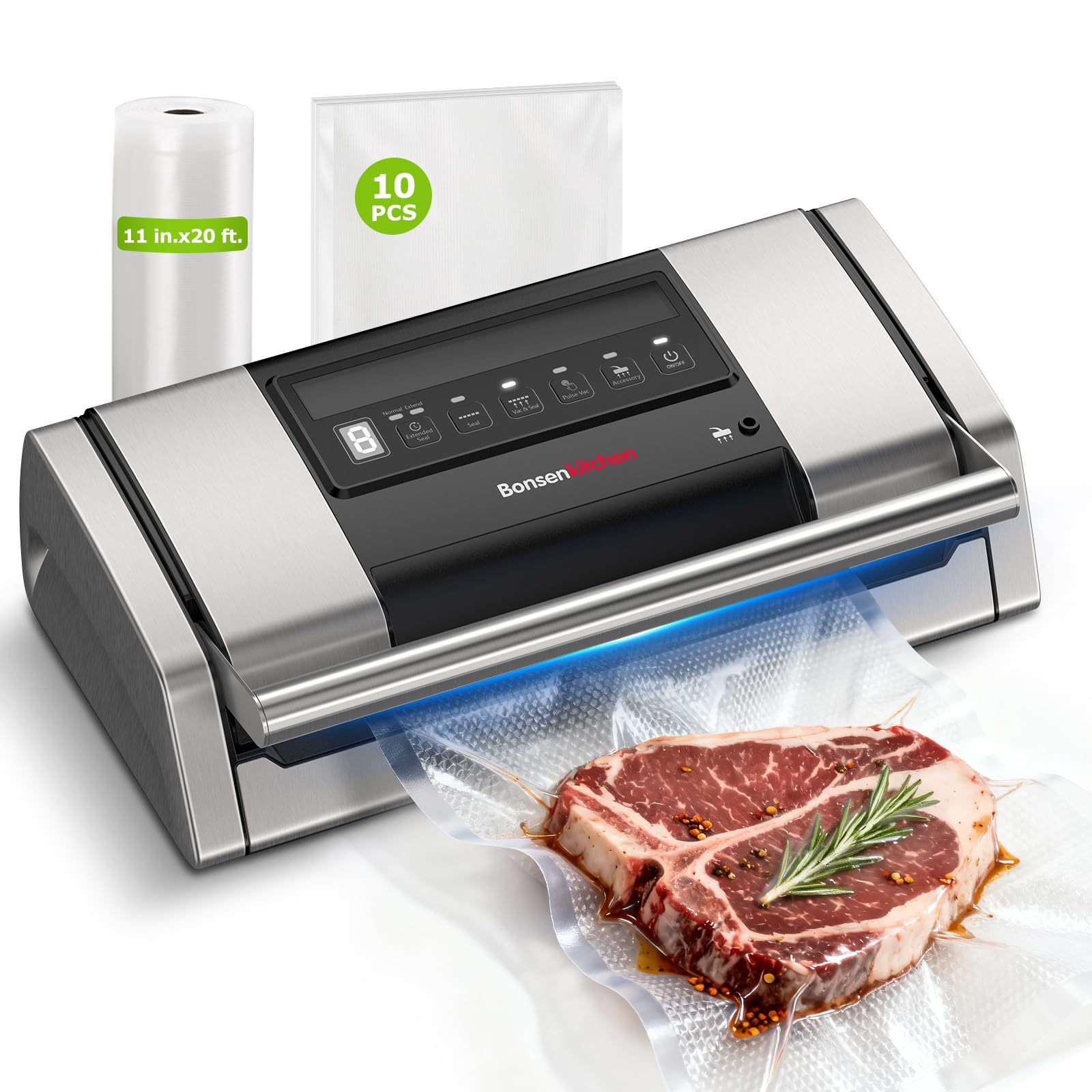
1. Bonsenkitchen Vacuum Sealer Digital Timer
Our pick — 4.5+★ from 650+ verified ratings; the strongest balance of quality and price.
Four pumps and a 3.3 mm seal strip that finally respects a wet steak.
The number to fix on first is 3.3 mm — that is the widened heating strip, the welded band of plastic holding your bag shut. On a dry bag of rice a thin strip is fine. On a marinade-heavy chicken thigh, a thin strip is where leaks are born, and this machine’s wider band is why it holds. Add the 135W motor driving four upgraded vacuum pumps and you get a sealer that pulls hard without the long wait — it runs up to 50 bags in 20 minutes, which is a full Sunday meal-prep session without standing over it.
Wet food is the real test, and this machine has the controls for it. You get vac and seal, pulse vac, seal, extended seal, and accessory modes — pulse for pulling suction in short bursts on delicate food, extended seal for running the heating strip longer so moisture at the seam cannot spoil the weld. The bag clamp holds the opening flat so it does not wrinkle while the lid closes, and a digital countdown tells you where you are in the cycle instead of leaving you guessing. It stays quiet at 68 dB, roughly the level of a normal conversation, so an early-morning session will not wake the house.
The honest catch is durability, the one place owner feedback splits. Most report a solid machine that keeps sealing, but a share of reports mention holes developing in bags over time — so treat the seam area with care and store the roll out of sunlight. Sealing a wet piece of meat is what wins people over here; it is the job this machine was clearly tuned for. Also worth noting: at 5.8 pounds, the FRESKO V2 next in this list is 1.8 pounds lighter — but the FRESKO carries 95 kPa against this machine’s 80 kPa sibling and does not match the widened 3.3 mm strip or the five-mode control set you get here.
What earns the top slot
- 3.3 mm widened heating strip welds through moisture better than a thin wire
- Four pumps and 135W run 50 bags in 20 minutes for bulk sessions
- Pulse vac plus extended seal handle juicy and delicate food
- 68 dB operation and one-handed easy-lock handle
- Built-in cutter, roll storage slot, and bag clamp in the kit
Where it asks for care
- Durability is the one mixed note — some reports of bag holes over time
- At 5.8 pounds it is the heavier machine of the two Bonsenkitchen picks
- Wet-food sealing needs pulse mode, not the default cycle
Buy it for: households sealing raw meat and sous vide cuts where a wet seam has to hold.
Think twice if: you only bag dry rice and coffee — the five modes are more machine than that job needs.
2. FRESKO Vacuum Sealer Machine Automatic Bag Detection
The sealer you close and walk away from while it does the thinking.
If the ritual of holding a button down while juice creeps toward the seal sounds like a chore, this is the machine that deletes it. Close the lid, the FRESKO detects the bag mouth and starts on its own. Underneath the automation sits a genuinely strong pump: 95 kPa of suction on a double-pump setup with a 140W motor, pulling at 18 L/min. Against the Bonsenkitchen VS3201’s 80 kPa, that 95 kPa figure is a 19% higher pull, and the extra bite shows when you are collapsing a bag around a chunky cut of meat.
Speed is the other headline. It runs 30 bags in 15 minutes with no forced cooling break, while the flagship Bonsenkitchen does 50 in 20 minutes — the Bonsenkitchen is faster over a long session, but the FRESKO gets a mid-sized batch done in a shorter stretch. The 0.2-inch widened heating strip welds through moist surfaces, and pulse vac plus extended seal give you manual control when a berry or a marinade needs soft handling instead of full suction.
What wins people over is the reliability of the automatic cycle — close, walk away, come back to a sealed bag. The recurring gripe is air removal on stubborn bags: the seal is strong, but some users find a pocket of air still sitting in the corner of a loosely packed bag. It helps to lay the food flat and leave headroom rather than stuffing the bag full. At 4 pounds it is 1.8 pounds lighter than the Bonsenkitchen VS5100 (4 pounds versus 5.8), so it tucks away easily between sessions.
The automation read: one-button running, a 95 kPa double pump, and 0.2-inch strip make this the machine for someone who wants the seal decided for them.
The fair caveat: pack bags loosely and leave headroom — a thin strip of air can linger in a stuffed bag even with the strong pull.
Reach for this if: you want to press one button and trust the machine to finish the job.
Look elsewhere if: you pack bags to the brim and expect a perfect collapse every time.
3. Bonsenkitchen Vacuum Sealer Machine 80 kPa
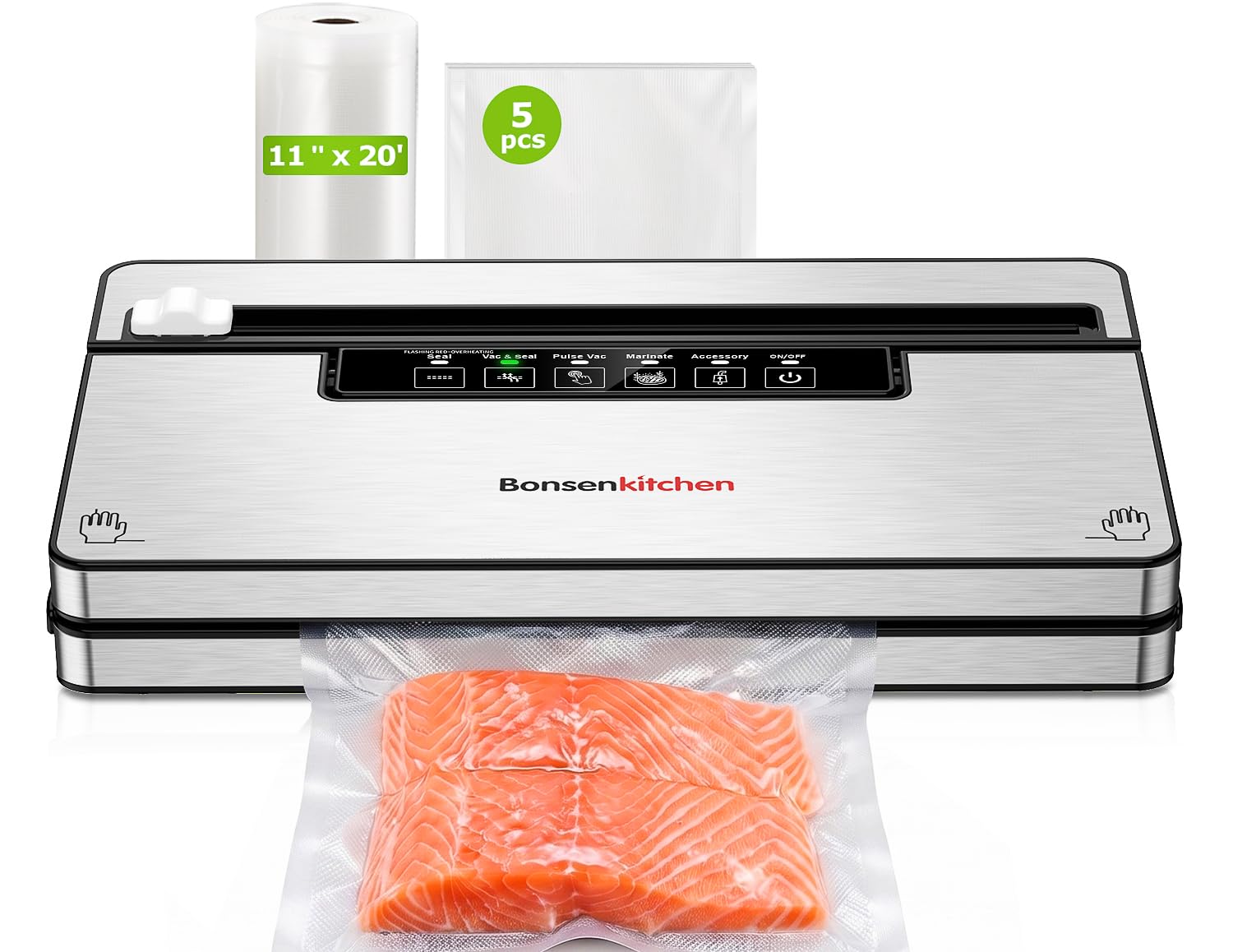
The budget pick with a drip tray, so wet meat does not ruin the party.
Sealing juicy food is where cheap machines embarrass themselves, and the fix here is mechanical rather than electronic: a removable drip tray that catches the liquid before it reaches the pump. Pull it out, rinse it, done. That single feature is why this entry-level machine handles raw chicken and marinated cuts without the mess. It pairs with 80 kPa of suction and a 5-mode system including pulse vac, so you can dial down the pull on chips and crank it up on a steak.
It is genuinely compact and easy to live with. Owners consistently single out how simple it is to run and how well it tucks onto a crowded counter — the compact footprint is one of the few aspects that lands unanimously positive. Built-in roll storage and a cutter mean you size bags without hunting for scissors, and the bag clamp keeps the opening from shifting mid-seal. It runs 40 bags in 15 minutes, which for a mid-week top-up is plenty. The kit includes 5 pre-cut bags and an 11 x 20-foot roll, and it carries 3-year coverage.
Where this one asks for patience is the heat bar and the seal itself — owner feedback splits on sealing performance and suction, which is the honest trade for the entry-level position. It is not the machine for someone bagging four whole salmon in one afternoon; it is the machine for a household that seals a few portions at a time and wants a drip tray to protect the internals. On raw pull it sits below the FRESKO V2’s 95 kPa, a 19% gap in the FRESKO’s favor, and that shows up on a stuffed bag. Short pulses on wet food get the best out of it.
The tray advantage: a removable drip tray plus 80 kPa suction and pulse vac is a serious wet-food setup for an entry-level machine.
The honest split: sealing and suction are mixed in owner reports — budget it as a portion-at-a-time sealer, not a bulk workhorse.
Best fit: a small kitchen sealing a few wet portions at a time, with the drip tray as insurance.
Not the one for: marathon sessions where the heat bar never gets a rest.
4. POTANE Precision Vacuum Sealer Machine, 8-in-1 Easy Presets

Eight presets and a sloped top aimed at keeping juice out of the seal.
The sloping top is the detail that tells you someone thought about wet food. When you vacuum a piece of meat, liquid gets pulled toward the bag opening; angling the lid sends that juice back down and away from the heating wire. That is a quiet engineering choice, and it works alongside the four operation modes and four vacuum modes — eight presets that let the machine adapt to dry, moist, soft, and delicate food instead of making you guess. Enhanced heating wires and a brushless motor round out the build.
It compacts down easily, and the footprint is one of the things owners point to most when they say it stores well. The kit is unusually complete: a foam gasket replacement, a hose for canisters, a safety cutter, starter bags, and two bag rolls. It is ETL certified by Nationally Recognized Test Laboratories and backed by a 2-year no-hassle return plus a 5-year warranty — two years longer than the 3-year Bonsenkitchen coverage. On a crowded counter, the vertical-friendly shape earns its place.
The trade is that sealing and suction are mixed in owner feedback — some report clean welds on multiple bags without issue, others hit a cycle that does not pull as tightly. It is a preset-driven machine, so the honest advice is to match the mode to the food rather than leave it on a default: dry for pantry goods, delicate or soft for anything that would squash. It is a confident pick for someone who wants a lot of control without reading a manual twice.
Why it earns a spot
- 8-in-1 presets cover dry, moist, soft, and delicate food
- Sloping top keeps juice away from the heating wire
- 2-year no-hassle return and 5-year warranty
- Compact 14.25 x 5.5-inch footprint stores easily
- Starter kit with two rolls, hose, cutter, and gasket
What to know before buying
- Sealing and suction land mixed in owner reports
- Preset-driven — leave it on a default and results vary
- No widened seal strip spec published for the seam
Go this way if: you want preset control over every food type and the longest warranty in the lineup.
Keep looking if: you want the machine to decide the mode for you on every cycle.
5. FoodSaver Compact Vacuum Sealer Machine
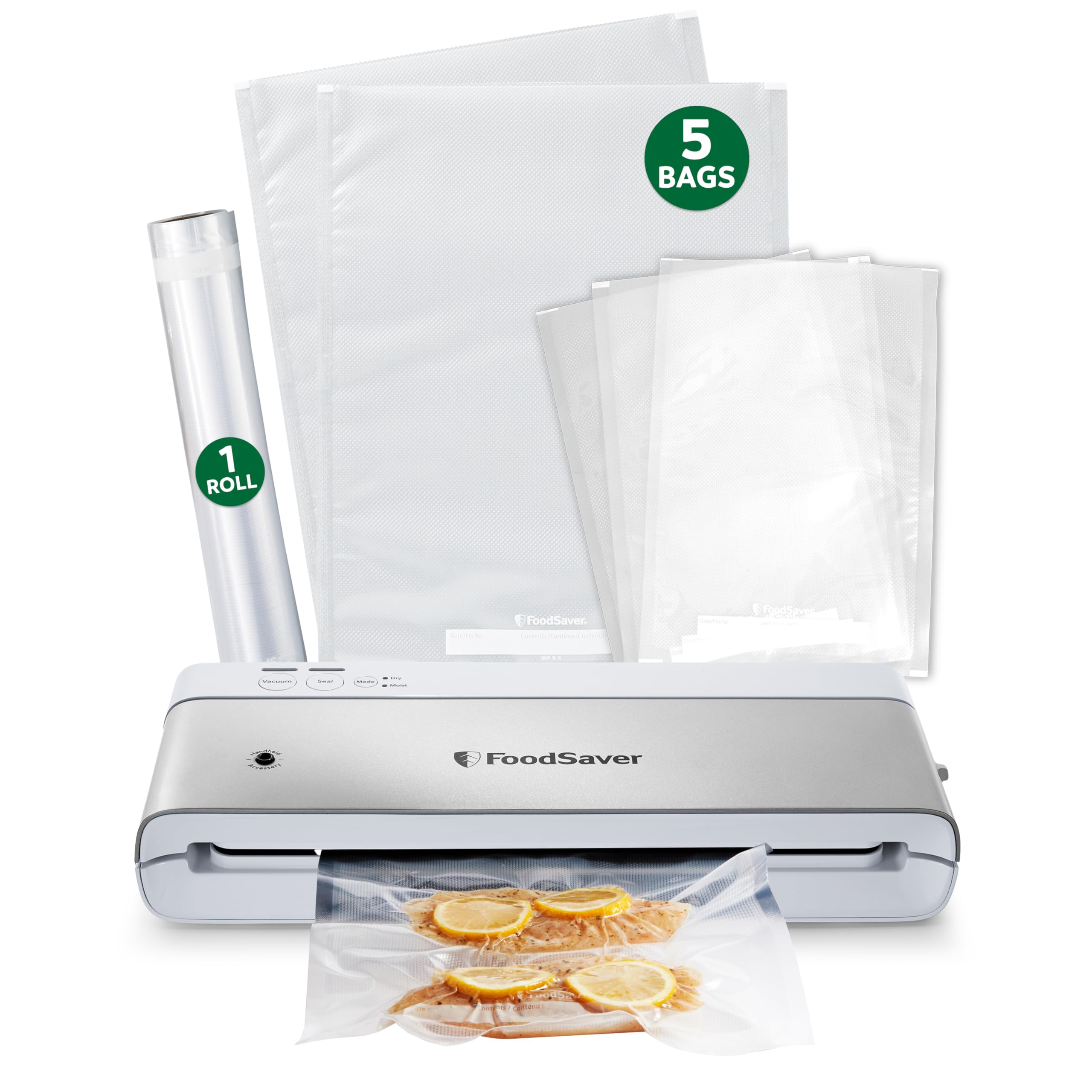
The brand-name sealer that stands on its side and opens up counter space.
Counter real estate is the reason this one exists. It stores vertically on its edge, and at 17.91 inches long by 5.59 inches wide by 10.24 inches tall it is designed to disappear against a backsplash instead of taking a wide horizontal bite out of your workspace. It pairs with dry and moist settings so you pick a mode instead of hoping the default handles a wet fish fillet. It keeps food fresh in the freezer up to 5x longer, seals with 35% less bag waste than earlier models, and ships with an 11 x 8-foot roll, 3 quart bags, and 2 gallon bags.
The brand ecosystem is a real consideration. This sealer connects to a FoodSaver Hand Held Sealer (sold separately) for sous vide or pantry storage, and it works with all other FoodSaver bags, rolls, and accessories. If you already own FoodSaver bags, that compatibility is worth a lot; if you do not, factor in that it is a closed ecosystem outside the aftermarket bag world.
Here is the honest part: functionality and quality come in mixed in owner reports, and sealing performance is the area that draws the most criticism — some find it does not vacuum and seal simultaneously or does not run the seal automatically. Those are real complaints, and this is not the machine for someone who wants push-button certainty without a learning curve. What it does offer is ease of use and a compact vertical footprint, and for a household already inside the FoodSaver ecosystem it remains a familiar, space-efficient choice.
Pick it because: it stands on its side, plays with every FoodSaver bag and accessory, and saves counter space.
Understand before buying: sealing is the complaint zone here — expect to learn the cycle, not just press and forget.
6. FRESKO Automatic Vacuum Sealer Continuous Seal
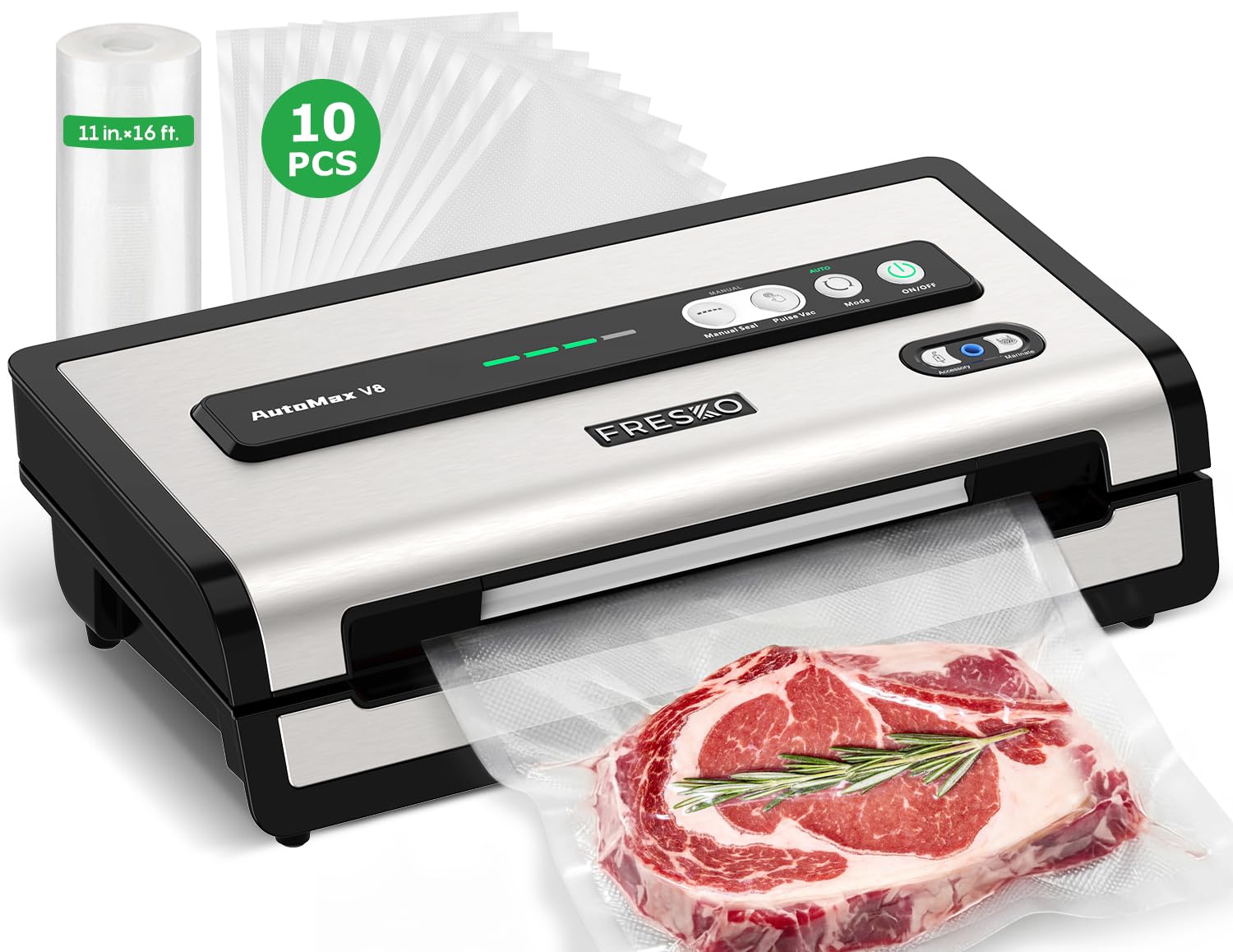
A bulk-session sealer that presses evenly for you, forty bags at a stretch.
Where most manual-press machines let you control the pressure, this one applies it for you — an even squeeze across an extra-wide seal strip so you do not get the thin spot that comes from holding one side harder than the other. That is the whole point of the automated design: a consistent weld, bag after bag. The 140W motor keeps the pace, and it turns out 40 bags in 20 minutes with no forced cooling breaks — a supermarket haul gets processed in one sitting without the machine gasping for a rest.
Hands-free is taken literally here. Close the lid and it detects the bag and starts automatically, with no button to press and no force to apply. Auto mode covers meats, cheese, vegetables, and dry goods; manual mode takes over for chips and berries; the external hose seals jars and speeds marinades. The built-in roll cutter and internal bag grip keep the bag aligned for a clean weld every time, and a removable drip tray handles cleanup. It is ETL certified, stainless steel built, and works with any textured bag, so you are not locked into overpriced refills. The kit has 10 pre-cut bags, an 11 x 16-foot roll, and 2 accessories.
The honest limit is that it is a young product with a smaller review base, so long-term durability is less proven than the machines with thousands of owners behind them. What is clear is quality and sealing — owners describe it as a machine that works as expected and creates good seals consistently. If you process bulk hauls and want to not think about your hands, this is the one that earns the extra spend.
The speed read: 40 bags in 20 minutes with an even-press wide strip is a genuine bulk-session machine, not a one-bag-at-a-time sealer.
The honest caveat: a newer model with a smaller track record — worth it for volume, but less proven than the household names.
For the bulk buyer: supermarket hauls and freezer-stocking sessions where a slow machine would never keep up.
Skip if: you seal a bag or two a week and want a model with years of durability history.
7. Vacuum Sealer for Food 95kPa Touch Display
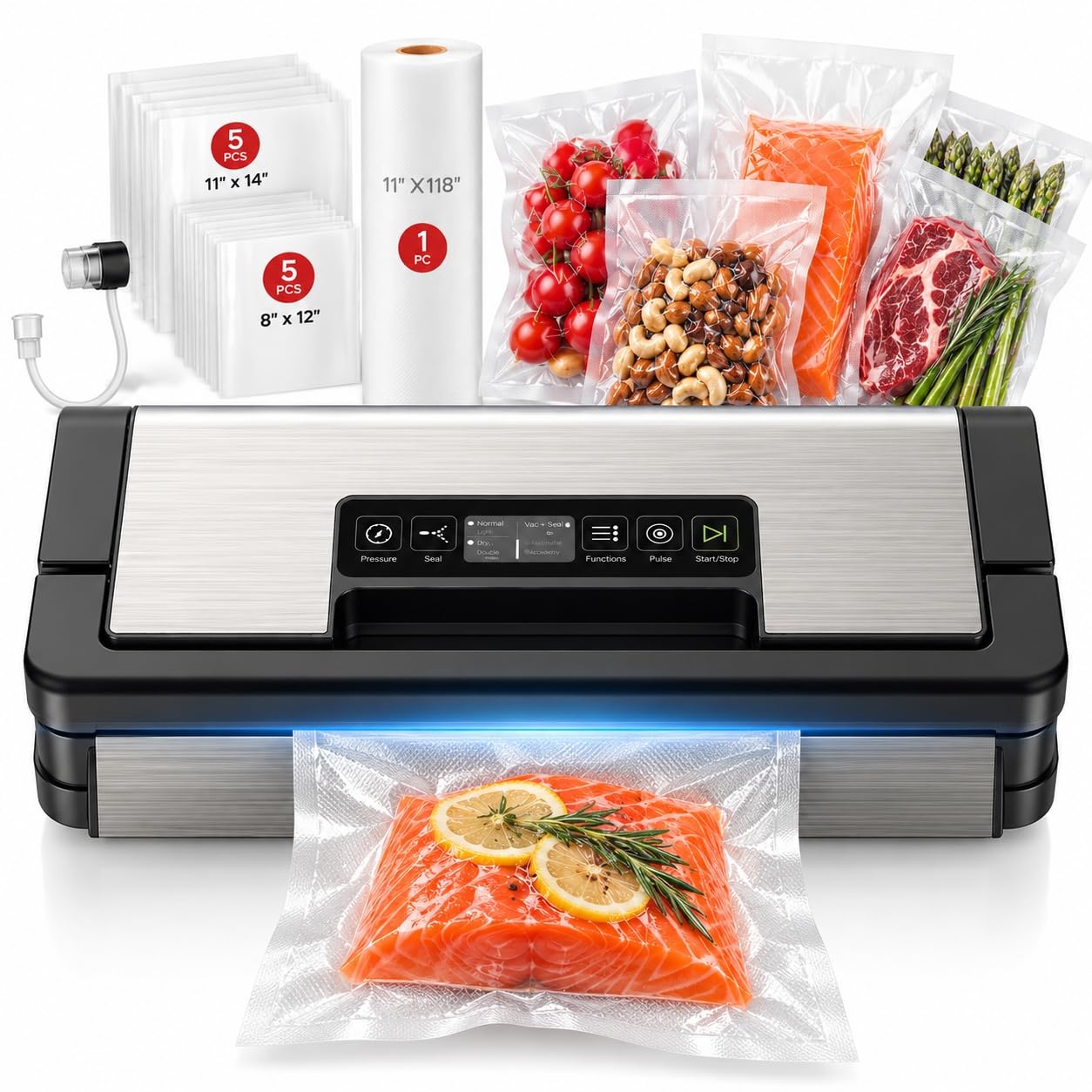
A double-sealed gunmetal machine that runs quiet enough for a sleeping house.
Two heating wires instead of one — that is the core of this machine. A double heat seal creates two welded bands across the bag, so if one seam has a weak spot the second one holds. It is a genuine redundancy, and it is aimed squarely at leaks. Add 95 kPa of suction on a 130W motor and you get fast cycles: dry food seals in 9 seconds, moist in 30. That is the spec that matters when you are bagging a week of lunches and want each one done before your coffee goes cold.
The quiet is a real feature, not a footnote. At under 70 dB it will not rattle the kitchen awake, which matters if you seal at night or in a small apartment. It is ultra-compact enough to take almost no counter space, has a touch display, and includes a built-in cutter plus roll storage so you cut any size bag on the spot without scissors. The starter kit includes 10 vacuum bags, and it carries a 1-year product support term.
Where you pay a little extra is proven volume — this is a newer model with a modest owner base, so it has less track record than the big-name machines. What the rating reflects is a machine that does what it says: strong suction, tight double-sealed bags, and quiet running. If you have been burned by a single-seam machine that leaked a freezer bag of shrimp, the second wire is the reason to consider this one over a single-strip sealer.
The seam argument: dual heating wires mean two welds per bag — a spare seam for the bags that would otherwise leak.
The honest note: newer and less proven, and it carries a shorter 1-year support term than the 3-year Bonsenkitchen machines.
Worth it for: anyone who seals at night, in a small kitchen, and wants a spare seam against leaks.
Consider another if: you want years of durability history and a longer support term.
Know the Specs
Suction Pressure (kPa)
kPa stands for kilopascals — a measure of how hard the pump pulls air out of the bag. A higher number means the plastic collapses tighter against the food, and that tighter collapse is what slows freezer burn. An 80 kPa machine is fine for dry goods and small portions; 95 kPa lifts the bags you see on the best automatic units. The practical effect: on an awkward, chunky cut of meat, the higher-kPa machine flattens the bag against the surface, so there is no pocket of air left to slowly dry the meat out.
Seal-Strip Width (mm or inches)
The heating strip is the metal bar that melts the bag shut, and its width is the size of the welded band holding your food inside. A wider strip is more plastic between the food and the air, which is how a machine keeps a good seal on a wet surface. You will see widths stated in millimetres (3.3 mm on the Bonsenkitchen VS5100) or decimals of an inch (0.2 inch on the FRESKO V2). Wet food needs the wide strip; dry rice and nuts will tolerate a thinner one.
Pulse Vac and Extended Seal
Pulse vac lets you pull suction in short bursts rather than letting the cycle run all the way. You use it on anything delicate or wet — chips, berries, soup — so the bag does not crush the food or suck liquid into the seam. Extended seal simply runs the heating strip longer, giving moisture time to be driven out of the weld before it closes. Together they are the wet-food toolkit, and you want both if raw meat is on your prep list.
Watts and Bag Throughput
Wattage is the motor’s power draw, and in a sealer it mostly speaks to speed and how hard the pump can pull: 135W and 140W machines sit at the fast end. But raw watts alone do not tell you how many bags you get through — throughput does. A machine rated for 50 bags in 20 minutes and one rated for 30 bags in 15 minutes are tuned for different sessions, and the larger number wins only if you seal in big batches. Match throughput to how much food you actually freeze, not to the biggest number on the page.
Common Questions
Can a food sealing machine seal wet meat without the juice ruining the seal?
Is 80 kPa suction enough or should I hold out for 95 kPa?
Do I have to use the same brand of bags as my sealer?
How long can food stay in the freezer after vacuum sealing?
What is pulse vac mode actually for?
Will a vacuum sealer fit under a kitchen cabinet or in a drawer?
Is a wider seal strip really worth paying more for?
Do I need a built-in bag cutter and roll storage?
How loud is a vacuum sealer, and does noise matter?
Can a vacuum sealer be used for sous vide cooking?
The Bottom Line
For most households the food sealing machine winner is the Bonsenkitchen VS5100 — the 3.3 mm widened seal strip and five modes (including pulse vac and extended seal) are what let it handle a wet steak without leaking, and that is the job that breaks lesser machines. If one-button simplicity is what you want, the FRESKO V2 closes the lid and takes over with 95 kPa of automatic suction. For bulk supermarket hauls, reach for the FRESKO V8-2 and its 40 bags in 20 minutes. And if you seal at night and want a spare seam against leaks, the double-sealed JLHSWENND VS9312 runs under 70 dB. The one thing worth remembering: a machine is only as good as its seal strip and the mode you pick, so match the strip width and the wet-food settings to what you actually freeze.
How we choose
We do not accept paid placement. Every pick is matched to a real buyer and a real use-case; we do not hands-on test units.
Sources
Specifications: manufacturer listings and product documentation. Review insights: verified customer reviews, as of November 2026. Pricing: not shown on this page (it changes often); check the current price via the retailer link.
As an Amazon Associate, Tactical Gear Guy earns from qualifying purchases. This does not affect which products we feature.