Specs are compiled from manufacturer listings and verified buyer reviews and can change over time — please confirm the key details on the product page before buying.
If your motorcycle, ATV, or lawn mower sits for weeks at a time, the battery quietly drains itself even when everything is switched off. A trickle charger (a small box that feeds a slow, steady current into the battery so it never goes flat) is the fix. The trick is buying one that stops charging at the right moment — a cheap unit that keeps pushing power will cook your battery instead of saving it. Below are the nine units worth your money, ranked so the strongest all-rounder sits first.
This guide is built by comparing the manufacturers’ published specifications and the patterns across verified customer reviews, so you get each pick’s real strengths and trade-offs instead of marketing spin.
You will see what each charger does in real garage life, which battery types it handles, and where the honest limits sit. Every pick below earns its place as a genuinely top rated trickle charger for keeping a stored battery alive through the off-season.
Top Picks

How To Choose The Best Top Rated Trickle Charger
Start with the battery you actually own, not the biggest number on the box. Amperage tells you how fast a charger pushes power back in — and for a maintenance job, slower is usually kinder to the battery.
Match amperage to battery size
A 750mA (milliamp) output like the Battery Tender Junior suits motorcycle and powersport batteries you mostly want to keep topped up. A 2A unit refills a larger car battery faster but needs to be smart enough to back off once the battery is full. Higher amperage is not automatically better here — overcharging is the real risk.
Look for a multi-stage program, not a dumb drip
A proper smart charger runs through stages — often described as bulk charge, absorption, and float mode — where float mode means it holds the battery at a safe resting voltage without pushing more current. That staged approach is what separates a maintainer from a basic trickle charger that just feeds current continuously.
Check battery chemistry compatibility
Most units handle flooded, AGM, gel, and VRLA lead-acid batteries. Lithium (LiFePO4) support is a separate feature — confirm it is listed before you plug into a lithium pack, because the wrong charging profile can damage it.
Decide if you need desulfation or force mode
Desulfation uses pulse charging (short bursts of current) to break down sulfate buildup on a neglected battery. Force mode lets you manually push charge into a battery that reads near zero volts, which standard chargers often refuse to touch. Neither is essential for routine winter storage, but both help rescue a battery that has been sitting dead.
Side-by-Side Comparison
| Model | Best For | Output | Voltage | Charging Stages | Amazon |
|---|---|---|---|---|---|
| Battery Tender Junior 12V 750mA★ Best Overall | Motorcycle and powersport storage | 0.75 A (750mA) | 12V | 4-step | Amazon |
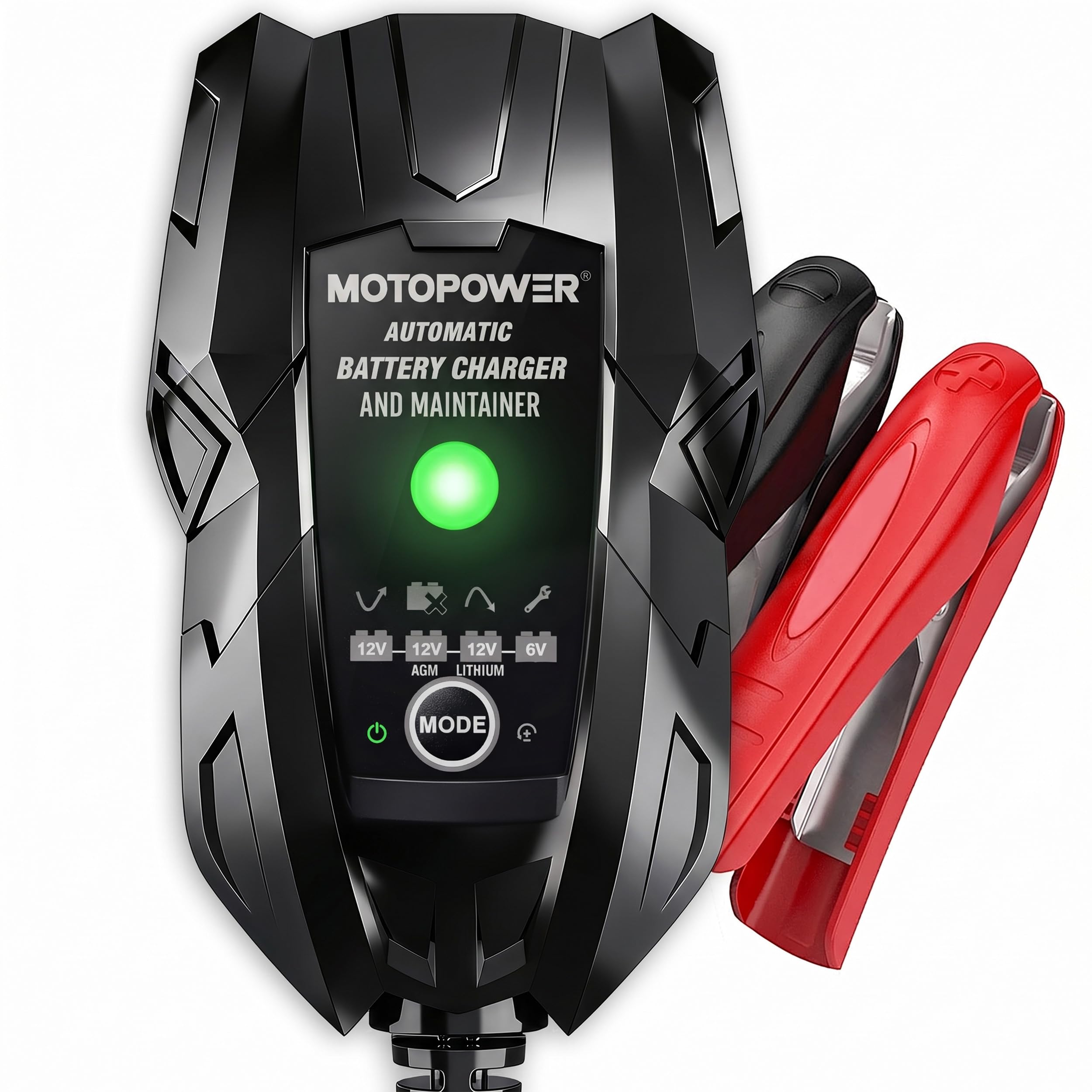
| MOTOPOWER MX1000Most Versatile | Mixed lead-acid and lithium fleets | 1 A | 6V / 12V | Staged with timer protection | Amazon |
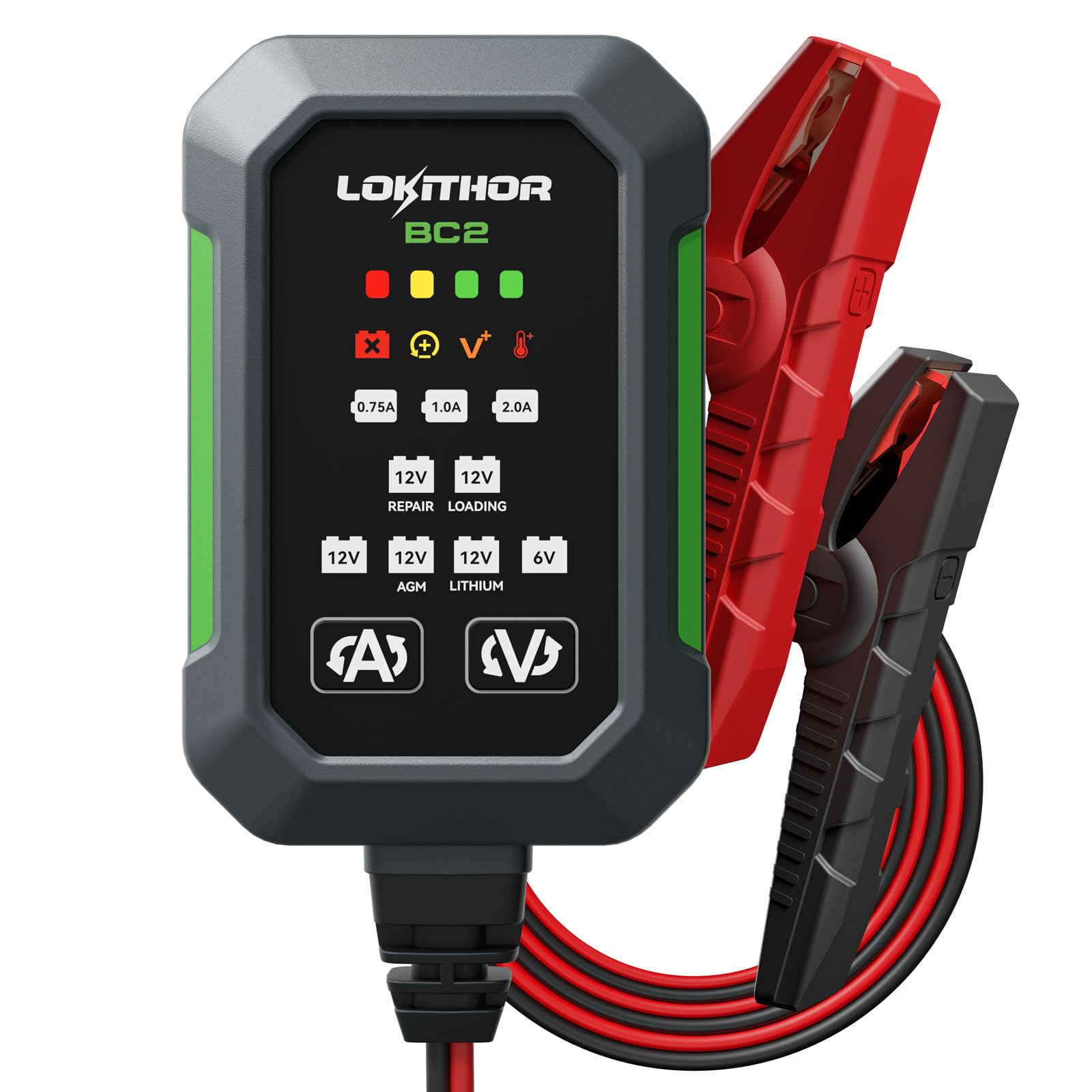
| LOKITHOR BC2Dial-In Current Control | Selectable-current flexibility | 2A / 1A / 0.75A | 6V / 12V | 10-stage | Amazon |
| Mroinge 1A [2-Pack] | Two vehicles, one purchase | 1 A | 12V | 4-step | Amazon |
| NOCO GENIUS1 | Rescuing deeply discharged batteries | 1 A | 6V / 12V | Multi-stage with desulfator | Amazon |
| Heagstat 2A 12V Smart Charger | Larger car batteries and LiFePO4 | 2 A | 12V | 4-step | Amazon |
| NOCO GENIUS2 | Faster recovery with premium build | 2 A | 6V / 12V | Multi-stage with desulfator | Amazon |
| TPE 6V/12V 1.5A Automatic | Plug-and-play Harley maintenance | 1.5 A | 6V / 12V | 5-step | Amazon |
| 12V Maintainer for Harley Davidson | Budget overnight charging | 1.5 A | 6V / 12V | 4-stage | Amazon |
Detailed Reviews
1. Battery Tender Junior 12V, 750mA Charger and Maintainer
Our pick — 4.5+★ from 50,000+ verified ratings; the strongest balance of quality and price.
The name that basically invented the motorcycle-tender category, and still the safest default.
The Battery Tender Junior pushes 750mA (0.75 amps) into a 12V battery, then steps down through a 4-step program — initialization, bulk charge, absorption, and float mode. In plain terms, it fills the battery, tops it off gently, and then holds it at a resting voltage instead of hammering it. For a bike or ATV that lives under a cover for the off-season, that staged approach is exactly what stops a battery from sulfating and dying.
What wins people over is the sheer consistency. Quality is the thing owners praise most, and it sits at 4.5+ stars across 50,000+ owners — a number you rarely see on a garage accessory. The unit’s own footprint is small, at roughly 3.3 x 1.3 x 2.4 inches and about 1 lb for the charger alone, so it tucks onto a shelf or hangs out of the way. A 12-foot output cord plus the included fused-ring terminal harness and alligator clips mean you can hard-wire a pigtail to the battery and just plug in whenever you park.
Here is the catch worth knowing before you buy. Compared with the Heagstat 2A charger further down, this one delivers 0.75A against the Heagstat’s 2A, so it is the slower of the two for reviving a flat battery in a hurry. That is also what makes it ideal for long-term care rather than rapid rescue. The other limit: it is a 12V-only maintainer, so if you split time between a 6V trail bike and a 12V car, you will want a dual-voltage unit instead.
junior sized 750mA
- 4-step program ends in float mode so a stored battery is never overcharged
- Spark-proof circuitry and automatic reversed hook-up detection keep connections safe
- Two-color status LED shows charge state at a glance
- 12-foot cord plus ring-terminal harness reaches hard-to-reach batteries
- Backed by a 5-year warranty and lifetime customer support
slow on big batteries
- 0.75A is slow for a fast recharge, which is the trade-off for gentle long-term care
- 12V-only, so 6V batteries need a different unit
small bike batteries: you own a motorcycle, ATV, or lawn mower and want one fuss-free maintainer you can plug in and leave for the season.
large deep cycles: you need to bring a completely flat car battery back quickly or you run both 6V and 12V equipment.
2. MOTOPOWER MX1000 Battery Charger
A dead-battery rescue kit that also happens to be a gentle everyday maintainer.
The MX1000 covers both 6V and 12V lead-acid batteries plus 12V lithium-ion (LiFePO4) packs, at a 1A output. That dual-voltage plus lithium support is genuinely useful if your garage holds a mix — a trail bike on one side and a car on the other — because one box handles the lot. It runs a full desulfation routine using pulse current, which breaks down sulfate buildup on a neglected battery, and it adds timer protection at each charging stage to shut down safely if a battery stops responding.
The standout capability is Force Mode. It lets you manually push charge into a battery reading down to zero volts — the kind that a standard charger simply will not detect or touch. It also charges batteries rated up to 30Ah and maintains batteries of any size. At around 300 g and flexing between 100 and 240VAC input, it travels easily if you maintain a boat or camper off-site.
The honest limit is amperage and track record. At 1A it is squarely a maintainer and slow-recovery tool, not a fast charger, and unlike the Battery Tender Junior above it does not have the same deep, years-long review base to lean on. It carries CEC, ETL, and UL specification listings, which speaks to the electrical safety side. Treat it as the pick for someone who values flexibility and rescue features over a long-proven brand legacy.
dual 6V and 12V: dual 6V/12V operation with lithium support, desulfation, and Force Mode for zero-volt batteries in one compact 300 g unit.
only one amp: 1A output makes it a maintainer first — a deeply drained car battery will take its time.
garage top ups: the owner juggling several battery types and chemistries who wants one charger that can also revive a dead one.
fast charging: you want proven long-term reliability data before committing — this is a newer model with a lighter review history than the front-runner.
3. LOKITHOR BC2 Car Battery Charger
Three current settings and ten charge stages — this one adapts to whatever is on your bench.
Most chargers lock in a single amperage; the BC2 gives you three — 2A for a quick top-up, 1A for routine daily maintenance, and 0.75A for smaller batteries. That adjustability is the real selling point, because you can match the current to the battery rather than hoping one speed fits all. It then runs a 10-stage charging algorithm that reads the battery’s condition in real time and adjusts power delivery from first diagnostics through final float maintenance.
It also brings a double-pulse repair mode: high-frequency, low-voltage pulses chip away at large surface sulfate deposits while low-frequency, high-voltage pulses work on stubborn deeper layers. For a battery that has been sitting neglected in a classic car, that is a genuine recovery tool. The loading (forced) mode lets it recover dead batteries down as low as 2V. A 55-inch DC cable plus 21.7-inch clamp cables with integrated M8 eyelet terminals make permanent mounting on a bike or ATV a plug-and-play affair.
The trade-off is straightforward — it is a compact but relatively new unit, so its longevity is not yet proven the way the long-running names are. Safety coverage is thorough, with spark-proof, short-circuit, reverse-polarity, overcharge, over-current, and overheat protection all present. If you like having control over your charging speed and want desulfation built in, this is a strong, compact 6V/12V choice.
mixed battery shelf: you want to choose your own charging speed, from a gentle 0.75A for small batteries up to 2A when you need it faster.
set and forget: you prefer a charger with a decade of real-world track record behind it.
4. Mroinge 1A 12V Smart Battery Charger & Maintainer [2-Pack]

The practical answer for a two-vehicle garage — two full maintainers in one package.
The Mroinge 2-pack simply solves a problem single chargers cannot: two batteries that both need to stay topped up at the same time. Each unit delivers 1A at 12V through the same 4-step program — initialization, bulk charge, absorption, and float mode — so neither bike, mower, nor ATV gets left out over the off-season. With a 12-foot total DC cord plus big battery clips and O-ring terminals, hooking up either vehicle is a two-minute job.
Reliability is the trait buyers value here, with customers reporting it just works with no fuss and keeps batteries charged. It handles the full lead-acid range — flooded, GEL, AGM, VRLA, deep-cycle, and maintenance-free — and the multi-layer safety set includes spark-proof connections, reverse-polarity protection, overcharge protection, and over-temperature protection. Each unit is compact at roughly 3.45 x 2.29 x 1.3 inches, so both tuck away on a shelf.
You give up desulfation (a pulse mode that can revive a sulfated battery) and lithium support. This is a pure lead-acid maintainer with no recovery mode for a battery that reads near zero volts. For routine storage of healthy batteries, though, two units at this level is hard to argue with. Each carries a 2-year warranty, which adds confidence on a value pick.
gentle 1A maintainer: two automatic 1A maintainers that keep both your stored vehicles ready, with no need to unplug one to charge the other.
no display screen: no desulfator and no LiFePO4 setting, so neglected or lithium batteries need a different tool.
winter storage: you keep two motorcycles, mowers, or ATVs on trickle and want them covered without buying a second unit later.
quick recharge: you need to revive a battery from near zero volts or you run a lithium pack.
5. NOCO GENIUS1 Smart Battery Charger

A compact 1A charger built to drag a neglected battery back from the dead.
The GENIUS1 does something most basic tenders cannot: it charges batteries from as low as 1 volt, and Force Mode lets you push power into one that reads a full zero volts. That makes it a genuine recovery tool for a bike or mower battery that sat all winter without a tender. It handles both 6V and 12V lead-acid (AGM, gel, SLA, VRLA) and lithium-ion (LiFePO4) packs, and its precision pulse charging detects and reverses sulfation and acid stratification to bring a tired battery back toward health.
An integrated thermal sensor (a built-in thermometer that adjusts the charge to the surrounding temperature) separates it mechanically. It backs off in summer heat and compensates in the cold rather than overcharging or undercharging. A 110-inch DC cable with clamps and integrated eyelet terminals gives generous reach, and it comes with a 3-year warranty. It is a proven name, with a deep base of owners behind it.
Be realistic about the speed, though. It is a 1A unit with a stated 10-hour charge time, so it is a maintainer and slow rebuilder rather than a fast charger. There are also scattered reports of units failing over time — real but not the norm, since it still holds 4.0+ stars across 60,000+ owners. If you want the capability to rescue a dead battery with temperature-aware charging and can live with a slow pace, this is a smart pick.
tiny genius footprint
- Charges from as low as 1 volt and Force Mode recovers zero-volt batteries
- Thermal sensor adjusts charging to ambient temperature to protect against overcharging
- Pulse charging reverses sulfation and acid stratification
- Handles both 6V/12V lead-acid and LiFePO4 batteries
- 110-inch DC cable and 3-year warranty
one amp ceiling
- 1A output and a 10-hour charge time make it slow by design
- A minority of buyers report units that stopped working — plan on the warranty
motorcycle trickle: anyone who needs to revive a deeply discharged battery and wants temperature-aware charging in a compact footprint.
car batteries: speed is your priority and you want a flat car battery back to full in a hurry.
6. Heagstat 2A Smart Battery Charger

Twice the charging muscle of a 750mA tender, aimed at larger car batteries.
Where the Battery Tender Junior tops out at 0.75A, the Heagstat pushes 2A into a 12V battery — that faster output suits a larger car or truck battery that needs a real refill rather than a slow top-up. It runs the familiar 4-step program ending in float mode, so once the battery is full it settles into safe maintenance. Charging capacity spans batteries from 7-85Ah, and it will maintain batteries from 7-150Ah, which covers most passenger cars, boats, and RVs.
The connection design is convenient: it plugs into a standard 120V outlet, is spark-proof at the lead, and is reverse-polarity protected so it refuses to supply power unless the connection is correct. A 12-foot cable with battery clips and O-ring terminals and a quick-disconnect harness make hooking up easy. Smart LED indicators show state of charge and diagnostics even while it is in maintenance mode. It also carries LiFePO4 support alongside flooded, GEL, AGM, VRLA, and deep-cycle lead-acid.
The thing to weigh is compatibility nuance — most owners have it working well and keeping car batteries charged overnight without overcharging, but a minority hit snags with certain battery types. If you know your battery chemistry and match it to the listed range, it is a solid, higher-output maintainer. The 2A speed is the draw, and it stays safe once the battery reaches full.
daily driver upkeep: your battery is a larger car or marine unit and you want faster topping-up than a 750mA tender offers.
heavy duty use: you run an unusual battery chemistry — double-check it is on the supported list before you commit.
7. NOCO GENIUS2 Smart Battery Charger

The GENIUS1’s bigger sibling — same rescue tricks, more output to get there faster.
The GENIUS2 takes the GENIUS1’s playbook and doubles the output to 2A. That means the same deep-recovery talents — charging from as low as 1 volt, or Force Mode to revive a zero-volt battery — arrive with more punch to shorten the wait. It handles 6V and 12V lead-acid (AGM, gel, SLA, VRLA) and lithium-ion (LiFePO4), runs precision pulse charging to reverse sulfation and acid stratification, and includes the same thermal sensor that tunes charging to ambient temperature.
The build is genuinely more substantial: an 80-inch DC cable with clamps and integrated eyelet terminals, a 72-inch AC cable, plus a mounting bracket with velcro strap and screws so you can fix it permanently in a garage or trailer. A stated 10-hour charge time and a 3-year warranty round out the package. It holds 4.5+ stars across 19,000+ owners, and the compact build is smaller than previous generations.
The speed is also mixed, with some finding it slow for a large battery. Still, if you want the recovery toolset and a bit more oomph plus the mounting hardware, this is the premium way to do it.
doubles the amps: double the 1A output of the GENIUS1 at 2A, plus a mounting bracket and longer cables so it can live bolted in your garage.
costs more: a slow pace for big batteries and reliability reports that are mixed — the 3-year warranty is your backstop.
bigger batteries: you want the full NOCO recovery features with faster output and permanent-mount hardware.
tiny cells: you are happy with a 1A pace — the GENIUS1 gets the same core job done for less.
8. TPE 6V 12V 1.5A Automatic Trickle Charger

A 1.5A smart charger with a safety timer built specifically to protect marginal batteries.
The TPE charger outputs 1.5A across both 6V and 12V lead-acid batteries, running a five-step program — qualification, soft start, bulk charge, absorption, and maintenance. An MCU chip (a small control processor) manages the whole sequence automatically, and because the unit is under 10 ounces, you can tuck it in a bag and take it to the boat or the shed.
The 72-hour safety timer is the standout feature: it starts counting whenever the charger is on and protects a marginal battery from overcharging. If the battery reaches the proper voltage within that window, the charger switches itself to float mode. It is rated to charge lead-acid batteries up to 40AH and maintain batteries up to 60AH, and reliability is the trait most praised — it works well as a Harley motorcycle trickle charger and on sealed toy-vehicle batteries. The multi-protection suite covers overvoltage, overcurrent, short-circuit, reverse-connection, and overheat.
There is one mixed signal worth flagging honestly. While many owners mention it keeps batteries fully charged, a portion noted batteries that died after around six months — so this one benefits from keeping an eye on the battery rather than plugging in and forgetting entirely. For a plug-and-play 1.5A maintainer at this level, it is capable, just worth watching.
lawn mower: a Harley or powersport owner who wants an automatic, timer-protected 6V/12V maintainer that travels easily.
smart charging: you plan months-long unattended storage — check on the battery periodically rather than leaving it fully solo.
9. 12V Battery Charger Maintainer Trickle

The entry-level pick that still gives you selectable 6V or 12V and both clamp styles.
For a straightforward overnight top-up, this budget unit outputs 1.5A and lets you switch between 6V and 12V. It runs a 4-stage smart program controlled by a microprocessor, and it handles the full lead-acid lineup — AGM, gel, VRLA, SLA, wet cell — so it will work with a car, motorcycle, or ride-on toy battery alike. Two connector types come in the box: battery clamps for quick jobs and ring terminals for a more secure permanent hookup.
What it does well is the basics — functionality and quality are the traits owners appreciate most, and it charges a car battery overnight without fuss. Setup is simple, and for anyone who just wants to keep a seldom-used vehicle’s battery from dying, it does that job without extra bells. Its footprint is small and light, so storing it between uses is no hassle.
Where it sits behind the leaders: there is no desulfation, no force mode for a zero-volt battery, and no lithium support — it is a pure lead-acid maintainer. If your battery is healthy and just needs regular topping up, that is enough. If it has been sitting dead for a season, you will want a recovery-capable unit like the NOCO GENIUS1 or the MOTOPOWER MX1000 instead.
cruiser owners: you want a simple, low-cost 6V/12V maintainer for routine overnight charging of a healthy battery.
dual sport bikes: your battery is deeply discharged or you need desulfation or lithium support.
Know the Specs
Amperage (750mA, 1A, 2A)
Amperage is how fast a charger refills the battery. A 750mA (0.75A) output is gentle and ideal for maintenance of motorcycle and powersport batteries, while 2A refills a larger car battery faster. For long-term storage, a lower amperage is usually safer because it produces less heat and stress on the cells. Pick 750mA for a stored motorcycle battery and 2A for a drained car battery you need back fast.
Charging Stages and Float Mode
A staged charger runs through phases — initialization, bulk charge, absorption, and float — instead of pushing one constant current. Float mode is the important end state: it holds the battery at a resting voltage without adding more charge, so you can leave the unit connected for months. A charger without float mode risks overcharging a battery left on for the season, so check for a full multi-stage program.
Desulfation and Force Mode
Desulfation uses pulse charging to break down sulfate buildup that forms on a neglected battery’s plates, helping restore lost capacity. Force mode lets a charger push power into a battery that reads down to zero volts, which standard units often refuse to touch. Both are recovery features — unnecessary for a healthy battery you keep topped up, but valuable for reviving one that sat dead for a long stretch.
Battery Chemistry Compatibility
Most trickle chargers support flooded, AGM, gel, and VRLA lead-acid batteries. Lithium (LiFePO4) support is separate and not universal, because these packs need a different charging profile. Before buying, confirm the charger lists your exact chemistry. Running a lithium battery on a lead-acid-only charger can damage it, so this check matters more than raw amperage for anyone with a modern lithium pack.
Common Questions
Can I leave a trickle charger connected to my motorcycle all winter?
What is the difference between a trickle charger and a battery maintainer?
Will a trickle charger work with an AGM or gel battery?
Can a trickle charger recharge a completely dead battery?
Does a higher amp charger charge my battery faster?
Do I need a different trickle charger for a 6V battery?
Will a trickle charger damage a lithium LiFePO4 battery?
Why does my trickle charger have a safety timer?
Can I hard-wire a trickle charger to my motorcycle permanently?
Do trickle chargers work on lawn mower and ATV batteries?
The Bottom Line
The clear winner is the Battery Tender Junior — a 4-step, float-mode maintainer that generations of riders trust, and the safest bet for keeping a stored motorcycle or mower battery alive through the off-season. If you need to revive a dead battery, the NOCO GENIUS1 with its Force Mode is the tool. And for a two-vehicle garage, the Mroinge 2-pack covers both batteries in one go. Whichever you pick, a multi-stage maintainer with float mode is what keeps a stored battery alive.
How we choose
We do not accept paid placement. Every pick is matched to a real buyer and a real use-case; we do not hands-on test units.
Sources
Specifications: manufacturer listings and product documentation. Review insights: verified customer reviews, as of November 2026. Pricing: not shown on this page (it changes often); check the current price via the retailer link.
As an Amazon Associate, Tactical Gear Guy earns from qualifying purchases. This does not affect which products we feature.