Specs are compiled from manufacturer listings and verified buyer reviews and can change over time — please confirm the key details on the product page before buying.
You want a big-screen movie night without paying big-screen prices, and the fastest way to get there is a proper projection surface instead of a painted wall. A real screen fixes the two things that make wall projection look flat: dull whites and hot spots. Below you get nine genuinely different options, from a foldable tripod screen you can carry to the backyard to a fixed acoustic frame you build into a dedicated theater room.
This guide is built by comparing the manufacturers’ published specifications and the patterns across verified customer reviews, so you get each pick’s real strengths and trade-offs instead of marketing spin.
The differences that matter are the gain (how much light the surface bounces back), the viewing angle (how far off-center you can sit), and how the thing goes up and down. Here is my full breakdown of the tv projector screen.
Top Picks


How To Choose The Best TV Projector Screen
The biggest mistake first-time buyers make is assuming the screen is just a white rectangle. It is really an optical component, and its surface is doing half the work your projector paid for. Get the surface and the mounting style right and a mid-range projector can look genuinely cinematic. Get them wrong and a premium projector looks washed out.
Gain and viewing angle fight each other
Gain tells you how much light the screen bounces back toward you compared with a plain white reference. A 1.5 gain surface (the Paris RHÔNE) throws a punchier image, so the picture holds up in a room with some light leaking in. The catch: higher-gain surfaces narrow the balance, so seats far off to the side lose brightness. A 1.1 gain surface (the Elite Screens pull-down and electric models) gives you a flatter, more even image across a wide 180-degree spread, so side seats stay bright. Match the number to your seating, not to the biggest figure on the listing.
Motorized, manual, fixed, or tripod
A fixed frame stays taut forever and gives you the flattest surface, but it owns that wall. A pull-down rolls away when you want the wall back and is the practical choice for a multi-use living room. A motorized screen adds a remote so you never tug a handle, which matters if the screen hangs high. A tripod screen folds into a bag and follows you to the yard or the campsite.
Throw distance and projector type decide compatibility
Some screens are built for standard long-throw projectors only, and the listing will say so plainly. Elite Screens flags its 100-inch manual and 125-inch electric models as not compatible with short-throw or ultra-short-throw projectors. Ultra-short-throw setups need an ambient-light-rejecting surface and a frame built for the steep angle, like the NothingProjector ALR model. Check this before anything else; it is the one spec you cannot work around.
Side-by-Side Comparison
| Model | Best For | Screen Size | Type | Gain | Amazon |
|---|---|---|---|---|---|
| Paris RHÔNE 100″ with Stand★ Best Overall | Backyard and travel movie nights | 100 inches | Tripod / portable | 1.5 | Amazon |
| Pyle 84″ Manual Pull-DownBest for Small Rooms | Small rooms and tight walls | 84 inches | Manual pull-down | — | Amazon |
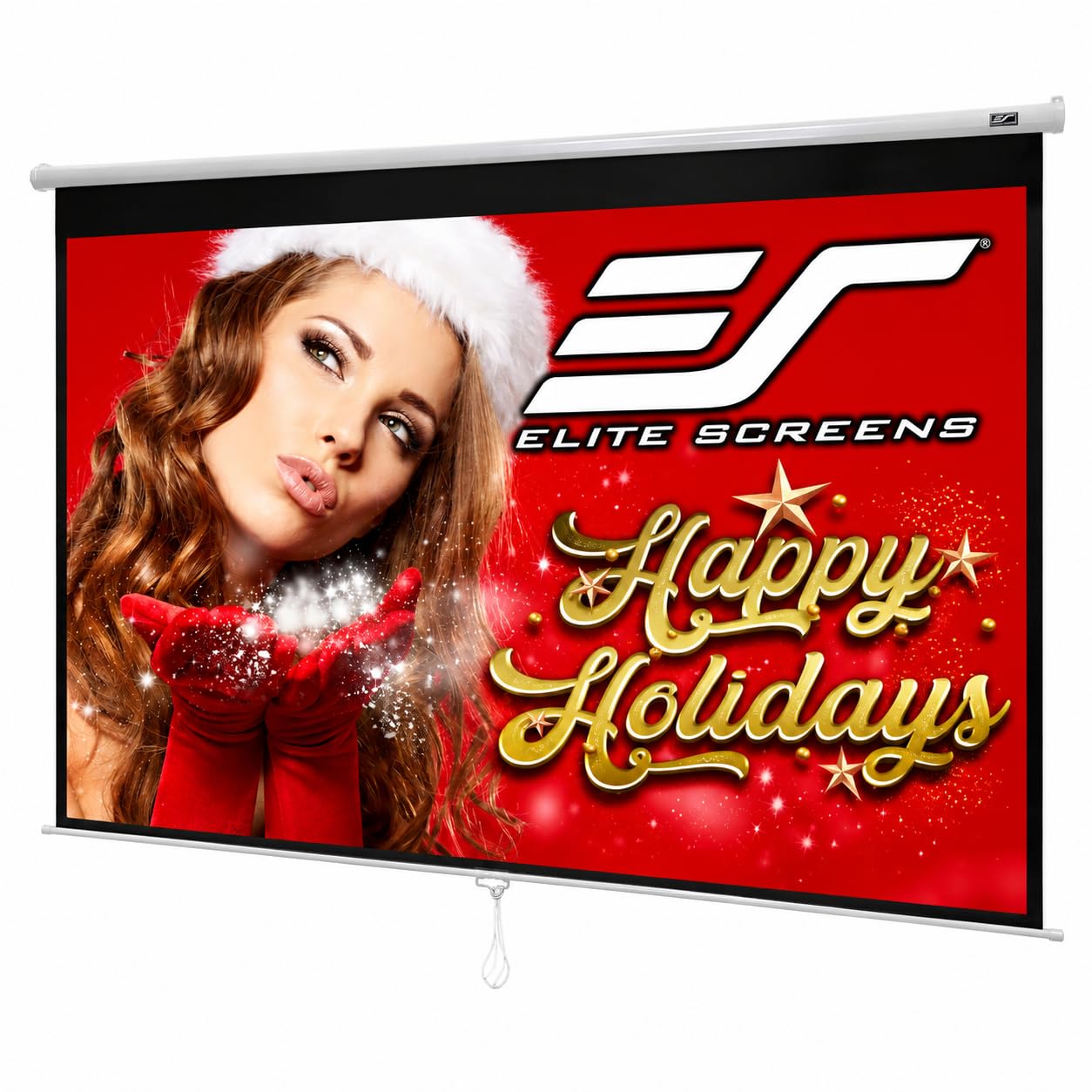
| Elite Screens M100XWidest Seating Spread | Wide-seating presentations | 100 inches | Manual pull-down | 1.1 | Amazon |
| 120″ Motorized Screen | Ceiling-hung living room setups | 120 inches | Motorized | 1.1 | Amazon |
| VIVOHOME 150″ | Big rooms and event spaces | 150 inches | Motorized | — | Amazon |
| AWOL Valerion 135″ | Permanent theater wall | 135 inches | Fixed frame | 1.3 | Amazon |
| Silver Ticket STR-169135 | Sound-through theater builds | 135 inches | Fixed frame, acoustic | 1.15 | Amazon |
| Elite Screens ELECTRIC125H2 | Remote-controlled dedicated rooms | 125 inches | Motorized | 1.1 | Amazon |
| NothingProjector ALR 120″ | Bright rooms and UST projectors | 120 inches | Motorized floor-rising ALR | — | Amazon |
Detailed Reviews
1. Paris RHÔNE Projector Screen with Stand, 100-inch
Our pick — 4.5+★ from 350+ verified ratings; the strongest balance of quality and price.
A 100-inch 1.5-gain PVC screen on a folding aluminum tripod that packs into a carry bag for the yard.
Most screens force a choice: mount it permanently or accept a flimsy image. This Paris RHÔNE sidesteps that with a 100-inch PVC surface on an aluminum X-shaped tripod, and its 1.5 gain is the highest figure on this list. For you, that means a punchier image in a room that is not pitch black — the backyard-at-dusk scenario where a low-gain surface goes grey and lifeless.
That 1.5 gain carries a trade-off worth naming. The listed viewing angle is 160 degrees, but a high-gain surface concentrates light toward the middle, so seats pushed far to the side lose some pop. The surface is also glossy, which can pick up a reflection if a lamp sits directly opposite. Neither is a fault — it is the physics of a bright surface — but it tells you this screen is happiest with the audience clustered in front of it.
What earns its keep
- The 1.5 gain is the brightest surface here — useful for dusk, patios, and rooms with some ambient light.
- 64-inch to 85-inch tripod height covers floor-level and table-height viewing from one screen.
- Three ground nails plus the aluminum X-tripod mean it stands up to a breeze instead of folding over.
- Breaks down into a carry bag — the only screen here that genuinely travels.
Where it asks for patience
- Glossy high-gain PVC concentrates light toward center, so far-side seating dims.
- The surface reflects a direct lamp or window behind the audience.
The screen to buy first: anyone who wants one screen for the living room, the yard, and the occasional trip — setup runs about two minutes across three steps.
Know before you commit: the glossy finish is a light-magnet, so plan your seating in front of it rather than wrapping around it.
2. Pyle Manual Pull-Down Projector Screen, 84-inch
An 84-inch pull-down that gives a cramped bedroom or office a real screen without eating the wall.
At 84 inches diagonal, this Pyle hands you a 50.3-inch by 67.3-inch viewing area — small enough for a spare bedroom, large enough to feel like a movie. It is the compact answer to a wall you cannot dedicate to cinema. The auto-locking mechanism means you pull it to the height you want and it holds there, so a low sofa and a high bar stool both get a workable picture.
Compared with the 150-inch VIVOHOME further down, this is a very different animal: pocket-sized by comparison and far easier to fit above a desk. The matte white surface with a black border frame is the part that does the real work here — the black masking surrounds the image so your eye reads deeper contrast than the bare wall ever gave you.
Fair warning on the retraction: it is the one part buyers struggle with. The screen can fight you on the way back up, and a few units arrive with a rip after the first pull. That is the honest cost of a manual mechanism at this tier. Treat the pull as a slow, guided motion rather than a yank, and most owners never hit the problem.
The compact math: 50.3″ x 67.3″ of viewing area fits rooms where a 100-inch screen would hit the ceiling fan — the deciding spec if your wall is short.
The one habit to build: guide the screen up gently. The retraction spring is the weak link, so a slow hand is what keeps it rolling for years.
Reach for this if: your room is small, your projector is standard long-throw, and you want the screen to disappear during the day.
Look elsewhere if: you plan to raise and lower it dozens of times a week — a motorized model saves you that motion.
3. Elite Screens 100-Inch Manual Pull-Down, M100X
If your seats wrap around the room, this 180-degree surface keeps every one of them bright.
Here is the number that sets this Elite Screens apart: 180 degrees of viewing angle off a 1.1 gain MaxWhite 2 surface. That is the widest spread in this lineup, and it is why the screen suits a church hall or a classroom where people sit at the edges. Compare that with the 160-degree figure on the 120-inch motorized screen — the difference is exactly the kind of geometry that decides whether side seats stay usable.
The black backing stops light punching through from behind, and the four-sided black masking soaks up projector overshoot, so the image sits in a clean frame rather than bleeding at the edges. It is listed as supporting 8K and 4K Ultra HD, HDR, and Active 3D, and the pull-down locks at multiple heights with a lanyard on the handle so you can reach it when the housing is mounted high.
The catch lives in the mechanism and the mounting kit. Retraction is slow and measured rather than brisk, and the included drywall anchors are the weak point — a few owners end up swapping them for sturdier hardware. The housing also demands suitable structural support, so plan where the studs are before you hang it. Mount it into solid wood and this screen rewards you quietly for years.
Why it holds the edge on seating
- 180-degree viewing angle is the widest here — edge seats stay bright.
- Black backing plus four-sided masking keeps the image crisp at the borders.
- Locks at multiple heights, with a lanyard so a high mount is still reachable.
- Listed as 8K/4K Ultra HD, HDR, and Active 3D ready.
What to plan around
- Retraction is deliberate and slow rather than quick.
- The included drywall anchors are worth replacing with heavier hardware.
- Not compatible with short-throw or ultra-short-throw projectors.
The call: a wide-room screen where the audience sits across the front rather than in a tight center block.
Rule it out when: your projector is a short-throw or ultra-short-throw model — the listing rules it out explicitly.
4. 120-Inch Motorized Projector Screen with Remote
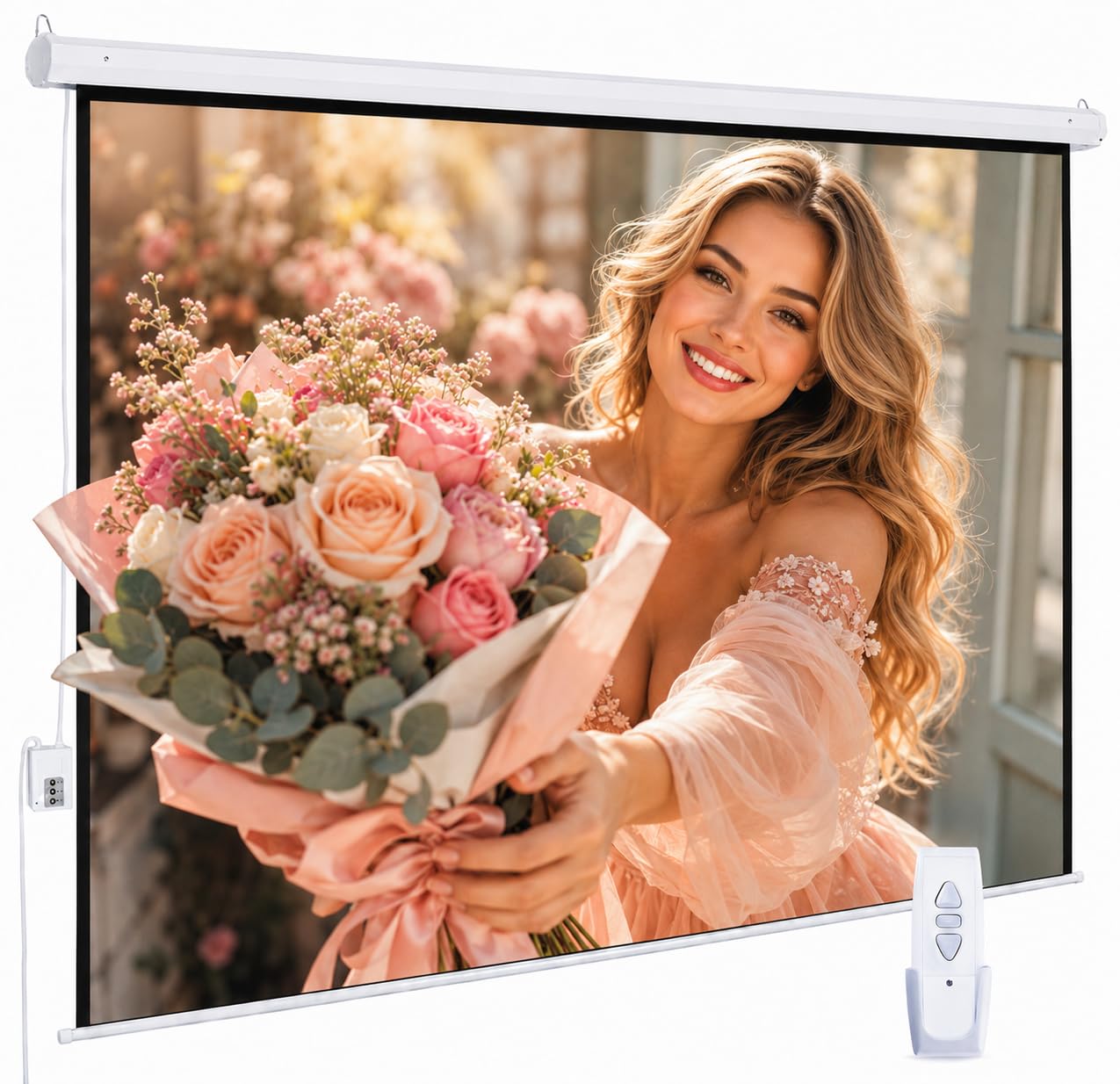
A 120-inch motorized drop with an RF remote and integrated switch, so you raise and lower it without a handle.
A 120-inch diagonal gives you a 104.8-inch by 58.7-inch view — big enough that a living room starts to feel like a small theater. The draw here is the electric mechanism: a prewired power cord, an integrated switch for drop and rise, and a radio-frequency remote that works from across the room. If your ceiling mount sits high, that remote is the difference between a screen you actually use and one you leave up.
The 160-degree angle and 1.1 gain matte white surface put it in the same optical family as the Elite pull-downs, and it handles LED, LCD, and DLP projectors. The matte finish is listed as yellow-staining-free and wrinkle-free, which is what keeps the image uniform instead of showing bright bands where a fold set in.
The honest friction here is a chemical smell when the screen is new, and it lingers for a while in a closed room. Air it out with the screen lowered for a couple of days and it fades. There is also a mixed note on the size matching the listing, so measure your ceiling run before you commit to a 120-inch drop.
What makes it easy to live with: the switch and RF remote both adjust drop and rise, so nobody has to stand on a chair to start movie night.
Air it first: that new-screen smell needs a couple of days of open windows with the screen down — a small annoyance traded for an electric drop.
Best fit: a living room with a high ceiling and a standard long-throw projector, where you want the screen gone at the press of a button.
Think twice if: the room has no ventilation window — the initial smell will outstay your patience.
5. VIVOHOME 150-Inch 16:9 Motorized Projector Screen
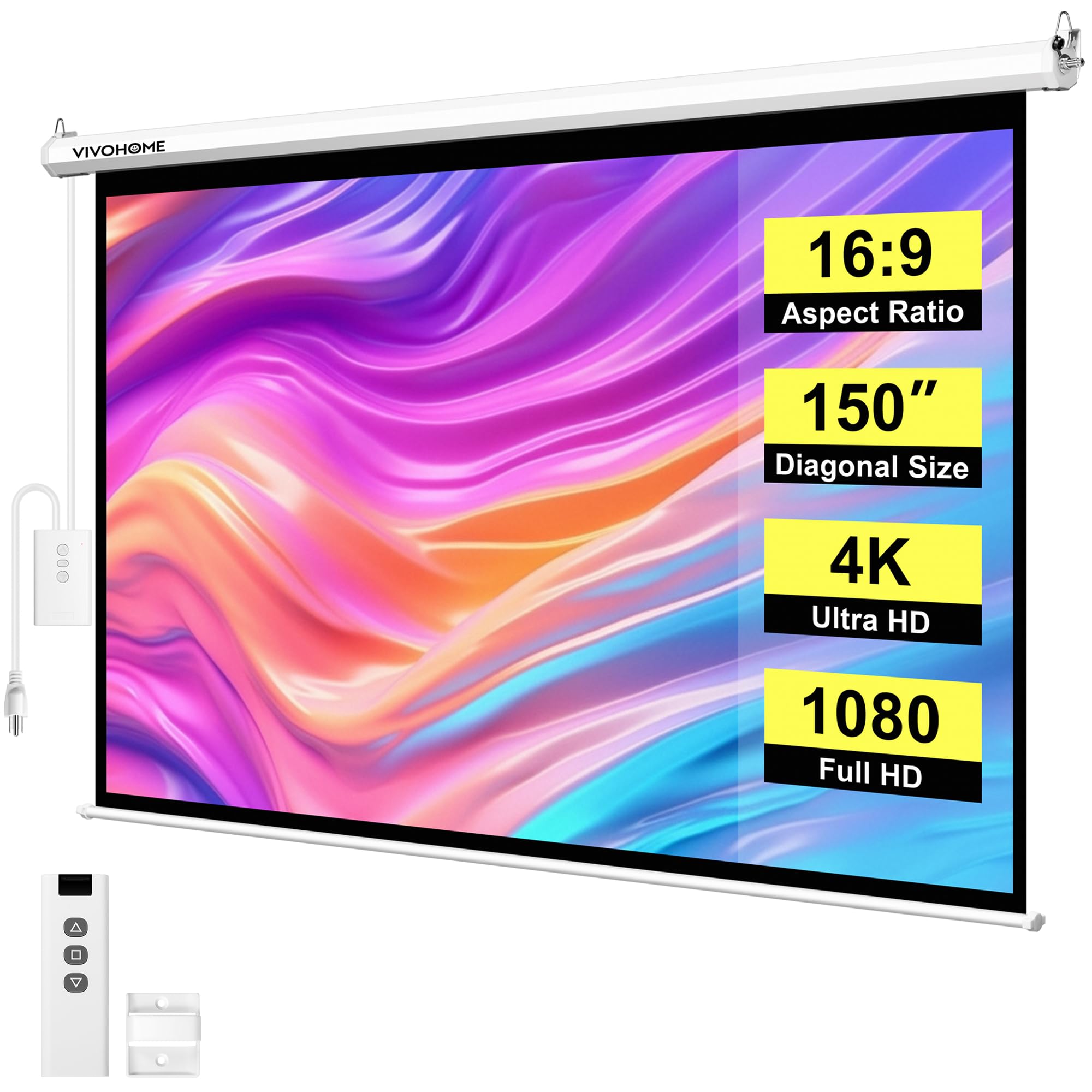
A 150-inch motorized drop with a 130.7-inch by 73.6-inch viewing area for big rooms and event spaces.
Nothing else here comes close to this VIVOHOME’s scale. It gives you a 130.7-inch by 73.6-inch viewing area on a 150-inch diagonal, and the listing puts the best viewing distance at 13 feet. Compare that to the 84-inch Pyle above — the size gap is the whole story, and it is enormous. If you have a long bare wall in a big room, a wedding venue, or a classroom, this is the screen that fills it.
The remote reaches up to 82 feet, which means you can drop the screen from the back of the room or the top of a lecture hall. The power cord uses an aviation connector so it can install on either side, and the 8mm metal casing plus three-layer waterproof PVC are built to resist creasing in transit. Wall or ceiling, horizontal or vertical — the mounting kit covers solid and soft surfaces.
The size comes with real caveats. The remote control is the weak point — a notable share of buyers never receive one, and reported stability issues mean the screen can move or resist retracting. Picture quality draws genuinely split reactions, from excellent to poor. The new-screen odor shows up again here and clears with airing. None of this makes it a bad screen; it makes it a screen you buy for maximum size and inspect on arrival.
The big-room argument
- 150-inch diagonal with a 130.7″ x 73.6″ viewing area — by far the largest here.
- Remote works from up to 82 feet and can be wall-fixed.
- Three-layer waterproof PVC resists creases and temperature swings.
- Mounts on wall or ceiling, horizontal or vertical, with screws for both surfaces.
The catches worth knowing
- The remote does not always arrive in the box — confirm it on delivery.
- Reported stability issues mean the retraction can stick.
- New-screen odor needs airing out, same as the rest of the motorized group.
Choose it for: sheer size in a large space where a smaller screen would look lost.
Open the box fast: check the remote is present and the drop runs cleanly while you can still raise it with the seller.
6. AWOL Valerion 135-Inch Fixed Frame Projector Screen
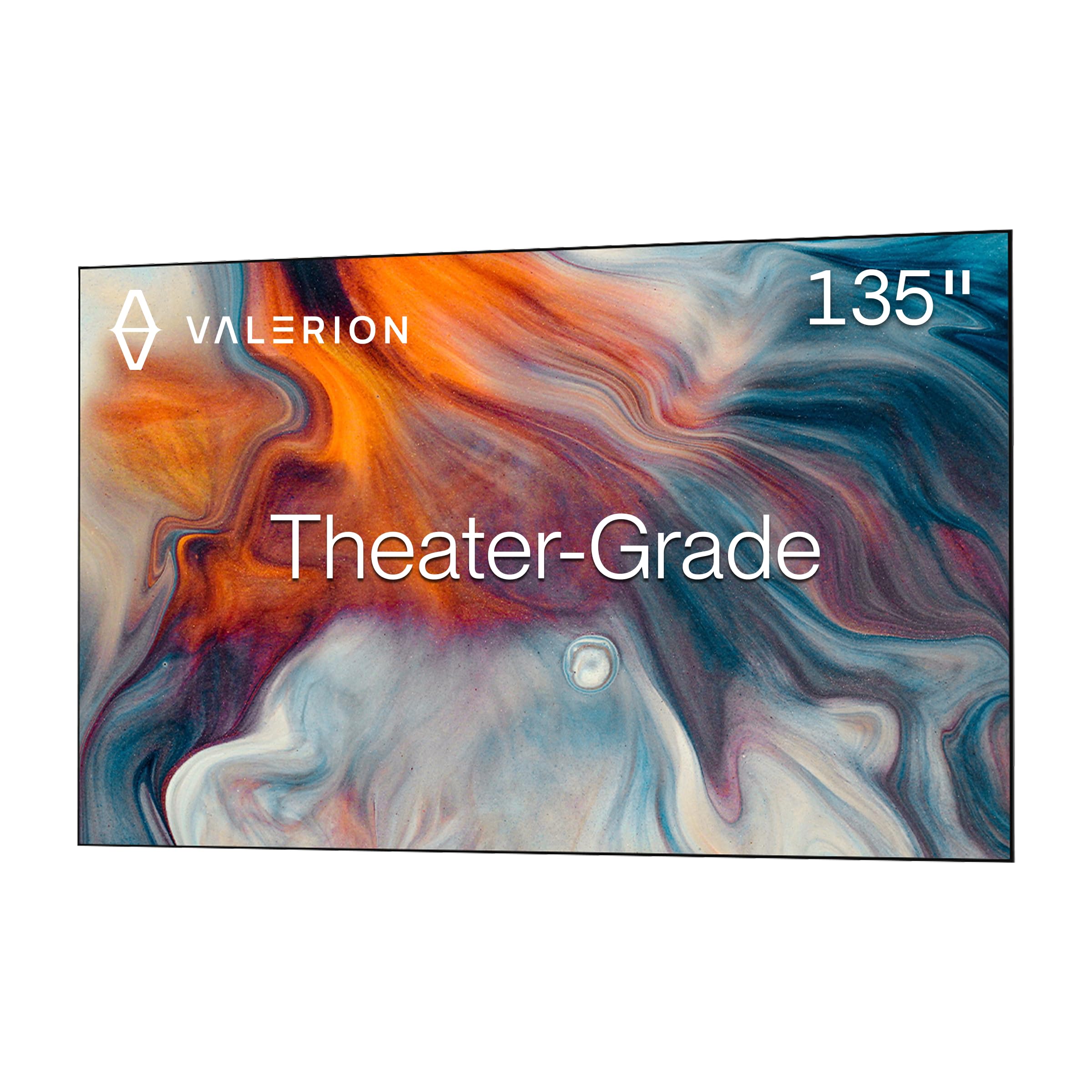
A fixed 135-inch matte white PVC frame at 1.3 gain that stays permanently taut with no rolling mechanism.
A fixed frame is the answer when the wall belongs to the theater. This Valerion gives you 135 inches of matte white PVC on a 122.5-inch by 70.25-inch frame, with a 1.3 gain that sits between the bright 1.5 tripod screen and the 1.1 gain Elite models. It is the middle ground for a darkened room that still wants some punch.
Because nothing rolls up, there is no spring to fight and no crease to develop. The surface is listed as wrinkle-free, which is the whole reason to go fixed — a permanent taut sheet gives you a stable image with no retraction lottery. The 170-degree half-gain viewing angle also means off-center seats hold up well. It works with long-throw, short-throw, and ultra-short-throw projectors, so you have flexibility on where the projector sits.
The one thing to plan for is commitment. A fixed frame cannot move out of the way, and the pick comes in sizes from 100 inches up to 220 inches, so measure the wall carefully before ordering. This is not a screen for a room that hosts a couch and a dinner party; it is a screen for a room that is already a theater.
The flattest option: no retraction, no creases — a taut fixed PVC surface gives you an image that stays stable year after year.
Measure twice: a 135-inch frame at 122.5″ x 70.25″ dominates a wall, so pick your size against the room, not against ambition.
Worth it when: you have a dedicated wall and want a surface that never needs pulling down or fussing with.
Not for you if: the room does double duty as a guest space — this frame does not disappear.
7. Silver Ticket STR Series 135-Inch Fixed Frame, Acoustic

A 135-inch fixed frame with a woven acoustic surface that lets a center speaker sit behind the picture.
This Silver Ticket solves a problem the other fixed frames cannot: where the center speaker goes. Its woven acoustic surface lets sound pass through, so a speaker mounts behind the screen and the dialogue still comes from the picture rather than the floor. For a home theater with real surround, that is a fundamental upgrade, not a luxury. The 1.15 gain and 160-degree viewing angle keep the brightness even across a wide seating spread.
The 135-inch diagonal gives you a 66-inch tall by 117.5-inch wide viewing area, and the aluminum frame is finished in light-absorbing black velvet. That velvet edge is the detail that makes the image look crisp — a dark border trains your eye to read more contrast. The tensioning rod system is designed to hold the surface taut, and the top and bottom brackets let you nudge the frame horizontally to center it on the wall.
The build-through process is where owners split. Assembly is the recurring gripe — a slow job with instructions some find vague. The result is worth the evening, but plan an unhurried session and watch the step-by-step video first. One compatibility note as well: the listing warns that some ultra-short-throw projectors are not compatible with this STR frame.
Why theater builders pick it
- Acoustically transparent surface lets a center speaker sit behind the image.
- 135-inch diagonal with a 117.5″ x 66″ viewing area at 1.15 gain.
- Black velvet-wrapped beveled frame sharpens the perceived contrast.
- Tensioning rods keep the surface flat without a rolling mechanism.
Settle in for assembly
- Putting it together is slow, and the instructions divide opinion.
- Some ultra-short-throw projectors are not compatible with this frame.
Built for: the dedicated theater where speakers sit behind the screen and the frame stays on the wall permanently.
Set aside a night: the assembly is a project in itself, so start it with time to spare and the video guide open.
8. Elite Screens Spectrum RC1 Remote, 125-Inch Motorized
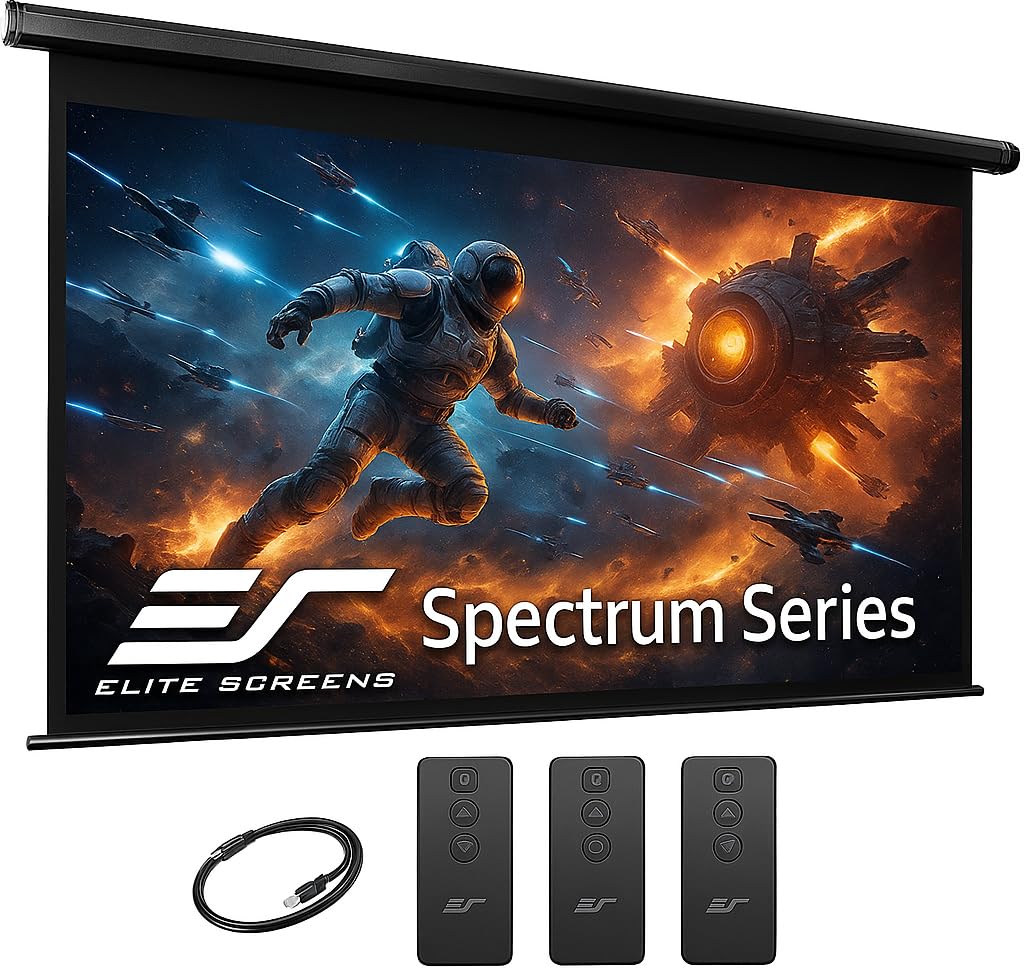
A 125-inch motorized drop with IR and RF remotes, a wall box controller, and a programmable height stop.
Elite Screens goes further than a bare remote here. You get both an infrared and a radio-frequency remote, a wall box controller with a built-in IR sensor, an RJ50 port for a wired 12-volt trigger, and a programmable vertical drop position. In plain terms: the screen can drop to the exact height you saved, every single time, and multiple screens can be controlled separately on different channels. Compare the 180-degree viewing figure with the 160-degree 120-inch motorized model — the wider spread keeps off-center guests in the bright zone.
The MaxWhite 2 surface is black-backed, 1.1 gain, and listed as 4K Ultra HD and Active 3D ready, with soap-and-water cleaning for the odd fingerprint. You get a 61.3-inch by 109-inch view inside a 74.5-inch by 120.5-inch overall frame. The casing arrives fully assembled, so installation is a hang-and-play job rather than a build.
The remote is the part that divides people — some love the three-remote setup, some get a unit that will not respond. There is also a mixed report on internals sounding fragile when the motor runs. One hard compatibility limit worth highlighting: this screen is not compatible with short-throw or ultra-short-throw projectors, so match it to a standard long-throw unit.
Set it and leave it: the programmable drop stop and 12-volt trigger mean the screen lands at your saved height without any adjusting.
The compatibility line: standard long-throw only. If you are running an ultra-short-throw projector, this screen is not the one.
The fit: a dedicated room with a standard long-throw projector, where you want the screen to drop to a set height on every cue.
Check first: confirm your projector type before ordering — short-throw and ultra-short-throw setups are ruled out.
9. NothingProjector Motorized ALR Screen 120-Inch

A 120-inch motorized ALR screen that rises from a floor base, so there is no wall mount and no drilling.
Every other screen here assumes you can darken the room. This one is designed for the opposite. Its ambient light rejection (ALR) surface is tuned to reject ceiling light and daylight, so a bright living room still delivers a legible picture instead of a grey haze. If your room has windows you cannot block, this is the technology that changes the outcome, and the 170-degree viewing angle keeps the image even for a spread-out audience.
The form factor is the other half of the story. This screen rises from the floor on its own base, so there is no wall mounting and no drilling. It retracts when idle to reclaim the space, and the height is adjustable with the remote or an app from a single press. It will also sync wirelessly with the projector to rise when the projector powers on and retract when it powers off, so the whole thing runs on its own.
The 4K UHD-ready ST Carbon Black surface is built for high-brightness and laser ultra-short-throw projectors specifically, so pair it with the right light engine. And the one recurring frustration is installation guidance — the instructions leave people wanting, even though the physical setup is less demanding than a wall mount. The sound benefit of the micro-perforated surface, with 0.4mm perforations, is note for anyone planning speakers behind it.
The bright-room answer: ALR technology rejects ceiling light and daylight, which is the single feature that makes daytime viewing possible at all.
The trade-off for the money: this is the premium end of the group, and the manual and app instructions do not match the price. Budget patience for setup.
Made for you if: your room cannot be darkened and your projector is an ultra-short-throw or laser unit.
skip it if: you have a standard long-throw projector — the ALR surface is built specifically for the steep UST angle.
Know the Specs
Gain (1.1 vs 1.3 vs 1.5)
Gain tells you how much light the surface reflects back toward the audience, referenced against a plain white standard. A 1.5 surface like the Paris RHÔNE bounces more light forward, which helps when a little daylight or a lamp is competing with your projector. A 1.1 surface like the Elite Screens pulls and electric models sends less light but spreads it more evenly, so off-center seats stay bright. In a fully dark room, gain matters far less than surface flatness and viewing angle, so do not pay up for gain you cannot see.
Viewing Angle (160 vs 170 vs 180 degrees)
Viewing angle is how far off to the side you can sit before the image dims noticeably. A 180-degree spread like the Elite 100-inch keeps edge seats bright in a wide room. A 160-degree spread like the 120-inch motorized screen and the Silver Ticket frame is a tighter cone, so the audience should sit more toward the center. Match the angle to the room’s seating, not to the biggest number on the listing.
Pull-Down vs Motorized vs Fixed Frame
A pull-down rolls into a housing and gives you the wall back, but it brings a spring mechanism you have to handle gently. A motorized screen adds a remote so nobody has to reach a high handle, and models like the Elite 125-inch let you save a drop height. A fixed frame gives you the flattest, most stable surface with no moving parts, at the cost of permanent wall space. An acoustic fixed frame like the Silver Ticket goes one further and lets sound pass through.
Aspect Ratio and Resolution Labels
A 16:9 screen matches most films and TV shows, while a 16:10 like the Elite 100-inch adds a little height for presentations and documents. Resolution labels — 4K, 8K, HDR, Active 3D — describe what the screen can display without losing detail, but your projector has to produce those signals first. The screen will not add resolution your projector does not have.
Common Questions
What does screen gain actually mean for brightness?
Will a short-throw or ultra-short-throw projector work with any of these screens?
Is a fixed frame screen really that different from a pull-down?
Do I need a screen if I already have a blank white wall?
How do I stop a pull-down screen from creasing or ripping?
What is an acoustically transparent screen for?
Which screen size should I pick for my room?
Do motorized screens need a special power setup?
Can I use a 4K or 8K projector with these screens?
Why do some new screens have a chemical smell?
The Bottom Line
One screen that works in the living room and the yard: buy the Paris RHÔNE 100-inch with stand. Its 1.5 gain and travel bag cover the most ground of any pick here. Spend on the NothingProjector ALR only if your room cannot be darkened and your projector is ultra-short-throw (it sits inches from the wall). And if you are building a real theater with speakers behind the screen, the Silver Ticket STR earns its slow assembly night.
How we choose
We do not accept paid placement. Every pick is matched to a real buyer and a real use-case; we do not hands-on test units.
Sources
Specifications: manufacturer listings and product documentation. Review insights: verified customer reviews, as of November 2026. Pricing: not shown on this page (it changes often); check the current price via the retailer link.
As an Amazon Associate, Tactical Gear Guy earns from qualifying purchases. This does not affect which products we feature.