Specs are compiled from manufacturer listings and verified buyer reviews and can change over time — please confirm the key details on the product page before buying.
Buying a 1 L Buchner funnel is mostly a decision about one thing: the frit, the porous glass disc at the bottom of the bowl that actually does the filtering. Get the pore grade wrong and you either wait all afternoon for liquid to crawl through or watch fine crystals slip straight past into the flask. This guide sorts the real 1000 mL options by what each one filters well, so you can match the funnel to your chemistry instead of guessing.
This guide is built by comparing the manufacturers’ published specifications and the patterns across verified customer reviews, so you get each pick’s real strengths and trade-offs instead of marketing spin.
One honest note before the picks: not every listing here is a strict 1000 mL funnel, because a few are kits where the 1000 mL flask does the measuring. That is the nearest same-type option for the same job, and each entry says exactly what you get. Here is how the field shakes out on the 1 l buchner funnel shelf.
Top Picks

How To Choose The Best 1 L Buchner Funnel
A Buchner funnel is a flat-bottomed glass or ceramic bowl with a perforated plate inside and a tube underneath. You drop filter paper on the plate, pour your mixture in, and pull vacuum through the tube so liquid is sucked down into a flask below. The solids stay on top. Everything about picking one comes back to three numbers: the frit porosity, the joint size, and the glass rating.
Start With The Frit Grade, Not The Bowl
The frit is the sintered disc that filters without needing paper, and its grade is listed in microns (μm), a unit meaning one thousandth of a millimeter. Coarse grades around 80~120 μm let liquid move fast and catch bigger crystals. Fine grades around 15~40 μm are slower but hold back much smaller particles that would otherwise cloud your filtrate. Match the grade to your smallest solid: a coarse frit under fine precipitate just passes it through.
Check The Joint Before You Buy
The 24/40 marking is a standard taper joint: 24 millimeters across the wide end, 40 millimeters of ground length. It is what lets the funnel seat into a matching Erlenmeyer or filtering flask without a rubber adapter. If your flask is a 24/40, a funnel with the same joint drops straight in. If not, you are shopping for adapters.
Read The Glass Rating For Heat
Borosilicate glass is chosen because it shrugs off temperature swings that would crack ordinary glass. The published withstanding limits here run from 200°C to 250°C. That ceiling matters when you pour a still-warm solution in — stay under it and thermal shock is not your problem.
Side-by-Side Comparison
| Model | Best For | Capacity | Frit Pore Size | Joint | Amazon |
|---|---|---|---|---|---|
| StonyLab Borosilicate Glass Buchner Funnel 1000ml, G2★ Best Overall | All-round default | 1000 ml | G2 40~80 μm | 24/40 | Amazon |
| QWORK 1000ML Buchner Funnel KitBest Starter Kit | First-time buyers | 1000 ml | 80 mm ceramic funnel | Rubber plug | Amazon |
| Deschem 1000ml 24/40 Glass Funnel, 3# Fine FritFine-Filtration Value | Fine precipitates | 1000 ml | 15-40 Micron | 24/40 | Amazon |
| Labasics G3 Fine Frit, 24/40, 1000 ml | Small-particle recovery | 1000 ml | G3 15~40 μm | 24/40 | Amazon |
| Labasics G2 Medium Frit, 24/40, 1000 ml | Wide-mouth heavy pours | 1000 ml | G2 40~80 μm | 24/40 | Amazon |
| YINGMALE 1000 mL Buchner Kit with Handheld Pump | No-house-vacuum labs | 1000 ml flask | Ceramic funnel | 9 rubber stoppers | Amazon |
| StonyLab Buchner Funnel with Fine Frit, 1L | Tight pore work | 1 L | G3 15~40 μm | 24/40 | Amazon |
Detailed Reviews
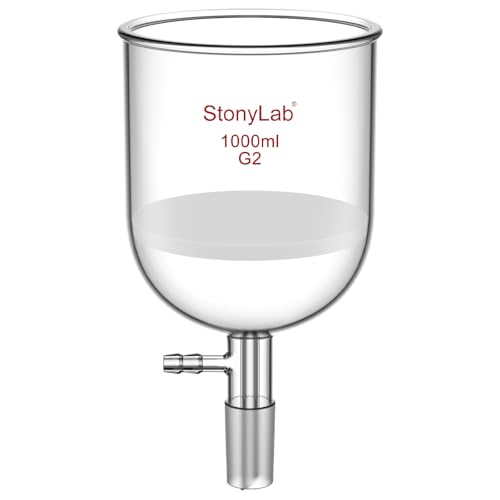
1. StonyLab Buchner Filtering Funnel 1000ml G2
Our pick — 4.5+★ from 100+ verified ratings; the strongest balance of quality and price.
A 40~80 μm G2 frit that handles routine precipitates without filter paper.
If you only buy one funnel for a general lab setup, this is the one to take: a 1000 ml bowl carrying a G2 frit rated at 40~80 μm. That pore range sits in the middle of the scale, so it lets liquid pull through quickly while still catching the bulk of a normal precipitate. You get the speed of a coarser disc without losing the solids you came for.
The bowl is borosilicate glass with a 24/40 taper joint, meaning it drops into any matching 24/40 Erlenmeyer or filtering flask without an adapter. The wide end measures 11.3 centimeters across, so a standard 113 mm filter paper circle seats inside the rim. The serrated vacuum tubulation under the bowl is cut with ridges that grip the hose, which keeps your vacuum line from slipping off mid-filtration.
Its heat ceiling is 200°C, which is lower than the 250°C the Labasics G2 further down reaches — 50°C less headroom on hot solutions. For room-temperature filtrations that gap never shows up. StonyLab also notes the funnel should not touch hydrofluoric acid, hot concentrated phosphoric acid or concentrated alkaline solutions, and back it with a 1-year limited manufacturer warranty.
What works in your favor
- G2 40~80 μm frit handles most routine precipitates without needing filter paper.
- 24/40 joint seats straight into a matching flask, no adapter shopping.
- 11.3 cm wide mouth takes standard 113 mm filter circles.
- Serrated tubulation gives the vacuum hose a grip so it stays put.
Where it asks for care
- 200°C limit is under the 250°C some competitors allow.
- Not suited to hydrofluoric acid or concentrated alkaline solutions.
- Glass this thin demands gentle handling and immediate cleaning after use.
Reach for this if: you want one dependable 1000 mL funnel for general crystallisation and precipitate work at room temperature.
Look elsewhere if: your protocol runs hot solutions above 200°C or involves the aggressive acids StonyLab warns against.
2. QWORK 1000ML Buchner Funnel Kit Filter Flask Set
A 1 L filter flask, 80 mm ceramic funnel and rubber plug in one order.
Most people buying their first Buchner setup forget they need a flask to catch the liquid. This kit closes that gap: a 1000 ml borosilicate 3.3 filter flask with a sidearm, plus an 80 mm ceramic funnel and a connected rubber plug to marry the two. The glass is industrial-quality, built thick to take temperature swings, and the sidearm is where your vacuum line attaches.
Clear graduation marks run up the side of the flask, so you can read how much filtrate you have collected without pouring it into a beaker. Everything is dishwasher safe, which makes cleanup a load of dishes rather than a scrubbing session. What wins people over here is the sheer amount of kit the set brings — a full filtering station rather than one part of it.
The one thing to size up front is the mouth: the wide end measures 8 centimeters across, noticeably narrower than the 11.4 cm you get on the Labasics funnels. Expect a smaller bowl than a photo can suggest, and plan around a slower pour. Ceramic is also a different animal from glass frit — it works with filter paper rather than filtering through its own disc.
Why it earns its spot: you get flask, funnel and plug in one order instead of three, so nothing arrives mismatched. The thick-walled borosilicate flask is the sturdy half of the pair.
The catch to know: the 8 cm bowl is the smallest capacity in this group and takes smaller pours. Some units and thicker glass also make the set a touch heavier to move and clean than a bare glass frit funnel.
Best for: a beginner or classroom that needs a complete vacuum filtration set to unpack and use.
Skip the skip-and-see: if you already own a 24/40 flask and want a standard glass frit funnel, a bare funnel is a cleaner fit.
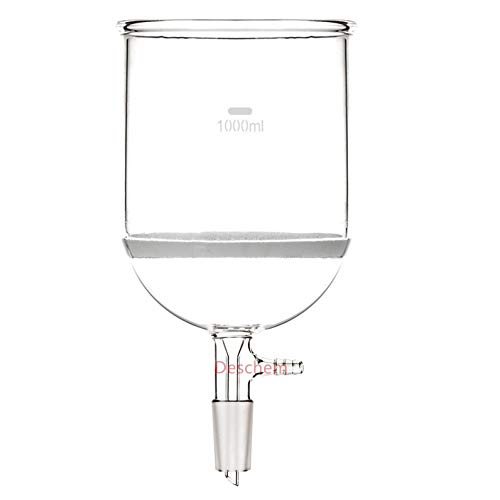
3. Deschem 1000ml Buchner Filtering Funnel 3#
A 15-40 micron frit on borosilicate 3.3 glass rated to 820℃ softening.
Deschem publishes more of its glass data than most, and that transparency is a good sign for a fine-pore funnel. The body is borosilicate 3.3 with a softening point of 820℃ and an annealing point of 560℃, plus a linear expansion of 32×10-7/℃. In plain terms, those are the numbers that describe how gracefully the glass survives a heating run without cracking.
The frit is a 3# coarse grade catching 15-40 micron particles, the same fine end of the scale as the Labasics G3. That density holds back precipitate that would pass a G1 or G2 disc. The wide end runs 112mm-114mm inside diameter, so standard paper sized for a 113 mm circle fits, and the vacuum tubulation is serrated for hose grip. It weighs 600 g, which is a solid, substantial piece of glass rather than a flimsy one.
The realistic caveat is speed. That fine disc is slower to pull through, and a dense fine frit needs a proper vacuum pump to do its job well. Bring the pump, and this funnel handles the small-particle filtrations that a coarse grade gives up on.
Why the spec sheet impresses
- 15-40 micron frit catches fine precipitates that coarser grades lose.
- Full published glass data: 560℃ annealing and 820℃ softening points.
- 112mm-114mm inner diameter takes standard 113 mm filter paper.
- 600 g of glass reads as a sturdy build, not a thin shell.
What to plan around
- Fine frit filters slowly and leans on a strong vacuum pump.
- Clogs more readily when your slurry is thick with solids.
- Cleaning a dense frit needs more care to clear residue.
Pick it when: you need to hold back small particles and want a funnel measured on real glass engineering, not guesswork.
Reconsider if: your vacuum is weak or your slurry is heavy — the fine disc rewards a strong pump and patience.
4. Labasics Büchner Filtering Funnel G3

15~40 μm pores that catch fine crystals the G1 disc lets through.
Step from the G1 up to this G3 and the pore size falls from 80~120 μm to 15~40 μm — a meaningful tightening that catches fine crystals and precipitates the coarse disc lets escape. Labasics lists this as its fine grade for separating solids like crystals or precipitates from larger volumes of liquid, and the narrow pores are exactly how it does that.
Joints sit at 24/40 on both top and bottom, so you seat the funnel in an Erlenmeyer or filtering flask and run it under a pump. The bowl measures 11.4 centimeters across the wide end, matching the other Labasics funnels so your filter paper and adapters stay swappable. The borosilicate body holds up to 250°C.
That narrow pore is the performance and the price. A fine frit is slower and easier to clog if your mixture is thick, so it wants a decent pump behind it. Labasics will sort out a damaged delivery on request, which softens the usual glass-in-the-mail worry.
The standout here: 15~40 μm pores plus 250°C heat tolerance make it the fine-grade twin of the coarse Labasics, and the shared 24/40 joint and 11.4 cm mouth keep your setup consistent.
The honest limit: fine pores mean a slower pull and more clogging risk on thick slurries — pair it with a real vacuum pump.
Choose this when: your solid is small and you have a pump strong enough to drag liquid through a tight disc.
Think twice if: your slurry is dense or your vacuum is a weak handheld — coarse grades exist for a reason.
5. Labasics Buchner Filtering Funnel G2

An 11.4 cm bowl and 250°C ceiling for big, warm pours.
Two numbers separate this Labasics G2 from the pack. First, the frit lands at 40~80 μm, the middle grade that balances flow against particle retention. Second, the bowl is 11.4 centimeters across the wide end — 4.4 cm wider than the 7 cm ceramic funnel in the YINGMALE kit, which is roughly 63% more mouth to pour into at once. That matters when you are tipping in a big volume from a beaker.
The 250°C ceiling is 50°C above what the StonyLab funnel at the top of this list allows, giving you more room to filter warm solutions. The 24/40 joint matches standard flasks, and the borosilicate glass carries serrated vacuum tubulation for a hose that grips under pull. There is a simple damage warranty, too.
Medium grade means it will pass very fine particles, so it is not the funnel for a powdery precipitate. But for a fast, high-volume, warm-solution filtration where the bowl size and heat ceiling do the heavy lifting, this is a strong mid-range pick.
The head-turner: a 11.4 cm mouth and a 250°C heat rating make big, warm pours easy to handle.
Trade-off to accept: 40~80 μm pores let fine particles slip through — great for flow, wrong for the smallest solids.
Worth grabbing if: you pour large volumes at warm temperatures and want a generous bowl.
Pass it up if: your target is a very fine precipitate that needs the tightest pores you can get.
6. YINGMALE Buchner Funnel Filtering Kit
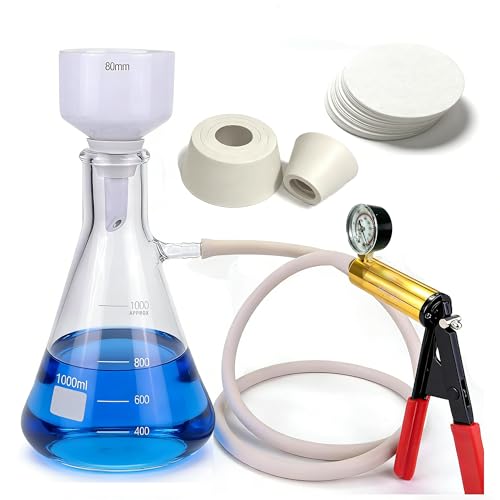
A handheld vacuum pump, 1 L flask and 9 stoppers in one kit.
Most Buchner setups assume a vacuum source you already have. This kit hands you one: a handheld metal vacuum pump that builds negative pressure and speeds filtration without a wall-line or vacuum pump station. Open the box and you can run a filtration — 1000 mL vacuum flask, ceramic Buchner funnel, manual pump, 9 rubber stoppers and 100 filter papers 70 mm wide.
The ceramic funnel spreads its pores evenly, so results stay consistent from run to run. Nine different stopper sizes mean you can make a tight, leak-free seal between funnel and flask even when the two are not a matched pair. The borosilicate glass flask gives clear visibility and handles thermal shock, and the maker suggests pre-wetting the filter paper for a secure seal.
The funnel bowl here measures just 7 centimeters across the wide end, the smallest in this group — 4.4 cm narrower than the 11.4 cm Labasics bowls, which is roughly 63% less mouth. It is a smaller batch tool, so plan on modest pours. Pre-wetting the paper, as the maker advises, also matters because a dry seal leaks and drags your vacuum down.
Why it is the odd one out, usefully: the included handheld pump and 9 stoppers mean the kit runs on its own, and the 100 filter papers get you started the same day.
Size it honestly: the 7 cm bowl is the narrowest here and suits small batches, not big pours.
Buy it if: you have no vacuum pump and want a complete, self-contained filtration setup to learn on.
Give it a miss if: you already own a pump and a 24/40 flask — a bare glass frit funnel does the same job with a wider bowl.
7. StonyLab Buchner Filtering Funnel 1L
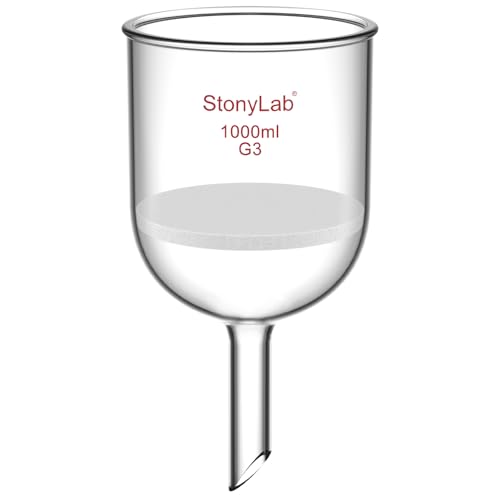
A G3 15~40 μm frit for fine precipitates the G2 disc passes.
StonyLab takes the mid-grade recipe from the top pick and swaps in a G3 frit rated 15~40 μm. That tightening lets you catch fine crystals and precipitates that slide through a 40~80 μm disc, which is the whole reason to choose this over its medium-grade sibling. It is the same family of high-precision work StonyLab names: chemical analysis, and petroleum and pharmaceutical filtrations, where that finer cut matters.
The 113 mm inner diameter seats standard StonyLab qualitative or quantitative filter circles, and the bowl spans 11.3 centimeters across the wide end. Weight is 0.75 kg, so it is a substantial piece of borosilicate glass built to take a pull, and it carries a 1-year limited manufacturer warranty. It also does the same job its sibling does for chemicals that paper or a diaphragm filter just cannot handle.
Two limits come with the finer grade. The withstanding temperature is 200°C — 50°C under the 250°C the Labasics funnels in this group reach. And like the other StonyLab pick, it should not be used with hydrofluoric acid, hot concentrated phosphoric acid or concentrated alkaline solutions. Fine pores also mean a slower, pump-hungrier filtration.
Where it shines
- G3 15~40 μm frit holds back fine precipitates the medium grade slips.
- 113 mm inner diameter takes standard StonyLab filter circles.
- Handles chemicals that paper or diaphragm filters cannot.
- 1-year limited manufacturer warranty covers you.
Where it asks patience
- 200°C limit, under the 250°C some competitors allow.
- Fine frit filters slowly and needs a strong pump.
- Off-limits for hydrofluoric acid and concentrated alkaline solutions.
This is your funnel if: you trust the StonyLab build and need the finer pore grade for small-particle recovery at room temperature.
Keep looking if: your work runs hotter than 200°C — the Labasics fine grade buys you more heat headroom.
Know the Specs
Frit Grade And Pore Size
The frit is the porous disc that does the filtering, and its grade is the first thing to match to your work. A G1 or “coarse” frit at 80~120 μm lets liquid move fast but lets small particles through. A G3 or “fine” frit at 15~40 μm is slower but catches small precipitates. G2 sits in the middle at 40~80 μm. Pick the grade by the size of the solid you need to keep.
24/40 Joint And Flask Fit
The 24/40 marking is a standard taper joint — 24 mm across the wide end, 40 mm of ground length — that lets a funnel seat into a matching Erlenmeyer or filtering flask. When the joint matches, the funnel drops in and holds under vacuum. When it does not, you need a rubber stopper or adapter to bridge the gap.
Borosilicate Glass And Heat
Borosilicate glass is chosen for its resistance to thermal shock, the cracking that hits ordinary glass when temperature changes fast. The withstanding temperatures here run from 200°C to 250°C. Stay under your funnel’s ceiling, and pouring a still-warm solution is safe.
Bowl Diameter And Filter Paper
The wide-end diameter decides what filter paper fits and how large a pour you can tip in at once. A 113 mm bowl takes standard 113 mm circles. A narrower bowl takes less volume per pour. Match the paper to the inner diameter, and the disc to the pore size.
Common Questions
What does the frit grade number mean on a Buchner funnel?
Will a 24/40 funnel fit my filtering flask?
Do I need filter paper with a glass frit funnel?
What temperature can a borosilicate Buchner funnel take?
Can I filter hydrofluoric acid through these funnels?
Is a fine frit better than a coarse frit?
Should I buy a funnel and flask kit or just the funnel?
How do I clean a glass frit Buchner funnel?
How big is a 1 L Buchner funnel bowl?
The Bottom Line
For most general filtration work, the 1 l buchner funnel to start with is the StonyLab G2 Medium Frit, because its 40~80 μm pores and 24/40 joint handle everyday precipitates with no guesswork. If your product is chunky and you want speed, reach for the coarse Labasics G1. And if you are starting from nothing with no vacuum on hand, the YINGMALE kit puts the pump in the box. Match the frit to your solids and the joint to your flask, and any of these will pull clean filtrate for you.
How we choose
We do not accept paid placement. Every pick is matched to a real buyer and a real use-case; we do not hands-on test units.
Sources
Specifications: manufacturer listings and product documentation. Review insights: verified customer reviews, as of November 2026. Pricing: not shown on this page (it changes often); check the current price via the retailer link.
As an Amazon Associate, Tactical Gear Guy earns from qualifying purchases. This does not affect which products we feature.