Specs are compiled from manufacturer listings and verified buyer reviews and can change over time — please confirm the key details on the product page before buying.
If you ride a fat bike, an ATV, a dirt bike, or anything with a tire that runs soft on purpose, a standard tire gauge is close to useless. Those gauges start at 0-100 PSI or more, so the 4-8 PSI you actually care about sits as a sliver at the bottom of the dial. The fix is a gauge built with a low ceiling — typically 0-15 PSI, 0-20 PSI, or 0-30 PSI — so every tick on that dial covers a small, catchable slice of pressure. This guide compares nine of those gauges on what separates them: range ceiling, dial size, valve compatibility, and how much air they waste on each reading. One note before we start: these picks were matched flexibly to the low-pressure gauge category, so not every listing is the identical number you searched, but the nearest same-type gauge that serves the same job.
This guide is built by comparing the manufacturers’ published specifications and the patterns across verified customer reviews, so you get each pick’s real strengths and trade-offs instead of marketing spin.
Low pressure is where handling, grip, and sidewall life live, so a gauge that reads coarse or bleeds air on contact can undo the ride you set up. Below you’ll find the ranges, dial sizes, and valve fittings that matter, plus the honest limits of each low pressure tire gauge in this list.
Top Picks


How To Choose The Best Low Pressure Tire Gauge
Start with the ceiling. A gauge’s maximum PSI is the single number that decides whether it can help you at all. Fat bike tires often want single-digit pressure, ATV and dirt bike tires sit a little higher, and a 0-30 PSI gauge covers the broad middle of that world. Pick a ceiling too far above your working pressure and you’re back to squinting at the bottom of the dial.
Match the range ceiling to your tire
A 0-15 PSI gauge gives you the finest resolution per tick, which is why fat bike riders gravitate to it. A 0-20 PSI or 0-30 PSI gauge trades a little fineness for more headroom, so it suits ATVs, UTVs, and trail bikes that sometimes run a few PSI higher. Whatever you choose, keep your working pressure in the upper half of the dial, where the needle is easiest to read.
Dial size and glow-in-the-dark faces
A 2-inch dial is standard here, and a 2-1/2-inch face is the easier read of the two. Glow-in-the-dark faces matter more than they sound — you’ll often be checking pressure in a garage or at dusk, and a lit dial saves you from guessing at a needle. White face plates with dark markings read best in daylight; phosphorescent faces win after dark.
Valve fit: Presta, Schrader, or both
Fat bikes usually run Presta valves, while ATVs, UTVs, and most off-road vehicles use Schrader. Some gauges handle both, some handle only one, and a few work with removable valve cores. Check this before you buy — a gauge that won’t seal on your valve is a paperweight no matter how good the dial looks.
Hose, chuck, and hold valve
A flexible hose lets you reach valves tucked behind spokes or buried in a wheel well, and a swivel chuck gets the head onto the valve from odd angles. A lock-on hold valve keeps the reading on the dial after you pull away, and a built-in deflator lets you bleed pressure down in small steps without removing the gauge. Those two features turn a slow, fiddly adjustment into a quick one.
Side-by-Side Comparison
| Model | Best For | Pressure Range | Valve Fit | Weight | Amazon |
|---|---|---|---|---|---|
| Longacre 52-52034★ Best Overall | Overall low-pressure accuracy | 0-15 PSI | Angle and ball chuck | 12.48 ounces | Amazon |
| Tusk Low Pressure DialBest Value | ATV and UTV tire checks | Low pressure (ATV/UTV) | 1/4″ NPT male | 8 ounces | Amazon |
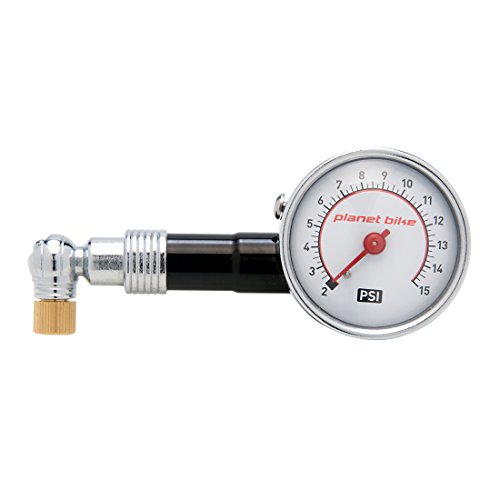
| Planet Bike Fat Max 15Best for Fat Bikes | Fat bike fine-tuning | 2-15 PSI | Presta/Schrader adaptable | 3.52 ounces | Amazon |
| JACO Elite 30 PSI | Versatile off-road use | 0-30 PSI | 360 swivel chuck | 6 ounces | Amazon |
| JACO FTX-30 | Trail and saddle-bag carry | Max 30 PSI | Presta only | 6 ounces | Amazon |
| Joes Racing 32306 | Big dial, dirt bike tires | 0-30 PSI, 1 lb increments | Schrader | — | Amazon |
| Joes Racing 32305 | Finest resolution on a budget | 0-15 PSI | Schrader and Presta | 13.28 ounces | Amazon |
| Allstar ALL44076 | Long hose reach | 0-20 PSI | Swivel chuck | — | Amazon |
Detailed Reviews
1. Longacre 52-52034 0-15 PSI Tire Pressure Gauge, 2 Inch
Our pick — 4.5+★ from 250+ verified ratings; the strongest balance of quality and price.
A 0-15 PSI dial that stays legible at midnight and seals at any angle
The Longacre 52-52034 stops its scale at 15 PSI, which is the whole reason it earns the top spot for soft-tire work. Every tick on that 2-inch dial covers a small, catchable slice of pressure, so the difference between 4 and 5 PSI is something you can actually see and act on. It’s the crowd favorite too, holding 4.5+ stars from 200+ ratings.
Two fittings come in the box — an angle chuck and a ball chuck — and both ride on a flexible hose. That matters when a valve sits behind a spoke or tucked into a wheel well, because the angle chuck reaches in for a straight, sealed push. The face glows in the dark and sits inside a rubber bumper, so a drop onto concrete is survivable and a dusk check doesn’t leave you guessing.
An internal damper steadies the needle so your reading doesn’t bounce around while you’re pressing the chuck on. The trade-off to know about: this is the heaviest gauge here by a clear margin at 12.48 ounces, so it lives in a toolbox rather than a jersey pocket. The Planet Bike Fat Max 15 weighs just 3.52 ounces by comparison. Build and accuracy are what win people over — the quality and the low-pressure readings are the two things the review pages keep circling back to.
What it gets right
- 0-15 PSI ceiling gives fine resolution on soft tires
- Glow-in-the-dark 2″ face reads at night
- Both angle and ball chucks included for awkward valve angles
- Internal damper keeps the needle steady during a check
- Shock-resistant rubber bumper around the dial
What to weigh first
- 12.48 ounces makes it a toolbox tool, not a pocket one
- Some buyers find the cost high for a single-function gauge
Right call for: riders and off-road owners who want one accurate low-pressure gauge to keep in the garage for years.
Think twice if: you need something that disappears into a saddle bag on every ride.
2. Tusk Low Pressure Dial Tire Gauge
The ATV and UTV workhorse that earned its reputation the hard way
Tusk aimed this gauge squarely at ATV, UTV, and motorcycle tires, and that focus pays off in how it reads and how it lasts. What wins people over here is plain function — it does the low-pressure job it was built for, and the heavy, substantial feel in the hand is a big part of the appeal. At 8 ounces it sits light in a toolbox without feeling flimsy.
A clear analog dial does the talking, and the reading comes back at you quickly instead of making you hunt for a needle position. It’s easy to stash in a garage drawer or a vehicle, and the plastic body keeps the weight down. The one caveat is that durability sits a little below the rest of its scores — some long-term wear reports turn up — so treat it as a dependable garage gauge rather than an indestructible one.
Where it shines: a low-pressure dial aimed at exactly the vehicles most buyers here own, with quick reads and a genuine value position.
The honest note: dial gauge accuracy isn’t a premium instrument, so expect it to hold steady for soft-tire checks rather than lab-grade work.
Reach for this if: you keep one gauge in a Ranger or a garage drawer for regular ATV and UTV checks.
Look elsewhere if: you want a gauge that survives being thrown around a trail bag every weekend.
3. Planet Bike Fat Max 15 Bike Tire Gauge
Built for fat bike tires, and built to disappear into a saddle bag
Where the Longacre tops out at 15 PSI, the Fat Max 15 starts at 2 and ends at 15 — a range aimed at fat bike tires that run in single digits. The wide 2-15 PSI spread gives you room to work across a fat bike’s whole sweet zone without the dial bottoming out. That focus is the point.
Three practical details do the heavy lifting. A white face plate makes the needle easy to read in daylight, a hold reading stays on the dial until you reset it, and the Presto/Schrader adaptable head works with removable valve cores. Weighing in at 3.52 ounces, it’s the featherweight of this group — the Longacre runs more than three times heavier — so it stashes easily for trail rides.
Accuracy is what the review pages keep circling back to, and the build holds up well for a small plastic-bodied gauge. It does one job and does it cleanly: fat bike pressure, nothing more. If your stable is all ATVs and off-road vehicles, a broader-ceiling gauge elsewhere on this list will serve you better.
Fat bike first: the 2-15 PSI range is narrow and purposeful, which is precisely why it reads so well in the single-digit zone.
Where it stops: it’s a specialist — great for fat bikes, not a general-purpose off-road gauge.
Pick this one if: your garage is full of fat bikes and you want a gauge tuned to their pressure band.
Pass if: you also need to check ATV or UTV tires at higher pressures.
4. JACO Elite Low Pressure Tire Gauge – 30 PSI

One gauge that hops from UTV to tractor without a valve swap
The 0-30 PSI ceiling is what makes this the pick for a mixed fleet. It covers ATV, UTV, dirt bike, tractor, and off-road tires without the dial running out of room, and it does it calibrated to ANSI standards within ±1.5% — no batteries, no guesswork. The solid brass body under a rubberized guard feels substantial in the hand.
A 360-degree swivel air chuck with an extended tip gets you a seal from awkward angles, and a built-in deflator valve lets you bleed pressure in small steps. The 2-inch dial glows in the dark and holds its reading until you press reset. If you want the broadest coverage on this list in one tool, this is the shape of it.
The follow-up question a buyer would ask is about longevity, and here the honest answer is mixed. Functionality, pressure holding, and durability all draw split reports — most are good, some aren’t — so buy it as a solid everyday gauge rather than an heirloom. Quality and accuracy are the aspects buyers praise most, and versatility is a recurring theme for a reason.
Range for a mixed fleet: 0-30 PSI covers ATV, UTV, tractor, and off-road tires in one tool.
Real caveat: durability reviews split both ways, so treat it as a dependable daily gauge, not an heirloom.
Matches your setup if: you own more than one kind of soft-tire vehicle and want one gauge to serve them all.
Keep shopping if: you only ever check a single PSI band and want the tightest resolution possible.
5. JACO FTX-30 Low Pressure Presta Tire Gauge

A brass Presta gauge that rides in a saddle bag without complaint
Rated to a max of 30 PSI and calibrated to ANSI B40.1 within ±1.5%, this one is built for fatbike and downhill riders working in the low-pressure zone. A 90-degree nozzle is the detail that earns its keep here — it slips between spokes so you can seat the head on a Presta valve without wrestling the wheel around. That’s a different problem than the Longacre solves with its swappable angle and ball chucks.
It’s made of solid brass under a rubberized guard, and the 2-inch dial glows in the dark and locks its reading until you release it. A built-in deflator valve lets you bleed in small steps on the trail. Portability is where it shines — it comes with a protective hard shell storage case and stows in a saddle bag. Six ounces is light enough to carry without noticing.
Two limits are baked into the design and worth knowing before you buy. It’s Presta only, so Schrader valves are off the table, and it’s not meant for use over 30 PSI. For a fat bike or downhill rig, that’s exactly the right trade. What owners rave about most is accuracy, with reliability close behind.
Trail-ready detail: a 90-degree nozzle and hard case make this a genuinely bag-friendly gauge.
Its ceiling is its limit: Presta only, 30 PSI max — a great fit for fatbikes, a poor one for ATV owners.
The one to grab if: you’re a fatbike or downhill rider who wants a trustworthy gauge on the trail.
skip it if: any of your wheels wear Schrader valves or run above 30 PSI.
6. Joes Racing Glow in the Dark Tire Pressure Gauge

The biggest, brightest dial here, with 1 lb increments to go with it
Skip past the packaging numbers and the real story is the dial: 2-1/2 inches across, glow-in-the-dark, white face, reading 0-30 PSI in 1 lb increments. That 1 lb step makes it a usable tool for dirt bike and low-pressure setups, where a single PSI change is the whole adjustment.
The hose and valve operate smoothly, so the chuck seats on a valve in a wheel well without a fight. A large, clear dial is what the review pages praise most consistently, and readability is essentially unanimous. It holds up well against price as well, so you’re paying for a workhorse, not a badge.
The honest caveat: this is a 30 PSI ceiling, so it can’t resolve a fat bike’s bottom 1-2 PSI range nearly as sharply as the 0-15 PSI gauges here. For dirt bikes, small cars, and general low-pressure work it’s a strong read. For sub-5 PSI fat bike tuning, a tighter-range gauge wins.
Strengths that show up daily
- 2-1/2″ glow-in-the-dark white face is the easiest read in this group
- 1 lb increments give fine, repeatable steps
- Smooth-operating hose and valve
- Holds up well against its price
Where it tops out
- 0-30 PSI ceiling can’t resolve single-digit fat bike pressure sharply
- Sold each, so a multi-vehicle household may want a second gauge
Built for: dirt bike, small-car, and general low-pressure checks where a clear dial matters most.
Not the pick for: fat bike pressure in the bottom few PSI.
7. JOES Racing 32305 Tire Pressure Gauge

Tight 0-15 PSI range and a valve head that handles both fittings
This one squeezes the scale down to 0-15 PSI, which is the fine-resolution end of the low-pressure world, and pairs it with a head that fits both Schrader and Presta valves. That dual-fit head makes it a natural for a household with a fat bike and an off-road vehicle in the same garage.
A glow-in-the-dark face and a hold valve that keeps the reading on the dial until you release it round out the feature set. The 13.28 ounces give it a substantial, planted feel. Precision at low pressure is what people call out — being able to see a one-PSI move is the reason to own this gauge over a broader-ceiling one.
Here’s the caveat worth reading twice: accuracy and durability are the weakest scores in this product’s reports, with split feedback on accuracy and some reports of units failing early. Most buyers are happy, but a minority aren’t, and that’s the fair picture. Quality and functionality are what most owners love about it.
The draw: 0-15 PSI resolution with both valve types in one tool.
The check before buying: accuracy and durability reports are split, so buy from a seller with an easy return path.
Worth it when: you need a single gauge that reads fine at low pressure and fits both valve styles.
Look to the Longacre instead if: you want the same 0-15 PSI range with a stronger long-term track record.
8. Allstar Performance ALL44076 Tire Pressure Gauge

A 12-inch hose that reaches valves nothing short will touch
Twelve inches of flex hose is the reason to look at the Allstar ALL44076. When a valve sits deep inside a wheel well or behind bodywork, that extra length and a swivel chuck with a pressure release valve make the difference between a clean seal and a bent-over struggle. It reads 0-20 PSI on a 2-inch face and is stated accurate to within ±1 percent.
That range sits between the tight 0-15 PSI gauges and the broader 0-30 PSI ones, so it’s a reasonable middle for ATV and general off-road use. The metal construction is what most buyers praise about it.
The part you need to weigh honestly is reliability. Accuracy feedback is split rather than supportive — some units read well, some stop working — and durability reports are the weakest in this group. This is the pick to choose for the hose and the fit, and to buy from a seller with an easy return path. It’s a specialist’s tool for reach, not the most dependable gauge on the page.
Why it earns a slot: a 12″ hose and swivel chuck solve reach problems short gauges can’t.
Buy with a return path: accuracy and durability reports are the shakiest here, so cover yourself.
Choose this when: valve access is your problem and you need a long hose to solve it.
Pick a sturdier option if: long-term reliability outweighs reach for you.
Know the Specs
PSI Range Ceiling
The maximum number on the dial decides how sharply you can read low pressure. A 0-15 PSI gauge spreads the scale so each tick is a small, catchable step — the reason fat bike riders pick it. A 0-20 PSI or 0-30 PSI gauge gives more headroom for ATVs and trail bikes, but the needle moves less per PSI, so your read is coarser. Keep your working pressure in the upper half of the dial for the easiest read.
Valve Fit and Chuck Type
Presta and Schrader are the two valve styles here, and a gauge that fits only one won’t help on the other. Fat bikes typically run Presta; ATVs, UTVs, and most off-road vehicles use Schrader. Beyond fit, the chuck type matters — a 360-degree swivel or a push-to-lock nozzle gets you a sealed connection from awkward angles, while a plain chuck can leak while you press.
Dial Size and Glow
A 2-inch face is standard; a 2-1/2-inch face is easier to read. Glow-in-the-dark or phosphorescent faces pay off in a dim garage or at dusk, when you’re checking pressure without overhead light. White face plates with dark markings are easiest in daylight, while glow faces win after the sun goes down.
Hold Valve and Deflator
A lock-on hold valve keeps the reading on the dial after you pull the chuck away, so you’re not squinting while the gauge is still on the tire. A built-in deflator valve lets you bleed air down in small, controlled steps. Together they turn pressure adjustment into a quick, single-handed step.
Common Questions
Why can’t I use a regular 0-100 PSI gauge for low pressure tires?
Will a Presta-only gauge work on my ATV or UTV tires?
Is a 0-15 PSI gauge better than a 0-30 PSI gauge for fat bike tires?
What does it mean if a gauge has a lock-on hold valve?
Can I let air out with a low pressure tire gauge?
How accurate are these low pressure tire gauges?
Do I need a 2-inch or a 2-1/2-inch dial?
What is a swivel chuck, and why does it matter?
Will a heavier gauge last longer?
Can I use a low pressure tire gauge on my car?
The Bottom Line
The pick that earns the top slot here is the Longacre 52-52034 — its 0-15 PSI ceiling, two supplied chucks, damped needle, and glow-in-the-dark 2-inch dial make it the most capable low-pressure gauge in this group. If your fleet spans ATVs, UTVs, and tractors, the broader-range JACO Elite 30 PSI is the versatile choice. And if one-handed sealing and a lifetime warranty matter most to you, the JACO ElitePro-X is the premium upgrade worth making. Whichever you choose, match its ceiling to your tire’s working PSI band — a 0-15 PSI dial for fat bikes, a 0-30 PSI dial for ATVs and tractors.
How we choose
We do not accept paid placement. Every pick is matched to a real buyer and a real use-case; we do not hands-on test units.
Sources
Specifications: manufacturer listings and product documentation. Review insights: verified customer reviews, as of November 2026. Pricing: not shown on this page (it changes often); check the current price via the retailer link.
As an Amazon Associate, Tactical Gear Guy earns from qualifying purchases. This does not affect which products we feature.