Specs are compiled from manufacturer listings and verified buyer reviews and can change over time — please confirm the key details on the product page before buying.
If you only buy one grater, buy one that is genuinely sharp and genuinely comfortable in your hand — that single choice decides whether grating Parmesan feels like ten seconds of work or a small chore you start avoiding. The picks below cover every real job: a fine zester for citrus and hard cheese, a coarse shredder for hash browns and pizza night, and a rotary crank model for people who shred a pound of cheese at a time.
This guide is built by comparing the manufacturers’ published specifications and the patterns across verified customer reviews, so you get each pick’s real strengths and trade-offs instead of marketing spin.
The trick most buyers miss is that blade style matters more than brand name — an etched fine blade and a coarse punched blade do completely different jobs, and buying the wrong one is why drawers fill up with unused tools. Here is the honest shortlist of the best manual cheese grater options for a real kitchen.
Top Picks


How To Choose The Best Manual Cheese Grater
Start with the food you actually grate most weeks. If it is lemon zest, nutmeg, garlic, ginger, and a dusting of Parmesan over pasta, you want a fine etched blade. If it is cheddar for tacos, mozzarella for pizza, or potatoes for hash browns, you want a coarse shredding face with enough surface area to move a big block fast. Buying both jobs in one tool rarely works well, and that mismatch is the number one reason a grater ends up unused.
Fine etched blades versus coarse shredding faces
A fine blade is made by photo-etching tiny teeth into a sheet of stainless steel, which produces small, fluffy gratings that melt quickly and release citrus oils without dragging the bitter white pith underneath. A coarse surface uses larger punched holes that turn a block of cheddar into long shreds for melting and layering. Neither is better — they answer different questions, so match the blade to the food instead of hunting for one grater that does everything.
Why handle shape and leverage decide your effort level
A hard block of Parmesan needs downward pressure, and where that pressure goes matters. Two-handed models with heavy-gauge handles on both ends let you press straight down over a bowl or pot. Paddle-style graters with a soft grip suit quick zesting and light jobs in the hand. A rotary crank moves the work to a turning motion instead of a pushing one, which some cooks find far easier on the wrist over a long prep session.
Material, rust, and the dishwasher question
Stainless steel is the baseline you want, because a rust-free blade is a sharp blade. Check whether the maker lists the steel grade, whether the frame is metal or plastic, and whether the grater is rated for the dishwasher. Plastic frames around a good blade are a common weak point, so treat any plastic component as the part most likely to age first. A metal body with a covered blade tends to hold up better over years of weekly use.
Side-by-Side Comparison
| Model | Best For | Blade Type | Build Material | Weight | Amazon |
|---|---|---|---|---|---|
| Microplane Premium Classic Zester 18/8★ Best Overall | Zesting and hard cheese | Fine etched | Stainless steel | 110 g | Amazon |
| Microplane Home Series CoarseEveryday Pick | Everyday coarse grating | Coarse | Stainless steel | 3.52 ounces | Amazon |
| Norpro Stainless Steel Coarse GraterHeavy Duty | Hash browns and big blocks | Coarse | 18/10 stainless steel | — | Amazon |
| OXO Steel Grater | Storage and all-round grating | Etched stainless | Stainless steel | 0.21 kg | Amazon |
| 3 in 1 Rotary Cheese Grater Hand Crank | Volume shredding | 3 interchangeable | 430 stainless, BPA-free ABS | 0.81 kg | Amazon |
| Cohesion Etched Zester & Grater Set of 2 | Fine and coarse in one set | Fine and coarse set | Stainless steel | 0.3 kg | Amazon |
| KitchenAid Fine Grater | Zesting and ginger | Fine bi-directional | Stainless steel | 5.44 ounces | Amazon |
| Zyliss Classic Rotary Grater | Parmesan at the table | Rotary drum | Stainless steel | 6.88 ounces | Amazon |
| Cuisipro Handheld Cheese Grater | Extra coarse shredding | Extra coarse | 304 stainless steel | 12.64 ounces | Amazon |
Detailed Reviews
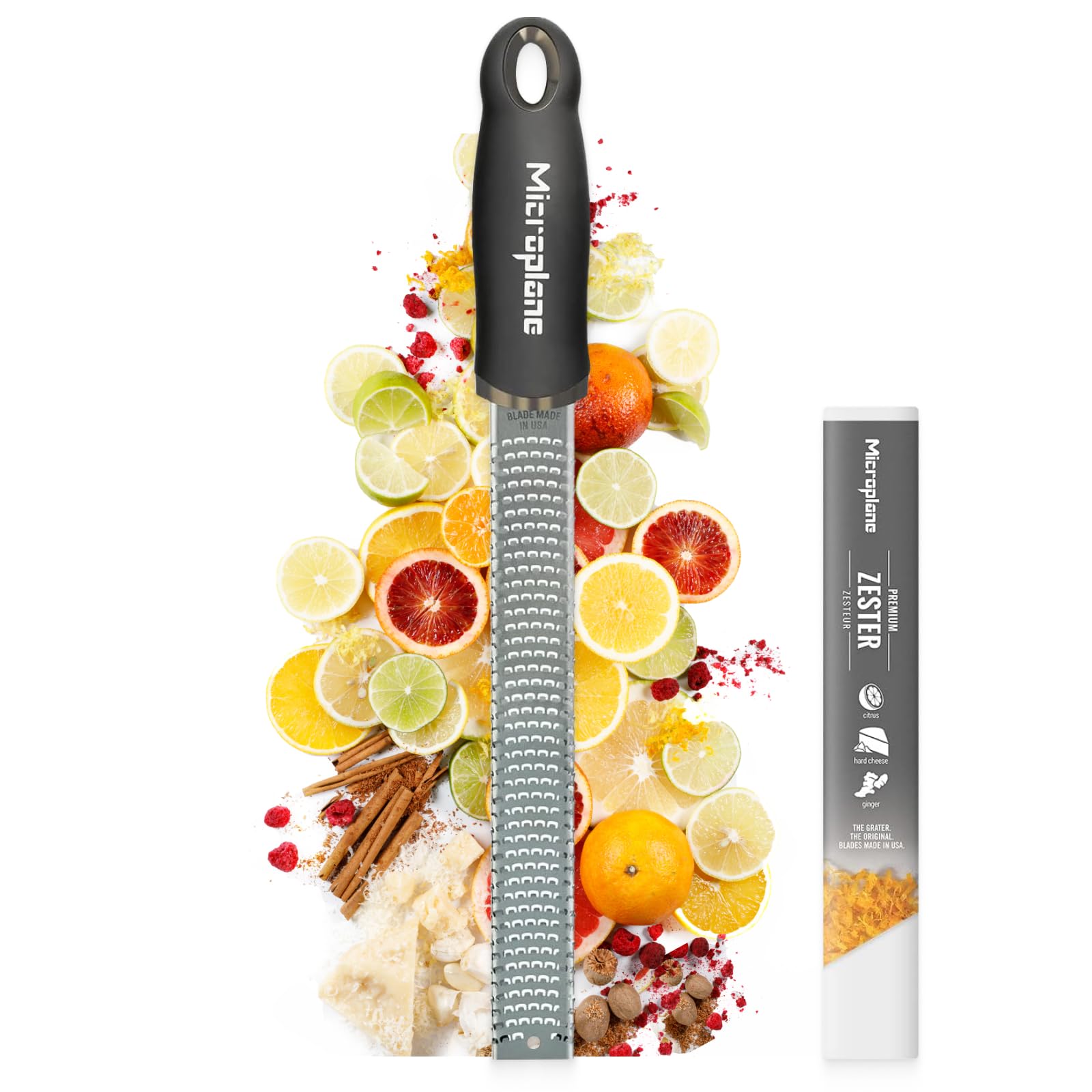
1. Microplane Premium Classic Series Zester 18/8, Black
Our pick — 4.5+★ from 49,000+ verified ratings; the strongest balance of quality and price.
The fine-tooth blade that turns a lemon into perfume and a hard cheese block into melt-ready fluff.
What makes this one the crowd favorite is a blade that does one job properly: teeth set at a precise angle that lift the flavorful rind off a citrus fruit and leave the bitter white pith behind. That one design detail is why people reach for it daily rather than once a month. It also grates Parmesan into fluffy mounds that melt fast over pasta, plus ginger, garlic, nutmeg, and whole cinnamon. The crowd is large — 4.5+ stars across 49,000+ owners — and quality is the thing people talk about most by a wide margin.
At 110 g with a 12-inch length, it sits in the hand like a small paddle and stores in a drawer without a fight. The blade is photo-etched from surgical-grade stainless steel and made in the USA, so it resists rust and keeps its fine teeth sharp. The stainless body is magnetic, so it hangs on a magnetic knife strip instead of rattling around with the spoons. Non-scratch end tabs keep it from gouging your countertops when you set it down mid-recipe.
The honest catch is care, not durability. Cleaning is straightforward if you rinse right after use and run a kitchen brush along the underside of the blade where fine particles hide, and it can go in the dishwasher. The trade-off is that the fine teeth reward quick rinsing — leaving soft cheese to dry on the blade turns a ten-second job into a soak-and-scrub. It is also a fine grater, so a big block of cheddar for pizza night will take longer than a coarse plate would.
Where the blade earns it
- Fine etched teeth strip rind and leave the bitter pith behind
- Rust-free surgical grade stainless steel, made in USA
- Non-scratch end tabs protect countertops
- 110 g body sits comfortably in the hand and stores flat
What to weigh first
- Fine teeth need a quick rinse so particles don’t dry on
- Not the tool for shredding a large block of melting cheese
- A rare unit comes with a less crisp edge
Reach for this if: you zest citrus, dust Parmesan, or grate ginger and nutmeg several times a week — this is the one tool that covers those jobs cleanly.
Think twice if: your kitchen runs on bulk cheddar, where a coarse plate like the Norpro does the volume work faster.
2. Microplane Home Series Hand Held Cheese Grater (Coarse, Red)
A lightweight coarse paddle that stores flat and handles carrots, chocolate, and hard cheese without fuss.
This is the softer-handled family member of the Microplane line — a coarse paddle aimed at carrots, ginger, nuts, chocolate, coconut, and hard cheeses. The blades are US stainless steel made at the company’s Russellville, Arkansas facility, and the soft-touch handle means light jobs in the hand stay comfortable. At 3.52 ounces it is light enough to hold over a bowl for a full recipe without your wrist noticing.
The grating action itself is the strong suit. It turns a block of Parmesan into small gratings fast, and cleanup is quick because stainless steel rinses clean. Where it gets a bit more complicated is the frame: some owners find it durable and expect years of use, while others note the plastic frame cracking within weeks, so durability is genuinely a mixed picture rather than a settled one. The same goes for coarseness — some cooks find it perfect and others want a wider shred.
There is a small practical annoyance worth knowing before you buy: a sticker on the handle can leave a stubborn glue residue that takes effort to lift. It is a one-time nuisance, not a reason to walk away. Compared with the Norpro’s two-handed design, this one trades brute leverage for a lighter, flatter tool that fits a shallow drawer.
How it fits a real kitchen: Best as the coarse helper beside a fine grater rather than the only grater you own. It handles light everyday gratings well, and the flat-store paddle shape keeps it out of the clutter.
One honest caveat: Treat the plastic frame as the aging part. If you regularly bear down on a hard block, a full-metal body will hold up longer.
Pick this one when: you want a light coarse grater for chocolate, nuts, and a quick Parmesan dusting, and storage space is tight.
Look past it if: you shred dense blocks weekly and want a metal frame that shrugs off heavy pressure.
3. Norpro Stainless Steel Coarse Grater, 14 x 5 Inches, Silver
A 14-inch slab of solid 18/10 steel built for big blocks, hash browns, and two-handed pressure.
When the job is a pile of potatoes for hash browns or a casserole’s worth of cheddar, surface area and leverage decide your speed. This one measures 14 inches by 5 inches (14″L x 5″W x 0.24″H), so it rests across a large mixing bowl or pot and lets you press straight down. The body is solid 18/10 stainless steel — commercial-grade — which resists rust and corrosion and keeps the coarse shredding face sharp. Performance is what wins cooks over most, followed closely by how long it lasts.
Two 6mm reinforced handles sit on either end. That extra-gauge steel gives a secure two-handed grip and genuine downward leverage, which is exactly what a dense potato needs. The coarse face shreds cheddar, mozzarella, pepper jack, potatoes, carrots, cabbage, and zucchini into uniform shreds with minimal effort. Put beside the OXO Steel Grater’s 11.5-inch body, this Norpro runs 14 inches long against 11.5 — noticeably more grating face for batch work.
Sharpness is the one spot where opinions split. Most find the edge plenty aggressive on cheese and vegetables, while a smaller group wants it keener from the start. It is also a large tool, so plan cabinet space for it. Cleanup is quick and easy, which matters because a big coarse plate collects a lot of shreds.
The batch-work argument: Nothing here beats it for volume prep. Big face, thick handles, and steel that stays rust-free add up to a tool that gets faster, not slower, the more you shred.
If your drawers are shallow, this is a tool you store upright.
Fits best: batch cooking — hash browns, casseroles, pizza night — where a wide grating face and two hands beat a small paddle.
Second thought if: you only ever grate a small amount of zest or Parmesan and want something drawer-sized.
4. OXO Steel Grater

The grater that comes with its own cover, so the sharp side never ends up loose in a drawer.
Storage is the quiet problem with sharp graters — the blade ends up exposed in a drawer and gets nicked or nicks something else. This OXO solves it with a cover that snaps on for safe storage, and owners appreciate that detail. The grating surface is etched stainless steel, and the sleek handle is designed to be comfortable to hold. At 0.21 kg it is light in the hand for everyday cheese, vegetables, and chocolate.
Quality is the theme in what buyers report: it is sturdy, sharp, and made entirely of stainless steel. The body measures 11.5 inches long by 2.75 inches wide by 1.5 inches high (11.5″L x 2.75″W x 1.5″H) and sits flat on the counter with a non-slip base. Set next to the Norpro above, it is the shorter, more compact tool — easier to steer one-handed, less surface area for a big block.
Where this one beat a lot of small graters is the whole package rather than one standout number: a cover, a non-slip foot, a stainless handle, and a dishwasher-safe body. Sharpness draws a little more varied feedback, with a few owners wanting a keener bite from the start, so it is worth a quick first-use test rather than assuming.
What buyers like
- Snap-on cover keeps the blade safe and your hands clear
- Non-slip base helps it sit steady on the counter
- Full stainless steel body feels sturdy in the hand
- Dishwasher safe for quick cleanup
Worth noting
- Smaller face than a 14-inch batch grater
- A few find the edge less aggressive than expected
- The cover adds bulk to a crowded drawer
A good fit for: households that value a covered blade and a non-slip base over maximum surface area.
Maybe not for: heavy batch shredders who want the widest grating face available.
5. 3 in 1 Rotary Cheese Grater
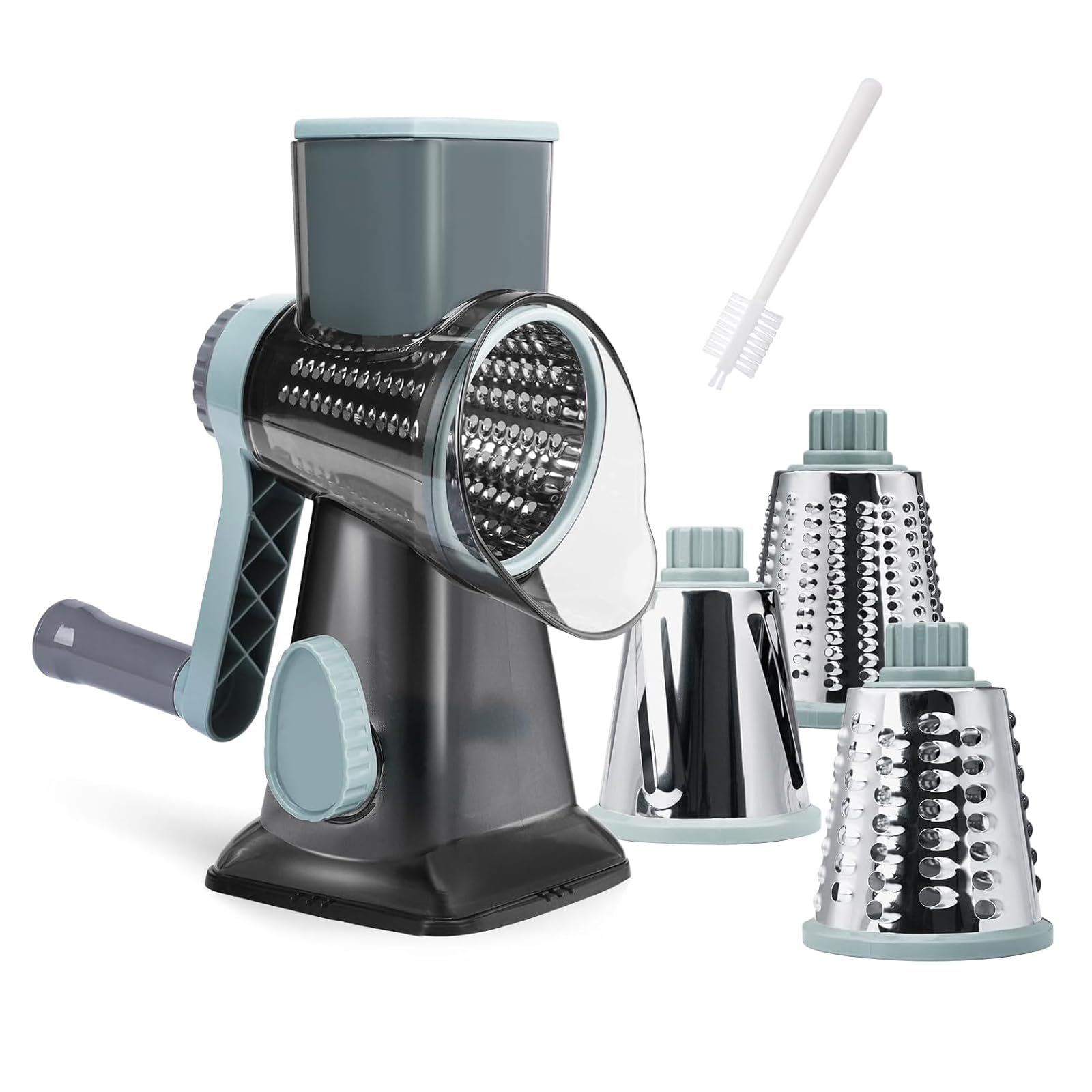
Crank instead of push — a pound of cheese through the drum in about half a minute.
The number that sells this one is speed: owners mention the crank shreds a 1-pound block of cheese in about 30 seconds. That matters if you cook for a family and grate cheese for pasta, salads, and curly fries in the same week. Three interchangeable blades cover coarse shredding, fine shredding, and slicing, so one unit handles cheese, carrots, cucumbers, nuts, and chocolate. The feeding port keeps your hands clear of the cutting edge, which is a real advantage over a flat blade when you are moving fast.
The build is 430 stainless steel blades inside a BPA-free ABS plastic body, and it weighs 0.81 kg. That is a sturdy, sit-on-the-counter tool rather than a hold-in-the-hand one. Compare it with the OXO Steel Grater at 0.21 kg and this rotary unit is the anchor of the two — the suction base locks onto smooth surfaces like marble and glass so the crank stays put while you turn. The drum blades come out fully, so you can rinse them under water or put the top-rack parts in the dishwasher.
The honest trade-off is the suction base. Some owners find it locks firmly to a smooth counter, while others report it loosening mid-job — so a textured or slightly damp counter is the wrong surface for it. Durability also draws mixed feedback, so treat the plastic housing with normal care rather than yanking the crank. Reviewers do call it much easier than hand grating for volume, and cleanup is a recurring bright spot.
Why it earns a spot: For shredding volume, nothing else here is as quick. Shredding a pound in 30 seconds makes fresh-grated cheese an everyday habit rather than a project.
The condition to check first: Your countertop. This tool works best on smooth, dry surfaces; if yours is textured, the suction hold is the first thing to test.
A strong choice when: you grate in bulk on a smooth counter and want shredding, slicing, and fine work from one crank tool.
Skip the idea if: you prefer a small flat tool that lives in a drawer — this one needs counter space to shine.
6. Cohesion Etched Zester & Grater Set of 2

Two blades, two jobs — a fine zester and a coarse grater in one set with a cover that doubles as a scraper.
If you cannot decide between fine and coarse, this set answers both questions at once. It arrives as 2 count with a fine blade and a coarse blade, made from razor-sharp stainless steel, each with a snap-on cover you can store over the blade when idle. That cover also works as a scraper or a small container for collecting what you grate, which cuts down on a separate bowl. The anti-slip handle keeps control while you work.
Quality is the strongest signal here — the graters are sharp and easy to use and clean. The set handles lemon and cheese but also chocolate, vegetables, and fruit, so it earns counter space across a whole week of cooking. Both blades run the full stainless steel body, and the set weighs 0.3 kg across the pair. Dishwasher-safe cleaning makes the routine short.
Here is the part to weigh carefully: durability is genuinely mixed, with reports of the plastic parts cracking within a year of use. That is worth factoring in if you grate daily and lean hard on the handle. The steel blades themselves keep doing their job; it is the plastic housing that ages first. Used with reasonable pressure instead of heavy force, the set holds up fine.
You get both, plus covers that protect the blades when stored.
How to keep it going: Treat the plastic housing gently and rinse rather than scrub hard, and the sharp edges stay useful for far longer.
Suits you if: you want fine zesting and coarse shredding from one purchase and like a cover that collects the food.
Not the first pick if: you expect to bear down on hard blocks daily — a full-metal body is safer here.
7. KitchenAid Fine Grater

Micro-serrations that bite on both the push and the pull, so zesting goes twice as fast.
The detail that defines this grater is the cut pattern: unique micro-serrations that grate in two directions. You get cutting action on the way down and on the way back, which adds speed and efficiency without you changing your stroke. It is built for fine work — zesting lemons, limes, and fruit, plus grating ginger and nutmeg into paste. The body is thick stainless steel with a soft foot that lets you grate straight into a bowl, onto a cutting board, or over a flat surface.
At 5.44 ounces with a 13.2-inch length, it is a full-size grater that carries its weight well in the hand. Quality is the thing that carries it, followed by how it performs for zesting. A protective plastic blade cover comes with it for storage, and the whole thing is dishwasher safe. Set against the Microplane Premium Classic above, it trades the precise rind-only tooth set for a longer body and the two-way cut.
Cleaning is the part where the feedback splits. Many find it simple to use and clean, while some find the fine teeth painful to clean if food is left to dry. The fix is the same as with any fine grater — rinse it while the food is still fresh rather than letting it sit.
What stands out
- Micro-serrations cut on both strokes for faster zesting
- Thick stainless steel body with a soft, bowl-friendly foot
- Protective blade cover included for storage
- Dishwasher safe
The honest limits
- Fine teeth demand prompt rinsing
- One direction of use to learn before it feels natural
- Long body needs a bit of drawer space
Made for: the cook who zests constantly and wants the speed of a two-way cut.
Better elsewhere if: you need coarse shredding for cheese and vegetables — this one is fine-blade only.
8. Zyliss Classic Rotary Grater

The table-side crank built for hard cheese — little pressure, a compact fold, and NSF certification.
This is the rotary grater that people picture at an Italian restaurant, and the design lives up to the image for hard cheese. It requires little pressure to turn, and it folds for compact storage, which makes meal prep easier when Parmesan is going over pasta. A non-slip knob steadies it on the table, the barrel disassembles easily for cleaning, and the crank is made for both left and right handed use. It is NSF Restaurant Certified, so it meets published food-safety standards for commercial kitchens.
Hard cheese is where it shines — Parmesan and other dense varieties go through quickly and come out light. Soft cheese is the opposite experience, and that is the honest limit: it clogs in the barrel, and soft cheese is the worst offender. Cleaning is mixed for the same reason: it comes apart and goes in the dishwasher, but some find the barrel tricky to empty fully. Durability draws a spread of feedback, from years of steady use to a shorter life under heavy daily pressure.
The body is 6.3 inches by 4.45 inches by 3.15 inches and weighs 6.88 ounces, so it stores in a small footprint. For a household that puts hard cheese on the table most nights, the turning motion is easier on the wrist than pushing a block across a blade.
The case for it: Hard cheese and nuts go through with almost no effort, and the fold keeps it out of the way between meals.
Where it gets awkward: Soft cheese and the cleaning routine. Keep it to firm varieties and it stays a pleasure to use.
Right for: hard-cheese households that want a compact crank grater for the table.
Look at a flat plate instead if: soft cheese or nuts are a regular part of your cooking.
9. Cuisipro Handheld Cheese Grater Stainless Steel, 11.5 Inch

An extra-coarse plate with a hand-shaped handle and rubber pads that keep it planted.
For thick shreds — the kind that hold their shape in a casserole or turn potatoes into proper hash browns — an extra-coarse surface is the tool. This one is shaped to fit naturally in the hand and eases the strain of pressing a block across a plate, and two santoprene pads on the base help keep it steady on a bowl or counter. It is built from 304 stainless steel and it is dishwasher compatible, so cleaning is not the usual chore.
Quality and durability carry this grater, with heavy-duty construction that owners expect to last and no rusting issues over time. At 12.64 ounces it has real substance, and the weight is part of why it feels secure while you shred. The extra-coarse face handles hard cheese, vegetables, and dense ingredients, and grating performance is strong on hash browns and potatoes for casseroles. Size gets its own share of praise, since a bigger face means fewer passes for the same block.
Value is the split here — some find it well worth the outlay, while others feel it sits on the pricey side for a single grater. Sharpness also draws a little variation, with a few owners wanting a keener edge. Both are small notes against a tool that owners describe as durable and rust-free.
What makes it steady: Substantial weight plus the santoprene base pads means it stays put, so you can press without it sliding away.
The fair caveat: It is a single extra-coarse plate, so fine zesting and dusting are simply not on its menu.
Choose this when: thick shreds for casseroles and hash browns are the main job and you want a supported, weighty grater.
Keep looking if: you want one tool that also handles fine zesting and Parmesan dusting.
Know the Specs
Blade Style: Etched Versus Coarse
An etched blade is made by photo-etching tiny teeth into a steel sheet, producing fine, fluffy gratings that release citrus oils and melt cheese fast. A coarse surface uses larger holes to turn a block into long shreds for melting and layering. Match the blade to the food: fine for zest, ginger, nutmeg, and Parmesan dusting; coarse for cheddar, mozzarella, potatoes, and cabbage. The fine plate will never satisfy a batch-cheese job, and the coarse plate will never give you zest.
Stainless Steel Grades and Longevity
Stainless steel is the baseline for a grater because a rust-free blade keeps its edge. Some makers list the grade, such as 18/10 or 304 — those are families of stainless steel that resist corrosion well. A plastic frame around a good blade is the common weak point, so look at what surrounds the steel. A full-metal body with heavy-gauge handles tends to age better than a plastic housing.
Handle Shape and Leverage
A hard block of cheese needs downward pressure, and where that pressure lands decides your effort. Two-handed models with heavy-gauge handles on both ends give you straight-down leverage over a bowl. Paddle-style graters with a soft grip suit light in-hand work. A rotary crank moves the work to a turning motion, which some cooks find easier on the wrist over a long prep session.
Suction Bases and Non-Slip Feet
A suction base locks a rotary grater to smooth surfaces like marble and glass so it stays put while you turn the crank. Non-slip rubber feet or santoprene pads on a flat grater do the same job on a bowl or counter. Both work best on dry, smooth surfaces; a textured or damp counter is where suction loosens. Check the base before you commit to a crank model.
Common Questions
Will a fine etched grater work on cheddar or mozzarella?
Is a rotary hand-crank grater better than a flat plate grater?
Why does cheese keep clogging inside a rotary grater?
Can a manual cheese grater go in the dishwasher?
How do I keep a grater from slipping on the counter?
Does a coarse plate work for hash browns and potatoes?
How long should a stainless steel grater last?
Can I zest a lemon without getting the bitter white pith?
What is the difference between an 18/10 and a 304 stainless grater?
Do I need both a fine zester and a coarse grater?
The Bottom Line
For most kitchens, the manual cheese grater worth starting with is the Microplane Premium Classic Series Zester 18/8, because its fine etched blade handles the daily jobs — citrus zest, Parmesan, ginger, garlic, and nutmeg — and its stainless body stays rust-free. If you shred big blocks for hash browns and pizza, reach for the Norpro Stainless Steel Coarse Grater and its wide 14-inch two-handed face. And for volume with a turning motion, the 3 in 1 Rotary Cheese Grater Hand Crank shreds a pound of cheese in about 30 seconds on a smooth, dry counter. Start with the fine blade and add a coarse plate as your cooking grows — that pairing covers nearly everything.
How we choose
We do not accept paid placement. Every pick is matched to a real buyer and a real use-case; we do not hands-on test units.
Sources
Specifications: manufacturer listings and product documentation. Review insights: verified customer reviews, as of November 2026. Pricing: not shown on this page (it changes often); check the current price via the retailer link.
As an Amazon Associate, Tactical Gear Guy earns from qualifying purchases. This does not affect which products we feature.