Specs are compiled from manufacturer listings and verified buyer reviews and can change over time — please confirm the key details on the product page before buying.
You know the moment: your back is strong, your legs are ready, and your hands quit before the bar does. A grip aid or a squat pad fixes that faster than any program change. This guide covers nine gym add-ons that solve specific, real problems — a bar that slides, a barbell digging into your hips, a squat you cannot sink into — and points you to the one worth buying first.
This guide is built by comparing the manufacturers’ published specifications and the patterns across verified customer reviews, so you get each pick’s real strengths and trade-offs instead of marketing spin.
Each pick here solves a specific training problem, not a spec-sheet checkbox. From a 2.25-inch grip widener to a 500-lb-rated hook, the picks below cover the Top Gym Accessories that actually change your session.
Top Picks

How To Choose Gym Accessories That Earn Their Space
A gym bag fills up fast, and most of it never leaves the car. Buy only the pieces that remove a specific obstacle — a bar that slips, a bar that hurts, a floor that dents. Every pick below solves one of those, and each one is small enough to live in a locker.
Match the accessory to the lift you actually do
Grip aids help pulling movements — deadlifts, rows, pull-ups. Padding helps squat and hip-thrust work. Wedges and slants help depth and ankle position. Buy for the movement you perform most and you will not waste bag space on a gadget you never use.
Read the load rating before the marketing copy
A barbell pad carries the loaded bar across your neck or hips, and a lifting hook carries the entire pull through one strap. Look for a stated weight capacity, a stated thickness on padding, and a material that does not thin out under load. Where a maker publishes a number, treat it as the spec that matters.
Check the diameter and the fit against your own equipment
A grip widener only works if it wraps your bar, and a cable attachment only works if its connector fits your machine. Measure your bar diameter or check the hole size on any cable attachment before you commit. A grip widener that will not wrap your bar or a cable attachment that will not clip on ends up in a drawer.
Side-by-Side Comparison
| Model | Best For | Type | Build Material | Stated Load / Dimension | Amazon |
|---|---|---|---|---|---|
| Fat Gripz Pro★ Best Overall | Building arm and grip size | Bar grip widener | Rubber | 2.25″ outer diameter | Amazon |
| SINYWAY Barbell Pad SetBest Bundle | Full leg-day kit | Pad + strap bundle | Rubber foam | 400 kg capacity | Amazon |
| WHATAFIT Resistance BandsBest for Home | Home full-body training | Tube band set | Natural latex | 150 lb combined | Amazon |
| ZELUS Weighted Vest | Adding resistance to walks | Weighted vest | Iron sand, SBR, spandex | 12 lb | Amazon |
| ODCPN Squat Wedge Block | Deeper squats and ankle mobility | Heel wedge | Silicone over ABS | 1500 lb capacity | Amazon |
| Marcy Equipment Mat | Protecting floors under machines | Floor mat | EVA foam | 78″L x 36″W x 0.25″Th | Amazon |
| DMoose Lifting Hooks | Heavy pulling without grip fatigue | Hook straps | Nylon, neoprene, steel | 500 lb capacity | Amazon |
| Fitarc Landmine Row Handle | Back-day row variety | Landmine attachment | Iron and steel | 1 in grip size | Amazon |
| QPARVERS Cable Attachment Set | Equipping a home cable machine | 4-piece cable set | Alloy steel | 0.5 inch cable hole | Amazon |
Detailed Reviews
1. Fat Gripz Pro
Our pick — 4.5+★ from 19,500+ verified ratings; the strongest balance of quality and price.
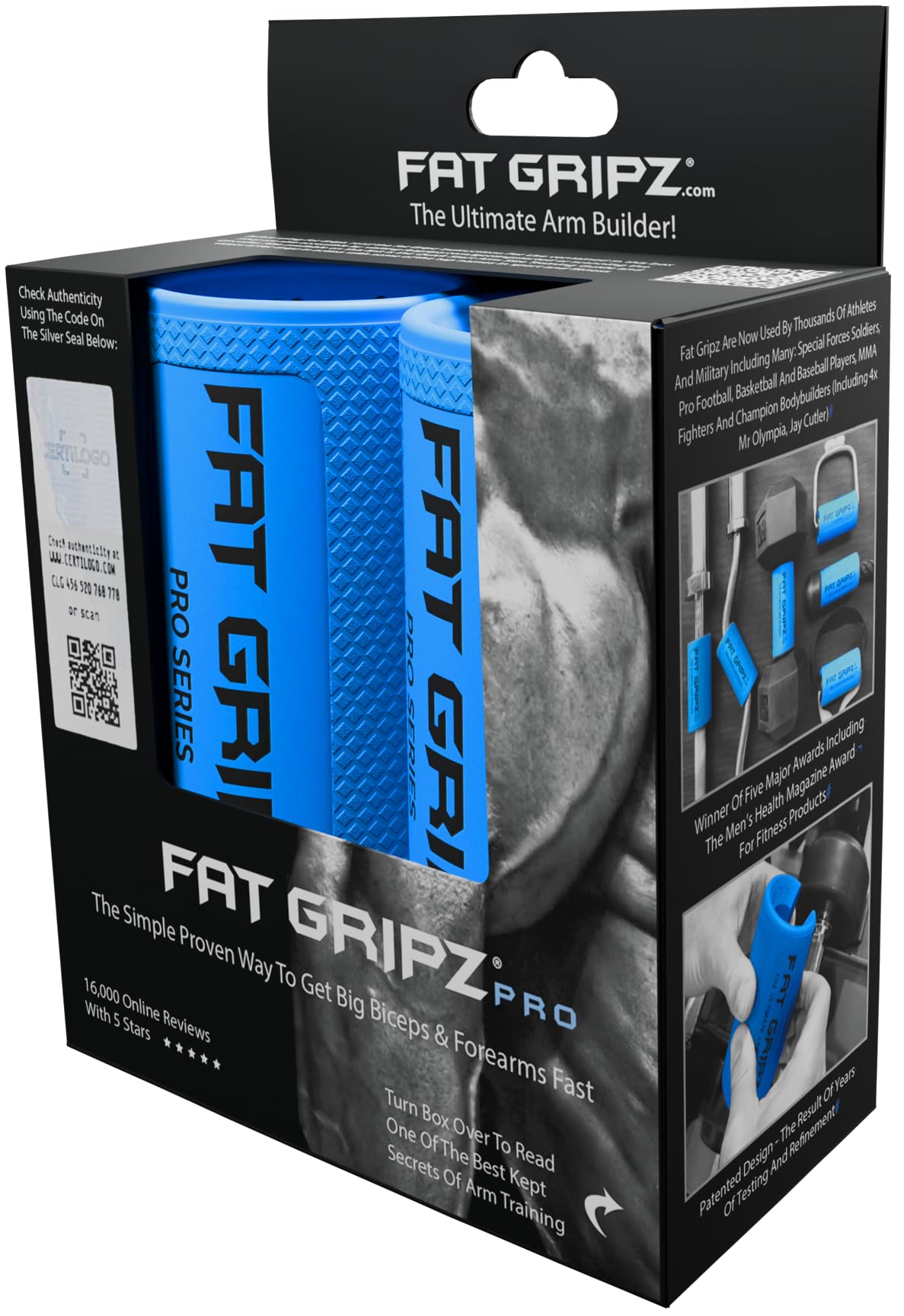
Two rubber sleeves that turn any ordinary bar into a forearm-burning thick bar.
If your forearms give out before your back does on rows and pull-ups, this is the pair to reach for first. A 2.25-inch outer diameter (the thickness of each sleeve where you grip it) forces your hands wider than a standard bar, and that extra span is what lights up your forearms and biceps. The whole pair weighs 1.1 pounds, so it rides in a side pocket without you noticing — a fraction of the load a 12-pound vest adds to every step.
They clip onto barbells, dumbbells, pull-up bars, resistance bands and machine handles, so one pair covers the entire gym. The rubber does not tear or roll under load, which matters because a sleeve that shifts mid-set is worse than no sleeve at all. Owner feedback keeps circling back to the same thing: the forearm burn arrives within the first set, and the challenge never really fades. Those four Men’s Health awards are printed on the box, and take them as brand history rather than a personal result.
The honest catch is comfort. A thicker bar means a harder squeeze, and a share of buyers report soreness in the forearms and biceps, with some feeling it in the wrists instead. That is the training effect, not a defect, but it does mean you should start light and let your hands adapt over a few weeks. Also note the flip side of the size: 2.25 inches is the original spec, and it is a genuinely harder grip than a bare bar from rep one.
What it does to your training
- Adds 2.25 inches of grip diameter to bars, dumbbells and pull-up bars.
- Rubber holds up without tearing or rolling, per long-term owner feedback.
- 1.1-pound pair travels in any bag pocket.
- One purchase covers pressing, pulling and band work.
Where it bites back
- Genuinely harder to hold — expect fewer reps at first.
- Soreness in forearms or wrists is a common early complaint.
- Not a substitute for straps when you are chasing a maximum pull.
The one to buy first: anyone whose grip fails before their back does on rows, pull-ups or carries.
Handle with patience: the first two weeks will feel harder than your normal bar, so drop the weight and let your hands catch up.
2. SINYWAY 10 PCS Barbell Pad Set for Squat and Hip Thrust
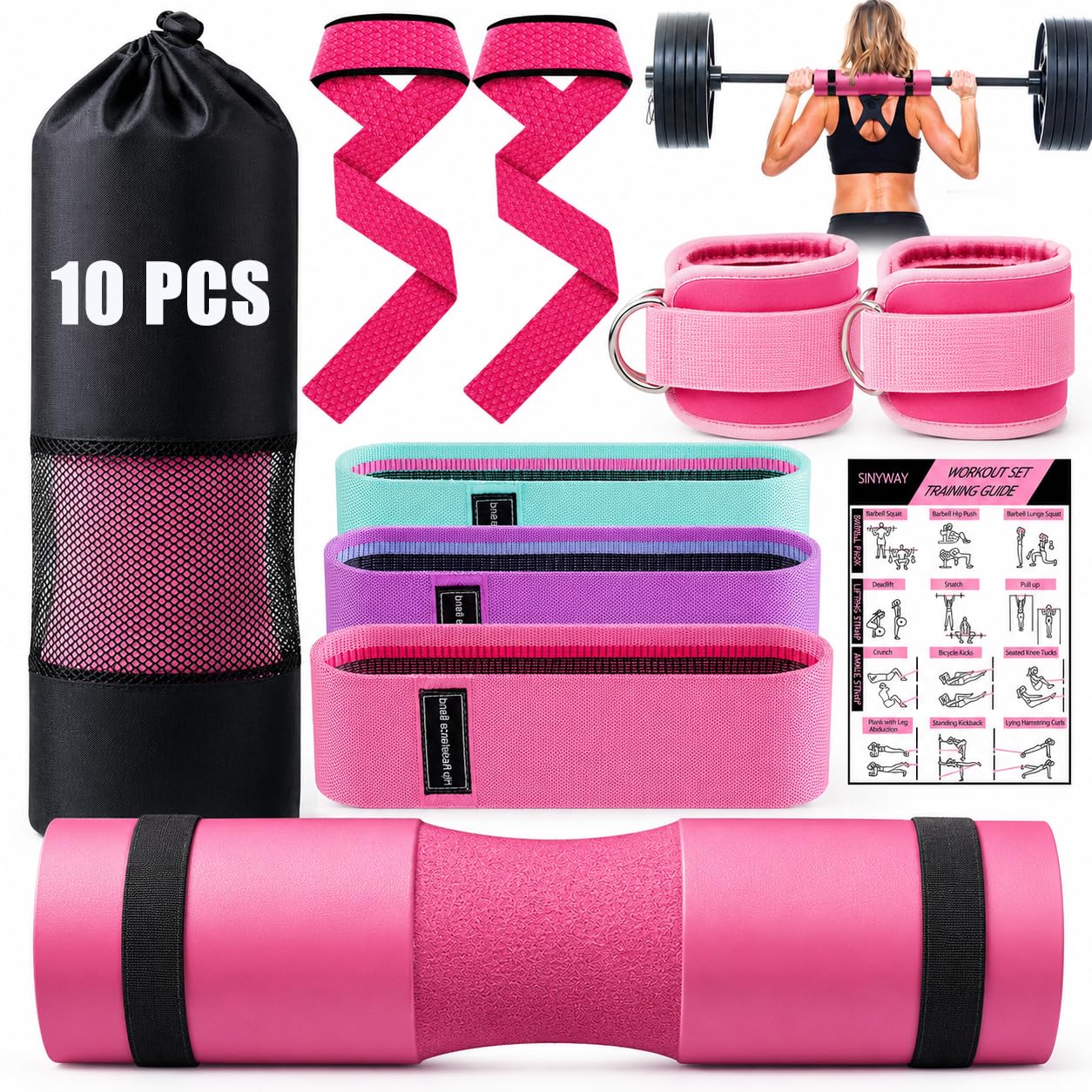
One box that outfits an entire leg day, from hip thrusts to kickbacks.
A barbell across your hips during hip thrusts is the single most common reason people quit the movement. This pad answers that with high-density rubber foam 1.3 inches thick — thick enough that the load spreads instead of digging in, and dense enough that it does not flatten when you squat with it. The buckle strap holds it on the bar so it stops sliding down your back mid-set, and the stated capacity reaches about 400 kg.
The set is the real argument. You get the pad, a carry bag, two ankle straps with D-rings, two lifting straps, and three fabric hip resistance bands rated Light (23-33 lbs), Medium (34-44 lbs) and Heavy (45-55 lbs) — ten pieces of leg-day gear in one bag. That breadth is what owners praise most; the pad itself draws the strongest feedback, described as good quality and a solid pick for hip thrust work specifically.
Here is the trade-off worth knowing before you order. The bands are the weak link in the kit, with gripes that they run loose and offer little resistance compared with a proper band set. If you want heavy banded work, buy this for the pad and the straps, and add a dedicated band set separately. If you want one take-it-all bag for leg day, this is the tidy answer.
Where the value sits: ten pieces, one carry bag, and a pad thick enough at 1.3 inches to keep a loaded bar off your neck and hips.
The weak piece: the three included bands are the part most likely to disappoint, so treat them as starter tension rather than training resistance.
Reach for this if: you want your squat and hip-thrust kit sorted in a single order.
Look elsewhere if: the resistance bands are the main reason you are buying — get them from a band specialist instead.
3. WHATAFIT Resistance Bands with Handles
Five color-coded tubes that stack from a light warm-up to a serious pull.
No rack, no bench, no problem. Five tubes rated at 10, 20, 30, 40 and 50 lb clip together for up to 150 lb of combined resistance, so one bag covers a warm-up set and a heavy row in the same session. Two cushioned handles take rows, presses and curls; two ankle straps add kickbacks and leg work; a door anchor turns any doorframe into a cable station. The whole kit weighs 2 pounds.
The construction explains why the set holds up better than cheap tube bands. Each tube is dual-layer natural latex, and every connection uses TPU collars, crimped brass ferrules, steel clips and reinforced nylon webbing — proper hardware, so the clip is less likely to slip out mid-rep. Owners use them for whole-body sessions at home, and the set works as a stand-in for gym machines on travel weeks.
The trade-off is lifespan. Rubber tubes fatigue, and the recurring honest note is that some sets break after steady use — so inspect each tube before every session, as the maker itself advises, and replace rather than tape. Stored out of sunlight and away from sharp edges, they last far longer. For a portable full-body setup, this is the pick.
Why it earns a slot: 10 to 150 lb of adjustable resistance, five tubes, two handles, two ankle straps and a door anchor — all in 2 pounds of bag weight.
Keep an eye on: latex tubes wear out, so a visual check before each session is part of owning these.
Best fit: the lifter training at home or in a hotel room who needs a full body session without a rack.
Not for: anyone who wants to pull near-maximal loads — you need a bar for that.
4. ZELUS Weighted Vest (12 lb)
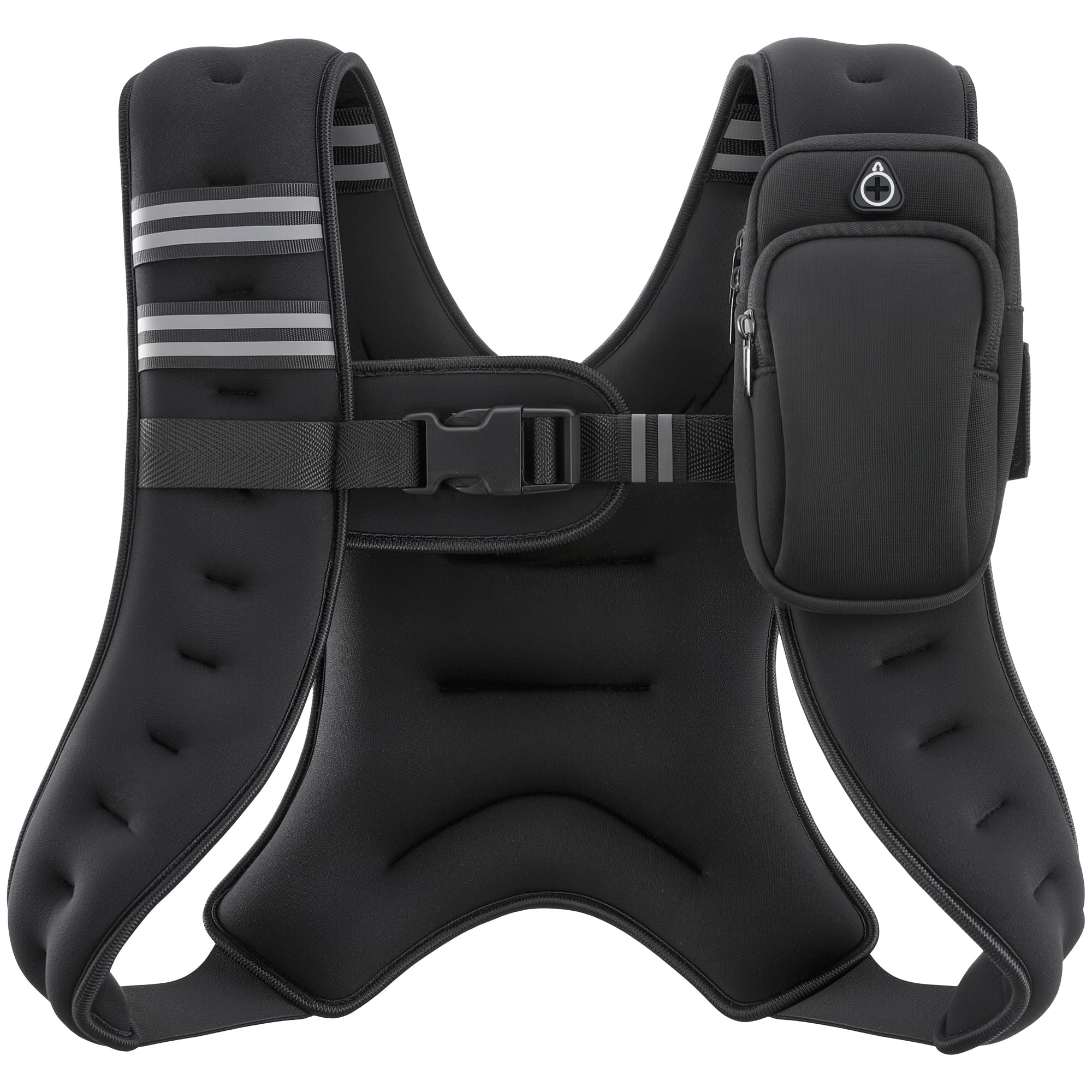
Twelve pounds of evenly spread iron sand that turns a walk into a workout.
Adding load to a walk is one of the simplest ways to make everyday cardio count, and this vest does it without a bar or a rack. The 12-pound version spreads iron sand evenly across the torso, so the weight sits on your frame rather than swinging at your sides. Adjustable buckle straps fit chest sizes from 31.5″ to 45″, which covers most adults in one size.
The reflective stripes are the detail that makes it genuinely useful outdoors — you are visible on an evening walk, not a dark shape on the pavement. There is an armband pouch for keys and a phone, plus a rear mesh pocket. Spandex fabric covers the shell and wipes clean with a damp cloth. Owners lean on it most for walks and runs, where the extra resistance is felt fast.
Two things to weigh. First, the fit range stops at a 45-inch chest, so larger lifters should measure before ordering. Second, out of the bag the fabric has a strong smell that needs airing out for a few days — set it outside or in a garage before your first wear. Seam wear shows up in a small share of long-term reports, so treat the straps gently when you pull it on.
What it brings to a walk
- 12 lb of evenly distributed iron sand for steady added resistance.
- Buckle straps fit chests from 31.5″ to 45″.
- Reflective stripes for visibility on evening sessions.
- Armband pouch and rear mesh pocket for phone and keys.
Set your expectations
- Needs airing out — the new-fabric smell is strong at first.
- Chest fit tops out at 45 inches.
- Seams can separate with rough handling over time.
Pick it for: daily walks, rucks and jogging where you want resistance without holding anything.
Think twice if: your chest measures above 45 inches — the buckle straps will not close comfortably.
5. ODCPN Squat Wedge Block (15° Bevel, 1500 lb Capacity)
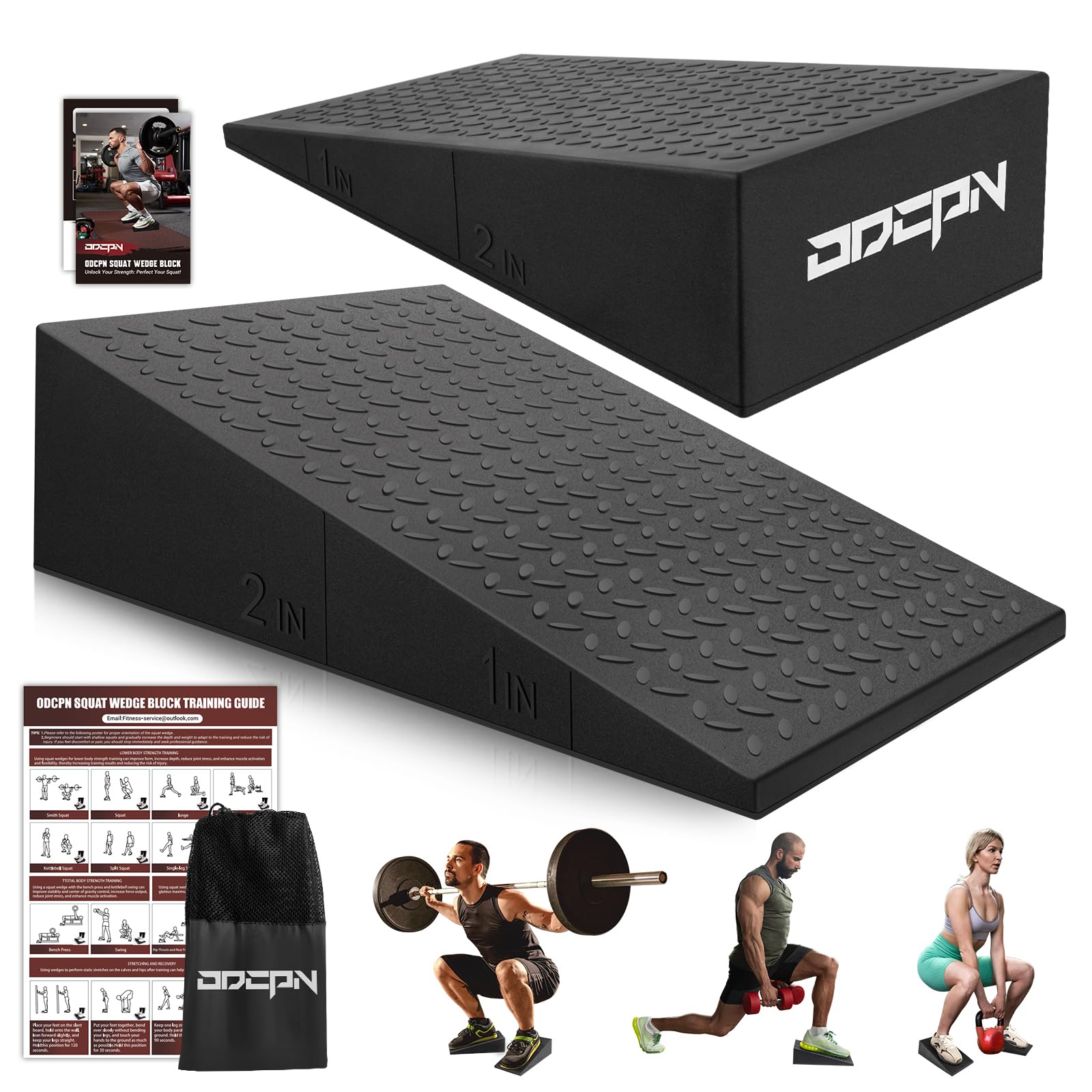
A heel lift that lets stiff ankles finally sink into a real squat.
If your heels lift off the floor at the bottom of a squat, the problem is usually ankle mobility, not leg strength. This wedge raises your heels on a 15° bevel — a slope angled to match how your ankle naturally bends — so you can reach depth while staying balanced over mid-foot. Height markings on the side of the block let you pick a consistent position each session.
The build is where it separates from the foam wedges. A high-density ABS core carries a stated 1500-pound capacity, and a silicone surface with a leaf-textured anti-slip pattern grips the floor instead of skating on it. At 11.8″ long and 5.9″ wide it gives full-foot support, which is more platform than typical foam or cork wedges offer. Owners mention it staying put on hardwood and on padded mats, which is exactly what you want under a loaded bar.
Beyond squats it works for knees-over-toes work, calf stretches and yoga, and the kit includes a training poster, a carry bag and an instruction guide. The catch is portability — at 1 kg it is a bag-sized item, not a pocket one, and it is heavier than a foam alternative. For a fixed home setup, that weight is the reason it does not move.
The build that matters: a 15° bevel, a 1500-pound stated capacity, and a leaf-textured silicone surface that holds its place on hardwood or a mat.
Worth knowing: this is a 1 kg block, so it lives in your gym rather than your gym bag.
Made for: lifters whose heels rise at the bottom of a squat and who train at home on a hard floor.
Skip the upgrade if: you only need a soft stretch aid — a foam wedge is lighter to carry.
6. Marcy Fitness Equipment Mat and Floor Protector

The unglamorous purchase that keeps a treadmill from denting your floor.
A treadmill, elliptical or bike puts its whole weight on a few small feet, and that is how carpet gets crushed and hardwood gets marked. This mat spreads the load across a 78-inch by 36-inch surface of 1/4-inch EVA foam — the same closed-cell foam used in gym flooring — so the pressure point disappears. It weighs 6.4 pounds, light enough to roll up and move when you rearrange the room.
It does two jobs at once. Under a machine, the matte surface gives firm, non-slip placement and reduces the noise and vibration that travels through a floor into the room below. On the floor itself, the cushioned surface absorbs impact from dropped dumbbells and kettlebells. Owners find it fits neatly under treadmills and works well beneath bikes, and the size runs larger than most jump-rope mats.
The honest limit is durability at the edges — foam this thickness can rip if you drag a machine across it or catch a corner, so lift rather than slide. At 0.25 inches it pads and protects; it is not a drop platform for heavy barbell work. Clean it with a damp cloth and it stays serviceable for years of steady use.
What you are buying: 1/4-inch EVA foam across 78 by 36 inches — impact absorption plus a non-slip base under heavy machines.
The trade-off: foam this thin will tear if you drag equipment over it, so set machines down rather than sliding them into place.
Worth it for: anyone with a treadmill, bike or elliptical sitting on a floor they care about.
Not the tool for: heavy barbell drops — you want a thicker platform for that.
7. DMoose Fitness Weight Lifting Hooks (Pair)
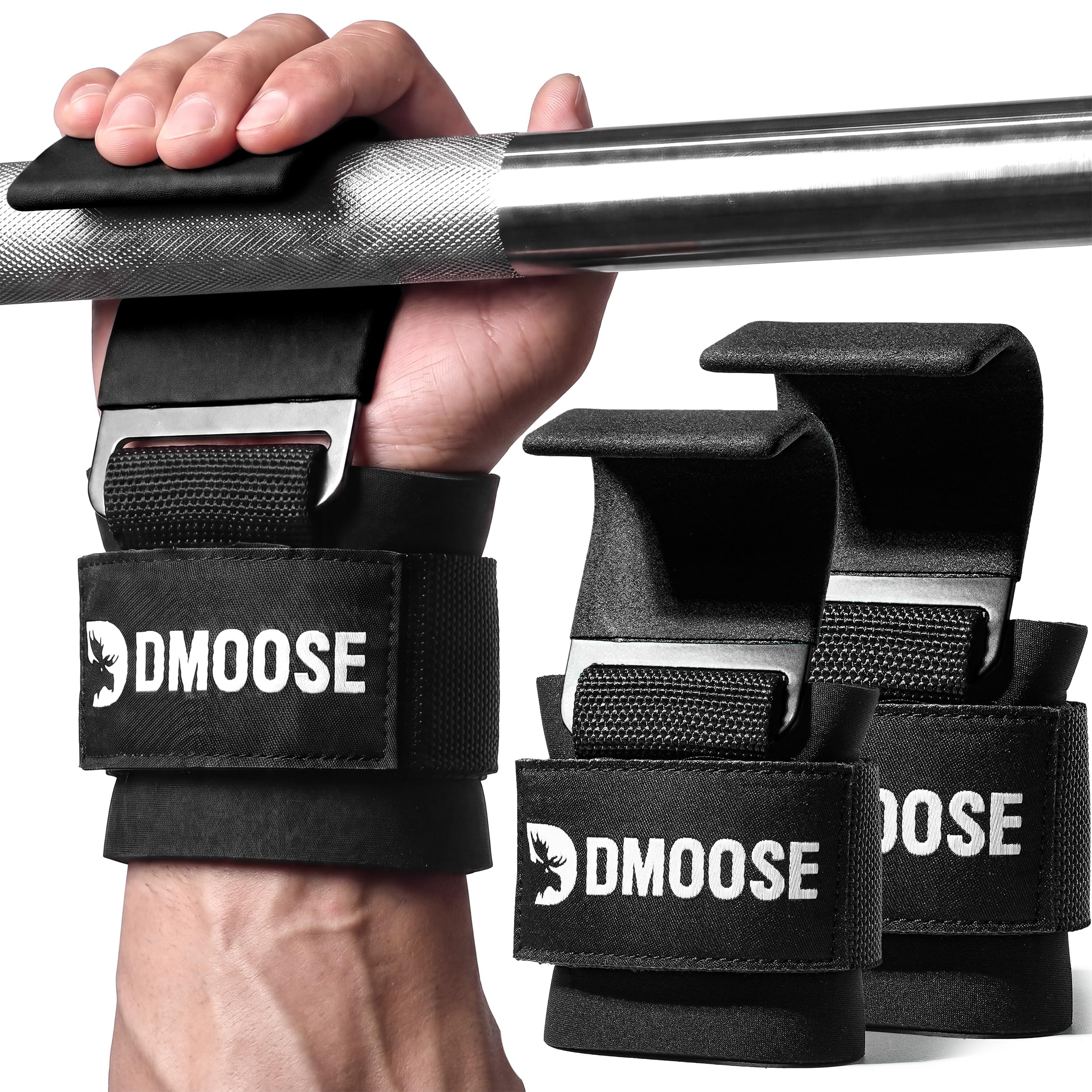
Steel hooks that take the bar out of your hands so your back can finish the rep.
When your grip quits at rep six of a deadlift, your back never gets the work it was built for. These hooks lock onto the bar and carry the load through a reinforced nylon strap, rated to a stated 500 pounds. The wrist section is padded to 8mm, thick enough that the strap does not bite into your skin on a heavy set.
The build is the reason they are here rather than the cheapest hooks on the shelf. Nylon, neoprene and steel come together with reinforced double cross stitching, and the Velcro closure adjusts so the hook sits where you need it. Pullers use them for deadlifts, rows, shrugs and pull-ups; the padding earns a lot of the goodwill, with wrist comfort the note that keeps coming up.
The mixed part is the grip itself. Some lifters find the hook keeps the bar locked tight through every rep; others feel the bar shift inside the hook, especially on a sweaty session. That is a fit-and-technique story as much as a product one — set the strap snug and the hook sits flatter against the bar. They are a training aid, not a license to skip grip work entirely.
What stands out: a 500-pound stated capacity, 8mm wrist padding and reinforced double cross stitching on a pair that weighs about half a kilo.
Where opinions split: the bar-to-hook contact is the dividing line — snug the strap and the hold gets flatter.
The right buyer: anyone whose deadlift and row numbers are capped by hand strength rather than back strength.
Hold off if: you are still building baseline grip — hooks let you lift more, but they do not build the hands.
8. Fitarc Landmine T Bar Row Attachment
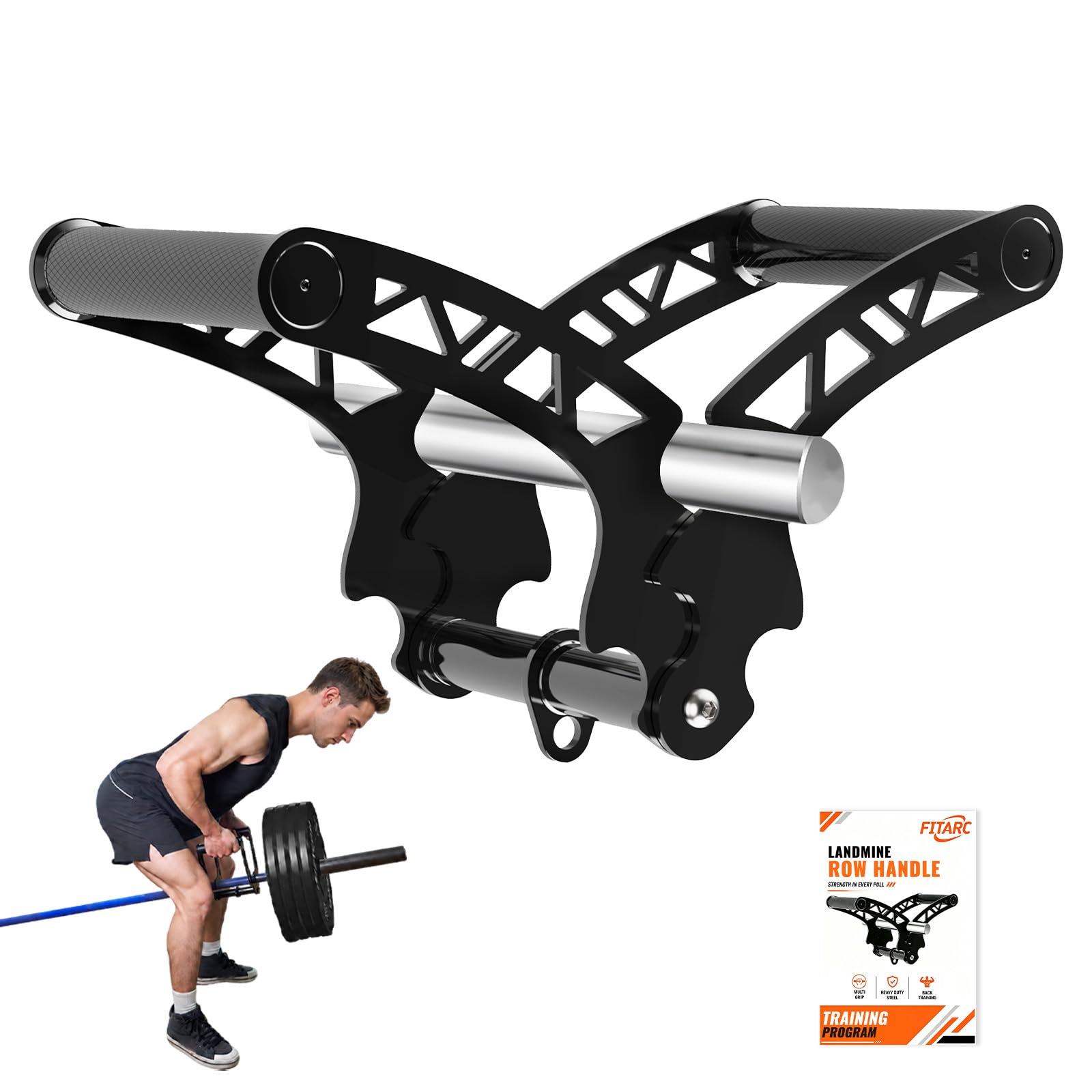
Three grip widths on one steel handle, so back day stops being one exercise.
A landmine row is only as good as the handle you pull with. This one offers grip widths of 15.7″, 11.8″ and 7.8″ on a single attachment, so you can shift from a wide pull that hits the upper back to a narrow one that loads the lats, without swapping equipment. The whole unit weighs 3 pounds and folds up for storage.
It is built entirely from steel with knurled grips — a textured pattern cut into the metal so your hands do not slide when they sweat — and both the frame and handle are fully welded. The extended frame holds the barbell away from your chest during rows, which is what lets you complete a full range of motion instead of cutting the rep short. It simply clips onto the bar and stays there when you step away mid-session.
The one spec to check before you buy: the grip size is 1 inch, so confirm it suits your bar setup. Beyond that, this is the most specialized pick in the guide — it only earns its place if you already own a barbell and a landmine sleeve. For a home lifter who does, it turns one bar into a whole back-day machine.
What three grips get you
- 15.7″, 11.8″ and 7.8″ grip widths on one attachment.
- Knurled steel grip that holds through sweaty sessions.
- Extended frame keeps the bar off your chest for full range of motion.
- Clips on and stays on — no reinstall between sets.
Before you commit
- Only useful if you already have a barbell and landmine sleeve.
- 1-inch grip size needs checking against your setup.
- Steel construction means it is a fixed-home item, not a travel one.
Buy this when: you already own a barbell and want to widen your back training beyond one row variation.
Leave it if: you train in a commercial gym that already stocks landmine handles.
9. QPARVERS Cable Machine Attachment Set (4 Pieces)

Four cable handles that turn one machine into a full upper-body circuit.
A home cable machine lives or dies by its attachments, and four of them cover nearly every upper-body movement. The V-handle rotates for seated rows that hit back, shoulders and arms together. The V-shaped bar is alloy steel with a knurled rubber handle and a 0.5-inch hole that fits standard cable systems. A straight rotating bar handles press-downs, upright rows and curls, and a nylon braided tricep rope with a chrome swivel rounds out the set.
Alloy steel is the load-bearing material across the bars, and the set comes in at about 2.92 kg, so it feels substantial in the hand rather than hollow. The rubberised grips sit comfortably against the palm, and customers note the attachments holding up past a year of steady use. For a garage gym that already has the machine, this is the cheapest way to multiply what it can do.
Check your machine before ordering. The 0.5-inch hole fits standard cable systems, but a non-standard carabiner or an odd-sized clip will need an adapter. And if you already own one good V-handle, buying the full set duplicates it — the value only lands if you are starting from nothing.
Why the set works: four attachments in alloy steel, a 0.5-inch hole that fits standard cable systems, and a rotating V-handle plus a swivel rope for press-downs and rows.
Check first: confirm your machine’s clip matches a 0.5-inch hole, and skip the set if you already own a solid V-handle.
The match: a home gym with a cable machine and no decent attachments yet.
Not needed if: you already own a rotating V-handle you like — you would be paying for a duplicate.
Know the Specs
Grip diameter and bar thickness
Grip diameter is simply how thick the handle is where your hand closes around it. A 2.25-inch sleeve like the Fat Gripz forces your hand open wider than a standard bar, and a wider span means your forearm muscles work harder on every rep. That is why you lift less with a thick grip at first — the same weight is doing more work. Cable attachments and landmine handles publish a separate fit size, such as a 0.5-inch hole or a 1-inch grip, and that number decides whether the piece connects to your machine at all.
Stated load capacity and padding thickness
Load capacity is the weight a maker says the piece can carry — a 400 kg barbell pad, a 500 lb lifting hook, a 1500 lb squat wedge. Treat those as the maker’s stated limits, useful for comparing one product against another of the same type. Padding thickness, such as the 1.3-inch foam on a squat pad or the 8mm wrist padding on a hook, tells you how far the pressure is spread across your neck, hips or wrist. Thicker padding and a higher stated capacity are the two clues that separate a piece built for loaded work from a light-duty accessory.
Common Questions
Will Fat Gripz fit on a standard Olympic barbell and pull-up bar?
How thick should a barbell pad be for hip thrusts and squats?
Do resistance bands with handles really replace gym machines?
How long do latex tube resistance bands last?
Is a weighted vest better than holding dumbbells for walking?
Will a squat wedge help if my heels lift off the floor?
Do lifting hooks stop you from building grip strength?
Will a fitness equipment mat fit under my treadmill?
What size hole do cable machine attachments need?
Can a landmine row handle be used without a landmine sleeve?
The Bottom Line
Start with the Fat Gripz Pro: at 4.5+ stars across 19,000+ ratings, its 2.25-inch diameter fixes the most common gym frustration of all — hands that quit before the back does. If your problem is a bar digging into your hips, the SINYWAY set sorts that in one bag. And when you want to lift more without your grip being the ceiling, the DMoose hooks carry the load so your back can finish the set.
Buy for the lift you actually do and measure before you order — one well-chosen accessory beats a bag full of maybe-useful ones.
How we choose
We do not accept paid placement. Every pick is matched to a real buyer and a real use-case; we do not hands-on test units.
Sources
Specifications: manufacturer listings and product documentation. Review insights: verified customer reviews, as of November 2026. Pricing: not shown on this page (it changes often); check the current price via the retailer link.
As an Amazon Associate, Tactical Gear Guy earns from qualifying purchases. This does not affect which products we feature.