Specs are compiled from manufacturer listings and verified buyer reviews and can change over time — please confirm the key details on the product page before buying.
You want your yard lit after dark without running cable to an outlet, and you want to change the color or schedule from your phone instead of climbing a ladder to flip a switch. That narrow wish is exactly what a solar smart light does — and the four picks below are the ones worth your time. The most important thing to know up front: panel quality and app control decide whether these feel clever or maddening, not the number of colors a listing brags about.
This guide is built by comparing the manufacturers’ published specifications and the patterns across verified customer reviews, so you get each pick’s real strengths and trade-offs instead of marketing spin.
Below you get a full comparison of separable panels, wide-angle flood coverage, pattern lenses and motion modes — everything a smart solar light buyer actually weighs. That one decision hinges on how much sun the panel sees and whether your phone stays in the loop.
Top Picks
How To Choose The Best Solar Smart Light
Your shopping problem is really a sun problem. A solar smart light only performs as well as the panel feeding it, and a panel in shade recharges nothing no matter how good the app is. So start with where the sun lands on your property, then work outward to wiring-free convenience and phone control.
Panel placement beats every other spec
A detachable panel on an extension cord lets you park the solar collector in direct sun while the lamp sits where you actually want light. If your yard’s sunny patch is nowhere near your dark path, that separation is the difference between nightly light and nightly darkness. Fixed-panel fixtures force you to compromise the light position to feed the battery.
Understand what IP65 and IP66 mean before you commit
An IP rating (Ingress Protection — a two-digit score for dust and water resistance) tells you how the housing copes with rain and grit. IP65 handles jets of water and IP66 handles stronger jets. Higher is better for a fixture that stays outdoors through every season in your climate.
Tunable white versus RGB color
White temperature is measured in Kelvin (K) — the lower the number, the warmer and more amber the light; higher numbers read cooler and bluer. RGB color is the fun layer for holidays and parties; the white layer is what you actually want for path lighting and everyday use. Buy for the white quality first and treat color as the bonus.
Know your control path
Bluetooth app control works from your phone within range of the fixture and needs no extra hardware. Voice control through Alexa or Google Home is a separate layer that usually needs a mesh hub. If talking to your lights matters, check whether the hub comes in the box or is sold separately before you order.
Side-by-Side Comparison
| Model | Best For | Light Form | Color Temperature | Color Range | Amazon |
|---|---|---|---|---|---|
| Linkind Smart Solar Spotlights SL6C★ Best Overall | Custom yard and holiday lighting | Spotlight | 6500 Kelvin | 16M colors, tunable white | Amazon |
| Consciot Smart Solar Spot Lights Outdoor | Budget holiday displays and paths | Spotlight | 1800 Kelvin | RGBTW, 16M colors | Amazon |
| Linkind Smart Solar Spotlights SL5 | Motion-triggered security lighting | Spotlight | 6500 Kelvin | 16M colors, tunable white | Amazon |
Detailed Reviews
1. Linkind Smart Solar Spotlights SL6C
Our pick — 4.0+★ from 900+ verified ratings; the strongest balance of quality and price.
Two independent beam rings and a panel you can string 118 inches away from the lamp — that is the trick.
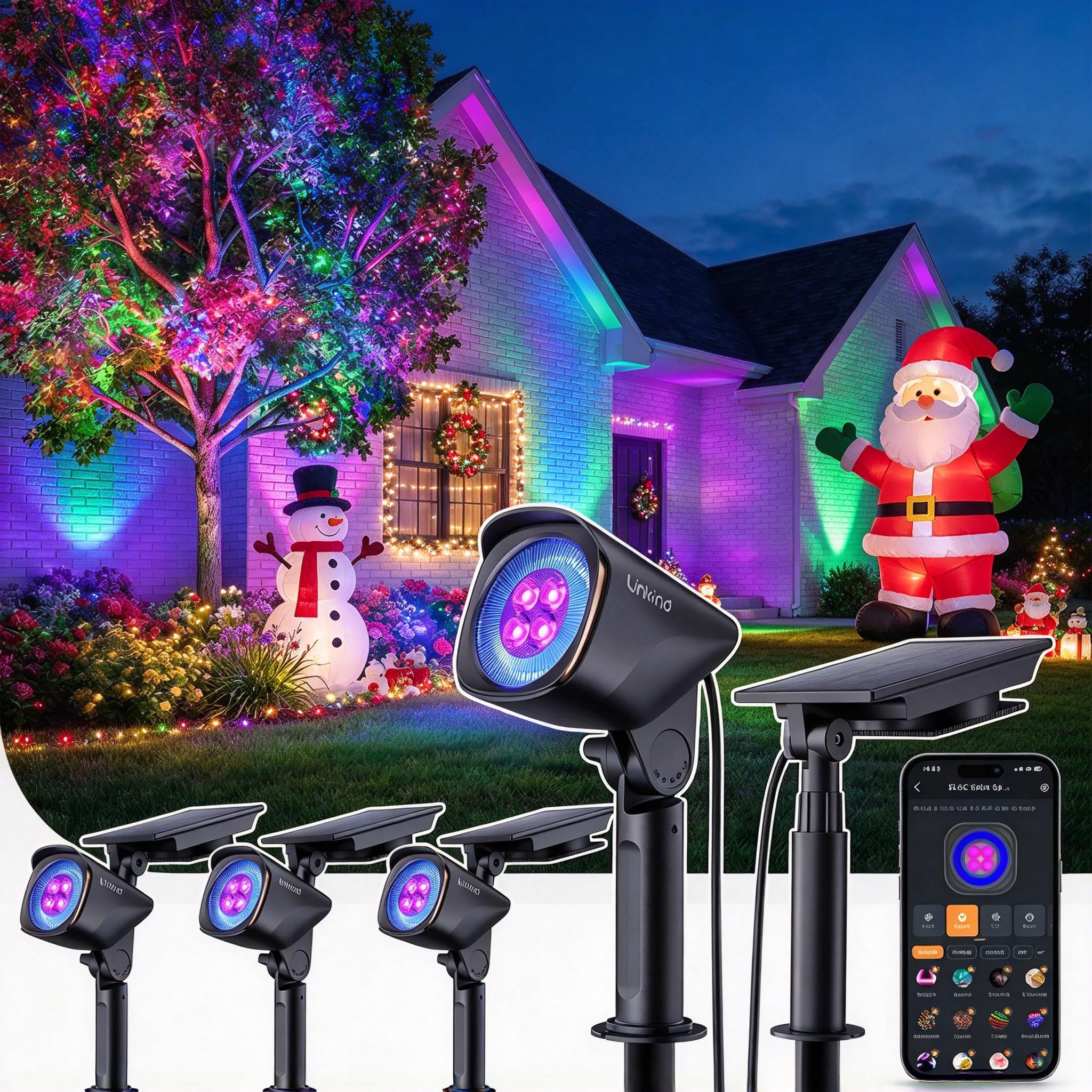
The SL6C is the most flexible fixture here because you are not forced to choose between good sunlight and good placement. The solar panel detaches and connects over a 118-inch extension cord, so the collector sits in direct sun while the light hangs or stakes exactly where you want it. You can also top it up over USB-C when a gray week drains the cell — a backup the Consciot and both other Linkind picks here do not give you in the same way.
Inside the head are two rings you drive separately. The inner 32° ring throws a tight accent beam at a feature plant or a flag, while the outer 82° ring floods a wider patio or garden bed. That range explains the base square-versus-thimble gap in the verified data: at 10.62″L x 7.95″W x 9.92″H it is a genuine 7.1x bigger footprint than the 1.5″L x 3.5″W x 2.5″H Consciot, so plan for visible hardware rather than a hidden puck.
Where the SL6C earns its keep is brute capability. 16M colors, tunable white, 55 presets and music sync run through the AiDot app, and you can build 8 groups of 32 lights each for a synchronized show across a whole yard. The build is IP66 with ABS+PC and rated for 14°F to 104°F, and owners back that up — the thing everyone raves about is the quality and the color range, with easy install a close second. The honest caveat is brightness and battery life: they divide opinion, with some owners keeping fixtures bright for years and others finding the charge fades or a unit stops recharging. Best if you want a full-featured show and you will actually park that panel in sun.
What makes the SL6C worth the bigger footprint
- Detachable panel on a 118-inch cord plus USB-C backup charging
- Inner 32° accent ring and outer 82° flood ring run independently
- 55 presets, music sync and 8 groups of up to 32 lights
- IP66 housing rated for 14°F to 104°F year-round
Where owners get split
- Brightness and battery life draw mixed feedback — real performance depends on sun exposure
- The largest housing of the four, so it is the most visible in a bed
- Alexa and Google control needs an added hub
Buy it for: the buyer who wants a two-beam fixture they can aim precisely and separate into groups across a whole yard.
Think twice if: you want a small, hidden fixture — this one is a big, deliberate-looking piece of hardware.
2. Consciot Smart Solar Spot Lights
The panel is the headline here — a gridline-free front and a chip that squeezes power out of weak light.
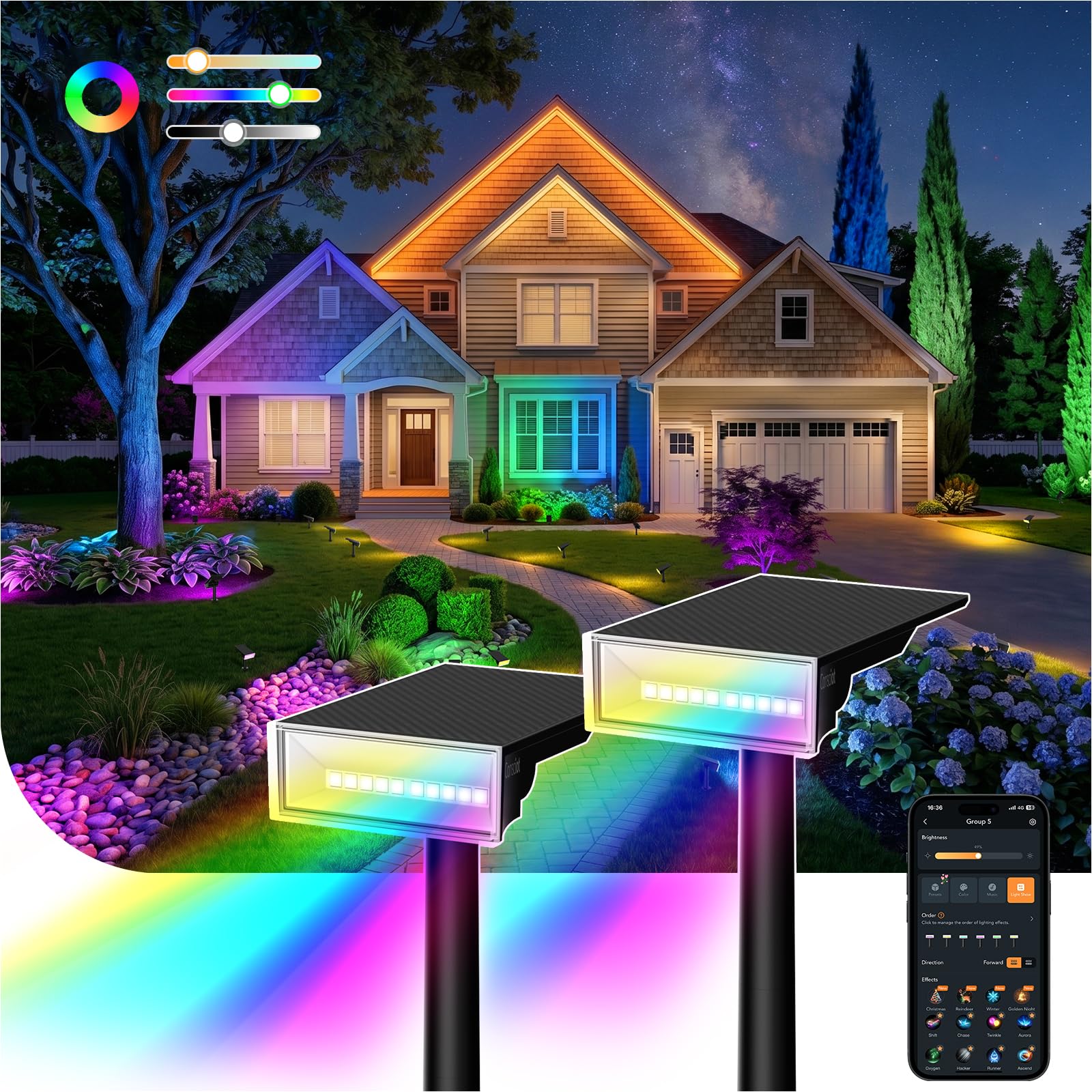
Most budget solar fixtures use a plain panel; the Consciot steps up to an HPBC panel with a gridline-free front, which means no electrode lines shade the light-receiving face. Paired with an MPPT smart chip that tracks and tune power conversion, the maker claims 30% higher charging efficiency and continued charging on cloudy days. We did not test that 30% figure, but the design logic holds: an unshaded panel face plus MPPT conversion means more usable charge for all-night run time.
The number that jumps out when you compare it to the SL6C is white temperature. This one is listed at 1800 Kelvin to 6500 Kelvin via RGBTW tunable white, so it reaches down into a warm amber end the 6500 Kelvin SL6C does not reach. That 1800K floor is 3.6x lower than the SL6C’s 6500K, so the Consciot is the pick for cozy holiday glow rather than crisp daylight white. It also offers 4 height options at 7.5, 11.4, 11.8 or 15.7 inches and a head that tilts up to 180°.
Control is hub-free through the AiDot app for colors, brightness, white temperature, schedules and groups — Alexa or Google Home voice control needs the Consciot BLE Mesh Hub, sold separately. The housing is IP65 and the whole fixture is a compact 1.5″L x 3.5″W x 2.5″H at the base, so it tucks into a bed without shouting for attention. First-use note straight from the listing: charge it 48 hours in direct sun before you rely on it. If you want warm-white holiday ambience on a modest budget and you can stand a separate hub for voice control, this is the smartest compromise on the page.
Best-fit buyer: someone lighting paths, plants or a Christmas display who wants a small fixture with warm-to-cool white range and app control.
The catch: voice control is not built in — the Consciot BLE Mesh Hub is required for Alexa or Google and is sold separately.
Reach for this if you want the widest white range and a compact stake-mount spotlight without stretching your budget.
Look elsewhere if you insist on voice control straight from the start with no extra hub purchase.
3. Linkind Smart Solar Spotlights SL5

A motion sensor plus three lighting modes makes this the one that guards a gate instead of decorating it.
If your reason for buying is a dark gate, shed or driveway rather than a holiday display, the SL5 is built for that concern. It runs three modes: Motion for safety and efficiency, Luminance for automatic dusk-to-dawn lighting, and Continuous for constant illumination. Motion mode only powers up when something moves, which is the smartest way to stretch a solar cell through the night. Aiming is generous too — 360° horizontal and 180° vertical adjustability, mounted on a wall or pushed into the ground, so you can point coverage at the exact gap you care about.
Around the back of that security job sits a full color rig. You get 16M colors, tunable cool and warm white at a 6500 Kelvin listed temperature, preset scenes, music sync and hubless group control for up to 8 groups of 32 lights. Unlike the SL6C above, the panel is not on a long detachable cord, so the SL5 depends on its own site getting real sun — pick your spot with that in mind. Voice control through Alexa or Google needs a BLE Mesh Hub, which is not included.
The fixture is IP65 water-resistant with a powder-coated finish, which is a step below the SL6C’s IP66 but still built for weather. Quality and brightness are the strongest signals in owner feedback here, with easy install right behind and the appearance drawing no complaints at all. Reliability is the honest split: plenty of units work straight from the start and keep going, while some arrive dead or quit within the first month. Best if a motion-triggered, aimable spotlight is your goal — that is a job the other three do not do.
Modes that stretch a solar charge
- Motion mode fires only on movement for the longest nightly run
- 360° horizontal and 180° vertical aiming for precise coverage
- Music sync, preset scenes and 8 groups of 32 lights
- Ground insert or wall mount from the start
Honest limits before you buy
- Reliability is genuinely mixed — some units arrive dead or fail early
- No detachable panel cord, so sunlight at the mount point is non-negotiable
- IP65 versus the SL6C’s IP66, and voice control needs a sold-separately hub
Pick this one when you need motion-triggered light on a dark gate, shed or driveway and you can guarantee the mount point gets sun.
Leave it if you want decorative color show lighting — this fixture’s strengths are aimed at security duty.
Know the Specs
Kelvin and RGBTW color temperature
Kelvin (K) measures how warm or cool a white light looks — lower numbers lean amber and cozy, higher numbers lean crisp and daylight-blue. RGBTW adds red, green and blue channels plus tunable white, so you get full color for holidays and a usable white light for daily paths. A wider listed span like 1800 Kelvin to 6500 Kelvin gives you more mood range than a fixture pinned near 6500 Kelvin.
Beam angle and throw
Beam angle in degrees describes how wide the light spreads. A tight 32° beam punches a sharp accent at one feature; a wide 82° flood washes a garden bed or patio. Matching the angle to the job matters more than raw brightness — a wide beam across a small bed can read dimmer than a tight beam on the same fixture.
IP ratings for outdoor fixtures
The IP number tells you how well the housing keeps out dust and water. IP65 handles water jets and IP66 handles stronger jets — so for a fixture facing a year of rain and grit, higher is safer. Match the rating to your climate and how exposed the mounting spot is.
MPPT and solar panel design
MPPT (Maximum Power Point Tracking) is a chip that continuously finds the best operating point for the panel, so it pulls more usable power from the same sunlight. A gridline-free panel front removes shading over the light-receiving face. Together they mean a better chance of all-night run time on cloudy days.
Common Questions
Do solar smart lights work if the panel sits in shade most of the day?
Do I need a hub for Alexa or Google control?
What is the difference between a spotlight and a pathway light?
How long should a solar smart light run on a full charge?
Can these lights be grouped and controlled together?
Is IP65 enough for a rainy climate?
What does tunable white actually let me do?
Can I charge a solar smart light without sun?
Whats the first thing to do after unboxing?
The Bottom Line
The solar smart light that fits the most buyers is the Linkind SL6C, because its detachable 118-inch panel lets you separate sunlight from placement and its 32° and 82° rings let you aim both a sharp accent and a wide flood. It also adds USB-C backup charging no other pick here matches.
If warm holiday ambience and a compact, budget-friendly footprint matter more than beam flexibility, the Consciot reaches a wider 1800 Kelvin to 6500 Kelvin white range in a tiny 1.5″L x 3.5″W x 2.5″H body. Want a walkway that looks designed? The Linkind SP6 and its five swap-in lenses are the pick. And for a gate or shed you want guarded rather than decorated, the motion-triggered Linkind SL5 with its 360° horizontal and 180° vertical aiming is the one to mount.
Whichever you choose, aim the panel at real sun first — that single step separates a yard that lights every night from one that goes dark by mid-evening.
How we choose
We do not accept paid placement. Every pick is matched to a real buyer and a real use-case; we do not hands-on test units.
Sources
Specifications: manufacturer listings and product documentation. Review insights: verified customer reviews, as of November 2026. Pricing: not shown on this page (it changes often); check the current price via the retailer link.
As an Amazon Associate, Tactical Gear Guy earns from qualifying purchases. This does not affect which products we feature.