Specs are compiled from manufacturer listings and verified buyer reviews and can change over time — please confirm the key details on the product page before buying.
You want to walk while you work without your microphone picking up a motor drone — that single requirement rules out most under-desk treadmills before you even look at the price. The three pads below are the ones built specifically around quiet running and a footprint that tucks under a desk, and the short answer is this: the WalkingPad C2 is the one to buy if you want the whole package, the Z1 is the slim-space specialist, and the ANCHEER is for anyone who wants a genuine running deck in the same footprint.
This guide is built by comparing the manufacturers’ published specifications and the patterns across verified customer reviews, so you get each pick’s real strengths and trade-offs instead of marketing spin.
A walking pad for office use lives or dies on two things: how loud the deck runs and how little floor it gives up. This breakdown covers both, plus the real trade-offs owners hit, so you can pick the Best Quiet Walking Pad for Office without guessing.
Top Picks
How To Choose The Best Quiet Walking Pad for Office
Choosing for an office is a different job from choosing for a home gym. At home you can turn the TV up. In an office you are sharing air with colleagues, and often a live call, so the motor, the belt and the deck all have to behave themselves at the same time.
Motor type beats raw horsepower for quiet running
A brushless motor (a motor design with no carbon brushes rubbing inside) runs with less mechanical noise and less of the high-pitched whine that carries through a headset microphone. The ANCHEER uses a 2.5HP brushless DC motor, and the WalkingPad Z1 is built around a brushless motor too. Horsepower tells you how much load the deck can pull; motor type tells you what your call will sound like. For office use, motor type wins.
Folded dimensions are the number your desk actually cares about
Ask yourself where the pad goes when you stop walking. If the answer is “under the sofa”, folded height is what matters — the WalkingPad C2 collapses to 5.4 inches tall and the Z1 is a slim 4.1 inches high in use. If the answer is “against the wall”, folded length matters more, and here the ANCHEER runs 40 inches folded against the Z1’s 31.8 inches. Match the number to the storage spot before you buy.
Speed range: what you need for typing pace
You will spend most of your walking time somewhere between a shuffle and a stride. The WalkingPad C2 and Z1 both run 1 to 4 mph, a narrower band than the ANCHEER’s 0.3 to 3.9 mph. The ANCHEER splits its range into two modes: 0.3 to 2.4 mph for under-desk working and 2.4 to 3.9 mph for a proper walk. Anything that tops out at typing pace is fine if you only ever plan to walk while answering email.
Belt length and deck comfort for long sessions
A short belt forces small, cramped steps, and an hour of that is worse than no walk at all. The Z1 carries a 47.6-inch walking belt, the ANCHEER a 40-inch deck. Longer belts suit taller walkers who want a natural stride. Belt surface matters too — the ANCHEER uses a seven-layer anti-slip running belt, which is the piece of spec that decides whether the deck feels planted underfoot.
Side-by-Side Comparison
| Model | Best For | Folded Size | Item Weight | Max Speed | Amazon |
|---|---|---|---|---|---|
| WalkingPad C2★ Best Overall | All-round office pick | 32.5 x 20.4 x 5.4 inches | 55 pounds | 4 mph | Amazon |
| WalkingPad Z1 | Tight storage spots | 31.8 x 22 x 5.4 inches | 50 pounds | 4 mph | Amazon |
| ANCHEER 2 in 1 | Walk-to-run flexibility | 40 x 25 x 5 inches | 46 pounds | 3.9 mph | Amazon |
Detailed Reviews
1. WalkingPad C2 Foldable Walking Pad Treadmill
Our pick — 4.5+★ from 200+ verified ratings; the strongest balance of quality and price.
The pad that folds flat, plugs in and disappears under your desk before your first meeting.
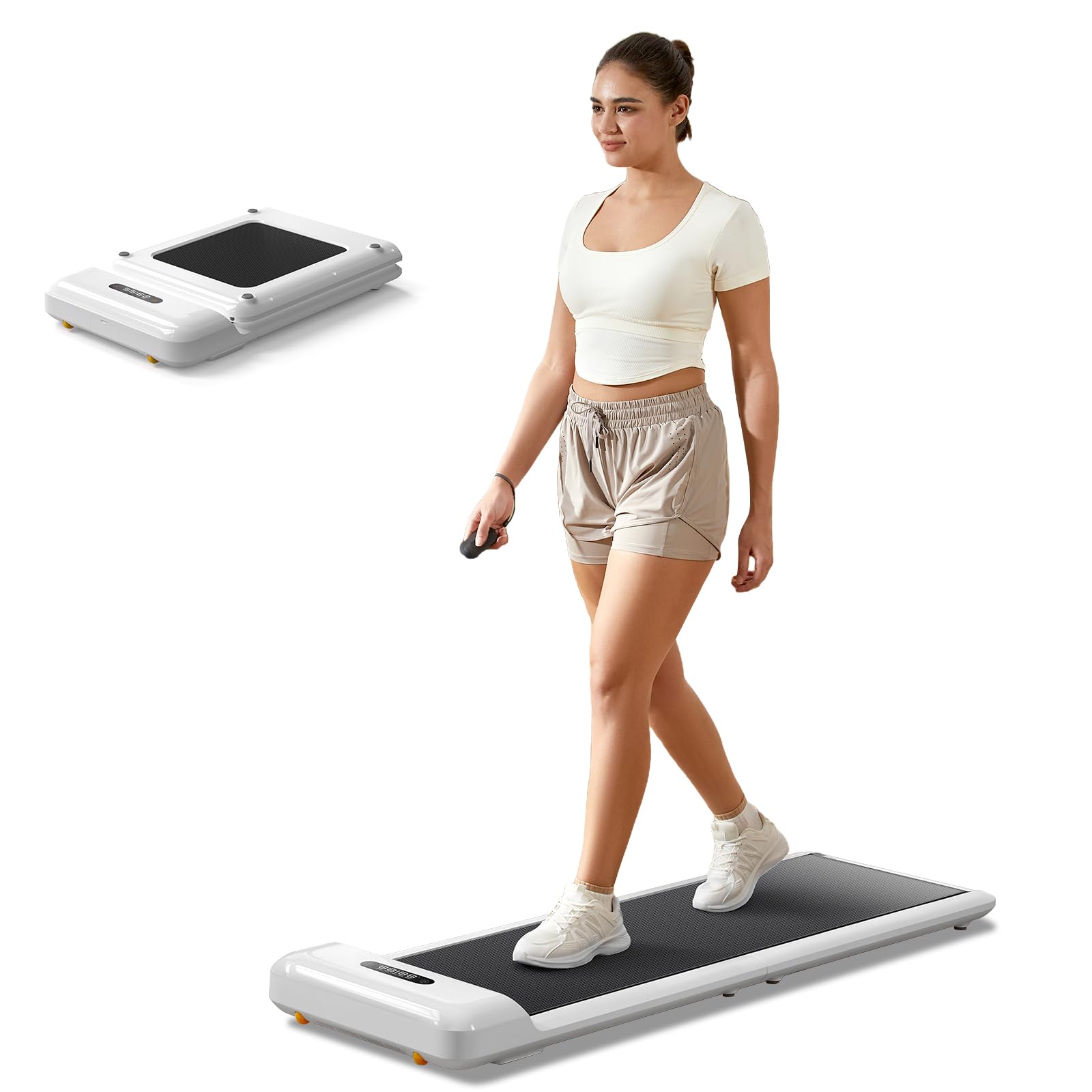
The WalkingPad C2 is the pad that solves the storage problem first and the walking problem second, and that order is why it lands at the top. Its platform folds a full 180 degrees, and the folded deck stands only 5.4 inches tall — low enough to slide under a bed or sofa and invisible in a working room. That 5.4-inch figure is the whole pitch for anyone whose office is also their living space.
Once it is unfolded, you get a 2.0HP motor rated to carry up to 220 lbs, with speed adjustable from 1 mph to 4 mph through either the remote or the app. The LED display tracks steps, training time, speed, calories and distance as you go, so you can glance down mid-task without breaking concentration. There is no assembly — unfold it, plug it in, walk. The 55-pound body rolls on two wheels at the base when you want to shift it out of the way. Measured against the ANCHEER, that 55 pounds makes the C2 the heavier of the two, 55 pounds against 46 pounds, so plan on rolling it rather than lifting it.
Here is where honesty earns its keep. Noise is the one mixed signal on this pad — plenty of owners find it genuinely quiet for a treadmill, while others say it runs louder than they expected. The C2 does run a smaller motor than the ANCHEER’s 2.5HP, 2.0HP against 2.5HP, which is the trade for its lighter build. Owners also fold and unfold it daily without complaint, which is the accessory that makes a compact pad actually livable.
What earns it the top spot
- Folds a full 180 degrees down to 5.4 inches tall — it stores under furniture instead of standing in the room
- No assembly at all: unfold, plug in, press go
- Remote plus app speed control from 1 to 4 mph suits everything from email pace to a real stride
- LED display reads out steps, time, speed, calories and distance live
- Five colorways, so it does not have to look like gym equipment
What to weigh before buying
- At 55 pounds it is the heavier of the two WalkingPad options here, so rolling beats lifting
- The 2.0HP motor is the smallest in this group — fine for walking, not built for miles of running
- 220 lbs weight capacity is the lowest ceiling on this list
- Noise reports split both ways; a quiet unit is likely, but not guaranteed in every box
Reach for this if: you want one pad that folds flat for storage, walks quietly enough for a shared room and needs zero setup — the all-round office answer.
Look at the ANCHEER instead if: a call-quality quiet motor is the single thing you cannot compromise on.
2. WalkingPad Z1 Foldable Walking Pad Treadmill

Four-point-one inches of deck, half the footprint when folded, and a belt long enough for a real stride.
If your desk sits in a shoebox apartment, start with this number: the Z1 stands just 4.1 inches high in use, making it the slimmest deck of the three here. That low profile means your chair rolls over it more easily and your feet step onto it without a climb. Add the fold-in-half design — the footprint drops by 50% when it folds flat — and you have a pad that genuinely goes under a bed or sofa rather than leaning against one.
What wins people over is the walking-pad quality overall, and the foldability is what they praise loudest — the deck folds up neatly and stores in a small footprint that slides under a desk. That said, the belt is the piece that deserves your attention. The Z1 carries a 47.6-inch walking belt, longer than the ANCHEER’s 40-inch deck, so taller walkers get a more natural stride instead of choppy little steps. It also comes in lighter than the C2 — 50 pounds against 55 pounds — despite the longer belt, and the folded deck measures 31.8 x 22 x 5.4 inches.
The honest catch is durability on the belt itself. Over time some buyers report the belt fraying or starting to tear, and a separate set mentions the belt slipping or the tread drifting. Others describe the pad as solid and heavy-duty, so it is not universal — but if you plan to log long daily sessions, treat belt wear as something to watch. Noise is mixed here the same way it is on the C2, and the brushless motor helps keep the low-end rumble down at walking pace. For a light, occasional-use pad that stores in a sliver of space, the Z1 fits the brief cleanly.
Where it fits: the lowest deck on the list at 4.1 inches, a longer 47.6-inch belt than the ANCHEER, and a folded footprint that halves — a strong pick if storage space is the binding constraint on your office setup.
What to keep in mind: expected belt wear over time and occasional slippage are the recurring gripes, so this suits steady casual walking more than hour-after-hour pounding. It supports up to 242 lbs and adjusts 1 to 4 mph.
Who it suits: anyone with very little floor to give up who wants a real walking belt rather than a tiny deck.
The trade-off: belt durability is the weak point, so it is better for regular everyday walking than heavy daily mileage.
3. ANCHEER 2 in 1 Under Desk Treadmill 2.5HP
The one that turns from an under-desk walker into a running deck without leaving the room.
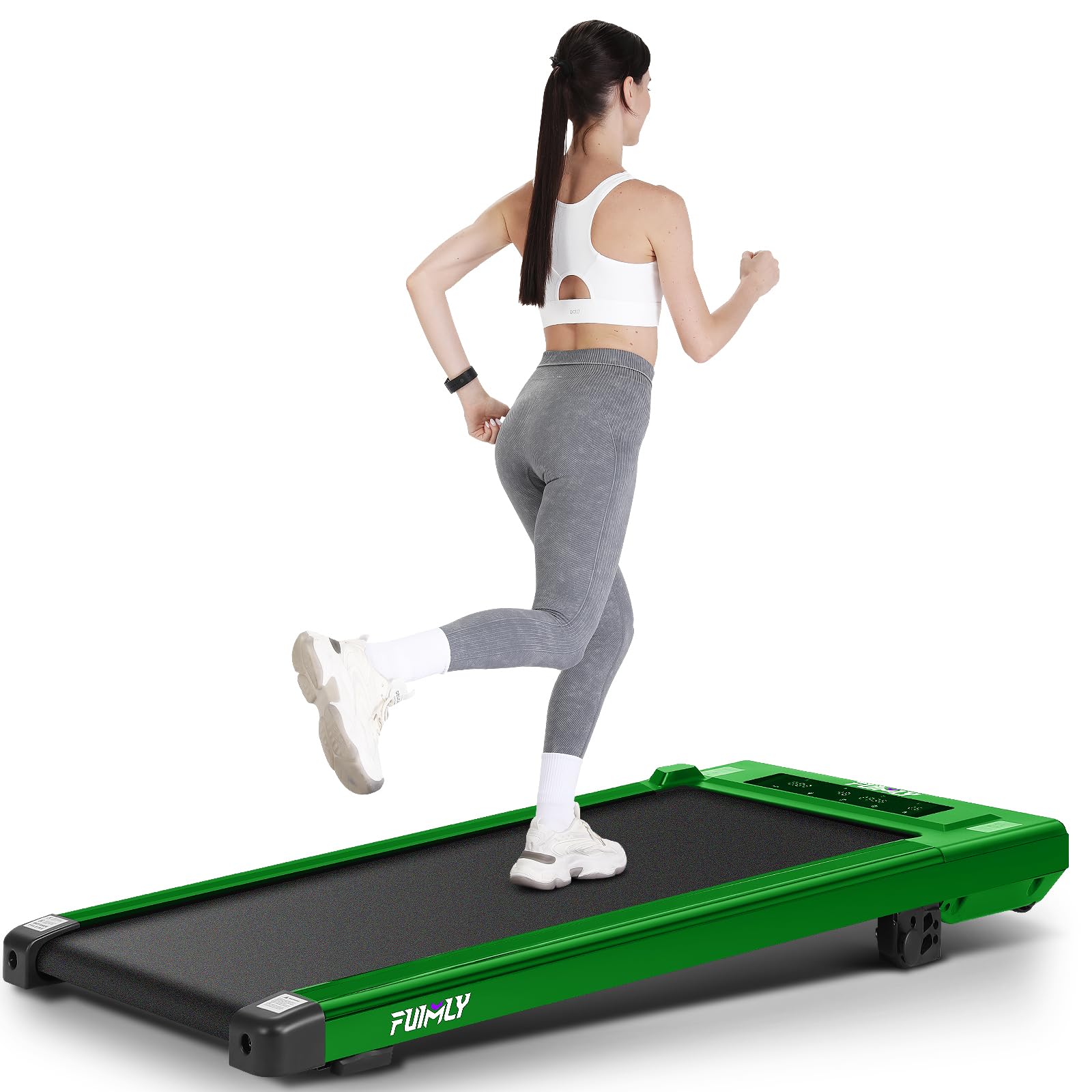
The number that matters on this one is 30dB — ANCHEER’s published operating figure for its brushless motor, and the spec that decides what your microphone hears. A brushless DC motor has no carbon brushes physically rubbing inside the motor, which is where a lot of the harsh noise and wear comes from in cheaper decks. The 2.5HP figure here is the highest maximum horsepower of the three, ahead of the WalkingPad C2’s 2.0HP, and it drives a 300 lbs weight capacity — the highest ceiling on this list.
Then there is the running half of the “2 in 1” promise. The speed range runs from 0.3 to 3.9 mph, and it splits into two modes: 0.3 to 2.4 mph for under-desk working and 2.4 to 3.9 mph for a proper walk. Very few pads let you dial down below 1 mph, so this is the one for someone who wants a shuffle pace during meetings and something faster after hours. The seven-layer anti-slip running belt is the comfort story — the thing owners point to first is how comfortable it feels underfoot, and a shock-absorbing belt is the piece that decides that.
The trade-off showed up clearly in the data: it is heavy. At 46 pounds the ANCHEER is the lightest pad of the three, which sounds counter to the complaints — but that weight sits in a steel frame that built-in transport wheels make movable rather than lifable. It is also the largest folded package of the three, at 40 x 25 x 5 inches, so measure your under-bed gap before committing. If you want the quietest walk at working speed and the option to push the pace, this is the pick. If portability is the priority, the Z1 squeezes into tighter places.
The quiet advantage: a 2.5HP brushless motor with a published 30dB running figure, a 300 lbs weight capacity and 12 Bluetooth app modes — the most running-oriented deck on the list.
The honest weight mention: the package is bulky, and owners repeatedly flag its weight. Built-in wheels help it roll, but it is not the pad you lift onto a shelf each evening.
Pick this one if: you want a quiet walk during calls and a faster session afterward, and can spare the floor space for the largest folded footprint of the three.
Think twice if: your storage spot is a narrow gap — at 40 x 25 x 5 inches folded it needs more room than the other two.
Know the Specs
Motor Type and Horsepower
Horsepower is the amount of work the motor can pull — a 2.5HP motor handles heavier loads than a 2.0HP one. Motor type is the quieter question: a brushless motor skips the carbon brushes that rub and whine in a brushed design, so it tends to run smoother and last longer. For an office pad, pick brushless first and horsepower second.
Folded Size and Profile Height
Folded size tells you where the pad lives when you stop walking — folded length decides whether it fits a wall gap, and folded height decides whether it slides under a bed. The deck’s standing height matters too: a lower deck like the Z1’s 4.1 inches is easier to step onto and lets your chair roll over it without a bump.
Speed Range and Modes
Most under-desk walking happens between a crawl and a stroll. A 1 to 4 mph range covers typing pace through a brisk walk. A two-mode range splits slow under-desk working from faster walking, which is useful if you want one pad for both email sessions and a lunchtime stride.
Walking Belt and Weight Capacity
Belt length sets your stride — a shorter belt forces smaller steps, a longer one lets taller walkers move naturally. Weight capacity is the ceiling for who can safely use the deck, and the pad’s own weight decides whether you roll it or lift it. Built-in transport wheels are the difference between easy and annoying.
Common Questions
Will a walking pad be heard on a work call?
What walking speed is practical while typing?
How much floor space does a folding walking pad save?
Do I need to assemble a walking pad before first use?
Can you run on an under-desk walking pad?
How much weight can these walking pads hold?
Why does the belt on a walking pad wear out?
Is a brushless motor worth paying more for?
What is the slimmest walking pad I can roll under a desk?
The Bottom Line
For most office setups, the winner among these quiet walking pad for office picks is the WalkingPad C2 because it folds a full 180 degrees to just 5.4 inches tall, needs no assembly and runs 1 to 4 mph by remote or app — the simplest pad to live with day to day. If a genuinely quiet motor is the thing you cannot compromise on, the ANCHEER is the one to grab, with its 2.5HP brushless motor and 2.4 to 3.9 mph running mode. And for the tightest storage spot, the WalkingPad Z1 is the one to reach for, with its 4.1-inch profile and fold-in-half design.
How we choose
We do not accept paid placement. Every pick is matched to a real buyer and a real use-case; we do not hands-on test units.
Sources
Specifications: manufacturer listings and product documentation. Review insights: verified customer reviews, as of November 2026. Pricing: not shown on this page (it changes often); check the current price via the retailer link.
As an Amazon Associate, Tactical Gear Guy earns from qualifying purchases. This does not affect which products we feature.