Specs are compiled from manufacturer listings and verified buyer reviews and can change over time — please confirm the key details on the product page before buying.
You walk out to the tank, lift the lid, and peer into the dark to find out how much water is left. That is the routine a level indicator is built to end. The right one shows you Empty to Full on a dial or your phone, without you touching a thing. The wrong one reads wrong, fogs up, or quits after a season. This guide separates the nine strongest options by what actually matters: how they measure, what they mount into, and how long the moving parts hold up.
This guide is built by comparing the manufacturers’ published specifications and the patterns across verified customer reviews, so you get each pick’s real strengths and trade-offs instead of marketing spin.
You will see electric gauges that read a sender’s resistance, floats that need no power at all, and ultrasonic units that never touch the water. Each pick below is matched to the tank and the wiring you already own, and that match matters more than any badge. The pages ahead rank every water tank level indicator by fit, wiring, and the simple question of whether it will still read straight in a year.
Top Picks

How To Choose The Best Water Tank Level Indicator
Most buyers get this wrong in the same way. They buy the gauge first and check the sender later. The gauge is only half the system. It reads a resistance signal from a sender (the float arm or probe sitting in the tank) and turns that signal into a needle position. If the two do not speak the same ohm range, the needle swings to the wrong place all day long. Match the signal first, then pick the face you like.
Match the ohm range before you buy anything
A 240-33 ohm sender sweeps from 240 ohms when the tank is empty to 33 ohms when it is full. Other senders use 0-190, 240-30, 0-180, or 10-180. Some gauges, like the 100TECH, let you press a button to select the range you need. That flexibility saves you from sending a unit back. A fixed gauge like the KUS CPWR-BB is locked to 240-33, so confirm your sender before ordering.
Decide if you want a float, a probe, or sound waves
Floats and chains are mechanical and need no power, which suits oil tanks and off-grid drums. Contact probes sit in the water and read conductivity. Ultrasonic units sit on the lid and bounce sound off the surface, so nothing touches the water and nothing corrodes. Each type has a different failure point: floats wear their gears, probes foul, and ultrasonic sensors need a clear straight shot down the tank.
Check the tank opening and height
A dial gauge needs a hole it can thread into or sit over. The Husky uses a 2-inch NPTF fitting, the Afriso needs a 2-inch NPT opening, and the Nestool wants a 2.80-inch opening on the lid. Height matters too: the Rain Harvesting dial suits tanks up to 8 feet, and the briidea sensor reads down to 13 ft. Measure both before you buy.
Side-by-Side Comparison
| Model | Best For | Measurement Type | Power / Signal | Water Protection | Amazon |
|---|---|---|---|---|---|
| KUS CPWR-BB 2″ Gauge★ Best Overall | Dash-mounted electric readout | Electric, 240-33 ohm signal | 12V or 24V | IP67 | Amazon |
| 100TECH Multi Ohm GaugeMost Versatile | Unknown sender type | Electric, five selectable ohm ranges | 9-32V DC | IP67 | Amazon |
| Afriso Float GaugeBest No-Power Pick | 275/330 gallon oil and water tanks | Mechanical float and string | None required | Sealed, odor tight | Amazon |
| Nestool WiFi Monitor | Phone alerts on a home cistern | Non-contact ultrasonic | Corded electric, 2.4GHz WiFi | IP66 | Amazon |
| briidea RV Tank Monitor | RV fresh water tanks | Non-contact, up to 13 ft depth | 7-32V DC | — | Amazon |
| Rain Harvesting Tank Gauge | Rainwater tanks up to 8 ft | Mechanical tank-top dial | None required | Vented tanks | Amazon |
| Moray WiFi Ultrasonic Sensor | Multi-tank remote monitoring | Non-contact ultrasonic, 10cm-4m | 2.4GHz WiFi plus RF433 | IP66 | Amazon |
| INNOVAMAX Aqua 4 UTP | Simple DIY wall-mounted readout | Contact probe, 7.87 inch | 120 VCA to 5 VCD power supply | — | Amazon |
| Husky Leak Guard Gauge | Oil and diesel tank inspection | Mechanical float and chain | None required | 4-window glass, UV inhibitor | Amazon |
Detailed Reviews
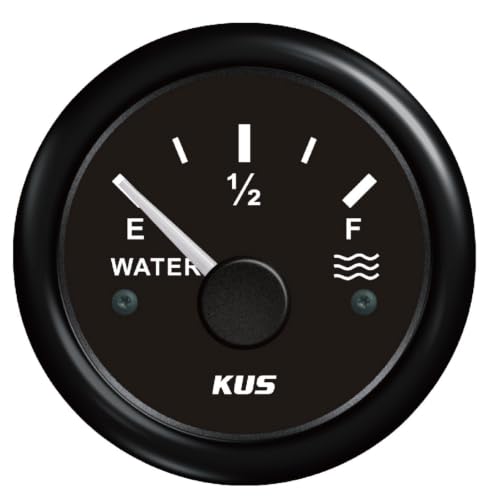
1. CPWR-BB 240-33 Ohm Electric Water Level Gauge
Our pick — 4.5+★ from 100+ verified ratings; the strongest balance of quality and price.
A 240-33 ohm dash gauge that reads your tank the moment the ignition turns.
The 2-inch dial fits a standard 52mm dash cutout, so it drops into the hole your old gauge left behind. It works from 12V or 24V, which covers most boats, RVs, and truck cabs. What wins people over is steadiness: the needle holds its position and stays readable season after season. Owners who swapped out a jittery old gauge say the needle now holds steady and reads true at a glance.
The ohm signal is the part to check before you order. This gauge is fixed at 240-33 ohm, meaning it reads a sender that goes 240 at empty to 33 at full. If your sender outputs 0-190 or 10-180, the needle will sit in the wrong place. Confirm the sender’s range first — that one check avoids most returns on a gauge like this. Buyers praise the accuracy most, and the housing draws its own credit for feeling solid rather than hollow.
The IP67 rating (a sealed enclosure that keeps dust out and survives brief water immersion) matters on a boat deck where spray lands constantly. Weight is 3.2 ounces, light enough to mount on a thin dash panel without bracing. It is a 2.36-inch cube of black plastic with a black bezel, and the LED backlight comes in either red or yellow, so it reads at night without glare. This is the pick for anyone who already owns a 240-33 sender and wants a clean, calibrated readout in the dash.
What earns the top spot
- Reads 12V or 24V systems without a converter
- IP67 sealing handles spray and rain on deck
- 2-inch (52mm) body fits standard dash cutouts
- Backlight in red or yellow for night reads
Before you mount it
- Locked to 240-33 ohm senders, no other range
- Needs a compatible sender you confirm first
Reach for this if: you have a 240-33 ohm sender and want a dash gauge that settles into the cutout and stays readable.
Think twice if: your sender runs 0-190 or 10-180 ohm — order a multi-range gauge instead.
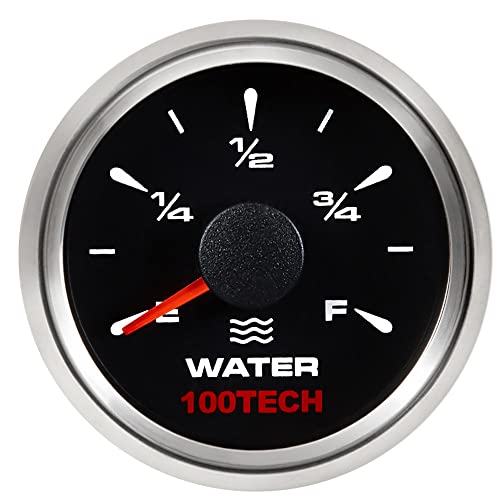
2. 100TECH Water Level Gauge
One button picks your ohm range, so you stop guessing what sender is buried in the tank.
You do not always know what sender the last owner installed. This gauge covers five ranges — 240-33, 0-190, 240-30, 0-180, and 10-180 ohm — and you set the right one by pressing a button. The default is 240-33 ohm. That button is the whole point: cycle until the needle reads Empty and Full correctly, and you are calibrated in about the time it takes to brew a coffee.
The build goes beyond the plastic of the KUS above. The bezel is 316 stainless steel (the marine grade that resists salt corrosion) over double-layer convex glass. The face carries IP67 waterproof and dustproof sealing with an anti-fog treatment, which is what keeps the dial clear after cold nights. Installation runs under 15 minutes per the maker’s instructions, and the wiring guide uses lighted labels rather than a wall of text.
Two things to know. It cannot work with fuel senders outputting 0-30, 0-90, or 73-10 ohm — this is a water gauge, not a universal one. And the eight-color backlight (red, green, blue, white, yellow, yellow green, orange, purple) is fun but purely cosmetic next to the real win, which is the selectable signal. Backed by a 2-year limited warranty with free lifetime tech support. It measures 2.54 inches across each side, slightly larger than the KUS at 2.36 inches, the difference in a verified spec sheet and only relevant if your cutout is tight. If your sender type is a mystery, this one solves the problem without a return label.
Where it wins: five selectable ranges kill the guesswork, and the 316 stainless bezel is a step above the plastic housings in this class.
The honest catch: it still cannot read fuel senders at 0-30, 0-90, or 73-10 ohm, so check your sender type before assuming it covers you.
Built for the mystery sender: buy this when you cannot confirm the ohm range and want to set it on the spot.
Wrong tool for: fuel tank senders — the resistive range does not extend that far.
3. Afriso Mechanical Float Operated Tank Contents Gauge
A float, a nylon cord, and a large dial that reads your oil or water with zero electricity.
Some tanks sit in a basement or a backyard where running a wire is a pain. This gauge needs none. A float rides the surface, a nylon cord over an epicyclic gear set turns the needle, and you read the level off a large dial face. The dual scale covers 24-inch and 42-inch fluid heights, so it works on both vertical and horizontal 275 gallon tanks, plus 330 gallon models, as long as the opening is 2-inch NPT.
The convenience is obvious: no battery, no 12V tap, no sender to fail. Buyers mostly praise that the float mechanism simply works, and installation earns nearly as much goodwill for being straightforward. It handles fuel oil, water, and Diesel Exhaust Fluid. The sealed body is odor tight, which matters on a heating oil tank where fumes otherwise creep into the room.
Accuracy is where reviews split. The gear-and-cord design is mechanical, so the hand can drift a little against an exact gallon count, and some buyers find it reads close rather than dead-on. Treat it as a level reference, not a calibrated meter. It is also ABS plastic with a nylon cord, so the moving parts want gentle handling. For a basement oil tank or a stationary water drum where you want a glance-level read without wiring, it does the job quietly.
The no-wiring advantage: mechanical float operation means it works in an unpowered shed or cellar with nothing to plug in and no sender to match.
What to weigh: the accuracy is honest but not precise — mechanical drift means it shows the level, not an exact gallon figure.
Suit it to: a 275 or 330 gallon tank where power is awkward and a clear dial beats a digital readout.
Pass if: you need calibrated, dead-on accuracy for billing or dosing.
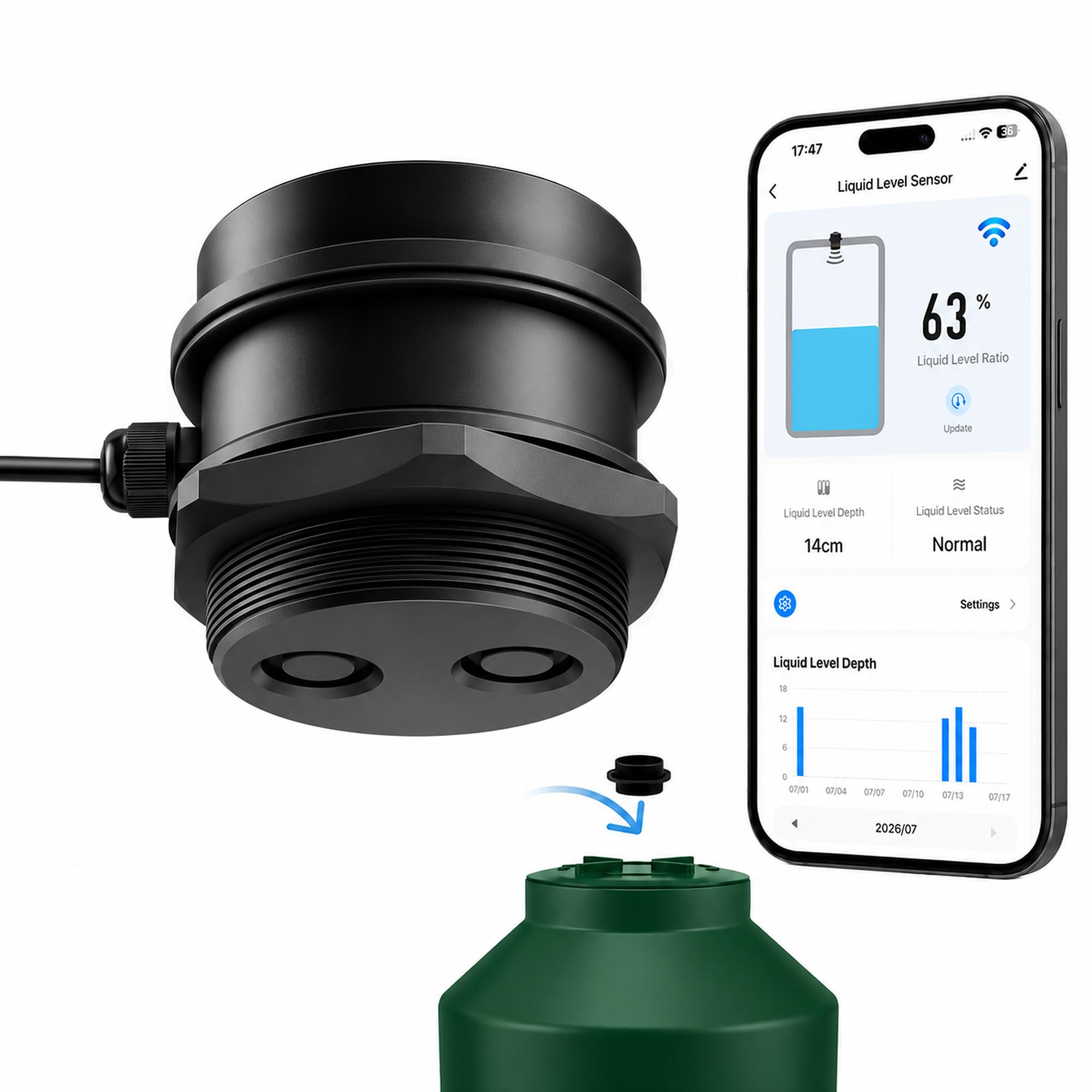
4. Smart WiFi Water Tank Level Monitor with Smart Life App
Sound waves read your cistern from the lid, and your phone tells you before it runs dry.
If the tank is out back and the house is ten steps away, checking the level by hand gets old fast. This unit sits on the lid and measures liquid depth with ultrasonic sound, never touching the water. That means no submerged probe to foul and no corrosion on the sensing face. You open the Smart Life App and see the real-time depth plus a level percentage, from wherever you are.
The useful part is the alerts. You set a high and a low threshold, and the app pings you when the tank crosses either line. That turns a manual chore into a background task. It also keeps a daily history of average depth and average percentage, so you can spot a slow leak by watching the trend rather than guessing.
Setup wants a 2.80-inch opening on the lid, and it pairs over 2.4GHz WiFi with Bluetooth help during the initial join. The IP66 housing (dust-tight and protected against strong water jets) is built for outdoor tank tops. It is corded, so plan a power run to the tank. The body is 3.5 inches long by 3.5 inches wide by 3 inches tall. This is the one to buy if you want the tank to report to you, not the other way round.
Pick this when: a phone alert at low water saves you a dry-tap morning, and you can get power to the tank lid.
Know before buying: it needs a 2.80-inch opening and a nearby outlet — no battery option here.
5. briidea RV Tank Sensor Monitor Panel with LED Indicator
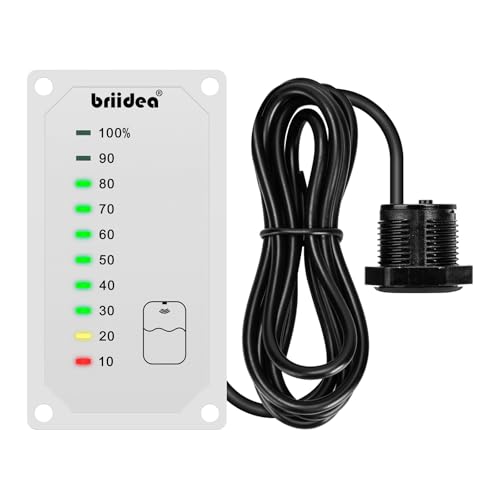
A panel that reads fresh water without touching it, built for the RV dash.
RV owners know the annoyance of crouching to eyeball a tank through a hatch. This kit mounts an LED panel where you can see it and reads the fresh tank without direct water contact, which also keeps the water cleaner. It detects down to 13 ft of depth, so it covers the larger tanks some rigs carry. The full kit arrives with the sensing parts included — you do not go hunting for extra electrodes.
Installation is the bright spot here, with RV owners finding the panel and sensor straightforward to fit. A multi-color LED indicator shows the level at a glance, and power-off memory keeps your settings through a battery disconnect or a shore-power swap. It runs on 7-32V DC, which suits off-grid setups as much as a campground hookup.
The trade-off is real and worth stating plainly. This is the pick with the lowest review standing among the panel-style units, and reliability is the split point — some units work well for a long stretch while others taper off within a few months. Quality feedback runs mixed the same way. Installation conditions matter too: the maker asks that the sensor sit in the middle section of the tank, stay dry during calibration, and that the tank be at least twice as long as it is tall. Read those before ordering, because a tank that fails the length-to-height rule is the wrong fit. Backed by a 2-year warranty.
Where it fits: an RV fresh tank where a visible LED panel and a 13 ft sensing depth match your dimensions and you want the whole kit in one box.
The caveat to honor: reliability reports are mixed, so buy from a seller with a clear warranty path and check the length-versus-height rule first.
Right for: a camper owner who wants a dash-mounted LED read and a tank shaped at least twice as long as it is tall.
Look elsewhere if: your tank is tall and narrow, or you want the most proven reliability record in this lineup.
6. Rain Harvesting Tank Gauge

A single hole in the tank top, a dial you can read from the ladder, and no wiring at all.
Rainwater tanks are often the hardest to check because the level drops out of sight below the lid. This gauge solves that with a tank-top dial sporting clear Empty and Full marks. A single hole in the tank is all the drilling you do. Once mounted, you set the hands on the dial to match your tank height, and the calibration is done. It fits all vented aboveground and belowground tanks up to 8 feet tall.
Quick, drill-one-hole installation is the reason rainwater owners reach for it. It goes on fast — buyers routinely note a tank-top setup that finishes in about ten minutes — and the dial is easy to read once the hands are set to your tank height. For a household rainwater system, that means you can see how much is left before the pump starts sucking air, and plan a refill or a top-up without a guess.
The honest side is durability. The plastic gears inside are the weak link, and the recurring report is that the moving parts are brittle and the unit may only last a season or so in tough conditions. Accuracy and readability draw a split response too, with dial calibration being the point that divides people. Mount it where it is sheltered, calibrate carefully, and treat the dial as a guide rather than an instrument. It weighs 8 ounces and measures 4 by 2 by 4 inches, light enough to sit on the lid without extra support.
Why it suits rainwater setups
- One hole to drill, quick to mount
- Clear Empty and Full dial visible from outside
- Fits vented tanks up to 8 feet tall
- No power, no sender, no wire run
Where it asks for care
- Plastic gears are brittle under stress
- Calibration needs patience to read true
- Longevity is shorter than metal-bodied gauges
Good match for: a vented rainwater tank where a quick, wired-free dial read is the goal and you can shelter the unit.
Consider the trade: the plastic gearing wants gentle use and periodic replacement in harsh sun.
7. Moray Smart WiFi Water Level Sensor ME201R

One app, up to ten tanks, and a signal that pushes through walls to reach them.
When you have more than one cistern, a single gauge does not cut it. This Tuya-based unit links up to 10 sensors to one app, so you can flip between tanks on your phone. It reads by non-contact ultrasonic, covering 10cm to 4m (4 to 157 inches) of depth — a span that suits everything from a small drum to a deep cistern. Custom high and low alerts fire when a tank crosses the line you set.
Connection is the standout spec. The RF433 gateway reaches up to 300m (984 feet) in open, obstacle-free ground, and it is rated to penetrate up to 20 walls. That matters on a property where the tank sits far from the router. It runs on 2.4GHz WiFi (not 5GHz), so pair it to the right band during setup. The IP66 housing is certified to CE, RoHS, and REACH, and it works from -10℃ to +70℃, which covers most weather.
Here is the honest part. Accuracy is the problem buyers hit most, with ultrasonic readings that stay off target being the common note. Reliability also runs mixed — some units work well, others quit after roughly four months. It is orange, weighs 0.3 kg, and measures 6.93 by 4.33 by 2.87 inches. The multi-tank range and long RF433 reach are genuinely useful, but treat this as a level tracker that needs honest testing early in the warranty window, which runs one year.
What makes it different: the RF433 link pushes up to 300m and through walls, so a far-off cistern still reaches the app.
The risk to size up: accuracy is the weak spot and reliability reports are split — buy where the one-year warranty is easy to use.
Worth it for: a multi-tank property where long RF range and one app for every cistern solve a real distance problem.
Be ready to: verify readings against a manual dip early, since accuracy and longevity are the listed concerns here.
8. Water Level Sensor & Meter
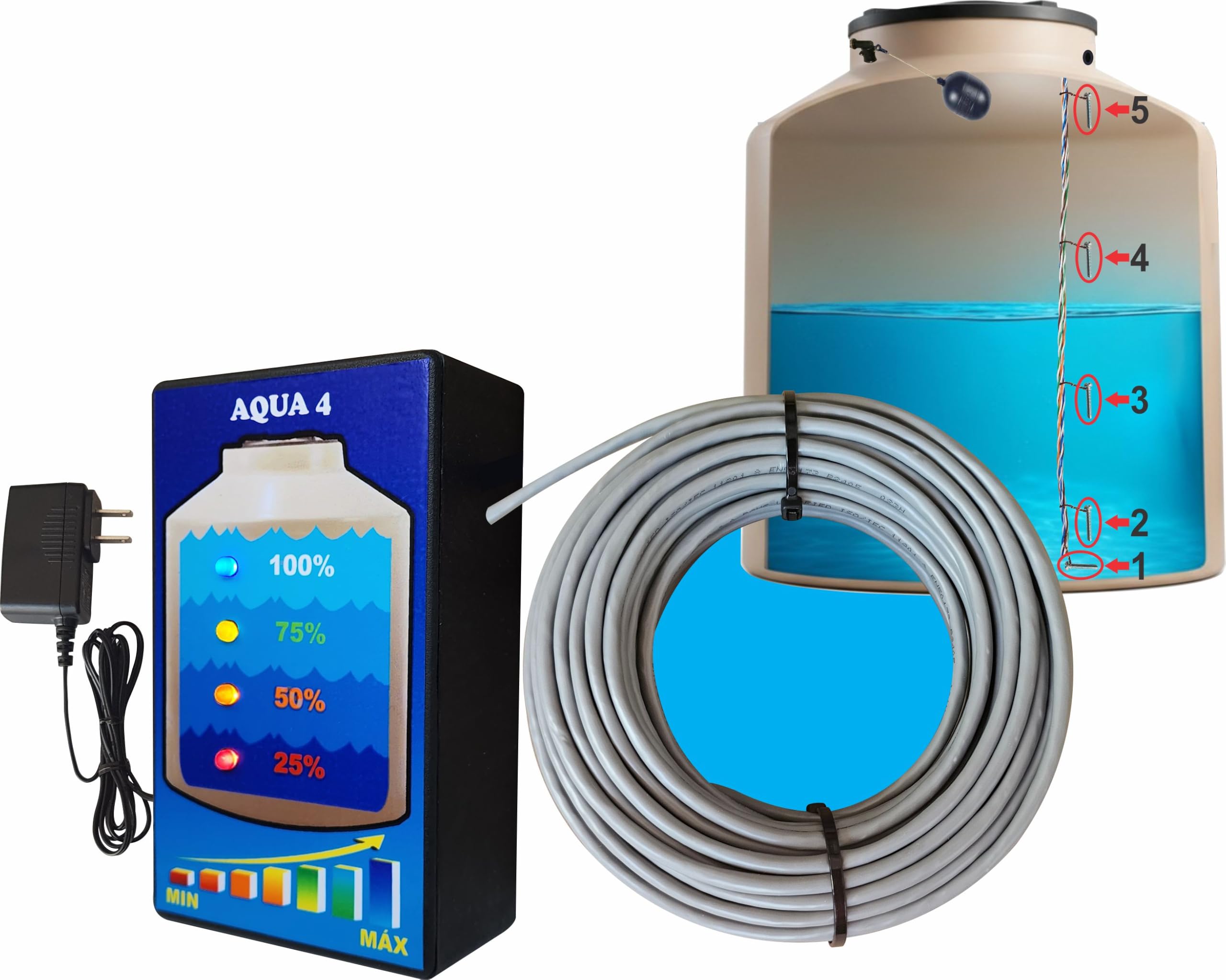
Cut, strip, and screw the wires, and the meter shows your level without a button press.
If you can handle a screwdriver, you can install this yourself — the maker sells it on exactly that. The kit arrives with a diagram, Spanish-language instructions, and a video tutorial link. You cut and strip each colored wire, place it in its labeled screw terminal, and you are wired. It runs off a power supply that plugs into any household outlet, so no battery to swap and no 12V tap to find.
The probe is a 7.87-inch UTP (twisted-pair network cable) adaptable type, contact-style, so it reads the water it sits in. The display stays on permanently, showing the level without you touching anything, and you can unplug it or leave it connected to check whenever you like. The kit includes the 5 galvanized screws for the wire ends. It mounts on the wall, which keeps the readout out of the tank area and in a spot you actually walk past.
The catch is that this is a contact probe with a 7.87-inch reach. That limits it to tanks where the probe reliably touches water at the depths you care about, and you will need the supplied power adapter near the tank. It is not compatible with other systems, so it lives as its own standalone meter. For a home tank or cistern where you want an always-on wall read and enjoy a hands-on install, the value is strong and the setup is genuinely simple.
Made for: a DIY owner who wants an always-on wall meter and does not mind a short, screw-driver install.
Not the fit if: your tank is deeper than a 7.87-inch contact probe can sensibly reach, or you want app alerts.
9. BJE by Husky Leak Guard Tank Gauge

A brass-and-glass gauge that drops a chain into the tank and reads the float on four windows.
For an oil or diesel tank, a stout mechanical gauge outlasts electronics. This one threads into a 2-inch NPTF fitting and hangs a 72-inch nickel-plated brass chain into the tank, adjusting down to 24 inches from the top. The float rides the surface, and the level shows across a large 4-window glass display with a high-visibility orange indicator and a UV inhibitor to slow sun damage. There is no power, no wire run, and nothing to fail electronically.
The fluid range is wide: oil, waste oil, diesel fuel, antifreeze, water, and other low-flash-point liquids all read on the same gauge. The 2-inch NPT thread covers most standard oil tank openings, and a 1½-inch version is sold separately if yours differs. Made in the USA from brass and glass, it comes in at 1.2 pounds. The glass face lets you see the float position from a distance, which is the practical part — a glance from the doorway tells you whether a delivery is due.
The chain length is the spec to set up carefully. You adjust it so the float reads Empty when the tank is empty and Full when it is full, and getting that right is the whole calibration. The 4-by-4-by-72-inch overall size includes the chain run, so check headroom above the tank. For a heating oil tank where you want a rugged, power-free readout that shrugs off weather, this is a solid, US-made choice built from metal rather than plastic.
The old-school build that lasts
- Brass chain and glass display handle rough weather
- Reads oil, diesel, antifreeze, and water alike
- No power or wiring to maintain
- Standard 2-inch NPTF thread fits common tanks
Weight it against your tank
- Chain must be adjusted to your tank height
- Needs a 2-inch NPTF opening, not a plain lid hole
Built for: an oil or diesel tank that needs a rugged, power-free gauge with a strong glass readout.
Check first: your opening is 2-inch NPTF and there is headroom for the 72-inch chain.
Know the Specs
Ohm Range (The Sender Signal)
An ohm is a unit of electrical resistance. A sender changes its resistance as the float rises or falls, and the gauge reads that change to move the needle. A 240-33 ohm sender runs from 240 ohms at empty to 33 ohms at full. Gauges are built for a specific range, so mismatching the two throws the needle off. If you cannot confirm your sender, a selectable gauge removes the gamble.
IP Protection Rating
IP stands for Ingress Protection, and the two digits rate solids and liquids separately. IP67 means dust cannot get in and the unit survives brief immersion. IP66 means dust-tight plus protection against strong water jets. On a boat deck or an exposed tank top, that rating is what keeps the dial clear and the electronics dry.
Contact Versus Non-Contact Sensing
A contact probe sits in the water and reads it directly. An ultrasonic sensor stays above the surface and measures depth with sound, so nothing corrodes and nothing fouls. Contact units are simpler and cheaper to build; ultrasonic units avoid maintenance but need a straight, clear path to the water and steady power.
Float and Chain Calibration
Mechanical gauges rely on a float that rides the surface and a cord or chain that turns the dial. The chain length or cord run sets the scale, so you adjust it until Empty and Full line up with your tank height. Mechanical units need no power, but the moving parts — gears, cord, chain — are the parts that wear.
Common Questions
Will a 240-33 ohm gauge work with my 0-190 ohm sender?
Do I need power to run a mechanical float gauge?
Can an ultrasonic sensor read through a closed tank lid?
What does IP67 actually protect a tank gauge from?
How deep a tank can a level indicator handle?
What size opening does a tank gauge need?
Can a tank sensor monitor more than one tank?
Why do some gauges read full when the tank is empty?
Do these monitors work on a fuel oil or diesel tank?
What temperature range can an outdoor WiFi sensor take?
The Bottom Line
If you already run a 240-33 ohm sender, the KUS CPWR-BB is the clean answer — a sealed 2-inch gauge that fits the dash and reads straight, with a strong record behind it. If you cannot confirm your sender’s range, the 100TECH multi-ohm gauge removes the guesswork with five selectable ranges and a 316 stainless bezel. And when the tank sits far from the house and you want alerts on your phone, the Nestool WiFi monitor reads from the lid without touching the water. Match the ohm range and the tank opening to your setup, and any of these nine will end the lid-lifting routine for good.
How we choose
We do not accept paid placement. Every pick is matched to a real buyer and a real use-case; we do not hands-on test units.
Sources
Specifications: manufacturer listings and product documentation. Review insights: verified customer reviews, as of November 2026. Pricing: not shown on this page (it changes often); check the current price via the retailer link.
As an Amazon Associate, Tactical Gear Guy earns from qualifying purchases. This does not affect which products we feature.